A Merciless Game of Subdivision Chess Where Every Single Legal Rule Becomes a Weapon of Retribution
CHAPTER 1: THE ASHES OF CEDAR
The wood chipper parked at the curb let out a guttural, metallic shriek that vibrated straight through the soles of Mark’s boots. A thick plume of amber dust and splintered cedar fibers spewed from its chute, settling like ash over the manicured lawn. Six weeks of measured post holes, carefully leveled rails, and treated cedar pickets vanished into the mechanical jaws in a matter of seconds.
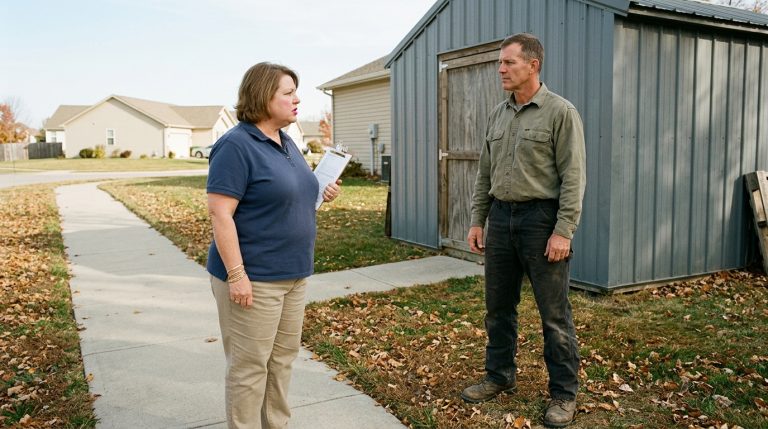
Mark kept his hands loose at his sides, his fingers curled just enough to suppress the twitch born from twenty years of military engineering and project management under fire. He recognized the architecture of a power play the moment he saw it. Karen stood near the property line, her floral-print muumuu billowing slightly in the humid afternoon breeze, clutching a three-ring binder like a scepter. Her face was flushed to a dull plum, her chin elevated with the absolute, unearned certainty of someone who had never once faced a consequence she couldn’t delegate away.
“That was before the board passed the emergency addendum to bylaw 7.4,” Karen called out over the roar of the diesel engine, her voice thin and sharp. “Picket-style fences are strictly prohibited on corner lots. It ruins the aesthetic continuity of the subdivision.”
Mark didn’t raise his voice. He didn’t blink. He calculated the distance between her boots and the property line, noting the precise angle of the sun and the lack of any official county vehicle or sheriff’s insignia. “I have the approved paperwork, Karen,” he said, his tone flat, cold, and level as a poured concrete slab. “Signed, dated, and logged by the Architectural Review Committee three weeks before ground was even broken.”
“Emergency powers supersede standard committee reviews,” she snapped, stepping closer, her eyes glittering with the intoxicating rush of minor authority. “You’ll receive the bill for the removal crew by tomorrow morning. Along with a fine for non-compliance.”
She turned on her heel, her clipboard wobbling under her arm, leaving him standing in the scarred patches of dirt where his anchor posts had lived for less than a month. The air smelled of bruised earth and exhaust fumes. Mark pulled his phone from his pocket, the screen cool against his palm, and hit record. He panned the lens smoothly from the smoking wood chipper across the raw, exposed perimeter of his yard, capturing the exact coordinates of the devastation. This wasn’t just a dispute over property lines or aesthetic codes. It was an opening salvo, and the perimeter was officially breached.
He waited until the crew packed their tools and the truck rumbled down the asphalt before turning toward the house. When the front door clicked shut behind him, the silence of the hallway felt tight, pressurized, and entirely unstable.
CHAPTER 2: THE RECONNAISSANCE OF SILENCE
The front door clicked shut with a muffled, airtight seal, locking out the lingering ghost of the wood chipper’s roar and the scent of pulverized cedar. Inside, the house was dead quiet. Mark stood in the dim foyer for three long seconds, his chest rising and falling in slow, measured rhythms, letting the adrenaline drain from his shoulders down to his boots. In twenty years of managing construction logistics under hostile conditions, he had learned that immediate retaliation was the hallmark of an amateur. Amateurs threw punches; professionals opened ledgers.
He unzipped his jacket and walked straight to his home office at the end of the hall. The room smelled faintly of old paper, printer toner, and the cold dregs of coffee left in a ceramic mug from three hours ago. The window blinds were drawn halfway, casting thin, horizontal stripes of late-afternoon amber across the walnut desktop.
Sitting down, Mark didn’t turn on the overhead light. He reached out and slid open the top right drawer, pulling forth a thick, heavy manila folder. It was labeled in crisp, block letters: HOA-ARC-7.4.
Inside lay the exact blueprints, the material specifications, the signed property survey, and the formal letter of approval bearing the signatures of all three members of the Architectural Review Committee. He flipped past them to a blank legal pad and picked up a G2 pilot pen. His hand moved with automatic, steady discipline, sketching out a grid of targets. Target one: the digital portal logs. Target two: the three committee members who had supposedly ratified an emergency addendum that never went to a vote.
The digital portal was the easiest breach. Mark powered on his desktop machine, the screen throwing a pale, clinical blue light across the sharp angles of his cheekbones. He logged into the subdivision’s management portal using his homeowner credentials—a clunky, outsourced database maintained by a third-party property firm two counties over.
His eyes scanned the document repository, filtering by date, metadata, and author ID. The administrative architecture of the website was sloppy, designed by someone who thought security meant a four-digit password and a generic SSL certificate. He navigated directly to the board resolution logs for the past quarter.
There was nothing. No record of an emergency meeting called under bylaw 7.4. No quorum certification. No public notice broadcast to the community registry.
Mark leaned back, his leather chair creaking softly in the dark room. A flash of memory pulled at the corners of his mind—a dusty operations tent outside Kandahar where a supply officer had tried to falsify a manifest by backdating a requisition form with a different pen tip. The ink had been slightly darker, the signature too hurried to match the protocol. Karen had made the exact same operational mistake. She had invented an emergency addendum out of thin air, banking on the passive compliance of a frightened neighborhood to keep anyone from checking the paperwork.
He picked up his smartphone and dialed the number for Arthur McAllister, the retired civil engineer who sat as the third member on the Architectural Review Committee.
The phone rang twice before a raspy, gravel-rough voice answered. “Yeah?”
“Arthur. It’s Mark Riley.”
There was a brief pause on the line, accompanied by the rustle of paper and the distant clink of silverware against a ceramic plate. When Arthur spoke again, his tone was lower, weighted with a grim, exhausted satisfaction. “I was wondering when you’d call, son. I saw what happened at your driveway an hour ago. That woman is running this place like a third-world junta.”
“She skipped the quorum, Arthur,” Mark said, keeping his voice flat and clinical. “There’s no digital trace of an emergency meeting on the portal. She manufactured the addendum.”
“Manufactured is a polite word for it,” Arthur grunted, a dry cough rattling in his chest. “She called a fake session last Tuesday night with just her and Janice—her little shadow on the secretary desk. The Hendersons were too terrified to show up, and Bob the treasurer was visiting his grandchildren in Phoenix. She’s acting with absolute impunity because nobody’s ever checked her math.”
“We’re going to check it,” Mark said, his pen tapping a rhythmic, silent beat against the edge of the desk. “I need to see you. Somewhere out of the neighborhood. Tomorrow morning at 0800 hours.”
“There’s a diner off Route 9,” Arthur replied immediately. “The Greasy Spoon. Booth in the back. I’ll bring my personal meeting logbook. The one with the real signatures.”
“See you there.”
Mark cut the connection and dropped the phone onto the blotter. He looked down at the empty space on his desk where his plans had been spread out, his mind already calculating the logistics of the next phase. The perimeter had been attacked, but the counter-offensive was locked and loaded. He stood up, walked to the window, and stared out into the darkening yard where the raw patches of dirt waited in the shadows.
CHAPTER 3: THE VOUCHER OF ARTHUS MCALLISTER
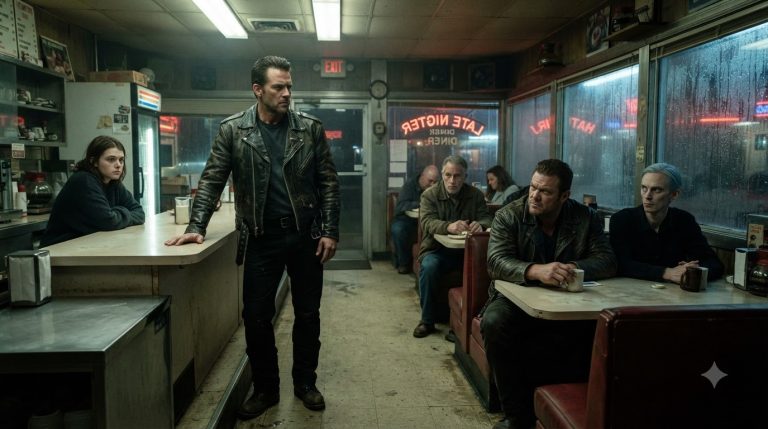
The diner bell above the door gave a high, tinny chime as Mark stepped out of the morning frost and into the stale warmth of the Greasy Spoon. The floor tiles were a checkerboard of faded yellow and black, scuffed by decades of heavy boots and rolling carts. In the very back booth, tucked beneath a plastic-shaded lamp that buzzed with an electrical hum, an elderly man in a frayed tweed jacket sat staring intently into a mug of black coffee.
Mark didn’t hesitate. He crossed the linoleum floor, his boots making a dull, rhythmic thud, and slid into the vinyl booth opposite Arthur McAllister.
Arthur didn’t look up immediately. He let out a slow, dry breath that smelled of peppermint and chicory, then reached into the inside pocket of his jacket. He withdrew a crisp, folded square of heavy-weight paper and slid it across the Formica table. The paper stopped right beside Mark’s coffee cup.
“That,” Arthur muttered, his voice raspy and low, “is the original physical logbook from the Architectural Review Committee meeting held three weeks ago. Not the digital copy Karen manages. The hard copy. Signed in ink by every sitting member.”
Mark picked up the paper, his thumb feeling the exact indentation of the pen strokes. He unfolded it under the dim amber light. The vote was clear, unanimous, and dated two weeks before Karen’s fabricated emergency decree. There was no mention of bylaw 7.4. There was no exception for corner lots. It was a clean, unimpeachable record of authorization.
“She didn’t just bypass the committee,” Mark said, his voice flat as he committed the names and dates to memory. “She actively forged a counter-narrative.”
“She’s been doing it for months,” Arthur said, leaning forward, his cloudy blue eyes sharp behind wire-rimmed glasses. He tapped a finger against the table. “She strong-armed the Hendersons into silence by threatening to audit their shutters. She runs the board like a petty warlord because nobody ever pushes back past the first notice. But a forged signature on an official municipal document? That crosses the line from neighborhood politics into criminal falsification.”
Mark folded the document neatly and slid it into his inner pocket, feeling the stiff edge press against his chest. “Thank you, Arthur. This changes the parameters of the operation.”
“What are you going to do?” Arthur asked, narrowing his gaze. “She’s got the management company wrapped around her finger.”
“We don’t fight her in the neighborhood,” Mark said, his tone dropping an octave, carrying the cold precision of a briefing room. “We bring in outside leverage. I’ve already notified my counsel—a former military litigator who specializes in property torts. Once we attach your logbook to a formal motion to compel, her paper shield is going to shred.”
He left a five-dollar bill on the table for coffee neither of them had touched, slid out of the booth, and pushed back out into the morning air. The operational gears were turning now, interlocking one by one with mechanical certainty. The enemy had chosen a war of attrition through bureaucratic bullying, but Mark was about to feed her own rules back to her with compound interest.
Back home, the raw dirt patch where his cedar fence used to stand seemed smaller, almost insignificant compared to the wider dossier he was assembling on his desk. He opened his encrypted laptop, scanned Arthur’s logbook into the master digital folder, and cross-referenced the contractor invoices listed on the portal. Something didn’t add up. The demolition crew Karen had hired wasn’t a standard municipal vendor; they were an unlisted, cash-only outfit registered out of an industrial park three towns over.
Mark narrowed his eyes at the invoice amount. Seven thousand dollars for a half-day teardown and wood-chipping job. It was inflated by at least four hundred percent. A cold realization settled in the pit of his stomach. This wasn’t just about an HOA president drunk on power over picket styles. It was a financial funnel. She was using the association’s emergency powers to route inflated service contracts through a shell company.
He didn’t blink. He picked up his phone and dialed Ben Carter’s direct office line. It was time to expand the indictment from a civil dispute into a full-scale forensic audit.
CHAPTER 4: THE IRON PINS OF PRECISION
The phone receiver settled onto its cradle with a dry, plastic snap. Mark did not move his hand away immediately; his fingers lingered on the textured edge of the desk, feeling the cold weight of the strategy falling into place. Ben Carter’s voice on the other end had been sharp with professional exhilaration. A formal demand letter was already being drafted, backed by Arthur McAllister’s signed committee logbook. But defense was only half the campaign. To dismantle Karen’s infrastructure, Mark needed a physical leverage point—something rooted in concrete measurements and immovable legal boundaries.
He stood up, his joints making a faint, dry pop, and walked out to the kitchen where Sarah was setting down a ceramic grocery bag. She looked up, her eyes tracing the tight lines around his mouth.
“Ben on board?” she asked quietly, her hands smoothing the fabric of her apron.
“Completely,” Mark said, walking over to wrap an arm around her shoulder, feeling the familiar tension in her frame. “We have the committee logbook proving she fabricated the emergency bylaw. But we aren’t stopping at a retraction. We’re launching a counter-offensive. I’m bringing in a certified land survey team tomorrow morning.”
Sarah’s lips parted in a slight, knowing curve, the exhaustion in her eyes momentarily eclipsed by a sharp, vindictive spark. “The east property line?”
“The east property line,” Mark confirmed. “If my hunch from the original developer plat map is right, her multi-tiered rose garden, her custom stone patio, and half of her prized Japanese maple are sitting squarely on our side of the legal baseline.”
The following morning at 0900 hours, a white pickup truck bearing the logo of Precision Land Services pulled up to the curb. Two technicians in high-visibility vests climbed out, hauling heavy tripods, digital transits, and metal detectors. They did not rush; they worked with the methodical, unhurried precision of engineers who treated earth and coordinates as absolute law. Mark watched from his kitchen window, holding a mug of black coffee, while Karen’s front curtain twitched—a brief flutter of white fabric as she monitored the activity from across the asphalt, assuming it was part of the compliance process for her new subdivision fence directive.
The survey crew spent four hours hammering stakes into the sod, sweeping the grass lines with metal detectors until they pinged against the original iron development pins buried three inches deep beneath the turf. When they finished, bright ribbons of neon pink flagging tape fluttered sharply in the gusty afternoon wind, tracing an unbroken, mathematical line straight through the center of Karen’s immaculate landscaping.
Mr. Evans, the lead surveyor, walked up the driveway with a rolled blueprint tucked under his arm and knocked twice on Mark’s door. Mark opened it immediately.
“Well, Mr. Riley,” Evans said, his voice clipped and professional as he unrolled the map across the kitchen island. “Your hunch was conservative. The true property line sits ten feet further east than the old holly bush boundary. Everything on this side—the patio, the retaining wall, the edge of the pavilion—is sitting on your parcel.”
Mark leaned down, tracing the bold black ink line with his thumb. The physical reality of the document was undeniable. It wasn’t an emotional grievance or a neighborhood dispute; it was an unyielding legal fact. “Permissive use,” Mark muttered, recalling Ben’s legal terminology.
“Exactly,” Evans replied, packing his transit bag. “Since the previous owners never formally deeded it over, and you’ve just revoked permission, that hardscaping belongs to whatever structure or boundary you choose to erect on your land.”
Mark thanked the surveyor and walked him to the door. The final piece of the tactical grid was now locked in place. He immediately contacted one of the approved corporate fence contractors from Karen’s own municipal directive—the largest, most rigid outfit on the list—and handed them a strict, pre-written work order. The instructions were singular and absolute: erect a six-foot white vinyl privacy barrier precisely along the pink flagging tape, following the survey pins down to the millimeter.
He didn’t need to shout across the fence or post notices. He simply needed to wait for Karen to return from her leadership conference in Orlando, where she was busy preaching subdivision governance while her own empire was about to be bisected by cold, unyielding plastic and steel.
CHAPTER 5: THE WHITE VINYL DIVIDE
The crisp, metallic thunk of a hydraulic post-driver echoed down the residential street, sharp enough to cut through the hum of morning traffic. Mark stood on his back patio, a mug of black coffee cooling in his hand, watching four men in high-visibility vests work with brutal efficiency. They moved along the line of bright pink flagging tape staked out by the survey crew two days prior, unrolling panels of gleaming, industrially rigid white vinyl.
The contract was airtight. It explicitly matched the subdivision’s mandatory aesthetic guidelines while anchoring every single post into the exact coordinates of the legal property baseline.
By mid-afternoon, the transformation was absolute. A six-foot solid white vinyl wall cut straight through the middle of what Karen had treated as her private sanctuary for three decades. On Mark’s side lay the expansive multi-tiered stone patio, the built-in outdoor kitchen, the prized rosebushes, and the sprawling Japanese maple she had babied like an only child. On her side—now reduced to a narrow strip of trampled sod barely four feet wide—sat her rear exit door, an empty grill, and an overwhelming sense of enclosure.
Mark didn’t gloat. He set his empty mug down on the patio table, walked inside, and waited. The trap was set, baited, and locked. All he needed was for the weekend to turn, and for Karen to return from her leadership conference in Orlando.
The explosion came precisely at 0800 hours on Saturday.
It wasn’t a normal knock or a polite doorbell chime. It was a high-pitched, guttural shriek that rattled the double-paned windows of Mark’s kitchen—a sound half-human and half-avian, born of pure, unadulterated shock.
Mark stepped out through the back sliding door, moving with slow, measured deliberation. He pulled his smartphone from his pocket, pressed record, and held it steady.
Karen was standing on her microscopic scrap of remaining lawn, still wearing her travel-crumpled airport sweatpants and a blue cotton t-shirt bearing the faded logo World’s Best HOA President. Her face was mottled a deep, terrifying plum, her chest heaving as she pointed a trembling, sausage-thick finger straight at his chest.
“What… what have you done?!” she shrieked, spittle flying from her lips as her voice cracked into an unnatural register. “You’ve walled off my garden! You’ve destroyed my property! I’ll have you arrested for criminal trespass this instant!”
Mark kept his voice flat, neutral, and meticulously calm. “Good morning, Karen. Welcome back from Orlando. I’m not quite sure what you’re referring to. I simply followed the subdivision’s mandatory beautification guidelines and erected a compliant fence.”
“You put it ten feet inside my yard!” she howled, stomping her foot so hard her sneaker slapped the turf. “That’s my patio! Those are my roses! That’s my Japanese maple!”
“Actually,” Mark said, stepping closer to the vinyl barrier and holding up a laminated copy of the survey map, “according to the certified land survey completed this week, this is the legal property boundary established twenty-five years ago. It appears you’ve been using a portion of my parcel under permissive use. Since you’ve made it clear that rules and boundaries must be strictly enforced, I’ve elected to revoke that permission.”
She stared at the map, her eyes darting frantically between the inked lines and the gleaming white plastic wall that split her hardscaping in half. Her brain visibly stalled, unable to compute that her own weaponized regulations had been legally turned against her with mechanical precision.
“I’m calling the police!” she sobbed, her voice tipping into hysteria as she yanked a phone from her pocket and punched frantically at the screen. “They’ll tear this garbage down right now!”
Twenty minutes later, a county patrol cruiser rolled up to the curb, its blue lights flashing against the morning sun. Two deputies stepped out, their expressions carved from pure, weary resignation as they waded through the suburban drama. Karen launched into a shrill, weeping monologue, pointing wildly at the fence, the patio, and Mark’s calm posture.
Mark didn’t interrupt. When she finally choked on her own breath, he stepped forward and handed the senior deputy his laminated dossier—the approved architectural guidelines, the certified survey map, and the contractor’s signed work order.
The deputy flipped through the documents, his eyes tracking from the paper to the vinyl barrier and back again. He let out a long, heavy sigh, handed the folder back, and turned to Karen.
“Ma’am,” the officer said, his voice flat and devoid of sympathy. “Based on these filings, the structure is entirely within the property bounds. This is a purely civil matter. We can’t help you.”
The cruiser doors slammed shut, and the vehicle pulled away, leaving Karen standing alone on a scrap of grass, staring at a white plastic wall that had just ended her reign.
CHAPTER 6: THE DEPOSITION OF THE QUEEN
The fluorescent lights of the community clubhouse hummed with a low, oppressive electrical frequency, casting a harsh glare over a room packed far beyond its legal capacity. Over a hundred residents stood shoulder-to-shoulder in the aisles, spilling out through the double doors into the humid evening air. At the front table, Karen sat flanked by her secretary Janice and the trembling treasurer Bob. Her face was drained of its usual crimson flush, replaced by a pasty, sweating pallor as she clutched a gavel that felt more like dead weight in her palms.
Mark stood in the front row, his posture rigid and balanced, holding a small remote control linked to the overhead projector screen. Next to him, Dave Rosetti stood tall in his pressed Marine dress blues, a silent pillar of immutable gravity.
Karen tried to bring down the gavel, her voice cracking as she attempted to command the room. “This meeting is strictly confined to the pre-approved agenda! We will not entertain unauthorized motions—”
Dave stepped forward, his deep, resonant voice cutting through her words like a bayonet. “Point of order, Madam President. Article Three, Section Five of the bylaws permits a floor motion for the immediate removal of the Board of Directors upon a valid second.”
Mr. Garcia shouted from the center aisle, “Second the motion!”
Before Karen could swing the gavel again, Mark pressed the remote. The projector screen behind the dais flared to life, illuminating the entire room with high-resolution photographic evidence. First came the image of Mark’s destroyed cedar fence vanishing into the wood chipper, followed instantly by the fabricated emergency addendum. Then came the cascading sequence of weaponized fines: Mrs. Gable’s ceramic gnomes, the Garcias’ basketball hoop, and Dave’s flagpole citations.
The murmurs in the crowd swelled into an angry, collective rumble. But Mark did not stop there. He clicked forward to the final slide—the forensic audit breakdown comparing the contractor’s inflated, kickback-padded demolition invoices against legitimate municipal quotes, alongside the survey map slicing straight through Karen’s illegal patio.
“A difference of twenty-seven hundred dollars per project,” Mark said, his voice carrying clearly across the silent, stunned room. “Paid directly out of our HOA dues. The question for the board, Karen, is simple: where did that money go?”
Arthur McAllister stood up from the middle rows, his voice steady and severe. “A vote has been moved and seconded. All in favor of a vote of no confidence and the immediate removal of the entire Board of Directors, raise your hand.”
A forest of hands shot into the air, filling the room with an undeniable, overwhelming majority. Karen stared out at the sea of raised hands, her mouth opening and closing silently as the reality of her deposition washed over her. Her reign was finished.
In the weeks that followed, the collapse accelerated with mathematical precision. Arthur was elected interim president, instantly retaining Ben Carter to audit the books. The forensic trail of inflated invoices exposed a systematic embezzlement scheme Karen had used to prop up her own failing personal finances. Armed with the audit binder, Arthur and Mark delivered the evidence directly to the district attorney’s office. Three months later, felony fraud and embezzlement charges were formally filed, forcing Karen into a catastrophic fire sale of her home.
The final morning of her departure, Mark sat quietly on his back porch. Across the property line, a crew of hired laborers worked under the watchful eye of Karen’s legal counsel, systematically jackhammering her custom stone patio and outdoor kitchen into rubble and hauling the debris away from his land. It wasn’t an explosive victory; it was the quiet, cold weight of order being restored.
Later that afternoon, a young couple moved into the house next door. They walked over before the moving boxes were even unpacked, their children trailing behind them, and politely asked if it was alright for the kids to play near the white vinyl fence. Mark smiled, welcoming them to the neighborhood, while General trotted happily along the secure perimeter.
The prize-winning roses that had crossed the property line were safely transplanted by Mrs. Gable’s hands into a new community garden by the clubhouse entrance, blooming brightly in the sun. Sarah stepped out onto the porch, handing him a fresh cup of coffee, and leaned against his shoulder as the evening breeze rustled the leaves. The struggle was over, the peace was earned, and the neighborhood finally belonged to everyone.