The Weight of Silence: How a Three-Year-Old Child Pierced an Eleven-Month Wall of Grief
CHAPTER 1: THE CREAM CHAIR
The coffee went cold in the cup. Rayan didn’t touch it.
He sat at the mahogany desk on the upper floor, his phone face down on the polished wood. The screen stayed dark. No urgent board summaries. No lawyer calls. Just the quiet hum of an air conditioner fighting a losing battle against the summer heat.
Downstairs, three floors away, his mother was sitting in the cream-colored chair by the window.
She had been sitting there for eleven months. She didn’t turn on the lamp when the sun dipped behind the garden wall. She didn’t ask for water. She simply held a faded photograph of a day that smelled like rain and cheap tea, staring straight through the glass at a world that had stopped spinning the night a truck ran a red light.
Rayan stood up, his joints popping in the quiet room.
He walked to the floor-to-ceiling windows and looked down at the empty gravel drive. Three luxury cars sat parked in precise alignment. A garage full of machinery worth more than most small towns. A vault full of numbers that could buy anything, fix anything, override any obstacle known to modern man.
Except the silence behind his mother’s ribs.
He reached into his pocket and touched the edge of a specialized medical report brought in from London three days ago. Glossy paper. Expensive ink. Written by a man who charged five thousand dollars an hour to say that grief was a closed door.
Rayan dropped the report into the wastebasket. It landed without a sound.
He didn’t need another specialist. He needed the one thing his money couldn’t buy, couldn’t schedule, and couldn’t manufacture: the sound of his sister’s voice coming out of the woman by the window.
A muffled crash echoed from the hallway downstairs—the sharp, unmistakable clatter of a small plastic toy hitting the marble baseboards.
CHAPTER 2: UNINVITED THRESHOLD
The hallway upstairs remained empty, save for the hum of the climate control. Rayan did not move from the window. Down the long corridor, past the rows of silent portraits, a small footstep padded softly against the runner rug.
Maryam stopped at the edge of the second-floor landing.
She wore a yellow dress with faded daisies near the hem, entirely unbothered by the heavy, suffocating quiet that choked the rest of the estate. Her dark hair was tied back with a blue ribbon that was already coming loose.
In her small hand, she clutched a smooth, grey river stone she had found near the fountain earlier that morning.
She did not look at Rayan standing by his study door. Her attention was drawn entirely to the open gap of the doorway at the far end of the hall.
The door to Zara’s room was cracked open by three inches. Just enough for a strip of pale afternoon sunlight to spill across the polished floorboards.
Nadia hurried around the corner from the service stairs, her breath catching in her throat when she spotted her daughter near the forbidden threshold.
“Maryam,” Nadia whispered, her voice tight with a mixture of fear and exhaustion as she reached out to grab the child’s shoulder. “We talked about this. You cannot go in there.”
The three-year-old pulled back, planting her small sneakers firmly against the wool rug with stubborn defiance.
“The auntie is lonely,” Maryam said, her voice carrying clearly down the empty corridor without an ounce of whispered caution.
Nadia froze, her hand hovering in the air between them. She glanced up toward Rayan’s open doorway, expecting the familiar, crushing weight of management disapproval or the cold dismissal of a billionaire protecting his grieving mother.
Rayan stayed completely still in the shadows of his study, his fingers curling into the fabric of his trousers.
Maryam ignored her mother’s outstretched hand entirely. She let go of the grey stone, letting it roll across the wood to rest against the baseboard with a faint clack.
Then, without waiting for permission, she pushed her small palm against the white-painted wood of Zara’s door, swinging it wide open.
CHAPTER 3: THE BROKEN SEAL
The dust motes hung motionless in the strip of afternoon light cutting across the floor.
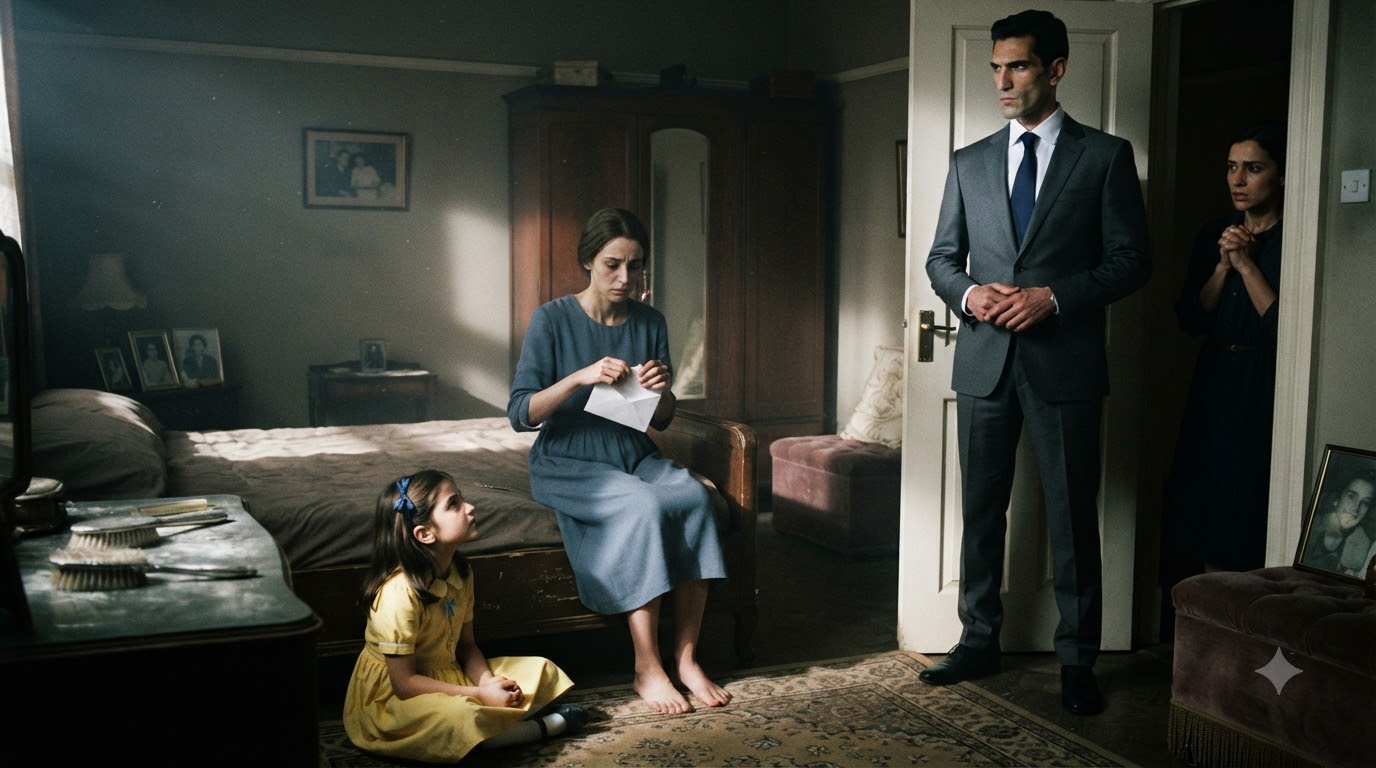
Zara did not flinch as the small figure stepped past the threshold. Her gaze, locked for months on an invisible point beyond the glass, shifted downward with the agonizing slowness of an old hinge moving through rust.
From the upper landing, Rayan watched his mother’s posture alter by a fraction of an inch.
Nadia hurried into the room, her palms flat against her thighs, ready to scoop the child away before the silence broke entirely.
“I am sorry, madam,” Nadia murmured, her voice tight with the frantic calculation of a worker protecting her livelihood.
Zara raised one hand, her fingers trembling against the heavy fabric of her skirt, and stopped Nadia in her tracks.
The silence in the room wasn’t empty anymore; it felt heavy, charged with a sudden, painful friction.
Maryam sat cross-legged on the rug right beside Zara’s footrest, entirely unconcerned with the tension, and pulled a folded envelope from the pocket of her dress.
“This came from the bag,” Maryam announced, holding out the paper with both sticky hands.
Nadia’s breath caught sharply in her throat as she recognized the paper she had dropped the night before.
It wasn’t Maryam’s crayon drawing; it was the letter Farida had handed her at the gate eight months ago, sealed with age and untouched until midnight.
Rayan moved away from the study wall, his boots making no sound on the runner as he descended the stairs to intercept the mistake.
He reached the doorway just as Zara’s thin fingers closed around the edge of the envelope.
The handwriting on the front was unmistakable—loopy, hurried, and violently alive.
“You shouldn’t have to carry this alone,” Rayan said, his voice dropping low as he stepped into the room.
Zara looked up at her son, her eyes wet for the first time in nearly a year, and tore the paper open with a sound that tore through the quiet like breaking glass.
CHAPTER 4: CRAYON AND LIGHT
The ink on the page blurred beneath a sudden drop of moisture.
Zara didn’t look away from the cursive lines written months before the accident, her chest heaving as the long-stifled grief finally broke through the barrier of stone.
Rayan stepped forward, his boots meeting the floorboards as he knelt beside the cream-colored chair and wrapped his arms around his mother’s trembling shoulders.
She held onto him with a desperate, crushing grip, pulling her son close in a way she hadn’t managed since the police car brought the news on a rainy Tuesday.
Maryam stood quietly near the doorway, holding a folded crayon drawing against her chest, watching the adults weep without any need for explanations.
The heavy, suffocating weight that had choked the halls of the massive estate for nearly a year began to dissolve, replaced by the raw, messy sound of true release.
Six weeks later, the dining room table was set for three.
The morning sunlight poured through the wide windows, catching the steam rising from a ceramic bowl of cardamom tea.
Zara sat at the head of the table, her posture straight, her eyes bright with the quiet peace of a person who had finally welcomed the world back inside.
To her left, Nadia arranged a plate of fruit with steady, relaxed hands, her shoulders no longer braced for an invisible reprimand.
And beside Nadia, kicking her legs rhythmically against the heavy wooden chair legs, Maryam held up a fresh piece of paper covered in clumsy, brilliant red strokes.
“Happy Mother’s Day, Auntie,” Maryam announced across the table, her voice ringing out with cheerful confidence.
Zara smiled—a full, deep smile that reached the corners of her eyes and chased away the last lingering shadow in the room.
Rayan took his seat opposite them, watching his mother laugh at something the little girl whispered, and picked up his teacup without a trace of heaviness in his hands.