The Weight of Cedar and Iron: How a Carpenter’s Ruler Demolished a Suburban Empire
CHAPTER 1: The Cedar Grain and the Pink Seal
The sun hadn’t cleared the ridge line yet, leaving the dew heavy and grey across the timber stacked neatly in the bed of the Ford. Damon wiped his palm down the thigh of his canvas work trousers, feeling the familiar grit of sawdust ground into the weave. He held the pink envelope between two fingers, turning it over to inspect the amateur cut of the flap.
“Seven point three,” he muttered, reading the code stamped in bold crimson ink.
The Maple Ridge Estates covenant didn’t apply to his stretch of old timberland. He knew every inch of the deed because he’d laid the foundation stones himself three months back, sinking them deep into the clay with a spirit level that didn’t lie. Yet here was Judith Newell, three blocks down and across an invisible municipal line, dictating the shade of his cedar posts.
From the kitchen window, the faint hum of the coffee maker clicked off. Damon didn’t turn. He listened instead to the crunch of gravel behind him—slow, deliberate, rhythmic. A pair of hard-soled shoes stopping precisely at the property boundary where the county asphalt gave way to his dirt drive.
“You’re tracking sawdust onto the municipal apron, Mr. Kesler,” a voice called out, sharp and dry as autumn husks.
Damon turned slowly, resting his forearm against the side rail of his truck bed. Judith stood with her sun hat tilted back, her chin lifted to catch the morning glare. Her fingers were laced over a clipboard stuffed with clear plastic sleeves, each one containing color photographs of his front porch.
“This apron is county property, Mrs. Newell,” Damon said, his voice level, stripped of any neighborly warmth. “Last I checked, your jurisdiction ends at the drainage ditch.”
“Jurisdiction is a matter of visual impact,” she replied, stepping one inch past the ditch line onto his dirt. She didn’t look at him; her eyes were fixed on the rough-hewn grain of the pergola he’d finished framing yesterday. “That wood is unsealed. It casts an irregular shadow over the common approach. The board met last night. We’ve adjusted your fine to seven hundred.”
Damon didn’t raise his voice. He reached into his tool belt, pulled out a small steel tape measure, and thumbed the lock. The metal blade hissed out with a metallic snap that made Judith flinch.
“You’re standing on my grade, Judith,” he said quietly, dropping the tape to the dirt between her shoes. “And every inch you move forward without a warrant is another line written in my ledger.”
She stiffened, her jaw tightening until the skin across her cheekbones turned chalk-white. She lowered the clipboard, her eyes finally locking onto his with a cold, desperate friction.
“You think you own this patch of earth because a clerk stamped a paper,” she said, her voice dropping an octave, losing its public-meeting cadence. “You don’t know what’s buried under these foundations, carpenter. And when the county starts digging, your little cedar posts will be the first things they burn.”
She turned on her heel, her sensible heels crunching back down the gravel, leaving him alone with the smell of wet pine and the rising sun catching the edge of the steel tape coiled in the dirt.
CHAPTER 2: The Perimeter Check and the Blueprint Drawer
The snap of the tape measure dying inside its metal housing left a flat, empty silence hanging over the yard. Damon didn’t move his boots. He watched the dust settle back into the tread marks left by Judith’s sensible heels, the grey powder coating the dried clay like ash.
Inside the house, the silence was thicker, smelling of fresh sawdust, linseed oil, and the cold metal of his tool chest. He let out a slow breath, the air frosting slightly in the early morning chill before dissolving into the shadow of the wraparound porch. He didn’t chase after her. A carpenter didn’t chase a loose nail; he drove it straight or pulled it out by the root. And Judith Newell had driven herself deep into timber she had no business cutting.
Damon stepped up onto the threshold, his boots scraping rhythmically against the heavy coir mat before he pushed the heavy oak door open.
The interior of the ranch was sparse, smelling of cedar and unpainted drywall. In the corner of the front room sat his drafting table, a broad oak surface scarred by decades of pencils, razor blades, and gouges from old utility knives. Atop it rested a flat, metal-reinforced plan case. He didn’t turn on the overhead light; he let the weak, slanting morning rays cut across the surface, illuminating the motes of dust drifting through the quiet room.
His hand went straight to the brass pull of the bottom drawer. It stuck for a fraction of a second—wood swelling slightly against the humidity of the night before—before giving way with a dry, wooden sigh.
Inside lay the county archive packet Cody had helped him pull three months ago, tucked inside a heavy manila folder marked with red grease pencil. Damon slid it out, the cardboard stiff and heavy in his calloused palms. He carried it over to the drafting table, flicking on the brass-shaded architect’s lamp that cast a sharp, yellow pool of light over the paper.
The top document was his deed, crisp and stamped with the county seal. But beneath it lay the auxiliary survey maps—the ones detailing the old Maple Ridge development boundaries drafted back when the tract was first zoned for residential use in the late nineties.
Damon pulled a sharpened yellow pencil from the groove in the table and began to trace the perimeter lines. His movements were mechanical, measured, driven by the steady rhythm of a man who spent his life calculating load-bearing walls.
Maple Ridge Estates sat on a forty-acre parcel carved out of a larger timber tract. According to the original county plat map—Document 44-B—the subdivision’s eastern border did not terminate at the natural drainage ditch. It terminated twelve feet short of it, leaving a narrow, unallocated strip of public easement running parallel to the dirt road. The very strip where Judith had stood three minutes ago telling him his cedar posts cast an irregular shadow.
“You didn’t just step over a line, Judith,” Damon muttered to the empty room, his thumb rubbing the sharpened graphite tip. “You built your entire administrative fence on county dirt.”
He flipped to the financial disclosures attached to the charter renewal filings from two years prior. The numbers didn’t balance. A subdivision of fifty homes paying standard maintenance dues should have carried a surplus large enough to pave their main loop twice over. Instead, the ledger showed a continuous, unexplained deficit categorized under General Infrastructure Maintenance. Yet the asphalt on Maple Ridge Drive was smooth, freshly sealed, and completely unremarkable.
There was no infrastructure repair happening on their side of the ditch. But there was a massive, expensive patio extension currently sitting in the backyard of Judith’s colonial three blocks down—a sweeping flagstone terrace with built-in planters and a custom stone fire pit that easily cost upward of twelve grand.
Damon pulled a small spiral notebook toward him, jotting down three distinct dates from the bank routing numbers listed on the violation notice. The routing numbers didn’t match the official municipal HOA account. They routed through a secondary commercial trust under the name Maple Ridge Community Integrity Fund.
A private trust. Not a municipal association account.
He leaned back in his stool, the wood creaking under his weight, and stared out the window toward the distant rooflines of the subdivision. The morning mist was burning off, leaving the sky a pale, slate grey. Judith wasn’t just running a local homeowners’ association like a petty tyrant; she was operating a localized tollbooth on public access, funneling uncollected penalties into a private slush fund to finance her own backyard landscaping.
The front gate rattled.
It wasn’t a knock; it was the sharp, metallic jingle of the latch being tested from the outside. Damon didn’t jump. He simply laid the pencil down across the ledger, keeping his eyes fixed on the front window where the edge of his porch met the gravel drive.
A shadow drifted across the frosted glass of the front door—tall, lanky, moving with the jerky, nervous energy of someone who knew they shouldn’t be standing on private property but couldn’t help themselves.
Damon pushed himself off the stool, his joints popping quietly in the still air. He walked across the pine floorboards, his boots making a heavy, solid thud with every step, and reached for the brass handle. He didn’t pull it open immediately. He waited, his palm resting against the cool metal, listening to the hurried scratching of a pen against paper being slid beneath the gap at the bottom of the door.
Then came the quick, retreating crunch of gravel sprinting back toward the municipal apron.
Damon turned the handle and pulled the door inward. Lying flat on the entryway mat was another pink envelope, identical to the first, sealed with the exact same glittery sunflower sticker.
He bent down, hooked his finger beneath the corner of the heavy paper card, and lifted it. Inside, written in neat, aggressive cursive across a square of bright pink cardstock, was a single sentence: Final warning, Mr. Kesler. Compliance is not optional.
Damon walked back to the drafting table, picked up his steel tape measure, and let the metal blade slide out once more, its sharp metallic hiss cutting cleanly through the silence of the room. He laid the pink card flat against the wooden surface, pinned its edge beneath the heavy metal base of the architect’s lamp, and reached for his phone to dial Cody’s direct line.
CHAPTER 3: The Quiet Walk to the Courthouse Doors
The phone receiver felt heavy in Damon’s hand, its plastic casing cold against his palm. On the other end of the line, the muffled rustle of paper signaled Cody flipping through his own copies of the county registry.
“You’re telling me she taped a second one to the jamb while you were sitting five feet away?” Cody’s voice came through the speaker, dry and laced with a low, gravelly disbelief.
“In broad daylight,” Damon said, keeping his eyes on the sunflower sticker glaring up from the drafting table. “She’s not just testing the municipal waters anymore. She’s marking territory.”
“Well, her timing couldn’t be worse for her,” Cody muttered, the sound of a pen tapping against a hard desktop coming through the line. “I spent the last two hours pulling the public works ledger for Maple Ridge’s last fiscal cycle. Damon, the math on their road maintenance fund doesn’t just look irregular. It’s an engineering ghost town. They haven’t purchased a single bag of asphalt mix or hired an outside grading crew in three years, yet the disbursement logs show monthly withdrawals labeled ‘General Paving Reserves.’ Thousands at a time.”
Damon felt the muscles in his jaw tighten. He reached out and picked up the steel tape, letting the cold metal slide back and forth between his thumb and index finger. “Where is the money going if they aren’t paving?”
“That’s what we’re going to ask the clerk when we walk through those intake doors,” Cody replied. “Meet me at the municipal annex in twenty minutes. Wear your work boots. Let’s let them see exactly who’s auditing their paperwork.”
The drive down to the county annex was short, the Ford’s engine rumbling a low, steady bass note against the dry asphalt of the county road. Damon didn’t rush. He kept the truck at a disciplined twenty-five miles per hour, watching the rearview mirror as the neat, uniform mailboxes of Maple Ridge Estates drifted out of sight behind a stand of dry oak and sumac.
The county annex building was a monolith of soot-stained limestone and tall, narrow windows that hadn’t seen a washing in a decade. The air inside smelled of damp paper, floor wax, and decades of municipal frustration. The courthouse was quiet that morning—the kind of quiet where the only sound you can hear is your own boots echoing on the terrazzo tile like a drum beat.
Cody was already waiting by the intake counter, leaning against the polished oak partition with a thick, leather-bound briefcase resting by his feet. He wore a rumpled grey suit that looked like it had been stored in the back of a closet since the nineties, and he was chewing on a toothpick with the steady focus of a man who enjoyed watching bureaucratic machinery grind to a halt.
“You brought the deed packets?” Cody asked, straightening as Damon approached.
Damon patted the heavy manila folder tucked firmly beneath his arm. “Every single survey marker, deed transfer, and boundary plat from the last thirty years. Plus the two pink cards.”
“Save the cards for the judge if we need ’em,” Cody said, flashing a thin, humorless smile. “Right now, we’re just here to file a formal motion for declaratory judgment and request a subpoena for the HOA’s private banking routing numbers. Let’s head back before the afternoon docket fills up.”
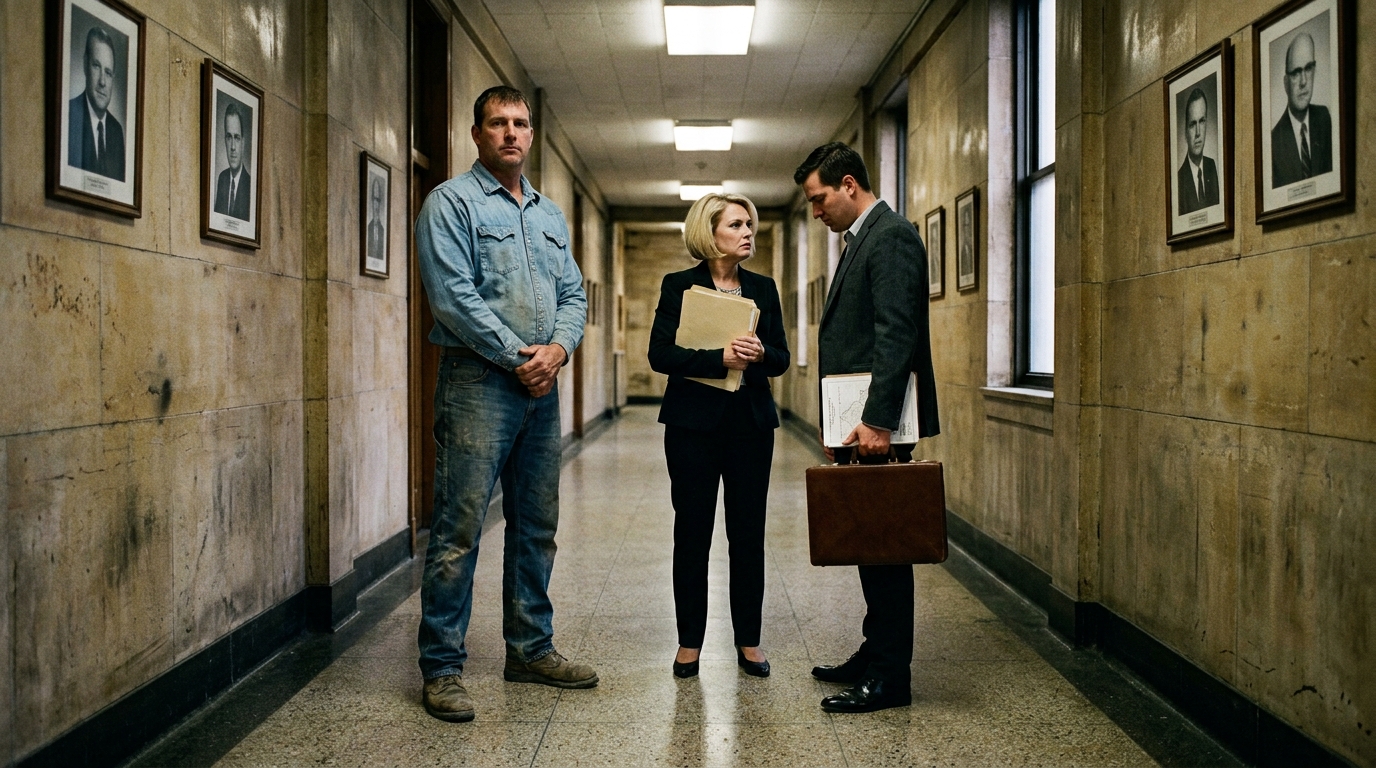
They walked down the long, dim corridor toward Hearing Room B. The walls were lined with framed photographs of former county commissioners whose eyes seemed to follow the dust motes drifting through the weak shafts of light cutting across the hall.
As they rounded the corner toward the double doors of the courtroom, a sharp, familiar rustle of starched linen stopped them short.
Judith Newell was standing by the water fountain, her blonde bob perfectly sculpted, clutching a fresh manila folder to her chest like a shield. Flanking her was a man in a tight charcoal blazer and immaculate, high-shine leather shoes—the kind of footwear that had never touched a shovel or a load of timber in its life. He was leafing through a stack of typed violation notices, his lips pursed in a look of administrative superiority.
Judith turned her head, her eyes locking onto Damon’s work-worn denim shirt and dust-caked boots. Her expression didn’t soften; it hardened into a cold, porcelain mask of absolute grievance.
“You’re trespassing on court-adjacent property, Mr. Kesler,” Judith said, her voice carrying down the empty hall with the resonance of a schoolmarm calling out an unruly student. “The Maple Ridge board has already filed an emergency injunction to halt your unauthorized exterior modifications.”
Damon didn’t break his stride. He kept walking, his boots striking the terrazzo with a heavy, deliberate rhythm that matched the ticking of the wall clock above the courtroom doors. He stopped two feet away from her, towering over her by half a head, the smell of fresh cedar and motor oil cutting through the sterile scent of the corridor.
“You’ve got the wrong address, Judith,” Damon said, his voice quiet, stripped of any theatrical edge. “And by this afternoon, the clerk won’t just be looking at my pergola. He’s going to be looking at where you’ve been hiding your paving funds.”
The man in the charcoal blazer stiffened, his fingers freezing over the manila folder. Judith’s jaw clenched so tight the skin turned bloodless around her mouth. She didn’t answer; she simply stepped aside, her eyes burning with a desperate, trapped fury as Damon reached out, pushed the heavy wooden door open, and stepped into the quiet chill of the hearing room.
CHAPTER 4: The Judges Ledger and the First Cracked Foundation
The air inside Hearing Room B smelled of floor wax and stale coffee. Damon pulled out the wooden bench seat, the legs scraping a harsh, dry note across the linoleum before he sat down. He laid his calloused hands flat on the table, feeling the cold, smooth grain of the wood. Across the aisle, Judith Newell settled into her chair with a sharp rustle of tailored wool, her posture rigid, her chin lifted as if she were inspecting an inferior grade of timber.
The judge entered through the side door without ceremony, his black robe swaying slightly before he dropped heavily into his high-backed leather chair. He didn’t look up from the single-page docket sheet resting before him, running a thick finger down the typed lines until his thumb stopped at their case number.
“Plaintiff and defendant present,” the judge muttered, his voice flat and worn by too many boundary disputes over dry creeks and fence lines. “Let’s dispense with the theatrics. Mr. Newell’s counsel filed an emergency injunction concerning aesthetic compliance. Mr. Kesler, your response.”
Cody didn’t wait. He stood up, buttoning his grey suit jacket with a slow, deliberate movement, and opened his heavy binder to the first tab.
“Your Honor, before we address any claims of aesthetic non-compliance regarding my client’s property, we request that the court take judicial notice of a fundamental jurisdictional defect,” Cody said, his voice dropping into an easy, conversational register that filled the bare room. “Mrs. Newell’s association is attempting to enforce covenants across a municipal boundary line that does not legally exist for them. Furthermore, we have uncovered a pattern of financial transactions that point away from community maintenance and directly toward unauthorized private enrichment.”
Judith’s attorney shot up from his chair like a spring-loaded latch. “Objection, Your Honor. Financial matters are entirely outside the scope of an exterior property aesthetic dispute.”
“Sit down, counselor,” the judge said without looking up. He finally raised his eyes, fixing a weary gaze on Judith across the aisle. “When an association uses small claims filings to extract capital from citizens outside its corporate charter, the court’s scope expands. What kind of financial transactions are we talking about, Mr. Cody?”
Cody slid a multi-page printout across the polished oak barrier toward the bench. “Over the past twenty-four months, the Maple Ridge Estates Homeowners Association has collected upwards of fourteen thousand dollars in compliance penalties from perimeter property owners who hold no membership contract. Those funds were not deposited into the municipal maintenance ledger. They were routed through a private commercial account under the title ‘Maple Ridge Community Integrity Fund.'”
Damon watched Judith’s face. The porcelain mask didn’t crack, but the blood drained entirely from around her lips. Her fingers tightened around the edge of her manila folder until her knuckles turned white.
“And what was that private fund utilized for?” the judge asked, his gaze narrowing as he scanned the line items printed on Cody’s sheet.
“Among other things, Your Honor,” Cody said smoothly, “invoices show direct disbursements to a commercial masonry contractor for a twelve-thousand-dollar flagstone patio extension and stone fire pit built behind a residential property located on Maple Ridge Drive. A property belonging to the association’s sitting president.”
The silence in the courtroom grew heavy, the kind of stillness that precedes a structural collapse. The judge lowered the paper slowly, laying it flat against the dark wood of his desk. He looked from Cody to Judith, his expression hardening into a cold, professional displeasure.
“Mrs. Newell,” the judge said softly. “Is this true?”
Judith stood slowly, her voice tight, vibrating with a desperate, defensive pride. “The integrity fund is a discretionary buffer reserve managed by the executive board to protect community standards from structural degradation along our exposed perimeter. If adjacent non-compliant structures lower our property values, everyone suffers. We used those funds to protect our neighborhood’s equity.”
“You used association routing numbers to build a stone patio in your backyard,” the judge corrected, his tone flat and absolute. “You do not possess the statutory authority to levy fines outside your subdivision, and you certainly do not possess the authority to operate a private slush fund under the guise of municipal governance.”
The judge picked up his heavy wooden gavel. The single strike didn’t echo; it cracked sharply against the sounding block, a clean, final sound that stripped Judith of every ounce of administrative authority she thought she held.
“The petition for injunction is denied with prejudice,” the judge ruled, his eyes fixed on Judith as she stood frozen at the plaintiff’s table. “Furthermore, this court is formally freezing the Maple Ridge Community Integrity Fund accounts and referring these records to the county district attorney’s office for a full forensic audit of all fine collections over the last three years. This hearing is adjourned.”
The gavel dropped a second time.
Damon didn’t smile. He simply reached across the table, gathered his manila folder, and slid it back beneath his arm. As he stood up, he caught Judith’s eye for a single, lingering second. Her chest rose and fell in short, rigid gasps, her eyes burning not with defeat, but with the cornered fury of a woman realizing her entire empire of paper had just been sheared down to the studs.
Cody tapped his toothpick against his teeth as they walked back down the aisle toward the heavy double doors. “Well,” Cody murmured quietly as the hinges swung shut behind them. “That breaks the ground open. But trust me, Damon—people like Judith don’t go down without swinging a heavy hammer.”
CHAPTER 5: The Subdivisions Bleeds
The Ford’s tires crunched across the gravel drive as Damon cut the ignition, the engine block clicking softly as it cooled in the damp afternoon shade of his wraparound porch. He didn’t step out right away. He sat with his hands resting on the hard plastic of the steering wheel, his knuckles grey against the rubber. Cody’s warning from the courthouse hallway still echoed in his mind: People like Judith don’t go down without swinging a heavy hammer.
A sudden gust of wind swept down the gravel lane, rattling the loose sheet of galvanized tin on the utility shed behind his property line and kicking up a swirl of dry dirt against the truck door. Damon pushed the door open, his boots hitting the packed earth with a flat, heavy thud.
He didn’t make it to his front steps before a low, urgent voice cut across the property line from the direction of the drainage ditch.
“Damon? You got a minute?”
Damon turned. Marisol stood near the boundary stake, her hands buried deep in the pockets of a worn canvas jacket. Her face was tight, her eyes darting nervously toward the distant, uniform rooftops of Maple Ridge Estates shimmering in the afternoon heat. She looked like a woman holding together a leaking dam with a single thumb.
Damon walked over, his stride unhurried, his heavy work boots grinding against the small stones of the path. “What is it, Marisol?”
She pulled a folded square of paper from her jacket pocket, her fingers trembling slightly as she extended it toward him. It wasn’t a pink envelope this time. It was an official-looking notice printed on cream-colored cardstock, bearing a formal block letterhead that mimicked county stationary.
“This came in my mailbox about an hour after you left for the courthouse,” Marisol said, her voice dropping to a harsh whisper. “They’re claiming my back property line encroaches on the drainage easement. They slapped a twelve-hundred-dollar lien notice on my title, effective immediately, unless I settle the balance directly with the Integrity Fund office by Friday morning.”
Damon took the paper, his thumb feeling the crisp, heavy texture of the stock. He scanned the header. The routing number listed at the bottom matched the secondary commercial account Cody had flagged in the court ledger—the exact private slush fund the judge had ordered frozen less than four hours ago.
“Judith’s board is doubling down,” Damon said, his voice flat, stripped of surprise. “Even with a freeze order on the accounts, they’re scrambling to collect whatever cash they can pry loose before the county investigators secure the bank ledgers.”
“They’re threatening to foreclose on the title, Damon,” Marisol said, her voice cracking slightly as she looked back toward her small, single-story home. “I’ve lived here six years. I put every cent I had into re-roofing last autumn. If they slap a fraudulent lien on public record, my mortgage lender is going to freeze my refinancing before I can even explain it to them.”
Damon folded the notice slowly, sliding it into the breast pocket of his denim work shirt. The friction of the canvas against his chest felt like a whetstone sharpening a blade.
“They won’t foreclose,” Damon said, his eyes narrowing as he stared down the empty gravel road toward Judith’s colonial three blocks away. “Because they just violated a direct federal and civil asset freeze order issued by the bench this morning. Mailing a new collection notice after an active judicial freeze isn’t a civil infraction anymore. It’s contempt of court.”
He turned back toward his truck, grabbing his heavy canvas utility bag from the passenger floorboard. He unzipped the main compartment, checked that his backup digital recorder and property files were secure, and looked back at Marisol.
“Get in the truck,” Damon said, his tone leaving no room for argument. “We’re going to pay a visit to the other perimeter homeowners who received these letters. If Judith wants to play a high-stakes game with fraudulent paper, we’re going to collect every single invoice she mailed out and hand them directly to the district attorney before the sun goes down.”
Marisol hesitated for a fraction of a second, her gaze flickering toward her house, then back to the dust-covered profile of the Ford. The wind gusted again, rattling the cedar posts of Damon’s pergola. She swallowed hard, pulled her jacket tighter around her shoulders, and walked firmly around the hood to climb into the passenger seat.