The Architect of Retribution: How a Quiet Veteran Dismantled a Suburban Tyrant Using Her Own Ironclad Rules
CHAPTER 1: THE WEIGHT OF CEDAR
The voice had the texture of crushed glass dragged across slate.
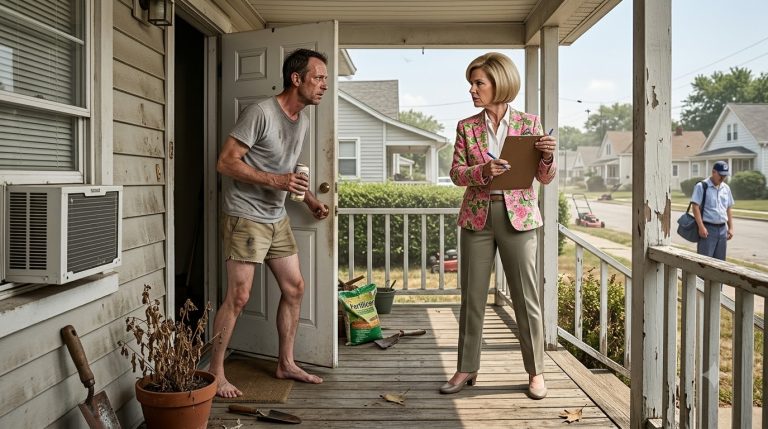
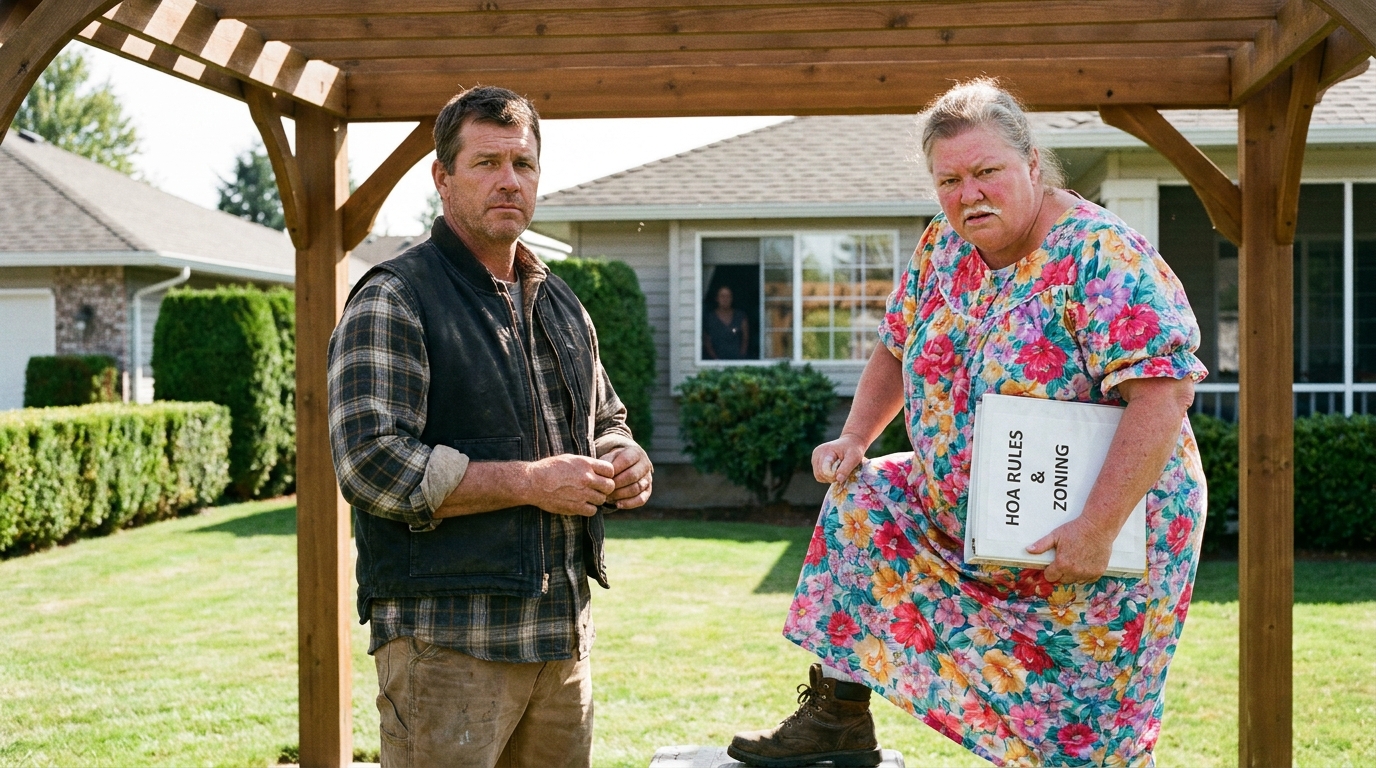
“That monstrosity,” she said, her tongue flicking out to catch a smear of white powdered sugar from her upper lip, “is coming down by Friday. If it’s not gone, I will have it torn down myself and bill you for every last splinter.”
I did not look at her face first. I looked at her hands.
Her fingers were thick, sausage-cased in skin so tight it looked polished, clutching a three-ring binder like a weapon she had used in a hundred petty skirmishes. Behind her, the quiet suburban cul-de-sac of Oak Ridge held its breath. Curtains twitched three houses down—Mrs. Gable, likely, taking notes through her sheer lace.
My gaze shifted from the clipboard to the gleaming cedar beams above my head. Three months of weekends. Three months of sawdust in my hair, of measuring twice, cutting once, and driving stainless steel fasteners into over-engineered joints designed to laugh off a category-three hurricane. It wasn’t just wood. It was an anchor. After twenty years in the Army Corps of Engineers, moving from one godforsaken forward operating base to another, building bridges over dry wadis and reinforcing bunkers against incoming ordnance, this house was supposed to be the end of the line. The permanent stop.
And this woman, draped in a floral muumuu that strained desperately against her shoulders, had just declared war on my horizon.
Sarah’s hand found mine. Her fingers were ice. Her knuckles had gone completely white, the skin stretched thin over bone. She didn’t say anything, but I knew the cadence of her breathing. She was waiting for the drop. She knew the look in my eye—that flat, grey stillness that settles over a man when the perimeter is breached and the variables narrow down to a binary choice.
“Karen,” I said. My voice didn’t rise. It didn’t need to. In the service, the loudest man in the room was usually the one taking the incoming mortar fire. “This structure was built in full compliance with all municipal zoning laws. I pulled a permit.”
She waved a doughy hand, nearly tipping the half-eaten donut from her palm. “Your little city permit is irrelevant,” she scoffed, the condescension dripping thick enough to coat asphalt. “The HOA architectural review committee, which I chair, did not approve it. Our covenants supersede municipal ordinances on matters of aesthetic harmony. It blocks the Millers’ view of the oak tree, and it’s coming down.”
I glanced past her shoulder. The Millers’ house sat fifty feet to the left. Their primary view from that angle was a blank brick wall and my side-yard fence. The only oak tree within a square mile stood squarely in my own backyard, twenty feet behind the pergola, casting its shade over the very beams she claimed it obstructed. The lie was lazy, constructed with the casual arrogance of someone who had never once been forced to defend a premise under cross-examination.
Sarah squeezed my fingers harder, her nails biting into my palm. “Jack, don’t,” she murmured, her voice a thin wire pulled too tight. “Let’s just… let’s talk to the board. Let’s handle it.”
I didn’t squeeze back. I kept my eyes locked on Karen’s small, wet black eyes, buried deep in folds of powdered flesh. She was waiting for me to sputter. She was waiting for the red-faced suburban explosion she could document, photograph, and use as justification for her next escalation.
Instead, I let my thumb trace the edge of my wedding band, a slow, calculated friction. I noticed something odd—a tiny, dark smudge of grease on the second beam to the left, right where my drill had slipped during Friday’s final assembly. A minor imperfection. A blemish in an otherwise flawless line.
“You’re trespassing, Karen,” I said softly.
She blinked, genuine shock momentarily overriding the smug set of her mouth. Her face mottled into a bruised purple hue. “You will be hearing from our attorney. You will be fined one hundred dollars a day until that pile of kindling is hauled away. I am documenting this insubordination.”
She fumbled with her phone, her thick thumbs hammering blindly at the glass screen, trying to capture my face while her camera app stubbornly focused on her own orthopedic shoes. With a final, sputtering threat about liens and special assessments, she turned on her heel, her muumuu catching the midday breeze like a ragged spinnaker, and stomped back down the grass.
The moment the crunch of her gravel-crushing soles faded toward the cul-de-sac, Sarah let out a long, ragged exhale that sounded like a tire losing its last PSI.
“What do we do?” she whispered, staring up at the rich, amber grain of the cedar overhead.
I didn’t answer right away. I let my eyes trace the exact angle of the sun through the rafters, mapping the shadows as they lengthened across the patio. She thought she was holding a scepter. She didn’t realize she had just handed me the blueprints to her own demolition.
“Get the three-ring binder from the office,” I said, my voice dropping an octave as the cold, sharp mechanics of planning took over. “The one from closing. Page four hundred. The 2007 amendment.”
Sarah looked up at me, her eyes widening as the terror gave way to something colder, something sharp and hard.
“Why?” she asked.
“Because,” I said, a slow, flat smile touching the corners of my mouth as I watched the dust motes dance in the dying light of the afternoon, “she forgot to check who drew the lines.”
CHAPTER 2: RECONNAISSANCE IN THE BINDING
The sun didn’t linger long over Oak Ridge. It dropped fast behind the western ridge, bleeding long, bruised streaks of purple and grey across the suburban rooftops before pulling the plug entirely on the evening light.
I didn’t turn on the overhead kitchen light. I left it off, relying on the amber glow spilling in from the stove hood, casting long, fractured shadows across the oak dining table. In the center of that table sat the three-ring binder from closing. It smelled of cheap vinyl, dry corporate paper, and five years of accumulated dust.
Sarah walked in carrying two mugs of black coffee, setting them down with a soft, ceramic clink that sounded entirely too loud in the quiet house. She didn’t sit immediately. She stood behind my chair, her hands resting lightly on my shoulders, her fingers kneading the tight muscles at the base of my neck where twenty years of army stress had carved out a permanent home.
“You’re not going to sleep tonight, are you?” she asked quietly.
“Can’t,” I said. “When an adversary tells you their rules supersede reality, you don’t argue with them. You read the fine print.”
I flipped the heavy plastic cover back. The rings gave a sharp, metallic snap.
The binder was thick, nearly four inches of densely packed paper divided by moth-eaten tabs: General Covenants, Architectural Guidelines, Dispute Resolution, Amendments. Most people who buy into a planned community treat these pages like wallpaper—ignore them until they peel, then curse the landlord. But to an engineer, a covenant is just a load-bearing calculation. It’s a set of tolerances. If the foundation is built on a lie, the whole structure will eventually shear under its own weight.
“Phase one,” I murmured, sliding a yellow legal pad and a red fine-point Pilot pen into the dim pool of light. “Let’s see what she actually signed her name to.”
Sarah pulled out the chair opposite me and sat down, dragging her laptop across the wood. Her screen flickered to life, throwing a pale blue wash across her face. “I’m pulling up the county recorder’s office portal. Let’s see when the architectural committee’s charter was last amended.”
For the next two hours, the house dissolved into silence, broken only by the rhythmic rustle of heavy bond paper and the clicking of Sarah’s keyboard. We worked with the methodical, unhurried cadence of a field unit cross-referencing aerial reconnaissance with ground intelligence.
Karen had weaponized the concept of aesthetic harmony, but she had done so with a staggering lack of administrative discipline. Dictatorships built on paper always assume no one else knows how to read.
I turned past the general provisions, skipping the tedious sections on lawn height and exterior paint palettes—though even there, the text was riddled with loose phrasing—until I hit the tab marked Article IX: Architectural Control Committee.
I ran my finger down the margin, past the composition requirements of the committee, past the appointment rules, down to the sub-clause regarding municipal overlap. There it was, buried on page eighty-four, printed in standard twelve-point Times New Roman under an unceremonious heading: Jurisdictional Supremacy.
“Sarah,” I said, my voice dropping into that flat, steady register that usually meant I’d found a fracture in a concrete pillar.
She looked up from the screen, her eyes blinking against the blue light. “Found something?”
“Listen to this.” I tapped the page with the back of my pen. “‘In any instance where a conflict arises between association architectural guidelines and municipal building codes, the stricter of the two shall apply. However, any structure fully engineered, permitted, and approved by the city’s planning and zoning department shall be considered presumptively compliant, with the burden of proof falling entirely upon the association to demonstrate material harm to the community.'”
Sarah leaned over the table, her breath catching slightly. “She didn’t read it.”
“She didn’t just fail to read it,” I said, a cold satisfaction settling into my chest. “She weaponized a manual she never opened. She assumes the rules are whatever she says they are on any given Tuesday morning because nobody has ever pushed back hard enough to make her turn the page.”
“And the permit?” she asked, her voice sharpening with a sudden, dangerous edge of hope. “Does the pergola match every single line on that city document?”
“Down to the millimeter,” I said. “Frank at the zoning office didn’t just stamp it; we spent forty minutes adjusting the setback calculations to ensure we cleared the utility easement by three feet. It’s airtight.”
I reached over and closed the binder with a heavy, satisfying thud that rattled the coffee mugs. But as the echoes died away, a deeper tactical reality settled in. Winning an argument on paper in my dining room wasn’t the same as winning on the battlefield. Karen wasn’t going to retreat because I recited a paragraph back to her. A bureaucrat backed into a corner doesn’t yield; they escalate. They double down on the noise.
“We don’t mail this yet,” I said, pulling the legal pad toward me and sketching out a timeline.
Sarah tilted her head. “Why not? Let’s hit her with it tomorrow morning. Send her a copy and shut her down.”
“Because a defensive counter-punch only stuns them,” I said, my eyes tracking the sharp, geometric lines of the notes I was writing. “If we just show her the clause, she’ll pivot. She’ll claim an exception, or rewrite an amendment retroactively, or bury us in arbitrary fines through some other administrative loophole. We don’t just want her to back off this pergola.”
I looked up, meeting Sarah’s gaze across the table.
“We want to strip her of the authority to ever do this to anyone else again.”
Sarah held my gaze for a long moment, the fear that had gripped her on the lawn earlier that afternoon completely burned away, replaced by the same cold, calculating resolve that had carried us through years of uncertainty. She nodded slowly.
“What’s our next move, commander?”
I uncapped the red pen, the smell of ink sharp and clean in the dim room, and began to outline the parameters of the paper trail.
“We give her enough rope to tie the knot,” I said softly. “Tomorrow, we draft a formal, polite rejection letter. We cite the clause. We attach a certified copy of the city permit. And we send it via certified mail, requiring a physical signature on delivery.”
I paused, looking at the dark window where the reflection of our kitchen stared back at us.
“Let’s see if she’s arrogant enough to sign her own name to her own undoing.”
CHAPTER 3: THE PAPER TRAIL
The bell above the post office door didn’t chime; it grated—a dry, brassy rattle that sounded like dry leaves scraping across concrete.
I didn’t look up from the counter. My focus was locked on the small, yellow square of the certified mail receipt card resting flat against the scarred laminate surface. Every line of text on it was crisp, filled out with the rigid, block-letter printing drilled into me during my first week at Fort Belvoir. Oak Ridge Homeowners Association, Attention: Karen J. Albright.
The postal clerk behind the wire mesh—a tired-looking man with a permanent crease across his forehead—tapped a heavy rubber stamp against an ink pad. Thud. The red ink bled into the paper fiber, leaving a crisp, square date that locked the transaction in time. Eight dollars and twenty cents. The cheapest, most lethal piece of hardware I had ever purchased.
“You want tracking on this?” the clerk asked, his voice flat, devoid of curiosity.
“Return receipt requested,” I said, sliding the envelope forward so the red-bordered tag faced him square. “I need a physical signature at delivery. Not a digital scribble. I want the green card back in my box with ink on it.”
The clerk pulled the envelope toward him, his thumb smudging a speck of graphite on the corner. He ran a scanner over the barcode. A sharp electronic beep confirmed the entry.
I turned away from the counter and stepped out into the harsh Central Ohio morning. The air had that sharp, metallic bite to it that precedes a frost, carrying the distant smell of wet asphalt and cut grass. My truck sat idling at the curb, its diesel engine rumbling with a low, predictable vibration through the steering wheel. Sarah was waiting inside, her fingers resting lightly on the dashboard, her eyes fixed on the rearview mirror as if expecting a process server to materialize out of thin air.
I climbed into the cab, pulling the door shut with a heavy, solid thud that sealed out the wind.
“Sent?” she asked, not turning her head.
“Sent,” I said, putting the transmission into drive. “She’ll have it by tomorrow afternoon. Twenty-four hours to process the text, check the municipal code override clause, and realize she’s standing on a trapdoor.”
“And if she ignores it?” Sarah looked over at me, her expression tight, her fingers interlaced tightly in her lap.
“Then she ignores a legal notice sent under statutory guidelines,” I said, keeping my eyes on the road as I eased the truck away from the curb. “Which transforms a neighborhood dispute into a documented failure of administrative duty. Every day she pretends that letter doesn’t exist, the leverage shifts.”
We drove back in silence, the quiet hum of the heater filling the cab. But my mind wasn’t on the post office anymore. If Karen was going to react the way bureaucrat-autocrats always reacted when cornered, she wouldn’t back down; she would double down on paper. She would issue a formal violation notice. She would try to out-volume us, burying the municipal code clause under a mountain of arbitrary fines and threatening language.
And to do that, she would need the financial machinery of the HOA functioning smoothly behind her.
That afternoon, after dropping Sarah off at the library, I pulled out the second folder—the stack of annual budget disclosures and financial summaries we had hauled out of our filing cabinet the night before. I spread them across the workbench in the garage, right beside my table saw and the spare boxes of stainless steel screws left over from the pergola build.
The garage was cold, smelling faintly of machine oil and dried sawdust. I pinned the three years of financial reports down with a pair of heavy aluminum speed squares.
The numbers were printed in neat, corporate columns, but they were structured with a deliberate lack of transparency. I traced the line items with the tip of a pencil. Grounds maintenance. Administrative fees. Legal retainers.
For a neighborhood of forty-eight homes, the annual landscaping budget had ballooned by forty percent over twenty-four months. There was no itemized breakdown of hours, no material costs, just a single flat payee name listed at the bottom of each fiscal year: Greenleaf Landscaping.
I pulled out my phone, opened the state’s public business entity search portal, and typed in the name. The database responded instantly, spitting out a PDF certificate of incorporation filed precisely two months before the landscaping contract was awarded by the HOA board.
I scrolled down to the list of corporate officers. President: Dennis Albright.
I stared at the screen. The name sat there in plain digital black and white. Dennis Albright. Karen’s maiden name—no, wait. I pulled up her Facebook profile from an old neighborhood directory search, zooming in on a family barbecue photo I had saved out of sheer procedural instinct weeks ago. Standing right beside her, holding a pair of grilling tongs with a strikingly familiar aggressive posture, was a lean, grey-tempered man bearing the exact same sharp, angular jawline. Her brother-in-law.
A no-bid contract awarded directly to family, funded by mandatory homeowner dues, wrapped in an administrative shell game of vague line items.
The pergola wasn’t just a random target of her tyranny. It was an intrusion into a fiefdom. If I built something without permission, without paying into her system, without bowing to the gatekeeper, it threatened the entire illusion of absolute control she maintained over the community’s purse strings.
A sudden, sharp metallic clink broke my concentration.
I looked down at the workbench. My pencil had rolled off the edge, striking a stray hex wrench resting near the vise. I reached down to pick it up, and as my fingers brushed the cold steel, my eyes caught a small, pale detail on the edge of the workbench that I hadn’t noticed before.
A thin, yellowish sliver of wood grain was wedged into the miter track of the saw table. It was cedar—a tiny scrap left over from the trim work on the pergola’s front beam. But it wasn’t flat. It had been neatly notched, scored with a sharp blade, as if someone had deliberately carved a small, deliberate mark into it.
My breath hitched slightly. I hadn’t carved that mark.
I stood up slowly, scanning the perimeter of the open garage door. The street outside was dead quiet. The afternoon sun cast long, slanted shadows across the driveway. No one was walking past. No one was standing by the property line.
Yet the microscopic detail on the saw table sat there like an unspoken punctuation mark, a physical discrepancy reminding me that while I was busy dissecting her paper trail, someone else had been close enough to touch the edges of my own construction.
Karen wasn’t just sitting behind her desk waiting for mail. She had eyes on the perimeter. And the game was already moving faster than the postal service could carry it.
CHAPTER 4: THE AUDIT OF INTEREST
The garage door remained half-closed, cutting off the lower half of the driveway and leaving the workbench bathed in the flat, amber glare of an overhead halogen work lamp.
I did not move away from the saw table immediately. My thumb stayed pressed against the sharp edge of the notched cedar scrap. The wood was dry, seasoned white oak and cedar fiber, but the cut was fresh—crisp edges that hadn’t yet weathered gray in the humid Ohio air. Someone had stood right where I was standing now, holding a pocketknife or a chisel, testing the hardness of the timber.
A flicker of movement across the street caught the edge of my peripheral vision. Mrs. Gable’s front curtain dropped back into place against her double-hung window with a sharp, invisible snap.
Information flows both ways in a cul-de-sac. Karen wasn’t just managing paper from behind her desk; she had ears and eyes planted in every adjacent yard, mapping our movements, timing our departures, looking for a structural fatigue point.
“Jack?” Sarah’s voice floated out from the open kitchen door leading into the garage. She stepped across the threshold, holding a fresh mug of coffee and a thick manila folder crammed with three years of stapled photocopies. “The state business registry portal just finished loading the historical filing logs for Greenleaf Landscaping. You’re going to want to see this.”
I let go of the wood scrap, wiping my thumb clean on my jeans, and turned to the workbench.
“Talk to me,” I said, leaning back against the cold cast-iron bed of the table saw.
Sarah flipped open the manila folder, laying out three distinct sheets of white paper side by side like tactical maps. Her eyes were sharp, stripped of any lingering hesitation. “The contract renewal dates don’t match the standard neighborhood budget cycle. Every other vendor—trash collection, pool maintenance, snow removal—gets renewed in November during the annual general meeting open vote.”
She tapped her pen against the first sheet. “Greenleaf? Their contract was pushed through on a special executive addendum. Signed in August. Directly by the board president, without floor approval.”
“Because a general vote requires a quorum and open bidding,” I said, looking down at the corporate officer registry. “A special executive addendum bypasses the floor entirely if the president classifies it as an emergency maintenance measure.”
“Exactly,” Sarah said, her voice dropping into a low, measured rhythm. “And look at the numbers. Year one of their contract: forty-two thousand dollars. Year two: fifty-eight thousand. Year three: eighty-one thousand. For grounds maintenance on common areas that haven’t added a single square foot of turf since twenty-eighteen.”
I traced the numbers with the blunt end of my pencil. An annualized forty percent inflation rate on mulch and grass-cutting in a flat, predictable Ohio subdivision wasn’t just poor management. It was an extraction mechanism. The neighborhood association wasn’t operating as a community collective; it was functioning as a private ATM, funneled through a corporate entity whose primary shareholder shared a bloodline and a barbecue patio with the woman holding the clipboard.
This was the structural flaw in her foundation. The pergola on my lawn wasn’t an aesthetic violation; it was a physical anomaly that threatened to draw unwanted light into the dark, closed-loop machinery of her finances. If the city inspectors and zoning boards started looking at my property lines, sooner or later they would start looking at the financial ledgers attached to the same municipal parcel numbers.
“She didn’t just build a tyranny out of bylaws,” I murmured, staring at the corporate filings. “She built a toll bridge.”
“And she staffed it with her brother-in-law,” Sarah added, sliding a printed photograph from the back of the folder.
It was a screenshot from an archived social media page. Dennis Albright, wearing a faded polo shirt, standing beside Karen at a backyard patio table littered with paper plates and aluminum cans. They weren’t just relatives; they were business partners operating under the protective cover of suburban apathy.
I picked up the photo, studying the background. Behind them, partially obscured by a trellis, was a custom-built privacy fence—one that clearly exceeded the neighborhood’s six-foot height restriction by at least two feet. Yet no violation notice had ever been issued for it. No daily fines had accrued. The rules applied strictly to everyone else, while the gatekeeper carved out exemptions for her own backyard.
A sudden, sharp memory pushed through the back of my mind—an afternoon three years ago in Kandahar, standing over a crumbling concrete culvert where a local contractor had pocketed half the reinforcing steel budget, leaving the bridge deck structurally sound on the surface but hollowed out beneath heavy loads. It looked fine from ten yards away. But the moment a twelve-ton logistics truck rolled across it, the shear stress would crack the whole thing wide open.
Karen’s regime was built out of the exact same hollow concrete.
“We have enough for a forensic audit,” Sarah said, watching my face closely. “If we take these filings to a lawyer who specializes in property management law, we can petition the county judge for an emergency injunction. Freeze the HOA accounts.”
“Not yet,” I said, shaking my head slowly. “An injunction right now just forces her into legal corner-cutting. She’ll hire a high-priced firm using neighborhood reserve funds to fight it out in motions for six months.”
I tapped the edge of the business registry printout with my pencil.
“We don’t want to freeze her accounts while she can still control the narrative. We let her take the bait on the certified letter. When she issues that illegal fine—when she files that lien against our house—she’s going to use the association’s legal account to do it. Every dollar she spends trying to crush this pergola is another documented misuse of funds pulled directly into our chain of evidence.”
Sarah folded her arms across her chest, a faint, cold smile touching her lips. “You’re feeding her rope.”
“I’m giving her the steering wheel,” I corrected, looking back toward the half-open garage door where the twilight was beginning to deepen into bruised shades of grey. “Tomorrow morning, that certified letter lands on her desk. By tomorrow afternoon, she’ll either back down—which she won’t—or she’ll double down with a formal penalty notice. When she signs that green return card, she signs her own indictment.”
I reached out and picked up the notched cedar scrap from the workbench, turning it over in my palm. The microscopic detail didn’t intimidate me anymore. It was just a footprint left by a scout who didn’t realize she was already surrounded.
CHAPTER 5: THE FLOOR IS NOT YOURS
The linoleum floor of the clubhouse lobby smelled faintly of high-test bleach and stagnant pool water. It was an antiseptic, soul-crushing scent designed to discourage loitering, but tonight it was thick with something far heavier—the nervous, sweaty friction of thirty homeowners crammed into a room built for fifteen.
I walked through the double doors with the Operation Pergola Freedom binder tucked tight beneath my left arm like a rifle stock. Sarah stayed half a step behind me, her expression a mask of absolute, unreadable calm.
At the front of the sterile, beige-walled room, seated behind a long folding table draped in a cheap blue vinyl cloth, sat Karen Albright. She looked imposing, draped in a floral muumuu that strained against her chest, her fingers drumming a slow, aggressive rhythm against a small wooden gavel. Beside her sat Barry, blinking rapidly behind thick wire-rimmed glasses, and Sheila, staring fixedly at a stack of unread meeting agendas as if hoping the paper would swallow her whole.
Karen struck the gavel. The sharp crack bounced hard off the drop-tile ceiling.
“This meeting of the Oak Ridge Homeowners Association is now in session,” she announced, her voice carrying that condescending, flat drone of an autocrat reading a sentence down to the condemned. “We have a packed agenda tonight, so let’s dispense with any unauthorized interruptions right out of the gate.”
She droned through the opening minutes, skimming past the treasury report—which Barry mumbled out without lifting his eyes from the table—and moved directly into the community landscape report, launching into a pre-rehearsed defense of Greenleaf Landscaping’s inflated billing cycle.
From the back row, Mr. Miller gave a slow, deliberate head-shake, rolling his eyes toward the fluorescent tubes overhead.
I didn’t wait for her to open the floor to new business. According to Robert’s Rules of Order—a text I had memorized during three sleepless nights of preparation—a member could move to amend the agenda at the precise moment old business transitioned to new.
I stepped out from the cluster of folding chairs, my boots clicking sharply against the linoleum.
“Madam President,” I said, projecting my voice without shouting, letting the baritone carry straight to the front table. Every head in the room snapped around.
Karen’s eyes narrowed into twin slits of wet obsidian. She gripped the edges of her binder. “Mr. Miller,” she said deliberately, mispronouncing my name with a petty, premeditated jab at dominance. “This is not the time for open floor comments. That is scheduled for the end of the meeting, if time permits.”
“According to parliamentary procedure governing association bylaws,” I countered, keeping my stride measured as I walked down the center aisle, “a member may move to amend the agenda to address an urgent jurisdictional conflict prior to the adoption of the formal schedule.”
A low, rustling murmur swept through the rows of folding chairs.
Karen’s face mottled instantly from pale pink to a dark, bruised magenta. She slammed the wooden gavel down once, twice, a sharp percussive clatter of panic. “You are out of order! Sit down or you will be assessed a five-hundred-dollar immediate compliance fine for disorderly conduct!”
“You cannot assess a fine for procedural adherence,” I said, stopping ten feet from her folding table. I didn’t raise my voice. I let the absolute flatness of my tone do the heavy lifting. “Especially when the board is actively in breach of Article Nine, Section Four, regarding municipal permit supremacy. And it is certainly out of order to conceal a financial conflict of interest with a preferred landscaping vendor who shares your family surname.”
The room went dead silent. The humming of the ceiling vent suddenly sounded like a jet turbine.
I had dropped the core of the investigation right onto the linoleum. I didn’t mention Dennis by name yet; I didn’t have to. The implication hung in the air with the weight of a dropped anvil.
Karen shoved her chair back so hard it screeched against the floor, legs skipping across the tiles. She lunged to her feet, her hands flat on the table, her chest heaving beneath the floral fabric.
“That is a slanderous lie!” she screamed, her voice cracking at the edge. “This meeting is adjourned! Everyone out! Get out right now!”
“You can’t just adjourn to shut down dissent,” shouted Mr. Garcia from the third row, standing up so fast his chair tipped over backward with a sharp clatter. “We have questions about our dues!”
“She’s running because she’s caught!” Mrs. Miller called out from the back, her voice shaking with the righteous fury of five years of suppressed terror.
Suddenly, the entire room erupted. The fragile, artificial veneer of suburban compliance shattered in a single second. People were on their feet, shouting, demanding answers, pressing forward down the narrow aisle. Barry looked like he was about to climb under the folding table to escape, while Sheila dropped her pen and began furiously shoving papers into a leather purse.
Panic made Karen dangerous. She didn’t retreat; she lashed out blindly, pointing a thick, trembling finger straight at my chest.
“You!” she shrieked over the roar of the room. “You caused this! Security! Remove him!”
There was no security. There was only the empty hallway leading back to the pool.
I held my ground, the leather spine of my binder gripped firmly in my hand. I hadn’t even opened the pages yet. Her own explosive, unhinged reaction had done more to prove my case to thirty voting homeowners than a thousand legal briefs ever could. She had exposed the fragility of her own dictatorship under the simplest application of truth and calm resistance.
Grabbing her clipboard and purse, Karen shoved past Barry, her face twisted in a mask of furious humiliation, and stormed out through the side exit doors, letting them slam back against the brick wall with a violent echo.
She had fled the room, but the war was only entering its final, critical phase. As the shouting died down into a murmuring wave of energized disbelief, Mr. Miller stepped into the aisle, clapping a heavy, supportive hand onto my shoulder.
“Well, son,” the old man said, his eyes bright with vindication. “You just kicked the hive. Now what’s our next move?”
I opened the binder to the blank legal pad at the back, sliding the red pen free from its loop.
“Now,” I said, looking out across the sea of determined faces, “we wait for her to file the lien.”
CHAPTER 6: THE ALLIANCE OF THE BRUISED
The garage door was pulled all the way down now, sealing out the damp Ohio night and trapping the smell of machine oil, sawdust, and burnt coffee within the concrete walls.
Mr. Miller sat on an overturned five-gallon drywall bucket near the table saw, holding a chipped ceramic mug between both hands. His knuckles were swollen with the dull ache of arthritis, but his eyes were sharp, catching the harsh white glare of the halogen work light overhead. Beside him stood Mr. Garcia, leaning against the cold metal frame of the shelving unit, holding a thick manila folder crammed with faded violation notices and photocopied receipts.
“She hasn’t called Dave yet,” I said, leaning over the workbench as I unclipped the red pen from my shirt pocket. “Her phone logs from the clubhouse exit showed her dialing a downtown Columbus commercial real estate firm, but they dropped the call before intake. She’s isolated.”
“Isolated doesn’t mean harmless,” Mr. Miller murmured, his voice dry and weathered like old pine. He took a slow sip of the coffee Sarah had brewed twenty minutes ago. “A cornered dog doesn’t calculate the fence height; it just bites whatever shadow moves closest. She still controls the association’s legal retainer until a judge signs an injunction.”
“Which is exactly why we aren’t waiting for her next letter,” I said, tapping the edge of the legal pad. “We need to widen the perimeter. The clubhouse meeting broke her quorum, but it didn’t strip her signature rights at the bank. If she manages to push an emergency administrative disbursement through before morning, she can drain the remaining legal reserve fund to cover her private retainer.”
Mr. Garcia shifted his weight against the metal shelf, the wire rack giving a faint, metallic groan. “What do you need us to do, Jack? Name it. After three years of getting cited because my six-year-old drew a hopscotch grid with washable sidewalk chalk, I’m past the point of quiet compliance.”
I looked across the garage at the faces gathered around the workbench—neighbors who had spent years locking their front doors at dusk, pretending not to notice the pink violation slips tucked behind their screen doors. Fear is a localized contagion, but unity is structural. Once the first bolt shears, the rest of the assembly either collapses or locks into a tighter grid.
“Intelligence and documentation,” I said, sliding three separate clipboards across the wood surface. “Miller, you take the architectural committee logs from nineteen-nineth through last Tuesday. Cross-reference every denied paint modification with the houses owned by Karen’s personal circle. Let’s map out the exemption radius.”
The old man nodded slowly, his fingers tightening around the warm ceramic mug. “I’ve got every denial letter she ever sent us stored in a tin box in the basement. I kept them because my wife refused to let me paint the front door desert sand.”
“Garcia, you take the financial side,” I continued, pointing to the state business registry printouts for Greenleaf Landscaping. “Take these deposit logs down to Dave Riley’s downtown office first thing tomorrow morning. He’ll need them for the emergency receivership filing. If we can prove the corporate entity was registered sixty days before the contract award without a competitive bidding waiver, the judge will issue an ex parte freeze on their corporate accounts within twenty-four hours.”
Garcia reached down and picked up the papers, his jaw setting into a hard, unyielding line. “Done. I’ll take a half-day off work. I’d rather lose a morning’s pay than let her spend another dime of our maintenance fees on her brother-in-law’s truck payments.”
Sarah stepped out from the interior kitchen door, carrying a fresh stack of encrypted communication printouts from the online portal we had set up for the neighborhood alliance. Her face was pale under the overhead light, carrying the quiet, intense focus of a researcher who had just crossed-referenced a critical data point.
“Jack,” she said, her voice dropping lower as she laid the papers beside my legal pad. “There’s something else. I just checked the county recorder’s online tracking feed using our parcel number.”
I looked up from the desk. “The lien?”
“It’s already logged,” she said, her fingers flat against the paper. “Filed four hours ago. Four thousand two hundred dollars, complete with administrative fees and a rush surcharge processed through the association’s commercial account.”
The garage went utterly still. The hum of the small refrigerator in the corner sounded deafening.
She had actually done it. Driven by panic and a desperate need to reassert authority after the clubhouse collapse, Karen had pulled the trigger on a formal, recorded encumbrance against our property title based on fines levied in direct violation of the association’s own bylaws and statutory hearing requirements.
A slow, cold satisfaction settled into my chest. She hadn’t waited for counsel. She hadn’t tested the waters. She had rushed headlong into the exact trap Dave Riley had mapped out during our initial phone consultation.
“An improperly filed lien without a statutory hearing period is a direct violation of the state debt collection and property rights acts,” I said, the words coming out flat and rhythmic. “It’s a statutory penalty trigger.”
Mr. Miller looked up from his mug, a grim, humorless smile touching the corners of his mouth. “She walked right into the razor wire.”
“She didn’t just walk into it,” I said, picking up the red pen and drawing a sharp, clean circle around the printed timestamp of the county filing. “She ran.”
I slid the paperwork into the front pocket of the Operation Pergola Freedom binder and snapped the metal rings shut. The sound was sharp, heavy, and final.
“Sarah, email the timestamped PDF of that lien to Dave right now,” I instructed, my eyes locking onto the dense grid of notes on my legal pad. “Tell him the pincer is closed. We file the full countersuit at eight o’clock tomorrow morning.”
CHAPTER 7: THE PINCER STRIKE
The heavy oak doors of the county courthouse did not swing open smoothly; they groaned on oiled brass hinges, releasing a wave of dry, heated air that smelled of old radiator dust and wet wool coats.
I didn’t slow my pace as I crossed the threshold. My boots struck the marble terrazzo floor with a sharp, rhythmic echo that bounced off the high, vaulted plaster ceiling. Dave Riley was already waiting by the clerk’s intake counter, leaning against the polished mahogany partition with a manila portfolio tucked under his arm and a dry, humorless smirk carved across his face.
“You brought the timestamped PDF?” Dave asked, not turning his head as I walked up beside him. His dark winter coat was unbuttoned, exposing a sharp charcoal suit that looked entirely too expensive for a municipal property dispute.
“Straight from the recorder’s digital feed,” I said, unzipping the front pouch of the Operation Pergola Freedom binder and sliding the crisp, printed copy of the four-thousand-two-hundred-dollar lien across the counter. “Logged at four hours past midnight. Processed through the association’s commercial account without a board quorum.”
Dave glanced down at the document, his finger tracing the embossed seal at the bottom. A low, appreciative whistle escaped his teeth. “She didn’t just walk into the trap, Jack. She drove a freight train right through the warning signs. Filing an encumbrance based on unvetted fines after illegally denying a statutory hearing isn’t just a breach of contract. Under state property code section fourteen, it’s a Class One predatory debt violation.”
He tapped the paper twice with his knuckles. “Let’s drop the hammer.”
The legal pincer didn’t require dramatic speeches or courtroom theatrics. It was executed with the cold, unyielding mechanics of a tactical strike. Within twenty minutes, Dave had filed the comprehensive civil complaint naming the Oak Ridge Homeowners Association and Karen Albright in her individual capacity as joint defendants.
The causes of action were stacked tight like cordwood: breach of fiduciary duty, tortious interference with property rights, willful violation of the Fair Debt Collection Practices Act, and a formal emergency motion for an ex parte temporary restraining order to freeze all association accounts and strip Karen of her administrative signature authority.
As the clerk stamped our copies with a heavy, satisfying mechanical thud, I felt the final pieces of the operational grid lock into place. Karen had spent years building a fortress out of administrative intimidation, but a fortress built on paper cannot survive a direct hit from statutory law.
“What’s the timeline on the injunction?” I asked as we stepped back out into the sharp morning air.
“Judge Harrison is a former real estate litigator who has zero patience for rogue association presidents,” Dave said, buttoning his coat against the biting wind. “He’ll review the Greenleaf Landscaping corporate registry and the illegal lien before noon. By three o’clock, the county sheriff will hand her a personal service packet that includes a freeze on every corporate asset she touches.”
The fallout wasn’t delayed by bureaucratic drag. It hit before the sun had even reached its zenith over the suburban rooftops.
We were back in the garage when my phone buzzed against the workbench. It wasn’t a call; it was an automated email alert from the neighborhood management company’s digital portal. I clicked it open.
Attached was a brief, frantic digital notification signed by the management company’s senior vice president. Due to the active civil litigation, the formal dissolution of board quorum via the clubhouse walkout, and an emergency judicial order issued forty minutes prior by Judge Harrison, all association administrative accounts, check-signing privileges, and architectural enforcement duties were suspended indefinitely pending a court-ordered forensic audit and special election.
Karen’s digital authority had been wiped out with a single keystroke.
A moment later, Sarah walked out from the kitchen door, holding her phone up with a quiet, triumphant light in her eyes. “Mr. Miller just called,” she said, her voice steady. “He saw the court process server pull up to Karen’s driveway ten minutes ago. She didn’t answer the door. She just stood behind her living room window with the blinds pulled half an inch apart, watching him tape the summons to her storm door.”
I looked down at the Operation Pergola Freedom binder resting flat on the workbench. The spine was worn, the corners slightly frayed from three weeks of heavy handling. But every page inside was locked in sequence, verified, and unassailable.
The structure of wood and stainless steel standing proudly out in the backyard was no longer just a pergola. It was a monument to the hard truth that arbitrary power only survives as long as people are willing to bow to its shadow.
“The paper trail is closed,” I said, closing the binder with a heavy, resonant snap that echoed off the concrete walls. “Now we take the neighborhood back.”
CHAPTER 8: THE DENOUEMENT OF CEDAR AND STONE
The diesel engine of the moving truck idled with a low, rhythmic thrum that vibrated through the dry asphalt of the cul-de-sac.
I didn’t turn away from the front window of my study. Down the street, sitting squarely in the driveway of number forty-two, a large, white box truck sat with its rear rolling door hauled halfway up. Two men in blue denim work shirts were carrying a heavy oak dresser down the porch steps, their boots scraping against the concrete slab with a hollow, grinding sound.
Beside the truck, standing near the edge of the dying lawn, Karen Albright wore a dark, heavy windbreaker that seemed to swallow her shoulders. She wasn’t holding a clipboard. Her hands were jammed deep into her pockets, her head tilted slightly downward as she stared at the cracks in the driveway pavement where her husband’s brother had once parked his landscaping trailers.
The personal liability lawsuit had not bankrupted her in terms of cash, but it had stripped away every layer of insulation she had spent a decade constructing. The forensic audit had laid bare the eighty thousand dollars in inflated Greenleaf contracts; Barry and Sheila’s sworn affidavits had documented her direct, calculated suppression of homeowner dissent; and the court-approved settlement had forced her signature onto a permanent, public apology posted on the association’s community board, alongside a binding agreement never to seek property governance office anywhere within the state.
There was no crowd watching her leave. No neighborhood delegation gathered to cheer or jeer. The quiet suburban street simply absorbed her departure with the cold, indifferent silence she had weaponized against others for five years.
Sarah walked into the study, carrying a ceramic mug of hot coffee. She stopped beside my shoulder, her eyes following the moving truck as it slowly shifted gears, its transmission whining against the slight incline of the road.
“The settlement check from Dennis cleared the association’s reserve account this morning,” Sarah said softly, her voice carrying a quiet, settled weight. “Mr. Miller posted the updated audit summary on the encrypted portal. The reserve fund is fully restored, and the new board voted unanimously to cancel the special assessment fees.”
I took the mug from her hands, the ceramic warm against my palms. “And the lien release?”
“Filed and recorded yesterday afternoon,” she replied, a faint smile touching the corners of her mouth. “Our title is clean. The pergola is officially ours.”
I set the coffee down on the desk and walked out the back door, stepping down onto the patio stones.
The autumn air had a sharp, clean bite to it, carrying the dry scent of fallen leaves and wood smoke from a chimney three houses down. The sun was dipping low behind the western ridge, casting long, amber slats of light through the overhead rafters of the cedar pergola.
Three months ago, those beams had been green timber, smelling of fresh pitch and sharp saw blades. Now, the wood had settled, the grain deepening into a rich, weathered honey tone under the shifting weather.
Yet something on the second primary cross-beam caught my eye—a small, dark smudge of grease near the left joint, right where my drill had slipped during the final hours of assembly weeks ago. A microscopic blemish in an otherwise perfect structure.
I reached up, pulling a clean shop rag from my back pocket, and wiped the spot away. The cedar grain beneath it was smooth, cool, and solid.
Footsteps crunched lightly on the gravel path behind me. I turned to see Mr. Miller walking across the lawn, carrying a small, square cardboard box filled with fresh bulbs for the autumn planting season. He stopped by the edge of the patio, tipping his cap back with a calloused thumb.
“Truck’s gone, Jack,” the old man said, nodding toward the empty driveway down the street.
“I saw,” I said, leaning back against the support post.
“Quiet morning,” Miller muttered, looking up at the amber rafters with genuine appreciation. “Funny how much room there is to breathe when nobody’s standing on your throat telling you how high to draw your breath.”
“It’s about the foundation,” I said quietly, tapping my knuckles against the dense cedar post. “If the foundation is built on level ground and true measurements, you don’t need rules to hold it together.”
Miller chuckled, a dry, warm sound that rattled in his chest. He set his box of bulbs down by the base of the oak tree and reached out to shake my hand. His grip was firm, dry, and honest—the grip of a man who had reclaimed his own doorstep.
“The Garcias are hosting a neighborhood block party out here next Saturday,” Miller said as he turned to walk back toward the sidewalk. “Bring that big grill of yours. We’re going to break in this patio the right way.”
“We’ll be there,” I said.
As Miller’s footsteps faded down the lawn, Sarah stepped out onto the patio, slipping her hand gently into mine. Her fingers were warm, steady, and completely at ease.
We stood together under the heavy cedar beams as the last rays of the Ohio sun slipped below the horizon, painting the evening sky in deep, quiet shades of blue and gold. The structure above us did not tremble or shift under the evening wind. It stood immovable, balanced against the elements, holding its ground in the quiet center of a world that had finally settled back into peace.