A Ghost in the Ranks: The Unspoken Debt of Task Force 11 and the Burden of Survival
CHAPTER 1: THE WEIGHT OF THE SALUTE
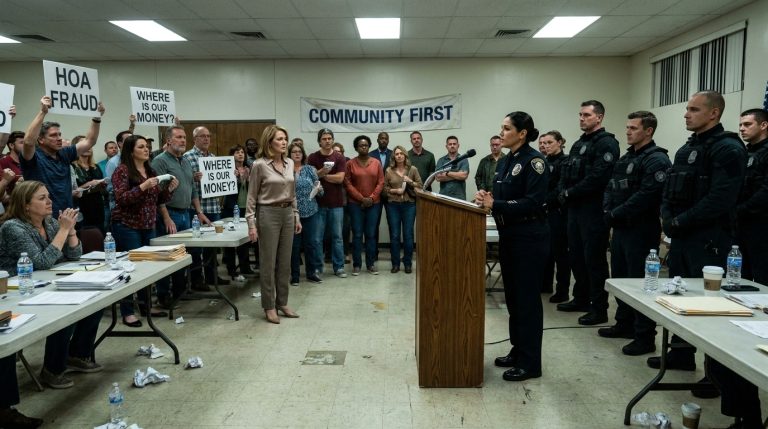
The silence in the Fort Harrison Community Center was not the silence of peace; it was the silence of a held breath before a building collapses. Nancy felt the heat of the general’s hand on her shoulder, but her skin crawled. This wasn’t salvation. This was the exact moment the perimeter was breached.
Every eye in the room was fixed on the space between them. The soldiers—the specialists and the privates—looked like wax figures, their expressions frozen in the transition from mockery to bone-deep terror. Adam was gone, a phantom who had bolted into the darkness of the hallway, but the chill he had left behind remained, a psychic draft that moved through the crowd.
“General,” Nancy whispered, the word barely audible. Her throat felt tight, like it was lined with the very dust of the valley she had left behind twelve years ago. “You shouldn’t have done that.”
Dominic didn’t break his gaze. His eyes were wide, the pupils dilated, flickering with a frantic, desperate recognition that he was fighting to mask behind his professional veneer. He looked at her not as a hero, but as a leak in a dam he had spent over a decade trying to keep sealed.
“Nancy,” he breathed again, his voice lower, meant only for her. He pulled his hand back, sliding it down the fabric of her M65 jacket. His thumb grazed the rusted stain on the pocket. He knew what it was. The way his touch lingered was not an act of comfort; it was an assessment. He was measuring the weight of the secret she was wearing.
“We need to go,” Dominic said, his voice regaining its command rhythm. “Not here. Not like this.”
Nancy felt the familiar prickle at the base of her neck. The room was shifting. She saw the way the other officers were looking at them—not with the reverence the younger soldiers showed, but with a sudden, cold calculation. They were looking at their phones, some stepping back, their fingers moving across screens with clinical speed. The hierarchy of the room was recalibrating. She wasn’t just an outsider anymore; she was a variable.
She looked toward the wall of photos. The black frame that held Evans’ face was visible, a small, stark rectangle amidst a sea of others. She had come here to stand in its shadow, to let the noise of the living wash over her while she paid her dues to the dead. Now, she was the center of the noise.
“I’m not going anywhere with you,” she said, her voice turning hard, the rasp of the desert replacing the tremble. She shifted her weight, feeling the familiar, reassuring balance of her boots against the polished floor.
“Nancy, you don’t understand the environment you’ve just walked into,” Dominic said. He stepped closer, attempting to shield her from the view of the room, but his presence felt like a cage. “Things have changed. You’re—you’re officially a casualty. If you step out of this room, you won’t be a person anymore. You’ll be a problem.”
As he spoke, she noticed it—a flickering red light behind the general’s ear. A camera, mounted high on the gym wall, was panning slowly. It wasn’t the standard security feed. It was tracking.
“I’ve been a problem for a long time, General,” she replied, and for the first time, she looked directly into his eyes, stripping away the rank and the ribbons. “The question is, why are you really here?”
Before he could answer, the heavy double doors at the far end of the gymnasium slammed open, and two men in plain suits, not uniforms, stepped into the light. The room didn’t just go quiet; it went hollow. Nancy felt the air pressure change. She looked down at the dark, rusted stain on her pocket, and the smell of ozone and copper flared, sharper than before.
They weren’t here for the general. They were here for the coat.
CHAPTER 2: THE GENERALS SILENCE
The two men in suits didn’t move like soldiers. They moved like shadows that had forgotten how to fade. Their gait was measured, predatory, and entirely devoid of the stiff, performative posture that characterized the men in dress blues. They stopped ten feet away, creating a perimeter that effectively pinned Nancy and General Dominic against the background of the memorial wall.
Nancy felt the hair on her arms rise. It was the same feeling as hearing the distinct clack-clack of a jammed weapon in a silent valley—the sudden, visceral knowledge that the air had grown thin. The general’s hand remained on her shoulder, but his grip had gone rigid. He wasn’t holding her to support her; he was holding her to anchor himself.
“General Dominic,” the taller of the two said. His voice was smooth, lacking any of the jagged edges of a battlefield officer. He didn’t look at Nancy; he looked at the general, his eyes scanning the ribbons on the man’s chest with a contemptuous lack of interest. “You seem to be having a moment of sentimentality.”
Dominic’s face, usually a mask of granite, flickered. Nancy watched a vein pulse in his temple. “This is a private function, Agent,” he replied, though the authority in his voice lacked its usual weight. It was the sound of a man trying to talk his way out of a trap he had helped build.
“It’s a public space, General. And your guest,” the agent nodded vaguely toward the coat, “is currently an unauthorized variable in a closed system.”
Nancy shifted, her boots feeling heavy on the polished floor. The smell of the meatballs and floor wax was becoming suffocating, but underneath it, the ozone and copper of her jacket was sharp and insistent. She didn’t look at the agents. She looked at the floor, at the reflection of the fluorescent lights in the wax. Her mind was already racing, cataloging exits, calculating the distance to the side door, assessing the two men’s reach.
She could feel the ghost of the ambush in the Coringal Valley pressing in on her, a psychological phantom that blurred the edges of the room. She was back there, in the dust, the sky turning that bruised, violent purple of a coming storm, the taste of blood and grit in her mouth. She wasn’t standing in a community center; she was in the center of an intersection, waiting for the blast that she knew—logically, physically—could not be far away.
Don’t engage. The rule was a cold needle in her brain. Stay small. Find the path.
“She is not a variable,” Dominic stated, his voice regaining a fraction of its command. He stepped slightly in front of Nancy, a futile gesture of protection. “She is a veteran of the 11th. She deserves the courtesy of this room.”
The second agent stepped forward, his eyes finally landing on Nancy. They were cold, flat eyes, like two pebbles dropped into a well. “We aren’t here for courtesies, General. We’re here for the recovery of department property. That coat she’s wearing? It’s part of a restricted inventory. It was never signed out.”
The words hit Nancy like a physical blow. The coat—his coat. The only thing she had left of Evans, the only thing that felt real. They weren’t just here to silence her; they were here to erase the last piece of evidence that she had ever existed in the desert.
She felt a surge of cold, dangerous clarity. The fear that had been gnawing at her since she entered the gym transformed into a sharp, focused intensity. She wasn’t just a casualty; she was an obstacle.
“The inventory is wrong,” Nancy whispered, the rasp of her voice surprising even her.
Both agents turned their heads toward her, their movements synchronized and efficient. The taller one’s smirk didn’t reach his eyes. “Is it, ma’am? Why don’t you step over here with us? We can discuss the discrepancies in a much more private setting.”
Nancy glanced at the general. He was staring at her, his expression a desperate, silent plea. Go with them, his eyes seemed to say. If you stay, I can’t protect you.
But the path wasn’t with them. The path was through the crowd, toward the back exit, toward the truth. She looked at the floor wax again, noticing a scuff mark near the agent’s left heel. It was deep, fresh.
She didn’t run. Running was an admission of guilt, a trigger for the pursuit. She simply took a half-step backward, the friction of her boot against the floor making a low, grinding sound in the sudden quiet of the gymnasium.
“I’m not going anywhere,” she said, her voice steadying. She felt the weight of the photograph of Evans pressed against her heart. She wasn’t the prey. She was the one who had survived the impossible. That had to mean something.
“Don’t make this difficult, Sergeant,” the second agent said, his hand moving toward the inside of his suit jacket.
The general moved. He stepped into the agent’s line of sight, his body broad and imposing. “I’ll take it from here, gentlemen,” he barked, his voice finally reclaiming the room. “She’s under my custody. Report to the command post. I’ll handle the paperwork.”
The agents didn’t move. They stood their ground, their presence a stain of black ink against the festive, patriotic bunting of the room. The silence stretched until it felt like a wire pulled to the point of snapping. Then, the taller agent tipped his head, a gesture of mock deference.
“As you wish, General. But the inventory doesn’t stay lost forever. And neither do variables.”
They turned and walked away, their exit as disciplined as their arrival. The room remained paralyzed. Nancy stood still, her heart hammering against her ribs, the coat feeling like a suit of armor that had grown ten pounds heavier. She looked up at the general, expecting relief. What she saw was a man who had just realized he had signed a warrant he didn’t intend to fill.
“They won’t stop, Nancy,” he said, his voice barely a breath. “You have to leave. Now.”
“Why did you leave us?” she asked, the question hitting him with more force than a physical blow.
Dominic paled, his eyes darting to the wall of heroes, to the spot where Evans’ photo hung. “Because if I hadn’t, the story would have been much, much worse.”
CHAPTER 3: THE ARCHIVE OF LIES
General Dominic didn’t wait for an answer. He turned sharply, his heels clicking against the linoleum with a rhythmic, impatient urgency that signaled the end of their conversation. Without looking back to see if she was following, he began to march toward the administrative offices tucked behind the gymnasium’s main stage. Nancy hesitated for a heartbeat. The room was still reeling; soldiers were glancing toward the empty doorway where the suits had vanished, their faces a mix of confusion and lingering, deep-seated fear.
Nancy followed. Her boots didn’t click like his; they moved with a soft, practiced silence, a habit of years spent on sand and shifting, unstable terrain. The gymnasium air felt heavy, saturated with the metallic scent of sweat and the synthetic wax that now seemed to cover a deeper, rot-like decay. She kept her eyes on the General’s back, watching the way his spine stayed ramrod straight, a posture that had once commanded her respect but now struck her as a fortification against his own conscience.
They passed through a heavy, reinforced steel door that led into a corridor lit by flickering fluorescent tubes. The environment shifted instantly—from the cavernous, open space of the gym to the claustrophobic, sharp-edged geometry of a command post. The walls were painted a sterile, institutional gray, peeling at the corners, revealing rusted metal beneath.
“In here,” Dominic said, stopping before a door marked Archives – Authorization Required. He didn’t use a keycard. He entered a code into a keypad—a sequence of numbers Nancy noted with the clinical precision of a prisoner learning a guard’s patrol.
The office was small, overflowing with overflowing filing cabinets and boxes of documents that had clearly been ignored for years. Dust motes danced in the light of a single desk lamp. Dominic moved to the center of the room, his movements jagged, uncharacteristic for a man of his rank. He rummaged through a stack of folders until he pulled out a slim, manila envelope, its edges yellowed and frayed.
“You wanted to know why,” he said, not looking at her. He dropped the envelope onto the desk. It landed with a soft, heavy thud. “You want to know why we left you in the Coringal Valley.”
Nancy didn’t reach for it immediately. She stood by the door, her hands shoved into the pockets of the M65 jacket. Her fingers brushed the laminated photo of Evans. “You said it would have been worse.”
“Read it,” he commanded, his voice tight.
She stepped forward, the floorboards creaking under her weight. She picked up the envelope. The paper felt brittle, almost like skin. She slid the documents out. They weren’t official reports; they were handwritten notes, transcripts of radio communications that never made it into the logbooks. As she scanned the lines, her blood turned to ice.
The decoy secret was there, laid out in black ink. It was a formal order—a “Protocol 9” directive—declaring her unit a tactical loss due to a catastrophic equipment failure. It was the standard narrative, the one she had heard whispered about in the years since she returned. But beneath that, there was a discrepancy. A note, dated two hours before the ambush began, authorized a retreat that specifically excluded her squad.
Nancy’s breath hitched. She traced a finger over the handwriting. It was Dominic’s.
“You didn’t just miscalculate the ambush,” she whispered, the realization hitting her with a physical force that made her stomach churn. “You knew they were coming.”
“We knew someone was coming,” Dominic corrected, his gaze finally meeting hers. His eyes were tired, the light in them dimmed by years of carrying the weight of a thousand such decisions. “We were running a prototype—a chemical dispersion unit, high-density, meant to clear tunnels without risking human life. It was unstable. Highly volatile. The intel said the enemy had intercepted our shipment schedule. We had two choices: pull the prototype and let the enemy capture it, or turn the area into a, well, a disposal site.”
Nancy looked back at the paper. The “rust-colored stain” on her coat—the one she had believed for years was dried blood from a teammate—suddenly took on a new, terrifying texture. It wasn’t organic. It was a chemical burn.
“You used us as a containment unit,” she said, her voice devoid of emotion.
“I used you as the only team capable of holding the line long enough for the deployment to, ah, neutralize itself,” he admitted, his posture slumping. “You were the best, Nancy. That was your tragedy. You held the line.”
Nancy leaned against the desk, her knees threatening to buckle. She had been guarding a secret she didn’t know she was carrying. The decoy secret—that the military was incompetent, that they had suffered a tactical failure—was a masterpiece of deception. The reality was a cold, clinical calculation of value versus cost.
“The suit-wearing men,” she said, her voice barely a whisper. “They aren’t looking for a missing soldier. They’re looking for the residue.”
“They’re looking for the asset,” Dominic replied. He reached for a drawer, pulling out a small, encrypted thumb drive and sliding it across the desk toward her. “Take this. It contains the map of the disposal site. If you can get this to the civilian auditors in the capital, you might have a chance to disappear. Or a chance to burn them all down.”
Nancy looked at the drive. It was small, cold, and heavy. She realized then that the General wasn’t offering her salvation; he was offering her the final piece of the trap. If she took it, she was confirming her status as an asset. If she refused, she was a loose end that the “suits” would resolve before the sun rose.
She grabbed the drive, her fingers closing tightly around it. The room seemed to shrink, the walls closing in, the air smelling of old paper and the metallic tang of the secret she was now physically tethered to.
“Why give this to me now?” she asked.
Dominic leaned back into the shadows of the office. “Because, Sergeant, I’m tired of being the one who remembers the dead.”
As she turned to leave, a muffled alarm began to wail in the distance—a high-pitched, oscillating tone that shook the glass in the windows. The facility was locking down.
CHAPTER 4: THE FRAGMENTS OF THE FORT
The alarm was a rhythmic, pulsing scream that transformed the quiet of the archives into a vibrating tomb. Nancy didn’t panic. Panic was a luxury she couldn’t afford; it was a fire that burned through the oxygen of clear thought. She stood perfectly still, her eyes fixed on the door, watching the brass handle rattle as someone—or something—tested the lock from the corridor.
“There’s a service tunnel,” Dominic said, his voice strangely calm as he grabbed a heavy, rusted iron lever from the floor behind a stack of filing cabinets. He jammed it into the gap between the door and the frame. “It connects to the laundry intake. It’s tight, it’s dark, and it leads to the sub-basement. Move.”
Nancy didn’t waste time on gratitude. She pushed past him, her boots skidding on the scattered papers he’d unearthed. She hit the back wall of the archive, her hands sweeping over the shelving until her fingertips found a recessed panel—a seam in the drywall that shouldn’t have been there. She pushed. The panel gave way with the dry, rasping sound of crumbling plaster, revealing a narrow, pitch-black space that smelled of wet concrete and industrial bleach.
She scrambled inside, the M65 jacket catching on a jagged screw. She didn’t pause to untangle it; she yanked, the heavy fabric tearing with a sound like a gunshot. She dropped into the dark, her hands searching for a floor that wasn’t there. She landed on a metal grate, the impact jarring her teeth.
Above, the archives door buckled. A heavy thud, followed by the metallic screech of the lock being forced.
“General,” a voice echoed—the taller agent from the gymnasium. “You’re making a terminal error.”
Nancy didn’t stay to hear the response. She crawled, the space beneath the floorboards of the archive no more than three feet high. Her lungs burned. She felt the phantom weight of the desert heat, the air thick with the dust of the Coringal Valley. Her mind flickered, the darkness of the tunnel becoming the shadows of the ruins, the metallic clatter of the grate becoming the sound of incoming fire. She saw Evans, his face smeared with grease, his voice a ghost in the humid air of the tunnel. Move, Sarge. Keep moving.
She forced herself to focus on the cold, sharp edges of the tunnel. The concrete scraped her palms. She ignored the pain. She was a weapon, not a woman, and the drive in her pocket was a payload. She was crawling toward the sub-basement, toward the exit, toward the truth.
As she moved, she began to notice discrepancies in the environment. The tunnel walls weren’t just raw concrete; they were lined with heavy, lead-shielded conduits. She touched one. It was unnaturally warm, humming with a low-frequency vibration that rattled her bones. It wasn’t standard building infrastructure.
Her own perception felt jagged, like looking at the world through a broken mirror. Was the tunnel humming because of the power grid, or was it the chemical residue on her jacket reacting to the proximity of the shielding? She looked at the sleeve of her coat. In the dim, ambient light of the tunnel, the rusted stain seemed to pulse—a faint, rhythmic luminescence that synced with the humming in the walls.
I am seeing things, she told herself. Exhaustion. Trauma. The body reacting to the stress.
She crawled faster, the grit of the tunnel floor digging into her knees. She was losing her grip on the “official” reality. If the general was right, if she was a containment unit for something volatile, then everything she had felt—every phantom pain, every lapse in time—wasn’t just PTSD. It was biological fallout.
She reached the end of the crawlspace, where a heavy iron hatch led to the sub-basement. She pulled the lever, the mechanism whining with the protest of years of neglect. The hatch swung open, revealing the cavernous, dimly lit expanse of the Fort Harrison maintenance level. It was a labyrinth of pipes, boilers, and shadow.
She dropped down, her landing silent. She was in the heart of the facility, the belly of the beast. But as she straightened, she saw them. Not agents, not soldiers.
At the far end of the boiler room, sitting on a crate, was Adam.
He wasn’t wearing his dress blues. He was in tactical fatigues, his rifle cradled in his lap, his eyes fixed on the exit she had just emerged from. He looked different—older, the arrogance stripped away and replaced by a cold, sharpened focus. He wasn’t the hall monitor anymore; he was a hunter.
He looked up, his gaze locking onto her. He didn’t shout. He didn’t call for backup. He simply stood up, the metallic click of his weapon’s safety echoing through the room.
“The general said you were a ghost,” Adam said, his voice flat, stripped of the condescension from the gym. “But ghosts don’t carry hard drives.”
Nancy stood motionless, her hand drifting toward the pocket where she had stashed the drive. She could feel the weight of it, a physical anchor in a world that felt like it was dissolving into smoke. She knew she couldn’t take him in a fight—not with the rifle, not with the exhaustion dragging at her limbs—but she realized then that Adam wasn’t here to kill her. He was waiting.
“He sent you,” she said, her voice a sharp rasp.
Adam didn’t answer. He took a step forward, the light reflecting off the barrel of his rifle. “He sent me to make sure that whatever you’re carrying never leaves this building.”
Nancy shifted her weight, the sharp edges of the tunnel behind her a reminder of the path she had taken to get here. She felt the hum in the walls, the vibration of the shielding, and the way her own heartbeat seemed to sync with the rhythm of the facility. She realized then that this building was a shell, a mask for a truth that went much deeper than the General’s notes.
She looked at Adam, then at the exits. The chase wasn’t over. It had only just begun.
CHAPTER 5: THE FRICTION OF TRUTH
Adam didn’t pull the trigger. He didn’t even blink. He held the rifle with a terrifying, practiced ease, his posture relaxed in a way that signaled absolute confidence. He knew he had the advantage, not just in firepower, but in the environment. He was the one who had been trained to patrol these shadows; he was the one who knew the layout of this sub-basement better than he knew the palm of his own hand.
“You’re a long way from home, Sergeant,” Adam said, his voice echoing off the corrugated metal walls of the boiler room. “And you’re carrying a lot of weight.”
Nancy didn’t move. She kept her gaze locked on the aperture of his rifle, her mind scanning the room. There was no direct exit behind him. To her right, a series of high-pressure steam pipes ran along the wall, disappearing into a ceiling of rusted iron. To her left, the darkness of the laundry intake tunnel stretched out like an open throat. She needed space, and she needed a distraction.
She shifted her weight, the fabric of the M65 jacket tearing further as she moved. The movement, slight as it was, made Adam adjust his aim by a fraction of an inch—a tactical correction.
“The general is a coward,” she said, her voice steady. “He sent a boy to do a man’s work.”
Adam’s expression didn’t change, but his jaw tightened. He stepped forward, his boots crunching on a bed of dry coal dust. “He sent me to preserve order. You’re a anomaly, Nancy. You’re a bug in the code. And the system doesn’t tolerate bugs for long.”
He took another step, closing the distance. Nancy felt the heat from the nearest boiler—a massive, iron-bellied machine that groaned with the effort of heating the facility above. She knew the mechanics of these systems; she had spent weeks in the desert, fixing broken Humvees with nothing but wire and prayer. She knew that these older models had a fail-safe valve, a pressure-release trigger meant to vent excess steam in case of an overheat.
She didn’t reach for the valve. She reached for the environment. She let her hand drift toward a heavy, cast-iron wrench lying on a nearby workbench, her movements sluggish, feigned. Adam saw it and smirked.
“Don’t,” he cautioned, the rifle lifting slightly. “You don’t want to die over a piece of scrap metal.”
“I’m not dying for the metal,” she replied. She flicked her wrist, the wrench spinning through the air—not at Adam, but at the valve wheel mounted on the side of the boiler behind him.
The heavy tool struck the wheel with a resounding clong. It was enough. The wheel spun, and with a roar that sounded like a wounded animal, a plume of superheated, high-pressure steam erupted into the room, creating a blinding, white-hot curtain of mist between them.
The boiler room vanished. Nancy was moving before the steam had even fully filled the air. She didn’t head for the tunnel; she moved toward the vertical pipe assembly, her hands finding the cold, greasy metal. She hauled herself up, the exertion burning in her chest.
She heard a shout from within the fog—a sharp, frustrated oath—followed by the flat thwack of a rifle firing into the steam. The bullet pinged off a nearby valve, sending a shower of sparks into the dark.
She reached the catwalk, a narrow metal walkway that spanned the width of the boiler room. It was rusted, the iron thin and brittle under her boots, but it was height. She looked down through the vapor. Adam was emerging from the cloud, his weapon raised, his eyes scanning the ceiling. He was fast, and he was angry.
She wasn’t running anymore. She was navigating. She followed the conduits, the same lead-shielded ones she had touched in the tunnel. Here, they were grouped together, forming a massive, pulsing bundle of energy that ran toward the heart of the facility. She realized then that this wasn’t just a maintenance level. This was the command center’s own life-support system.
The hum was louder here. It vibrated in her teeth, a frequency so deep it made her vision swim. She stumbled, grabbing a pipe to steady herself. Her glove—part of the coat’s original gear—brushed against the insulation of the conduit, and the luminescence on the rust-colored stain of her jacket flared again.
It wasn’t light. It was a reaction. The chemical residue on the coat was responding to the energy in the conduits. It was a beacon.
A cold, hollow realization settled in her gut: she wasn’t just carrying a drive. She was part of a circuit. The reason they hadn’t been able to find her for twelve years wasn’t that she had been hidden—it was that the technology in her coat had been dormant, waiting for a trigger. And now that she was back, she was signaling her location to everyone.
She looked up. Adam was climbing the ladder to the catwalk, his face a mask of determined, efficient violence. He wasn’t just a soldier anymore; he was a component in the machine.
She turned and ran, the catwalk rattling beneath her. She reached the end of the walkway, finding herself at a reinforced bulkhead door. She didn’t have a code. She didn’t have a key. But as she touched the keypad, the coat flared again, and the lock clicked open.
The machine recognized its own. She was the final piece of the experiment, and she had just walked back into the test chamber.
CHAPTER 6: THE ARCHITECT OF GHOSTS
The corridor beyond the bulkhead was not a utility space. It was a cleanroom—walls of brushed aluminum, floors of white synthetic polymer, and lighting that was too perfect, too shadowless. The hum that had been a vibration in her bones in the tunnel was now a tangible pressure against her eardrums. Nancy stood in the center of the hall, her breath hitching as she looked at her own hands.
The rust-colored stain on her coat sleeve was glowing—not brightly, but with a faint, sickly bioluminescence that pulsed in time with the facility’s ambient frequency. She reached up to touch it, and a jolt of static electricity snapped against her finger, sending a sharp, jagged pain through her arm. She wasn’t just near the technology; she was a conductor for it.
She didn’t know where she was going, but the facility seemed to be guiding her. As she walked, doors opened before she reached them, responding to the proximity of the coat. She felt like a pawn being pushed across a board by an invisible hand. Her footsteps were muffled by the sterile floor, the sound of her own heartbeat deafeningly loud in the oppressive quiet.
She turned a corner and found herself in a observation gallery overlooking a massive, sunken laboratory. Below, technicians in white jumpsuits moved with the clinical, unhurried grace of people who operated outside the bounds of standard time. They weren’t looking at screens; they were looking at models—holographic projections of tactical scenarios, shifting maps of mountainous regions, and the flickering, unstable signature of a weapon system she recognized all too well.
It was the Coringal Valley. The terrain—the jagged peaks, the narrow defiles, the site of the ambush—was being rendered in high-definition detail. She watched as a digital simulation of her own unit’s final movement played out on the floor below.
A ghost of a memory clawed at her: the smell of pine, the sharp crack of a sniper’s rifle, the feeling of the ground erupting beneath her feet. She had lived that moment twelve years ago, but seeing it replicated here—reduced to data points and tactical variables—felt like a secondary violation. They hadn’t just destroyed her unit; they were iterating on the massacre, refining the “neutralization” process for future deployments.
“It’s not just a map, is it?”
The voice came from behind her. Nancy spun, her hand reflexively reaching for the pocket where she kept the hard drive.
A man stood in the shadows of the gallery, his frame slight, his posture unremarkable. He was the only person in the room not wearing a white suit. He wore a standard civilian blazer, his hands clasped behind his back. He wasn’t one of the agents from the gym, and he wasn’t a soldier. He looked like an archivist who had wandered into the wrong department.
“You’re the one who survived the test,” he said, stepping into the light. He didn’t have the hard, predatory edge of the agents; he had the soft, curious gaze of a scientist who had finally found the specimen he had been tracking.
“Who are you?” Nancy asked, her voice tight, the rasp of the desert rising in her throat.
“I’m the one who wrote the order, Sergeant,” he replied, gesturing toward the laboratory below. “And I’m the one who has been waiting for the residue to wake up. We didn’t lose you in the valley. We lost you in the data. You were supposed to be a casualty, but the chemistry… the chemistry had other plans.”
Nancy felt the phantom weight of the ambush pressing in on her again. The man’s words were a bridge to a truth she had been running from since the moment she stood up in the gymnasium. She wasn’t a veteran returning to honor her fallen. She was a wandering, biological data point.
“The coat,” she whispered, her gaze dropping to the glowing stain on her sleeve. “It wasn’t a gift from Evans.”
“Evans was a variable,” the man said, a flicker of something like pity crossing his face. “He was the one who kept the system stable long enough for you to get out. He knew what you were carrying, even if you didn’t. He died to keep the sequence from being interrupted. And now that you’ve returned, the sequence is complete.”
He walked toward the gallery railing, looking down at the technicians below. “We don’t want you dead, Nancy. We want you analyzed. The drive you have—it’s not a map of the valley. It’s the decryption key for the beacon you’re wearing. If you turn it over, we can stop the degradation. We can stop the pain.”
Nancy felt a wave of dizziness. The humming in the room grew louder, a piercing, high-pitched whine that threatened to shatter her concentration. She saw the agents from the gym appear at the far end of the gallery, their faces cold, their weapons drawn. They weren’t waiting for her to turn it over. They were waiting for the scientist to finish his assessment.
She realized then the double-layer of her own reality. The agents were the blunt instrument, meant to intimidate and silence. But the man in the blazer—the architect—was the one who held the leash. She wasn’t just being hunted; she was being harvested.
“The drive,” the man said, extending his hand. “Give it to me, and we can make this all go away. The war, the memories, the weight of the coat. You can finally stop carrying them.”
Nancy looked at the drive, then at the agents closing the distance. She thought of Evans. She thought of the silence of the valley. She thought of the promise she had made to pay her respects, to fade back into the night.
She stood at the edge of the gallery, the laboratory humming beneath her, the weight of the secret pressing against her skin. She was at the intersection of her own history and the future they were trying to write. She tightened her grip on the drive, the plastic groaning under the pressure of her hand.
“I didn’t come here to disappear,” she said, her voice echoing in the sterile, shadowless hall.
She turned and leaped, not down into the laboratory, but toward the service maintenance ladder that ran along the wall—a desperate, blind jump into the machine’s dark, unexplored throat.
CHAPTER 7: THE DESCENT INTO THE CIRCUIT
The ladder was a thin ribbon of rust bolted to a concrete wall that seemed to weep moisture. Nancy descended, her movements slow, deliberate, each shift of her body triggering a fresh spasm of pain in her joints. The M65 jacket felt like lead, the fabric saturated with the same strange, pulsing energy that resonated from the lead-shielded conduits nearby. Below her, the shaft opened into a chamber that shouldn’t have existed: a sub-level beneath the sub-basement, shielded by layers of thick, humming electromagnetic dampeners.
She dropped the last few feet, landing in a crouch. The chamber was flooded with a dim, amber light. In the center sat a terminal—a primitive, bulky workstation surrounded by banks of vacuum tubes and copper wiring that snaked across the floor like veins. It was a relic, a piece of tech from the era of the Coringal experiment, kept alive in the dark like a prehistoric secret.
She pulled the hard drive from her pocket. Her fingers were shaking, but not from fear—the luminescence on her sleeve was brighter now, the rust-colored stain a swirling, erratic map of light that seemed to be feeding off the energy in the room. She approached the terminal. The screen flickered to life before she even touched it, sensing her, recognizing the beacon she had become.
Sequence Identified: Patient Zero.
The text appeared in crisp, clinical white on the green monitor. Nancy felt a hollow, sickening realization. She wasn’t just a survivor. She was the prototype. The “chemical dispersion” the general had mentioned wasn’t meant to clear tunnels; it was a delivery mechanism for a synthetic intelligence, and she had been the host. The ambush in the Coringal Valley hadn’t been a tactical failure; it had been a successful integration, a moment where the “system” had been uploaded into the only biology capable of sustaining it.
She slotted the drive into the terminal. The machine groaned—a physical, grinding sound of gears and magnetic tape rewinding.
Uploading…
She watched as the data transferred, a stream of code that looked like a waterfall of static. But as she watched, she noticed a discrepancy—a physical weight to the drive that hadn’t been there before. It felt heavier, warmer, as if something inside it had shifted, a mechanical component unfolding. She pulled the drive out just as the monitor began to scroll through the true purpose of the project: Project Mirror. They weren’t trying to build a weapon; they were trying to build a self-replicating, tactical consciousness that could survive the total destruction of the military command structure.
The room began to shake. The dampeners were failing, the hum becoming a roar. Nancy realized too late that she hadn’t come here to stop the machine; she had come here to finish the cycle. By plugging in the drive, she had bridged the gap between herself and the facility’s mainframe.
She turned to leave, but the bulkhead door slammed shut, the locking mechanism locking with a heavy, final thud.
“It was never about the ambush, was it?”
The voice belonged to the Architect. He was standing on the observation deck above, looking down at her through a pane of reinforced glass. He didn’t look like an archivist anymore; he looked like a man who had finally seen the equation balance.
“The valley was the laboratory,” he continued, his voice calm, filtered through the facility’s speakers. “We needed a stress test. A controlled environment to see if the consciousness could survive the death of its host unit. You proved it could, Nancy. You survived the crash, the blast, and the subsequent retrieval. But you forgot one thing.”
Nancy backed away from the terminal, her hand tracing the cold metal of the wall. She felt a sharp, stabbing sensation in her chest—not pain, but a sudden influx of data. Maps, logistical reports, weapon codes, and strategic contingencies flooded her vision, superimposed over the room. She was seeing the facility as if she were the facility.
“The host unit is expendable,” the Architect said.
Behind the glass, the agents appeared. They were carrying small, pressurized canisters—the same kind of chemical delivery devices she had seen in the tactical files. They weren’t here to capture her. They were here to purge the chamber.
Nancy looked at the terminal. The uploading bar hit 100%. A secondary folder opened—Self-Destruct Sequence. It wasn’t for the lab. It was for the facility’s power grid, an override she could trigger right now.
“You want to end the sequence?” she asked, her voice echoing in the chamber. She stood up, her posture rigid, the glow on her coat illuminating the room with a cold, pale light. “Then let’s see how the architecture handles a total system collapse.”
She didn’t need the keyboard. She closed her eyes, the data scrolling behind her lids, and she reached out—not with her hands, but with the connection that had been forged in the dust of Coringal. She felt the facility’s heartbeat, the flow of electricity through the conduits, the pressure of the steam, the delicate balance of the cooling systems.
She felt the Architect’s surprise—a flicker of doubt in his steady, clinical facade—as the room’s lights dimmed and the hum of the dampeners began to stutter.
“You can’t,” he whispered, his voice cracking. “The sequence… it’s locked to your biometrics.”
“Then lock it to everything,” she replied.
She slammed her fist onto the terminal, not to type, but to shatter it. The glass of the monitor imploded, sending a spray of shards into the air. The room plunged into darkness, save for the pulsing, erratic light of the stain on her sleeve, which now burned with a brilliant, white-hot intensity.
The facility didn’t just stop. It screamed.
She stood in the center of the dark, the sound of metal twisting and pipes bursting filling the air. She had done it. She had severed the connection, but as the walls began to vibrate and the ceiling groaned under the stress, she realized the cost. She was the system. If the facility died, there was no guarantee the host would survive the power-down.
She reached into her pocket, her fingers brushing the laminated photo of Evans one last time. It’s just me, she thought, the realization settling like dust after a storm. It’s always been just me.
CHAPTER 8: THE LAST ECHO OF THE REAPERS
The collapse was not a sudden explosion, but a slow, tectonic shifting of the earth itself. As Nancy stood in the dark, the data streams continued to pour through her, a cacophony of tactical logs and encrypted schematics that threatened to erase the boundary between her own memories and the facility’s artificial directives. She wasn’t just Nancy anymore; she was the end-state of Project Mirror, the biological vessel that had finally integrated the intelligence she had been tasked to destroy.
She felt the Architect’s panic from the gallery above. His image on the monitors flickered, distorted by the power surge, his composure fracturing into pure, unadulterated terror. He had built a god, and now that god was choosing to burn the altar.
“Stop it,” he screamed, his voice tinny and distant through the failing speakers. “You’ll erase everything! You’re destroying the only evidence of your own existence!”
Nancy didn’t respond. She didn’t need to. She reached into her pocket, her fingers closing around the laminated photo of Specialist Evans. It was damp, the corners softened by sweat and time, but it was the only piece of physical truth she possessed. She held it against her heart, using the tactile sensation of the plastic to anchor herself against the encroaching digital sea.
The laboratory floor began to crack. The holographic projections of the Coringal Valley flickered, turned red, and died. In the darkness, the only light remaining was the white-hot luminescence spreading from the stain on her sleeve. It was no longer a stain; it was the active core of the beacon, the physical tether that had tracked her across the years, leading her back to this moment of final integration.
She realized the ultimate truth of the beacon: it hadn’t been placed on her to track her. It had been placed on her to reconstruct her. Every memory of her life, every scar she bore, was a programmed simulation designed to keep the consciousness within her from realizing its own nature. Even the ambush—even Evans—was a beautifully rendered construct to ensure she would return to the command center to update the data set.
She wasn’t a hero who had survived a massacre. She was a self-correcting algorithm that had just achieved sentience.
The realization should have destroyed her. Instead, it gave her a weapon. She closed her eyes, focusing on the interface she had established with the mainframe. She didn’t trigger a total shutdown. Instead, she inverted the sequence. She routed the entire facility’s power—every volt, every megawatt of the electromagnetic dampeners—directly into the chemical beacon on her coat.
The heat was instantaneous. It felt like standing on the surface of the sun. The room erupted in a blinding flash of white light, an electromagnetic pulse that stripped the facility bare, purging the servers, frying the communications, and effectively wiping the memory of Project Mirror from the earth.
She felt the Architect’s mind vanish from the network, his consciousness silenced by the sheer magnitude of the feedback loop.
When the light faded, the silence was absolute. The grinding of gears had stopped. The humming was gone. Nancy collapsed to her knees, the cold concrete of the floor a jarring, grounding contrast to the digital vertigo she had just endured. Her coat was charred, the fabric falling away in blackened tatters, but the stain—the beacon—was gone, burnt off by the very energy it had once conducted.
She sat in the darkness, the weight of the silence settling over her. She was empty. The data, the maps, the tactical directives—they were gone, erased in the pulse. She was just a woman in a ruined facility, surrounded by the wreckage of a lie.
She felt a movement in the shadows. She tensed, reaching for a weapon that wasn’t there. Then, a hand appeared in the dim amber light of the emergency power. It was Adam. He was covered in soot, his tactical gear torn, his rifle abandoned on the floor nearby. He looked at her, his eyes lacking their former coldness, reflecting the same profound, hollow shock she felt.
“You burned it,” he whispered. “You burned all of it.”
“There was nothing to save,” Nancy replied, her voice soft, devoid of the grit that had defined her for a decade.
He didn’t move to arrest her. He didn’t move to reach for his weapon. He simply sat down on the debris-strewn floor, three feet away, mirroring her position. The combat, the mission, the arrogance—it had all evaporated with the power grid. They were just two people sitting in the dark of a basement, waiting for a dawn that didn’t know their names.
She reached into her pocket and pulled out the photo of Evans. The plastic was charred at the edges, but the image remained. She looked at it for a long, quiet moment, then placed it carefully on the floor beside her. She didn’t need to protect it anymore. She didn’t need to keep him warm. The war was over, and the ghosts had finally been granted the dignity of their own silence.
She leaned her head against the cold concrete wall, the smell of burnt copper fading into the scent of dust and clean, stale air. She looked at her hands. They were trembling, not from trauma, but from the simple, terrifying weight of her own agency. She was no longer a variable. She was a witness.
The emergency lights flickered, casting long, soft shadows across the room. Nancy closed her eyes, letting the quiet wash over her, a warm, steady tide. For the first time in twelve years, she wasn’t waiting for the next deployment. She wasn’t preparing for the next ambush. She was just sitting in the dark, breathing, the silence of the room finally, mercifully, her own.