Every scratch on the cold steel barrel reminded him of the life he was forced bury.
CHAPTER 1: The Weight of Clay
The spade did not click; it thudded. The iron of the blade struck something that lacked the hollow ring of limestone or the soft give of rotting oak roots.
Walter Hensley stopped. He did not lean on the hickory handle—his lower spine had passed the age where leaning offered relief—but instead let his fingers slip down the shaft until he was kneeling in the damp October loam of the Lexington plot. The air smelled of cold turnips and dead alfalfa.
With his bare hands, his fingernails splitting against the grit of the four-generation clay, he cleared the gray earth from the shape. It came up heavy, a calcified chunk of orange-brown scale that looked less like a machine and more like a fossilized bone. The wood of the stock was already gone, turned back into peat and black mush that stained his palms, but the barrel remained—a thick, choked rod of oxidized iron crust.
He didn’t brush at it. He didn’t blow the dust away. He simply gripped the weight of the receiver, feeling the rough, blistering scale of iron oxide chew into his calloused palm. It was cold. A dry, deep-earth cold that seemed to live inside the metal rather than on it.
Walter turned the mass over. To anyone else from the county, it was a piece of an old Ford axle or a discarded plow share from the turn of the century. But his thumb, lacking the smooth skin of his youth but retaining the geometric memory of forty years in ordnance shops, found the bridge of the receiver. His skin scraped over a small, jagged pit in the scale. There was a hard edge beneath.
He rose, his knees making a small, dry sound like dry cedar snapping underfoot, and carried the three-pound weight toward the shadow of the barn.
Behind him, the open garden patch looked like an open trench. The sun was gray behind the ridge, throwing no shadows, only a flat, desaturated light that made the old farmhouse look like an oil painting that had dried too long in the sun. He didn’t look back at the house. He looked down at his hand. The rust had left a dark, greasy smudge across his lifelines—thick, orange, and smelling faintly of sulfur and ancient water.
Inside the barn, the cold was different. It smelled of tallow, dry canvas, and the sharp, vinegar tang of old solvent bottles that had evaporated into the pine rafters fifteen years ago. He set the hulk on the greasy oak top of his workbench. The iron rattled against the wood—a dull, dead thud.
Walter reached for the small brass wool bundle in the third drawer, his fingers trailing over the cold iron handles. His breath formed a faint, brief mist over the rusted receiver as he leaned down, his eyes narrowing until the world outside the eight inches of steel ceased to exist.
He began to scrub, the brass fibers tearing into the orange skin with a rhythmic, dry hiss.
CHAPTER 2: The Assessment of the Hulk
The dry hiss of the brass wool against the receiver frame filled the cold expanses of the barn, a steady, granular scrape that left a fine trail of orange powder on the oil-blackened oak of the workbench. Walter didn’t adjust his posture. His right shoulder, stiff from three decades of cold-weather range testing and the creeping calcification of seventy-eight years, held a rigid line. He felt the vibration of the steel through the thin bone of his thumb—a dull, uneven hum that signaled just how deeply the pit marks had eaten into the skin of the Springfield.
He stopped scraping. He didn’t lift the tool, merely let his weight rest through his forearm, his eyes fixed on a two-inch patch just above the thumb-cut on the left side of the receiver wall.
The rust here wasn’t the flaky, superficial scale born from a damp basement or an ungreased cabinet. It was dense. The Virginia clay had packed into the nooks of the Mauser-style action, forming a hard, oxidized cement that had cross-linked with the underlying carbon steel over decades of seasonal freezing and thawing. With his left hand, Walter reached for a small horn-handled inspection pick—a tool he had ground down himself from a dental instrument in the old Rock Island facility before the modernization sweeps of seventy-four.
The point of the pick met the crust. He applied three pounds of downward pressure, his thumb steadying the shaft against the receiver ring. The crust didn’t flake; it ground down into a greasy paste under the steel point, smelling faintly of sulfur and the metallic rot of ancient water.
“Don’t force the bridge,” he muttered to the empty workspace. His voice sounded thin, dry as old paper against the high timber rafters of the barn. Dorothy used to tell him he spoke to the metal because he’d forgotten how to speak to people who didn’t carry a punch-card clearance.
He leaned closer, the bill of his gray canvas cap nearly touching the receiver ring. Under the magnifying lamp—its arm creaking as he pulled the green metal shade down until the bulb sat three inches from the steel—the orange scale began to resolve into structural lines. He wasn’t looking for beauty; he was looking for the clean, flat planes of the original factory milling. The Springfield Armory had used high-carbon steel during the early months of eighteen, oil-tempered and double-heat-treated until the surface skin was harder than the files used to check them. If the pitting had pierced that heat-treated layer, the receiver was dead. It would be nothing more than an expensive pipe bomb waiting to rupture under fifty thousand pounds of chamber pressure.
The pick scraped a microscopic millimeter to the left. A small flake of black scale came away, exposing a flash of gray-white metal beneath. It was dull, lacking the reflective sheen of modern chrome-moly barrels, but it was solid. The tool didn’t sink. The underlying steel held its line.
Walter let out a slow, measured breath through his nose, his thumb moving down to the trigger guard assembly. The floorplate was jammed solid, its latch seized by a thick wedge of petrified organic matter—likely the remnants of the leather sling that had rotted into the magazine well before the wood of the stock had completely disintegrated. He tried to slide the bolt backward, but the handle remained locked in the down position, the lugs frozen into the receiver recesses by a dark, resinous glaze that looked like dried linseed oil but lacked the characteristic sweetness. It smelled older. Heavy. Like government-issue cosmoline from the mid-century stores.
He stood up straight, the vertebrae in his lower back clicking in a short, uneven sequence that mirrored the rhythmic ticking of the old Western Clock Co. timer on the wall. His fingers were stiff, the skin around the knuckles white from the cold of the unheated barn. He walked three paces to the small cast-iron stove in the corner, shook the ashes down with a short iron rod, and dropped two split chunks of seasoned hickory onto the remaining coals. The smoke that rose from the door was blue, sharp with the clean smell of wood fat, cutting through the stagnant grease of the workshop.
He didn’t wait for the heat to reach his stool. He returned to the bench, his eyes tracking the physical trajectory the rifle must have taken to reach his garden plot. Thirty acres of rolling limestone ridges. The patch he’d broken was old ground, untouched since his grandfather had run dairy cattle through the lower branch before the state highway cut the property in two. A rifle didn’t just sink four feet into Virginia clay by accident. It hadn’t been dropped by a hunter; a hunter didn’t bury a bolt-action infantry arm with the bolt closed and the floorplate latched. It had been placed there.
His eyes fell back to the frozen bolt handle.
The metal configuration was standard for a late-batch nineteen-oh-three, but as he ran his bare index finger over the gas-escape hole on the right side of the receiver ring—the single small vent designed to save a soldier’s eye if a primer ruptured—his nail caught on something irregular. The edge of the hole wasn’t round. It had been chamfered slightly from the inside, a half-millimeter bevel that no factory inspector in Springfield would have passed during the wartime production rush of eighteen. It was precision work, done with a small, hand-turned cutting stone rather than a production mill.
Walter’s hand stayed on the receiver, his thumb pressing against the cold metal until his pulse throbbed against the iron. The details were returning to him now, not as memories, but as physical rules. The thickness of the receiver walls, the precise taper of the barrel breeching, the exact weight of a firing pin spring under twenty pounds of compression—these weren’t things he had to remember. They were stored in the small muscles of his palms, the same muscles that had spent forty years measuring tolerances with micrometers that had no digital readouts, where an error of a ten-thousandth of an inch could be felt as a slight drag against the thumb.
He picked up a heavy square-shank screwdriver, its blade ground flat to fit the specific wide slots of military tang screws. He placed the tip into the rear guard screw hole behind the receiver tang. The slot was completely packed with gray silt. He used the inspection pick to clean the groove, clearing out the packed earth until the sharp, square shoulders of the screw head appeared under the yellow light of the bulb.
He set the screwdriver into the slot. He leaned his entire torso over the tool, his chest pressing down against the wooden handle to keep the blade from camming out and marring the historic metal, then turned his left wrist.
The screwdriver didn’t move. The iron screw stayed locked in its eighty-year-old threads, the metal emitting a sharp, dry groan that echoed off the cold face of his anvil five feet away. The resistance was absolute, the steel thread seized by a white, powdery film of zinc-oxide or some non-standard military compound that had crept into the threads before the rifle ever touched the soil.
Walter didn’t twist harder. He knew what happened when a man forced an ordnance screw; the head would shear, leaving the threaded shank frozen inside the receiver hole like a broken tooth, ruining the structural alignment of the entire action. He let the pressure off slowly, his chest rising from the handle.
He looked at the small jar of penetrating solvent at the back of the shelf—its label faded to a generic yellowish gray, the fluid inside thick and dark as chicory coffee. He reached for it, his fingers closing around the cold glass, his eyes still fixed on the irregular bevel of the gas vent hole. The story of the iron was changing under his hand, the simple narrative of a buried relic giving way to the hard, geometric realities of a specialized modification. He had to get the receiver out of its crust. He had to see the sear.
He poured three drops of the dark oil onto the screw head, watching the fluid pool in the square slot before slowly creeping outward into the orange scale, turning the bright rust into a dark, blood-colored ring.
CHAPTER 3: The Transactional Counter
The dark, blood-colored ring of oil widened across the orange scale, but the screw remained dead, frozen into the receiver tang with the cold permanence of a welded seam. Walter did not strike the screwdriver handle with a mallet. He did not risk fracturing the century-old cast iron. Instead, he slowly lifted his palms off the grip, took a clean square of the wool blanket from the corner of the bench, and began to wrap the rifle. He folded the heavy gray fabric over the rusted muzzle, rolled the receiver twice to cushion the projecting bolt handle, and tucked the loose edges beneath the middle weight.
He lifted the bundle. The cold of the barrel seeped through four layers of woolen weave, pressing into the flesh of his inner forearm as he walked toward the barn doors.
As his hand touched the iron latch of the exit, his eyes caught a sharp, silver glint near the baseboard of the tool rack—a modern, zinc-plated hex nut, completely free of dust, resting on the clean concrete. Walter stopped. His gaze lingered on the small object. No machine in his shop utilized metric zinc fasteners, and his own maintenance routine left the floor bare. Someone had stood by the rack. Someone had dropped a modern lock nut within the last few weeks while he was up at the upper orchard. He didn’t bend down to pick it up. He simply memorized the precise distance from the doorframe, shifted the heavy gray bundle higher against his chest, and kicked the latch free with the heel of his boot.
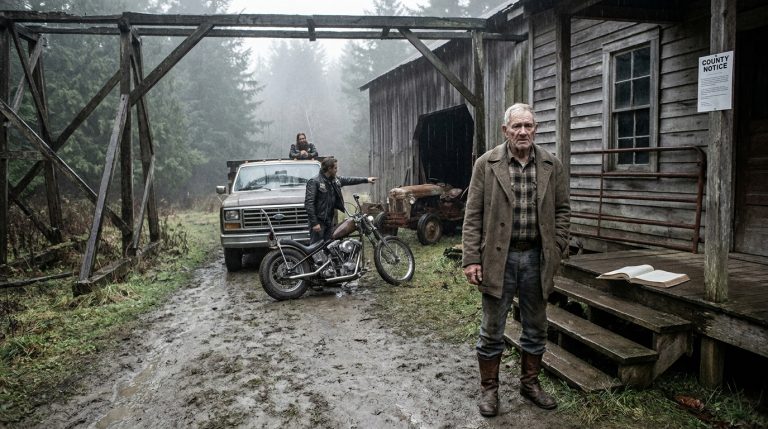
The morning air outside was thin, sharp with the scent of frost-bitten cedar. He carried the wrapped iron across the gravel driveway to his nineteen-ninety-four Ford, setting the bundle flat on the cracked red vinyl of the passenger seat. The springs inside the cushion groaned under the three-pound weight.
Walter slid behind the wheel, his boots leaving two small patches of gray mud on the rubber floor mat. The engine caught on the second turn, a low, mechanical rattle that vibrated through the steering column and into the bone of his wrist. He did not look at the farmhouse as he backed down the dirt lane. His eyes remained fixed on the narrow gray ribbon of Route Eleven, his mind counting the twelve miles into the commercial core of Lexington. Every expansion joint in the concrete sent a sharp shudder through the truck’s suspension, shifting the wool bundle an inch closer to the dashboard, the hidden bolt handle scraping softly against the vinyl.
When the truck rolled into the asphalt lot of Precision Arms, the sun had risen enough to turn the sky a hard, unblinking white. The shop sat wedged between an agricultural supply depot and a chain auto-parts store, its front window covered by a heavy black security grate. Inside, the air was warm, smelling of synthetic gun oil, new nylon holsters, and the faint, sweet chemical signature of the electronic vapor device Tyler Brennan held near his chin.
The twenty-nine-year-old didn’t look up from his phone when the door bell chimed. He was sitting on a high stool behind a thirty-foot run of seamless polymer countertops, his thumb moving across the glass screen with a rhythmic, indifferent flick.
Walter walked to the counter, his steps silent on the industrial carpet. He set the wrapped blanket down on the pristine gray surface. The impact made a solid, heavy thud that caused the rows of modern polymer-framed pistols in the glass display case beneath to shift slightly on their plastic stands.
“Help you?” Tyler asked, his voice flat, his thumb completing one final swipe before he dropped the phone onto a rubber mat beside his register.
Walter did not answer with words. He reached for the corner of the gray wool, his calloused fingers peeling the fabric back in three deliberate movements, revealing the orange-brown crust of the receiver and the dark, oil-soaked tang screw under the bright glare of the overhead fluorescent tubes.
Tyler glanced down at the mass for perhaps three seconds. A small, dismissive twitch formed at the corner of his mouth, followed by a brief, dry laugh that didn’t reach his eyes. “You’re joking, right?” He pushed himself off the stool, leaning his forearms against the polymer counter, his eyes scanning the blistered metal with visible impatience. “Look at this thing. It’s completely destroyed. The rust goes all the way through, guaranteed. You’d have to be crazy to waste money trying to fix this, and honestly, I’d have to be crazy to take your money for it.”
Walter’s jaw tightened, the skin over his cheekbones turning the color of dry limestone, but his posture remained perfectly vertical. “The rust is surface oxidation,” he said, keeping his tone measured, transactional, and low. “The underlying steel is high-carbon Springfield stock from eighteen. The core is sound. I require a manual impact driver with a hollow-ground five-sixteenths bit to clear the tang thread without marring the receiver walls.”
Tyler let out another short laugh, his hand reaching back toward his phone. “Grandpa, I don’t know what YouTube videos you’ve been watching, but that’s not how this works. Even if by some miracle the metal wasn’t completely compromised, you’re looking at hundreds of hours of manual labor. The stock is gone entirely. Half the small parts are probably missing, and for what? A rifle that might blow up in someone’s face if they tried to fire it.” He extended his index finger, his manicured nail touching the edge of the gray wool blanket to push the bundle six inches back across the counter toward Walter’s chest. “My advice? Throw it in the trash and save yourself the embarrassment. This is beyond saving, and to be honest, restoration work like this is way above your pay grade, Gramps.”
The words hung between them under the sharp hum of the fluorescent lights. Walter did not pull the blanket back. His eyes left Tyler’s face and dropped to the young man’s hands—noticing the clean, soft skin around the cuticles, the absence of carbon stains under the nails, and the way Tyler held his wrists, high and loose, like a man who had never had to drive a stuck pin out of a rusted receiver with a four-pound sledge in the rain.
“The pay grade,” Walter repeated softly. He didn’t raise his voice. He didn’t mention the three commendations from the Department of the Army currently sitting in a cedar box in his attic, nor the fact that the very design of the custom match-grade sears Tyler ordered from Pennsylvania catalogues had been standardized by a committee Walter chaired in sixty-eight.
He reached out, his thick, soil-darkened fingers folding the wool back over the orange metal, covering the Springfield until it was nothing more than an anonymous gray shape once more. He did not look at Tyler’s face again. He gripped the center of the bundle, lifted the weight off the gray polymer counter, and turned back toward the glass entrance door, his old boots leaving two dry prints of gray Virginia clay on the clean industrial carpet behind him.
CHAPTER 4: The Current and the Soda
The front tire of the Ford dropped into the frozen rut at the lip of the driveway with a dull, heavy jolt that knocked the steering wheel two inches to the left. Walter didn’t adjust his grip on the black plastic rim. He kept his forearms locked, letting the truck’s momentum carry it past the old mail cradle and up the rising gravel curve toward the barn. The gray wool bundle on the passenger seat shifted forward against the glove box door, its metal core producing a faint, hollow clink against the latch mechanism.
He killed the ignition. The engine died with a wet, shuddering rattle that left the interior of the cab completely silent, save for the ticking of the cooling manifold beneath the floorboards.
Walter sat behind the wheel for thirty seconds, his hands remaining flat against the curved plastic of the steering assembly. His knuckles were gray from the chill of the morning, the small valleys between the tendons packed with a fine, persistent residue of iron dust from his morning’s labor. Through the windshield, the weathered pine planks of the barn facade looked silver under the high, flat noon sun. He didn’t check the rearview mirror. He reached across the vinyl, his palm closing around the middle width of the gray blanket, and pulled the three-pound weight back against his ribs.
His boots met the gravel with a sharp, dry crunch. The transition from the truck to the concrete floor of the shop was eight paces, each one measured to absorb the stiffness in his left hip.
Inside, the blue hickory smoke from the small iron stove had settled into a thin, transparent layer six feet off the floor, keeping the air down by the workbench near fifty degrees. Walter set the wrapped Springfield flat on the oak top, right beside the jar of dark solvent he had left open before his drive into town. The drop of oil on the rear tang screw had soaked completely into the orange crust, leaving a gray, translucent wet spot that looked like grease on cardboard but had done nothing to loosen the crystalline lock of the threads.
He didn’t touch the screwdriver this time. He walked past the anvil to the dark rear wall where the old plastic chemical tubs were stacked beneath a canvas tarp.
With his right hand, he pulled the tarp free, the stiff fabric releasing a small cloud of dry lime dust that made his throat tighten. Beneath lay a fifteen-gallon industrial tote, its gray polyethylene walls scarred by old acid burns and yellowed along the waterline by decades of stagnant mineral baths. He dragged the container into the yellow radius of the magnifying lamp, the plastic bottom scraping over the rough concrete with a long, hollow groan.
From the lowest shelf of the storage rack, Walter retrieved a heavy cardboard box with faded red lettering: Church & Dwight Co. Arm & Hammer Washing Soda. The box was half-full, the granular sodium carbonate having clumped into a solid, chalky cake from the humidity of five winters. He used a short piece of half-inch rebar to break the mass, striking the cardboard until the white crystals broke back into a fine, heavy powder that smelled faintly of dry alkali.
He tipped the box. Two pounds of white carbonate cascaded into the bottom of the gray tote, the dust rising in a silent, powdery plume that coated the hair on his forearms like frost.
He didn’t use a measuring cup. His hands knew the volume by the thickness of the white layer against the gray plastic—two fingers deep, enough to bring the electrical conductivity of twelve gallons of well water down to three ohms per square inch. He walked to the brass spigot by the door, filled a five-gallon galvanized bucket until the iron handle cut into his palm, and carried the sloshing weight back to the tub.
The water hit the white crystals with a loud, churning hiss. Walter knelt on the concrete, using an old hickory stir-paddle to circulate the fluid in wide, counter-clockwise sweeps. The mixture turned milky at first, a cold, opaque broth that slowly cleared as the carbonate dissolved into the hard limestone water, leaving the liquid clean but heavy, its surface covered by a thin layer of silver bubbles that didn’t pop.
He stood up, his lower vertebrae resetting with a dull click, and walked back to the oak bench.
With two fingers, he unrolled the gray blanket, exposing the rusted iron length of the receiver. He picked up his specialized pin punches and a small brass-faced hammer, his movements dropping into a tight, military rhythm that left no space for hesitation. He tapped the front trigger guard pin—a sixteenth-inch cylinder of steel that had frozen into its lug. The brass face of the hammer struck the punch with a short, metallic clink. The pin didn’t move on the first blow. It didn’t move on the second. On the third, the crust broke with a sound like a dry twig snapping, and the small iron rod slid half an inch out the opposite side of the frame.
He removed the trigger group assembly, setting the delicate, oil-blackened components into a separate tin tray. The sear was now visible from the underside of the receiver casing, its square engagement surface still hidden by a thick coat of dried cosmoline and dark river silt.
Walter took a length of thick copper wire from a spool above the lathe, twisting the bare metal three times through the empty magazine well of the Springfield until the loop was rigid. He lifted the entire three-pound iron mass by the wire lead, suspending the skeleton of the rifle above the clear chemical bath.
“The cathode,” he said, the word catching on the dry salt dust in his throat.
He lowered the metal. The orange-brown receiver entered the water with a soft, bubbling sigh, the clear fluid rising around the barrel until the rusted muzzle touched the bottom of the tub. The gray scale looked darker under two inches of dissolved soda, its blistering texture magnified by the ripples in the surface. He attached the negative lead from his old variable-power DC transformer—a heavy gray box from a sixties-era laboratory that sat on a shelf above the tub—clipping the copper jaws directly to the wire loop.
For the anode, he slid two flat plates of scrap iron down the inner walls of the plastic tote, ensuring they sat three inches from the Springfield’s barrel without making physical contact. He clipped the red, positive lead to the scrap plates.
His hand moved to the toggle switch on the face of the transformer. The black plastic lever was cold, its internal spring stiff from disuse. He pushed the toggle upward.
The gray box responded with a deep, low hum that rattled the loose glass windowpane five feet away. The needle on the analog ammeter kicked twice, fluctuating wildly before settling at four and a half amperes, its red pointer vibrating against the white scale face. Inside the tub, the reaction was instant. A fine, dense curtain of microscopic hydrogen bubbles began to rise from the surface of the rusted receiver, the clear soda water turning a pale, sickly green around the edges of the barrel as the electrical current began to rip the oxygen molecules away from the century-old iron.
Walter leaned over the rim of the container, the green magnifying lamp throwing his shadow across the bubbling water. The smell of the bath changed within forty seconds—losing the clean, alkaline scent of the washing soda and turning into something heavy, wet, and sharp with the smell of old iron mines and stagnant clay. He didn’t turn the current up. He kept his finger on the fine-adjustment dial, his thumb regulating the flow until the bubble stream was steady, small, and continuous. The chemical extraction had locked onto the metal. The scale was being dismantled from the inside out, one molecule of oxide at a time, in a silence that only the hum of the transformer could break.
CHAPTER 5: The First Black Skin
The low, vibrating resonance of the sixty-era transformer box continued to rattle the loose glass of the south window, a continuous gray drone that had filled the seventy-two hours of the chemical bath. Walter sat on his wooden stool, his fingers linked over his knee, his eyes fixed on the gray plastic rim of the industrial tote. The surface of the solution was no longer clear. A thick, gelatinous crust of rusted loam and black iron-oxide sludge had floated to the top, forming a oily layer that trapped the rising hydrogen gas in large, heavy bubbles.
He reached out, his hand steady as he flipped the black plastic toggle switch downward.
The hum died instantly, leaving a stark, dense silence in the barn that was broken only by the drip of alkaline water from the copper lead wires. Walter pulled his heavy rubber gloves over his wrists, the black latex stiff from the cold air, and leaned over the tub. He gripped the twisted copper loop wire that suspended the skeletal receiver beneath the sludge.
He pulled upward. The iron emerged from the milky broth with a wet, heavy suction sound.
The blistering orange-brown crust was gone, replaced by a soft, soot-black skin of converted iron that coated every surface like wet velvet. Walter carried the dripping weight to the deep zinc sink under the window, his boots clicking in a slow, calculated measure across the dry concrete. He turned the iron tap. A thin stream of well water hit the receiver ring, instantly washing away the black residue in dark, greasy ribbons that exposed the raw metal beneath.
He picked up a short block of fine brass wire wool, dipping it into a tin of cold mineral spirits before pressing it against the side of the receiver wall.
The brass fibers worked through the remaining black slime with a smooth, precise drag. With each deliberate stroke of his forearm, the original machining marks of the Springfield Armory began to surface—clean, straight lines left by a cutting tool in the early months of nineteen-eighteen. The metal wasn’t bright like modern steel; it was a deep, muted slate gray, seasoned by the oil-tempering process and decades of burial in the Virginia loam.
He turned the action over under the glare of the green metal shade lamp. His thumb moved down the left side of the receiver ring, wiping away a final smudge of alkaline silt.
The stamped lettering emerged from the gray skin, crisp and deep. U.S. SPRINGFIELD ARMORY. MODEL 1903. Beneath the factory name, the six-digit serial number caught the light: 456789.
Walter stared at the numbers, his breath catching slightly in his throat, his chest flattening against the rim of the zinc sink. The factory records from his own time in ordnance logistics were clear—serial numbers in the mid-four-hundred-thousand range had left Massachusetts during the spring push of eighteen, destiné for the infantry divisions in the Meuse-Argonne sector. The steel ring showed no cracks, no structural fractures along the receiver bridge where the pressure from the thirty-ought-six cartridge would be highest.
But as he tilted the receiver ten degrees to the right, letting the light fall into the internal channel where the bolt lugs locked, his eyes found a physical discrepancy that the rust had hidden.
The internal face of the right locking recess wasn’t flat. A small, curved channel had been scraped into the hardened steel wall—a relief cut three-hundredths of an inch deep, done with a specialized diamond-tipped hand burr rather than a production mill. It was a proprietary modification designed to prevent carbon buildup from binding the bolt under continuous rapid fire.
Walter’s hand began to go cold beneath the wet rubber of his glove. He knew that specific cut. He had drafted the technical blueprint for that identical relief channel during his early months at the classified military development lab in sixty-eight, a non-standard adjustment used exclusively on weapons modified for long-range field testing by specific reconnaissance teams.
He didn’t move. The water from the tap continued to run over the barrel, a thin, clear line that split across the gray steel muzzle and ran down the zinc drain with a low, hollow gurgle. The rifle hadn’t been lost by a doughboy in eighteen. It had been modified five decades later, using parameters that existed only in the classified technical manuals locked inside his own memory.
He turned his eyes back to the tool rack by the door, where the modern zinc hex nut still lay undisturbed near the baseboard. The physical pieces of the workshop were beginning to realign, the simple antique recovery transforming under his palm into an explicit record of an intervention he had never been told occurred. He shut the water off, the sudden silence in the zinc basin emphasizing the heavy, industrial smell of the mineral spirits that rose from his palms.
CHAPTER 6: The Resisting Screw
The silence that followed the tap’s closure left the shop feeling smaller, the cold air pooling tightly around the zinc rim of the basin. Walter did not dry his hands on the wool blanket. He shook the excess water from the black latex of his gloves, the drops rattling against the corrugated metal lining of the sink before he stepped back to the oak workbench. The receiver lay flat on its side under the green magnifying lamp, the wet, gray-black skin of the steel slowly turning a matte charcoal color as the remaining mineral spirits evaporated into the pine rafters.
He reached for the square-shank screwdriver again. The blade, hardened and hand-hollowed to fit the precise dimensional tolerances of nineteenth-century military manufacturing, sat heavy in his palm.
The three drops of penetrating solvent had vanished, drawn deep into the threads by capillary action over the three days of the electrolysis bath, but the screw head itself remained aligned exactly as it had been before the soak—the deep slot pointing toward the rear edge of the receiver bridge like a frozen needle. Walter set the tip into the slot. He took a short breath, letting his weight settle over the tool until the center of his chest pressed directly against the flattened wooden handle, his knees locking against the frame of the lower storage drawers.
He turned his left wrist counter-clockwise.
The steel didn’t yield. The tang of the tool bit hard into the slot, but the resistance that met it wasn’t the spongy elasticity of a dirt-clogged thread; it was a dead, crystallized lock. The metal emitted a short, high-pitched ping—the distinct harmonic chime of two high-carbon surfaces that had molecularly bonded under pressure.
Walter stopped. He did not increase the torque. If he applied more than twelve foot-pounds of rotational pressure, the slotted head of the screw would shear along its centerline, leaving a threaded slug of hardened ordnance iron permanently embedded in the rear pillar. A broken screw meant utilizing the milling machine to drill out the core, a process that risked wandering into the softer walls of the receiver casing and destroying the absolute alignment of the action.
“The seal isn’t rust,” he murmured, his voice flat against the unheated planks of the ceiling.
He leaned down until his eye was level with the receiver tang. Under the yellow glare of the bulb, a microscopic margin of white, powdery residue had forced its way out of the thread seam during the electrolysis cycle—not iron oxide, but the chalky remains of a lithium-based sealing compound used by government workshops to permanently lock fast fasteners against tampering or accidental field disassembly. This rifle had been assembled to stay together until a depot level overhaul required its destruction.
Walter straightened, his lower back protesting with a dull, familiar ache that ran down into the heel of his left boot. He walked to the shelf behind the lathe and retrieved a small, brass-headed torch and a bottle of specialized fluid.
He struck a flint. The blue cone of the flame sizzled against the cold air, smelling sharply of butane and old copper. He brought the tip of the inner blue flame down until it touched the center of the screw head, avoiding the thin walls of the surrounding receiver tang. He held it there for exactly forty seconds, his internal count steady as a metronome, watching for the microscopic puff of gray smoke that would signal the thermal decomposition of the lithium adhesive.
The smell hit his nose first—a bitter, chemical reek like burning rubber that rose from the thread margin.
He extinguished the torch, set it flat on the fire-brick pad beside the anvil, and immediately seized the square screwdriver before the heat could migrate into the structural mass of the receiver ring. He placed the blade back into the slot. He drove his weight downward once more, his right shoulder bearing down with thirty pounds of static force while his left hand gripped the shank of the tool with a pair of adjustable locking pliers to increase his mechanical leverage.
He applied the pressure in one clean, unblinking surge.
Crack.
The sound was loud as a small-caliber pistol shot in the enclosed space of the barn. The screwdriver didn’t slip. The pliers moved three degrees counter-clockwise, the resistance suddenly dissolving into a loose, granular grate as the charred remains of the lithium sealant turned to dust between the threads. Walter turned the pliers twice more, his movements slow, deliberate, and smooth, until the screw rose out of its counterbore by three full millimeters.
He lifted the tool, reached down with his bare fingers, and spun the screw the rest of the way out of the hole.
The shank was over an inch long, its threads covered in a black, sticky carbon residue left by the heat of the torch. He set the freed screw into the tin tray beside the trigger group, then lifted the receiver by its barrel. With the rear guard screw removed, the internal sear mechanism was fully exposed to the light of the lamp.
Walter tilted the action upward, his eyes narrowing as he scanned the small trigger-lever pivot point. His thumb reached into the pocket of his overalls, pulling out a small steel-framed inspection mirror that he slid beneath the sear housing.
The decoy secret was there, rendered in unmistakable physical geometry. The sear face hadn’t been ground down by an amateur or worn smooth by high-round-count usage. A tiny, dual-stage adjustment step had been cut into the heat-treated lip—a manual modification that reduced the trigger pull from the standard infantry five pounds down to a crisp, uniform two and a half. The work was fresh, completely free of the pitting that had scarred the exterior of the barrel, protected by a dense coating of green graphite grease that had survived the clay.
Walter’s fingers remained perfectly still against the cold gray barrel. This specific dual-stage modification was not part of the standard army technical series; it was an experimental match-grade blueprint he had personally logged into the classified ledger at the Aberdeen test facility in the autumn of sixty-eight. The rifle in his hands wasn’t an antique that had dropped out of a family barn during the war. It was a targeted operational piece that had been modified under his own technical authority before it was driven into the Virginia clay.
He turned his head toward the small window that looked out over his garden. The rows of turned dirt were gray under the clouding afternoon sky. His eyes drifted back to the tin tray, where the black-greased sear caught the yellow light of the bulb like a drop of fresh oil on wet slate. The pieces of his career were no longer historical markers; they were under his roof, and the silence of the barn felt less like isolation and more like a perimeter.
CHAPTER 7: The Grain of the Walnut
The green graphite grease remained stark against the inspection mirror, a thick, preserved bead of cold petroleum that smelled of high-altitude proving grounds. Walter didn’t reach for a rag to clear it. He carefully set the mirror back into his bib pocket, laid the bare slate-gray action down across two canvas blocks at the rear of the bench, and turned toward the wood racks behind his old wood-turning lathe.
The air in the back corner of the barn was colder, unreached by the cast-iron stove, smelling deeply of dried tannin, old sap, and the dead humidity of twenty Virginia summers. His hand moved along the vertical stacks of rough-sawn lumber until his fingers touched the chalked edge of a heavy, two-inch-thick plank.
It was American black walnut, harvested from the lower orchard boundary after the lightning storm of ninety-six. He had milled it himself, sealed the end-grain with heavy amber shellac to check any checking or splitting, and left it to cure in the stagnant air of the rafters. Walter gripped the rough perimeter of the wood, his shoulders tightening as he pulled the thirty-pound weight out of the rack. The raw surface was rough as horsehide, the gray-brown wood fibers dry and sharp enough to pierce the skin of his thumb through his canvas shirt.
He carried the blank to the massive woodworking vise at the opposite end of the workspace. As he lifted the timber to drop it into the iron jaws, the heavy screw handle of the vise—a cast-iron ball-end bar—slipped out of his grease-slicked fingers and clattered against the concrete, the impact shearing a small, rotten splinter off the bottom of the tool cabinet.
Walter stopped. He stood over the dropped iron handle, his breath rising in three quick, ragged plumes under the rafters. A man didn’t drop his leverage. His left wrist was trembling slightly, the deep muscular strain of lifting thirty pounds of unmanaged hardwood highlighting the limits of his eighty-year-old skeleton. He did not lean down immediately. He waited until his pulse slowed back to the uniform ticking of the Western Clock timer, then knelt, retrieved the iron handle, and drove the vise jaws shut until the iron teeth bit a quarter-inch into the soft sapwood of the blank’s outer edge.
He reached for his seven-inch draw-knife, its curved steel handles worn smooth by the palms of three generations of woodworkers. He set the hollow-ground blade against the top edge of the walnut block.
He pulled. The first cut was heavy, the steel blade stuttering through the rough, weather-grayed outer bark before catching the dense, purple-brown heartwood beneath. A wide, curling ribbon of walnut peeled away from the blank, falling into the sawdust piles by his boots with a soft, dry hiss. The smell hit him instantly—sharp, bitter, and rich with the scent of organic acid, a clean vegetable contrasting with the chemical reek of the lithium sealant and petroleum solvent that had dominated the last four days.
He worked for two hours without a time-skip, his forearms moving in short, downward arcs that slowly reduced the block into the rough, linear geometry of a military stock.
His eyes tracked the grain lines with every pass of the blade. The growth rings were tight, less than a sixteenth of an inch apart, indicating a tree that had grown slowly in the hard, rocky limestone soil of the ridge. The fibers ran straight from the butt-plate section down through the wrist and into the forearm, a uniform orientation that guaranteed the stock would absorb the instantaneous recoil punch of the thirty-ought-six cartridge without fracturing along the wrist line.
Under the green shade lamp, the wood began to resolve into the distinct profile of a nineteen-oh-three.
Walter used his thumb to trace the top plane where the receiver would seat. He didn’t use a modern pencil; he used a hard piece of carpenter’s soapstone to mark the baseline for the barrel channel. The white lines were clean against the purple wood. But as he stood back to check the horizontal alignment from the butt to the nose, his eyes drifted to the lower edge of the blank where the trigger guard mortise would be cut.
A dark, circular blemish sat embedded three inches deep in the wood—a knot line where a small branch had been pruned decades before the tree was felled. The grain around the blemish swirled in an irregular, chaotic spiral that looked like water pooling around a rock.
Walter’s tool slowed. He touched the edge of the knot with his bare index finger. It was hard, dense as flint, the swirled grain around it creating a localized stress point that would make hand-chiseling the fine internal walls of the magazine well twice as difficult. If he didn’t clear the wood with absolute precision, the chisel would follow the grain spiral, tearing a chunk out of the thin sidewall and ruining forty hours of labor before the action could be bedded.
He didn’t remove the blank from the vise. He adjusted his stance, shifting his weight to his right heel to take the pressure off his stiff hip, and picked up a narrow, flat-ground cabinet scraper. The steel plate was cold against his palm, its burnished edge ready to scrape the hard walnut grain one paper-thin ribbon at a time. The sun had completely left the south window now, leaving the corners of the barn in a deep, desaturated gray shadow that the yellow bulb could only push back by a few feet. He leaned into the wood, the rhythmic scritch of the scraper replacing the knife’s heavy tear as the first fine curls of purple-brown wood dust began to settle over his grease-stained boots.
CHAPTER 8: The Friction of Mortises
The small pile of purple-brown wood shavings by his boots did not move, banking softly against the rubber lip of his sole as the gray afternoon light drained completely from the barn’s upper rafters. Walter didn’t reach for the light switch to bring up the high overhead tubes. He adjusted the position of the green desk lamp, pulling the metal shade until the hot radius of the bulb sat exactly four inches above the walnut blank. The swirled grain around the flint-hard knot cast a tiny, crescent-shaped shadow across the guide lines he had drawn with his soapstone.
He took up his half-inch framing chisel—a pre-war socket gouge forged from crucible steel, its flat back polished down until it mirrored the gray line of his knuckles.
He placed the bevel edge of the blade against the rear marker of the magazine well, exactly one millimeter inside the white soapstone boundary. He didn’t use a wooden mallet. He brought the heel of his right palm down onto the rock-maple handle, a short, sharp blow that forced the steel into the walnut grain with a dull thunk. The wood didn’t split; it resisted with the thick, oily density of seasoned heartwood, the cut releasing a fresh, concentrated wave of bitter organic tannin into his face.
He worked in real-time, zero-skip increments, clearing the internal core of the mortise sixteenth of an inch at a time.
Every vertical plunge of the chisel required a balanced mechanical counter-thrust from his left shoulder to keep the cutting edge from following the spiral grain around the knot. If the blade wandered even half a millimeter to the left, it would pierce the thin outer sidewall where the stock met the receiver floorplate, ruining the structural integrity of the bedding and reducing thirty hours of hand-shaping to scrap wood. His knuckles went white against the steel socket, the continuous friction of the wood grain scraping under his palm until the skin was raw and hot.
“Keep the pillar straight,” he muttered, his jaw clamped tightly against the dry dust rising from the floor of the well.
He lifted the chisel, picked up a smaller, narrow-ended corner punch, and began clearing the tight corners where the magazine walls would guide the five-round ammunition clips into the receiver. The wood inside the mortise was darker, almost black from the depth of the tree’s growth rings, its surface showing the neat, stepped texture of his manual clearances.
He didn’t stop to rest his lower back. He took the slate-gray Springfield receiver from the canvas blocks at the rear of the bench, holding the cold steel cylinder by the bare muzzle. He turned it over, lowered the action vertically into the newly cut channel, and pressed down with the meat of his thumbs.
The iron didn’t slide home. The flat under-surface of the receiver ring caught on the upper ledge of the walnut inletting, a high spot of three-thousandths of an inch keeping the tang from dropping into alignment with the rear guard screw hole.
Walter pulled the action back out. He reached for a small piece of blue machinist’s transfer chalk, scraping the dry block along the bottom planes of the steel until the gray metal was covered in a thin, bright cobalt film. He lowered the receiver back into the wood a second time, pressed down firmly until his shoulders creaked under the strain, and lifted it away.
The blue chalk had transferred to the walnut in three small, irregular patches right at the margin of the swirled knot grain. These were the high spots—the micro-interferences that prevented a perfect, stress-free metal-to-wood fit.
He picked up a short, bent-neck cabinet scraper, its edge burnished down to a razor-thin wire hook. He set the tool against the blue-stained wood fibers, his thumbs applying downward pressure to flex the steel plate as he dragged it across the grain. The scraper didn’t peel; it took away the walnut in fine, powdery dust that looked like crushed purple slate, smoothing the floor of the channel until the blue pigment was entirely erased.
He repeated the alignment loop four times without looking at the Western Clock timer on the wall.
The fourth time, the Springfield action dropped into the walnut channel with a single, clear clack—the sound of precision-machined steel seating flush against hand-carved wood with zero lateral play. The alignment was absolute. The barrel sat perfectly centered in its long fore-end groove, the clearance along the sides uniform to a fraction of a millimeter, ensuring the iron would float free during the violent harmonic vibration of a live discharge.
Walter leaned over the assembly, his nose three inches from the receiver ring. His bare index finger moved over the left wall of the stock where the wood met the receiver bridge.
The metal sat tight, but as his skin moved past the iron line, he felt a minute indentation in the walnut—not a mark from his scraper, but a narrow, pre-existing horizontal slot that had been machined into the inner face of the wood blank years before he had pulled it from the rafters. The slot was precisely the width of a standard military-issue steel reinforcement cross-bolt—a non-standard fixture used only on sniper configurations to prevent the stock from cracking under heavy, sustained field conditions.
Walter’s hand stayed on the stock, his palm resting over the purple grain of the butt-wrist. He hadn’t cut that slot. The blank had been grooved prior to its storage in his barn, a deliberate structural preparation hidden beneath twenty years of bark and shellac. He looked up at the quiet corners of the tool cabinet, then down at the blue chalk dust on his fingers. The material world was narrowing around him, the individual elements of the rifle and the timber revealing a pre-designed trajectory that his late wife had locked away before the first winter frost had ever hit her garden patch.
CHAPTER 9: The Fifteen Coats
The narrow cross-bolt groove inside the raw inletting remained hidden beneath his thumb as Walter drew the action back out of the wood. He set the slate-gray steel carefully into its canvas cradles, his eyes turning to the small amber jar of raw linseed oil sitting on the corner shelf. The air in the barn had dropped another three degrees, sharpening the smell of the cold timber and causing the golden liquid inside the glass to turn thick, sluggish, and clouding near the bottom.
He did not reach for a modern chemical polyurethane or a quick-drying synthetic lacquer. He pulled the cork from the jar, the dry pop echoing off the flat iron face of the anvil.
Walter tipped the glass directly over the butt-stock, letting three heavy, amber drops fall onto the hand-scraped grain. The oil sat on the purple-brown surface for a second, a raised, viscous bead reflecting the yellow bulb of the magnifying lamp before it began to sink slowly into the winter-dried pores of the wood. He laid the jar down and brought the meat of his bare right palm down onto the walnut.
He began to rub. The friction of his calloused skin against the raw wood fibers produced a low, continuous rasping sound that rhythmically filled the silence of the shop.
He didn’t use a rag; a rag left lint in the grain and stole the heat required to force the oil deep into the cellular walls of the walnut. The heat had to come from the slide of his own hand, his palm moving in wide, oval strokes from the butt-plate line down through the thin wrist and along the fore-end. The wood was thirsty, drawing the grease into its grain until the dull purple-brown surface turned a deep, shimmering violet-black, the swirled lines around the flint knot resolving into distinct, fiery rings under his hand.
The heavy, sweet, slightly sickening smell of the linseed oil filled his throat, the scent instantly triggering a sudden, intrusive memory from the late winter of seventy-four.
He was standing in the unheated basement of the old Ordnance logistics terminal, his hands covered in the exact same cold grease while three federal investigators from the security division broke the locks on his technical filing cabinets. Dorothy had been sitting on the wooden stairs behind him, her hands tucked inside her woolen sleeves, her expression perfectly flat, watching the agents log every blueprint he had drawn since the Korean mobilization. They were looking for the non-standard field records—the unauthorized modifications that didn’t exist on the master microfiches. Walter had kept his wrists loose then, his mind calculating the exact clearance margin of his personal tool chest while the state cars idled in the gravel outside.
He shook the image from his eyes, his palm never breaking its rhythmic stride across the fore-end of the stock.
That was fifty years gone, but the horizontal cross-bolt slot he had felt inside the walnut blank was a physical extension of that exact season. Dorothy hadn’t just saved a piece of timber from the lower orchard; she had chosen a piece that was already pre-grooved by a military duplicator before the federal teams could seal the depot gates. She had built a perimeter around his work before he even knew he needed to run.
He completed the first coat, the wood turning matte and tacky as it absorbed the last of the amber fluid.
Walter did not leave the stool. He waited thirty minutes by the ticking Western Clock timer, his fingers scraping a small pocket knife against his thumbnail to clear the dried wood dust, before tipping the jar for the second application. A proper military-grade finish could not be rushed with a hot lamp or an artificial dryer; each layer had to oxidize naturally against the cold air, curing until the wood fibers hardened into a dense, water-resistant shield that would not swell or warp under a trench line’s mud.
He laid on five coats before the clock struck midnight, his hand growing numb from the continuous, heavy drag of the drying oil.
By the ninth coat, the purple wood had stopped taking the oil through its surface, the golden liquid pooling into a clear, wet gloss that looked like varnish but felt soft and heavy beneath his skin. Walter worked the excess fluid with the edge of his palm, driving the moisture into the microscopic gaps around the swirled knot until the swiveled grain was perfectly level with the straight lines of the wrist. His palm was red, the skin hot and stinging from the constant friction against the hard walnut rings, his shoulder joint clicking with a dry, granular scrape every time he extended his arm toward the nose of the stock.
He did not count the hours. He counted the layers by the thickness of the smell in the room.
When the fifteenth coat was rubbed down to a uniform, hand-burnished satin sheen, the walnut no longer looked like raw lumber. It had the deep, translucent luster of an old dark river stone, its surface smooth as cold glass but warm to the touch from the blood heat of his own skin. His fingerprints were sealed into the grain now, microscopic traces of his old ridges locked beneath fifteen layers of hardened oil, binding his physical body to the skeleton of the rifle with a finality that no technical manual could describe. He set the stock vertically into a drying rack behind the stove, his boots dragging heavily across the concrete as he walked to the sink to wash the sticky amber residue from his palms under the cold, silent iron tap.
CHAPTER 10: The Cold Blue Horizon
The remaining chill of the well water clung to the cracks in his fingers as Walter turned back from the sink. The skin of his hands felt tight, stripped of its natural moisture by the harsh alkali of the bath and the subsequent hours of raw linseed friction. He did not let the cold settle. He walked to the middle of the oak workbench where the receiver and barrel assembly sat, the gray-slate metal completely dried now, resting on clean white lint-free pads under the green magnifying lamp.
He reached for a small amber bottle labeled Express Blue No. 44—a traditional mercuric chloride formulation he had preserved since his final deployment rotation in Germany.
The chemical liquid inside was clear, but as he pulled the glass stopper, a sharp, metallic acidity bit the back of his throat, a cold vapor that tasted faintly of old batteries and wet slate. Walter dipped a clean, tightly rolled cotton daub into the neck of the bottle, pressing the fiber against the glass rim to express any excess fluid. A dry applicator was a failure; a dripping one would run along the barrel, causing deep, vertical streak marks that no amount of steel wool could balance out.
He brought the wet cotton down onto the top plane of the receiver ring.
The metal reacted instantly to the acid contact. The pale gray steel turned a dark, copper-blue streak under the moist stroke, the chemical solution sizzling softly against the cold iron skin before drying into a dry, dusty yellow crust of localized surface rust. Walter moved his forearm in one long, unbroken sweep from the breech thread down to the muzzle, ensuring the moisture lay uniform across the entire radius of the barrel.
He didn’t wait for the metal to cool. He picked up his small brass-framed propane stove, lit the circular element with his flint striker, and held the barreled action three inches above the rising blue heat cone.
The yellow crust darkened under the thermal surge, the heat converting the active red ferric oxide into stable, black ferro-ferric oxide within sixty seconds. The smell changed as the iron reached two hundred degrees—losing the vinegar tang of the liquid and turning into a dry, sulfurous heat that filled the low perimeter of the workbench. Walter turned the metal continuously, using a pair of wooden dowels slid into the bore to avoid touching the sensitive chemical skin with his bare fingers.
He took the hot barrel to a long wooden trough filled with boiling well water, submerging the steel until the yellow salt crust dissolved completely into the bubbling bath.
When he lifted the assembly out three minutes later, the iron was no longer gray. It was covered in a thick, uniform coating of loose, velvety black soot. Walter took a pad of fine-wire carding cloth—a block of thousands of tiny, micro-bent steel pins mounted to a leather handle—and began to brush the surface with short, vigorous strokes. The wire pins tore into the soot layer with a low, dry whistling sound, stripping away the loose residue without scratching the microscopic oxide film that had bonded to the iron underneath.
With every pass of the carding tool, the true finish began to emerge from the black dust.
It was not the high-gloss, blue-black mirror reflection produced by modern commercial salt tanks; it was a deep, desaturated charcoal-blue that seemed to absorb the yellow lamp glare rather than bounce it back into the room. The surface looked heavy, dense, and old, matching the historic profile of the pre-war military arsenals exactly. Walter didn’t stop after the first pass. A professional military finish required multiple layers to build up the necessary depth to resist field corrosion.
He laid on ten separate coats over the next four hours, the repetitive cycle of applying fluid, heating, boiling, and carding running in an unbroken mechanical chain.
By the ninth pass, his right shoulder joint was burning from the constant, rapid friction of the carding brush, a sharp needle of arthritic pain locking into his rotator sleeve every time he drew the wire pins back along the taper of the barrel. He didn’t drop the tool. He tightened his grip on the leather backing, using his body weight to drive the pins through the stubborn soot deposits around the front sight lug. The metal was growing darker with every boil, the blue-black hue shifting from a translucent stain into a solid, opaque skin that looked like cast iron but lacked its rough grain.
When the tenth coat was carded down to its final, hand-burnished state, the Springfield stood complete on the blocks.
Walter extinguished the propane burner, the sudden drop in the blue flame’s roar letting the dull, continuous ticking of the Western Clock timer return to the center of the shop. He picked up a clean linen rag soaked in sheep-tallow grease, wiping the warm barrel until the metal ceased to smoke. The dark blue finish settled into its permanent state under the grease—a deep, light-absorbing horizon of steel that showed no tool marks, no pitting, and no remaining trace of the eighty years it had spent buried beneath the Virginia turnips. He laid the heavy action into the cured walnut stock, his hand pausing as the metal dropped into its channels with a quiet, solid thud that sounded like a heavy door closing in an empty house.
CHAPTER 11: The Journey to the Counter
The quiet, solid thud of the action settling into its permanent bedding vibrated slightly through the oak legs of the workbench. Walter didn’t let his fingers linger on the oiled wood of the fore-end. He picked up the clean linen square, folded the white weave twice over the deep charcoal-blue of the receiver, and rolled the heavy completed rifle into the center of the gray wool blanket. His hand tightened around the thick knot of the fabric, his knuckles stark and gray from the week’s long exposures to stone, acid, and oil.
He lifted the entire twelve-pound package, wedging the mass high against his lower ribs as he pushed past the barn door.
The noon air was dead, a heavy blanket of low-hanging winter clouds turning the ridges of the Blue Ridge into a single desaturated smudge against the horizon. Walter did not pause on the gravel. He walked eight paced to the driver’s side of the Ford, laid the wool bundle flat across the cracked red vinyl of the bench seat, and slid his boots behind the pedal controls. The starter motor grinded twice before the cylinders caught, a heavy, mechanical shudder vibrating through the floorboards as he threw the transmission lever into reverse.
He drove the twelve miles into Lexington without a single skip of the real-time distance.
Every expansion seam along Route Eleven caused the truck’s old leaf springs to let out a dry, low groan, the gray bundle on the seat shifting a fraction of an inch with every dip in the asphalt. Walter kept his forearms locked against the wheel, his eyes tracking the narrow white lines of the highway while his mind monitored the steady, thrumming hum of the manifold beneath his feet. He didn’t turn on the radio. The only sound in the cab was the low, rhythmic rush of the wind leaking through the dry rubber seals of the vent window.
When the truck rolled into the commercial parking lot off the bypass, the gravel beneath the tires was wet with the first mist of an afternoon frost.
Walter turned the key, letting the engine die with a final, wet gasp before he reached across the vinyl cushion. His forearm absorbed the cold of the hidden iron barrel through the blanket as he lifted the package, tucked the loose ends beneath his elbow, and kicked the heavy steel door open. The transition from the gravel to the interior of Precision Arms took exactly fourteen paces, his boots leaving a faint trail of wet gray grit on the industrial carpet as he crossed the threshold.
The warmth inside the building was identical to the prior Tuesday, smelling heavily of aerosol cleaner, brand-new nylon web gear, and the synthetic grape flavor of Tyler Brennan’s electronic cigarette.
The twenty-nine-year-old was sitting in the exact same position behind the polymer counter, his head dropped forward over the glass screen of his phone, his manicured thumb moving across the display with an indifferent, rhythmic flick. Two older men in heavy canvas field jackets stood near the rear ammo racks, their low voices dropping into an immediate silence as the latch bell on the front door clattered against the frame.
Walter walked directly to the high polymer surface, his spine holding a rigid, vertical line that showed no trace of the four hours he had spent bent over the carding wheel.
He set the gray wool bundle flat on the gray countertop. The heavy impact made a clear, metallic ring inside the glass cabinets below, causing three rows of black tactical pistols to rattle against their plastic display stands.
“Told you before, old man,” Tyler said without lifting his eyes from the screen, his thumb completing one final swipe before he dropped the device flat onto the rubber register mat. “I don’t have the bench time to look at junk from the garden. If you’re back for a second opinion, the answer’s the same as last Tuesday. It’s scrap.”
Walter did not speak. He extended his right hand, his oil-blackened fingernails catching the blue glare of the overhead fluorescent tubes as he took the corner of the wool weave. With three slow, unhurried pulls of his arm, he peeled the fabric back, letting the heavy gray blanket fall away from the wood.
The Springfield Model 1903 lay exposed under the stark lights of the commercial shop.
The deep, charcoal-blue finish of the receiver ring didn’t gloss or shine; it absorbed the fluorescent glare entirely, turning the iron into a heavy, lightless horizon that looked dense as granite. The hand-scraped walnut of the stock showed its fiery purple growth rings clearly beneath fifteen layers of hand-rubbed oil, the swirled lines around the flint-hard knot polished down to a seamless, glass-smooth plane that followed the wrist line without a single tool mark or blemish. The bolt handle sat high and clean, its hand-ground lugs sliding home with a tight, dry mechanical click as Walter drew the steel back to prove the timing.
Tyler’s words died in his throat. His hand, which had been reaching toward his register keys, stayed frozen five inches above the mat, his fingers twitching slightly against the warm air of the room.
He stood up off his stool, his boots making a short, scraping sound against the lower rungs as he leaned his torso over the counter. His eyes scanned the length of the barrel, tracking the precision alignment of the front sight blade and the neat, hand-staked margins of the rear aperture. He reached out an index finger, his clean nail hovering a millimeter above the stamped lettering on the receiver ring before he pulled his arm back, his chest flattening against the gray edge of the counter.
“This,” Tyler stammered, his face turning a dark, blotchy red under the white tubes. “This isn’t the piece you brought in. That’s impossible. No one cleans out eighty years of deep-earth pitting in seven days. You went and found an arsenal-grade collector’s piece from an estate sale.”
“Serial four-five-six-seven-eight-nine,” Walter said, his voice dropping into the quiet center of the room like a heavy weight. He didn’t raise his tone. He kept his eyes fixed on the bridge of Tyler’s nose. “Check the register log from last Tuesday. The iron doesn’t lie, son.”
From behind the ammo racks, the two older men stepped closer to the counter, their eyes wide as they took in the deep color of the bluing. The retired Marine officer reached into his canvas coat, pulling a silver-plated spectacles case from his vest. “Jesus,” the older man murmured, leaning down until his nose nearly touched the walnut wrist. “Look at the inletting around that tang screw. That’s not factory work. That’s ordnance depot level tool-work from the old school. I haven’t seen a cold-carded blue like that since the sixty-eight matches at Camp Perry.” He looked up at Walter, his eyes narrowing with a sharp, sudden interest. “Mister, I’ll write you a check for twelve thousand dollars right now. I’ve been hunting a clean eighteen-batch Springfield for thirty years.”
Walter didn’t look at the checkbook. He didn’t turn his head toward the officer. His gaze remained locked on Tyler Brennan, watching the young man’s throat move as he swallowed against the dry air of the shop, the silence between them growing thick, transactional, and heavy with the absolute collapse of the commercial leverage.
CHAPTER 12: The Metric of Shamed Eyes
The checkbook remained open in the Marine officer’s hand, the white paper a stark rectangle against the gray polymer of the counter. Walter did not look at the numbers. He kept his shoulders set square, his eyes fixed on the precise space between Tyler’s eyebrows until the young gunsmith slowly lowered his gaze to his own palms. Tyler’s fingers were flat against the cash register mat, the soft skin of his wrists trembling slightly under the cold hum of the ceiling tubes.
“It’s not for sale,” Walter said. His voice was low, carrying the dry, unyielding density of the barn’s oak bench.
He didn’t lift the Springfield. He reached down, his thumb smoothing over the fifteen-coat oil finish of the walnut forearm, tracing the exact line where the wood met the slate-gray steel of the receiver. “The iron belongs to the land it came out of. It stayed in the clay for fifty years to keep it out of the inventory ledgers.”
Tyler swallowed, his throat moving in a tight, difficult click against his collar. He looked up, the arrogance completely washed from the lines of his jaw, replaced by a gray, hollow realization that looked older than his twenty-nine years. “The internal sear,” Tyler muttered, his voice dropping into a half-whisper that didn’t reach the men behind the ammo racks. “I saw the relief channel when you pulled the bolt back. It’s the same cut from the sixty-eight ordnance circulars. The ones my father kept in the back safe. Nobody has the cutters for that match step anymore.”
Walter didn’t offer a confirmation. He let his bare palm rest over the receiver bridge, covering the stamped digits of the serial number. “Your father knew the registry was false, son. He retired to Florida because the paper trail from the seventy-four security sweeps ended at his state line. The people who buried this rifle didn’t do it out of neglect; they did it because the field modifications were never supposed to leave the development lab.”
The young gunsmith didn’t reach for his phone. He stood perfectly vertical behind his high polymer station, his face flushed with a dark, uniform red that ran down into the collar of his branded polo shirt. “Sir,” he said, the word coming out dry and deliberate, his hands slipping off the register mat to settle at his sides. “I owe you an apology. I judged your capacity by the dust on your overalls, and I was completely wrong. This isn’t just a recovery. It’s mastery. I’ve spent three years thinking this shop was the limit of the trade, but looking at this iron… I realize I don’t know the first line of the craft.”
Walter studied the young man’s eyes for five seconds under the fluorescent glare, checking the alignment of his focus. He saw the potential beneath the pride—the hard, genuine curiosity that separates a parts-exchanger from a true traditionalist.
“Skill without humility is scrap metal, Tyler,” Walter said, his tone dropping into a flat, ancestral cadence that had guided three generations of apprentices through the Aberdeen armory lines. “The moment you believe the ceiling of the trade is inside your own building is the moment your tools start to wander. If you want to learn the metric of the steel, you come out to the ridge on Tuesday morning. Bring your files, and leave the screen in your truck.”
He didn’t wait for a verbal covenant. Walter folded the edges of the gray wool blanket back over the deep blue of the barrel, tucked the heavy twelve-pound bundle under his left arm, and turned toward the glass exit. The two spectators in the canvas field jackets stepped back three full feet to give his shoulders clearance, their caps tilting in a silent, collective nod of respect as he crossed the threshold.
The drive back up Route Eleven took thirty minutes in real-time, the truck’s manifold thrumming a low, familiar baseline against the floorboards. The frost had settled into the lower hollows of his property by the time he cleared the mailbox cradle, the white grass crunching with a crisp, brittle crack beneath the Ford’s front tires.
He carried the wrapped Springfield back into the cold expanses of the barn, setting it down on the oak bench exactly where the red clay had first been scraped from its skin.
The blue hickory smoke had completely vanished from the rafters, leaving the workspace smelling of cold iron, tallow, and the dry vegetable sweetness of the cured walnut shavings. Walter didn’t light the propane burner. He walked to the storage cabinet behind the anvil, pulled a small brass key from his watch pocket, and unlocked the glass-fronted case that sat above his primary tool rack.
Inside, the interior was bare save for a clean white flannel pad. He unwrapped the rifle one final time, letting the desaturated light from the south window fall across the light-absorbing charcoal-blue of the steel. He set the Springfield horizontally onto the brass pegs of the display, the wood and iron settling into the space with a permanent, motionless weight.
He picked up his narrow-ended corner punch—the tool he had used to clear the tight mortises of the magazine well—and set it back into its vertical clip in the storage drawer. The iron shaft was cold against his palm, its tip slightly dulled by the resistance of the swirled walnut knot. He took a small piece of Arkansas oilstone from his bench tray, dropped three drops of clear oil onto the white surface, and began to draw the tool’s edge across the stone in slow, circular strokes.
The rhythmic scritch-clink of the tool-steel against the stone filled the room, a steady, low baseline that matched the continuous ticking of the Western Clock on the wall. His fingers were stiff, the raw skin around his knuckles hot and stinging from the week’s long friction, but the movement of his wrist was perfectly level.
The story of the Springfield was locked behind the glass now, its operational utility preserved, its history bound to the fourth-generation clay of the ridge by the deliberate work of his own hands. He stopped sharpening, wiped the oil from the punch with his apron hem, and stood in the absolute silence of the shop, his eyes fixed on the violet-black grain of the stock until the sun dipped entirely behind the western gap, leaving the barn in a deep, atmospheric peace that no modern change could reach.