The Carbon Fox: A Gritty Tale of Metal, Grit, and the Unyielding Weight of an Earned Sky
CHAPTER 1: THE THRESHOLD OF IRON
The air inside the cabin tasted of recycled panic and stale coffee. Norman Randall did not look at the younger man whose fingers were currently digging into the stiff, decades-old hide of his flight jacket. Norman’s knuckles, thick and gnarled like riverstones polished by a century of heavy water, remained locked onto the aluminum frame of the cockpit door. Through the narrow glass pane, the world was a desaturated expanse of churning, iron-gray clouds.
Beneath his boots, the floorboards vibrated with a jagged, irregular pulse. It wasn’t the rhythmic thrum of a machine in its prime; it was the frantic, high-frequency shudder of a turbine chewing through air it couldn’t digest.
“Sir, I am the authority on this aircraft right now,” Kyle’s voice hit a sharp, brittle register, the kind of noise a man makes when he’s trying to build a wall out of cardboard. He puffed his chest, his name tag crooked. “The last thing we need is a passenger with a hero complex. Get back to your seat.”
Norman turned his head. His eyes, the color of a faded wintry sky, were heavy with the film of eighty-three years, but behind that clouding lay a terrifyingly static focus. He didn’t see a lead flight attendant; he saw an obstacle. A minor friction in a system that was rapidly shedding its tolerances.
“Your altitude has dropped four hundred feet in the last ninety seconds,” Norman said. His voice didn’t rise above the low, grittier rumble of the straining engines. It had the dry weight of gravel sliding down a chute. “Your air speed is fluctuating by twelve knots every three seconds. The autopilot isn’t flying this beast, son. It’s just managing the descent until the earth corrects it.”
“We’ve radioed for assistance,” Kyle countered, his face flushing a dark, dangerous crimson against the stark white of his collar. He looked past Norman toward the cockpit console, where the co-pilot lay slumped like a sack of damp grain over the center pedestal. The captain’s head was thrown back against the side window, his jaw slack, skin the color of wet cement. “The situation is under control.”
A sharp, metallic crack echoed from the galley behind them—a service cart breaking its latch, spilling plastic and tin across the floor. The plane bucked violently, a shudder that rattled Norman’s teeth against his jaw. The overhead bins let out a long, creaking moan as the nose dipped three degrees lower into the gray soup.
“Is it?” Norman asked softly.
He didn’t wait for the boy to answer. Norman’s left hand reached into the inner pocket of his jacket, the leather protesting with a dry scrape. His old fingers fumbled for a split second against the worn folds of his wallet before pulling out a small, laminated slip of paper. The edges were fraying, the plastic yellowed like an old tooth. He held it up between two thick fingers, right in the space between Kyle’s eyes and the cockpit glass.
Kyle snatched it, his thumb smudging the faded ink. “A private multi-engine rating? From twenty years ago?” A harsh, short laugh escaped him. “This is a three-hundred-ton commercial transport, old man. This isn’t a go-kart. You’d kill us faster than the computer.”
“The computer doesn’t know the air is freezing on the leading edge of the wing right now,” Norman whispered, his gaze shifting to the digital primary display inside the cabin. The airspeed tape was turning amber. “But I can feel it in the floorboards. Now get out of my way.”
Before Kyle could move his arm, the master caution chime cut through the cabin with a piercing, repetitive electronic shriek. The floor didn’t just dip—it dropped. The emergency lighting flickered, casting the narrow hallway in a pale, apocalyptic amber. The automated voice of the system began its low, rhythmic drone: Stall. Stall.
Norman didn’t push. He simply shifted his weight forward, using the plane’s own downward momentum to clear Kyle from the threshold. The boy stumbled back against the galley wall, his eyes wide and vacant as Norman stepped over the metal lip and into the cockpit, his hand instantly finding the cold, heavy iron of the control yoke.
The cockpit didn’t smell like a modern machine; it smelled of hot insulation, ozone, and the distinct, coppery tang of human sweat. The control column was vibrating so hard it blurred in his grip, fighting against the dead weight of a frozen autopilot loop that refused to let go.
CHAPTER 2: THE WEIGHT OF FRICTION
The vibration of the control yoke didn’t just rattle the skin of Norman’s palms; it bit deep into the bone, a jagged, metal-on-metal shudder that felt less like a modern flight system and more like a heavy industrial lathe tearing through iron. The coppery reek of ozone and hot electrical housing thickened in his throat, dry and suffocating. Beneath his boots, the rudder pedals kicked back with a rhythmic, mechanical spite.
The computerized voice continued its dead, flat delivery—Stall. Stall.—but Norman wasn’t looking at the flashing amber indicator on the primary display. His eyes were down, tracking the heavy gray housing of the control column where it vanished into the floorboards.
“Get away from those controls,” Kyle’s voice hacked through the din, shrill and frantic from the threshold. The boy’s fingers clutched at the plastic molding of the bulkhead, his knuckles white, his manicured hair coming apart in damp strands across his forehead. “You’re overriding the core flight envelope! The system is built to protect itself!”
“The system is trying to hold a heading it doesn’t have the air for,” Norman grunted. The words felt like gravel scraping against iron in his chest. His arms, thin but roped with the sinew of a life spent pulling mechanical cables, locked at the elbows. He leaned his entire torso over the yoke, using his weight to counteract the hydraulic resistance. “The computer is pulling back to fight the altitude drop, but it’s starving the wings. Look at the tape, boy.”
Through the cockpit door, Sarah had managed to wedge herself between the galley counter and the bulkhead, her fingers white around the plastic casing of the cabin handset. Her face was bloodless, her wide eyes locked onto the slumped, unresponsive form of the co-pilot. “Kyle… the ground control… they’re still calling. They say the transponder is showing a non-standard descent profile.”
“Tell them we’re manual,” Norman barked, his voice dropping into the flat, unyielding register of an officer who had seen aluminum disintegrate over the jungle. “And tell them the autopilot clutch is frozen.”
Kyle moved then, his instinct for bureaucratic survival overriding his terror. He lunged into the small cockpit space, his shoes slipping on a stray flight manual that had slid across the floor. His hand clamped onto Norman’s right shoulder, fingers digging through the cracked leather into the muscle beneath. “No. We reset the primary flight computers. That’s the emergency directive. Section four. You don’t touch the manual bus!”
“You reset those computers now, and the trim tabs will lock at thirty degrees while we’re in a three-degree slip,” Norman didn’t turn his head. He could smell the sweat on Kyle now—sharp, sour, the smell of a man who realized the floor beneath him was no longer solid. “We’d split the tail section before the system finishes its reboot. Is that what your section four says?”
Norman’s right hand released the yoke for a split second, reaching down into the dark, narrow gap between the pilot’s seat and the center console. His fingers, calloused and stiffened by age, scraped against the rough, industrial carpet until they found the cold, unpolished iron of the manual mechanical override valve—a legacy backup hidden beneath the digital veneer. The metal was cold, covered in a thin layer of grit and dry grease that had settled over years of neglect.
Kyle grabbed Norman’s wrist, his grip frantic. “Stop! You’re breaking federal protocol! This is a restricted system!”
“The air doesn’t care about your protocol, son,” Norman said, his voice dropping into a terrifyingly quiet space. With a brutal, short jerk of his shoulder, he threw Kyle’s weight off his arm. His fingers clamped onto the iron valve and twisted.
The sound that followed was a wet, heavy hiss—the sound of hydraulic fluid under high pressure being forced through a restricted bypass. It smelled immediately of old mineral oil and iron filings, a heavy, industrial stench that drowned out the artificial perfume of the cabin. The control column gave a sudden, violent lurch forward, nearly tearing itself from Norman’s left hand as the artificial feel unit died, leaving him with the raw, heavy weight of the control surfaces.
The nose of the three-hundred-ton jet pitched forward into the dark gray soup of the cloud layer. The G-forces lifted Kyle off his feet for a terrifying fraction of a second, his hands flailing against the ceiling panel before he dropped hard onto the observer’s seat behind Norman, his breath escaping him in a ragged, wet gasp.
“You’re diving,” Kyle whispered, his voice stripped of its authority, reduced to a small, rattling noise in the throat. “You’re diving us into the dirt.”
“I’m giving the wings their speed back,” Norman said. He was staring straight through the rain-streaked windshield. The water wasn’t beaded; it was flat, tearing across the glass in grey sheets that obscured the tips of the windshield wipers. He could feel the massive aircraft through his spine now—the subtle side-slip, the way the wind was catching the belly of the fuselage. The digital alarms were still screaming, but the pitch of the engines was changing, moving from a strained, whistling whine to a deeper, full-throated roar as the air began to move cleanly over the engine cowlings.
Sarah’s voice came through the open door, tiny against the roar of the headwind against the nose cone. “Nellis… ATC says they’ve cleared the low-altitude corridor… but they’re asking who is on the stick. They don’t have our signature.”
Norman didn’t look back at the wallet in his jacket pocket, nor the faded gray fox patch sewn into the dark lining. He kept his eyes on the altimeter tape, watching the numbers spin downward through twenty-eight thousand feet into the dark, rusted iron of the storm.
“Tell them,” Norman said, his knuckles turning a stark, bloodless white against the wheel, “the manual bus is engaged. We’re flying the iron now.”
CHAPTER 3: THE COUNTERINTUITIVE DIVE
The descent numbers on the altimeter tape blurred into a continuous, gray smear as the Boeing 777 punched deeper into the freezing heart of the storm. Twenty-eight thousand feet. Twenty-seven thousand five hundred. The roar of the headwind slamming against the nose cone grew from a sharp whistle into a deafening, bass-heavy thrum that vibrated directly through the metal frame of the pilot’s seat and into Norman’s spine.
His boots were pressed flat against the unyielding iron of the rudder pedals, feeling every microscopic twitch of the tail section as the massive aircraft slid through the turbulent air. The manual hydraulic bypass valve he had twisted was weeping thin, pale mineral oil near his right heel, the sharp, bitter scent of hot grease rising to mingle with the chemical tang of the cockpit’s overheating avionics bay.
“We’re gaining too much speed!” Kyle screamed from behind him, his upper body pinned against the bulkhead by the sudden, forward-leaning gravity of the dive. His hands scrambled across the rough fabric of the jumpseat harness, trying to drag the straps over his shoulders with fingers that couldn’t stop shaking. “The structural threshold is three hundred and thirty knots! Look at the redline, old man! You’re going to tear the wings off!”
“The wings won’t tear if they have clean air,” Norman said through gritted teeth. The skin across his cheekbones felt tight, pulled flat by the heavy, compressive force of the descent. He didn’t look at the airspeed tape, which was creeping into the checkered red territory. He looked through the windscreen, watching the heavy sheets of grey water morph into jagged, crystal streaks of rime ice forming along the lower edges of the glass. “If I pull the nose up now, the elevator tabs will catch the full force of the slipstream and snapshot the control cables. We stay down until the engines clear their throats.”
Behind them, Sarah was clamped to the doorway, her small frame shaking as she held the cabin handset to her ear with both hands. Her knuckles were raw where she had scraped them against the galley door latch during the drop. “Ground control… they’re saying military tracking has us on high-priority monitoring. They want to know… they’re asking if the controls are being held under duress. Kyle, tell them something!”
Kyle didn’t answer her. His eyes were wide, fixed entirely on the left side of the control column where the autopilot disconnect light was pulsing a dull, rhythmic crimson—not the clean, bright blink of a standard disengagement, but a ragged, flickering stutter that suggested a short circuit deep within the electronic wire bundles beneath the floorboards. He lunged forward again, his shoulder slamming into Norman’s seatback as he reached for the main throttle quadrant. “I’m pulling the fuel control levers. We have to shut down the inner pumps to force an automatic system override!”
“Touch those levers and you kill our hydraulic pressure completely,” Norman’s voice didn’t rise, but it held the cold, heavy finality of an anvil dropping into dust. He didn’t take his left hand off the heavy wheel, but his right hand shot out like a rusted iron trap, his thick, scarred thumb slamming down onto the top of Kyle’s wrist, pinning the boy’s hand flat against the cold gray plastic of the center pedestal. “The manual bus only works as long as the engine pumps are turning fluid. You cut the fuel, and this three-hundred-ton glider becomes a brick before we hit twenty thousand. Sit down and lock your harness.”
The physical contact was brief, but the raw, unyielding density of the old man’s grip left Kyle frozen. He stared down at the gnarled hand holding his wrist—a hand marked by old oil burns and deep, white scars from decades of working with raw machinery. For three seconds, the only sound inside the small enclosure was the fierce, hollow scream of the atmosphere tearing past the aluminum skin of the fuselage.
Slowly, Norman eased his right hand back to the control wheel. He could feel the exact moment the air pressure beneath the wings shifted. The mushy, unresponsive slack in the column suddenly firmed up, turning into a solid, heavy wall of resistance. The engines, which had been choking on the turbulent, thin air of the stall zone, found their purchase. The pitch of their whine dropped an octave, settling into a deep, vibrating rumble that shook the grit on the dashboard.
“Now,” Norman muttered to himself.
He didn’t pull back with a sudden jerk. He used the weight of his own shoulders, leaning his torso back into the spine of the pilot’s seat, coaxing the massive column toward his chest millimeter by millimeter. The aluminum ribs of the aircraft groaned in protest, a long, low creak that traveled from the nose gear bay all the way down the length of the passenger cabin behind them.
The spinning numbers on the altimeter tape began to slow their frantic downward dance. Twenty-two thousand. Twenty-one thousand two hundred. The nose came up, heavy and stubborn, slicing through the gray soup until the digital horizon line on the screen leveled out into a solid, static bar. The terrible, stomach-lifting drop was gone, replaced by the heavy, reassuring compression of level flight.
Norman let out a slow, dry breath through his nose, his knuckles remaining bloodless where they gripped the iron wheel. The aircraft was stable, holding its own against the storm at twenty-one thousand feet, but the wheel was still pulling hard to the left, fighting him with a constant, malicious friction that didn’t belong in a healthy machine.
Kyle pulled his wrist back, tucking his hand against his ribs as if it had been burned. He looked at Norman, his face a hollow mask of sweat and gray exhaustion, before his gaze drifted down to the central diagnostic screen where a single, yellow line of text began to repeat itself across the bottom of the interface.
“It didn’t reset,” Kyle whispered, his voice small against the dull roar of the engines. “The autopilot computer… it’s still trying to command a nose-down trim. It’s still in the loop.”
Norman didn’t look at the screen. He kept his eyes fixed on the empty gray darkness beyond the glass, his old muscles locking into place to hold the three-hundred-ton beast straight and level against its own machinery. “Then we don’t let go,” he said.
CHAPTER 4: THE MIDPOINT DECOY
The yellow line of text on the diagnostic panel didn’t blink; it sat there like an iron tooth, hard and sharp against the blue phosphor light. Autopilot Loop 1B: Permanent Trim Engagement. Norman felt the cold weight of it through his boots, the plane still trying to slip sideways into the dense, rain-slicked dark. His forearms were aching now, a dull, throbbing heat building beneath his rolled-up sleeves where the ancient muscle was grinding against the raw, hydraulic pull of the column.
Kyle didn’t look up from the small, auxiliary cabin terminal nestled in the recess of the forward crew locker. His fingers were flying across the gray, grease-filmed keys, the plastic clacking like a nest of beetles in a dry wall. The light from the screen caught the sweat on his cheekbones, turning his skin the color of rusted tin.
“It doesn’t match,” Kyle whispered, his voice catching on the dry air of the galley. He pulled a long, narrow strip of thermal paper from the lower slot of the register, the paper tearing with a sharp, dry scratch that sounded like a fingernail across a chalkboard. “I’ve just pulled the federal registry from the company’s local memory cache. Your multi-engine ticket… the one you showed me… it’s restricted to unpressurized frames under twelve thousand pounds.”
Norman didn’t move his chin. He kept his eyes fixed on the gray, violent sheets of water slamming against the windscreen, his shoulders locked against the wheel’s persistent pull to the left. “The physics of a lifting body don’t change because the cabin has an air compressor, son. The air is still air.”
“No, you don’t get it,” Kyle said, his boots scraping against the metal threshold as he leaned into the cockpit, his face tight, the paper crumpling in his fist. “The regulatory signature is already flagged. The moment you pulled that manual override bypass valve, the digital transponder logged an unauthorized control seizure. A federal hijacking variant. The military routers aren’t tracking us as an emergency civilian flight anymore—they’ve tagged us as a rogue asset.”
“Then they can watch us hold twenty-one thousand,” Norman grunted. A sudden, heavy shudder rolled through the floorboards as a localized pocket of frozen rain hammered the belly of the plane. The iron column twisted in his palms, the raw mechanical linkage down below groaning as the oil-slicked cables ground against their pulleys. “If I let go of this iron right now, the logic loop in that box will have us back in a thirty-degree dive before you can finish reading your paper.”
“They’re going to treat us like a threat,” Kyle’s voice dropped into a flat, terrified register, the transactional confidence completely gone from his expression. He looked at Sarah, who was still jammed into the galley alcove, her fingers trembling against the casing of the radio handset. “Sarah… look at the second-level logic. The company terminal isn’t accepting our crew validation tokens anymore. It’s an automated isolation protocol. They think someone took the flight deck by force.”
Sarah looked up, her wide eyes reflecting the dull red glow of the master caution light. “The Denver sector controller… they’ve stopped giving us heading corrections, Kyle. They’re just repeating the same instruction. They’re telling us to maintain current coordinates and prepare for visual interception. Their voices changed. They sound… cold.”
Norman’s left thumb pressed against the cold plastic of the trim switch on the control wheel, trying to nudge the horizontal stabilizer against the computer’s ghost commands. Nothing happened. The mechanical tabs were dead, unyielding, frozen by the electronic lockout that had seized the primary bus. The only thing keeping the plane from tumbling was the physical pressure of his gnarled fingers and the dry, calloused skin of his palms holding the iron column straight by fractions of an inch.
“They’re following the manual, boy,” Norman said, the words rattling low in his chest like loose stones in a tin can. “The manual says when a box goes dark and the plane behaves like a thief, you clear the sky around it. They don’t know the box is the one doing the stealing.”
He could feel the grit under his collar, the stale salt of his own sweat drying in the thin, pressurized air. Every line on his face felt deep, carved by eighty-three years of survival and the hard knowledge that machines were only as honest as the men who built their logic loops. Through the rain-slicked glass, the cloud layer beneath them seemed to thicken, turning into a vast, desaturated desert of iron-gray ridges that offered no place for an ancient man to land.
Kyle let the thermal paper slip from his fingers, the white ribbon drifting down to the grease-stained carpet near the co-pilot’s boots. He looked at Norman, his posture slumping as the rigid structure of his training collapsed under the weight of an unscripted reality. “We have one hundred and sixty-four people behind that door,” he muttered, his hand dropping to the cold gray plastic of the observer’s seat frame. “And according to the log, we’re flying a crime scene.”
Norman didn’t look down at the floorboards, nor at the hidden pocket of his jacket where the Carbon Fox patch lay silent against his ribs. He just tightened his grip on the vibrating wheel, his old muscles adapting to the heavy, rhythmic drag of the iron.
“Then we make sure they get to see the end of the script,” Norman said.
CHAPTER 5: THE ESCORTS SHADOW
The dry echo of Norman’s voice had barely settled into the coppery air of the flight deck when the static line gave a sharp, metallic pop. On the main glareshield, the primary barometric altimeter flickered, its digital drums rolling backward and forward in a erratic, blind dance before dropping two hundred feet in a single pulse. The manual linkage in Norman’s palms resisted the change with a raw, grinding shudder that felt like an iron spade scraping against frozen soil.
“The pressure sensors are cycling,” Norman muttered, his knuckles tightening down onto the worn leather wrapping of the wheel. The grit under his fingernails ground into the seams of the grip. “The static ports outside are freezing over or the computer is lying to the analog tubes. Kyle, check the mechanical backup gauge on the lower bulkhead.”
Kyle didn’t jump to obey. He was frozen, his shoulder still pressed hard against the corner of the observer’s seat, his gaze fixed entirely on the left-hand windscreen.
Out of the endless, desaturated expanse of the slate-grey storm, a shape was congealing. It wasn’t the soft, rounded silhouette of a commercial carrier, nor the bright blink of a civilian transponder. It was a jagged, diamond-cut shadow the color of a wet anvil, slicing through the sheeted rain with a terrifyingly smooth velocity that defied the churning air. An F-35 Lightning II. It materialized less than three hundred feet off their port wing, its dark, heat-absorbent coating gleaming with a dull, oil-slick sheen under the amber flash of the 777’s strobe lights.
“They’re here,” Kyle’s voice was dry, a whisper that barely cleared his teeth. “They didn’t wait for Denver to clear the corridor. They’ve already closed the gap.”
Through the grey condensation on the double-paned cockpit window, the silhouette of the fighter jet remained impossibly steady, its short, swept wings biting into the gale with a rigid, calculated precision. The pilot’s helmet was visible inside the clear bubble canopy—a faceless, dark visor reflecting the dull crimson of the storm clouds.
Sarah dropped to her knees in the threshold, the plastic handset clutched to her ear like a lifeline, her knuckles raw where she held the wire tight. “Norman… the emergency frequency just uncoupled from the standard router. Someone’s overriding the terminal from the outside. A military command logic.”
A heavy, jagged crackle tore through the pilot’s overhead speakers. It wasn’t the rhythmic, professional cadence of an air traffic controller; it was a flat, low-frequency signal that carried the dry hiss of high-altitude encryption.
“Transatlantic 721, this is Ghost Lead on uniform frequency,” the voice said, cold and metallic, stripped of any human inflection by the digital compression. “You are currently designated an unverified threat asset operating within a restricted domestic corridor. Identify the current pilot on the stick and state your manual validation token immediately.”
Kyle leaned forward, his hand reaching toward the radio console with a frantic, desperate urgency. “We have to give them the company registration code. If we don’t validate within sixty seconds, the protocol allows them to treat the manual override as a hostile disruption.”
“They won’t accept a commercial code from a dark box, son,” Norman said. He didn’t take his eyes off the iron horizon, his arms straining against a sudden, violent buffet of wind that tried to slide the three-hundred-ton jet into the path of the fighter. “Sarah, key the transmission toggle on the pedestal. Use the manual bypass line near the oxygen mask.”
Sarah’s fingers fumbled along the lower edge of the center console, her nails scraping against the raw, unpainted aluminum framework until she found the heavy, three-position toggle switch. She clicked it down. The small green light above the bracket remained dead, but the low hum in the overhead speakers shifted, opening a clear, analog path that bypassed the central computer’s encrypted firewall.
“Tell them,” Norman commanded, his voice dropping into that low, gravelly timbre that carried the weight of hundreds of hours over unmapped jungle. “Tell them Carbon Fox has the iron. We’re holding twenty-one thousand feet on manual hydraulics, and we’ve got a frozen trim loop.”
Sarah held the small plastic mic close to her lips, her breath coming in short, ragged gasps that rattled through the line. “Ghost Lead… this is Transatlantic 721. The volunteer pilot… he says his call sign is Carbon Fox. He’s holding the plane on manual hydraulics. The autopilot is frozen.”
The line went silent. For five long seconds, the only sound inside the flight deck was the fierce, hollow scream of the headwind tearing across the nose cone and the wet, rhythmic hiss of the mineral oil leaking from the bypass valve onto the floorboards.
Then, the visor inside the F-35’s canopy tilted. The fighter jet banked gently to the right, its dark tail section catching the pale light of the upper cloud layer as it slid fifty feet closer to the commercial wide-body.
The speaker crackled again, but the flat, mechanical compression was gone. The voice that came through was younger, its professional detachment fractured by an unmistakable, sharp note of reverence. “Transatlantic 721… say again your last identifier. Did you say Carbon Fox?”
“He’s on the stick,” Sarah whispered, her eyes locked on Norman’s weathered profile.
“Copy that, 721,” the interceptor pilot’s voice came back, clear and unburdened by the digital encryption. “Ghost Lead has visual confirmation. General Randall, we copy you five by five. We have the sky cleared from here to Southern Nevada. Nellis is standing by on long-runway configuration. Just tell us where you need the nose pointed, sir.”
Kyle’s hand dropped away from the center pedestal, his fingers catching on the rough edge of the metal housing. He stared at the overhead speaker, then back at the ancient man whose gnarled hands were currently wrestling three hundred tons of aluminum through a mountain storm. The name tag on Kyle’s chest was still crooked, but the institutional certainty that had defined him for the last three hours had completely turned to ash.
“A general…?” Kyle muttered, his boots slipping slightly in the thin layer of hydraulic oil beneath the pedestal. “You’re… you’re not on the company registry because you’re not civilian.”
“The air doesn’t care about the uniform either, boy,” Norman said, his voice flat as he pulled the heavy column two inches closer to his ribs to fight a sudden, downward downdraft. “But the men who fly it do.”
Through the windscreen, a second F-35 materialized out of the gray darkness on their starboard side, its sharp nose aligning perfectly with their heading, creating a cold, geometric cage of military steel around the falling airliner.
CHAPTER 6: THE GHOST IN THE WIRE
The metal rim of the control column felt brutally cold, a stark contrast to the burning ache spreading up Norman’s forearms. Beyond the rain-lashed windscreen, the geometric silhouettes of the twin F-35s held their positions, absolute rock-solid fixtures in the shifting slate-grey dark. They were a perimeter of iron, but inside the cockpit, the real fight was narrowing down to a matter of inches.
“The left actuator is binding again,” Norman grunted, his boots flat and rigid against the rough texture of the rudder pedals. He could feel the steel cables beneath the deck plating stretching, humming like taut wire fencing under a gale. “The system isn’t just resisting the manual bypass anymore. It’s searching for an input I’m not giving it.”
Kyle, his knees still slightly unstable from the plane’s previous lurch, gripped the edge of the center pedestal. His gaze was fixed on the lower mechanical track where the primary thrust levers were slotted. The unpainted aluminum of the casing was smeared with the gray grime of oil residue and old industrial grease. “The fuel flow parameters are steady, but the automation lights… they shouldn’t be cycling green if the core computers are blocked.”
“Look under the throttle rail, boy,” Norman commanded, his voice dropping into the low, gravelly vibration of an old engine turning over in dry dirt. “Not at the glass screen. Look at the mechanical teeth.”
Kyle dropped his chin, squinting into the dark recess beneath the power levers where the automated servo-motors coupled with the physical linkages. A cold sweat dripped from his brow, hitting the dusty plastic trim with a soft click. Through the shadows of the lower housing, a faint, rhythmic tick-tick-tick sounded—not the clean click of an electronic relay, but the dry, grinding friction of small gear teeth biting into the manual override pin against its design limits.
“The servo is trying to pull the throttles back,” Kyle whispered, his fingers hovering over the grease-coated tracks. “But the flight management system is supposed to be isolated. Norman, the input isn’t coming from the cockpit terminal. The logic lines are receiving an external payload instruction from the secondary ground-link antenna.”
“Sabotage,” Norman said, the word heavy and flat, devoid of surprise. He had seen systems rigged before, from rusted fuel lines in the Delta to compromised radio networks over the DMZ. A machine was only as honest as its cleanest wire, and this one was dirty. “The dead crew wasn’t a sudden leak or bad food. Someone wanted this three-hundred-ton hull to find the ground without a pilot to argue with it.”
“If the internal system has been compromised by a localized loop, then the autopilot override switch won’t clear it,” Kyle’s voice lost its remaining frantic edge, replaced by a cold, calculating desperation. He reached down, his fingers catching on the rough edge of the lower access panel. “The manual says the secondary datalink router is wired through the avionics bay beneath the forward galley floor. We have to break the circuit breaker physically.”
“You leave that bay closed until we clear the ridge line,” Norman barked, his old muscles bunching as the control column gave a sudden, jagged jerk to the right, attempting to tear itself from his palms. The sheer force of the mechanical defiance caused the steel wires below to emit a high-pitched, metallic shriek. “The moment you pop those breakers, you lose the secondary hydraulic pressure booster. I’m holding this iron with pure muscle right now, son. You take away the booster, and the air stream will snap my wrists like dry twigs.”
“Then we have less than twenty minutes before the next automated command cycle hits the fuel line,” Kyle said, his hand resting on the unpolished metal latch of the bulkhead locker. He looked at Sarah, who was still holding the analog mic to her cheek, her face a pale reflection against the crimson glow of the master caution panel. “Sarah… tell Ghost Lead we have an internal system contradiction. We need a direct line to Nellis engineering before we begin our approach profile.”
Sarah didn’t look at the flashing red indicators; she kept her eyes on the gnarled hand of the old man, watching the thick veins across the back of his skin pulse with the strain of the struggle. She pressed the toggle. “Ghost Lead… Transatlantic 721. The pilot reports the automation is actively fighting the manual linkages. We require an immediate technical interface for the primary throttle bus at Nellis.”
The answer through the overhead speaker came back with zero delay, the tone tight and hard. “Copy, 721. General Thorne has just assumed direct command from Cheyenne Mountain. They’re routing the factory schematics to our tactical displays now. Hold your heading, Fox. We’re not letting this bird go dark.”
A violent tremor shook the floorboards as the aircraft hit the outer boundary of the desert lowlands, the smell of iron and dry earth filtering through the ventilation ducts as they began their descent into the lower, warmer layers of the air. The grit on the instrument panel vibrated like sand on a drumhead. Norman didn’t let his posture slip by a millimeter, his eyes tracking the dark, invisible line where the gray storm clouds met the jagged shadows of the Nevada ridges down below.
CHAPTER 7: THE KISS OF ALUMINUM
The shadow of the ridge lines rose out of the lower gray mist like broken teeth, dark and jagged against the pale alkali flats below. The aircraft was dropping through four thousand feet now, its massive frame bucking as it hit the hot, turbulent thermal currents rising from the desert floor. The smell of sun-baked dust and dry salt filtered through the air vents, replacing the sharp, metallic sting of ozone with the raw scent of the ground.
Norman’s palms were slick with old sweat, the grit under his collar scratching against his skin with every micro-movement of his shoulders. The control wheel was pulling left with a heavy, malicious persistence, a constant fluid pressure that felt like trying to hold open an iron gate against a flash flood. Below his right heel, the manual hydraulic override valve continued its slow, wet hiss, a thin stream of mineral oil pooling around the metal tracks of the pilot’s seat.
“The automated trim just jumped to six degrees nose-down,” Kyle said, his hand clamped hard onto the top of the center console. The white knuckles of his fingers were trembling against the unpainted aluminum trim. He didn’t look at the warning lights anymore; his eyes were locked on the long, pale gray ribbon of Runway 21R appearing through the rain-streaked windscreen. “The secondary servo is trying to lock the elevators before the landing gear deploys. Norman, if that loop hits maximum extension at fifty feet, the nose gear will strike first. It’ll split the forward fuselage.”
“It won’t strike first if we give it drag,” Norman said, his voice flat, carrying the dry weight of gravel sliding across iron. He didn’t take his left hand off the heavy wheel, but his right hand moved to the speed brake lever on the central console, his gnarled fingers wrapping around the cold, grooved plastic. “Sarah, tell Ghost Lead to drop their speed to one hundred and sixty knots. If they stay on our flanks when the spoilers lift, the jet wash will roll them into the dirt.”
Sarah keyed the analog switch near the oxygen casing, her lips brushing the cold metal of the mic. Her small frame was braced hard against the threshold of the cabin door, her shoes slipping slightly in the layer of hydraulic fluid. “Ghost Lead… Transatlantic 721. We are deploying manual speed brakes. Clear the wingtip corridors.”
Through the side window, the F-35 on the port flank peeled away with a sudden, clean roll, its angular tail section catching the orange glare of the desert sun as it slid into a wide escort loop three quarters of a mile back. The sky was opening up, the gray storm clouds breaking apart into long, tattered ribbons that let the harsh, desaturated light of the Nevada basin hit the cockpit dashboard.
Norman pulled the speed brake lever back three notches. The response was instantaneous—a massive, rumbling vibration that shook the entire three-hundred-ton hull as the upper wing panels rose into the slipstream. The nose tried to pitch down violently, responding to the automated loop’s lingering ghost command, but Norman anticipated the drop. He threw his entire upper body back into the spine of the seat, his boots shoving the rudder pedals flat against the floorboards until the iron cables beneath the deck plating gave a long, high-pitched hum of pure tension.
“Gear down,” Norman grunted.
Kyle reached for the heavy plastic lever on the central panel, pulling it down through the gate. A deep, mechanical clunk traveled up the length of the airframe as the massive main gear doors split open against the wind. The drag increased tenfold, a heavy, dead friction that felt like the plane had plunged into wet sand. The airspeed tape dropped toward one hundred and fifty knots, the redline markers creeping up from the bottom of the interface like small, amber teeth.
“One hundred feet,” Kyle’s voice was a flat, ragged whisper now. He had his eyes fixed on the analog radio altimeter—the small, mechanical dial that bypassed the main computer bus completely. “Ninety feet. The nose-down trim is still increasing. It’s fighting you, Norman. It’s fighting you for the dirt.”
“I’ve got the iron,” Norman muttered. The skin across his jaw was tight, his teeth grinding together until his skull throbbed. He could feel the runway through the palms of his hands—the literal texture of the air shifting as the belly of the plane entered the ground-effect zone, a thick cushion of compressed air building between the aluminum skin and the cracked concrete below.
The computer wanted a dive. The machine wanted to strike the earth with its nose, following a logic loop written by an invisible hand three thousand miles away. But Norman Randall wasn’t flying the computer. He was flying the raw shape of the metal.
At thirty feet, he didn’t pull back on the yoke; he released the hydraulic bypass valve by a fraction of an inch with his heel, letting the raw pressure drop just enough to allow the elevator tabs to flutter. The nose rose two degrees—not through electronic instruction, but through pure, unadulterated aerodynamic leverage.
The main tires touched the concrete with a sound like a cannon shot—a massive, smoking screech of rubber meeting aggregate that sent a violent shudder through the flight deck. The nose gear remained suspended in the air for two agonizing seconds, floating above the center line while the automated servo ground its teeth to pieces trying to slam it down. Then, with a slow, heavy grace that belonged to a machine forty years younger, the nose wheels settled onto the runway, kissing the concrete so gently the dashboard didn’t even rattle.
The reverse thrusters didn’t deploy automatically; the logic circuit was dead. Norman reached forward, his gnarled hand clamping around the physical override levers on the throttles, pulling them back past the detent with a single, brutal twist of his wrist. The massive engines roared in protest, their fans spinning backward, throwing a cloud of white dust and dry salt fifty feet into the air behind them as the three-hundred-ton carrier began its long, rumbling deceleration toward the waiting ranks of military vehicles at the end of the line.
Norman let his shoulders sink into the padding of the pilot’s seat, his fingers slowly, deliberately uncurling from the cold iron of the wheel. The skin of his palms was white, marked by deep, red indentations from the metal seams, but his hands were steady. He didn’t look at the digital screens as they flickered and died one by one, starved of their programmatic logic. He just stared straight ahead at the vast, silent heat shimmer of the Nevada desert.
CHAPTER 8: THE RANDALL PROTOCOL
The massive turbines spun down into a low, metallic click-click-click, their heat shimmers warping the desert horizon into jagged ribbons of glass. The high-frequency vibration that had chewed through Norman’s bones for the last four hours vanished, leaving a heavy, ringing vacuum in his ears. The smell of scorched rubber and hot mineral oil remained trapped inside the small flight deck, thick and static.
Norman did not unbuckle his harness immediately. He sat with his palms resting open on his knees, his gnarled skin still carrying the sharp, red impressions of the control wheel’s iron seams.
The forward cabin door didn’t open from the inside. A series of heavy, pneumatic thuds rattled the fuselage as the military stairs coupled with the outer frame. The seal broke with a sharp hiss of escaping pressure. A line of Air Force personnel stepped into the forward galley, their boots clattering against the deck plating with a precise, synchronized weight, but they held the threshold, parting down the center to clear the path.
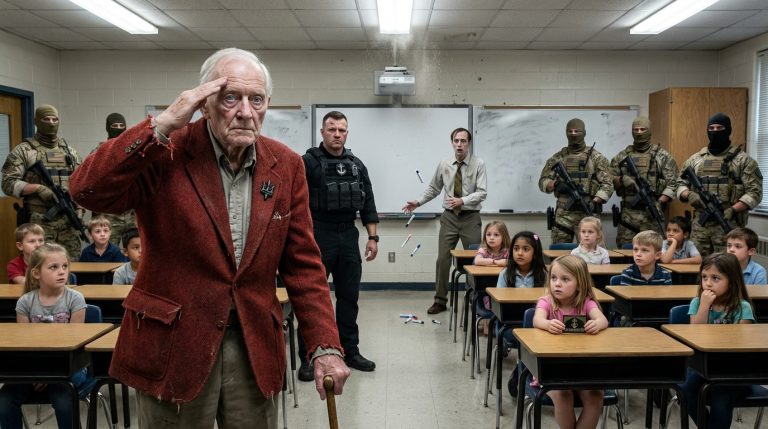
A single officer in a crisp utility uniform strode onto the flight deck. General Marcus Thorne. His face was weathered, lines carved deep around his jaw like cracks in dry creek-bed mud, his eyes carrying the sharp, defensive focus of Cheyenne Mountain. He stopped exactly two paces from the pilot’s seat. He didn’t speak a word of jargon. He simply brought his right hand up to his brow in a salute so taut the fabric of his sleeve hummed.
“General Randall,” Thorne said, his voice thick, carrying the dry rattle of a man who had been staring at tactical screens for forty-eight hours without a break. “It is an honor, sir.”
Norman let out a dry, rattling breath through his nose. He raised his right arm, his old joints cracking under the fabric of the red leather jacket, and returned the gesture with a short, deliberate tilt of his wrist. “Good to have concrete under the boots, Marcus.”
Thorne turned his head, his eyes freezing into dark slits as his gaze fell upon Kyle. The boy was still leaning against the observer’s seat frame, his uniform shirt soaked through with grey sweat, his hands limp across his ribs. “The flight data logs have already completed their wireless transmission to our secure routers, General Randall. We have the full logic profile. The automated loop wasn’t a manufacturer error. It was an active cyber-payload injected through the commercial maintenance network three hours before departure.”
“The box was dirty from the start,” Norman said, his voice a low gravelly rumble. He reached down into his jacket pocket, his stiff fingers pulling out the worn leather wallet. He didn’t look at the Carbon Fox patch; he looked at the fraying edges of the leather itself, feeling the dry friction of the hide beneath his thumb.
“The company’s executive board wanted the hull to go down,” Thorne continued, his voice dropping into a flat, transactional register that left no room for interpretation. “An insurance realignment mixed with a systemic liability sweep. They used an unverified automation update to lock the crew out. This man—” Thorne pointed an iron finger directly at Kyle’s crooked name tag—”actively attempted to enforce that automated lock against a decorated military asset. His clearance has been revoked. His career in civilian aviation is finished before the sun sets.”
Kyle visibly shrank against the bulkhead, his chin dropping toward his chest, his mouth working silently like a fish caught in shallow water. The rigid system of rules and protocols he had built his entire identity around had not just failed—it had been engineered to destroy him.
“Easy, Marcus,” Norman said softly. He stood up from the seat, his knees popping like dry twigs in the quiet of the cockpit. He walked over to the central console, where the manual hydraulic override valve was still weeping pale mineral oil onto the carpet. He reached down with his right hand, his gnarled fingers gripping the unpolished iron knob, and turned it three times until the bypass line clicked shut, stopping the leak. “The boy was only following the text he was given. When the world starts spinning sideways, people grab the only line they know, even if that line is tied to an anchor.”
He turned to face Kyle. There was no anger in Norman’s wintry sky-blue eyes—only the deep, weary clarity of a man who had seen too many structures collapse under the weight of their own design. He placed a heavy, scarred palm on the boy’s slumping shoulder. “The fault isn’t in the soldier who follows the manual, son. It’s in the manual that doesn’t trust the man on the ground to feel the air. Remember that when you build your next set of rules.”
Kyle looked up, his face bloodless, his lips trembling as he met the old general’s gaze. He didn’t offer an excuse. He just nodded once, a slow, heavy drop of his head that carried the silent weight of an entire worldview turning to dust.
Three weeks later, the morning sun over the local valley was low and desaturated, casting long, sharp shadows across the gravel parking lot of the VFW post. Inside, the air smelled of old wood stain, tobacco tin, and the dry, bitter aroma of black coffee brewing in a commercial aluminum urn.
Norman Randall sat at his usual corner table near the window, his red leather jacket thrown over the back of the pine chair. In front of him sat his old ceramic mug, its glaze cracked into a thousand tiny veins like dry earth.
The heavy front door creaked open, the iron latch rattling against the frame. Kyle walked in. He wasn’t wearing the white collar or the polished shoes of a lead flight attendant; he wore simple canvas trousers and a faded denim shirt, his hair unquaffed, his face carrying the clean, unvarnished look of a man who had spent three weeks working under the open sky.
He didn’t make a speech. He didn’t offer a rambling apology. He walked straight to Norman’s table, his boots clicking softly on the worn linoleum floor, and set a fresh, steaming porcelain mug of black coffee directly on the scarred wood beside the old man’s hand.
“Sir,” Kyle said, his voice quiet, steady, stripped of any bureaucratic veneer.
Norman looked up from his cup. He didn’t smile, but the hard, static lines around his jaw softened by a fraction of an inch. He reached out and wrapped his thick, calloused fingers around the handle of the new mug, feeling the direct, uninsulated warmth of the porcelain against his skin. He gave a single, slow, deliberate nod of his chin.
It was a dismissal, an acceptance, and a truce—all contained within the small, silent space of a morning routine. The sky outside was vast, clear, and completely empty of machines.