The Frozen Boundary: A Sovereign Rancher’s Stand Against Systemic Extinction in the White Dust
CHAPTER 1: THE CRACK OF HIGHTENSILE WIRE
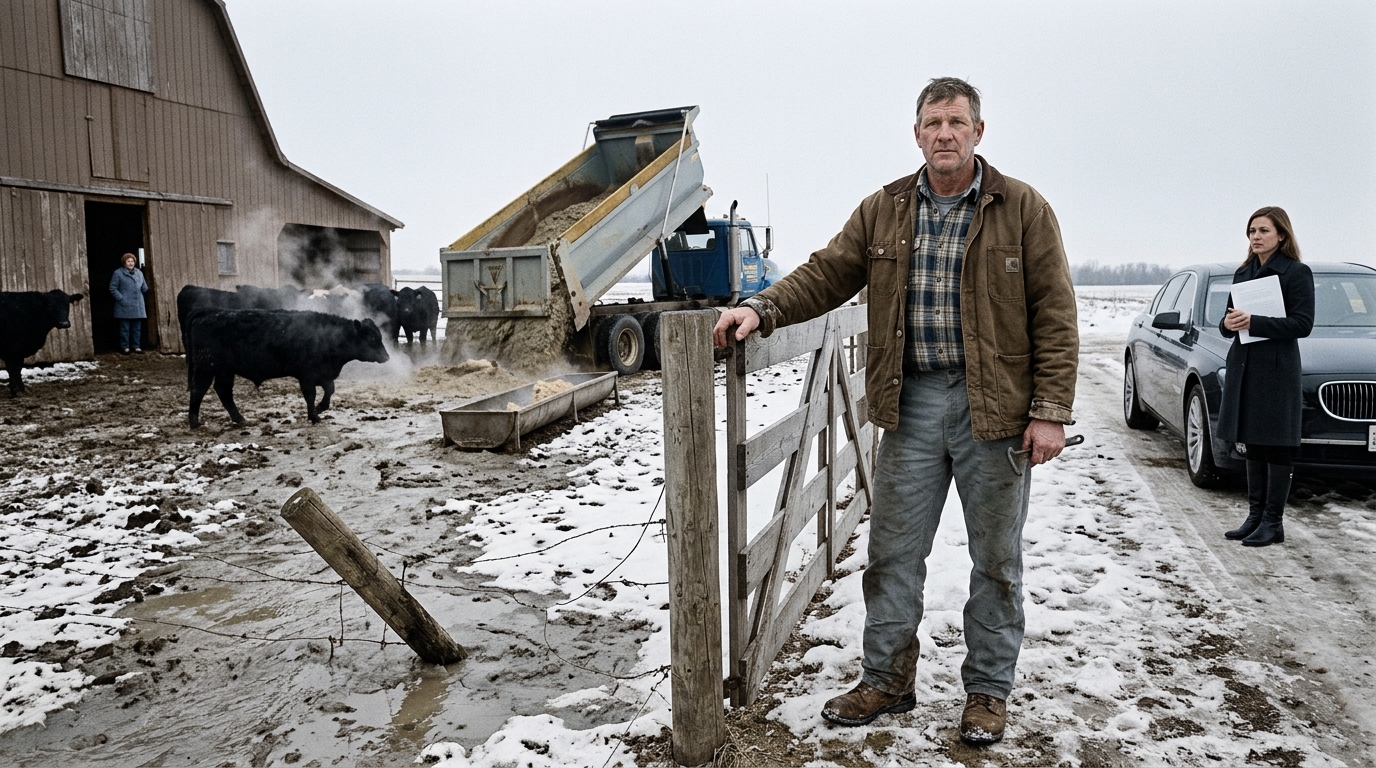
The high-tensile wire didn’t just break; it whipped through the freezing air with the crack of a rifle shot.
Six-inch pine posts snapped at the frost line. The steel plow blade hit the corner brace at forty miles an hour, throwing a arc of ice and pulverized cedar across the road. Before the splinters settled, the heavy twin-axle dump trucks were already backing through the breach.
Diesel exhaust rolled blue and thick across the snow. The first bed hoisted. Twelve tons of gray, chemical-caked slush crashed into the pasture lane, burying the winter feed trough under five feet of salt-laden sludge.
I didn’t run. Running on frozen mud gets a man a broken hip. I rolled the cold iron hitch pin from my left palm to my right, feeling the notched steel bite into my scarred knuckles.
The bulls panicked instantly. Twelve hundred pounds of pure muscle slammed into the inner corral gates. Hooves skidded on the black ice beneath the powder. The black Angus yearling lost his footing, his flank hitting the frozen earth with a dull, hollow thud that rattled the barn tin. Steam exploded from his nostrils in violent bursts.
Behind me, the barn door creaked on its iron track. Martha stood in the opening, her wool coat pinned tight at her throat. She didn’t scream. She just held the door frame, her bare knuckles white against the weathered oak, watching the gray wall of sludge spill toward the shelter.
A red BMW 7-Series rolled to a stop two inches from the jagged stub of the corner post.
The door opened. Clean leather smell cut through the reek of burning diesel. She stepped out onto the ice in spotless leather boots, her coat untouched by the sideways snow. She didn’t slam the door. She unfolded a sheet of twenty-pound bond paper with slow, deliberate precision.
“Emergency Winter Authority,” she said. Her voice didn’t carry anger. It carried the flat, metric weight of a clerk stamping a lien. “Temporary land seizure under Municipal Code 14. Community safety.”
Behind her, the yearling scrambled up, bleeding where the ice had sliced his hock.
She didn’t look at the bull. She looked at the barn, then at Martha, then down at her paper.
“This is an active agricultural lease,” I said. My voice was lower than the idle of the trucks. “That slush is eighty percent calcium chloride. It kills the grass. It ruins the stock.”
“You should have adapted sooner,” she said. She didn’t look up from the page. “Winter doesn’t wait.”
She turned toward the lead truck and raised one gloved hand. A brief, neat wave.
“Keep dumping,” she told the driver.
The second truck backed up, its reverse beeper cutting through the roar of the gale. A fresh load of black sludge slammed into the lane, burying the second trough. On the header of the paper she held, beneath the official coat of arms, sat the clean, centered text: HOA Executive Board — Emergency Directive 12.
I tapped the iron hitch pin against the top rail of the surviving gate. Three heavy, rhythmic strikes. The cold metal rang clear through the storm.
“You’ve got three minutes to pull those rigs off my parcel,” I said.
She smiled—not with her eyes, but with the subtle tightening of her jaw—and slipped the paper into her interior pocket.
“Or what, Arthur?” she asked quietly. “You’ll file a complaint?”
CHAPTER 2: SALT ON THE FROST LINE
The truck driver didn’t drop the bed immediately. He revved the engine twice, the diesel governor screaming against the governor limiter, a wall of black soot blowing straight into the wind. The hydraulics groaned, the steel bin tilting another three inches, spilling a gray wave of salt-crusted ice over the gravel lane.
I didn’t move my boots from the gate line. The red BMW’s driver-side window rolled up three inches—just enough to seal out the smell of raw exhaust, not enough to hide her face.
“You’re standing on public access, Arthur,” she said through the gap. Her voice came through flat, clipped by the glass. “Check the county portal before you break something you can’t afford to replace.”
The iron hitch pin in my hand felt heavy, thick as a wrist, cold enough to stick to the bare skin of my palm. I lowered it slowly, tapping it once against the top hinge. The iron rang clear, a flat chime that made the lead bull in the pen toss his horns and snort.
“This fence was built in ’84,” I told her. “The line runs three feet clear of the road ditch. You’re six feet inside my deed.”
She didn’t answer. She reached down, picked up a thermal cup from the console, and took a sip. Her eyes stayed locked on the road ahead, completely dismissing the gate, the pasture, and the four hundred head of cattle huddled against the north barn wall.
The truck driver gave up on waiting. He slapped the hydraulic lever. Twelve tons of slush slammed into the fence post with the weight of a falling oak. The cedar post didn’t just break; it sheared sideways, driving six feet of rusted barb wire through the crust of the snow.
I turned my back on her car and walked toward the barn.
You don’t fight a machine when it’s moving. You wait until the fuel runs out, or until you find where the oil is leaking.
Martha met me at the sliding door. Her hands were tucked deep into the pockets of her canvas chore coat, her shoulders hunched against the draft cutting through the oak slats. Her eyes were fixed on the yearling bull down in the corner pen.
“He won’t put weight on the left hind,” she said. Her voice didn’t shake, but it had that tight, thin edge it always got when the money was short. “The ice cut the heel bulb. If salt gets into the joint capsule by morning, we’ll have to put him down.”
“He’ll stand,” I said. I grabbed a wooden shovel from the wall, the handle worn smooth by thirty years of sweat and linseed oil. “Get the lime bucket. We cover the lane before the hard freeze hits at sunset.”
We worked for two hours without speaking. The dump trucks kept coming—one every twenty minutes, their yellow strobes cutting through the gray twilight like slow embers. They weren’t just clearing the subdivision main; they were hauling from the commercial strip three miles south. I watched the stencil on the side of the third truck as it backed up: Vanguard Mutual Services. The letters were fresh, sprayed over an old municipal seal that hadn’t been sanded down properly.
By five o’clock, the snow piles were eight feet high, blocking the south alley completely. The water trough was buried under a foot of gray slush. The water inside had turned thick and brackish, a thin film of oily chemical film floating on the surface.
I left Martha in the kitchen with the stove running and took the old Ford down to the county seat.
The clerk’s office was almost empty. The radiators under the tall windows hissed and spat rust-colored steam into the dry air. Behind the counter, Clara sat with her glasses hanging from a silver chain around her neck, her fingers hovering over a mechanical keyboard that had lost half its lettering.
“Need the parcel map for 409-B,” I said, leaning against the worn oak counter. “The winter easement filing.”
Clara didn’t look up immediately. She finished typing a line, hit the return key with a heavy click, then pushed her glasses up her nose.
“Arthur,” she said softly. “You shouldn’t be down here tonight. The road’s drifting over out by the ridge.”
“The map, Clara.”
She sighed, her shoulders dropping under her knitted cardigan. She turned to the gray filing cabinet behind her desk, pulled a manila folder from the back, and dropped it on the counter between us.
“It came in Tuesday,” she said, keeping her hand flat on the cover. “Board approval came through under the emergency ordinance. Signed off by the road commissioner.”
I pulled the folder toward me. The paper was clean, crisp, thirty-pound bond with the county seal stamped in blue ink at the bottom.
Emergency Land Authorization — Parcel 409-B.
I skipped the boilerplate legal text and went straight to the signature line at the bottom of page three.
My name was written in dark blue ballpoint pen. The A was wide and looped at the top, the r dragged out into a flat line. It looked like my signature if you glanced at it from ten feet away through a dirty window. But the loop on the t was closed, and I haven’t closed that loop since I broke my thumb on a headgate twenty years ago.
“Who brought this in?” I asked.
Clara looked at the door leading to the hallway, then back at me. Her mouth set into a thin, hard line.
“She did,” Clara whispered. “Brought it in with the HOA courier at eight on Wednesday morning. Said you signed it in the truck while they were surveying the culvert.”
I stared at the blue ink on the white paper until the letters blurred into flat streaks.
“This isn’t my writing, Clara.”
“It’s stamped, Arthur,” she said, her voice barely louder than the hiss of the radiator. “Once the emergency order is stamped, it takes a circuit judge to stay it. And Judge Miller is out until the third week of January.”
I didn’t argue. I took out my phone, laid the document flat under the overhead fluorescent light, and took three clear photos of the signature, the stamp, and the parcel number listed in the header: Parcel 409-B — Temporary Municipal Utility Zone.
Outside, the snow was falling straight down now, thick, heavy flakes that clotted on the Ford’s windshield like wet cotton. I started the engine, let the heater blow warm air against my frozen fingers, and sat in the dark parking lot for five minutes.
The red BMW was parked in the reserved space right beside the courthouse annex door. Its tires were clean, the wheel wells scraped free of mud, the polished red paint reflecting the orange glow of the streetlights like fresh blood on snow.
I reached down, pulled the iron hitch pin from my coat pocket, and laid it on the passenger seat.
CHAPTER 3: GRAVES AND GREY MONEY
The iron hitch pin lay cold against the cracked vinyl of the Ford’s bench seat. Through the arc of the wiper blade, the red BMW’s tail lights cast two long, crimson streaks across the packed ice of the courthouse parking lot.
I didn’t follow her car when it pulled out onto the main drag. I let the engine idle until the cab smelled of hot oil and damp wool, then turned the truck south toward Oak Ridge Cemetery.
The access road hadn’t been plowed. Four inches of dry powder dragged against the front axle as the old Ford ground up the incline. I parked by the iron maintenance gate, leaving the parking lights on to cut through the swirling grey.
The snow around the burial plot was churned deep. Heavy boot prints—deep-heeled work boots and narrow street shoes—had torn through the crust around the granite headstone.
Beside the stone, the small oak cross we’d set in the earth after the funeral was gone. I found it six feet away, shoved headfirst into a snowdrift beside a cedar stump. The three-quarter-inch pine crossbar had been snapped clean at the notch, the splintered grain stained grey with road slush.
My thumb ran over the rough fracture. The break was fresh. White wood showed beneath the dark varnish, untouched by the frost.
Jesse had been twenty-six when he took the job at the county auditor’s desk. He’d come home on a Sunday night three years ago, sitting at our kitchen table with a stack of printouts, his finger tracing a line of recurring line-item transfers labeled Emergency Public Safety Maintenance. He’d filed a formal inquiry on a Monday. By Friday, his desk was cleared out, and three months later, the stress and the blacklisting had driven him clear out of county work into private hauling before his truck went over the guardrail on Route 9.
He’d believed in the paper trail. He’d believed that if you showed a man a clear ledger, the truth did the work for you.
I stood over the stone, my boots buried to the laces in the drift. My left thumb rubbed the raw blister on my knuckle—the one I’d earned dragging the yearling clear of the frozen ditch four hours ago.
“They’re using the same ledger, son,” I said into the wind.
The drive back to the ranch took thirty minutes through the thickening drift. When I turned down the lane, two contractor pickups were idling near the broken corner post. The drivers were leaning against a hood, drinking coffee from paper cups, their yellow hazard lights painting the snow-draped pines in rhythmic flashes of amber.
One of them was on a handheld radio, his voice rising over the clatter of his truck’s diesel clatter.
“—don’t care about the owner,” he was saying, his back to me as I stepped out of the Ford. “The HOA contract auto-renews on the fifteenth if the disposal yard stays active. That’s mid-seven figures split three ways through the shell group. We keep hauling until the gate’s buried.”
He turned, saw me standing four feet away in the dark, and cut the radio off with a snap of his thumb.
“Private property,” I said.
“Emergency access corridor,” he shot back, though he didn’t step toward me. He flipped his cigarette into the snowbank between us. It hissed once and went black. “Order came down from the board chair an hour ago. Any interference gets logged as a civil violation.”
“Who pays Vanguard Mutual?” I asked.
The driver hesitated. His eyes shifted toward his partner, then back to my coat pocket where my hand rested flat against the iron hitch pin.
“We just haul the snow, old man,” he muttered. “Talk to the office.”
“I am talking to the office,” I said. “And the office is using a dead boy’s signature.”
He didn’t answer that. He climbed into the cab, slammed the heavy steel door, and shifted into reverse, his tires throwing a shower of gravel against the fence wire as he backed out toward the highway.
I walked down to the lower barn. Martha was inside, setting a fresh bale of timothy hay into the corner stall. The yearling bull was lying down in the clean straw, his breathing slow and heavy, a thick grey ointment smeared over the gash on his hind leg.
She looked up when the barn door slid shut.
“Clara gave you the file?” she asked.
I pulled the printed photos from my coat and laid them on the wooden grain chest between us. The blue-ink signature on the county seal looked stark under the single bare bulb hanging from the rafter.
Martha didn’t touch the paper. She looked at the wide loop of the A, then down at the closed loop on the t. Her mouth tightened until her lips turned white against her weathered skin.
“She did this to Jesse,” Martha said softly. “Three years ago. The audit.”
“It wasn’t an audit,” I said, leaning my hands against the grain chest until the rough pine bit into my palms. “It was the setup for the disposal contract. They needed a parcel with a creek boundary to handle the chemical runoff without triggering state EPA checks. Parcel 409-B.”
“Our land,” she whispered.
“Our land,” I said. “And they’ve got two million dollars in municipal disposal fees riding on keeping it buried until the spring thaw converts it to commercial usage.”
Outside, the heavy roar of a fresh convoy echoed off the ridge—three trucks, gear-grinding as they hit the turnoff.
CHAPTER 4: THE ORANGE LINE
The three trucks didn’t stop at the breached corner post. They drove thirty yards deeper into the pasture lane, their dual tires grinding through the crust until they hit the soft mud above the creek bed.
Martha didn’t look back at the barn door as the engine vibrations rattled the glass panes in the window sash. She carefully picked up the three printed photographs from the grain chest, folded them once down the middle, and slipped them into the deep interior lining of her canvas coat.
“They’re coming clear down to the willow line,” she said. Her thumb worked the fraying edge of her cuff, tight and rhythmic. “If they reach the feeder spring, the whole lower six acres goes toxic by nightfall.”
I picked up the iron hitch pin from the bench, feeling the cold metal settle into the calluses of my palm, and pushed the sliding barn door open.
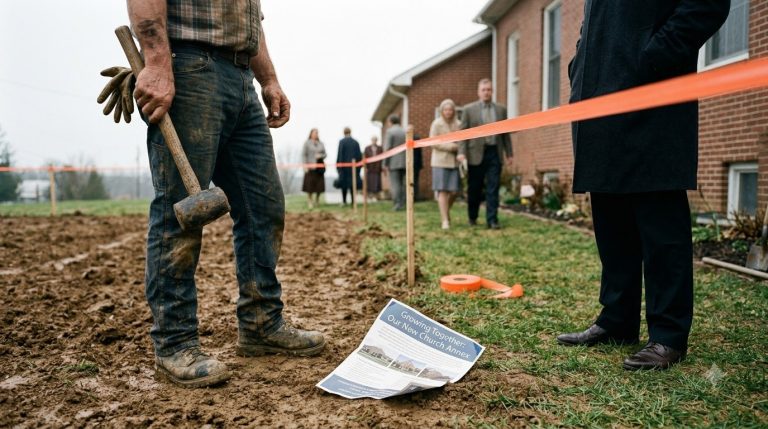
The glare hit first. Two survey crews in high-visibility vests were already pounding steel T-posts directly into the frozen sod. They had strung bright orange plastic tape between the markers—a straight, surgical line cutting through the feeding lane, twenty feet inside our fence posts.
A white county pickup idling by the gate bore the emblem of the Environmental Health Division. Two men in heavy parka coats stood on the shoulder with clipboard cases, taking soil core samples where the gray slush met the creek bank.
I walked straight past the surveyor pounding the third T-post. The iron pin in my hand stayed low at my side.
“Who authorized the boundary stakes?” I asked the lead inspector.
The man didn’t look up immediately. He wiped a smudge of slush off his digital thermometer, made a quick notation on a yellow grid pad, then turned his head. His breath came out in short, thick clouds.
“County Code Enforcement, Mr. Miller,” he said. His voice was flat, devoid of malice or sympathy. “We received a formal notification of structural non-compliance from the HOA board under Emergency Directive 12. Uncontrolled agricultural runoff threatening a designated utility corridor.”
“This isn’t a utility corridor,” I said. “It’s deeded pasture. Parcel 409-B.”
He pulled a laminated sheet from his clipboard and held it out. He didn’t hand it to me; he held it steady so I could read the bold red stamp across the top: ACTIVE INVESTIGATION — SPECIAL USE RECLASSIFICATION PENDING.
“Vanguard Mutual filed the environmental assessment on behalf of the district,” the second inspector added, pointing his pen toward the orange tape line. “They’re claiming salt seepage from your feed troughs is contaminating the storm drainage network. Until the hearing, access within twenty feet of the survey line is restricted.”
My phone buzzed in my pocket—a sharp, double vibration. I pulled it out with my left hand. A text alert from the county court portal sat on the screen: Notice of Hearing — Petition for Immediate Asset Seizure & Interim Receivership. Filed by HOA Legal Counsel.
The date was set for eight o’clock tomorrow morning.
Behind the inspectors, a dark blue commercial flatbed backed into the gap. Four men in unmarked coveralls began unloading six-foot concrete barricades—the heavy highway barriers used to block off collapsed bridges.
I stepped up to the orange tape. The surveyor holding the driver malleted his post stopped mid-swing, his shoulders tensing under his orange vest.
“Touch that tape and it’s a class-two obstruction charge,” the inspector said quietly, not raising his voice. “We have two deputies sitting at the crossroads. They aren’t here to argue property boundaries.”
I looked past him, down the lane toward the main road.
The red BMW was parked on the elevated shoulder, its hazard lights pulsing slow and steady against the snowbanks. She sat inside, the dome light on, reading through a stack of legal-sized papers while a man in a dark tailored coat leaned against her passenger door, speaking into a cell phone.
I didn’t tear down the orange tape. I turned the hitch pin over in my hand once, feeling the sharp shoulder of the notch where the iron had sheared off thirty years ago.
“Martha,” I called out over my shoulder.
She stepped out from the barn shadow, her face hard against the wind.
“Call the feed lot in Sterling,” I told her. “Tell them we’re moving the herd to the top forty before dark. And tell them to bring the flatbed.”
The inspector narrowed his eyes. “You’re moving stock during an active containment order?”
“I’m moving my property off land you haven’t managed to steal yet,” I said.
I walked past the concrete barriers, my boots crunching through the crusted salt, straight toward the Ford. Every step carried a price—the cost of diesel we didn’t have, the stress on the heavily pregnant heifers, the loss of the winter shelter. But as I opened the truck door, I saw the man in the tailored coat hang up his phone and hand a fresh yellow envelope directly to the red BMW’s driver.
They were rushing. They were rushing because the paper trail Jesse left behind was beginning to bleed through the frost.
CHAPTER 5: THE SHOWDOWN AT THE FENCE
The yellow envelope disappeared into her interior coat pocket before the door of the Ford even latched.
I didn’t turn the key. Through the fogged glass, I watched the man in the dark coat step back into the snow, his eyes scanning the orange tape line before he climbed into the lead contractor truck. The diesel engines roared together, a heavy chorus that shook the frost from the oak branches above the driveway.
By seven that evening, the emergency session at the community center was standing-room only.
Wet coats dripped onto the linoleum floor. The air smelled of stale coffee and damp wool. At the front table, three HOA board members sat behind name cards, their faces pale under the flickering fluorescent tubes. She stood at the center podium, her hair pinned tight, a leather-bound folder open in front of her.
“This emergency session exists for one reason,” she said, her voice cutting clean through the hum of the crowd. “To resolve a persistent obstruction on Parcel 409-B that compromises regional safety during severe winter events.”
She clicked a handheld remote. A projector beam cut through the room’s haze, casting a boundary map onto the bare drywall behind her. The pasture was shaded in red, labeled in bold black text: Vanguard Mutual — Municipal Utility Zone.
“Effective immediately under Emergency Directive 12,” she continued, “the easement transitions to permanent district control.”
A murmur rippled through the back rows. Two ranchers stood up near the door, their voices rising over the hum, but she didn’t pause. She raised her left hand, gesturing toward the back entrance.
The double doors opened. Two county deputies stepped inside, followed by a man in a charcoal suit—a plainclothes investigator with a silver shield pinned to his lapel.
I didn’t shout. I stepped up from the third row, walked to the front table, and dropped Martha’s folded manila folder directly over her open leather binder.
She didn’t reach for it. Her eyes narrowed as she looked down at the top page.
“That’s a forged signature on a backdated land conversion permit,” I said. My voice was low, but in the quiet room it carried like iron striking pine. “Filed under Emergency Directive 12 to conceal two point eight million dollars in unauthorized disposal transfers through Vanguard Mutual.”
A rustle went through the room. She looked up, her expression freezing into a mask of sharp, cold contempt.
“Mr. Miller is agitated,” she told the board, her voice steady. “This is an administrative matter—”
“The signature closes the loop on the letter t,” I said, pointing to the high-resolution photo on the projector page. “I broke my thumb twenty years ago. I haven’t closed that loop since ’04. And the second file in that folder shows every transaction routed to your personal asset account since Jesse filed his audit three years ago.”
The plainclothes investigator stepped past the table. He picked up the folder, opened it, and ran a thumb across the printed bank ledgers.
“Did you authorize these filings yourself?” he asked her.
She didn’t answer. Her hand twitched toward the edge of the podium, her knuckles whitening as her composure snapped.
“This is harassment,” she said, her voice dropping an octave, sharp and thin. “He’s interfering with a public safety operation.”
She didn’t wait for the board to vote. She turned, grabbed her keys from the table, and pushed through the side door leading straight into the snowstorm.
I followed her out to the parking lot.
The gale had intensified, driving white curtains across the asphalt. Her red BMW was parked twenty feet from the pasture fence, where the herd had gathered against the top rail, their dark shapes huddled together against the roar of the wind.
She yanked the car door open, reached inside, and hit the PA system toggle on the center console.
The loudspeaker mounted on the roof rack crackled to life with a deafening screech. Her voice erupted over the pasture, amplified and distorted by the blizzard.
“Clear the perimeter!” she shouted into the receiver, her voice echoing off the barn walls. “This property is under emergency seizure! Step away from the line!”
The sound hit the bulls like a whip.
The lead yearling bolted first, his hooves skidding on the ice. The four hundred head behind him surged as one solid mass—twelve hundred pounds of panic and muscle slamming straight into the inner corral gate.
She didn’t turn off the speaker. She reached down, hit the panic button on her key fob, and the BMW’s horn began to scream—a shrill, rhythmic pulse that cut straight through the storm.
“Turn it off!” I yelled over the alarm.
She didn’t move. She stood by the open door, her face pale in the red flash of the hazard lights, daring the storm, the cattle, and the county to stop her.
The fence gave way with a sound like a tree shattering.
Sixteen hundred pounds of black Angus bull hit the corner post at full gallop. The cedar sheared at the frost line. High-tensile wire snapped, whipping through the air like cut cable.
The herd poured through the breach.
The red BMW took the full impact. The first bull’s shoulder slammed into the front fender with a metal-crunching thud that caved the wheel well into the tire. The second bull rose up, its hooves coming down hard across the hood, shattering the windshield into a spiderweb of frosted glass.
Paint sheared away. Panels buckled under the crushing momentum of forty head moving together in the dark.
She screamed—a sharp, helpless sound instantly swallowed by the roar of the cattle and the wind.
The plainclothes investigator grabbed her coat collar from behind, dragging her back three steps into the doorway of the annex as the driver-side door of the BMW buckled inward like an empty tin can.
When the herd cleared the gap, heading toward the open upper pasture where the wind was broken by the ridge, the noise faded into the whiteout.
The red BMW sat in the snow line—crushed, silent, its alarm dead, the driver-side door folded flat against the frame.
The investigator stepped forward through the drift, his cuffs already unclasped in his right hand.
“Ma’am,” he said, his voice flat against the howling wind. “You’re under arrest.”
CHAPTER 6: RUSTED SOIL
The steel latch clicked shut around her right wrist with a flat, metallic snap that didn’t carry across the wind.
She didn’t fight as the investigator guided her toward the rear door of the county cruiser. Her spotless coat was smeared with black grease from her driver-side door, her leather boots sinking ankle-deep into the slush she’d paid to dump across my pasture lane. She didn’t look back at the crushed red frame or the splintered posts. She looked straight ahead into the whiteout, her jaw set, her mouth a thin, hard seam that refused to offer a single word.
The cruiser’s tail lights faded into the swirling snow at the highway turnoff, leaving the parking lot in silence.
By midnight, the storm began to break. The wind died down to a steady, freezing draft coming off the north ridge, cutting through the steam rising from the county vacuum trucks lined up along the pasture fence.
Different crews were working now. State environmental contractors in yellow rubber overalls moved methodically down the ditch line, operating heavy suction hoses that drew the chemical slush off the grass and into sealed steel tanks. The stencil on their truck doors didn’t say Vanguard Mutual. It bore the clean, plain lettering of the State Department of Agriculture.
I stood by the breached corner post with Martha. The iron hitch pin sat in my coat pocket, heavy and cool against my hip.
Clara walked down from the annex steps, a sealed white packet tucked under her arm. She stopped two feet away, her breath coming out in small, even puffs, her boots crunching on the gravel.
“Judge Miller signed the emergency injunction at ten,” Clara said, handing the packet to Martha. “Interim order frozen. Emergency Directive 12 is formally revoked by the circuit court. Parcel 409-B is restored to agricultural status, clear of all municipal encumbrances.”
Martha took the packet, her gloved fingers pressing flat against the heavy bond paper. She didn’t open it. She just held it against her coat.
“And the account?” I asked.
“State auditors seized the ledgers from Vanguard Mutual an hour ago,” Clara replied quietly. “The entire two point eight million dollars in disposal fees has been impounded. It was structured as a shell account under her name to force a land-use conversion once the soil salt levels triggered an agricultural abandonment clause. It wasn’t just a snow site, Arthur. It was an intentional wipeout of your deed.”
Jesse had found the edge of that same ledger three years ago. He’d seen the transfers, but he hadn’t lived long enough to see where the line ended.
“The remediation costs are charged directly against the impounded funds,” Clara added, looking down at the damaged fence line. “Every yard of salt-polluted dirt gets dug out and replaced with clean topsoil before spring planting. It’s written into the court order.”
I nodded once to Clara. She turned and walked back toward her car, leaving us alone with the low hum of the state pumps.
At first light, the sun broke through the overcast—a pale, sharp yellow light that glinted off the ice hanging from the barn eaves.
A young man from the county road crew walked up the lane carrying a small wooden box wrapped in oilcloth. He stopped three feet away, holding it out with both hands.
“Found this down in the drift by the culvert, Mr. Miller,” he said softly. “Thought you’d want it back.”
I took the box and unfolded the oilcloth. Inside lay the oak cross from Jesse’s grave. The pine crossbar was still broken, the splintered edges raw where the slush had washed over it.
“Thanks, son,” I said.
When the state trucks pulled out at noon, the lower lane was scraped down to the hard gray gravel. The orange tape was gone. The concrete highway barriers had been hauled off on a flatbed.
I walked up to the shop, fetched the box of heavy iron staples, the stretcher hoist, and a fresh eight-foot post of cured green oak.
Martha came down twenty minutes later with a thermos of black coffee and a small tin of wood glue. We didn’t talk while we worked. I set the oak post deep into the posthole, tamped the earth down hard with the heavy iron bar, and set the corner brace.
Martha held the pine crossbar steady on the wooden bench while I ran two long steel screws through the notch, drawing the splintered oak back together until the grain locked tight and seamless.
We drove up to Oak Ridge Cemetery before the sun hit the ridge line. The snow around the stone had been smoothed over by the night’s wind. I cleared the drift with my glove, set the oak post three feet into the frozen earth beside the granite, and tamped the snow firm around the base.
The cross stood straight again—scared at the break, but solid in the frost.
I reached into my coat, pulled out the cold iron hitch pin, and set it on top of the fence post down at the lower pasture gate. The metal rested in the notch where the old wire used to run, holding the line steady against the quiet winter air.
Out in the upper forty, the herd had moved down from the ridge. The lead bull dropped his head to the fresh hay Martha had scattered along the fence, his breath rising in long, white clouds into the clear sky.
The land was bruised, but the line was held.