The Rust and the Blueprint: How One Retired Sapper Dismantled a Suburban Empire of Petty Bureaucracy
CHAPTER 1: THE LINE IN THE GRASS
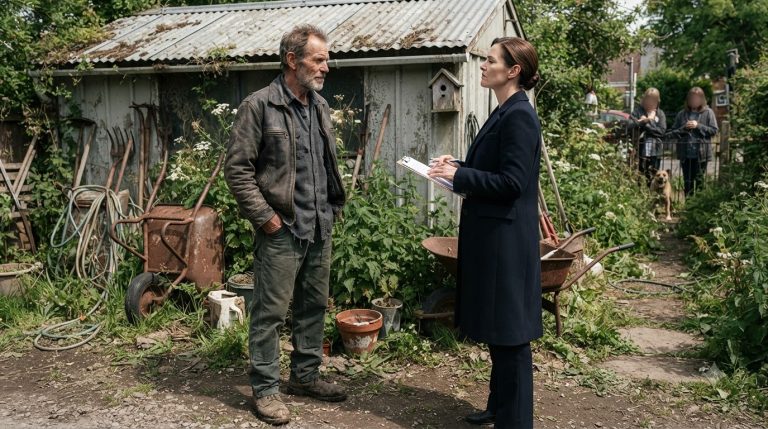
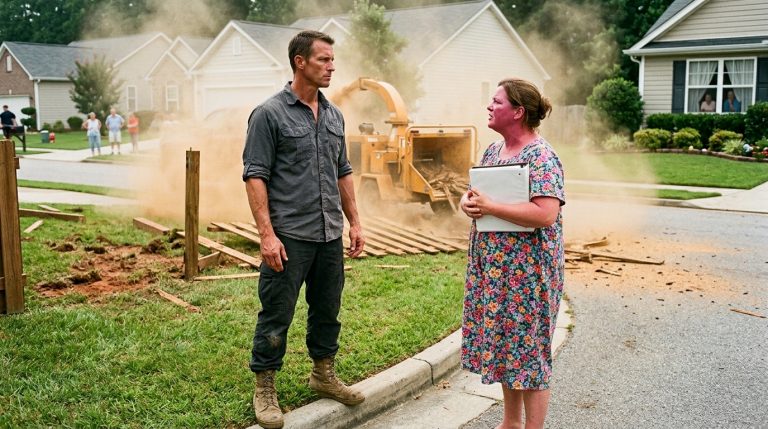
The words, dripping with a venomous sweetness, hung in the crisp autumn air between my property line and the perfectly manicured sidewalk where she stood. Karen, the self-appointed queen of the Oakridge Meadows Homeowners Association, clutched a clipboard to her ample chest like a holy shield. A smear of bright pink lipstick formed a taut, disapproving line across her mouth. Her eyes, small and hard, raked over the brand-new battleship-gray metal siding of my workshop, a structure I had spent the better part of a year and a significant portion of my retirement savings to build.
To her, it was just a hobby shack, a dangerous anomaly marring her sea of beige and taupe vinyl. To me, it was a sanctuary forged from the discipline and precision I had learned over twenty years as an Army combat engineer—a place where raw timber and cold iron were transformed into enduring work.
I felt the familiar, cold calm settle over my nervous system, the exact physiological drop that always preceded a complicated extraction overseas. I planted the soles of my boots firmly into my own patch of autumn-dried grass and met her gaze without blinking.
“This hobby shack, as you call it,” I said, my voice level, carrying the flat, unhurried cadence of a man who measured his words by their weight, “was built to commercial-grade specifications. It passed every single county inspection from the foundation pour to the final electrical sign-off. It is arguably the most fire-resistant structure in this entire zip code. I have the binders of permits and engineering reports sitting right on my desk to prove it.”
She waved a dismissive, fleshy hand, the cheap gold bracelets on her wrist clinking together with a sharp, annoying chime. “County permits mean nothing to the association, Mr. Hayes. We have our own covenants, conditions, and restrictions. Your industrial monstrosity is an aesthetic violation and, more importantly, a hazard. All that machinery, the chemicals, the sawdust—it’s a tinderbox waiting for a spark.”
The sheer audacity of the weaponized ignorance hung heavy between us. She hadn’t set a single foot inside the threshold, yet she had already drafted its death warrant in her mind. This was never about public safety. It was about the unwritten law of the neighborhood: that no man builds anything of substance without first kissing the ring.
“I’ll be sending you the official notice of violation,” she sniffed, already turning her back on me, her victory entirely secure in her own imagination. “You’ll have thirty days to cease operations and submit a plan for its demolition.”
The word demolition lingered in the quiet morning air, tasting like dry ash. As she marched down the sidewalk toward her beige sedan, I watched the rhythmic movement of her shoulders and calculated the exact radius of her reach. She thought she had drawn the first blood in a simple neighborhood dispute. But as I turned back toward the heavy steel-reinforced door of my shop, a sudden, sharp coldness prickled at the base of my neck—a subtle inconsistency in her administrative certainty that didn’t quite add up.
CHAPTER 2: THE BINDING OF PROOF
The heavy steel door of the workshop clicked shut with a muffled, airtight seal, locking out the autumn wind and the lingering aftertaste of Karen’s parting shot. I stood in the center of the room for a long moment, the quiet hum of the dust collection system fading into the background silence. My fingers still tingled slightly from the adrenaline spike—that old, familiar combat alertness that turned the world into a sharp grid of vectors, threats, and calculated responses.
She thought thirty days was a countdown to execution. To her, a notice of violation was a bludgeon, a final sentence delivered with the authority of someone who had never faced a real consequence in her life. But she didn’t understand the anatomy of a paper trail. She didn’t know what it meant to build something that could withstand structural stress tests, let alone a bureaucratic shakedown.
I walked over to the long maple workbench beneath the north window, where the light fell in a clean, pale slant across the scarred wood. Resting there was the stack of thick, cardboard binders I had compiled over the past year.
I pulled out the first one, its spine labeled Phase One: Structural Engineering & Foundation. The cover was scuffed from use, the plastic label pocket slightly yellowed at the edges. Flipping it open, I ran a calloused thumb down the plastic sheet protectors holding the county building permits, the concrete pour certificates, and the structural engineer’s load calculations. Every signature was in ink, every stamp was official, and every single requirement had not just been met, but doubled.
The physical texture of the page was reassuring—heavy, unyielding paper that smelled faintly of printer toner and old glue. This wasn’t a collection of opinions or subjective neighborhood complaints. It was an immovable wall built of facts.
My wife, Sarah, stepped into the workshop a few minutes later, pushing open the heavy door with a gentle shove. She carried two mugs of black coffee, steam rising into the cool air between us. She walked over and set one down on the edge of the workbench, her eyes scanning the open binders before shifting to my face.
“She really sent it, didn’t she?” Sarah asked, her voice quiet, carrying an undercurrent of fatigue that she tried hard to mask. “I saw her walking back down the sidewalk like she owned the entire county registry.”
I picked up the mug, wrapping my hands around the warm ceramic to draw the heat back into my fingers. “She sent it,” I replied, my tone flat and even. “A formal notice of violation. Thirty days to cease operations and submit a demolition plan. She thinks she’s got us cornered.”
Sarah let out a short, humorless breath, leaning back against the edge of an empty shelf. She looked around the expansive, meticulously organized interior of the 1,500-square-foot workshop—at the heavy metal conduit running cleanly along the walls, the fire-rated Type X drywall, the commercial-grade sprinkler system overhead.
“Demolition? For this?” She shook her head, a flash of righteous anger tightening her jaw. “After all the months you spent making sure every single wire and pipe was up to code, after Dave from the county signed off and shook your hand. How can they just ignore reality?”
“Because reality isn’t what she’s managing,” I said, taking a slow sip of the bitter coffee. “She’s managing an illusion. Oakridge Meadows runs on compliance, not code. We followed the law to the letter, but we forgot to bow down to the unwritten bylaws of her little kingdom. That’s the real infraction.”
Sarah crossed her arms, her gaze dropping to the second binder, the one containing the local covenant agreements we had signed at closing. “So what’s our counter-move? We can’t just ignore an HOA legal notice. Even if they’re wrong, they have lawyers and fine-print clauses.”
“We don’t ignore it,” I said, setting the mug down with a soft clack against the wood. “We answer it. But we don’t do it with an angry letter or a shouting match on the lawn. That’s what she’s banking on—she wants an emotional reaction, something she can take to the board and point to as erratic or hostile.”
I reached out and flipped open the covenants document, my finger tracing the text down to Section 7, Paragraph B—the very catch-all bludgeon Karen had cited in her letter. It vaguely prohibited any “noxious or offensive activity” and structures “out of harmony” with the taupe and beige vinyl siding of the surrounding 30-year-old tract homes.
“Look here,” I said, pointing to a clause buried deep in the sub-sections, near the appendix tracking historical property definitions. “When this development was carved out in the early sixties, the perimeter lots—our half-acre strip bordering the state woodland—had a different set of auxiliary building exemptions. They were grandfathered in for agricultural and workshop use before the developers subdivided the middle blocks.”
Sarah leaned in closer, her eyes scanning the faded text. “She didn’t read past the first page, did she?”
“She didn’t have to,” I answered, a cold, methodical satisfaction settling into my chest. “People like Karen rely on the weight of intimidation. They assume nobody reads the fine print because nobody ever pushes back hard enough to make them look. Her letter is built on a foundation of loose sand. She’s citing a subjective aesthetic clause while completely ignoring the overriding state and county compliance mandate that supersedes her HOA authority.”
I pulled a fresh, blank binder toward me from the shelf above the desk, along with a pack of heavy-duty tab dividers and a fine-tip black marker.
“We’re going to draft a legal brief,” I told her, my voice dropping into the steady rhythm of a Sapper planning a defensive line. “We’ll break down every single claim she made in that notice. Appendix A: the final signed county building permit. Appendix B: the structural engineering blueprints. Appendix C: the fire marshal’s preliminary sign-off. And Appendix D: a point-by-point rebuttal of her covenant interpretations, complete with the manufacturer specifications for our dust collection system—showing it filters down to one micron and operates well below ambient neighborhood noise levels.”
Sarah watched me for a moment, the tension in her shoulders slowly easing as the scope of the preparation sank in. A small, knowing smile touched the corners of her mouth.
“You’re not just defending the shop, are you?” she asked softly.
“Defense is a losing game,” I said, picking up the marker and writing MASTER RESPONSE BRIEF neatly across the tab of the first divider. “You don’t win a siege by hiding behind your own walls. You draw them out, let them overextend, and make them prove every single claim they make in writing. By the time we mail this packet via certified delivery, requiring her personal signature, she won’t just be reading a reply. She’ll be looking at the first permanent stake of a trap she didn’t even realize she was walking into.”
The quiet hum of the workshop seemed to deepen around us, a steady, unshakeable pulse of steel and concrete against the rising storm outside.
CHAPTER 3: THE SURVEILLANCE LOG
The ink on the master response brief was barely dry when the first physical probe arrived from the perimeter. I didn’t rush to the window or shout across the yard. In my twenty years as a sapper, you didn’t react to a tripwire by jumping out of a trench; you checked your angles, verified your blind spots, and watched the pattern unfold.
Sarah was inside the house, her shadow moving behind the warm amber glow of the kitchen window, but out here in the yard, the temperature had dropped with the sinking sun, leaving the crisp smell of dry earth and oxidized iron hanging heavy in the autumn air.
I walked slowly from the workbench toward the southern corner of the workshop, my boots crunching softly on the gravel path. Two days had passed since Karen received the certified mailing receipt bearing her spiky, indignant signature. The silence that followed wasn’t peace; it was the heavy, low-pressure quiet before an artillery shift. A bully like Karen doesn’t fold when faced with an organized brief. They simply change vectors.
The beige sedan appeared precisely at 4:15 p.m., matching the exact micro-schedule I had begun tracking in a new, unlined ledger. It slowed to a crawl as it passed my half-acre frontage, tires hissing faintly against the asphalt. Through the tinted driver-side window, I caught the familiar flash of a silver-blonde helmet of hair—a rigid posture, eyes locked straight ahead, pretending not to look while drinking in every detail of the battleship-gray siding.
It was a juvenile intimidation tactic, a psychological probe designed to make me feel watched, managed, and perpetually under siege.
Instead of stepping out onto the lawn, I stepped back into the shadow of the overhang and adjusted the angle of the newly mounted high-definition security camera. The lens blinked a steady, amber pulse of light, silently uploading every frame of the drive-by straight to an encrypted cloud vault. I pulled out my digital decibel meter and logged the ambient neighborhood noise—55 decibels of distant traffic and rustling leaves—then clicked my five-horsepower cabinet saw on for a controlled, twelve-second diagnostic run with the doors sealed. The meter read a flat 60 decibels at the property line. Quiet, compliant, and legally bulletproof.
A sharp movement across the street caught my eye.
Gary, the thin, perpetually nervous accountant from the HOA board, and his wife were conducting their evening constitutional. Except their constitutional had a distinct vector. They weren’t walking their dog; they were marching with a rigid, awkward purpose straight toward the corner of my property line, their heads bobbing in sharp consultation.
As they neared the edge of the grass, Gary paused, pulled a sleek smartphone from his windbreaker pocket, and raised it at an obvious, clumsy angle, trying to capture footage of the workshop’s ventilation exhaust.
I didn’t yell. I didn’t storm across the turf. I simply walked out into the open, carrying a heavy piece of dimensional oak lumber across my shoulder, moving with deliberate, unhurried mechanics. When Gary realized he was staring directly down the barrel of my gaze—no longer an anonymous observer, but an individual caught in the act of petty harassment—his hand jerked as if he’d touched a live terminal. He fumbled the phone back into his pocket, grabbed his wife’s elbow, and scurried off like a startled raccoon ducking behind a dumpster.
The psychological phantom of my past overseas service flared briefly—the sudden, sharp instinct to secure the perimeter against an advancing scout party—before I ruthlessly suppressed it. This wasn’t a combat zone. It was a suburban lawn governed by codes, covenants, and paper trails. And every clumsy probe they launched only added another verified entry to my logbook.
Back inside the quiet sanctuary of the workshop, the digital log grew thicker. By evening, an email arrived from the property management company, forwarded down from an anonymous neighbor complaining about “excessive industrial noise and noxious chemical fumes” at 7:00 p.m. on a Tuesday.
I didn’t blink. I pulled up the timestamped security footage showing the workshop completely dark, locked, and silent at that exact hour, alongside a screenshot of my noise-level data and the manufacturer’s safety data sheet proving the water-based wood stain I used earlier had zero volatile organic compounds and smelled faintly of nothing more than linseed oil.
I hit reply with the cold, measured efficiency of an engineer issuing a technical correction. I attached the exhibits, itemized the timestamps, and closed with a polite request that the management company properly vet all future complaints before routing them through official channels.
As I clicked send, the screen cast a pale, steady blue light across the workbench. The traps were set. Karen thought she was burying me in an avalanche of administrative attrition, but every false complaint she engineered was just another brick pulled out of her own foundation, leaving her exposed to a reality she hadn’t prepared to face.
CHAPTER 4: THE INSPECTION DAY
The morning air carried a sharp, biting frost that crystallized the edges of the autumn grass along the driveway. At exactly 9:55 a.m., the beige sedan rolled to a halt across the street. Karen stepped out with the practiced stiffness of a general arriving at a parade ground, her clipboard clutched to her chest like a shield. She didn’t have to wait long before a white county vehicle turned down the asphalt and pulled directly into my driveway.
A man in a crisp blue uniform stepped out, his posture square and his eyes carrying the weary, unblinking focus of someone who had spent decades reviewing structural vulnerabilities. His name tag read Miller.
I didn’t wait by the door; I walked down the concrete path to meet him, moving with the measured, deliberate cadence of a sapper greeting a senior inspector on an active site. Karen immediately scuttled across the asphalt to intercept, her face tight with manufactured urgency.
“Marshal Miller, thank you for coming,” she began, her voice pitching into a sweet, artificial resonance. “I’m Karen Albright, the HOA president. We are all deeply concerned about the severe hazards being cultivated inside this structure.”
Miller didn’t break stride. He gave her a curt, professional nod, his eyes already tracing the clean lines of the battleship-gray metal siding, before turning his attention entirely to me.
“Mr. Hayes?” he asked.
“Yes, sir. John Hayes,” I said, extending a hand.
His grip was dry, hard, and brief. “Fire Marshal Miller. Let’s see what we’re dealing with.”
As I led him toward the heavy steel entrance, I could feel Karen hovering just behind our shoulder, vibrating with the breathless anticipation of a public condemnation. I unlocked the heavy-duty deadbolt and swung the insulated steel door wide.
Miller stepped across the threshold and paused. His eyes made a sweeping, practiced arc across the space—not missing the neat runs of metal conduit snaking along the interior walls, nor the bright red sprinkler heads mapped in a precise grid across the ceiling, nor the massive steel drum of the cyclone dust collector standing quiet and sealed in the corner.
“Let’s start with suppression,” Miller said, pulling a standard checklist from his pocket.
I walked him directly to the main riser in the western bay. “Commercial wet-pipe system,” I said, tapping the heavy galvanized iron. “Tied straight into the four-inch water main at the property boundary. Full pressure test conducted prior to drywall installation. All certificates and hydro-tests are cataloged in the inspection packet on the workbench.”
Miller ran a calloused thumb over the main valve handle, checking the gauge needle resting firmly in the green zone. “Good pressure. What about your detection matrix?”
“Hardwired, interconnected smoke and heat sensors with a continuous battery backup,” I replied, pointing upward. “Individual units per bay, plus a dedicated rate-of-rise thermal detector centered directly over the main breaker panel.”
He walked over to the electrical installation—a heavy 200-amp primary breaker feeding four subpanels, every wire bundled, zip-tied, and routed through metal conduit without a single stray strand. He didn’t ask me to open the panel covers; he inspected them with a critical, unhurried eye, noting the absence of improvised taps or overloaded circuits.
Karen, unable to contain her mounting panic, stepped past the threshold, her finger trembling as she pointed toward the corner. “What about the dust? The fine particulate matter! Everyone knows a woodworking shop is a tinderbox waiting for a single spark!”
Miller turned his head slowly, casting a flat, unimpressed look in her direction. “Ma’am, standard atmospheric accumulation is managed by containment protocols. Let’s look at his extraction system.”
I led him to the five-horsepower cyclone unit. He inspected the heavy steel housing, traced the heavy-gauge grounding strap designed to bleed off static electricity, and checked the sealed fifty-five-gallon collection drum. “MERV-Seventeen filtration venting externally through a filtered exhaust,” Miller muttered, making a crisp notation on his pad. “Cleaner air in here than in most commercial offices.”
He finished the rest of his checklist methodically—checking extinguisher inspection tags, testing the illuminated emergency exit sign, and measuring the exact clearance margins around the workbenches. With every checkmark, the tight, triumphant smirk on Karen’s face dissolved further into a mottled, sour gray.
When he finished, Miller stepped back to the center of the concrete floor and clicked his ballpoint pen shut with a sharp snap. He raised his voice just enough to carry across the open space to where Karen stood clutching her clipboard.
“Mr. Hayes,” Miller said clearly. “I have been a fire marshal for eighteen years. In that time, I have inspected hundreds of commercial fabrication spaces and residential outbuildings. I can state for the record that this is one of the safest, most meticulously engineered facilities I have ever evaluated. You exceed county code requirements across multiple categories. You’ll receive my official report declaring this structure completely compliant and free of hazards.”
Karen’s face went from pale to a blotchy, furious crimson. “That’s impossible! There are chemicals, there are ignition sources—you have to shut him down!”
Miller turned to face her directly, his patience wearing entirely thin. “Ma’am, you filed a formal complaint alleging a severe fire hazard. My duty is to evaluate facts under the law, not personal grievances. Based on what I’ve inspected today, the only hazard here was the time required to investigate a baseless claim.”
He paused, casting a cold, appraising eye toward the street and the suburban rooftops beyond. “You know, this development has been around for quite a few decades. Perhaps I should schedule some time to look over the common infrastructure—the pool house, the aging electrical rooms, the shared facilities. Make sure the association is maintaining its own structural obligations up to code.”
It was a casual, professional parting shot meant to dismiss her interference. But as Miller walked back toward his vehicle, the words echoed against the steel walls of the workshop, igniting a clear, unyielding trajectory in my mind. She had weaponized the county against my private property. It was time to find out what was rotting underneath hers.
CHAPTER 5: THE ARCHIVES OF OAKRIDGE
The county records office sat three miles down the state highway, housed in a low-slung, cinderblock municipal building that smelled permanently of stale coffee, damp concrete, and the chemical vinegar of aging microfilm. The transition from the crisp outdoor air into the fluorescent-lit archive room was immediate.
I didn’t waste time at the front counter. I walked past the low divider gate, carrying a small leather folio containing my credentials and index notes, straight toward the rows of heavy steel shelving units. A middle-aged clerk with tired eyes and a green plastic visor looked up from a stack of tax assessments as I approached.
“Public records request,” I said, my voice carrying the steady, unhurried cadence of a man who knew precisely what drawer he needed to open. “Master subdivision plats and auxiliary building logs for Oakridge Meadows, phase one through four, spanning nineteen-sixty-two to present.”
The clerk blinked, then sighed, standing up with a dull groan of protesting joints. “You’ll need the sub-basement archive racks for anything prior to nineteen-eighty. Section four, aisle twelve.”
I didn’t take shortcuts. I walked down the narrow, unheated concrete corridor step-by-step, the rubber soles of my boots clicking against the polished floor until the white light gave way to the humming amber tubes of the sub-basement. Dust motes drifted lazily through the air, catching the sickly yellow glare of overhead fixtures.
A massive steel cart waited near the center aisle, piled high with heavy, rolled blueprints secured with dried rubber bands and thick cardboard binders whose cloth spines had frayed into fuzzy gray lint.
I cleared a section of the laminate sorting table, laid out my notepad, and unspooled the oldest set of blueprints first. The paper was brittle, yellowed at the perimeter like toasted parchment, and smelled intensely of dry cotton fibers and ancient adhesive. Dated June 1962, the original master schematics for the Oakridge Meadows community clubhouse bore the precise, elegant hand-inked lettering of an era long since buried under modern vinyl siding.
Working methodically section by section, I traced the electrical schematics. The entire facility was serviced by a single, outdated one-hundred-amp main distribution panel. The lighting circuits specified a method long abandoned by modern electrical codes: knob-and-tube wiring, where bare copper conductors were suspended through joists on ceramic insulators. The outlets were ungrounded two-prong slots—a relic of an era when a standard household load consisted of nothing heavier than a floor lamp and a radio.
Of course, original plans were just a baseline. Structures evolve, systems get upgraded, and panels get replaced. I turned from the blueprints to the permit ledgers, hauling down the heavy decade-by-decade logbooks from nineteen-sixty-five onward.
I spent the next two hours running my finger down column after column, cross-referencing parcel number twelve-hundred—the clubhouse address.
There was a permit for a shingle roof replacement in nineteen-eighty-eight. There was a minor plumbing adjustment for the pool changing rooms in nineteen-ninety-seven. There was an HVAC compressor swap in two thousand and five.
And then, a blank wall of silence.
No electrical permits. No structural reinforcement filings. No safety overhaul sign-offs. The only entry for electrical work in sixty years was a trivial permit from two thousand and eleven authorizing the replacement of a single wall sconce in the women’s restroom.
The weight of the realization settled over me with the heavy, unyielding density of wet concrete. For decades, while successive boards of self-appointed neighborhood guardians had aggressively policed homeowners over minor fence heights and blade-of-grass infractions, the central community hub had operated on a sixty-year-old electrical skeleton. They had crammed refrigerators, commercial ice makers, event lighting, and computer hookups onto a system designed when a television set was a luxury novelty.
My fingers traced the empty lines in the ledger. Karen hadn’t just built her authority on a foundation of arbitrary rules; she had presided over a ticking time bomb while demanding everyone else bow to her imagined safety standards.
I pulled out my phone, disabled the flash to protect the fragile inks, and captured high-resolution, distortion-free images of the original schematics, the empty permit pages, and the historical plat maps. Every file was immediately encrypted and uploaded to the cloud repository, creating a duplicate fortress of data.
As I rolled the blueprints back into their protective cardboard cylinders and secured the rubber bands, the cold, practical reality of what came next crystallized in my mind. A paper trail in a basement archive was only ink on old dead trees. To make it matter, it had to be brought out into the open air where the light could hit it.
I packed my folio, closed the zipper with a sharp, definitive snap, and turned my back on the steel shelving units, stepping back toward the stairs.
CHAPTER 6: THE ASSEMBLY OF SHADOWS
The heavy brass zipper of my leather folio closed with a sharp, dry rasp, cutting off the dim fluorescent hum of the municipal archive memory. I didn’t stay to admire the copies. The files were secured, encrypted, and backed up, but ink on digital storage meant nothing until it was placed into human hands.
Returning home was an unbroken line of motion. I drove the state highway with my hands locked at ten and two, the dashboard clock ticking off the miles while my mind calculated the vectors of the next phase. Karen had built an empire of petty intimidation on the assumption that nobody would look past the surface of her neat, taupe-and-beige suburban illusion. But an empire built on unverified authority has no tactical depth when the foundational pillars are exposed to daylight.
When I stepped through the front door of the house, Sarah was waiting in the kitchen, her posture tight, her hands wrapped around a ceramic mug. Without a word, she handed me a fresh cup of coffee, the steam curling upward into the quiet air.
“They’re coming?” she asked, her voice low.
“They’ll be here in ten minutes,” I replied, taking a measured sip of the dark, bitter roast. “Mark, Susan, and Carol. If we’re going to challenge the board on their own turf during the annual budget meeting, we can’t operate as a lone grievance. A single homeowner complaining is a nuisance. A coalition reviewing structural compliance is an unignorable variable.”
The doorbell rang precisely at 7:00 p.m.
I didn’t open it with a welcoming grin. I unlatched the deadbolt with a mechanical click and pulled the solid oak door inward, admitting three individuals whose expressions carried the wary, tense gravity of people stepping into a briefing room before an operation.
Mark, the young father who had pushed back against rising association dues last spring, entered first, his jacket zipped tight against the autumn chill. Susan, retired from decades of surgical nursing where details meant the difference between recovery and systemic failure, followed closely, her eyes sharp and analytical. Carol, the veteran history teacher whose presence commanded quiet respect across the entire block, brought up the rear, closing the front door with a soft, deliberate click.
We gathered in the living room. Instead of sitting on the sofa, I cleared the coffee table entirely, laying out the evidence sheet by sheet: the 1962 master blueprints, the photographed permit ledgers spanning decades of complete administrative silence, and the dismissive, arrogant letter from the HOA’s retained legal counsel refusing our initial records request.
I didn’t offer a preamble or an emotional plea. I laid the facts out like ordnance on a map.
“This is the clubhouse wiring schematic from nineteen-sixty-two,” I said, my voice flat and even, pointing a calloused finger at the faded ink lines. “Knob-and-tube distribution, single one-hundred-amp service feed. And this next ledger page is the county permit log for twelve-hundred Oakridge Lane.”
Susan leaned forward, adjusting her reading glasses. Her gaze tracked down the empty rows of decades past. “There’s nothing here,” she whispered, her voice tightening with disbelief. “No upgrades, no safety overhauls, no electrical sign-offs since the Johnson administration. They’ve been running computers, commercial refrigeration, and event heaters on sixty-year-old copper?”
“Insulated by cloth and ceramic that hasn’t been inspected since my kids were in diapers,” Carol added, her sharp eyes scanning the documents with mounting cold fury. She looked up from the table, meeting my gaze directly. “And when you formally requested the compliance records under state statute, their lawyer called it burdensome.”
“A stonewall,” I said. “They thought a brief letterhead intimidation tactic would make us back down. They’re banking on the fact that most homeowners pay their dues, avoid friction, and never look behind the administrative curtain.”
Mark ran a hand through his hair, staring down at the blueprints as the implications settled over him. “If that building catches a spark during a community function, the whole structure goes up like a dried matchbox. And Karen has been sitting in that office preaching safety while weaponizing the bylaws against anyone who builds a proper workshop.”
A heavy, suffocating doubt flickered briefly at the edge of my awareness—the unyielding weight of suburban apathy. Neighbors are notoriously hard to mobilize when they are comfortable; getting them to stand against an established board required more than logic—it required absolute, undeniable exposure.
“We don’t argue with them,” I told the room, my voice cutting through the rising tension. “We don’t stage a protest or shout from the sidelines. We use their exact procedural rules against them. The annual budget meeting is in two weeks. It’s the one session all year where the board cannot legally block new business from the floor.”
Carol nodded slowly, a firm, unyielding line forming at the edge of her mouth. “I’ll raise the motion. As a resident of twenty years, I have the floor rights to ask the direct question about clubhouse safety and record transparency. When she dodges or hides behind her usual platures, you step in with the documentation.”
“And Mark and I will back the motion from the audience,” Susan added, her hands resting flat on the edge of the table. “If they refuse to answer or try to gavel us down, we make the failure of governance a matter of public record on the spot.”
I looked around the small circle of faces. The initial hesitation was gone, replaced by the cold, steady resolve of individuals who realized that true defense sometimes required going entirely on the offensive. The baseline was set. The trap was no longer theoretical.
CHAPTER 7: THE FLOOR IS CLAIMED
The air inside the Oakridge Meadows clubhouse hall was thick with the scent of floor wax and stale coffee, humming with the low, restless murmur of eighty residents packed onto folding chairs. The room was standing room only, bodies lining the back perimeter wall beneath rows of fading community plaques. At the head table sat Karen, flanked by her two remaining board cronies. Her fingers rested on the wooden gavel with the possessive ease of someone who believed the room belonged exclusively to her design.
I didn’t take a seat near the front. I stood quietly toward the back, right beside Mark and Susan, keeping my weight balanced and my eyes locked on the front dais. Carol sat three rows ahead, her posture straight, her hands resting calmly over a leather folder containing our master copies.
Karen droned on through the routine financial statements, her voice cutting through the PA system with a polished, venomous sweetness. She detailed landscaping budgets, seal-coating schedules for the parking lot, and routine pool pump repairs, gliding over the agenda as if the entire community were an obedient machine turning precisely to her specifications. She had no inkling of the grid we had mapped out. She thought tonight was just another routine exercise in administrative theater.
When she finally reached the end of the treasurer’s summary, she paused, adjusted her collar, and delivered the standard prompt with practiced indifference.
“Is there any new business from the floor?”
A heavy, expectant silence dropped over the room, flattening the murmurs into absolute stillness.
Before Karen could draw breath to move on to adjournment, Carol stood up. She didn’t rush. She rose with the deliberate, unyielding authority of a veteran teacher commanding a lecture hall. All eyes in the room shifted instantly to her.
Karen’s eyebrows hitched upward, a flicker of irritation crossing her features before she forced a tight, condescending smile. “Yes, Carol. What is it?”
“Madam President,” Carol began, her voice carrying clear and steady across the public address mic, “I have an inquiry regarding the structural integrity and safety compliance of the very building we are sitting in tonight.”
The silence in the hall sharpened. Karen’s smile tightened into a brittle line. “All community assets are maintained to the absolute highest standards, Carol. The board handles those matters.”
“With all due respect, that is a platitude, not a record,” Carol replied, her tone unyielding. “Several residents have attempted to review maintenance logs and electrical safety certifications for this facility and have hit a wall. Could the board inform this community when a licensed electrician or county inspector last certified that this sixty-year-old building meets current life-safety codes?”
A sudden ripple of murmurs broke out across the folding chairs. Karen’s face flushed a mottled, defensive pink. She glanced sharply at her board members, her command slipping.
“We have professional contractors who service the property whenever maintenance is required,” Karen snapped, her voice losing its composed cadence. “This is entirely out of order.”
Before she could slam the gavel down to shut down the inquiry, I stepped out from the back row and walked down the central aisle, my boots clicking rhythmically against the linoleum.
“Madam President,” I said, my voice flat, carrying the unhurried weight of a man delivering a field report. “Perhaps I can clarify.”
Karen’s head snapped toward me, her eyes narrowing into slits of pure, unfiltered hostility. “Mr. Hayes. This is not the forum for your personal grievances regarding your property violations.”
“This has nothing to do with my property,” I answered, stopping ten feet from the dais. I reached into my folio and laid the original 1962 electrical schematics flat across the front table, anchoring them beneath my palm. “This has to do with public records secured from the county municipal archive. These are the original plans for this clubhouse. They specify knob-and-tube distribution on a hundred-amp service. According to the county permit ledger, there has not been a single major electrical overhaul sign-off on this structure in six decades.”
The room erupted into overlapping shouts of disbelief. Heads turned toward the discolored plastic outlet covers and the ancient light switches lining the walls.
Mark raised his voice from the middle rows. “So our dues are paying for a building that hasn’t been inspected since the sixties?”
Susan stood up beside him. “We have a right to see those inspection reports. Produce them.”
Karen’s face twisted into an ugly, mottled purple. She seized her wooden gavel and brought it down hard, the sharp crack echoing off the drywall. “Order! Order in this room! These are malicious lies spread by a disgruntled resident attempting to sabotage this board!”
“They are not lies,” I boomed, my voice cutting through the noise with absolute tactical finality. “They are verified public documents. If what I am stating is false, then produce the compliance certificate. Produce the fire marshal’s annual safety logs. If you have them, lay them on this table right now and this discussion ends.”
The board members sat in frozen silence, their faces draining of color as they stared down at the blueprints. They had nothing because nothing existed.
Karen lost whatever grip she had left on her composure. She pointed a trembling finger directly at my chest, her voice cracking with hysteria. “You have no right! You’ve been trying to tear down this community ever since you brought your monstrous, illegal workshop into our neighborhood!”
Her desperate, public outburst was a fatal tactical error. By turning an objective structural safety issue into a personal, venomous vendetta, she revealed to every single resident in the room that her leadership was driven entirely by petty tyranny, not community welfare.
Carol seized the exact moment of collapse.
“Madam President, your conduct and administrative negligence are entirely unacceptable,” Carol called out, her voice ringing clear above the chaos. “I am formally moving from the floor that the HOA immediately commission an independent, level-three engineering and safety inspection of this facility, funded from the reserve account, with the full unredacted report distributed to every homeowner. Do I have a second?”
“I second the motion!” Mark shouted instantly.
Dozens of hands shot up across the room in a dense forest of dissent. Under the association’s bylaws, a floor motion seconded in an open meeting could not be blocked.
Karen stared out at the sea of determined faces, realizing too late that her empire of rules had completely crumbled. She raised her gavel weakly, dropped it onto the table, and sat down in utter, public defeat. The game was over.
CHAPTER 8: THE CONDEMNATION AND THE RESTORATION
The sound of the bright red CONDEMNED – UNSAFE FOR OCCUPANCY sticker adhering to the glass double doors of the clubhouse was sharp and final. Peterson, the lead independent engineer, smoothed down the corner of the warning placard with a gloved thumb, his expression grim. Beside him stood Fire Marshal Miller, hands thrust deep into the pockets of his blue jacket, shaking his head slowly as he looked over the diagnostic readouts.
Inside the building, the inspection team had systematically dismantled the illusion. They peeled back drywall panels and accessed attic spaces where live, cloth-wrapped knob-and-wire circuits from nineteen-sixty-two lay tangled directly against dry roof trusses, chewed clean by generations of rodents. The system wasn’t just non-compliant; it was an active hazard that had survived decades of administrative neglect under Karen’s watch.
Karen stood fifty feet away near the edge of the asphalt parking lot, a pale, shrunken figure stripped of her clipboard and her authority. Her two remaining board cronies had resigned via email an hour before the final inspection began. The association’s insurance carrier, reviewing Peterson’s preliminary findings, had already issued a formal notification suspending liability coverage until the entire facility was stripped down to the studs and rebuilt from scratch—a remediation estimate exceeding two hundred thousand dollars that the mismanaged reserve funds could never absorb.
The fallout was absolute. A special assessment had to be levied across the neighborhood to cover the immense cost of rectifying decades of institutional rot, turning Karen’s name into a cautionary curse word throughout the development. Within a fortnight, a moving van appeared in her driveway, and she departed quietly, selling her property at a steep loss and vanishing two towns over.
When the leadership vacuum crested, a delegation led by Carol and Mark came straight to my door. They didn’t come with demands; they came with a request. They needed someone who understood structural integrity, project management, and unyielding compliance to guide the reconstruction.
I accepted the interim presidency on strict operational terms: temporary service until the clubhouse was fully restored, the wiring replaced with modern commercial-grade conduit, and a new, transparent board properly elected.
For the next six months, the project ran like a field deployment. I managed the contractor bids, established weekly milestone updates for every homeowner, and ensured absolute transparency in every financial ledger. Finally, the day arrived for the final sign-off.
Fire Marshal Miller walked through the freshly drywalled, brightly lit main hall of the clubhouse, inspecting the new two-hundred-amp distribution panel that sat square, clean, and fully labeled against the back wall. He signed the final certificate of occupancy with a smooth, decisive stroke of his pen.
“Looks solid, Mr. President,” Miller said, offering a tight, appreciative smile. “Almost as solid as your workshop.”
That evening, the sun dipped below the tree line, casting long, amber shadows across the perimeter of Oakridge Meadows. I stood in the wide-open doorway of my own workshop. The air inside was cool, carrying the clean, familiar scent of freshly cut oak and oxidized iron. I flipped the toggle switch, letting the overhead LED strips flood the space with steady light.
On the center workbench rested a completed project—a beautifully joined, handcrafted wooden cradle destined for Mark’s newborn child. The rhythmic, low-frequency hum of the cabinet saw starting up was no longer challenged as a noxious threat; it was simply the steady, honest sound of a man working in peace, within a community that had finally been forced to trade its fragile illusions for a deep, enduring truth.
Victory isn’t about vengeance or breaking adversaries. It is about restoration. It is about the quiet, heavy satisfaction of a structure built true, a community protected from its own blind spots, and the absolute freedom to build whatever you choose on your own ground, measured by your own hand.