
A Twelve-Year-Old Girl Stuns Elite University Mathematicians by Unlocking a Decades-Old Mathematical Mystery All On Her Own
CHAPTER 1: Worn Sneakers on Marble
The lecture hall air smelled faintly of old paper and bitter institutional coffee.
Twelve-year-old Leila Carter kept her head down, her fingers curled tightly around the spine of a second-hand notebook inside her jacket pocket.
Around her, students from exclusive prep schools rustled expensive cardstock and adjusted gold-plated mechanical pencils, their laughter soft and comfortably insulated.
None of them looked her way, and she preferred it that way.
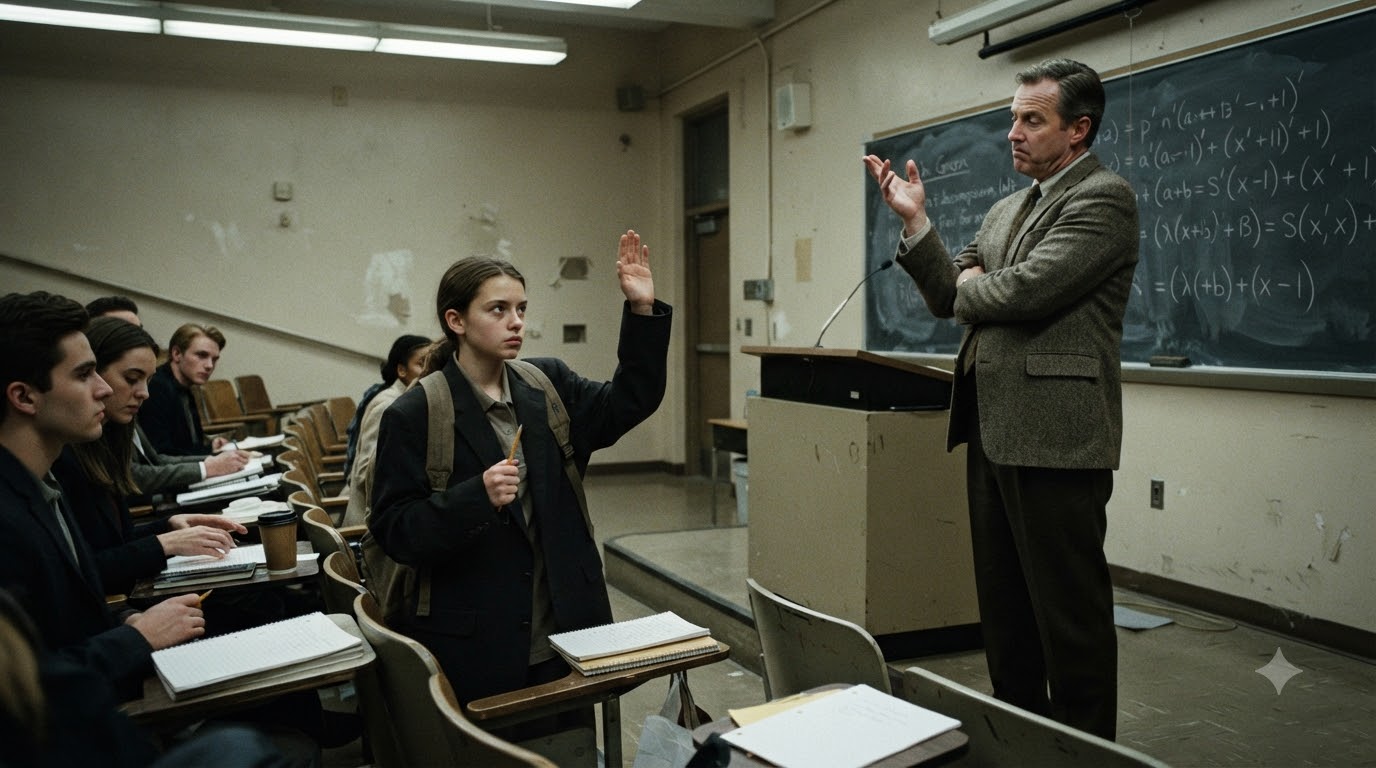
Up at the front of the amphitheater, Dr. Malcolm Green tapped a piece of chalk against the slate blackboard with sharp, rhythmic precision.
His eyes scanned the seating chart with cold indifference before landing directly on her name.
“Public school?” he asked, his voice cutting cleanly through the murmur of the room.
“Yes, sir,” Leila answered, her voice steady despite the dry tightness in her throat.
Dr. Green nodded once, a crisp motion devoid of warmth, and turned back to the board to begin.
He launched immediately into an intractable sequence on prime decompositions, writing equations that filled the boards with dizzying complexity.
The room scribbled furiously to keep pace.
Leila didn’t pick up her pen.
She watched the chalk move, her mind tracking the underlying rhythm of the numbers beneath his standard approach.
The flaw in his sequence was small, buried deep within the third transformation, but it was unmistakably there.
Her fingers twitched inside her pocket, grazing the wooden edge of a heavily chewed pencil.
She knew what happened if she spoke up too soon; she knew the cost of crossing the line.
Dr. Green reached the end of his derivation and turned back to the class, expecting the usual silent awe.
Leila raised her hand.
CHAPTER 2: The Dismissal of Chalk
“You are not ready for innovation, Ms. Carter,” Dr. Green said, his voice dropping an octave to carry the full weight of his authority.
The prep-school students around Leila muffled their chuckles behind expensive leather-bound notebooks.
Leila kept her hand raised for three seconds too long, feeling the heat climb up her neck before she slowly lowered it back to her desk.
She reached into her jacket pocket, her thumb finding the splintered edge of her wooden pencil and pressing down until the graphite snapped quietly against her palm.
“Master the basics first,” Dr. Green added, turning his back to her as if the matter were entirely settled.
The rest of the lecture blurred past in a series of standard prime decomposition models that felt more like a cage than an education.
When the bell finally rang, the lecture hall emptied in a rush of expensive coats and murmurs, leaving Leila alone at her desk.
She packed her battered notebook into her bag, her fingers moving with stiff, mechanical precision.
Back in her cramped Roxbury apartment that evening, the radiator hissed a rhythmic, metallic counterpoint to the quiet scratch of her pen.
Jermaine ironed his overnight security uniform at the small kitchen table, the scent of hot steam and starch drifting into her makeshift study.
“How was the second day?” her father asked, not looking up from the crisp crease of a collar.
“They don’t want the math,” Leila said, her eyes fixed on the equations spreading across her desk. “They want compliance.”
Jermaine set the iron down with a heavy thud, walking over to place a warm, calloused hand on her shoulder.
“Then give them something they can’t file away in a drawer,” he said softly.
She turned back to her papers, her pencil moving across the margin where she had jotted down a peculiar historical note copied from a library volume.
The original 1980 Hamilton-Weston paper contained a strange, faded redaction near the third theorem—a blacked-out line that looked suspiciously like a deliberate omission rather than a printing error.
Leila leaned closer to the desk lamp, her pulse quickening as she realized the missing text wasn’t a mistake at all.
It was a trap left behind by the founders, designed to stall anyone who didn’t already possess their institutional key.
She picked up a fresh sheet of paper and began to write, her breath catching in her throat as the hidden logic finally snapped into place.
CHAPTER 3: Midnight Equations and Splintered Wood
Leila rotated her hand, easing the cramping tension in her fingers before picking up a spare ink cartridge.
The paper before her was littered with non-traditional quantum transformation models, bridging the historical gap left by the 1980 margin note.
Across the small room, the rhythmic hiss of the radiator offered the only sound against the heavy stillness of the night.
Her father’s boots sat neatly by the front door, worn at the heels from another grueling shift protecting property that wasn’t his.
She did not have the luxury of academic backing, nor did she have a network of professors to shield her from departmental retaliation.
She had only the raw logic, cold and unforgiving, pulling the entire architectural framework together line by line.
Every variable accounted for.
Every historical blind spot exposed.
When the final calculation locked into place on the page, the exhaustion hit her like a physical weight, pressing her shoulders down toward the wood grain.
She laid the pen aside, her eyes burning from lack of sleep, but the proof was complete.
It was airtight, undeniable, and entirely her own.
CHAPTER 4: The Closed Door
The hallway smelled of floor wax and old paper.
Behind the mahogany counter, an administrative clerk did not look up from her paperwork as Leila approached.
“Submissions for the conjecture review go to the departmental drop-box,” the clerk said, her voice flat and dismissive.
“I need this logged directly with the committee chair,” Leila replied, setting the thick, bound stack of her 30-page proof onto the polished wood.
The clerk finally glanced up, her eyes narrowing as they took in Leila’s thrifted blazer and youthful face.
“We don’t process student papers of this scale without a faculty sponsor,” the clerk said, pushing the manuscript back across the counter. “Rules are rules.”
Leila did not reach for the papers; she kept her palms flat against the wooden edge, feeling the cold grain bite into her skin.
Without outside mentors to clear the path, the system was designed to swallow her work before it ever reached a desk.
“The rules state that any verifiable solution must be logged for committee review within forty-eight hours,” Leila said, her voice dropping into a quiet, unyielding register.
The clerk stiffened, realizing the girl wasn’t going to fold under a standard brush-off.
“Leave it,” the clerk snapped, snatching the papers away and tossing them into an unlabelled drawer. “If it gets looked at, it gets looked at.”
Leila turned on her heel and walked out, knowing the trap had just snapped shut around her proof.
CHAPTER 5: The Podium Silence
Dr. Green stood rigid beside the projection screen, his jaw working a tight muscle near his cheek.
“You were not called to speak, Ms. Carter,” he said, his voice clipped and vibrating with suppressed fury.
The prep-school students shifted uneasily in their seats, sensing the sudden breach of departmental protocol.
Leila did not step back.
She rested her palms flat on the wood, feeling the grain bite into her skin as she locked her gaze onto his.
“The Hamilton-Weston conjecture has a dimensional flaw in its third prime transformation,” Leila said, her voice cutting cleanly through the heavy air.
“Mathematical fantasy,” Dr. Green barked, taking a sharp step forward to block access to the whiteboard. “This department does not entertain amateur fabrications.”
He expected her to shrink, to fold under the collective glare of elite academia just as every gatekeeper before him had planned.
Instead, she reached into her jacket pocket, pulled out a single sheet of paper containing the unredacted topological framework, and laid it directly over his lecture notes.
“Verify it line by line,” she said.
Dr. Green’s hand hovered over the paper, his fingers twitching with a cold, desperate rage as he realized the archive trap had completely failed.
CHAPTER 6: The New Equation
Dr. Malcolm Green stared at the verified committee seal, his fingers twitching against the mahogany edge as he attempted one final, desperate deflection.
“This bypasses standard peer review channels,” he muttered, his voice cracking under the weight of public exposure.
“The committee reviewed every line,” the department chair replied, sliding the certified papers across the desk toward Leila. “The proof stands on its own merits.”
Leila did not smile or gloat; she simply reached out and picked up her manuscript, feeling the clean, unyielding weight of the verified pages.
The decades-old historical trap set by the institution had finally broken under the pressure of undeniable logic.
Back in her Roxbury apartment that evening, the hiss of the radiator welcomed her home.
Jermaine sat at the kitchen table, ironing his overnight uniform while a small, framed letter from a fifth-grade student in Chicago rested neatly against the wall.
“They verified it?” her father asked, setting the iron down.
“Yes,” Leila said, placing her notebook on the table next to a fresh, unchewed pencil.
She picked up the framed letter, reading the words of a young girl who believed math had no room for people like them.
The door to the room was open now, and the numbers finally belonged to everyone.
Leila sat down at her desk, picked up her pen, and began writing the next line.