The Quiet Weight of the Sky: A Study in Silver, Salt, and Fading White
CHAPTER 1: THE AMBER PULSE
The sunbaked asphalt of Naval Station Norfolk radiated a dry, synthetic heat that smelled of scorched rubber and low-tide salt. Evelyn Reed kept her thumb pressed against the housing of the handheld digital scanner, her palm absorbing the vibration of the fleet’s annual commissioning ceremony—the low, rhythmic bass of a brass band tuning three hundred yards down the pier, the flutter of miniature nylon flags in the hands of children waiting by the bleachers, the high, thin whine of an auxiliary power unit from a docked destroyer.
On the small, grease-smudged screen of her device, General Miller’s security bar-code didn’t turn green. It didn’t flash red either. Instead, it pulsed a slow, stubborn amber—a digital hesitation that meant the base’s main terminal hadn’t synchronized with the Pentagon’s temporary transit log.
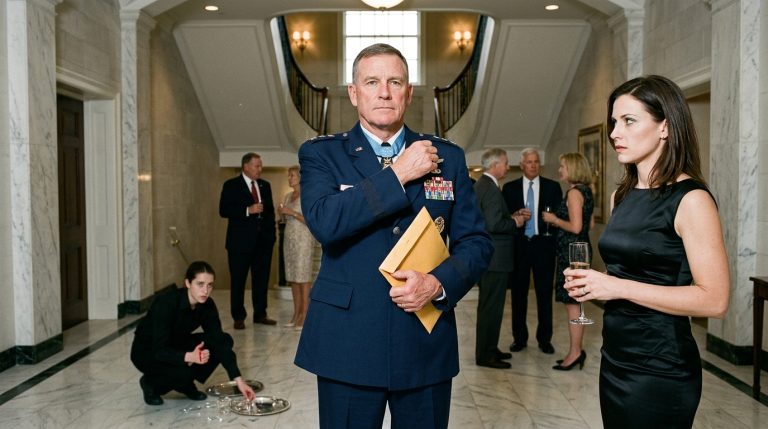
“I don’t have time for this,” Rear Admiral Thompson said. His voice was low, tailored for the perimeter of the VIP checkpoint, but it possessed the hard, metallic edge of a man who spent his life speaking over the roar of twin-screw turbines. His dress whites were immaculate, the gold braid on his combination cap catching the noon glare with a sharpness that made Evelyn’s hazel eyes narrow slightly. “This is General Miller. His credentials are unimpeachable. Let him pass.”
Evelyn didn’t shift her weight. Her boots, worn smooth at the heels but shined to a dull, professional standard, remained anchored to the chalked yellow line of the entrance gate. She looked past Thompson’s shoulder—not at the general, whose expression had hardened into an elite sort of boredom, but at the light. The sun was directly overhead, turning the white uniforms of the gathered officers into a blinding, featureless sheet. The edges of Thompson’s sleeves were crisp, starched so stiffly they seemed to click against his wrists as he moved.
“Sir, with all due respect, protocol requires a visual confirmation from the command post,” she said. Her voice was small, dry, and flat, designed to stay within the two-foot clearance between them. It was a civilian voice, stripped of the cadence of command, softened by three years of answering phones and signing clipboard registries. “If the digital scan fails, it will only take a moment.”
“The system is down because of the ceremony load, contractor. You know it, and I know it.” Thompson stepped closer. The scent of starch and heavy lavender shaving cream pushed past the smell of jet fuel. He didn’t look at her face; his eyes remained fixed on the blue-and-white plastic identification badge clipped to her navy polo shirt. It was frayed at the plastic laminate, the photo showing a woman with her hair pulled back into a neat, functional bun—anonymous, forty-two, and graying at the temples. “Your job is to facilitate, not obstruct. Now, step aside, or I will have you removed from this base permanently.”
The silver bracelet on Evelyn’s left wrist felt cold against her skin, despite the noon heat. It was a simple, tarnished band, hammered from an old piece of titanium hull-shaving she’d kept in a pocket a lifetime ago. It rubbed against the bone as she kept her hand raised—not an offensive gesture, but the steady, unyielding block of a gate-keeper who knew that an unverified amber pulse was a hole in the sky.
The silence between them stretched, heavy and salt-bitten, broken only by the distant, lonely cry of a harbor gull circling the gray superstructure of the carrier pier. She didn’t drop her hand. She waited for the earpiece to click.
CHAPTER 2: THE ECHO IN THE ROOM
The static in Evelyn’s right ear remained a dead, hollow hiss. Rear Admiral Thompson did not lean back; his shadow stayed clamped over her boots, a heavy, sharp-edged block on the concrete. She could see the tiny, salt-bleached fibers fraying along the shoulder seams of his dress whites, a subtle testament to how many times this specific uniform had been pressed, steamed, and forced to hold its shape against the Virginia humidity. Everything on this pier was trying to maintain an illusion of flawless iron, but under the heat, the edges were always going soft.
Her left arm remained steady, the handheld scanner resting flat against her thigh, its amber pulse casting a faint, rhythmic glow across the faded fabric of her khaki trousers. The glare from the water was intensifying, lifting the smell of creosote from the wooden pilings below the asphalt. Thompson’s jaw tightened, the skin over his cheekbones stretching into pale, bloodless bands. In the military hierarchy of Norfolk, silence from a subordinate was supposed to indicate submission, but Evelyn’s stillness wasn’t submissive. It was operational.
The rigid alignment of Thompson’s posture—the absolute refusal to acknowledge the possibility of a flaw in his environment—triggered a phantom resonance in her chest. It was the exact same spatial compression she had felt four weeks ago in the main briefing room of Building N-23.
That room had smelled of damp carpets and stale ozone from the cooling fans of three ceiling-mounted projectors. Evelyn had sat in the back row, her thumbs tracing the missing cover of the paperback novel she kept in her cargo pocket. The pages had been softened by sweat and grease until they felt like old flannel, a stark contrast to the stiff, unblemished briefing packets laid out before thirty uniform officers. She had been the only civilian contractor in the room, tucked away on the security roster like an afterthought, a piece of structural padding meant to listen and sign the attendance sheet.
On the projector screen, a blue-line map of the base perimeter had been displayed, detailing the motorcade route for the upcoming diplomatic visit. The officers had discussed logistics with a smooth, practiced cadence, their voices rising and falling in predictable waves of agreement.
Evelyn had looked at the map and seen the mistake instantly. It wasn’t a matter of rank; it was a matter of geometry.
When she raised her hand, the movement had been small, her arm rising no higher than her shoulder. The security chief had paused, his eyes scanning past the gold oak leaves and silver eagles until they settled on her navy polo shirt. When he called her name, she didn’t stand up. She kept her voice at the flat, conversational level she used for gate checks.
“Admiral, the proposed route for the motorcade has a significant blind spot between the armory and hangar 4,” she had said, her finger pointing toward the intersection where the line-of-sight symbols clipped through the concrete bulkhead. “The surveillance tower there has a restricted line of sight for nearly two hundred yards. If the lead vehicle slows at the turn, the mid-section of the transport becomes completely isolated from the primary watch box.”
The silence that followed had been cold, a sudden drop in pressure that made the hum of the projectors sound twice as loud. Thompson had been at the podium, his fingers resting lightly on the varnished wood. He hadn’t looked at the map. He had looked down the center aisle, past the rows of starched backs, until his gaze locked onto her faded badge.
“Is this true?” Thompson had asked, his voice dripping with an artificial, patient softness that was more insulting than a shout. He had directed the question to the Navy master-at-arms sitting three rows ahead of her.
The master-at-arms had shifted, his collar biting into his neck as he cleared his throat. “Sir, technically yes, but we deem the risk to be minimal based on the secondary roving patrols.”
Thompson had let out a short, dry breath—not quite a laugh, but the sound of a man clearing a speck of dust from his sleeve. His eyes hadn’t left Evelyn’s face. “The risk is minimal. Let’s leave the strategic analysis to the people who actually wear the uniform, shall we?”
A few low, nervous chuckles had rippled through the front rows, the sound of junior officers paying their dues to the podium. Evelyn hadn’t lowered her head. She had simply let her hand drop back to her lap, her thumb returning to the fraying edge of her paperback book. She had felt the weight of thirty pairs of eyes labeling her as an intrusive civilian, an administrative speed bump who didn’t understand the broader stroke of the command. They hadn’t seen her note the exact frequency of the tower’s sweep cycle; they hadn’t known she was calculating the deceleration curve of an armored Suburban based on wet asphalt friction. They just saw a contractor who didn’t belong in the light.
A sharp, double-click exploded inside her right earpiece, shattering the memory and bringing the noon glare of the pier back into absolute, agonizing focus.
The audio channel opened with a burst of gray noise, followed by the dry, nasal voice of the watch officer inside the base command post. “Checkpoint Alpha, this is Control. We have a manual override on the transit manifest for General Miller. Repeat, manual override. Clerical entry omission from the Pentagon travel desk. Validate credential manually and log the entry under code Delta-Nine. Clear.”
The channel clicked shut, leaving only the standard, faint hum of the open line.
Evelyn didn’t blink. She lowered the handheld scanner, her thumb releasing the trigger. The amber pulse vanished from her trousers, leaving only the dull, unreflective gray of the plastic housing. She stepped back exactly six inches, clearing the yellow line, her posture remaining perfectly straight as she reached for the physical logbook resting on the metal stand beside the gate.
“Clearance confirmed, Admiral,” she said, her voice remaining level, devoid of any satisfaction or triumph. She picked up the plastic pen, its blue cap chewed down to the white inner lining, and began writing the registration numbers into the log. “General Miller is cleared for the VIP seating area. Access code has been logged manually.”
Thompson stayed frozen for a split second, his hand still resting near the gold buttons of his tunic. His blue eyes scanned her face, searching for a smirk, a shift in her jaw, or some small sign of civilian disrespect that he could leverage into a formal complaint. But there was nothing. Her skin was dry, her expression as blank and unreadable as the gray hull of the destroyer docked behind him. He looked at General Miller, who gave a brief, impatient nod, before Thompson turned his back to her, his leather shoes clicking twice against the asphalt as he escorted the general past the barrier.
Evelyn watched them move away into the sea of dress whites, her fingers lingering on the cold, tarnished silver of her bracelet. The standoff was over, but the heat on the pier was still rising, and the air felt thick enough to burn.
CHAPTER 3: THE RUSTED PERIMETER
The cheap plastic cap of the ballpoint pen clicked as Evelyn tucked it back into the metal ring of the clipboard. The sound was flat, swallowed immediately by the broad, sun-bleached expanse of Checkpoint Alpha. Rear Admiral Thompson and General Miller were already twenty yards down the asphalt, their starched whites dissolving into the bright, shifting haze of the pier assembly. Evelyn did not watch them for long. She picked up her heavy canvas duty belt, adjusting the weight of the radio housing against her hip, and stepped away from the relative shade of the gate kiosk.
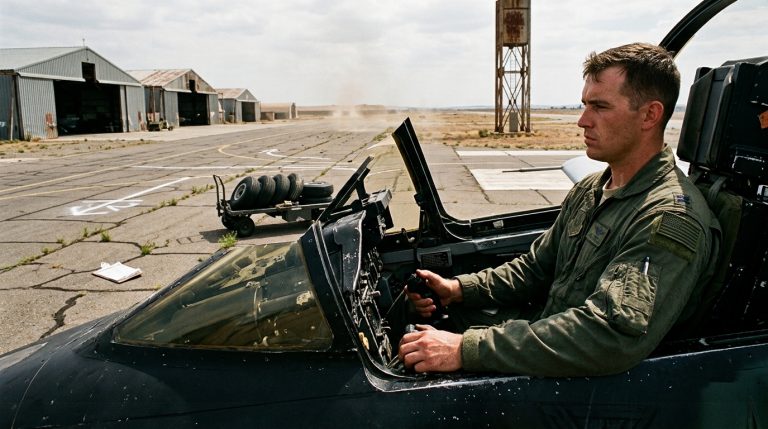
The heat on the perimeter track was different from the pier. Away from the water, the air stalled against the towering corrugated metal of the storage bays, picking up the dry, chemical odor of sun-baked grease and zinc-coated steel. Her left knee gave a quiet, familiar click on her first step onto the packed gravel path that traced the base boundary. It was a slight, uneven hitch in her stride—the physical residue of a high-altitude cockpit canopy fracturing against an oxygen-starved horizon years ago—but she managed it with a practiced, rhythmic economy. To a casual observer from the main road, she was simply an aging contractor pacing out a shift. To herself, she was a sensor sweeping a grid.
Two miles from the VIP checkpoint, the gravel gave way to sparse, heat-killed crabgrass along the back gate. Here, the fence line ran parallel to an old drainage canal where the brackish water sat entirely still, skin-filmed with oil scum. Evelyn walked slowly, her eyes tracking the chain-link grid from the top tension wire down to the concrete footings.
She stopped where the shadow of Hangar 4 cast a narrow, gray blade across the earth. The soil beneath her boots felt unusually yielding, the crusted topsoil collapsing into fine, powdery silt with the slightest pressure. She knelt down, the fabric of her khaki trousers straining against her knee, her fingers reaching out toward the base of the galvanized fence post.
The zinc coating on the bottom three rungs had completely bubbled away, leaving a rough, dark orange crust that flaked off under her fingernails like old scab tissue. When she wrapped her palm around the bottom tension wire to check its tautness, a single strand didn’t just bend—it sheared off with a heavy, leaden snap, the sound surprisingly dense in the midday silence. The wire didn’t possess the spring-steel snap of normal base-grade fencing. It was soft, weighted, and left a greasy, iron-dark smear across her thumb.
Evelyn held the broken strand between her fingers, her thumb feeling the internal grain of the fracture. This wasn’t standard environmental corrosion from the harbor salt. The metal had been exposed to an acid wash or a chemical thinning agent, the type used in industrial machine shops to strip oxidation before welding. Someone had deliberately treated this specific section of the barrier to look aged from a distance while structurally destroying its load capacity near the ground.
A shadow fell across the gravel behind her, accompanied by the heavy, rhythmic thud of thick-soled running shoes hitting the packed earth.
Evelyn didn’t look up immediately. She let her fingers trail down the rusted wire, her forearm absorbing the vibration of the runner’s approach. The footsteps slowed, the stride breaking into an irritated, uneven shuffle before coming to a complete halt three feet from her shoulder.
“Everything to your satisfaction, contractor?” Thompson’s voice was ragged from the three-mile loop, his breath coming in sharp, shallow bursts through his teeth. He was in his physical training gear now—a gray, sweat-soaked shirt that clung to his ribs and blue shorts with the naval emblem faded at the hem. His face was flushed a dark, dangerous crimson under the noon sun, the veins at his temples pulsing against his skin like blue thread.
Evelyn stood up deliberately, her movements fluid despite the click in her joint. She kept the broken piece of wire concealed against the palm of her hand, her thumb holding it flat against her duty belt. “The wire is showing signs of corrosion near this post, sir,” she said, her voice dropping into that same flat, civilian tone she used for the logs. “And the ground here is softer than the surrounding area. It could be a potential breach point.”
Thompson scoffed, a wet, rattling sound that ended in a sharp cough. He wiped a streak of gray sweat from his forehead with the back of his hand, his eyes tracking the dark smear of iron dust on Evelyn’s shirt before settling on her face with renewed irritation. “I’ve been running this perimeter for ten years, Reed. The fence is fine. The base infrastructure is evaluated by engineering units every six months, not by hourly gate guards.”
“The bottom tension loop has completely lost its tensile strength, sir,” Evelyn added, her voice remaining entirely level, stripped of any defensive edge. She pointed down at the powdery silt around the concrete footer with the tip of her work boot. “A five-pound vertical lift would clear enough clearance for a full field pack.”
“Get back to your post and stop inventing problems,” Thompson said, his jaw tightening as he stepped past her, his shoes kicking up a small cloud of the fine, gray dust. “We have three hundred dignitaries arriving on this base in less than two hours. I don’t need civilian contractors playing detective on a standard security fence to justify their overtime. Move.”
He broke back into a jog, his heavy shoulders rolling with an aggressive, defensive momentum as he disappeared around the corner of the armory wall.
Evelyn waited until the sound of his running shoes died out completely against the asphalt of the main road. Then, she reached into her pocket, withdrew a small, clear plastic property bag she used for stray keys, and dropped the sheared fragment of the treated wire inside. She didn’t submit a standard work order through the gate log; instead, she walked back toward the security shack, her mind tracing the geometry of the base map. Thompson thought she was looking for a vulnerability in his command, but she knew the truth was much simpler: the hole was already open, and someone had spent a long time making sure it looked like regular wear and tear.
CHAPTER 4: THE TAN UTILITIES
The last particle of gravel settled into the dust behind Rear Admiral Thompson’s departing form, leaving the perimeter road wrapped in a baking, heavy silence. Evelyn didn’t wait for the heat to thicken further. She turned toward the small secondary gate shack at the corner of Pier 3, her left hand keeping the plastic bag containing the chemical-stripped wire flat against the canvas pocket of her cargo trousers. Every step she took away from the fence line was an exact measurement of time; the formal ceremony was scheduled to commence in less than forty minutes, and the arrival of the special operations detachments would compress the checkpoint spacing down to seconds.
Inside the shack, the air was trapped behind salt-filmed plexiglass windows, smelling of old coffee grounds and the chalky, disintegrating foam of an old desk chair. She reached for the primary logistics clipboard—a scratched aluminum plate held together with electrical tape at the hinge—and flipped past the morning’s civilian contractor registries. Her fingers, still carrying the faint, iron-dark stain from the perimeter fence, traced the typed lines of the master arrival manifest.
A subtle discrepancy caught her eye between the third and fourth lines. The ink on the VIP annex sheet was crisp, standard thermal printing from the base administration pool. However, the registration numbers assigned to General Miller’s staff vehicle didn’t match the routing codes printed on the secondary gate manifest. The numbers had been transposed—not by a computer typo, but with the specific nomenclature used exclusively by the inner-tier evaluation groups of Naval Intelligence.
The clerical error Thompson had screamed about wasn’t an administrative oversight from the Pentagon travel desk. It was an deliberate insertion. The checkpoint failure had been engineered from within the base’s own security routing pool to test the visual verification latency of the gate guards.
Before she could process the depth of the log’s footprint, the low, throaty rumble of a diesel engine shook the plexiglass panes.
Evelyn closed the clipboard, letting the aluminum plate snap shut with a dull metallic clink. She stepped back into the blinding noon glare of the pier, her hand instinctively coming down to rest near the radio housing on her belt. A dark green transport van, its side panels caked in dried salt-crust and the dust of a different climate, pulled up to the staging barrier. The vehicle carried no flags, no bright uniform markings, and no starched trim.
The side doors slid back with a heavy, ungreased friction that sounded like raw iron scraping against slate. A unit of Navy SEALs began stepping down onto the sunbaked asphalt, their movements carrying the quiet, synchronized economy of men who spent their lives operating in enclosed spaces. They wore desert-tan utilities, the fabric faded by sun and rough washing until the camouflage pattern was nearly indistinguishable, blending into a uniform shade of dusty sand. Their skin was dark from extended exposure to a harsh, arid sun, and their boots were split at the seams, stitched back together with heavy nylon thread.
They were here to receive a unit citation for a deployment that officially didn’t exist on the afternoon program, their presence a stark, muted contrast to the sea of gleaming brass and starched white dress uniforms gathering around the main grandstand.
Admiral Thompson appeared from the side of the VIP tent, his dress whites once again projecting an aura of absolute, unblemished authority. He had changed out of his physical training gear, his gold buttons catching the glare with a precision that seemed designed to blind. His face had cooled from the dark crimson of his run, returning to a hard, pale mask as he stepped directly into the path of the incoming unit. He was flanked by two master-at-arms personnel, their black leather utility belts creaking in unison.
“Major Reed,” Thompson said, his voice carrying over the low idle of the transport van, using her civilian name with a sharp, tactical emphasis meant to establish the boundary before the guests. He stopped three feet from her, his white cap casting a sharp shadow across his eyes. “You are still directing civilian foot traffic away from the VIP block. Your post was shifted to the outer perimeter twenty minutes ago by my direct order to base maintenance.”
Evelyn remained still, her hands resting flat at her sides, her hazel eyes fixed on the center button of his tunic. “The perimeter wire requires immediate structural shoring, sir,” she said, keeping her tone within the flat, non-commissioned envelope. “I returned to update the logistics log before the final detachment clearance.”
“Your contract is with base security, but your presence on this pier is at my discretion,” Thompson said, his voice dropping into that venomous, low whisper that carried clearly to the ears of the first three men in the tan utilities. His fingers twitched near his belt. “And right now, my discretion is telling me you are a liability. I want you off this pier. Now report to your supervisor and inform him you’ve been removed from duty. Is that understood?”
The silence that followed was absolute, the heavy, salt-choked air of the harbor pausing between them. The sailors in their dress whites near the bleachers looked away, their posture stiffening with the awkward discomfort of witnesses to a public execution. Thompson stayed planted, his chin tilted slightly upward, waiting for the civilian contractor to break, to argue, or to lower her head in compliance.
Evelyn didn’t shift her weight. She reached for her radio to acknowledge the supervisor, her thumb brushing against the old silver bracelet on her wrist. The metal felt warm now, heated by the noon sun until it felt like a living wire against her pulse. She looked past Thompson’s shoulder, meeting the watchful, dark eyes of the lead SEAL commander, who had stopped his men five paces back. The space between the starched whites and the faded desert sand felt impossibly wide, a fault line running right down the middle of the concrete pier.
CHAPTER 5: THE CHAOTIC SIGNATURE
The pressure of Evelyn’s thumb against the rubber side-button of her radio remained constant, an unexecuted transmission frozen in the space between her breathing and Rear Admiral Thompson’s gaze. The idling diesel of the SEAL transport van sent a warm, heavy vibration through the soles of her boots. Then, without an acoustic warning, the dense, stalled air of the pier fractured. A sudden thermal gust tore off the harbor basin, whipping across the concrete bulkhead with a dry, whistling hiss that rattled the loose canvas flaps of the VIP tents.
The wind caught the left sleeve of her navy blue polo shirt. The soft, faded cotton—weakened by years of base laundry cycles—ballooned outward before pinning itself flat against her bicep, pushing the fabric upward past her elbow in one smooth, violent sweep.
For the people positioned within the five-foot envelope of the checkpoint, the exposure was immediate. Snaking up Evelyn’s forearm, starting from the thick bone of the wrist and disappearing beneath the twisted roll of the sleeve, was a raised, jagged track of discolored scar tissue. It wasn’t the clean, thin line left by a surgeon’s steel scalpel or the pale mark of an industrial burn. It was a chaotic lattice of puckered, graying skin that bunched together like pulled twine, the unmistakable signature of high-velocity metal fragments puncturing tissue under immense atmospheric force.
A chief petty officer standing near Thompson’s left flank—a master-at-arms veteran whose eyes were usually fixed on security clipboards—shifted his gaze. His jaw slackened by a fraction of an inch as his eyes tracked the erratic path of the scar. He had seen that exact traumatic tearing twice before, once in the triage tents outside Fallujah and once after an engine casing failure on an active flight deck. He knew the look of flesh that had been melted and rearranged by shattering titanium. His brow furrowed, his boots shifting on the asphalt as he looked from the scar back to the fading laminate of Evelyn’s ID badge.
Evelyn didn’t look down at her arm. Her movement to pull the sleeve back down was fluid, deliberate, and entirely mechanical—a single, practiced twitch of her right fingers that restored the anonymous blue boundary of the contractor uniform within the span of a single heartbeat.
The wind died as quickly as it had arrived, leaving the salt grit settling on the concrete. As she turned her torso to comply with Thompson’s removal order, her collar shifted along the back of her neck, the worn cotton pulling tight against her skin. For a split second, the Marine Gunnery sergeant stationed by the ceremonial stage caught a glimpse of her upper back, just below the hairline.
The dark ink was faded, softened by years of sweat and skin regeneration into a dull charcoal shadow, but the lines were absolute. It wasn’t a standard anchor, a motto, or a sentimental script. It consisted of two sharply angled, predatory strokes that formed the unmistakable tips of a raptor’s talons—the specific insignia worn exclusively by the pilots of elite tactical aviation units. The Gunny stayed rooted, his white-gloved hand lingering near the hilt of his ceremonial sword, his mind struggling to reconcile the low-profile presence of a gate guard with a symbol that only belonged five thousand feet above the dirt.
Five paces away, the leader of the late-arriving SEAL unit didn’t move toward the VIP seating area. His tall frame remained loose but perfectly balanced, his eyes locked onto the economy of Evelyn’s retreat. He watched her left leg—the tiny, almost imperceptible delay in her heel-strike that she masked by tilting her pelvis an inch to the right. It wasn’t the limp of a civilian who had slipped on a pier; it was the structural compensation of a body that had survived a high-speed deceleration matrix.
He squinted against the glare, the gray water behind her serving as a stark silhouette. His memory didn’t pull a face from a base registry; it pulled a profile from an old, classified pre-mission brief in the belly of a carrier five years prior.
“Chief,” the commander murmured, his lips barely moving as he kept his eyes on the back of Evelyn’s blue polo shirt. His voice was low enough to be buried by the low rumble of the van’s exhaust. “Take a look at that woman.”
The grizzled Master Chief beside him turned his head slightly, his eyes narrowing as they tracked the contractor toward the secondary shack. “The security guard? Yeah. Bad timing for her. Thompson’s on a tear today.”
“No,” the commander said, his voice tightening until it carried a hard, metallic resonance that made the Master Chief’s back stiffen. “Look at her frame. Look at how she calculates the distance to the bulkhead while she’s walking away from an reprimand. Have you ever seen her before?”
The Master Chief studied her for three seconds, his eyes moving from her boots to the neat bun of her hair, then shook his head. “Doesn’t register, sir. Just looks like another hourly clocking in.”
The commander didn’t look away as Evelyn reached the door of the security shack. He whispered a single word into the salt wind—a designation that wasn’t on any civilian roster, a name that carried the cold, silent weight of an engine flameout at fifty thousand feet.
“Wraith.”
The word didn’t leave his lips before a sharp, high-pitched shriek of over-stressed steel ripped across the pier, cutting through the ambient murmur of the crowd like a buzzsaw.
CHAPTER 6: THE TRAJECTORY OF IRON
The word Wraith had barely left the SEAL commander’s lips when the sound of structural failure demolished the baseline silence of Pier 3. It wasn’t a sudden explosion, but a long, agonized scream of high-tensile steel buckling under uneven loads. To Evelyn’s left, fifty yards past the VIP checkpoint lines, a heavy-duty lighting rig positioned on a multi-ton mobile lift began a slow, sickening lurch toward the harbor water. A high-pressure hydraulic line inside the secondary lifting cylinder had split, spraying a fine, amber mist of pressurized fluid across the staging deck.
The main mast of the rig, supporting sixteen massive steel lamp housings, shuddered once before its steel cables began to unspool from the drum with the rapid, rhythmic chatter of a machine gun.
The trajectory was immediate. The structural cross-beams were arcing directly toward Sector B of the bleachers—a tiered wooden and aluminum grandstand packed with families, children, and junior enlisted personnel who had arrived early for the flyover. Panic did not wait for the impact. A jagged, collective scream rose from the stands as people scrambled toward the single exit rail, their bodies crowding the narrow aisle until the flow of movement locked entirely.
On the staging deck, the response was a frozen second of uniform confusion. Admiral Thompson had pivoted on his heels, his white cap tilting backward as his eyes tracked the descending shadow of the steel tower, his hand reaching instinctively for a radio that wasn’t switched to the local emergency net. The master-at-arms details beside him remained stationary, their boots planted on the yellow line as their training struggled to categorize a mechanical collapse within a standard tactical checklist.
In that fraction of a heartbeat, the civilian contractor named Eevee ceased to occupy the space. The slight, uneven hitch in Evelyn Reed’s left knee didn’t vanish—it was absorbed into a calculated, aggressive stride that did not prioritize comfort.
“Brace and cover!” Her voice exploded across the pier. It wasn’t the flat, polite cadence she had used at the gate shack; it was a throat-tearing projection forged in the acoustic scream of F-22 engine bays, a voice designed to cut through canopy roar and terminal alarms. It carried an absolute, instinctual weight that forced forty people in the nearest row to drop flat against the aluminum floorboards before their minds could identify the source of the command.
She didn’t run toward the center of the crowd; she ran parallel to the descending arc of the tower, her eyes tracking the speed of the hydraulic fluid draining onto the asphalt. Her spatial awareness, honed by thousands of hours calculating closure rates against supersonic horizons, broke the collapsing scene into a simple vector map. The rig was coming down at an angle of thirty-five degrees, accelerating by three feet per second squared as the remaining support cables unraveled from the cracked winch drum.
“VIPs against the bulkhead! Stage right!” she bellowed, her right arm extending toward the thick, unyielding steel wall of the docked destroyer. The command was precise, clear, and stripped of administrative fluff. It gave the scattered officers a definitive heading, breaking their paralysis.
She reached the base of the bleachers just as the shadow of the upper cross-beam blocked out the noon sun. Two young seaman apprentices were standing paralyzed near the lower access gate, their arms linked in a futile attempt to hold back a crowd of climbing families.
Evelyn reached out, her fingers catching the starched collar of the nearest sailor, pulling him three inches to the left with a mechanical force that jarred his spine. “You two, get the children clear now. Use that maintenance corridor.”
Her finger jabbed toward a narrow, unlit gap between the armory wall and the utility sub-station—a three-foot safety lane that wasn’t marked on the public maps but ran directly to the open tarmac behind Hangar 4. The sailors didn’t salute; they didn’t look at her badge. The raw authority in her face was a uniform of its own. They dropped their arms and began hauling toddlers and parents into the dark concrete lane just as the upper tier of the grandstand began to split under the weight of the shadow.
Evelyn stepped back, her boots planting firmly in the silt-dust near the foundation line, her eyes measuring the final six feet of the tower’s descent. The silver band on her wrist was hot against her skin, the metal vibrating with the low, subterranean rumble of the pier’s pilings absorbing the strain of the shifting load. She didn’t look back to see if Thompson or the SEALs were moving to assist; she stayed focused on the path of the iron, her mind registering each structural pop as a countdown to zero.
CHAPTER 7: THE CRUSH ZONE
The concrete beneath Evelyn’s boots shuddered with a deep, subterranean groan as the primary cross-beam of the lighting rig sheared through the upper aluminum support rail. The sound was an absolute, grounding roar—a chaotic crunch of twisting metal and splintering pressure-treated timber that sent a cloud of gray chalk dust and pulverized paint flecks exploding into the hot harbor air. The multi-ton tower didn’t collapse into a loose heap; it wedged itself into the lower structural frame of the grandstand exactly where she had calculated, the remaining taut cables snapping one by one with the high, melodic ring of breaking piano wire.
Evelyn kept her back pressed against the lower concrete footing of the assembly, her chest absorbing the localized shockwave of the impact. The hot, misty spray of hydraulic fluid settled over her face and arms, carrying a bitter, synthetic taste that mixed with the dry dust in her throat. She didn’t close her eyes. Through the gray shroud of the debris cloud, her hazel gaze scanned the lower access lane, verifying the lines of movement she had initialized five seconds prior.
The two seaman apprentices were already clear, their starched uniforms covered in gray silt as they pulled the final group of civilian dependents through the narrow gap between the armory wall and the utility sub-station. The corridor had held. The families were streaming onto the open tarmac behind Hangar 4, their movements fast but directional, stripped of the circular, trapping panic that had threatened to lock the main exit rail.
Evelyn stepped out from the shadow of the buckled frame, her boots grinding through a carpet of shattered glass from the high-intensity lamp housings. The immediate kinetic threat had terminated, but the pier was wrapped in a dense, unmoving silence, the ambient sounds of the fleet’s ceremony completely smothered by the dust. Through the haze, the figures on the staging deck began to resolve into sharp silhouettes.
Rear Admiral Thompson remained near the VIP boundary, his hands dropped to his sides, his white cap slightly askew from the vibration of the impact. His face was entirely devoid of its earlier color, the starched lines of his tunic dusted with a fine layer of gray zinc powder. He looked at the mangled wreckage of the tower, then at the empty safety lane where the crowd had been less than ten seconds ago, and finally at the quiet woman standing in the debris with a frayed blue polo shirt and khaki trousers. His jaw moved slightly, but no cadence of command emerged from his throat; his framework had no protocol for a civilian contractor who had just assumed absolute tactical control of his deck.
Beside him, the unit in the faded desert-tan utilities had stopped their advance. They hadn’t ducked; they hadn’t scattered. They stood in a loose, lethal crescent formation, their watchful eyes cataloging the structural stability of the remaining beams before tracking back to Evelyn’s position. The lead commander stepped forward, his split-seamed boots clearing the yellow checkpoint line without an administrative glance. The professional distance between them had collapsed down to nothing, replaced by a cold, mutual understanding that didn’t require an identification badge or a starched collar to recognize.
Evelyn reached up with her right hand, her fingers clearing a streak of damp hydraulic grit from her cheekbone. Her thumb brushed against the tarnished silver bracelet on her wrist, its cool titanium weight serving as the only unyielding anchor in the shifting haze. She did not look at Thompson’s frozen expression, nor did she acknowledge the murmurs starting to ripple through the junior officers along the perimeter lines. Her focus remained on the immediate sector, her mind already transitioning back to the logistics registry, her flawed leg taking the first step back toward the quiet clarity of her post.
CHAPTER 8: THE SACRED FOREST
The crunch of a broken lamp shard beneath her sole was the only sound that broke the absolute stillness settling across Pier 3. Evelyn didn’t look down at the glass. She kept her weight distributed evenly, her eyes steady as the lead SEAL commander halted exactly three feet from her. His team moved silently behind him, anchoring themselves into a rigid, unblinking line that walled off the wreckage from the VIP staging area. The desert-tan fabric of their utility shirts, stained with dark grease and salt rings, smelled of coarse canvas and cold harbor mud.
The commander did not offer a formal greeting. He stared into her hazel eyes, his gaze shifting down for a fraction of a second to trace the jagged track of the fragment scar on her forearm before returning to her face. The lines around his mouth were deep, carved by wind and high-altitude glare.
“Ma’am,” he said. His voice was remarkably quiet, yet it possessed a dense, structural resonance that traveled through the humid air with perfect clarity. He didn’t check her frayed plastic badge. He didn’t look at Thompson. He simply brought his right hand up to his brow, his fingers locking into a salute so sharp, so mathematically precise, it seemed to slice through the lingering haze of hydraulic mist.
It was not the perfunctory gesture given to an administrative superior; it was the salute a warrior extends to a relic.
Behind him, the movement was instantaneous. The entire special operations detachment snapped their boots together, the synchronized strike of their worn heels echoing off the gray steel bulkhead of the destroyer. Seven right hands cracked against their brows in absolute, unified precision. The silent weight of their respect hit the pier like a physical force.
Evelyn stayed perfectly still, her palm resting flat against the side of her khaki trousers. The cool curve of the titanium bracelet on her wrist felt exceptionally heavy, pressing against her pulse. She could see the realization spreading outward from the SEAL line like a crack in thin ice. The Marine Gunnery sergeant near the stage, whose eyes had been fixed on the raptor’s talon insignia beneath her collar, straightened his back until his spine locked, his white-gloved hand coming up in a flawless, rigid salute.
Then, the forest began to grow.
An army colonel attending as a guest of the ship’s captain came to attention, his leather shoes clicking against the grit. Across the pier, the older Air Force veterans tucked into the spectator rows—men and women who had spent a decade repeating whispered legends about a pilot who had walked away from a disintegrated cockpit at sixty thousand feet—stood up from the wooden benches. Their eyes were wide, fixed on the quiet contractor in the faded navy polo. One by one, their hands came up. The junior sailors on crowd-control duty followed, their training taking over as the entire perimeter became a sea of raised hands and starched sleeves, all directed toward the woman with the clipboard.
Rear Admiral Thompson was the last to move. He remained pinned to the asphalt, the world he had meticulously organized around rank and gold braid having turned completely upside down. The woman he had publicly humiliated, the contractor he had ordered off his deck as a bureaucratic liability, was a decorated pioneer whose shadow reached further than his entire command. The pale mask of his face grew tighter, his breath hitching as the collective judgment of the pier settled over his shoulders.
Slowly, his arm rose. The movement looked difficult, as if he were lifting the entire weight of the fallen lighting rig, his fingers stiffening as they touched the brim of his gold-braided cap. His salute remained held far past the requirements of standard protocol—a silent, suffocating admission of his own arrogance.
Evelyn did not revel in the space they had opened for her. The hundreds of silent, awe-filled stares didn’t offer comfort; they threatened the sanctuary of the anonymity she had spent three years building near the waterline. She met the SEAL commander’s gaze for one final, unblinking second, giving him a single, micro-nod—the quiet acknowledgment of one operator recognizing another in the middle of a crowded deck.
As the salutes began to lower, Thompson stepped forward, his leather shoes dragging slightly through the white powder on the asphalt. The sharpness had vanished from his eyes, his starched posture looking oddly hollowed out under the noon sun.
“Major Reed,” he said, the name cracking slightly in his throat as he struggled to find the cadence. He stopped two feet away, his cap held in his hand now, revealing the thin, graying hair at his temples. “I… my conduct was inexcusable. There is no administrative excuse for the disrespect I’ve shown you on this pier.”
Evelyn looked at him, her expression holding no trace of malice, no civilian satisfaction, and no military triumph. She didn’t see an admiral; she saw a man who had finally run into the geometry of his own error. She reached down, her thumb tracing the smooth, worn edge of the titanium band on her wrist—the metal she had hammered out to remind herself of the young pilots who were still flying those unpatched birds with systemic radar flaws, the ones she stayed near the fleet to watch over from the safety of the gates.
“We all have a watch to keep, Admiral,” she said, her voice returning to that small, dry, conversational level that stayed within the two-foot clearance between them. She picked up her aluminum clipboard from the metal stand, her fingers smoothing down the frayed edge of the plastic logbook cover. “Today, mine was this checkpoint. That’s all that matters. Please see to your guests.”
She turned deliberately, her left knee giving that same quiet, predictable click as she set her stride toward the secondary gate shack. She didn’t look back at the grandstand, nor did she watch the first responders begin to clear the buckled iron beams. She walked back into the shade of the plexiglass windows, her pen ready, her fingers anchoring themselves once more to the quiet routine of the registry.