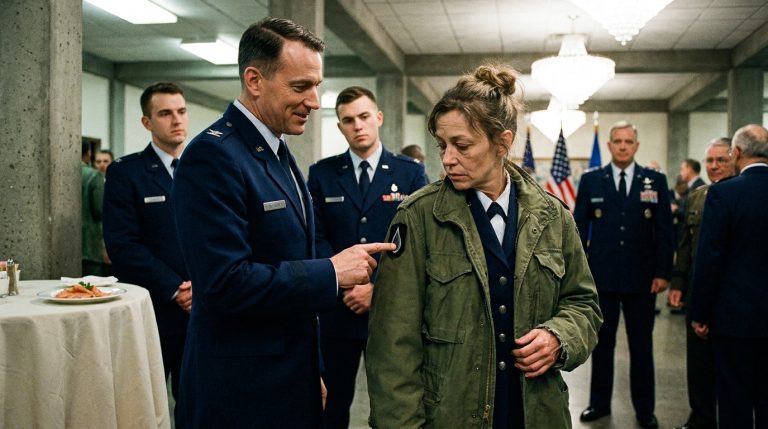
The Navigator’s Ghost: A Cold Calculation of Duty, Discipline, and the Weight of Unseen Command
CHAPTER 1: The First Snap
The fluorescent lights of the USS Holstead’s mess deck hummed with a low-frequency vibration that rattled the teeth. Lieutenant Junior Grade Christopher Blake stood motionless, his eyes locked on the burger, his finger hovering over the screen of his phone like a weapon. The silence in the galley was absolute—the kind of silence that precedes an explosion.
Thomas Brennan held the spatula, his grip unchanging. His knuckles were pale, smooth skin stretched over rigid bone. He didn’t look at Blake’s face; he watched the boy’s pulse jumping in his carotid artery. That was the first tell. A man who couldn’t control his own physiology had no business commanding a section.
“You’re documenting this, Lieutenant?” Brennan’s voice was dry, a whisper of gravel against silk. “A burger order? Is this the standard of tactical analysis you bring to the bridge?”
Blake’s face tightened, the skin pulling back from his teeth in a grimace. “This is about operational discipline, Brennan. You’re a placeholder, a relic of a time when we weren’t fighting for our survival. If you can’t handle a simple kitchen directive, how are you operating in my ship’s vital systems?”
Brennan shifted his weight. He didn’t feel the floor beneath his non-slip shoes; he felt the deck of a destroyer in 1962, the pitch and roll of a hurricane that defied physics. He looked at the patch on his shoulder—the faded threads of Task Group Atlantic 7. He felt the cold iron of the bulkhead behind him.
“I’ve seen men who look just like you, Lieutenant,” Brennan said, his eyes finally meeting Blake’s. “They look at the surface of things—the cheese, the uniform, the rank—and they miss the structural integrity of the foundation. You aren’t checking my service. You’re trying to find a hole in the hull because you’re afraid of what’s inside.”
Blake stepped forward, his boot scuffing the deck, the sound uncomfortably loud. He reached out, his hand sweeping toward Brennan’s shoulder, a gesture of dominance.
“You’re done, old man. I’m reporting this to logistics. I want you off this ship before the next watch.”
As Blake’s fingers brushed the faded anchor and wings on Brennan’s shirt, the galley didn’t just go quiet; it seemed to hold its breath. Brennan saw something then—a flicker in Blake’s eyes, a shadow of genuine, unadulterated fear masked as ego.
Brennan didn’t flinch. Instead, he reached into his apron pocket, his fingers brushing a small, heavy brass key that didn’t belong to any lock on the USS Holstead. The ledger in his cabin was missing a page, and now, he knew exactly who had taken it.
“You think this is about the burger, Lieutenant?” Brennan leaned in, his voice cutting through the hum of the lights like a razor. “You’ve made a move on the board that you don’t even understand. And now, you’re going to have to live with the result.”
The galley hatch hissed open, but it wasn’t the logistics officer who stepped through. It was Chief Reeves, her eyes fixed on the phone in Blake’s hand, her face a mask of cold, professional resolve. The trap was set.
CHAPTER 2: The Geometry of Silence
The air in the galley was thin, stripped of its warmth by the sudden, sharp silence that followed the opening of the hatch. Chief Reeves stood between the galley counter and Lieutenant Blake, her posture a masterclass in static defense. She was a wall of resolve, and behind her, the crew had collectively stopped moving, their eyes darting between the young officer’s trembling hand and Brennan’s steady, iron-calm presence.
Brennan didn’t look at the Chief. He looked at the floor, at the scuff marks on the non-slip tiles, and felt a familiar, cold prickle at the base of his neck. It was the phantom smell of ozone and wet canvas—the unmistakable scent of a storm that had refused to break sixty years ago. He was back on the destroyer, the deck heaving beneath his feet, the sound of the wind screaming like a banshee. He forced his eyes to focus on the chrome of the serving counter. The smell of frying onions and synthetic grease ground him back into the present, but the ghost of the hurricane remained, pulling at his concentration.
“Lieutenant,” Chief Reeves said, her voice dropping into that specific, deadly register that senior enlisted use when a junior officer has crossed the line from authority into lunacy. “I suggest you take your tray to the wardroom and sit down. This matter is being handled.”
Blake’s face was a map of collapsing composure. His skin had gone a chalky, bloodless gray, and his eyes—previously sharp and judgmental—were now darting around the mess deck as if he were looking for an exit that didn’t exist. He had expected to assert dominance; instead, he had stumbled into a theater of collective, unspoken loyalty that he hadn’t even known existed.
“You don’t understand,” Blake whispered, his voice cracking, losing its sharp, cutting edge. He looked at the notebook in his hand as if it were a foreign object. “I’m just doing my job. The standards—they were explicit.”
Brennan stepped around the corner of the counter. The movement was slow, deliberate. His boots made no sound on the deck. He didn’t tower over Blake; he didn’t need to. He simply occupied the space with an absolute, terrifying stillness.
“Standards aren’t a shield, son,” Brennan said. His voice was low, hitting the lieutenant like a physical weight. “They are a floor. If you think you’re standing on top of them, you’re looking at the world upside down.”
Brennan reached out and gently—almost clinically—took the notebook from Blake’s limp hand. He didn’t look at the contents. He flipped it shut with a sharp, final snap of leather that echoed against the overhead bulkheads. The sound was like a pistol shot in the confined space.
“Chief,” Brennan said, his eyes never leaving the lieutenant’s face. “Please ensure the Lieutenant is escorted to his quarters. He’s had a long shift, and his perspective is currently compromised.”
“Aye, sir,” Reeves replied, the ‘sir’ hanging in the air with the weight of a court-martial.
Blake tried to speak, his jaw working, but no sound came out. The realization of his miscalculation was dawning on him, not as an intellectual understanding, but as a physical sensation of shrinking. He had been so convinced that the old man was a vulnerability to be excised that he had failed to see he was standing in the presence of an architect of the very discipline he worshipped.
As the security detail stepped forward—men and women who had spent their weeks listening to Brennan’s stories in the quiet hours of the night shift—Blake offered no resistance. He turned, his uniform immaculate, his posture broken, and allowed himself to be led toward the hatch.
Brennan stood alone behind the counter as the mess deck began to slowly, cautiously resume its rhythm. The clatter of trays returned, but it was muted, respectful. Brennan reached into his pocket and touched the cold, jagged teeth of the brass key. He knew why the ledger was missing its page. He knew who had been digging into the archives, and he knew that Blake was merely the tip of a spearhead aimed at a past that was never meant to be reconstructed.
He didn’t move for a long time. He stood in the center of the galley, watching the shadows lengthen across the stainless steel, feeling the ship’s vibration through his heels. The test had been a success, but it had alerted the wrong people. He hadn’t just exposed a bad officer; he had forced the command to notice that the old man in the blue apron was more than a volunteer.
The storm was coming back. Not the one from 1962, but a modern one, built of digital paper trails and the desperate ambition of men who wanted to claim a legacy that wasn’t theirs. Brennan took a breath, the air tasting of stale coffee and the inevitable. He walked to the back of the galley, locked the pantry door, and pulled a small, hidden communications device from behind the insulation of the bulkhead.
It was time to see who was actually listening.
CHAPTER 3: The Weight of Hidden Signals
Thomas Brennan stood in the shadow of the pantry’s cooling unit, the small, cold transmitter pressed against the callouses of his thumb. The ship hummed—a deep, resonant vibration that he felt in his marrow, a language of iron and pressurized steam. He slipped the device into the hidden lining of his apron, the fabric already worn thin by years of similar clandestine habit. He didn’t rush. Rushing was for men who were still learning the rhythm of the sea; Brennan moved with the glacial, terrifying certainty of a man who had already measured the distance between his survival and his past.
He pushed the pantry door open. The galley had returned to its routine, but the texture of the air had shifted. The chatter was thinner, the clatter of the trays more deliberate. Sailors worked with their heads down, eyes occasionally flicking toward the spot where Blake had been broken. It wasn’t fear, exactly—it was an awareness. They knew something had been shattered, and they were all waiting to see what would rush in to fill the vacancy.
Brennan stepped back into the line, his movements mechanical, efficient. He picked up his spatula. The stainless steel reflected the overhead fluorescent lights, which seemed to strobe in a rhythmic, irritating cycle. For a fleeting second, the light caught the edge of a stainless-steel table, distorting the perspective. The room seemed to stretch, the distance to the bulkhead doubling in the flickering glare. He blinked, grounding himself. It was just the fatigue, he told himself, but the feeling of being watched was pervasive. It wasn’t the gaze of the crew; it was the clinical, systematic observation of someone who knew how to look for inconsistencies.
His focus narrowed to the task at hand, but his ears remained tuned to the frequencies of the ship—the sudden, rhythmic thud of heavy boots on the deck grating outside the mess deck. The heavy hatch swung open with a hiss of equalization.
Commander Patricia Morgan stepped through. She wasn’t wearing her usual composed, administrative mask. She moved with a purpose that bypassed the mess deck entirely, her eyes scanning the room until they locked onto Brennan. She didn’t look at the serving line; she looked at the man behind it.
Brennan met her gaze without altering his rhythm. He flipped a burger, the sizzle of the meat on the hot surface the only sound in the immediate vicinity. He saw the tension in the set of her shoulders, the way her hand drifted toward the leather folio tucked under her arm. She was an officer who prided herself on transparency, yet there was a frantic, brittle edge to her composure.
“Mr. Brennan,” she said, her voice cutting through the ambient noise, though it lacked the sharp, disciplinary edge of Lieutenant Blake’s earlier theatrics. It was colder, more dangerous. “A word, if your duties allow.”
Brennan nodded slowly, placing the spatula down. He wiped his hands on the apron, a gesture that gave him a moment to process the geometry of the room. Chief Reeves, positioned at the edge of the dining area, was watching Morgan, her expression unreadable. She would be the pivot point, Brennan knew.
“The kitchen can survive without me for a moment, Commander,” Brennan replied.
He walked out from behind the counter, his non-slip shoes squeaking softly on the deck. As he approached, he noticed the subtle, rhythmic tapping of Morgan’s fingers against the folio. She was nervous—or perhaps, she was terrified of what she had discovered in the records. She didn’t lead him toward the wardroom. Instead, she guided him toward the quiet, low-traffic corridor that led to the engineering sub-levels, a place where the hum of the turbines acted as a natural acoustic shield.
They walked in silence for fifty paces. The lighting here was dim, the walls lined with exposed pipes that dripped condensation onto the deck plates. It felt like the bowels of a ship from 1962, dark and suffocatingly tight.
“You’ve caused a significant disruption, Thomas,” Morgan said, not looking back. Her voice echoed off the steel walls. “Blake is being processed, but the logistics of his removal have opened a window. A very public window.”
“I didn’t open it,” Brennan said, his voice steady. “I just stood where I was placed. If the window was already broken, that’s a maintenance issue.”
Morgan stopped and turned. The dim light caught the side of her face, highlighting the exhaustion beneath her eyes. She leaned in close, her voice dropping to a whisper that was almost entirely swallowed by the groan of the ship’s machinery. “The Captain is looking into the service records of Task Group Atlantic 7. He thinks it’s an error in the archives. I know better. I’ve seen the way you hold yourself when the hull groans at a specific frequency.”
She held up the folio. “I found the page that was missing from the ship’s ledger. It was in Blake’s quarters. He didn’t steal it; he found it, and he didn’t know what he was looking at. But I do.”
Brennan felt the cold weight of the transmitter against his ribs. He looked at the folio, then up at Morgan. She wasn’t just investigating; she was trying to reconcile the legend with the man in the apron. She was looking for a hero, and in doing so, she was about to pull a thread that would unravel everything.
“Commander,” Brennan said, his voice hard as iron. “Some things are kept in the dark because the light would destroy the very thing you think you’re honoring.”
He took a step closer, the narrowness of the corridor forcing them into a space of uncomfortable proximity. “If you open that file, you don’t just clear my name. You rewrite the history of this ship, and you might not like the ending of that story.”
Morgan didn’t flinch, but her grip on the folio tightened until her knuckles turned white. The turbine hummed louder, a deep, rhythmic vibration that seemed to match the pounding in Brennan’s own chest. The secret was breathing, and for the first time in sixty years, it was no longer under his control.
CHAPTER 4: The Archive of Echoes
The air in the sub-level was thick, saturated with the metallic tang of recirculated air and the distant, rhythmic grinding of the ship’s stabilizers. Brennan kept his eyes fixed on the condensation dripping from a overhead conduit, counting the seconds between each rhythmic oscillation of the ship. He needed that silence. He needed to ensure his pulse remained steady, a flat line of composure against the rising tide of Morgan’s inquiry.
“You’re asking questions that weren’t meant to be answered, Commander,” Brennan said, his voice dropping into that low, resonant frequency he had used to command men under fire six decades ago. He didn’t look at her. He watched the way the dim overhead lights cast long, distorted shadows across the bulkhead. “The record isn’t missing. It was redacted. There’s a distinction.”
Morgan stepped back, the folio clattering against the wall as she moved. The space was too narrow for a confrontation, and the lack of room made the tension feel suffocatingly real. “Redacted by who? The Navy doesn’t redact survival records, Thomas. They celebrate them. Unless that survival came at a cost that the admiralty couldn’t justify to the public.”
She was smarter than she looked, or perhaps, simply more relentless. Brennan felt the ghost of the hurricane again—the way the sea had seemed to swallow the horizon, the way the radar screen had flickered into nothingness. He shifted his weight, his non-slip shoes squeaking against the slick steel deck. He needed to get her out of here, away from the archive access points, before she stumbled onto the second set of logs—the ones that didn’t exist in any digital database.
“Come,” Brennan said, turning away from her toward the heavy, vertical ladder leading up to the main storage level. “If you want to see the architecture of the past, you don’t look at the files. You look at the ship itself.”
The climb was slow. Brennan’s joints ached—a reminder of the years that had passed—but his grip on the rungs remained firm. He heard Morgan’s breath, rhythmic and controlled, following him. When they reached the upper storage deck, the atmosphere changed. It was cooler here, the air drier, filled with the scent of ozone and aging paper. This was where the legacy of the Holstead was kept, a quiet, dusty tomb of manuals and maintenance logs.
Brennan moved directly to the rear section of the stacks, a corner labeled for decommissioned logistics assets. He reached behind a stack of weathered technical manuals, his fingers finding the familiar, cold indentation of a physical lock. He withdrew a small, brass key—the same one he had felt in his apron pocket in the galley—and inserted it into a panel that looked like a standard junction box.
With a click that sounded like a gunshot in the stillness of the archive, the panel swung open. Inside lay a set of authentic, hand-stamped authentication keys—the kind used for manual override of communication arrays. They were misplaced, abandoned in the wrong locker, a relic of a logistical oversight that had lasted for twenty years.
Morgan leaned over his shoulder, her eyes widening as she saw them. “These aren’t maintenance tools. These are for the secure, manual override of the carrier group’s tactical broadcast. Why are these here?”
“Because in 1962, the world didn’t rely on computers, Commander,” Brennan said, his voice hollow. “It relied on men who had to make decisions when the machines failed. You think I’m a legend because I navigated through a storm. I’m a ghost because I had to decide which signal would go out to the fleet, and which would be silenced.”
He didn’t explain further. He let the weight of the statement settle between them. Morgan reached out, her fingers hovering near the keys, but she didn’t touch them. She realized then that the archive wasn’t just a place of history; it was a crime scene.
“If you bring these to the Captain,” Brennan said, his eyes finally locking onto hers with a piercing, predatory focus, “you’re not opening a file. You’re firing a shot at the integrity of the entire command structure. Are you sure you want to be the one who pulls that trigger?”
Morgan pulled her hand back, her face draining of color. She looked at the keys, then at Brennan, and for the first time, she saw the distance between the volunteer cook and the man who had stood on the deck of a dying ship in the middle of a hurricane. The silence in the archive was absolute, broken only by the distant, thumping heartbeat of the ship, a sound that now seemed to mirror the ticking of a clock that had started long ago and was finally, inexorably, running out.
CHAPTER 5: The Simulated Crisis
The silence in the archive was torn apart by the shrill, discordant wail of the ship-wide alarm. It wasn’t the rhythmic cadence of a fire drill; it was the sharp, jagged pulse of a General Quarters simulation. Instantly, the overhead fluorescent lights buzzed, strobed a violent, blinding white, and then plunged the entire sub-level into absolute, suffocating darkness.
Brennan didn’t move. He stood anchored to the floor, his breathing shallow and controlled. He could feel the proximity of Commander Morgan; he could hear the quick, sharp intake of her breath as the darkness hit. She was disoriented, reaching out blindly against the racks of manuals, the frantic scrabbling of her fingertips against the metal shelving sounding like a swarm of insects.
“Stay still,” Brennan whispered, his voice low, commanding. The darkness was a physical weight, but it was familiar. He felt the ship’s vibration—a sudden surge in the turbine output—and knew they were transitioning to a high-energy state.
“Thomas?” Morgan’s voice was strained, laced with a tremor of genuine, unvarnished fear. “What is this? This isn’t on the drill schedule.”
“The ship’s automated systems are triggered by any unauthorized access to the manual override interface,” Brennan said, his eyes scanning the gloom. He didn’t see color; he saw outlines, shapes, the negative space of the room. “We tripped a silent circuit. The system thinks there’s a security breach. It’s locking down the sub-levels.”
He heard the heavy, pneumatic thud of the archive hatch locking shut. They were trapped. Brennan reached into his apron and gripped the authentication keys. He needed to find the manual release for the lockdown before the security detail arrived. He knew the protocol; he had written the original iteration of it in a damp office in 1962.
“Give me your hand,” Brennan ordered.
Morgan hesitated, then reached out. Brennan took her wrist, his grip firm, and began to move. He didn’t rely on sight. He counted steps, felt the orientation of the floor plates, and listened to the hum of the cooling fans. They moved with a fluidity that betrayed his age. He knew this ship because he knew the men who had designed it—men who, like him, trusted physics over software.
As they reached the far end of the racks, the alarm tone shifted. It grew deeper, more urgent. Red emergency lighting flickered to life, bathing the corridor in a harsh, subterranean glow. It wasn’t enough to see detail, but enough to see silhouettes. And there, at the end of the aisle, Brennan saw a shadow move.
It wasn’t a security guard. The movement was too precise, too deliberate. It was a man, tall and thin, standing near the manual release junction.
“Who’s there?” Brennan called out, his voice ringing with a cold, metallic authority.
The shadow didn’t answer. It shifted, and in the crimson strobe of the emergency light, Brennan saw the glint of a handheld scanning device. Someone was extracting the data from the backup logs—the very logs Brennan had spent sixty years protecting.
“They’re not here for the records, Thomas,” Morgan whispered, her voice a sharp realization. “They’re here to wipe the original Task Group logs. If they get that access, they can replace the official history with a digital phantom.”
Brennan didn’t wait. He released Morgan’s wrist and moved. He didn’t use the direct path; he navigated the stacks, his body low, his movements efficient. He was the predator now, the navigator who knew how to operate in the blind. He reached the end of the row just as the shadow tapped a sequence into the junction box.
“That access requires an authentication key,” Brennan said, stepping into the red light.
The figure froze. It was a technician, wearing the standard grey work uniform of the Engineering Department, but there was a calculated stillness in his stance that didn’t belong to a junior enlisted. He turned, and in the flickering, erratic light, Brennan saw his face—a young man with cold, hollow eyes that betrayed no emotion.
“You’re an echo, Mr. Brennan,” the technician said, his voice a flat, synthesized monotone. “And echoes don’t belong in a modern system.”
The technician raised a hand, and the room seemed to tilt. The alarm reached a crescendo. The technician didn’t attack; he simply turned back to the console and keyed in a command that Brennan recognized—an emergency purging sequence. The archive’s contents began to spin down, the servers humming with a high-pitched, lethal whine.
Brennan lunged, not for the man, but for the junction box. He slammed the authentication key into the override port. The console groaned. He was fighting a digital ghost with an analog tool, and the friction between the two was sending sparks showering down onto the deck. The ship shuddered. Brennan felt the floor plates buck beneath him.
“Thomas!” Morgan shouted from the darkness behind him. “The whole level is venting pressure! We have to go!”
Brennan ignored her. He pushed the key further, his knuckles bleeding against the sharp steel casing. He wasn’t just stopping a purge; he was locking the truth behind a gate that required a physical presence, a key, and a choice. He turned the key.
The sound was like a thunderclap—a sudden, violent release of pressurized air that knocked the technician backward. The red lights died, replaced by the warm, amber glow of standard emergency power. The archive, and the history it contained, was locked behind a physical barrier that no digital intruder could bypass.
Brennan slumped against the console, his chest heaving. His hand was trembling, the brass key warm and vibrating against his palm. He looked up at the technician, but the man was already gone, dissolved into the labyrinth of the ship like smoke. He hadn’t won; he had only bought time. And as he looked at his bloodied hand, Brennan realized that the cost of the truth had just increased.
CHAPTER 6: The Decoy Uncovered
The archive was still. The air, heavy with the smell of ozone and burnt insulation, clung to Brennan’s lungs. He leaned his back against the console, his hand trembling as he pulled the brass key from the port. The junction box had cooled, but the metal still burned with a residual, biting heat that seemed to seep into his very bones. Beside him, Commander Morgan was silent, her breath hitching in the dim red glare of the emergency lights.
“They’re going to come back for this,” she whispered, her voice lacking its usual command, stripped down to raw, nervous energy. “They aren’t just IT technicians, Thomas. That level of clearance, that kind of cold, calculated erasure… that’s not something a standard-issue crewman does on a whim.”
Brennan didn’t answer immediately. He stared at the bulkhead, but the sharp, modern steel of the USS Holstead was blurring. For a fraction of a heartbeat, he saw the salt-crusted, weeping iron of the 1962 destroyer, the riveted plates groaning under the pressure of the hurricane. He blinked, the vision receding, but the sensation of imminent catastrophe remained. He had played the game according to the old rules, but the board had changed.
“They aren’t just wiping history,” Brennan said, his voice hard. “They’re building a new one. A version of this ship’s mission that ignores the variables, the ones I had to account for in the dark. If they finish the purge, they make it look like the mission was a technical failure, not a tactical choice.”
He stood up, his legs stiff. He reached out to brace himself against the console, his gaze fixed on the archive’s main hatch. “We need to get you to the Captain. Not through the corridors—they’ll be watching the primary transit routes—but through the maintenance conduits. If you have the data you extracted, you have the proof. But you have to move, and you have to be quiet.”
“I’m not leaving you here, Thomas,” Morgan insisted, stepping forward. She looked at his hand—it was smeared with a mixture of grease and blood, the skin raw from the friction against the console. “You’re the only one who can verify the manual override protocols. If they catch you, they don’t just erase the history, they erase the witness.”
Brennan looked at her, really looked at her, for the first time. She wasn’t just a commander looking for a story; she was a woman trying to preserve something she felt was vital. He sensed a familiar, stubborn loyalty in her, a mirror of the men he had led through the storm.
“I’m the decoy, Commander,” Brennan said, a cold, weary smile touching his lips. “That’s all I’ve ever been since I stepped onto this ship. I was the old man, the volunteer, the target. As long as they’re focused on me, they’re not looking at the structural inconsistencies you’ve already started to uncover.”
He pushed himself away from the console and began to systematically dismantle the junction box, ensuring no trace of his entry remained. He didn’t care about his own safety; he cared about the integrity of the line he was holding. He handed Morgan a small, encrypted memory chip he had salvaged from the hidden device in his apron.
“Get this to the bridge. Tell the Captain to look at the broadcast logs from 0400 hours on October 16th, 1962. If the logs are still original, they’ll show an unauthorized transmission. If they’ve been overwritten… then you’ll know who is really running this ship.”
Morgan took the chip, her fingers brushing his. “What are you going to do?”
“I’m going to make sure they know exactly where to find me,” Brennan said. He walked toward the main hatch, his posture regaining that terrifying, rigid stillness. He checked the seal, listened to the rhythmic thrum of the ship, and felt the familiar, cold resolve settling into his heart.
He didn’t wait for her to move. He wrenched the manual release lever and stepped out into the darkened corridor. The ship was quiet now, the alarm having cut out, leaving behind a silence that felt more dangerous than the noise. He walked with a measured, heavy gait, intentionally telegraphing his position. He was a veteran navigator, and he knew that sometimes, to survive a hunt, you had to lead the predator into your own, carefully laid trap.
He reached the end of the corridor and stopped. He could hear them coming—not the heavy, hurried footsteps of security guards, but the soft, rhythmic clicking of tactical boots, the sound of men who were as efficient and cold as the code they were protecting. Brennan gripped the brass key in his pocket and stood in the center of the passageway, waiting for the shadows to coalesce into his next challenge. The decoy was ready.
CHAPTER 7: The Navigators CounterMove
The hallway stretched before Brennan, a tunnel of shadow and brushed steel that hummed with the ship’s restless energy. He didn’t turn to look behind him. He knew the tactical reality: three men, coordinated, quiet, closing the distance at a pace that suggested they didn’t just know the ship—they owned the very geometry of it. He stepped into the alcove of a bulkhead access point, his back pressing against the cold, unyielding surface. He held his breath, listening. The rhythm of their boots was synchronized, a mechanical cadence that betrayed their origin. They weren’t sailors; they were a surgical strike team, sent to excise the anomaly of Thomas Brennan.
He didn’t reach for a weapon. He didn’t have one. Instead, he reached for the environmental controls of the corridor. With a practiced, subtle movement, he slid the locking pin from a nearby fire suppression manifold and leaned his weight against the manual release valve.
As the lead figure rounded the corner, Brennan didn’t wait for a visual confirmation. He yanked the valve. A blast of freezing, high-pressure foam erupted into the corridor, filling the narrow space with a blinding, white-out suspension. The lead man stumbled, his tactical visor immediately obscured. The synchronization of the team broke; the sudden change in air pressure and the chemical sting of the suppressant acted as a chaotic variable they hadn’t accounted for.
Brennan moved. He didn’t charge; he drifted, his non-slip shoes silent on the grating. He hit the first man low, leveraging his weight against the man’s knee before twisting to strike the base of his neck with the heel of his hand. It wasn’t a fight of brute strength; it was a fight of leverage and kinetic redirection. The man collapsed without a sound, the tactical gear he wore turning into a weight that pinned him to the deck.
The second man fired, but the foam had distorted his aim. The high-velocity round sparked against the bulkhead, the sound of the ricochet echoing like a whip-crack in the confined space. Brennan used the distraction of the shot to close the gap. He grabbed the barrel of the weapon, diverted it toward the overhead conduits, and delivered a sharp, crushing strike to the man’s sternum. The man gasped, his grip failing as the air left his lungs, and he sagged.
The third man—the leader, the one who had been at the console in the archive—had remained back, his eyes darting through the swirling white foam. He raised a sidearm, his finger tightening on the trigger.
“You’re a relic, Brennan,” the man hissed, his voice still that flat, synthetic monotone. “You’re fighting for a ship that doesn’t exist anymore.”
Brennan didn’t stop. He didn’t even slow down. He charged the man, not with violence, but with a sudden, overwhelming speed. He didn’t go for the gun; he went for the man’s balance. He slammed into the technician, driving him back against the bulkhead with such force that the man’s head struck the steel with a dull, hollow thud. Brennan didn’t let him fall. He pinned him there, his arm across the man’s throat, his eyes locking onto the hollow, empty gaze of the intruder.
“This ship is made of more than just code,” Brennan said, his voice a low, terrifying growl. “It’s made of the men who kept it whole when the world was burning. You want to purge the records? You want to delete the truth? You’re going to have to delete me first.”
He took the technician’s sidearm, not to use it, but to dismantle it. With a swift, mechanical movement, he released the magazine and ejected the slide, the pieces clattering to the floor in a disjointed heap. He then drew the brass key from his pocket and held it up, the yellow metal catching the dim, flickering emergency light.
“Take this back to whoever sent you,” Brennan said, shoving the key into the technician’s hand. “Tell them the Navigator is still on the bridge. Tell them the storm never ended.”
He shoved the man away, leaving him gasping and disoriented on the deck. Brennan didn’t wait to see if he would rise. He turned and walked away, his gait even, his breathing steady. He felt the ship’s pulse through his soles, a vibration that felt like a heartbeat. He had stalled them, but he knew the tactical reality: the bridge would be next. The Captain would be waiting. The final decision, the one he had been carrying for sixty years, was now only minutes away. He adjusted his apron, straightened his faded patch, and turned his eyes toward the ladder leading to the command deck. The final chapter of the voyage had begun.
CHAPTER 8: The Weight of Silence
The bridge of the USS Holstead was a cathedral of low-light instrumentation, a landscape of glowing green consoles and silent, focused duty. When Brennan stepped through the hatch, the air felt different—thinner, charged with the static of high-stakes command. Captain Morrison stood at the center of the navigation station, his back to the door, his posture one of controlled, tectonic tension. Commander Morgan stood to his left, her hand hovering near her sidearm, her eyes darting toward the heavy doors as Brennan entered.
“Navigator,” Morrison said, his voice not a command, but an acknowledgment. He turned. His eyes, usually sharp and inquisitive, were weary, burdened by the realization of the truth that had been pulled from the archives.
Brennan didn’t salute. He walked to the center of the deck, the sound of his non-slip shoes rhythmic against the quiet floor. He felt the weight of the brass key in his pocket—a final, physical anchor to the man he had been in 1962. He reached into his pocket and placed the key on the navigation console. It caught the dim green light, a dull, yellow spark in a room of cold illumination.
“You found the logs,” Brennan said, his voice a calm, steady blade. “You found the transmission records.”
“I found the truth,” Morrison corrected. He gestured toward the screen in front of him, where a decrypted data stream was scrolling—the original, unredacted record of the 1962 storm. “You didn’t just navigate the convoy, Thomas. You signaled the rival battle group. You gave away our position to prevent them from firing on a civilian tanker that was caught in the crossfire. You sacrificed the cover of your own task force to save three hundred civilians who weren’t even on the manifest.”
The silence on the bridge was deafening. The watch officers froze, their eyes fixed on their screens, pretending the air wasn’t thick with the confession of a sixty-year-old moral fracture.
“I was a Lieutenant,” Brennan said, his eyes unfocused as he looked back through the decades. “The storm was a wall of water. The radar was a blind man’s cane. If we hadn’t signaled, the tanker would have been obliterated by our own destroyers. It was an unsanctioned engagement, yes. It was a breach of protocol, yes. But it was the only way to keep the line from breaking.”
“And you’ve carried this as a stain on your record for half a century,” Morgan added, her voice soft, filled with a sudden, aching understanding. “You spent your life volunteering, baking for the night shift, staying in the shadows—not because you were hiding, but because you were waiting for a command that would let you pay back the debt.”
“I didn’t want to be a hero,” Brennan said. “I wanted to be a navigator.”
Morrison looked at the key, then at the man standing before him. The Captain’s cold, lethal fury from the galley had evaporated, replaced by a quiet, profound respect. He turned to the helm. “Navigation officer, clear the current course. Set a new heading.”
“Sir?” the helmsman hesitated.
“Set a new heading,” Morrison repeated, his voice firm. “We’re going to acknowledge the historical location of Task Group Atlantic 7. It’s time the record reflected the truth of the voyage.”
He turned back to Brennan. The Payoff was here—not in the form of a medal, or a ceremony, but in the simple, brutal acknowledgment that his actions had been earned. The Poetic Justice of his life’s work—the fact that he had spent his twilight years mentoring the very generation that had almost discarded him—crystallized in the moment. He looked at Morgan, then at Morrison, and saw the reflection of his own service in their tired, determined faces.
Brennan walked to the console, his hand reaching out to touch the navigation controls—the familiar, cold plastic of the instrument panel. He adjusted a coordinate, a small, subtle correction that brought the ship into perfect alignment with the true, historical path of the convoy. It was a symbolic closure, a repair of the navigation error he had left behind in 1962.
The ship hummed beneath them, the turbines settling into a steady, resonant thrum. The tension on the bridge began to dissolve, the atmosphere shifting from a state of crisis to one of calm, directed purpose. Brennan took a breath, the air tasting of nothing but the steady, quiet hum of a ship that was finally, after sixty years, on the right course.
“The work is done, Captain,” Brennan said, his voice a whisper that carried the weight of a lifetime.
He stepped back, his posture relaxing. He felt the tightness in his shoulder—the injury from 1962, the wear of eighty-two years—begin to fade into a dull, manageable ache. He looked at the window, at the vast, dark expanse of the sea, and for the first time, he didn’t see the storm. He saw the horizon, clear and open. He reached out and touched his shoulder, where the faded patch remained, the threads finally at rest. The Navigator had brought them home.