The Paper Cut Doctrine: How a Rogue Surveyor and a Certified Abstract Broke Echo Ridge
CHAPTER 1: THE DIRT AND THE DEED
“You need to stop occupancy immediately,” the woman said.
She didn’t introduce herself. People who wear three-hundred-dollar cream slacks onto someone else’s unpaved gravel don’t think introductions are for equals. She stepped out of a white SUV with the Echo Ridge logo stamped on the door, flanked by two board loyalists and a maintenance man holding a clipboard like a weapon he didn’t know how to aim.
I kept my hands on the plastic moving bin in the bed of my truck. I didn’t drop it. I didn’t set it down.
“I closed on this property three days ago,” I said. My voice didn’t rise. It didn’t need to.
She handed me a glossy sheet on heavy cardstock. “This structure is under review as a historic community amenity. You cannot move in until the board resolves ownership.”
“That’s not how county deeds work.”
“That may be what you were told,” she said. Her smile stayed locked in place, tight as a drawn bowstring.
She wanted me to sweat. She wanted me to hear the word board and feel that cold, administrative panic that makes normal people sign away their rights just to keep the noise down.
I didn’t answer. I reached into my pocket, pulled out my brass nautical caliper, and clicked the slide twice. Thwack. Thwack. The solid metal sound cut clean through the lake breeze. I laid the paper against the truck’s tailgate, pulled out my phone, and took three photos. Frame one: her face, the house number, the truck license plate. Frame two: the document header. Frame three: the bylaw citation at the bottom.
No court seal. No county stamp. No judicial signature. Just corporate letterhead and empty threats.
“You won’t solve this with snapshots,” she said. Her tone tipped from professional to sharp.
“I don’t solve things with talking,” I said, sliding the caliper back into my palm. “I solve them with records.”
She turned on her heel and walked back to the SUV, her heels grinding into my gravel.
Ten minutes after the white SUV kicked up dust down the lane, I walked my southern boundary line. Three feet inside my property ribbon—a faded orange survey marker tied to an iron pin driven deep into the pine needles—sat a fresh wooden sign.
ECHO RIDGE COMMUNITY ACCESS ONLY. TRESPASSERS WILL BE PROSECUTED.
The stain on the cedar post was still wet.
I knelt, pulled the brass caliper from my pocket, and measured the distance between the iron survey pin and the fresh spade hole. Exactly thirty-six inches inside my deeded line. They hadn’t made a mistake. They’d looked at the ribbon, measured three feet onto my land, and hammered down their flag anyway.
A subtle discrepancy caught my eye in the freshly turned dirt: a torn blue plastic tag sticking out from beneath the post foot, bearing the stamp Plat-404.
My thumb rolled the brass thumbwheel of the caliper, clicking it against the frame.
They weren’t trying to fix a boundary. They were planting a flag and waiting to see if I had the stomach to tear it down.
I took five slow, overlapping photos of the pin, the sign, and the blue tag in the dirt, then emailed them directly to Mara Keen with a single line in the body:
They’ve already crossed the line. Check the survey index.
My phone buzzed six seconds later.
Mara: Don’t touch the sign. Let them think it worked. I’m pulling the county plat now.
I stood up, wiped the red mud from my knuckles onto my jeans, and looked back down at the low cedar cabin by the water. The dock gate chain rustled in the wind.
They thought they were dealing with a weekend buyer who’d fold under the weight of an HOA letterhead. They had no idea the house didn’t belong to a corporation—and the paper trail was already wrapping around their necks.
CHAPTER 2: THE CHOKE POINT
The screen of my phone went dark, but the weight of Mara’s message hung in the cold lake air like exhaust. I lowered my thumb from the brass caliper’s slide, letting the metal click home into its housing with a dull, heavy snapping sound. Thwack.
Behind me, the white Echo Ridge SUV was already a dwindling cloud of dust down the gravel lane, but the dirt beneath my boots remained turned and raw. I didn’t look back at the sign. I didn’t give them the satisfaction of an audience.
I walked back toward the cabin, the heavy soles of my work boots crunching into the wet slate paths near the porch. The air smelled of damp pine, old cedar, and the faint, bitter metallic tang of unburnt diesel coming off the cove.
My phone vibrated violently against my palm before I reached the top step.
I flipped the screen up. It wasn’t Mara. It was the freight dispatcher from the regional marine transport dock up the lake.
“Mr. Vance?” The dispatcher’s voice was thin, wrapped in the static of a cheap headset and the background roar of heavy rigging. “We’ve got a problem with your furniture drop. The flatbed’s loaded, but we’re holding the pontoon barge at the slip.”
I halted at the threshold of my own front door, my hand resting against the unpainted cedar casing. “What kind of problem?”
“Got a call twenty minutes ago from Echo Ridge administration,” he said, clearing his throat with a dry, uncomfortable cough. “A woman named Karen. She flagged your parcel number on our dock log. Said the shoreline access at your site is currently flagged under a municipal review. Claimed if our crew ties off on that dock to unload your gear, we’re trespassing on common amenity space.”
He paused, waiting for me to yell. People usually yell when their beds and kitchen tables are stuck on a barge floating in four feet of cold water.
I didn’t yell. I leaned against the doorframe, my thumb running over the smooth, worn knurling of the caliper in my pocket. “Did she give you a court order?”
“She gave us an administrative notice reference,” the dispatcher said. “Look, man, I don’t care about neighborhood drama. But my guys don’t break dock lines or risk equipment liens for a delivery fee. Until your shoreline’s cleared, the barge stays tied to post four.”
The move was precise. It was clean. It didn’t require a sheriff or a judge. It relied entirely on third-party risk aversion. Karen knew a commercial transport company wouldn’t touch a legal gray zone with a ten-foot pole. If she couldn’t starve me out with paper, she’d freeze my life in transit—leaving me sleeping on a bare pine floor in an empty cabin while my life sat locked on an aluminum deck two miles across the bay.
“Is the call recorded?” I asked.
A brief silence hung over the line, punctuated by the rhythmic clanking of a gantry crane in the background. “All our dispatch lines record automatically for logistics logging. Why?”
“Forward the audio file and the log timestamp to my email,” I said. “Right now.”
“Mr. Vance, I can’t just hand over—”
“You just told me a non-owner used verbal intimidation to disrupt a bonded commercial contract,” I said, keeping my tone flat as stone. “You hold that barge, you become a named party in a tortious interference suit before five o’clock. You forward that voicemail to me and my counsel, and you’re just a witness who got lied to.”
The dispatcher went quiet. I could hear the rustle of paper, the click of a computer mouse, and a heavy sigh over the line.
“Check your inbox in two minutes,” he muttered, and hung up.
I didn’t step inside the cabin. I sat down on the top stair of the porch, opened my laptop on my knees, and pulled up the county land recorder index.
The notification popped into my inbox ninety seconds later. An audio file (.wav format), timestamped 08:12 AM. I clicked play. Karen’s voice came through the laptop speakers—crisp, measured, dripping with manufactured institutional authority.
“This is Karen Reed, President of the Echo Ridge Community Association. We are issuing a formal notice regarding Parcel 14-B, the waterfront cabin structure. Access to the dock and gangway is restricted pending community asset review under Vanguard Hospitality management guidelines…”
I stopped the recording.
Vanguard Hospitality.
My finger froze over the trackpad. The name hadn’t appeared anywhere in the estate sale documents. It hadn’t been on the HOA letterhead she handed me ten minutes ago on the gravel. Vanguard was a private commercial developer—the kind that bought up dying resorts, put up gated entries, and tripled the dues while turning private coves into rental retreats.
I opened a separate browser tab and queried the state corporate registry.
Vanguard Hospitality LLC. Registered six months ago. Registered agent: a corporate law firm in the county seat. Associated filings: a pending commercial land use application for the Echo Ridge shoreline plat—including a small, grayed-out sub-parcel labeled The Cedar Trust.
The sub-parcel was my land.
They hadn’t just made an administrative error on a survey map. They had built a commercial expansion plan around an assumption that the old fishing guide’s estate would rot in probate long enough for them to absorb it into a corporate trust.
My phone rang again. It was Mara.
“The county recorder just flagged an affidavit,” she said without greeting. Her voice was ice-cold. “Karen filed a supplemental document two hours before you picked up your keys. She’s claiming your parcel was historically taxed as shared recreational property under an amended 1994 plat.”
“Does the amendment exist?” I asked.
“I’m looking at the county index right now,” Mara said, and I heard the faint, metallic tap of her pen hitting her desk. “The plat reference she cited—Plat-404—doesn’t belong to your section. It’s registered to a residential tract two miles inland. She took an old, unrecorded draft map from a completely different subdivision, slapped your parcel number on the cover sheet, and filed it with the clerk to dirty the title index.”
“Sloppy,” I said.
“Sloppy works if the buyer panics and walks away,” Mara replied. “It creates a cloud on the title. Your title insurance company sees an active cloud, they freeze your policy defense. The marina sees a cloud, they freeze your dock access. You get isolated, exhausted, and broken before you can even get a court date.”
“She didn’t just file an affidavit,” I said, staring at the corporate registry screen on my laptop. “She used the name Vanguard Hospitality on the dispatcher’s voicemail. She’s fronting for a commercial acquisition.”
Mara went silent for three seconds. “Send me that audio file. Now.”
“It’s already in your inbox,” I said.
Down at the shoreline, the sound of a diesel engine began to thrum across the water.
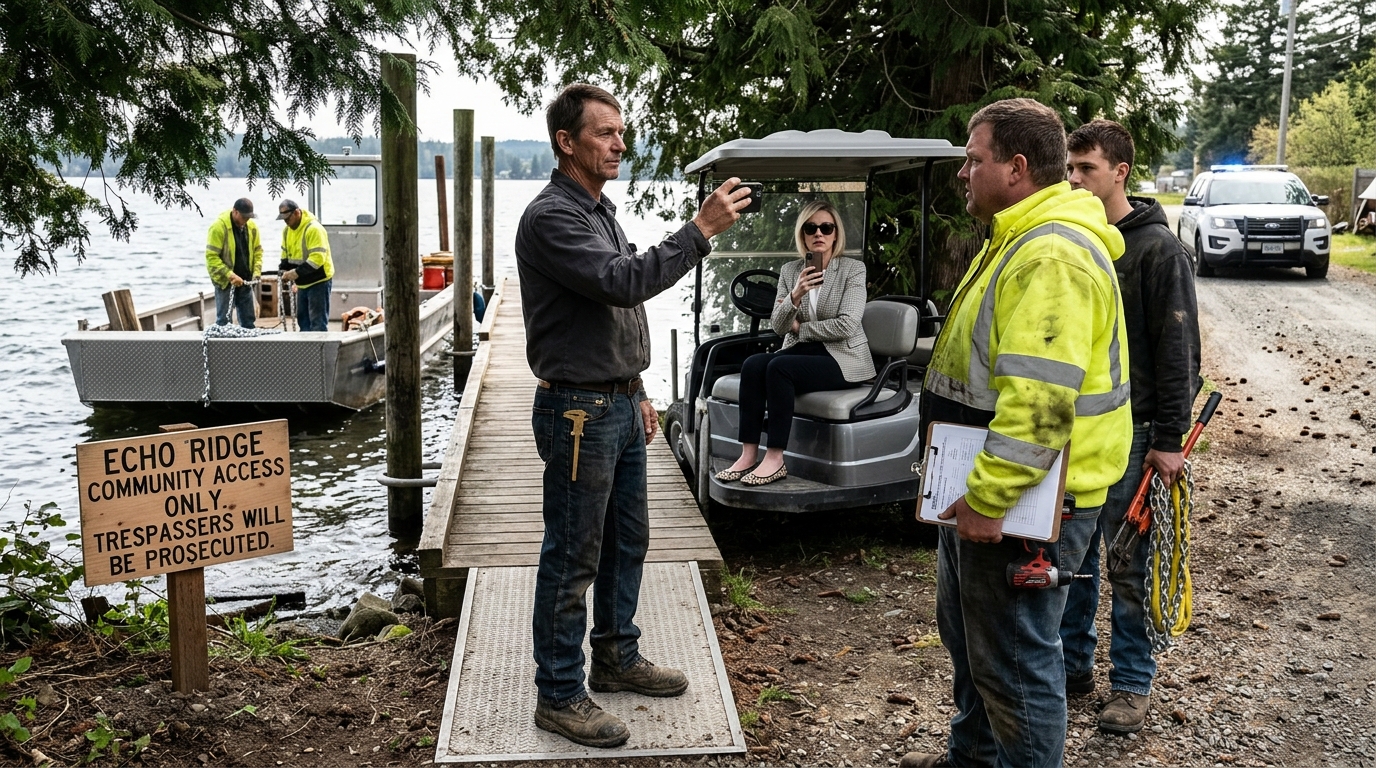
I stood up, walked to the edge of the porch, and looked down at my dock. A flat-bottomed aluminum work barge was cutting through the morning mist, heading straight for my gangway. Two men in dark work jackets were standing on the bow, holding aluminum braces and a heavy industrial chain kit. Behind them, idling twenty yards out in a sleek gray golf cart parked beneath the overhanging cedars, sat Karen.
She had her sunglasses on, her arms crossed, watching the boat approach like an admiral directing a fleet.
I closed my laptop, slid the brass caliper into my front pocket, and began walking down the wooden steps toward the water.
CHAPTER 3: THE SHORELINE STUNT
The hollow thrum of the diesel engine rattled the water against my dock pilings before my boots hit the gravel path. I kept my stride even, hands loose at my sides, feeling the cold weight of the brass caliper pressing against my right hip through my denim.
Twenty yards out, the aluminum work barge cut its throttle, coasting into the shallows with a low, metallic scrape against the lake bottom. The foreman on the bow—a heavy-set man in a grease-stained hi-vis jacket—stepped off onto my gangway before the deck cleared the water. A younger worker followed behind him, carrying a three-foot bolt cutter and a heavy galvanized chain wrapped in yellow vinyl.
“Hold up right there,” I said. My voice wasn’t loud, but it hit the open water clean.
The foreman didn’t stop. He had a clipboard tucked under his left arm and a battery-powered impact driver hanging from his belt tool loop. “We’ve got a work order to secure common amenity infrastructure.”
“You’re standing on private property,” I said, stepping onto the shore end of the gangway to block the narrow walkway. “This dock is deeded to Parcel 14-B. Turn that hull around.”
He stopped two feet from me, smelling of stale coffee and two-stroke exhaust. “Look, pal, I don’t get into neighborhood squabbles. We were hired to isolate the gangway joint and chain the gate until the board verifies the survey.”
“Who signed the work order?”
He jerked his chin back over his shoulder toward the gray golf cart sitting idle beneath the cedars. Karen sat behind the wheel, sunglasses reflecting the flat gray sky, phone held level at her chest. She wasn’t driving. She was watching, using two contract workers as a human shield while she filmed.
“The board president,” the foreman said. He tapped the clipboard. “Paperwork says this shoreline section is flagged as shared access.”
I pulled my phone from my pocket with my left hand, keeping my right thumb hooked over the brass caliper in my jeans. I raised the lens, pointing it straight at his face, then panned down to the company logo stitched across his jacket pocket: North Cove Marine Contractors.
“State your name for the record,” I said.
He squinted, shuffling his boots on the diamond-plate aluminum. “Name’s Miller. What is this?”
“Who told you the paperwork was clear, Mr. Miller?”
“The board president,” he snapped, his jaw tightening as he realized the camera was recording his badge and face in high definition. “She said the county review was pending and the board had authority to restrict entry until the hearing.”
“She lied to you,” I said flatly. “And you’re currently committing criminal trespass and destruction of private property on a recorded line. If that driver touches those aluminum joist bolts, your company gets named in the injunction before four o’clock.”
Miller hesitated. His eyes flicked past my shoulder toward the golf cart under the trees, then back to my face. He wasn’t a bad guy; he was just a contractor who’d taken a deposit from a woman with a confident tone and a polished letterhead.
“Miller!” Karen’s voice cut across the water, sharp as a boat whistle. She stepped out of the golf cart, her designer flats crunching into the wet pine needles at the property line. “Execute the work order! The association bears full legal responsibility for amenity maintenance!”
Miller looked at the bolt cutters in his worker’s hand. “Look, buddy, she says they hold the insurance—”
“She doesn’t own the dirt,” a new voice called out from the head of the lane.
A county cruiser rolled slowly down the gravel, its tires crushing the pine cones with a sharp, dry pop. Deputy Nolan stepped out into the damp air, his utility belt clinking as he walked down the embankment. His eyes scanned the barge, the chain in the worker’s hands, and finally settled on Karen standing ten feet inside my boundary line.
“Deputy,” Karen said instantly, smoothing her jacket as she stepped forward. Her voice smoothed out into that practiced, civic-leader cadence. “I called dispatch fifteen minutes ago. We are executing a temporary access restriction on a disputed amenity—”
“Hold on, Karen,” Nolan interrupted. He pulled a small notebook from his breast pocket, not looking at her. He looked at Miller. “Who authorized you to put a chain on this gate?”
“Echo Ridge HOA,” Miller said, backing up a step on the gangway. “Work order #408.”
Nolan turned to me. “Mr. Vance. You got your papers?”
I reached into my jacket and pulled out the laminated county deed packet, along with the printed email from the county assessor’s office confirming my parcel was clear of HOA encumbrances. I handed them over.
Nolan read in silence for forty seconds, the wind rustling the corner of the printouts. He didn’t rush. He read the parcel number, matched it to the survey pin location on the map, and then looked at the fresh wooden sign Echo Ridge had hammered into my soil three feet away.
“Karen,” Nolan said, closing his notebook with a soft leather snap. “Did you file a court injunction to seize this dock?”
“We filed an administrative affidavit with the county assessor,” she said, her voice dropping an octave, losing its warmth. “That creates an active review state—”
“An affidavit ain’t an order,” Nolan said. He looked at Miller. “Unpack that chain. Take your boat, take your tools, and get off this man’s water. If I see this flatbed tied to this dock again today, I’m booking the crew for trespass.”
Miller didn’t argue. He signaled his worker, grabbed the chain, and dropped back onto the barge deck before Nolan even finished his sentence. The diesel engine roared, spat a cloud of blue smoke into the overhanging cedars, and backed hard into the bay.
Karen stood alone on the gravel path, her hands clenched into tight fists at her sides. Her face was pale, the composure cracking around her eyes like thin ice.
“This isn’t over, Deputy,” she said quietly. “The board has statutory authority over common shoreline access under The Cedar Trust guidelines.”
It was the second time a name slipped out that didn’t belong to a standard HOA file.
Nolan didn’t blink. “Take it up with the county judge, Karen. Right now, you’re standing on private dirt. Step back across the ribbon.”
She stared at me for three long seconds—a cold, calculated glare that promised blood on paper—then turned and walked back to her golf cart without another word. The electric motor hummed as she reversed down the lane, leaving a trail of crushed pine needles behind her.
Nolan looked at me, then down at my hands. My right thumb was still resting against the brass caliper in my pocket.
“She’s not going to stop,” Nolan said softly. “She’s got three board members who do whatever she types up, and a corporate attorney on retainer.”
“She’s got paper,” I said, looking out at the wake left by the departing barge. “I’ve got the record.”
My phone buzzed in my pocket. It was a text from Mara:
County clerk just sent the transcript from the board’s internal executive session last Tuesday. You need to see line 14.
CHAPTER 4: THE METADATA TRAP
The screen glowed pale blue against the gathering dusk as I swiped open the document Mara had attached. Deputy Nolan’s cruiser was already a pair of red taillights disappearing up the gravel lane, leaving behind only the smell of idling exhaust and the cold, damp silence of the shoreline.
My thumb tapped line 14 of the PDF transcript.
It wasn’t a summary. It wasn’t a sanitized set of official minutes approved for public viewing. It was an unedited transcript excerpt from a closed online executive session recorded eight days before I signed the closing papers at the title office.
Karen Reed: “The estate’s probate attorney is slow. If we jam the deed chain with the Plat-404 draft before the conveyance records, he’ll either settle cheap or leave the cabin empty for the summer.”
Board Member 2: “What if the buyer pulls a certified abstract?”
Karen Reed: “He won’t know where to look until the summer window closes. Use contractors, not residents. Workers don’t ask title questions if the check clears from Vanguard Hospitality.”
I stood at the water’s edge, the lake breeze snapping the cold jacket collar against my neck.
There it was. Not just intent, but premeditated clouding of a public record. She hadn’t stumbled into a boundary dispute; she had engineered a title defect to force a distressed sale, using an offshore-funded commercial shell to underwrite the play.
I scrolled down to the file properties tab at the bottom of the document. The metadata author field didn’t read Echo Ridge Homeowners Association. It read: Vanguard Development Group / Acquisitions / Project: The Cedar Trust.
The decoy—the story she’d peddled to the residents about preserving neighborhood character and managing shared amenities—shattered completely. The HOA wasn’t trying to protect a historic cabin. The HOA was being used as an uncompensated proxy to clear encumbrances for a private hospitality group.
My phone vibrated. Mara’s name lit up the screen.
“Line 14?” she asked when I picked up.
“Line 14, line 22, and the metadata tag,” I said, walking slowly back toward the porch. “She put the acquisition target name directly in the file properties.”
“It gets worse,” Mara said. I could hear the rustle of heavy paper files over the line. “I just ran the business registration for Vanguard Hospitality against the county land trust registry. Guess who sits on the advisory board for The Cedar Trust entity?”
“Karen.”
“Karen and two officers from the county assessor’s regional oversight committee,” Mara said, her tone cutting and razor-sharp. “That’s why her fraudulent affidavit got indexed so quickly. She didn’t just slide a fake plat map into the file; she had someone on the inside bypass the verification queue.”
I reached the cabin steps, taking them one at a time. “That turns an administrative boundary squabble into systematic fraud.”
“It turns it into a felony,” Mara corrected. “And because she used interstate mail to send that formal hearing notice threatening you with daily fines on a non-member parcel, we have clear mail fraud and tortious interference wrapped in a single bow.”
“When’s the county hearing?”
“Monday morning. Nine o’clock at the county recorder annex,” Mara said. “She thinks she’s coming in to argue neighborhood zoning rules in front of a friendly board. She has no idea I’ve subpoenaed the full digital audit trail for Plat-404 directly from the state server.”
“Do we notify the sheriff?”
“Not yet,” Mara said flatly. “We let her walk into that room with her attorney, her binder, and her confidence. We let her make her statements under oath. Then we drop the abstract, the metadata, and the audio recording on the record.”
I stepped inside the cabin, leaving the door open to the cool lake air. The bare pine floors were dark and quiet in the evening shadow. I sat down at the scarred pine table in the center of the room, pulled out my brass caliper, and set it flat against the wood.
The brass gleamed under the overhead bulb.
They had spent months laying a trap for an aging fishing guide’s estate, counting on isolation, administrative fatigue, and quiet intimidation to deliver the waterfront into their commercial trust. They had calculated everything except the arrival of someone who kept every record, verified every pin, and measured every lie down to the thousandth of an inch.
I opened my laptop, linked it to the phone’s hotspot, and began compiling the master exhibit index for Monday morning.
CHAPTER 5: THE ANNEX EXECUTION
The double doors of Hearing Room B swung closed behind us with a soft, pneumatic hiss.
The air inside the county annex was cold, smelling of stale floor wax, ozone from industrial printers, and old paper. High fluorescent lights buzzed softly overhead, reflecting off the polished terrazzo floor like glare on lake ice.
Karen sat at the far end of the long mahogany counsel table, wearing a tailored navy blazer. Her arms were folded neatly over a leather-bound binder. Beside her sat an associate attorney from the county seat—a young man with slicked hair who kept adjusting a gold tie bar—and two board members who looked like they’d rather be anywhere else on earth.
Karen’s head turned as Mara and I pulled out our chairs. She offered a brief, practiced smile that didn’t reach her eyes.
“This shouldn’t take more than twenty minutes, Vance,” she said across the table, her voice smooth and conversational. “An administrative review clears up the language, we establish the temporary shoreline easement, and everyone moves on with their summer.”
I didn’t answer. I set my briefcase on the table, unlatched the brass catches with two sharp, heavy clicks, and pulled out my brass caliper, setting it flat against the dark wood next to a thick manila folder.
Mara sat down, unbuttoned her jacket, and laid out five bound exhibit packets in perfect parallel lines. No dramatic gestures. No raised voices. Just the steady, methodical placement of paper.
Hearing Officer Vance—no relation, a dry man with silver hair and wire-rimmed glasses—stepped up to the dais, adjusted his microphone, and looked down at his docket sheet.
“In the matter of Echo Ridge Association versus Parcel 14-B,” he said, tapping his pen twice on his notepad. “Petitioner asserts a cloud on title stemming from historic plat amendments and requests a temporary access injunction on shoreline structures. Counsel for the petitioner, proceed.”
Karen’s attorney stood up immediately, buttoning his coat. “Thank you, Mr. Hearing Officer. Our position is straightforward. The association’s governing documents, tied to the historic Plat-404 filing, have long recognized the cabin’s dock as a shared amenity. Recent transfers from the prior estate created an ambiguity that requires administrative stabilization under The Cedar Trust recreational framework—”
“Ambiguity?” Mara interrupted, her voice flat as cold slate. She didn’t stand up. She stayed seated, her hands resting quietly on her exhibit index. “There is no ambiguity, Mr. Hearing Officer. There is only a recorded forgery.”
The young attorney blinked, his scripted speech catching in his throat. “Now, see here—”
“Exhibit A,” Mara said, sliding the first packet across the mahogany table toward the dais. “The certified abstract of title issued directly by the State Land Recorder forty minutes ago. Clean deed chain from 1952 to present. Zero HOA encumbrances. Zero shared access easements.”
“That abstract fails to account for the supplemental affidavit filed last week—” the attorney started.
“Exhibit B,” Mara continued smoothly, sliding the second packet forward. “The county assessor’s audit of that exact affidavit. As of 8:15 this morning, the county recorder tagged the affidavit as fraudulent. The citation Karen Reed used—Plat-404—belongs to an inland residential tract two miles south. It has no legal connection to Parcel 14-B.”
Karen’s posture didn’t slouch, but her jaw tightened until the muscle below her ear twitched. “That was an administrative indexing error by county staff—”
“Exhibit C,” Mara said, dropping the heavy audio transcript transcript onto the table with a firm, hollow thud. “The digital metadata from the closed board session dated fourteen days ago. Created on a terminal registered to Vanguard Hospitality LLC.”
The young attorney looked down at Karen. Karen didn’t look back at him. She stared straight at Mara’s face, her fingers digging into the leather edge of her binder.
“I’ll read line 14 into the record,” Mara said, opening the folder. “‘If we jam the deed chain long enough with the Plat-404 draft, he’ll either settle cheap or leave the cabin empty for the summer. Workers don’t ask title questions if the check clears from Vanguard Hospitality.'”
The room went dead silent.
The two board members at the end of the table turned their heads in unison to look at Karen. The young corporate attorney slowly sat down, pulled his fountain pen back into his breast pocket, and closed his pad. He was done.
Hearing Officer Vance leaned forward over his glasses, his eyes locked on Karen. “Mrs. Reed. Did you issue an instruction to place physical barriers on a private dock based on a plat reference you knew belonged to a different subdivision?”
Karen opened her mouth. For two seconds, her practiced composure held. Then her eyes flicked to me, down to the brass caliper sitting on the table, and back to the hearing officer.
“The association was acting in good faith to preserve community options—” she started, her voice rising half an octave.
“Good faith doesn’t manufacture land records, Mrs. Reed,” Vance said. He picked up his wooden gavel and set it down hard against the oak block. Crack. “The petition for injunction is denied with prejudice. I am issuing an immediate administrative order striking the affidavit from the index.”
He looked at Mara. “Counsel, submit your petition for legal fees, transport interference damages, and sanctions by noon tomorrow.”
Karen stood up abruptly, her chair scraping against the terrazzo floor with a sharp, screaming shriek. “This isn’t an isolated plot! The board has statutory rights under—”
“Mrs. Reed,” Vance cut in, his voice cold as mountain water. “If you or any representative of your association steps onto Parcel 14-B again without a court order, Deputy Nolan will execute a criminal warrant for trespass and record tampering before sunset. We are adjourned.”
Karen didn’t wait for her attorney. She grabbed her binder, turned on her heel, and walked out of the hearing room, her heels clicking against the stone floor in a rapid, ragged rhythm. Her corporate attorney stayed behind just long enough to hand Mara his business card and whisper a request for a settlement conference regarding the sanctions.
I picked up my brass caliper, slid it into my pocket, and stood up.
“Clean,” Mara said, snapping her briefcase shut.
“Not clean yet,” I said, looking at the open doors leading to the hallway. “We still have a post to set.”
CHAPTER 6: THE CEDAR POST
The heavy oak doors of the county annex clicked shut behind us, cutting off the echoing buzz of the fluorescent hallways. Outside, the afternoon sun had burned through the morning haze, leaving the sky a clear, hard blue over the mountain ridge.
Mara stood on the wide concrete steps, adjusting her leather briefcase strap. “The certified copy of the injunction was served to the HOA’s registered agent fifteen minutes ago,” she said, her voice crisp and unhurried. “Vanguard Hospitality pulled its commercial land application off the county portal before we even stepped out of the hearing room. They’re cutting their losses.”
“What about Karen?” I asked, looking out toward the parking lot where the white Echo Ridge SUV was nowhere to be seen.
“The state recorder referred the Plat-404 filing to the district attorney’s real estate fraud unit,” Mara said, pulling a set of keys from her coat pocket. “The board voted during the recess to suspend her executive access. Her reign over Echo Ridge is officially over.”
I didn’t offer a speech. I didn’t celebrate. I nodded once, shook Mara’s hand, and walked to my truck.
The drive back to the cove was quiet. The two-lane highway wound through the dark timber, the shadow of the pines sweeping across the windshield in steady, rhythmic intervals. When I turned down the gravel turnaround onto my parcel, the silence of the lake met me like an old friend returning after a long storm.
The temporary Echo Ridge sign was still standing three feet inside my survey ribbon, its wet stain dark against the dry dirt.
I walked to the bed of my truck, pulled out a heavy steel post-hole digger, a claw hammer, and a six-foot cedar timber I’d bought at the lumber yard two weeks ago.
First, I walked to their sign. I set the steel claw against the pine crossbar and pulled. The soft wood splintered with a sharp, dry crack. I kicked the post loose, pulled the galvanized nails from the soil, and tossed the broken pieces into a pile by the lane for the county scow to collect.
Then I set to work on the real line.
I dug down two feet into the dark, damp earth right beside the iron survey pin wrapped in orange ribbon. The work was slow, heavy, and clean. The blade of the digger bit through pine roots and damp shale, sending up the rich, sharp scent of turned earth and pine resin. My forearms burned, my boots braced hard against the slope, but I didn’t stop until the hole was deep enough to hold the timber plumb.
I lifted the cedar post and set it firm into the dirt.
It wasn’t a corporate banner. It wasn’t painted in pastel colors or stamped with a committee logo. I had spent three hours the night before carving the house number—14-B—deep into the heartwood with a hand chisel, then sealing the grain with linseed oil.
I poured in the crushed slate, tamped the soil down with the heavy end of a pry bar, and checked the angle.
I pulled the brass caliper from my pocket, laid its flat edge against the iron pin, and measured the clearance to the carved face of the post. Zero margin. Exactly on the deeded line.
Thwack.
The slide clicked home into its brass frame. I slid the tool back into my pocket for the last time.
Down at the water, the lake had gone flat as glass, reflecting the gold and deep purple of the evening sky. My dock gate stood open, the yellow vinyl chain removed, the gangway resting solid against the wooden pilings. The water slapped rhythmically against the cedar siding of the cabin—a slow, quiet pulse that belonged to no board, no corporate trust, and no fraudulent affidavit.
My neighbor from down the road walked up the lane, a small cooler slung over his shoulder. He stopped by the fresh cedar post, ran his hand over the carved numbers, and looked down at the water.
“Looks like the paperwork finally cleared,” he said, handing me a cold bottle.
“It cleared,” I said, taking a sip. The beer was cold, crisp, and clean.
“Quiet down here now,” he said, looking across the cove where the Echo Ridge pavilion sat dark and empty under the trees.
“It was always quiet,” I said, setting the hammer back in the bed of my truck. “Some people just had to learn how to read the map.”
We stood on the porch as the sun dipped behind the western ridge, watching the dusk settle over the water. The cabin didn’t look like a amenity or a commercial asset. It looked like four walls, a roof, and six hundred feet of honest dirt that answered to nothing but the record.