The Devil’s Caliber: In the Pitch Black Coral of Peleliu, Survival Demands a Cold Fire
CHAPTER 1: RED TIP GREEN FLASH
The stenciling on the crate lid was wrong.
Corporal James Mitchell ran his thumb across the wet pine. Standard .30 carbine crates carried black block lettering: LOT 42-B, FRANKFURT ARSENAL. This lid had a raw red stroke slapped across the wood. No lot number. Just a three-letter code—T3-I—stamped over a faded skull emblem.
A bullet struck the coral outcropping six inches above his helmet. Jagged rock splinters stung his cheek.
“Mitchell!” Staff Sergeant Henshaw’s voice cut through the dark, raspy with coral dust and dried blood. “Stop admiring the wood and load up! They’re coming out of the cave mouth!”
Mitchell didn’t answer. He jammed his thumb into his pocket, his knuckles scraping against the cold brass of the spare magazine. He pulled it out. Under the faint, sickly glow of a dying moon, the bullet tips didn’t show the dull copper of standard ball ammunition. The nose of every round was dipped in thick, crimson lacquer.
Thirty yards out, the coral scraped.
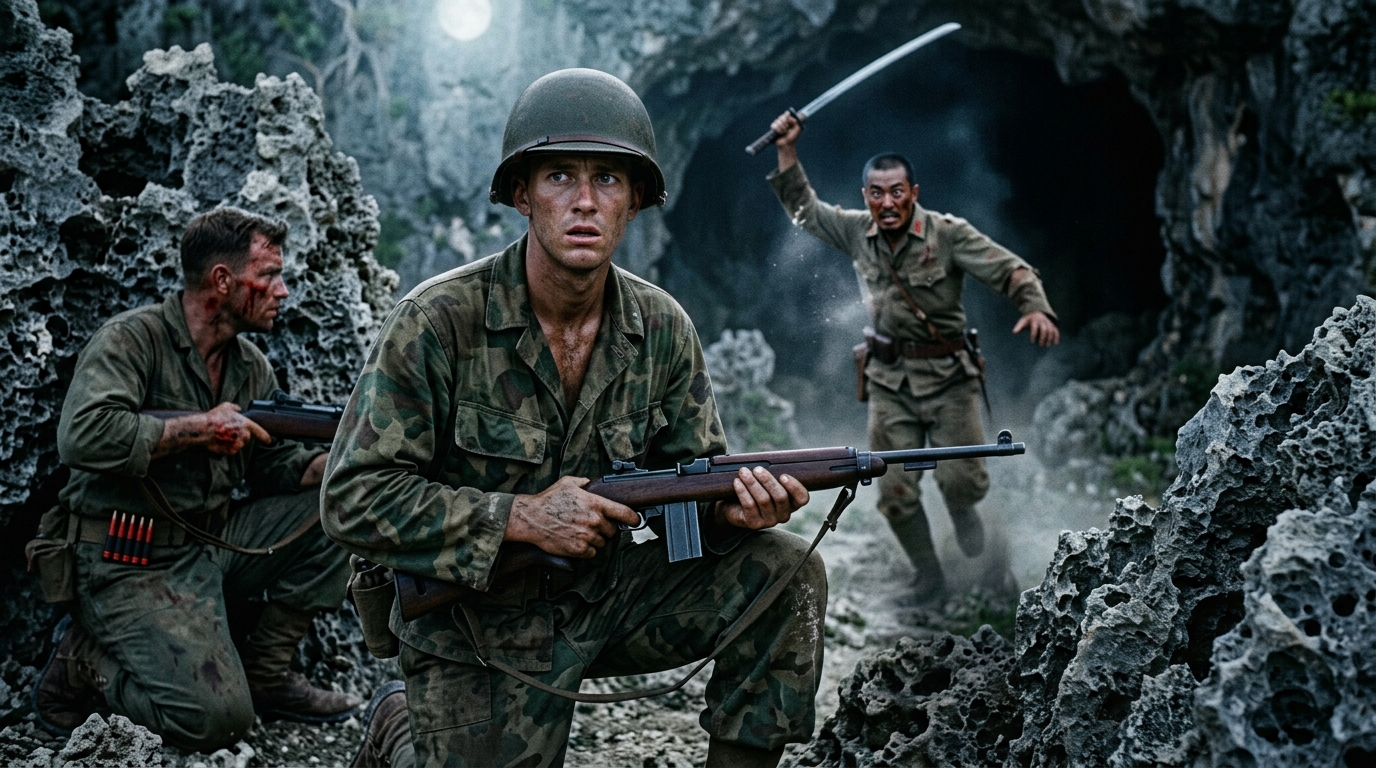
A shadow detached itself from the pitch-black mouth of the limestone ridge. Leather boots slammed against raw rock. A Japanese officer, uniform torn at the shoulder, surged forward with a raised shin-gunto sword. The steel caught the moonlight in a single silver streak.
Mitchell raised the M1 carbine. His index finger found the steel hook of the trigger.
Click-clack.
He squeezed. Three quick, rhythmic pulls.
Pung. Pung. Pung.
The light 110-grain ball rounds punched into the charging man’s torso. Fabric tore. The officer staggered, his stride breaking for a fraction of a second, but his momentum didn’t stop. He didn’t drop. He didn’t even scream.
Twenty yards.
“He’s taking ’em!” Henshaw yelled from the left flank, his own Garand barking twice. “Keep shooting, Mitchell!”
Mitchell knew the math. Everyone on Peleliu knew it. The standard carbine was a paper-cutter. Unless you caught them in the spine or the eye socket, the fanatical rush didn’t stop until six inches of steel were through your ribs.
He slammed the release catch. The empty steel box dropped into the jagged coral.
His hand went to his belt. He pulled the magazine with the red-lacquered tips. He slapped it home. The bolt slammed forward with a dry, mechanical metallic crunch.
Fifteen yards. He could see the officer’s eyes now—rimmed with red veins, pupils dilated to tiny black pins under the influence of senriu speed. The sword whistled as it cut the humid night air.
Mitchell didn’t aim for the head. He aimed center-mass. He pressed the trigger.
The report wasn’t the sharp snap of a standard round. It was a dense, heavy thud that shook the wooden handguard.
The muzzle blast flared—not yellow, but a blinding, chemical green.
The round struck the officer’s chest. The thin copper jacket shattered on impact. Inside the wound channel, the compressed IM11 core mixed violently with air and body fluids.
There was no entry hole. The man’s tunic exploded outward in a white-hot geyser.
The charging soldier stopped dead in his tracks. A harrowing, metallic screech tore from his throat as four thousand degrees of burning magnesium ignited his uniform, his skin, and the fat beneath it. The green-white flame spread instantly across his chest, crawling up his neck toward his jaw.
The sword dropped into the rocks with a sharp clatter.
Mitchell froze, his rifle still leveled. The smell hit him a second later—not black powder, not cordite, but the sweet, sickening stench of burning fat mixed with scorched cotton.
The man collapsed to his knees, beating wildly at his own face with burning hands.
“Jesus Mary,” Henshaw whispered from the dark.
CHAPTER 2: THE ASHES OF HILL 100
The chemical fire didn’t die quickly. It hissed, eating through flesh and muscle until it hit bone, sputtering with a pale, violet smoke that smelled of sulfur and fried copper.
Mitchell stayed on one knee behind the coral ledge. His left palm was clamped so hard against the carbine’s handguard that the wooden grain bit deep into his calluses. He couldn’t look away from the smoldering lump fifteen yards down the slope. The officer’s sword remained pinned under a charred forearm, the hilt completely melted into a lump of black rubber.
A boot heel crunched on the limestone.
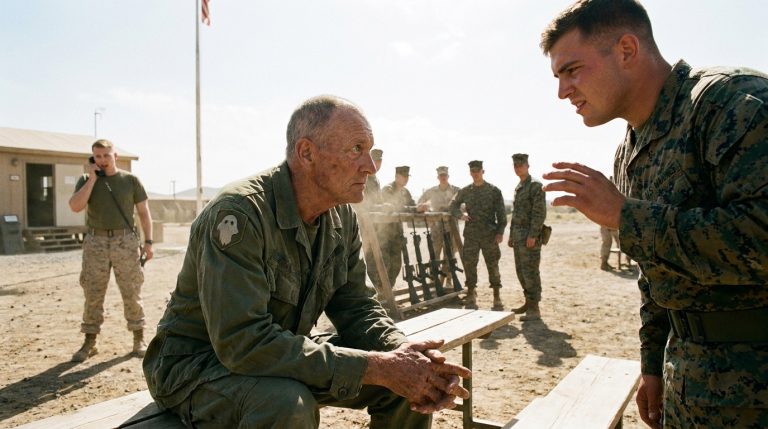
Staff Sergeant Henshaw dropped into the recess beside him. The sergeant’s face was slick with sweat and greyed by pulverized coral, his M1 Garand held low across his chest. He didn’t speak right away. His chest heaved, breathing in short, shallow rasps through his teeth as he stared at the corpse.
“That wasn’t a standard hit,” Henshaw whispered. His voice was flat, devoid of the usual raspy bark he used to drive the squad up the ridges. “Ball round leaves a hole. That… that tore him open from the inside out.”
“It’s the new crate,” Mitchell said. His tongue felt thick, dry as chalk. He didn’t offer his canteen; water wouldn’t clear the taste of the smoke hanging over the shelf. “The ones marked red.”
Henshaw reached out, his thick, grease-stained fingers catching the hot barrel of Mitchell’s carbine. He pulled the nose of the weapon toward his face, sniffing the muzzle. A thin ribbon of green vapor drifted out of the flash hider.
“Frankfurt Arsenal doesn’t paint round tips red unless it’s tracer,” Henshaw muttered. He reached into Mitchell’s web belt, his thumb rough as sand as he yanked out the spare magazine. He angled the top round into the faint moonlight. “Tracer’s got a lead core and a barium cup at the base. This nose is hollow. It’s soft.”
He pressed the edge of his thumb against the bullet tip. The gilding metal yielded with a faint, rubbery give.
“It’s light,” Mitchell added. He rolled another round between his fingers, testing the balance. “Fast. But look at the box.”
Mitchell leaned back, slitting the canvas cover of the supply crate wedged between two limestone boulders. The wood wasn’t standard pine—it was cheap, splintered plywood held together by zinc nails instead of heavy steel banding. Stenciled across the side in jagged, uneven red dye was a single text string: PROJECT HALPERN – DISPATCH B.
Henshaw squinted at the letters, tracing the fresh stencil with his fingernail. “Halpern? That ain’t an Ordnance designation. Ordnance uses numerical codes. Who brought this up the ridge?”
“Runner from Regiment,” Mitchell said, his eyes scanning the pitch-black tree line thirty yards down. “Said it was priority issue for point men. Said we were supposed to test the stopping power on cave infiltrators.”
“Test?” Henshaw turned his head sharply, his bloodshot eyes locking onto Mitchell. “We’re holding a frontline ridge against a reinforced battalion, and Division is giving us experimental trash without a technical manual?”
“It stopped him, Sarge,” Mitchell said quietly. He pointed toward the slope. “Three ball rounds didn’t even slow his stride. One of these stopped his heart in half a second.”
“It didn’t stop his heart,” Henshaw spat, his hand trembling slightly as he shoved the magazine back into Mitchell’s chest. “It cooked him. Look at his hands, Mitchell. He was trying to dig his own eyes out while he was still standing.”
A low rustle echoed from the mouth of the cave complex directly below them. It wasn’t a charge this time. It was the deliberate, slow dragging of equipment over loose stone.
Mitchell racked the bolt back an inch. The brass casing of the chambered round caught the dim light, its red lacquer tip gleam like a fresh droplet of blood against the dark receiver. The mechanism gave off a sharp, metallic click that sounded loud enough to shatter the limestone around them.
“They aren’t coming out,” Mitchell whispered, his eyes narrowing as he watched a thin shadow retreat deeper into the cave mouth. “They saw it.”
Henshaw wiped his forehead with his sleeve, leaving a dark streak of sweat and carbon across his brow. “They’ve been charging machine guns for three days straight without flinching. Now they’re pulling back?”
“They aren’t scared of dying,” Mitchell said, his fingers tightening around the trigger guard as he felt the cold, heavy weight of the unexploded IM11 compound sitting inside his magazine. “They’re scared of burning.”
CHAPTER 3: THE GREEN SILENCE OF CAVE COMPLEX 4
The rustle in the cave mouth faded into a flat, suffocating quiet.
Mitchell didn’t lower his carbine. His right thumb flicked the safety down, the small steel latch clicking against the receiver. The sound seemed to bounce back off the damp limestone walls of the overhang. Beside him, Henshaw stayed crouched, his heavy knuckles white where his hands locked around the stock of his Garand.
“They aren’t retreating to regroup,” Mitchell said. His breath was a dry, raspy wheeze that tasted of ozone and scorched cloth. “They’re pulling back because the green light blinded whoever was behind that heavy machine gun.”
Henshaw spat a dark gob of tobacco and coral dust onto the rock. “Then we don’t give ’em time to rub their eyes.” He tapped Mitchell’s shoulder with two fingers, a sharp, hard jab. “You lead with that green fire. Keep your bursts to two rounds. I’m right behind you with the big steel.”
Mitchell slid his left boot forward. The jagged coral bit through the worn rubber sole of his canvas jungle shoe, pressing against the raw blister on his heel. He ignored the sting. He dropped into a low creep, easing around the lip of the overhang until his shoulder scraped the wet, moss-slick entrance of Cave Complex 4.
The air inside hit him like a wet blanket soaked in kerosene. It was cold—colder than the tropical night outside—but thick with the stagnant stench of unwashed bodies, damp charcoal, and the unmistakable, sweet decay of three-day-old gangrene.
Ten feet in, the natural moonlight died completely.
The cavern narrowed into a jagged throat of black rock. Mitchell kept his back pressed to the left wall, feeling the cold moisture seep through his herringbone twill jacket. His left hand guided the handguard of his weapon through the dark, tracing the unseen contours of the passage ahead.
Clack.
A metallic click echoed twenty yards deeper in the tunnel. It wasn’t the bolt of a rifle; it was the heavy, brassy engagement of a tripod latch. A Nambu Type 92 heavy machine gun being locked into a fixed defensive firing cone.
“Down,” Mitchell breathed, his voice barely a rasp.
He didn’t hit the deck—the floor was a bed of razor-sharp stalagmites and shattered granite. Instead, he dropped his weight into his thighs, leaning into a deep crouch as he pointed the red-tipped carbine blind into the throat of the tunnel.
A blinding muzzle flash erupted from the darkness ahead. The rhythmic, chugging roar of the Nambu shook the limestone ceiling, sending a shower of loose pebbles crashing onto Mitchell’s helmet. 6.5mm rounds snapped through the narrow passage, cracking against the rock wall six inches above Henshaw’s head with violent, white-hot sparks.
The ricochets whined through the dark like hornets.
Mitchell didn’t wait for the gunner to adjust his elevation. He leaned his shoulder out from behind a stone rib, lined the weapon with the flickering yellow muzzle flash, and squeezed the trigger twice.
Pung-thud. Pung-thud.
The green flash illuminated the cave like a flashbulb in a crypt.
For a fraction of a second, the entire subterranean bunker was frozen in a sickly, emerald glare: three Japanese soldiers crouched around the heavy brass tripod, their faces wide-eyed and coated in soot. The first red-tipped bullet struck the gunner’s chest plate.
The thin copper jacket ruptured instantly against the steel plate, spraying the compressed IM11 compound directly into the man’s throat and collarbone.
A blinding geyser of white-green fire erupted inside the narrow bunker. The chemical reaction didn’t just ignite the soldier’s uniform; it devoured the oxygen in the enclosed space with a deafening whoosh. The thermal expansion created a localized pressure wave that knocked the two loaders backward against the rock wall, their hands tearing frantically at their own smoking faces.
The heavy machine gun went dead silent.
The screaming began a second later—a high, shrill shriek that rattled off the damp stone walls and echoed deep into the heart of the island.
Henshaw surged past Mitchell, his Garand leveled, but he didn’t pull the trigger. He stopped dead at the entrance of the machine-gun nest, the green-white glare reflecting in his wide, unblinking eyes.
The gunner was slumped over the tripod. The magnesium fire was burning straight through his leather harness, eating into the metal frame of the Nambu itself. A pool of liquefied grease sizzled on the stone floor beneath the body, feeding a slow, crawling flame that cast long, dancing shadows across the cavern ceiling.
“Get up,” Henshaw growled, his voice cracking as he grabbed Mitchell’s collar and yanked him forward. “Don’t look at it. Keep moving before the smoke fills the shaft!”
Mitchell stumbled over a discarded ammo box. His boot kicked something small and metallic that rolled across the stone with a light, hollow clatter.
He dropped his eyes for a fraction of a second. It wasn’t Japanese gear.
Lying in the dirt, half-covered by a smear of green-tinged ash, was a crushed American brass casing. The headstamp wasn’t military surplus from ’42 or ’43. Stamped cleanly around the primer cup was a single, crisp mark: FA-44-T3.
Mitchell’s thumb slipped on the carbine’s stock. Someone had fired these exact experimental rounds inside this very cave before his squad ever stepped foot on Ridge 100.
“Henshaw,” Mitchell called out, his voice tight as he kicked the casing against the wall. “We aren’t the first ones they gave these crates to.”
Henshaw didn’t turn around. He was already staring into the deep darkness of the secondary tunnel, where the sound of hurried, desperate boot heels was retreating into the subterranean depths.
“Doesn’t matter,” Henshaw whispered, his hand shaking as he reloaded his Garand with a loud, mechanical snap. “We’re the ones who have to finish it.”
CHAPTER 4: THE SHADOW OF HILL 100
The brass casing was still warm against Mitchell’s palm.
He didn’t put it in his pocket. He squeezed it between his thumb and forefinger until the sharp rim bit into his calloused skin. Five paces ahead, Henshaw’s boot soles squelched through a dark puddle of stagnant water and engine oil. The smoke in the secondary tunnel hung thick and motionless, heavy with the stench of charred canvas and burned fat.
“Keep your muzzle up,” Henshaw growled without turning around. His right hand remained locked on the handguard of his Garand, his knuckles raw and scraped red from limestone corners. “If there’s an officer back here, he’s got a Nambu sidearm or a grenade waiting for the doorway.”
Mitchell stepped over a bundle of severed copper comms wire. The tunnel widened into an arched cutout carved directly into the coral heart of Hill 100. It wasn’t a firing trench; it was a battalion command node. A rough pine desk sat overturned in the corner, its drawers kicked open and papers scattered across the muddy floor.
In the center of the alcove, a kerosene lantern flickered weakly on top of a steel field safe. Beside it sat something that didn’t belong in a Japanese bunker: an American olive-drab canvas courier pouch, its leather strap severed by a clean knife stroke.
Mitchell moved before Henshaw could call out a perimeter check. He thrust his carbine’s muzzle toward the dark shadows behind the desk, verified the space was clear, and dropped to one knee beside the safe.
“Mitchell, leave the trash,” Henshaw warned, his head turning as he watched the dark mouth of the rear escape hatch. “We clear the shaft and get back to the ridge. Sun’s coming up in an hour.”
Mitchell reached into the open pouch. His fingers brushed against a thick stack of mimeographed documents bound by a single brass brad. The top sheet wasn’t written in Japanese kanji. It was printed in crisp, pica typewriter text under an official War Department letterhead.
At the top right corner, a heavy black stamp read: RESTRICTED – ORDNANCE FIELD TRIAL 44-C.
Right below it was the familiar block marking: Frankfurt Stencil #8-B.
Mitchell’s eyes scanned down the page, his breath catching in his throat. It wasn’t a standard shipping manifest. It was an evaluation matrix. Columns were neatly gridded with hand-penciled checkmarks under categories that made his stomach turn: Target Distance, Tissue Degradation, Incapacitation Time (Sec), and Psychological Impact on Surrounding Personnel.
“Sarge,” Mitchell said. His voice came out flat, hollow as a dry canteen. “Look at this.”
Henshaw stepped back from the tunnel entry, his boots clicking on the damp stone. He bent down, snatching the papers out of Mitchell’s hand with a jerk. “I told you, it’s regimental logistics—”
Henshaw went dead silent.
The flickering yellow light of the kerosene lamp cast deep, hollow shadows across the sergeant’s face as his eyes moved across the typed lines.
“This isn’t an ammo delivery,” Mitchell whispered, pointing a blood-stained finger at a paragraph near the bottom. “They didn’t ship these crates to Division supply because we were out of ball ammunition. Look at the unit roster.”
Henshaw’s thumb pressed against the paper, crumpling the wet margin. The typed text explicitly listed First Battalion, Seventh Marines as Primary Field Test Subject Group. Attached to the manifest was an observation log signed by a captain from Regimental G-2.
Target engagement observed at 0340 hours. Subject Corporal J. Mitchell deployed T3-I cartridge against charging officer. Immediate ignition of thoracic cavity recorded. Subject demonstrated 100% cessation of forward movement within 0.8 seconds. Secondary psychological deterrence verified; adjacent enemy personnel abandoned bunker position.
“They were watching,” Mitchell said. He stood up slowly, the joints in his knees popping in the quiet cavern. His hand went to the red-tipped magazine in his belt. “They were sitting on the ridge behind us with field glasses, writing down how long it took that guy to burn.”
Henshaw’s jaw worked silently. A muscle in his cheek twitched, a violent, involuntary tremor that he tried to hide by turning his head toward the dark wall. He folded the papers twice, cramming them deep into his internal field jacket pocket, and zipped it shut with a sharp, metallic pull.
“You don’t say a word of this to the squad,” Henshaw said. His voice was no longer raspy; it was cold, smooth, and dead. “Not to Duca, not to the corman. Nobody.”
“They’re treating us like laboratory dogs, Sarge,” Mitchell spat, stepping directly into Henshaw’s path. “They sent us up this ridge with ammunition that eats gun barrels and cooks men alive just to fill out a chart for some engineer in Pennsylvania!”
Henshaw leaned in until his nose was an inch from Mitchell’s. The smell of stale tobacco and cold sweat on the sergeant’s collar was suffocating.
“You want to throw a fit at Regimental HQ?” Henshaw growled, tapping his finger hard against the chamber of Mitchell’s carbine. “You do that after we offload this hill. Right now, there’s two hundred Japanese soldiers in these caves who don’t care who printed the paper. They just know we’re carrying fire. And if we don’t keep shooting, they’re going to crawl over that wall and cut our throats while we’re arguing about logistics.”
A heavy, muffled explosion thundered from the ridge above them, shaking the cavern ceiling and showering both men in cold, white coral dust.
“That’s our line,” Henshaw said, turning toward the rear exit. “The counter-attack is starting. Load your weapon, Corporal.”
Mitchell looked down at the carbine in his hands. The red lacquer on the top round glinted under the dying lamp, slick, bright, and monstrous. He pulled the bolt back, let it fly forward, and followed the sergeant out into the dark.
CHAPTER 5: THE CORROSION ON RIDGE 100
The ceiling didn’t just rattle; it buckled.
Mitchell lunged through the narrow rear fissure right on Henshaw’s heels. The moment his boots hit the open trench outside, the tropical sky opened up in a sheets-of-lead monsoon downpour. The torrential rain hit his hot rifle barrel with a hiss, sending up little wisps of white steam that vanished into the grey dawn fog.
“Get up to the parapet!” Henshaw roared over the thunder and the drumming rain. “Duca! Hold that left flank!”
The trench was already six inches deep in red, liquid mud. Private First Class Duca was huddled against a sandbag wall, frantically working the bolt of his Springfield rifle. Ten yards past the wire, dark figures surged through the curtain of rain—a desperate, bayonet-first counter-charge launched straight out of the lower ravines.
Mitchell slammed his chest against the slick coral barrier. His hands were soaked, the skin on his fingertips wrinkled and soft from sweat and rain. He raised the carbine, acquired a charging shadow through the downpour, and squeezed the trigger.
Click.
No report. No green flash. Just a hollow, dull metallic thud.
Mitchell’s stomach dropped. He didn’t hesitate; he brought his right hand back, grabbing the charging handle to yank the slide rearward. The operating slide moved a quarter-inch and jammed rock-hard.
“Sarge!” Mitchell yelled, his knuckles grinding into the steel bolt handle as he fought the mechanism. “It’s seized!”
Through the receiver slot, he could see the problem. The driving rain had soaked through his canvas pouch, penetrating the cheap plywood crate boxes. The thin gilding metal jackets of the red-tipped rounds—engineered at barely fifteen thousandths of an inch to ensure rapid deformation—had expanded under the extreme humidity. The soft nose of the bullet had crushed against the feed ramp, wedging the brass cartridge sideways into the chamber like a bent nail.
“Use your boot!” Henshaw screamed from six feet away, firing two heavy Garand rounds into the advancing skirmish line. “Kick the handle!”
Mitchell drove the heel of his jungle shoe down onto the carbine’s steel charging handle.
Crunch.
The crushed round sheared at the shoulder. A yellow smear of wet, pasty IM11 compound oozed out of the split copper jacket, running down the feed ramp and smearing across his thumb. The smell hit him instantly—not unburned powder, but a sharp, chemical sting that burned his nostrils like concentrated lye.
“They knew,” Mitchell muttered, his eyes wide as he stared at the dissolving chemical residue on his skin.
The soft copper jackets weren’t a manufacturing oversight. The engineers who cut the Frankfurt Stencil onto those crates knew the tropical moisture would rot the soft gilding metal within hours of exposure. They weren’t building a reliable service round; they were running a short-duration burn test. They needed the cartridges to fire immediately upon delivery before the island climate turned them into useless lead scrap.
“Mitchell! Front!” Duca screamed, pointing a muddy arm toward the wire.
A soldier surged over the breached sandbags, a rusted bayonet extended straight for Mitchell’s throat.
Mitchell didn’t have time to clear the chamber. He grabbed the carbine by the barrel, dropped his shoulder, and drove the heavy wooden stock straight into the attacker’s chest with the full momentum of his weight.
The heavy walnut buttstock collided with the soldier’s ribs with a sickening crunch. The man hit the red mud sideways, his bayonet sliding harmlessly across the wet coral shelf. Mitchell didn’t wait. He drove his boot down onto the man’s wrist, disarming him, then ripped his own trench knife from his belt with his right hand.
Henshaw dropped into the mud beside him, his Garand smoking as he cleared the remaining wire with three fast shots.
“Your piece is down?” Henshaw demanded, wiping rain and mud out of his eyes.
“The whole box is rotten, Sarge!” Mitchell yelled back, holding up his thumb covered in the yellow, melting IM11 paste. “The copper’s too thin! The wet air is swelling the jackets in the magazine! Every single one of these carbines is going to jam on the second round!”
Henshaw looked down at Mitchell’s hand, then at the jammed receiver of the carbine. The rain was washing the yellow paste off Mitchell’s skin, but where it touched, the flesh was already turning a raw, angry red.
“They didn’t give us a weapon,” Mitchell said, his voice dropping into a dangerous, icy quiet despite the roar of the rain. “They gave us a fuse.”
Henshaw grabbed Mitchell by the strap of his web gear, dragging him toward the command bunker at the center of the ridge. “Then we don’t shoot ’em from the magazine. Strip the belts. We run what’s left through the heavy guns before the whole hill goes under.”
CHAPTER 6: THE FINAL ACCOUNTING OF HILL 100
Henshaw’s grip on Mitchell’s web gear pulled tight, the canvas strap cutting into Mitchell’s collarbone as they ducked through the low timber entrance of the central bunker.
Rain roared against the sandbag roof, forcing streams of orange mud down the log walls. Inside, three Marines from Company K were feeding brass links into an air-cooled Browning machine gun. Across the floor sat two unbroken wooden supply crates—their lids held down by heavy zinc bands, stamped in runny red ink with Project Halpern and the crisp block marks of Frankfurt Stencil #8-B.
“Rip ’em open!” Henshaw ordered, shoving Mitchell toward the crates while he took the gunner’s spot by the firing slit. “Load the loose rounds straight into the cloth belts! Don’t use the magazines!”
Mitchell dropped to his knees in the mud. He jammed the flat blade of his trench knife under the lid of the first box and heaved upward. The zinc banding snapped with a sharp ping.
Inside sat fifty cardboard boxes of the red-tipped cartridges. The rain hadn’t reached the interior yet, but the humid air was already making the thin gilding metal jackets sweat. Mitchell’s fingers worked with frantic, mechanical speed, tearing open the cardboard flaps and dumping hundreds of brass rounds into the lap of his wet trousers.
“They didn’t just want a field test, Sarge,” Mitchell said, his voice flat as he shoved a red-tipped bullet into a canvas belt loop. The chemical coating on the tip left a greasy red stain on his knuckles. “They knew the thin copper wouldn’t hold up in the tropics. That wasn’t a defect.”
Henshaw didn’t look back from the slit. “Keep loading, Mitchell!”
“Look at the label under the lid!” Mitchell shouted over the rhythmic clatter of the Browning outside. He pointed his knife at a printed paper sheet glued inside the box cover. “It ain’t an instruction sheet for us. It’s an environmental decay log! Storage limit under high humidity: 72 hours. They sent this batch knowing it would rot in three days!”
The truth came unraveling out of those paper sheets like thread from a torn sleeve.
Layer 1 was the cover story—a secret regimental field trial to evaluate stopping power against cave infiltrators. But Layer 2 was the true, cold calculus engineered back in Maryland and Pennsylvania. Ordnance Division didn’t care if the M27 jammed after three days. They needed to test the violent combustion of the IM11 compound against human flesh under extreme conditions, forcing an immediate, terrifying Japanese tactical retreat from the cave complexes before the entire island invasion stalled out. The frontline Marines were never meant to keep these weapons; they were simply the delivery system to burn the enemy out of the limestone, after which the weather would conveniently corrode the remaining evidence away.
“They traded us,” Mitchell said, his hand trembling slightly as he loaded the last link. “They knew the guns would seize up in the rain. They gave us three days of fire to break their line, and then left us with jammed carbines.”
Outside, the Japanese counter-attack hit the wire.
A dozen figures surged through the grey fog, bayonets glinting in the dark dawn rain. Henshaw slammed his thumb onto the spade grip of the Browning.
Tat-tat-tat-tat-tat!
The heavy gun roared, spitting a stream of red-tipped fire through the fog. The green chemical flashes illuminated the ravines in rhythmic, sickly pulses. Where the rounds hit, the fire ignited despite the torrential rain, burning through wet uniforms and flesh alike. The assault broke in less than forty seconds. The survivors scattered back into the dark mouth of the lower ravines, abandoning the ridge entirely.
The silence that followed was suffocating, broken only by the steady, heavy thrum of rain against the sandbags.
Henshaw let go of the spade grips. He slowly turned around in the dim bunker light, his hands dripping with gun oil and rain. He looked at Mitchell, then down at the crumpled Project Halpern documents sticking out of his own jacket pocket.
“The ridge is held,” Henshaw said quietly. His voice carried no triumph—only the flat, crushing weight of a man who had survived a trap by stepping on someone else’s neck.
Mitchell stood up slowly. His carbine lay discarded in the mud at his feet, its bolt jammed tight over a ruined, swollen cartridge. He reached down, picked up a single unspent red-tipped round from the crate, and held it up between two fingers.
“What do we do with the paper, Sarge?” Mitchell asked.
Henshaw pulled the bound mimeographed sheets from his jacket. The wet paper was soft, the black typewriter ink running in faint grey trails across the Frankfurt Stencil header. He didn’t burn it—there was no dry fire on Hill 100. Instead, he walked over to the open crate, shoved the papers deep beneath the empty cardboard boxes, and slammed the heavy wooden lid back down over the box.
He picked up a heavy rock from the wall and drove a zinc nail through the pine lid, locking the evidence inside the wood.
“We keep our mouths shut,” Henshaw said, his bloodshot eyes locking onto Mitchell with an absolute, unyielding coldness. “We tell Division the ammo worked. We tell ’em it saved Company K. Because if we tell the boys out there that Division used ’em for an experiment, nobody’s going to fix their bayonets when the next hill comes up.”
Mitchell looked at the sealed crate. His hand went to his thumb, where the yellow stain of the IM11 compound had left a faint, permanent chemical scar across his skin.
He didn’t argue. He pulled his standard M1 Garand off the wall rack, checked the steel bolt, and listened to the dry, reliable snap of the spring mechanism as it locked into place. The fire was gone. All that was left was the cold iron, the mud, and the long walk down the ridge.