Finding Rooted Peace Through the Quiet Persistence of Golden Honey and Shared Community Resilience
CHAPTER 1: The Weight of the Border
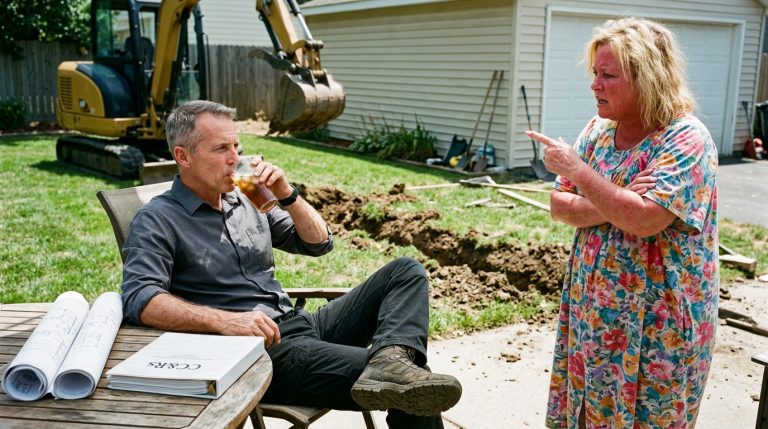
The air carried the heavy, cloying scent of overripe gardenias as the president of the adjacent subdivision planted her sensible, ugly sandals firmly onto the soft earth just inches from the small, discreet sign that read, Thorne Apiary, Private Property. Her arms were crossed so tightly it looked painful, pinning a clipboard against her side like a scepter of office. Marcus stood motionless beside the white Langstroth hives, his hand resting on the smooth wood of a hive tool. He watched the pages of her clipboard flutter in the gentle breeze, listening to the low, industrious hum of fifty thousand Italian honeybees that wove an invisible safety net over the surrounding land. The Estates at Willow Creek—a name far too grand for its collection of beige, cookie-cutter houses—stretched out behind her like a manufactured grid of uniform conformity. She had marched straight across the manicured lawns instead of using the sidewalk, her path as uncompromising as a bulldozer. Let her speak, he reminded himself, drawing on the quiet patience learned in distant, sun-scorched places where silence was often the only armor. “Your bees are a menace, and I’m shutting you down,” she snapped, her blotchy pink face clashing violently with peroxide blonde hair. “This is your final official warning, Mr. Thorne.” Marcus kept his breathing slow and measured, feeling the warmth of the afternoon sun soak through his shirt while the faint, persistent ringing in his ears hummed in rhythm with the boxes at his back. He thought of his grandfather’s hands, worn like old leather, and the quiet sanctuary they had carved out of this soil decades ago. He thought of Sarah and young Lily waiting inside the restored farmhouse just beyond the fruit trees. The official papers fluttered as she thrust them forward, demanding compliance to a set of bylaws that ended strictly at his property line. As the crisp legal threat fell to the dry dirt at his boots, a cold realization settled into his chest, not as panic, but as the steady, unyielding clarity of a man protecting his home.
CHAPTER 2: The Logic of the Field
The kitchen counter smelled of damp earth and the sweet, lingering tang of raw propolis as Marcus laid out the cease-and-desist papers under the warm circle of the desk lamp. Outside, the twilight bled across the sky in shades of faded indigo and bruised rust, casting long, fractured shadows over the weathered porch boards. Sarah stood opposite him, her hands resting flat on the butcher-block island, her eyes fixed not on the aggressive, spiky handwriting of the notice, but on his face. She knew that look—the slow, deliberate quiet that always settled over him whenever a perimeter was breached. It was the same expression he had worn back during the long deployments, when every variable had to be weighed and every exit mapped before a single step was taken.
“She’s banking on intimidation,” Sarah said softly, breaking the steady hum of the refrigerator. Her fingers traced the frayed edge of a ceramic mug filled with cooling coffee. “People like that don’t look at the land, Marcus. They look at paper. They think a stamp and a fancy title give them ownership over things they’ve never planted.”
“Paper can be answered with better paper,” Marcus replied, his voice dropping into that low, measured cadence that left no room for panic. He pulled a fresh legal pad toward him, clicking his pen with a sharp, metallic snap that felt entirely too loud in the stillness of the old house. “A bully operates on the assumption that you’ll react out of anger. They want you shouting on the lawn so they can call it a disturbance. We aren’t going to shout.”
He reached for his phone, dialing a sequence of numbers muscle memory had preserved from a decade ago. On the third ring, a sharp, crisp voice cut through the static.
“Rosetti Law. Dave speaking.”
“Dave. It’s Marcus.”
“Thorne! Good to hear you, buddy. Tell me you aren’t calling from the middle of another desert runway.”
“Close. I’m in the middle of a subdivision.” Marcus leaned back against the wooden chair, letting his gaze drift toward the dark window where the faint outline of the black willow windbreak marked the edge of his property line. “I need you to look at a jurisdictional boundary for me. An HOA president just dropped a cease-and-desist on my porch, threatening a property lien over my hives.”
On the other end of the line, Dave let out a dry, knowing scoff. The rustle of paper crackled through the speaker as his old friend shifted in an office chair miles away. “Ah, the suburban fiefdom. Classic. Let me guess—she cited some archaic subdivision covenant about livestock or commercial operations, right?”
“Section 7, paragraph four, sub D,” Marcus recited smoothly, his eyes scanning the harsh text. “Claims my apiary is a public nuisance.”
“Well, unless your property was legally annexed into their master deed when the developer paved over the old acreage—which your county plat map explicitly says didn’t happen—she’s trying to ticket a car parked outside her own driveway,” Dave said, his tone sharpening into professional gear. “A frivolous lien is a cloud on your title, sure, but it’s also an open invitation for a slander-of-suit counter-action. It’s a bully tactic, Marcus. Don’t let them rattle your cage.”
“I don’t intend to,” Marcus said. “What’s our defensive posture?”
“Documentation. Every square foot of paper you have. Certified copy of your deed, the original county plat maps, and a look at your state’s Right to Farm Act. Most states protect small-scale agricultural operations from nuisance claims by non-farming neighbors, especially if you were there first. Prove you’re operating under best management practices, and she’s legally standing in quicksand.”
“Understood. I’ll pull the records from the courthouse tomorrow morning.”
“Do it,” Dave urged. “And send me a copy of that notice. I’ll draft a formal response letter that will make her legal counsel choke on his morning coffee. Let’s see how much posture she has when her HOA’s liability insurance is on the line.”
Marcus clicked the phone off, the silence returning instantly, heavy and textured with the distant, steady murmur of the hives settling in for the night. The memory of an old NCO from his early days flickered unbidden through his mind—a sergeant who always insisted that terrain was never neutral; you either commanded the high ground or you were already losing it. Karen thought she held the high ground because she had a clipboard and a list of beige-painted rules. But she hadn’t checked the soil, and she hadn’t looked at the map.
The next morning found Marcus at the county courthouse, navigating the cool, echoing marble corridors of the records department. The air smelled of aged paper, floor wax, and damp stone—a stark, grounding contrast to the artificial perfection of the Estates at Willow Creek. With the certified copies of his grandfather’s original 1950s deed and the county plat maps secured in a thick manila folder, he drove out to the agricultural extension office tucked away on the northern edge of the county seat.
Dr. Eleanor Vance greeted him with the weary, passionate enthusiasm of someone who had spent a lifetime defending things that couldn’t speak for themselves. Her office was buried beneath stacks of botanical journals, soil sample bags, and old topographical maps. When Marcus laid out his dilemma, her eyes lit up behind wire-rimmed glasses.
“An HOA dispute,” she murmured, shaking her head as she adjusted a stack of pamphlets. “It’s the modern tragedy of the suburbs, Mr. Thorne. People want the illusion of the countryside—the manicured lawns, the blooming fruit trees, the rustic charm—without any of the biological reality required to sustain it. They want the honey without the sting of the work.”
She pulled a heavy black binder from her shelf, flipping through tabbed plastic sleeves until she reached a dense legislative printout. “Your state’s Right to Farm Act was updated just two sessions ago. We lobbied hard to include apiculture explicitly under the protected agricultural umbrella. As long as you maintain standard best management practices—water sources, flight barriers, proper hive spacing—you are legally untouchable by municipal or neighborhood nuisance claims.”
She didn’t stop there. Moving to her desktop computer, she brought up a complex geographic information system mapping tool, her fingers flying across the keyboard. “Let me show you something interesting. We’ve been mapping regional pollination dependencies for local orchards and small homesteads.”
She clicked a series of icons, overlaying a translucent grid over a satellite image of the Estates at Willow Creek. A series of bright, concentric circles bloomed outward from the precise coordinate of Marcus’s apiary, completely blanketing the subdivision’s neat rows of houses.
“Look at this,” Dr. Vance pointed to the screen, her voice dropping lower with scientific fascination. “The native pollinator population in this specific valley was practically wiped out when that developer bulldozed the native brush three years ago. Based on the standard foraging radius of an Italian honeybee, your hives aren’t just a quiet hobbyist setup. They are the primary biological engine for every single fruit-bearing tree in that entire neighborhood.”
She clicked another button, scattering dozens of small green dots across the subdivision’s grid. “These are registered properties with fruit trees—apples, pears, plums, cherries. According to our agricultural yield data, fruit production inside this specific corridor has spiked by nearly four hundred percent over the last five years. Right around the time you established your apiary.”
Marcus stared at the screen, the green dots glowing like tiny constellations against the gray satellite map. The cold knot of anger in his chest suddenly dissolved, replaced by a sharp, crystal-clear strategy. Karen had spent her morning printing threats on cheap letterhead, entirely unaware that the very foundation of her neighborhood’s seasonal beauty—and the property values she claimed to protect—depended entirely on the silent, relentless labor of the insects she wanted to banish.
“Without your bees,” Dr. Vance said quietly, turning to look at him with a knowing smile, “those trees are just expensive, decorative sticks.”
Marcus gathered his folder, thanking her with a firm handshake. As he walked out into the bright midday sun, the weight of the manila envelope felt different now. It wasn’t just a shield against a petty bureaucrat’s lawsuit anymore. It was a complete blueprint for an entirely different kind of campaign.
He climbed back into his truck, the engine turning over with a steady, reassuring rumble. The legal firewall Dave was building would handle the front door. But the information sitting in his passenger seat gave him the keys to the entire house. He drove home through the sunlit country roads, the horizon stretching out wide and open before him, already calculating the next quiet, methodical move.
CHAPTER 3: The Silent Harvest
The truck tires crunched over the dry gravel drive, the sound echoing softly against the weathered gray boards of the old farmhouse. Marcus cut the ignition, letting the sudden, heavy stillness wrap around him before stepping out into the cool evening air. The scent of woodsmoke and damp earth hung low over the yard, mingling with the sweet, familiar hum of the hives resting in the shadow of the black willows. Inside, the warm glow of the kitchen window cut a soft, golden rectangle into the deepening dusk. Sarah was already moving inside, silhouette shifting past the glass as she packed small glass jars into cardboard shipping boxes, her movements steady and measured.
Marcus walked up the porch steps, the manila folder clutched firmly in his hand, feeling the quiet pulse of purpose that had sustained him through five years of restoration on this land. He pushed the screen door open just as Lily ran in from the living room, her small hands clutching a clumsy crayon drawing of a bee with six legs too many.
“Daddy, look,” she called out, thrusting the paper upward. “It’s the queen. She’s guarding the whole yard.”
Marcus scooped her up in a smooth, practiced motion, burying his face briefly in her hair, breathing in the scent of shampoo and summer grass. “She’s magnificent, sweetheart. A real general.” He looked past her small shoulder to where Sarah stood by the wooden island, her eyes meeting his with an unspoken, searching question. He set Lily down gently with a promise of a story after dinner, then walked over to lay the county maps and agricultural reports across the broad wooden surface.
“The county extension office confirmed it,” Marcus said softly, his voice carrying the calm weight of absolute proof. He tapped the edge of Dr. Vance’s GIS printout. “The subdivision’s entire fruit yield—every apple, pear, and cherry tree lining those cookie-cutter streets—has skyrocketed by nearly four hundred percent since we set up the apiary. Without these bees, their prized landscaping is nothing more than decorative firewood.”
Sarah leaned over the paper, her finger tracing the concentric rings radiating outward from their property line to engulf the precise grid of the Estates at Willow Creek. A slow, knowing smile touched the corners of her mouth, though her eyes remained sharp with pragmatic caution. “Karen thinks she’s fighting a zoning war with legal notices,” she murmured. “She has no idea she’s trying to outlaw the very lungs of her own neighborhood.”
“She won’t have to guess for long,” Marcus replied.
The next afternoon, the kitchen counter looked less like a culinary workspace and more like an intelligence staging ground. They didn’t draft angry letters or prepare retaliatory threats. Instead, they relied on precision and sweetness. Alongside the large boxes of Willow Creek Gold, they lined up rows of tiny, two-ounce sampler jars. Sarah printed out custom labels featuring a delicate illustration of a bee resting on a blossom, bearing a simple, disarming inscription: A gift from your hardest-working neighbors. Thorne Apiary.
Beneath those jars sat the core of the operation: a folded, two-page presentation containing the county GIS maps on one side and the stark, undeniable economic data on the other. It calculated the aggregate five-to-seven percent property value premium tied directly to mature fruit trees, landing on a collective neighborhood valuation boost of over one and a half million dollars. It was an argument written entirely in the universal language of home equity and curb appeal.
As dusk settled into a thick, indigo blanket over the valley, Marcus stepped off his back porch and crossed the invisible threshold separating his ten acres from the manicured lawns of the subdivision. The transition was immediate. Here, the grass was cut to an identical, desperate height; the beige houses stood like silent, uniform sentinels under the amber glare of automated streetlamps. It felt sterile, almost lifeless, save for the distant hum of traffic on the outer bypass.
He moved quietly, keeping to the deep shadows of the decorative crabapple trees and manicured hedges. There was no rush, no hesitation in his stride. He operated with the methodical discipline of a logistics officer securing a supply route, except his cargo tonight was information and gratitude.
At the first house—a modest split-level with a children’s tricycle abandoned on the front walk—he knelt silently, placing a single honey sampler and a crisp, folded copy of the presentation squarely on the welcome mat. He moved to the next, and the next, skipping only one specific property near the center of the cul-de-sac: the sprawling, aggressively manicured lawn belonging to Karen.
Let her find out what was coming from her neighbors, he thought, stepping lightly across the damp sod. Let the conversation start without a gavel or a clipboard to anchor it.
By the time he reached the edge of the subdivision and turned back toward the dark, comforting silhouette of his own farmhouse, over a hundred identical packages rested silently on front doorsteps across the Estates. The air grew crisp, carrying the faint, sweet scent of crushed clover and the steady, reassuring thrum of the hives waiting in the dark. The seeds of a different kind of harvest had been planted in the sterile soil of the subdivision. The ground was primed, and the quiet pressure was building toward a threshold Karen could neither legislate away nor ignore.
CHAPTER 4: The Clubhouse Reckoning
The air inside the Estates at Willow Creek community clubhouse was thick with the scent of cheap commercial carpet and nervous anticipation. Fluorescent lights hummed overhead, casting a harsh, clinical glare over rows of metal folding chairs that were already filled to capacity. People stood three-deep along the perimeter walls, clutching crumpled papers and turning to whisper anxiously among themselves. Marcus walked in quietly, his boots clicking softly against the linoleum. Sarah stayed step-for-step beside him, her presence a steady, quiet anchor. They took seats in the second row directly facing the long elevated table where the board sat in rigid silence.
Karen occupied the center chair, encased in a power-red blazer that appeared a size too small, her face set in a blotchy, defensive mask of absolute authority. Beside her, the treasurer nervously shuffled a stack of papers while avoiding eye contact with the crowd. A small wooden gavel rested near Karen’s right hand like an idle weapon.
“This emergency meeting of the Estates at Willow Creek Homeowners Association is now in session,” Karen announced, her voice strained as she forced projection over the murmur of the room. “The sole item on tonight’s agenda is the ongoing nuisance and public safety violation posed by the commercial bee farm operating on our immediate border. We are here to authorize legal counsel to pursue a formal property lien and injunction.”
A collective ripple passed through the rows of folding chairs. Karen raised her clipboard, preparing to launch into her carefully rehearsed inventory of grievances, but before she could strike the gavel, a heavy voice rang out from the back.
“Point of order, Madam President.”
Carlos Garcia stood near the rear doors, holding a crisp copy of the neighborhood handout high in his grip. His face was weathered from construction sites, steady and unyielding. “The bylaws explicitly state that any homeowner targeted by board action has a guaranteed right to be heard before a vote is taken. Mr. Thorne is sitting right there. He has the floor.”
Karen’s jaw tightened until the skin white-lined around her mouth. “Mr. Garcia, this is an executive matter regarding community safety—”
“He’s right,” Brenda, the board secretary, interrupted sharply. She wasn’t looking at her phone anymore; instead, her finger rested heavily on an open, bound copy of the municipal code. “Section twelve, paragraph three. Right to be heard. Mr. Thorne must be permitted to address the members.”
Murmurs erupted into open debate across the room. Trapped by her own procedural trapdoors, Karen offered a tight, venomous glare toward her secretary before forcing a strained, acid smile. “Very well. Mr. Thorne, you have five minutes.”
Marcus stood, walking slowly to the small wooden lectern. He didn’t pull out the manila folder or a stack of legal threats. He simply rested his hands on the edges of the stand and looked out at the familiar faces of his neighbors—Maria Garcia, older residents he had waved to across fences, and even a few who had looked away nervously just days before.
“Thank you, Madam President, and thank you, members of the board,” Marcus began, his voice a steady, measured baritone that instantly cut through the room’s chaotic hum. “I’m not here tonight to debate your bylaws, because as we all know, they do not apply to my land. I am here to talk about value. I understand the core mission of this association is protecting the collective investment of every homeowner here.”
He paused, letting the silence settle into the room. “Yesterday, a small package was left on your doorsteps—a jar of honey and a short presentation. It wasn’t about my rights. It was about your money.”
He turned his gaze slightly toward Carlos. “Mr. Garcia knows the value of a solid foundation. The foundation of this community’s appeal isn’t just uniform paint or trimmed grass; it’s the mature landscaping, specifically the dozens of fruit-bearing trees lining your yards. Over the last five years, those trees have experienced a miraculous surge in productivity. Pears, apples, cherries—yielding four hundred percent more fruit than when these lots were cleared.”
Karen leaned forward, her face draining of color as the mathematical reality hit the room.
“Real estate data shows that mature fruit trees add a five to seven percent premium to property values,” Marcus continued, his eyes sweeping across the rows of attentive neighbors. “Across this entire subdivision, that fruit premium accounts for over one million five hundred thousand dollars in collective equity. And as county agricultural records confirm, the native pollinator population here is practically zero. The sole biological engine driving that financial boost is sitting in my backyard.”
The silence in the clubhouse became absolute.
“Your president is asking you tonight to spend your hard-earned dues to sue the very source of your property’s increased value,” Marcus concluded quietly. “The choice before you is simple. Do you want to vote for barren branches, or do you want to keep the lifeblood of your neighborhood’s equity?”
He stepped back from the lectern amidst a stunned, breathless pause that lasted three heartbeats before Carlos Garcia began to clap. Within seconds, the entire room erupted into a thunderous wave of validation.
Karen struck her gavel frantically, her voice cracking as she shouted for order, but the tide had completely broken. Mr. Miller, the retired accountant sitting near the front, stood up calmly with his own folder of financial printouts.
“Before we vote on any lawsuit,” Mr. Miller said, his voice cutting cleanly through the noise, “I believe we have more pressing questions for the board. Specifically regarding the thirty percent surge in our landscaping budget funneled directly to a company owned by Karen’s nephew—and the unpermitted, non-compliant stone koi pond recently installed in her own backyard.”
The revelation detonated across the room like a localized squall. Accusations flew, books were audited on the spot, and within twenty minutes, a motion for a vote of no confidence was brought to the floor. When Brenda called the tally, a deafening wall of affirmative votes filled the room. Karen stood frozen at the head of the table, her authority evaporating entirely. With a choked sob of humiliation, she snatched her clipboard, shoved past her silent supporters, and bolted through the exit doors, leaving behind a profound, restorative calm.
CHAPTER 5: The Pollinators Harvest
The silence lasted only a heartbeat before Mr. Miller cleared his throat with a crisp, administrative efficiency that signaled the permanent shifting of an era. Standing before the assembly, the retired accountant adjusted his glasses and looked out over the crowded rows of folding chairs.
“Well, then,” Miller said, his tone steady and matter-of-fact. “Our first order of business as a newly reconstituted community is to formally table the motion to pursue legal action against Mr. Thorne indefinitely, and to ensure our bylaws reflect the reality of our shared ecosystem.”
A fresh chorus of affirmative voices rose through the room, lighter and more relaxed than the desperate shouting that had preceded it. The vice president, who had spent the evening looking as though he wished the linoleum floor might swallow him, accepted the gavel from the table with a trembling hand. He looked over the crowd, his gaze landing directly on Marcus in the second row, and offered a soft, apologetic smile.
“Mr. Thorne,” the acting president said publicly, “on behalf of the Estates at Willow Creek, I believe we owe you an apology—and a very long overdue thank you.”
Marcus simply nodded, his expression remaining even as Sarah reached over to squeeze his hand tightly against her palm. The storm had broken, not through anger or force of arms, but through the patient, immutable alignment of facts and biology. Karen’s elaborate structure of intimidation had collapsed under the weight of its own corruption, leaving behind a neighborhood ready to breathe.
In the weeks that followed, the transformation across the subdivision unfolded like a slow-motion spring thaw. The oppressive miasma of rigid conformity and surveillance lifted from the streets. Basketball hoops appeared at the ends of driveways and stayed there. Bright, non-approved marigolds and wild coneflowers sprouted in garden beds where sterile bark mulch had once reigned. Karen’s house went on the market almost overnight, lingering quietly until an enforcement order compelled her to tear out her illegal, non-compliant stone koi pond at her own personal expense before the sale could finally close. The irony was profound, a poetic ledger balanced down to the very last stone.
The new HOA board acted with swift, deliberate purpose. Under Miller’s leadership, the community drafted a formal amendment creating a protected zone for adjacent ecological contributors, permanently embedding Thorne Apiary into the neighborhood’s framework. More than that, the community began to heal from the inside out.
On a crisp autumn afternoon a few years later, the Estates at Willow Creek hosted its annual harvest festival. The central green space groaned beneath long wooden tables laden with heavy pies, crumbles, ciders, and preserves—every single item crafted from the abundantly fruitful trees that lined the neighborhood. A golden banner fluttered gently in the breeze above the festivities, featuring an intricate wood-carved rendering of a honeybee resting on an apple blossom, carved by Carlos Garcia himself.
Marcus stood near the edge of the festival grounds, his hands resting on the smooth wood of a freshly painted observation hive. Beside him, Lily worked deftly with a hive tool, her movements patient and precise as she inspected a frame of golden comb. The soft, continuous hum of the apiary drifted across the fence line, blending seamlessly with the distant laughter of children playing tag between the fruit trees and the warm cadence of neighbors sharing recipes over picket fences.
Sarah walked up beside him, handing him a warm cup of cider spiced with cinnamon. She leaned her shoulder against his, her eyes reflecting the orange and purple hues of the setting sun as it bled across the uniform beige rooftops that no longer felt so uniform at all.
“Quiet day,” she observed softly, her voice carrying a deep, unhurried peace.
“The best kind,” Marcus replied, lifting his gaze to follow the last returning foragers dipping low over the black willow windbreak, carrying the sweet weight of the valley home. The ringing in his ears had long since faded into the background, drowned out completely by the steady, unyielding pulse of a community that had finally learned how to grow.