The Cold Calculus of Survival: When Bureaucracy Seals the Road and Blood Pays the Fine
CHAPTER 1: THE WEIGHT OF ORANGE PAPER
The orange paper didn’t flutter. The wind off the ridge hit forty miles an hour, but the adhesive tape was heavy-duty, industrial-grade, pressed dead-center into the frosted glass of my front door.
Seven hundred and fifty dollars.
I rolled the heavy brass threads of a Cold-Forge pressure-valve key between my thumb and index finger. Click. Turn. Click. The brass was zero degrees, biting into the calluses of my palm. Through the window, Miranda Holt’s boots crunched across the hardpack. She didn’t look back at the white wall where the street used to be. She didn’t have to. Three board members flanked her, clipboards tucked inside heavy Gore-Tex coats like armor.
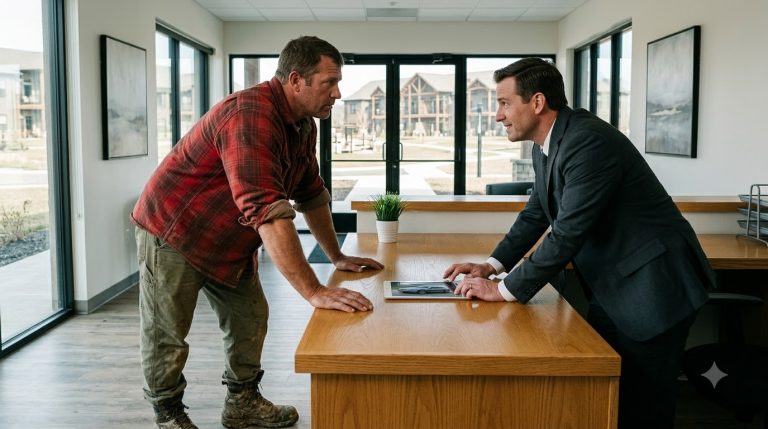
“Effective immediately,” Miranda said. She didn’t offer a greeting. Her breath bloomed white in the freezing air, sharp and short. “Shut the rig down.”
“The drift at the turn is three feet high, Miranda,” I said. My voice stayed low, flat, stripped of friction. I didn’t open the storm door more than an inch. “Plows haven’t hit this end in forty-eight hours. If an engine needs to turn around down here, it’s backing into a ditch.”
“Environmental contamination,” she replied. She tapped the top of her clipboard with a gloved knuckle. “Thermal runoff mixes with the road salt. It leaches straight into the storm drains. Soil impact. Groundwater liability. The board reviewed the specs.”
“The specs say clean propane,” I said. “Zero residue.”
“Unregulated mechanical snow removal,” she countered. Her eyes were pale, dry, locked onto mine without a blink. “You were warned on Tuesday. The fine escalates daily. Continue operating that rig, and we file for an immediate property lien.”
Behind her, two men in yellow vests were already pulling thick plastic sheeting over the steel frame of my snowmelting rig. They wrapped it tightly, pulling red zip-ties through the frame, snapping orange lead seals across the fuel lines. They photographed the rig from four angles. Standard protocol. Evidence gathering.
I didn’t step onto the porch to stop them. I just turned the valve key in my pocket. One thousand PSI. Three hundred degrees at the nozzle. Eight minutes to clear ten yards of solid pack.
“The emergency services route is compromised,” I said quietly.
“First responders adapt,” Miranda said, turning her back to the driveway. “Compliance avoids consequences.”
She walked away toward the top of the block, her heels leaving precise, shallow indentations in the ice.
By noon, the second notice arrived. Same orange paper. Same heavy tape. Fifteen hundred dollars. Scrawled across the bottom in red marker was a single handwritten line: Final Warning before Sector-7 Audit submission.
I stood in the garage, staring at the sealed rig. Through the side window, I watched the upper street. A private plow cleared a driveway three houses up, angling its blade to dump two tons of grey, wet slush straight into the funnel at the dead end. The snow didn’t melt. It settled, compressed, and froze into a solid, impenetrable barricade.
My phone buzzed on the workbench. An alert from the HOA application.
Community Update: Unauthorized machinery neutralized. Protecting our local ecosystem. Comments disabled.
I leaned over the workbench, opened my laptop, and pulled up the municipal tax records for the cul-de-sac. Buried inside the latest infrastructure report was a stamp I hadn’t seen on previous filings: Apex Indemnity – Pending Review.
I locked the brass key back into the rig’s control box, the metal clicking shut like a deadbolt.
Outside, the wind shifted north. The temp dropped four degrees in ten minutes. The trap was set, and the ice was setting with it.
CHAPTER 2: THE AUDIT OF ICE
The metal casing of the laptop was so cold it pulled the heat straight out of my fingertips. Outside, the wind slammed against the garage door, rattling the steel tracks in their brackets. On the display, the text remained unchanged: Apex Indemnity – Pending Review.
Below it, buried in the raw attachment of a forwarded internal update that Miranda Holt had sent to the board members three weeks prior, sat a single line item that hadn’t been scrubbed: Winter Access Contract: Terminated.
Not suspended. Not delayed for budgetary adjustments. Terminated.
My thumb clicked the brass threads of the Cold-Forge key in my pocket. The math was immediate, clinical. The HOA had pocketed the winter maintenance assessment fees from twenty-four homeowners, canceled the private plow services entirely, and reallocated forty thousand dollars into an escrow account labeled Sector-7 Audit Preparation.
They hadn’t just banned my snowmelter because of a hypothetical salt leak. They banned it because every square yard of blacktop I cleared was physical proof that the road was usable—and that their official excuse for the isolation was a total lie. If the cul-de-sac stayed buried long enough, the county would mark the lower four properties as inaccessible during severe weather events, triggering a mandatory municipal reassessment.
My phone screen flickered on the workbench. A private message from Dan down the street.
My dad’s oxygen concentrator is on battery backup. Power grid is wavering. Is there any way out?
I typed back with two fingers, keeping the response stripped of emotion: Not through the turn. The wall is five feet high and frozen solid. Keep the backup batteries warm.
I minimized the budget file and opened the local property ledger. Apex Indemnity wasn’t an insurer. It was a holding firm registered under a private LLC out of the capital. Three of the board members—including Miranda—held minority voting shares in the firm’s regional parent company. They were deliberately letting the dead-end freeze over, building a paper trail of municipal neglect to justify a tax write-off and force a distress sale of the bottom lots.
A sudden dull thud rattled the side door of the garage.
I picked up the heavy flashlamp from the bench and stepped toward the frosted pane. Outside, the street had vanished. The wind drove snow sideways in blinding, horizontal sheets, packing fresh powder directly into the crevices of the orange violation seals wrapped around my rig.
I didn’t break the seals. Not yet.
Instead, I took three high-resolution photographs of the laptop screen showing the time-stamped budget updates, then forwarded the unedited file directly to the county emergency management oversight server. I attached a single line of text: Access corridor obstructed by intentional service withholding. Infrastructure failure imminent.
The automated receipt arrived six seconds later: Filed under Case Reference: Sector-7 Audit Log.
I locked the laptop, pulled my heavy gloves back on, and walked to the front window. Down the street, through the swirling whiteout, the lights in Miranda’s house burned bright and steady. But at the bottom of the hill, where the snow formed a solid wall against the asphalt, the dark shapes of trapped vehicles sat buried to their side mirrors.
The trap was fully set. The paperwork was filed. All that was left was the spark.
CHAPTER 3: THE LEVER AND THE LOCK
The phone didn’t vibrate once—it screamed.
The caller ID flashed Miranda Holt. I didn’t open the door. I didn’t step into the gale. I tapped the speaker button, my thumb leaving a smudge of grease and ice on the glass screen.
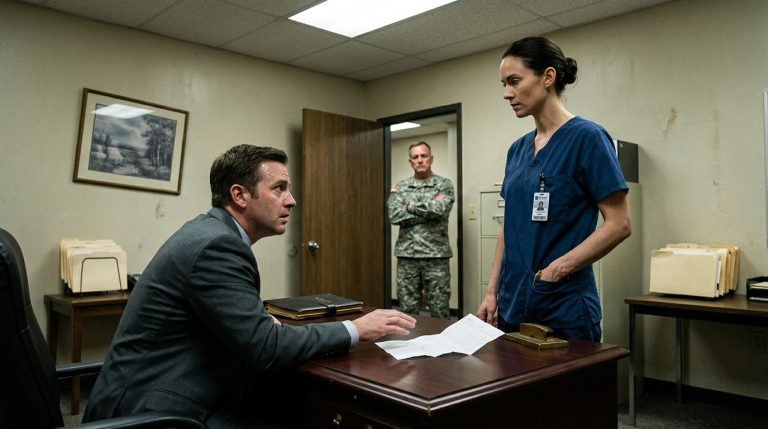
“He isn’t answering,” Miranda said. The authoritative edge in her voice had vanished, replaced by a wet, ragged panic. “He went into the lower bay to start the generator. The door dropped. The automatic release snapped.”
“Who?” I asked. My tone remained level, cold as the brass key pressed inside my fist.
“My son,” she choked out. “The drift collapsed behind the tracks. He’s trapped inside. The exhaust—he was trying to jump the sedan’s battery with the portable unit.”
In the background, over the howling draft blowing through her phone’s microphone, came the distinct, flat crackle of an emergency dispatch operator. Miranda had put county services on speaker on a second line.
“Ma’am, stay on the line,” the dispatcher’s voice bled through, tinny and distant. “Units four and seven are stalled at the intersection of Highway 9. The road through your sector is completely unplowed. We cannot clear the turn. Repeat, emergency vehicles cannot breach the drift.”
“Please,” Miranda sobbed into the receiver, speaking directly to me now, her voice stripped of every policy, every ordinance, every threat of property liens. “Please. I know what I signed. I know what I posted on the app. He’s pounding on the panel. The sound is getting softer.”
I turned slowly on my heel, facing the rear alcove of my garage.
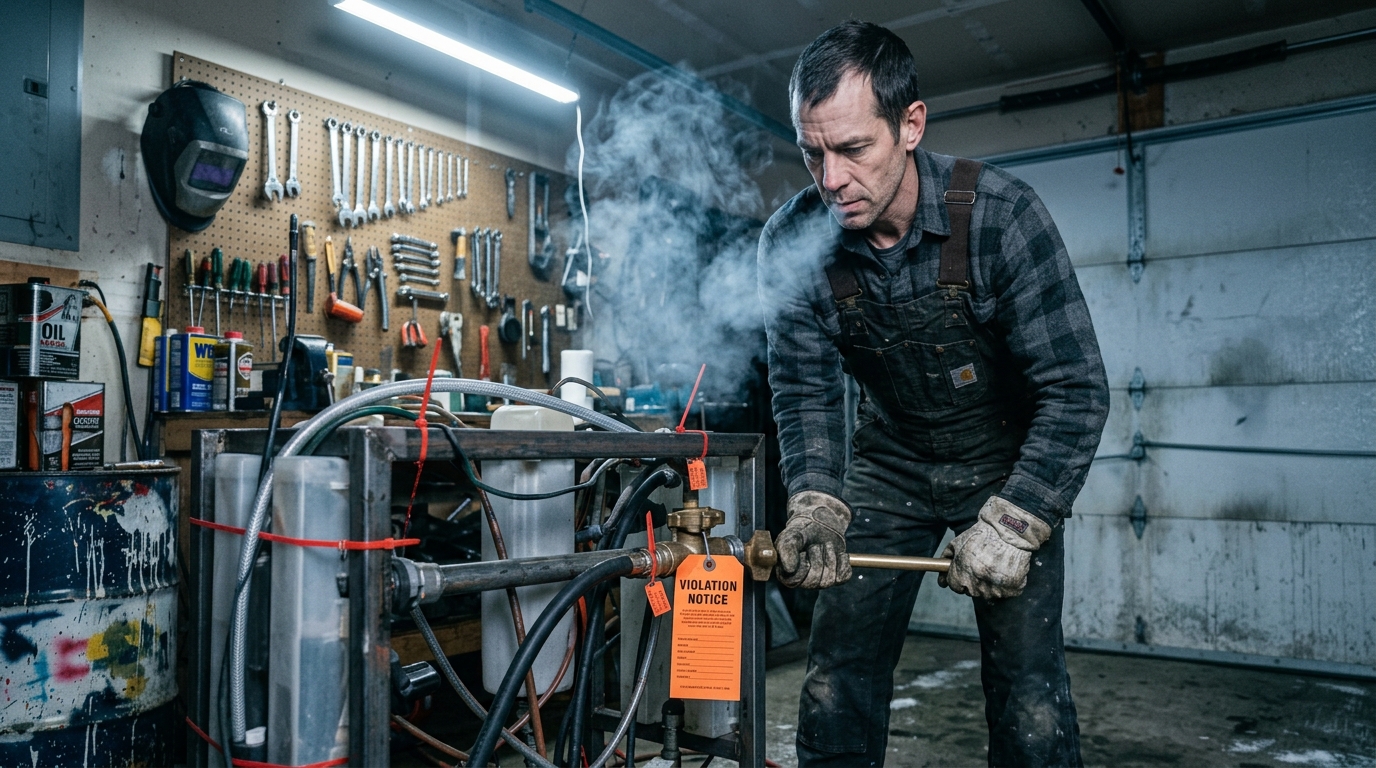
Wrapped in thick industrial plastic, secured with heavy red zip-ties and lead tags, sat the snowmelter. The bright orange violation notice—the third one issued in forty-eight hours—glared under the overhead LED strip. Unauthorized Mechanical Removal Device. Property Lien Pending.
“Miranda,” I said into the speaker.
“I’m here! I’m right here!”
“The Sector-7 Audit file,” I said, my voice dropping an octave, dead-calm. “The contract termination for the plow route. You signed it to fund the Apex Indemnity escrow.”
A sharp, gasping silence cut through her side of the line. Even through the storm, the realization hit her like an iron bar. She had constructed the barrier herself. She had signed the paper that canceled the plows, built the white wall at the bottom of the street, and sealed her own child inside a air-tight concrete box filling with carbon monoxide.
“I’ll sign whatever you want,” she wept, her breath ragged. “I’ll dissolve the board. I’ll pay the fines myself. Just get down here. He’s stopped pounding.”
“I don’t want your signature,” I said. “I want you to stay on the line with dispatch. Tell them the access corridor is being opened by private equipment under emergency necessity.”
I ended the call without waiting for a reply.
I reached into my pocket, pulled out the heavy steel utility blade, and stepped up to the snowmelting rig. The cold plastic groaned as I drove the steel straight through the center of the orange violation notice, slicing the municipal seal cleanly in two.
With three quick strokes, I severed the heavy red zip-ties. The plastic shroud fell away to the concrete floor in a crumpled, frozen heap.
I grabbed the heavy brass valve key, slotted it into the primary fuel regulator of the Cold-Forge Propane manifold, and spun the threads wide open. The pressure gauge needle slammed against the upper limit—twelve hundred PSI.
The storm outside raged on, but inside the garage, the steel frame of the burner hummed with cold, latent force. The line was crossed. The paperwork was dead. Now, only thermal velocity remained.
CHAPTER 4: THERMAL VELOCITY
The igniter coil didn’t click—it struck like iron against flint.
A blue cone of compressed flame erupted from the burner jets with a concussive thump that shook the dust from the garage rafters. Heat rolled back across my face, dry and scorching, instantly evaporating the frost on my collar. The needle on the primary regulator settled at eleven hundred PSI.
I grabbed the heavy steel towing bar attached to the melter’s frame, kicked the wheel locks free, and shoved the rig through the threshold.
The instant the three-hundred-degree thermal array hit the drift outside, the blizzard screamed back. Superheated steam exploded upward in a dense, blinding column, whistling like a broken steam pipe as it collided with the zero-degree gale. Water hissed and boiled across the freezing concrete, then turned into a roaring black torrent that cut straight down the center incline of the street.
I leaned my full weight into the rig’s rear handle, forcing the burning nozzle into the heart of the five-foot wall.
Three inches per second.
The ice didn’t just melt—it fractured under thermal shock. Great crystalline slabs groaned, splintered, and collapsed into the boiling slush beneath the chassis. The blacktop emerged beneath my boots, wet and steaming, completely stripped of pack.
Halfway down the block, front doors slammed open. Shadows emerged on snow-slick porches. Flashlights cut through the whiteout, their beams catching the white plume of steam rising thirty feet into the storm. Someone shouted my name. I didn’t turn my head. My eyes remained locked on the pressure manifold, watching the needle vibrate against the safety pin.
“Stop!”
Miranda stood in the middle of her driveway, wearing a thin wool coat over her pajamas, her boots completely submerged in the freezing slurry pouring off the road. Her face was gray, slick with melted snow and tears. “You’re cutting too close to the gas meters!”
“Get back on the porch, Miranda,” I said. My voice didn’t rise above the roar of the propane jet. I didn’t slow my pace by a single inch.
A sudden mechanical shudder rattled through the rig’s chassis. The main line pressure dropped fifty pounds in a second—subterranean backpressure from the clogged storm drain below was pushing cold water straight back up into the melter’s exhaust port. The flame sputtered, turning sickly yellow.
I didn’t hesitate. I reached down, bypassed the internal safety valve with my thumb, and turned the Cold-Forge manual key two full rotations to the right.
The burner roared back to life, white-hot, dumping unmetered fuel straight into the chamber. The steel housing turned cherry-red. The stench of scorched paint hit my nose, sharp and metallic, but the ice wall before us gave way with a sound like shattering glass.
We hit the turn at the bottom of the street.
The drift here was dense, grey, packed hard by weeks of plow dumps. The melter slammed into it like a battering ram. Heat tore through the core, carving a six-foot-wide trench straight to the dead end. Slush rained down around us, but beneath the rig, clean, bare asphalt appeared.
Ten feet ahead, the lower garage door of Miranda’s house sat crushed under two tons of frozen pack, its lower panel bowed outward from the weight.
I locked the melter’s brake, grabbed the heavy iron pry-bar mounted to the frame, and stepped over the boiling runoff. I didn’t look at Miranda, who had stumbled down the hill behind me, falling to her knees in the slush.
I jammed the iron tip beneath the garage door’s warped bottom lip, set my heels against the wet street, and threw my entire body weight backward into the lever.
CHAPTER 5: CHECKMATE ON BLACK ASPHALT
The aluminum panel didn’t give way smoothly—it shrieked as the iron bar sheared through the bottom roller bracket.
I drove my shoulder against the edge, using leverage against the curb to pop the track. The door lurched upward eighteen inches with a wet, heavy thud.
A cloud of trapped, lukewarm exhaust rushed through the gap, thick with the sharp stench of unburnt fuel. Inside the dark space, beside the idling bumper of a sedan, a young man slumped on the cold concrete. His face was gray, his forehead pressed against the tire rim, his breathing shallow and rapid.
I hauled him out by the arms, dragging his body past the steaming threshold into the fresh, sub-zero draft.
“Get blankets!” I barked over the whistle of the snowmelter.
Two neighbors who had followed the cleared lane sprinted forward, dragging heavy quilts from a porch. Miranda collapsed beside her son on the wet street, her gloved hands trembling violently as she pulled his head into her lap. She didn’t look at me. She couldn’t.
High on the ridge, the strobe lights finally broke through the storm.
An all-wheel-drive county paramedic unit crawled down the melted corridor, its heavy winter treads gripping the bare blacktop I had carved five minutes earlier. Right behind it followed a dark gray utility cruiser bearing the state seal of the Sector-7 Audit Division.
The vehicle doors slammed shut almost simultaneously. Paramedics moved in with oxygen tanks and monitors, working with quiet, practiced efficiency. One of the technicians glanced over his shoulder at the black, steaming lane cutting through the chest-high drifts, then looked at the red-hot frame of the snowmelting rig still idling beside us.
“Who cleared this grade?” he asked.
I held up the brass Cold-Forge key, its cold surface coated in soot. “Private equipment.”
“If this corridor wasn’t open,” the medic said, clamping an oxygen mask over the boy’s face, “his core temp and blood saturation would have hit non-viable levels before we reached the upper intersection.”
The official from the state utility cruiser stepped down into the slush. His boots crunched against the clear pavement. He didn’t look at the snowmelter first—he looked at the bright orange violation seals floating in the steaming runoff near the curb.
“Who issued these citations during a declared emergency?” the auditor asked. His voice was flat, dry, carrying the weight of administrative authority.
Miranda didn’t speak. She sat on the wet pavement, holding her son’s hand, her thumb rubbing a frayed thread on her coat cuff in an involuntary, rhythmic tic.
I pulled my phone from my coat, unlocked the screen, and handed it directly to the auditor.
Displayed on the screen were the forwarded internal budget updates, the time-stamped proof of the canceled plow contract, and the formal submission receipt sent to the county server two hours prior.
“The board canceled winter access three weeks ago,” I said. “They reallocated forty thousand dollars into an escrow account held by Apex Indemnity. They were using the environmental fines to build an artificial access hazard.”
The auditor tapped the screen twice, zooming in on the account registration details. His eyes narrowed slightly as he read the corporate entity number.
“Apex Indemnity,” he murmured, looking directly at Miranda. “The holding entity tied to the regional land development buyout.”
“The road was obstructed by municipal negligence,” I added, holding his gaze. “The machinery was deployed under emergency public safety necessity.”
The auditor handed the phone back, reached into his coat pocket, and pulled out an official county enforcement binder. He tore a yellow carbon slip from the block and slapped it directly against the windshield of Miranda’s car.
“HOA enforcement authority in this district is suspended effective immediately under the Sector-7 Audit emergency protocol,” he stated. “All outstanding fines, liens, and violation notices issued against this address are nullified.”
Miranda looked up, her lips parting as if to offer a policy defense, but no sound came out. The paper trail had caught her. The trap she had constructed to force a land default had collapsed under the weight of her own son’s rescue.
The ambulance doors slammed shut, the red lights painting the black, melted street in rhythmic bursts of color as it pulled away toward the highway.
CHAPTER 6: THE UNBROKEN LINE
The yellow paper rattled once against the windshield, then pinned itself flat under the wiper blade.
Around us, the street stayed quiet. The storm hadn’t stopped, but the wind had dropped to a low, hollow whistle through the overhead power lines. Vapor rose off the wet asphalt in long, lazy coils, drifting up into the dark snowdrifts that still walled the sides of the block.
The auditor turned his collar up against the chill, picked up his briefcase, and walked toward his cruiser. He stopped at the door, glancing back down the length of the road.
“The formal dissolution notice for the board will hit the registry by nine tomorrow morning,” he said. His voice was calm, clipped, stripped of drama. “The Apex Indemnity filings are frozen. Every transaction under the Sector-7 Audit jurisdiction is going to be combed through line by line. You won’t see another board citation here.”
“Good,” I said.
He nodded once, stepped into the cruiser, and pulled away. The heavy winter tires rolled smoothly over the bare, black surface, leaving twin dark tracks through the slush where the street met the main road.
Across the drive, Miranda remained on her knees near the edge of her garage. She wasn’t crying anymore. Her hands rested flat against the damp concrete, coated in fine gray grit from the road. The blanket someone had draped over her shoulders had slipped off one side, dragging in the runoff.
She looked down at the paper slip stuck to her windshield, then slowly turned her head toward me. Her lower lip twitched—an unconscious, desperate attempt to hold onto the composure she’d spent years constructing through board meetings and policy updates.
“It wasn’t supposed to go like this,” she whispered. The sound was barely louder than the water dripping off the eaves. “The land assessment… we needed the capital reserve for the district overhaul.”
“You built a trap,” I said, stepping closer until my boots stopped three inches from the edge of her wet drive. “You just assumed you’d be the one holding the latch.”
She swallowed hard, her eyes darting to the Cold-Forge Propane manifold mounted on my rig. The brass valve key gleamed dull silver under the streetlights, its threads still warm from the twelve-hundred-PSI burn. She didn’t offer another excuse. She didn’t mention compliance, or bylaws, or property values. The paper trail had closed around her, and she knew it.
She stood up slowly, her knees stiff from the freezing pavement, and walked back into her dark, empty house without looking back.
I turned back to the snowmelter.
The burner housing had cooled from cherry-red to a dull, soot-streaked gray. I reached down, took the brass valve key in my gloved hand, and spun the threads closed until the seal sat tight against the seat. Click. Turn. Lock.
I pulled a small steel file from my coat pocket and spent five minutes smoothing out a tiny burr on the regulator bracket—a minor mechanical defect caused by the extreme backpressure during the burn. Metal filings fell onto the dark asphalt, silver flakes disappearing into the wet sheen.
Down the block, porch lights stayed on. Dan’s father was sitting by his front window, waving a slow hand through the glass. Further down, two neighbors were out with shovels, quietly clearing the slush from around their storm drains so the meltwater had somewhere to go.
The road was clear. The line was open.
I took the handle of the rig, turned it toward my garage, and rolled it back up the hill, the wheels turning easily over the bare ground.