The Lone Highway to Redemption: One Outlaw, A Shattered Grandmother, and a Fatal Cold Run
CHAPTER 1: THE BROKEN THRESHOLD
The grease on my wrench was still cold when the brass bell above the diner door rattled like a loose tooth.
I didn’t look up from my coffee. Mid-July in Barstow meant the air inside Peggy’s Crossroads Diner smelled like burnt bacon, stale diesel, and eighty percent humidity from a swamp cooler that had given up the ghost in ninety-eight.
Then came the drag.
Thud-scrape. Thud-scrape.
It was a heavy, mechanical sound, the brutal rhythm of an orthopedic shoe pulling dead weight across cracked checkered linoleum. I turned my head slowly, setting the thick ceramic mug onto the Formica counter.
She looked seventy-two going on ninety. Her blue floral dress was stained with red desert dust at the hem, hanging loose over shoulders that looked like dry pine kindling. Sweat had plastered silver hair across her forehead in dark, matted strings. But her knuckles—her knuckles were chalk-white, clamped around the strap of a worn leather handbag so tight her forearms twitched with micro-tremors.
She wasn’t looking at the menu. She was looking at the room like a rabbit measuring the distance to a fence line.
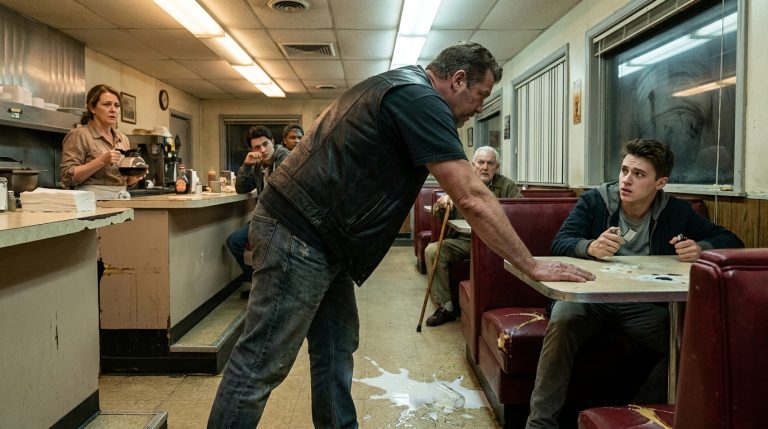
The front booths were crammed with local mechanics and truckers, all staring down into their plates, studiously ignoring the old woman’s desperate eyes. The only empty vinyl bench was the one right across from me.
She took three ragged breaths, her chest rattling. Thud-scrape.
She stopped right at the edge of my booth. Her left knee was swollen to the size of a grapefruit under her stockings, bent at a unnatural angle that made my own old knee ache just watching it.
“Excuse me, mister,” she rasped. Her voice was thin, like dry paper tearing. “Can I sit?”
I looked at her wrist. Purple, finger-shaped bruises encircled the joint— fresh, dark, and vicious.
I slid my six-foot-four frame against the wall, clearing the bench. “Sit down, ma’am. Get off that leg.”
She didn’t just sit; she collapsed. A sharp gasp tore out of her throat as her bad leg stretched awkwardly into the aisle. She pulled the heavy handbag onto her lap, hugging it against her ribs like a bulletproof shield.
I caught the eye of the waitress behind the counter. “Sarah. Water. Ice. Slice of the cherry pie.”
“Thank you,” the old woman whispered. She took the glass I pushed toward her with both hands, the ice clinking violently against the glass as her arms shook. “Thank you. I’m just… resting.”
“You’re running,” I said quietly, flicking the thumb-wheel of my brass Zippo. Click-snap. “People resting don’t look over their shoulder every six seconds.”
Before she could form the lie, the heavy glass doors of the diner rattled in their frame.
A jet-black Suburban pulled off Highway 40, its front tires spraying gravel against the diner’s side window. It didn’t park in a space. It idling diagonally across two spots, blocking my 1998 Harley Road Glide.
The old woman let out a small, strangled squeak and shrank into the corner of the booth, trying to bury herself behind my shoulder. “Oh God,” she breathed. “They saw me.”
The Suburban doors opened. Two men stepped out onto the shimmering asphalt.
They wore tailored charcoal suits that cost more than my entire garage, but they didn’t move like businessmen. They moved with the light, balanced stride of men who carried heavy weight under their armpits and didn’t care who saw the bulge.
The tall one had slicked-back dark hair and a mouth that looked like it had been cut into his face with a razor. The broader one behind him had a thick neck, a broken nose, and hands like meat cleavers.
They walked inside. The bell chimed again.
The chatter in the front of the diner died instantly. Truckers stared into their coffee. Sarah froze with the coffee pot held mid-air.
The tall suit—Briggs—scanned the room until his eyes locked onto the wisp of silver hair tucked behind my leather vest. A slow, bloodless smile spread across his lips. He started down the aisle, his leather soles clicking sharply against the floor.
“Martha,” Briggs said softly as he stopped two feet from our table. His voice was smooth, lubricated with fake concern. “You’re making this very difficult for your family. Your sister is worried sick. It’s time to go back to the facility.”
The woman—Martha—didn’t look at him. She just dug her fingernails deeper into her leather bag.
“She doesn’t look like she wants to go to a facility, friend,” I said, keeping my voice down in my chest. I didn’t stand up. I just sat there, taking up space, resting my right hand flat on the table near my Zippo.
Briggs finally looked at me, his eyes running over the heavy leather cut I wore, the faded ink on my forearms, and the thick gray in my beard. He dismissed me in a heartbeat.
“This doesn’t concern you, biker,” Briggs said flatly. “The old woman has severe dementia. She walked off from a memory care unit in Barstow. Step aside and let us do our jobs.”
“She ordered cherry pie,” I said. “Dementia patients don’t ask for cherry pie. They ask for their mothers.”
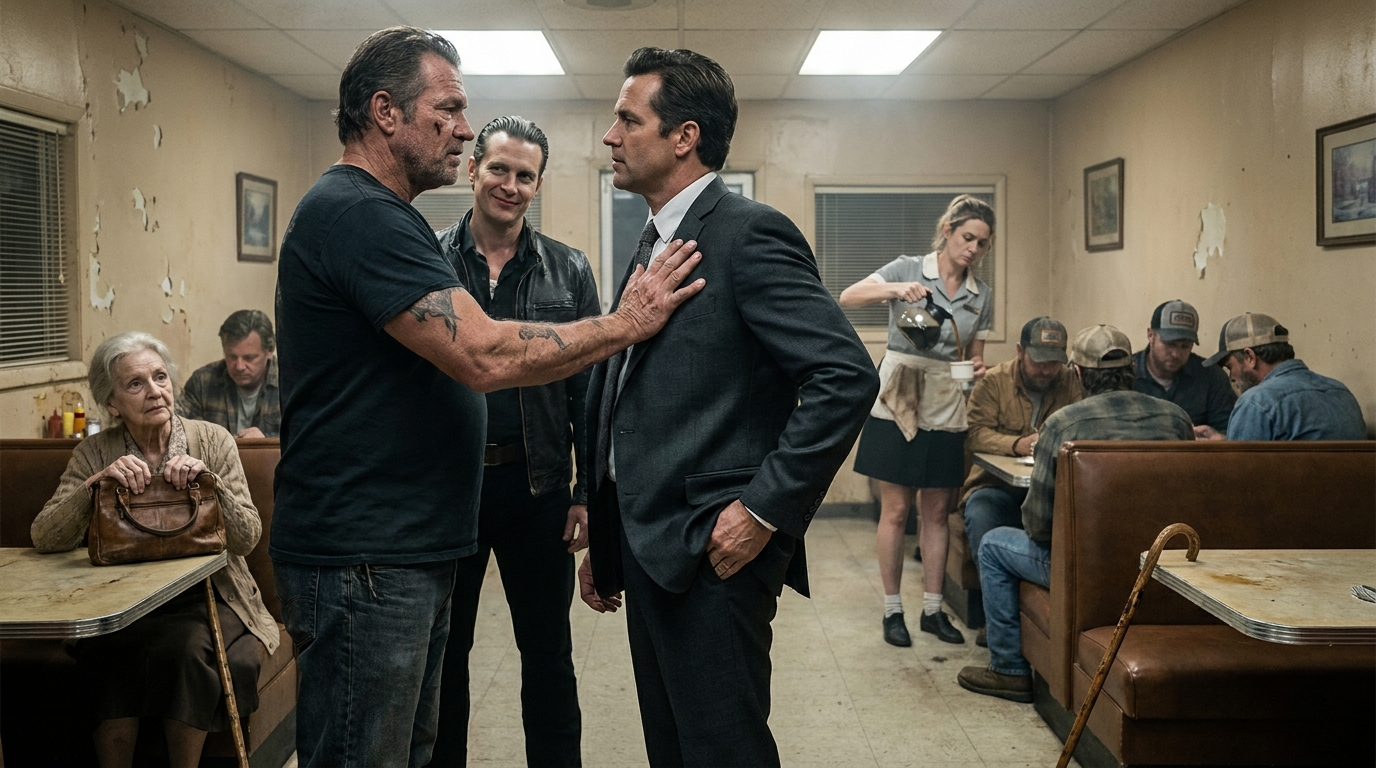
The heavy muscle behind Briggs—Sterling—took a heavy step forward. His right hand dipped six inches inside the left breast of his jacket. “Look, pop,” Sterling growled, his voice like gravel in a blender. “Hand over the old lady before this diner becomes very uncomfortable for you.”
I didn’t reach for a gun. I didn’t yell. I just stood up.
Six feet, four inches. Two hundred and eighty pounds of hardened muscle, scar tissue, and bad decisions. My shadow completely blocked the harsh desert sunlight hitting Briggs’s face.
I reached out with my left hand and rested my palm flat against Sterling’s chest, right over his hidden armpit holster. I didn’t push. I just held him there with forty pounds of dead-weight pressure.
“You’ve got three seconds to turn those shiny shoes around,” I whispered, leaning down so close Briggs could smell the stale coffee on my breath. “If you’re still in this aisle on four, I’m going to take that hollowed-out cane she’s carrying and break it over your knee.”
Briggs’s eyes narrowed. He looked around the diner. It was just me. No gang. No club brothers. Just one old outlaw standing in front of a broken old woman.
He did the math. Two armed men against one guy in a diner.
“We’re leaving,” Briggs said, placing two fingers on Sterling’s wrist to pull him back. “For now.”
Briggs backed away, his eyes locked on Martha. “This isn’t over, Martha. You can’t walk forever on that leg.”
They turned and walked out. The glass door clicked shut behind them.
Through the window, I watched them walk to the black Suburban. They didn’t pull out onto the highway. They backed into the shade of the abandoned Texaco station across the street, the engine idling, watching the front exit.
I sat back down. The diner was dead silent.
“All right, Martha,” I said, snapping the Zippo shut with a loud, metallic clack. “The wolves are parked across the street. Start talking. Who are they, and what’s in the bag?”
Martha looked at me, tears cutting clean tracks through the dust on her cheeks. She slowly unzipped the heavy leather handbag.
She didn’t pull out a gun. She reached down, grabbed the base of her grandson’s scarred wooden walking cane resting against her ankle, and laid it on the table.
Then I heard it. A faint, metallic sound.
Chirp.
It came from the rubber tip of the cane. A soft, electronic pulse every forty-five seconds.
CHAPTER 2: THE SILENT TRACKING
My right thumb stayed locked on the cold brass hinge of the Zippo while the rubber tip of that wooden cane kept chirping like a dying cricket.
“Martha,” I said, setting the lighter down on the Formica. “Who gave you that stick?”
“Leo,” she whispered, her hands fluttering over the handbag like wounded birds. “He mailed it to me six weeks ago from Chicago. Said his knee was acting up and he wanted me to have his old custom cane.”
I didn’t answer. I reached across the table, grabbed the rubber ferrule at the base, and twisted. The wood gave a dry, stubborn groan before the bottom four inches detached in my hand.
Out dropped a sleek black USB drive, bouncing once off the table before settling near my coffee mug. But inside the exposed hollow of the shaft, tucked behind a coil of compressed foam, a tiny green LED pulsed in rhythm with that faint, high-pitched chirp.
It wasn’t a battery indicator. It was a cellular transmission pulse.
“They aren’t following your face, Martha,” I said, my voice flat. “They’re following your luggage.”
I plucked the tiny circuit board out of the wood, tossed it onto the linoleum, and crushed it beneath the heavy steel toe of my work boot. The plastic crunched like a cockroach shell, and the chirping stopped instantly.
Across the street, through the sun-bleached vinyl blinds of the diner window, the brake lights of the idling black Suburban flashed twice.
“They lost the signal,” I muttered, sliding out of the booth. “Which means they’re done sitting in the shade.”
“What do we do?” Martha’s voice cracked, her fingers digging into my arm with surprising, desperate strength. “The police—”
“The police are ten miles out on the highway, and those two suits have forty thousand dollars worth of corporate lawyers to clear them before sunset,” I said. “You wanted Los Angeles. We’re going to Los Angeles.”
I grabbed the heavy Kevlar-lined riding jacket off the rack by the counter and draped it over her narrow shoulders. It swallowed her whole, the thick armor pads drooping past her elbows, but it would keep her skin on her bones if the asphalt came up to meet us.
“No backup?” she asked, her pale eyes wide behind the visor of the half-helmet I pulled down over her silver hair.
“Backup brings crowd noise,” I said, buckling the chinstrap beneath her trembling jaw. “I travel faster alone.”
I led her out the back exit into the alley, bypassing the front doors entirely. The desert air hit us like an oven door flung open, ninety-eight degrees of dry, dusty heat radiating off the gravel parking lot. My 1998 Road Glide sat waiting in the glare, its matte-black frame absorbing the glare of the desert sun.
I hoisted Martha onto the rear pillion. She was light—too light—like a bundle of dried cedar sticks wrapped in a floral dress.
“Wrap your arms around my belt,” I told her, stomping down hard on the footboard. “Don’t look at the mirrors. Don’t let go.”
The heavy V-twin engine coughed once, spewed a blue plume of exhaust into the desert air, and roared to life with a mechanical shudder that shook my teeth. I kicked the stand up, dropped the hand clutch, and slammed the throttle wide open.
Gravel sprayed against the diner’s aluminum siding as the rear tire caught traction. We hit the hot asphalt of Route 66 at forty miles an hour, banking hard toward the southbound ramp of Interstate 15.
In my side mirror, the black Suburban lunged out from the abandoned Texaco lot, its heavy V8 engine roaring as it tore through the dust to cut the distance.
They didn’t have the tracker anymore, but they had eyes on the highway. And eighty miles of open mountain pass lay between us and the city.
I clicked my jaw shut, tucked my elbows tight against my ribs, and pushed the needle past eighty.
CHAPTER 3: THE CAJON BOTTLENECK
Heavy wind buffeted the Road Glide at eighty-five miles an hour on the steep incline of the Cajon Pass, Martha’s knuckles clamped white-hot into the thick leather of my belt.
The black Suburban loomed two hundred yards back in my right mirror, its massive grille surging through the dry mountain air like a freight train. Up ahead, the two northbound lanes squeezed narrow against the sheer rock face of the pass, bordered only by rusted steel guardrails and a three-hundred-foot drop into the dry canyon bed below.
Briggs was done playing cat-and-mouse. The heavy SUV accelerated, crossing the yellow solid line to come up on my left flank, intending to pin us directly against the mountain wall.
“Hold tight!” I shouted into the turbulence, downshifting into third gear. The engine howled in protest, the back tire briefly screeching against the scorching pavement as the tachometer needle slammed into the red line.
The heavy steel front bumper of the Suburban lunged forward, missing my rear tire by less than six inches. Sterling leaned halfway out the passenger window, his face contorted in a grimace of pure rage as he reached out with a heavy iron crowbar to hook my handlebars.
Without a fleet of bikes to swarm them, I had exactly one thing on my side: gravity and six hundred pounds of iron under my seat.
I didn’t swerve away. I leaned hard into the Suburban, bringing the heavy metal engine guard of the Road Glide directly into the side panel of their door with a deafening metallic screech.
Sparks erupted between the two vehicles, blinding Sterling for a fraction of a second as the iron crowbar slipped from his fingers and clattered uselessly into the canyon below.
Briggs jerked the steering wheel to crush me against the concrete barrier, but he overcalculated the momentum of his three-ton rig on the steep downgrade.
I kicked my right boot hard off his front tire hub, using the recoil to drop the bike three inches lower into the turn, slipping behind his rear bumper just as his front left tire clipped the jagged edge of the mountain guardrail.
The steel rail buckled with a sharp, explosive groan.
The Suburban’s front axle snapped under the force, forcing the heavy vehicle into a violent, uncontrolled spin across both lanes. Smoke poured from its shredded tires as it slammed sideways into the dirt embankment, wedging itself immovably between the mountain face and a massive granite boulder.
I didn’t slow down to admire the wreckage. I straightened the handlebars, felt Martha’s tight grip loosen just a fraction around my waist, and let the incline carry us down toward the sprawling concrete grid of Los Angeles.
The mountain air began to thicken with smog and city heat, but the road ahead was wide open.
“We lost them,” Martha sobbed against my shoulder, her voice barely audible over the deep rumble of the exhaust.
“Not yet,” I said, thumbing the cold brass lighter in my pocket as the tall glass towers of downtown rose up in the haze. “We still have to deliver the bill.”
CHAPTER 4: THE FEDERAL RECKONING
I stood on the sweltering concrete steps of the Federal Bureau of Investigation regional building, the small black USB drive resting heavy in my open palm while Martha leaned her full weight against her grandson’s broken wooden cane.
Two armed security guards in crisp uniforms surged through the heavy glass doors, hands hovered low over their holstered sidearms as they assessed my oil-stained leather vest, my dust-coated boots, and the bruised, trembling woman at my side.
“Federal property,” the lead guard barked, his eyes darting toward my Harley idling near the red curb. “Clear the plaza immediately.”
“Call Agent Thomas Miller,” Martha said, her raspy voice cutting through the hum of city traffic. She didn’t shrink back this time. She stepped forward, dragging her bad foot, her eyes locking onto the tall, sharp-featured man in a dark navy suit stepping out into the sunlight behind the guards. “Tell him Leo Sullivan’s grandmother is standing on his steps.”
The suit froze. His hand paused midway to his jacket pocket.
“I’m Miller,” he said, pushing past the guards. His gaze dropped to the black drive in my hand, then to the worn wooden cane in Martha’s grip. “Leo? Leo gave you that?”
“He gave me the drive,” Martha said, holding her chin high despite the tears carving clean lines through the road grime on her face. “And he died because of what’s inside it.”
Miller reached out, taking the small plastic drive from my palm like it was unexploded ordnance. “The syndicate filed a missing persons report three hours ago, claiming you were abducted by an armed outlaw from a diner in Barstow.”
I pulled my brass Zippo from my pocket, snapping the top open and shut with a clean, metallic clack.
“They tried to collect her twice,” I said. “Once at the diner, once in the pass. Their black SUV is currently wrapped around a granite boulder on Highway 15 if your field guys want to go scrape them off the rock.”
Miller looked at me for a long, quiet moment, taking in the road road-dust, the scraped exhaust guard on my Road Glide, and the total lack of backup standing behind me. “You brought her eighty miles through a corporate dragnet on a single bike?”
“She asked to sit at my booth,” I said flatly, sliding the Zippo back into my vest. “In my book, that means you see the ride through.”
Miller turned back to Martha, resting a hand gently on her shoulder to guide her through the heavy glass doors into the air-conditioned lobby. “You’re safe now, Mrs. Higgins. The evidence on this drive ends the entire logistics operation today.”
Martha paused at the threshold. She turned back toward me, her frail hand reaching out to touch the leather sleeve of my cut. “Thank you, Tommy.”
“Keep the cane, Martha,” I said softly, giving her a single, sharp nod. “It’s got good wood in it.”
I swung my leg over the Road Glide, dropped the transmission into gear with a heavy mechanical clunk, and let the V-twin rumble wash over the quiet plaza.
There were no sirens following me down the street, no black SUVs sitting in the mirrors, and no trackers hidden in the frame. Just thirty miles of open desert highway waiting on the other side of the city line, and an unfinished cup of cold coffee sitting on a Formica counter back in Barstow.
I twisted the throttle and rode home.