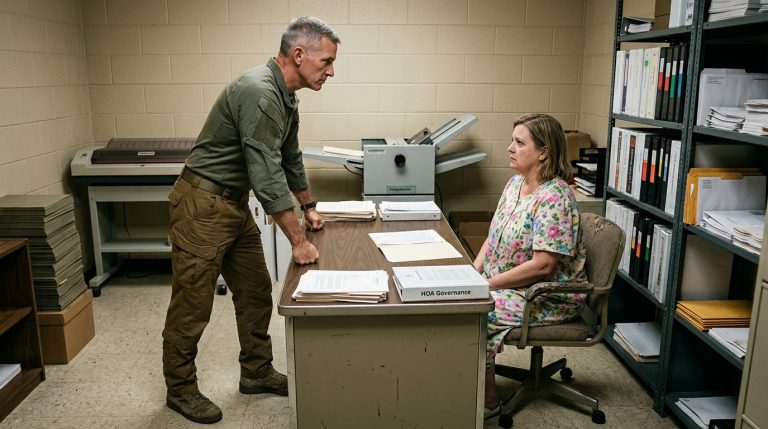
A Gritty Novel of Retribution Where Silence Shatters Under the Weight of Unyielding Justice and Cold Resolve
CHAPTER 1: THE COLD TILE
The maple syrup pooled thick and amber across the porcelain, soaking the edges of Emily Carter’s untouched pancakes.
Across the diner floor, Tyler Grant’s laughter carried over the hiss of the grill.
He didn’t look at her like a person. He looked at her like an obstacle he had successfully kicked out of his path.
Emily’s fingers gripped the edge of her wheelchair, her knuckles whitening until the skin pulled tight.
Linda stood behind the counter, her hand locked around the handle of a stainless-steel coffee pot so hard her wrist trembled.
Walter Briggs shifted his weight in the corner booth, his thumb tracing the worn grain of his wooden cane.
Nobody moved.
Every pair of eyes in the Maple Diner carefully avoided the sticky puddle of milk and shattered glass near the corner.
Complicity wore a quiet face in small towns.
Tyler leaned his hip against the booth frame, his smirk sharpening as he waited for approval from shadows who didn’t dare breathe.
Emily stared down at her reflection in the spilled white liquid, fractured and blurred beyond recognition.
The door behind her didn’t jingle softly this time.
It slammed back against the wall with a dry, concussive crack that rattled the ceiling tiles.
CHAPTER 2: HEAVY METAL APPROACH
The air in the Maple Diner turned instantly cold, heavy with the sharp smell of rain and exhaust clinging to black leather.
Logan Maddox didn’t look at Tyler Grant first.
He didn’t look at the two cronies shrinking against the laminate counter, either.
His gaze swept across the floor, past the spilled syrup, past the pooled milk, locking directly onto Emily Carter’s shaking hands where she sat pinned in her corner booth.
A heavy metallic clack echoed through the dead silence of the room.
Logan’s thumb flicked a scuffed steel Zippo lighter open and shut, open and shut, the rhythmic snap of the spring-loaded hinge ticking down like a countdown timer.
He closed the remaining distance in three unhurried strides, his heavy vest hanging off broad shoulders, carrying the solitary weight of a man who didn’t ask for permission.
“You find that amusing?” Logan asked, his voice a low, gravelly baritone that barely rose above a whisper.
Tyler forced a dry cough, his chest puffing out as he tried to summon the unearned authority he’d wielded five seconds ago.
“Look, pal, you’re in the wrong place to start something—”
The Zippo snapped shut with a definitive, bone-dry crack.
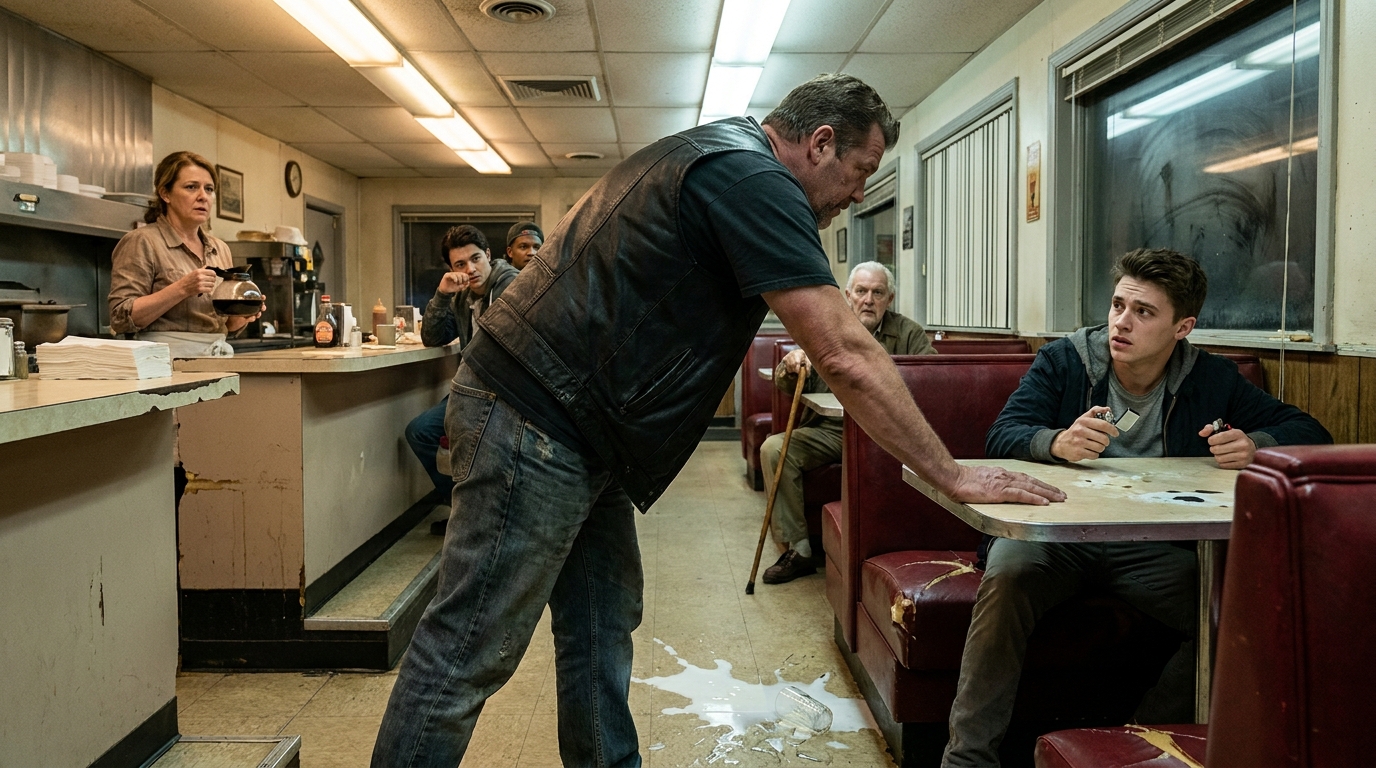
Logan didn’t raise a fist. He simply leaned down, planting one large, calloused hand on the edge of Tyler’s table, pinning the boy in place with nothing more than six feet of scarred, unbroken resolve.
“You just made this my business,” Logan said softly, his eyes like two pieces of flat, gray iron. “And nobody in this room is leaving until the mess on the floor is gone.”
Across the diner, Walter Briggs lowered his wooden cane half an inch, his knuckles white, staring at the lone biker who had just stepped into the fight everyone else ran from.
CHAPTER 3: STRIPPING FALSE PRIDE
A nervous tremor twitched in Tyler’s jaw, ruining the posture he’d spent ten minutes building.
Logan didn’t lean back. He shifted his weight, resting his left forearm flat on the Formica table, inches from the spilled syrup.
“You got a phone in your pocket,” Logan said, his voice dropping into a flat, measured tone. “Call whoever you think backs you up in this town.”
Tyler’s hand twitched toward his jeans, then stopped.
Mason slid two inches to the left along the counter, his sneakers squeaking loudly against the tile, looking for an exit that meant pushing past six feet of scarred leather.
“We were just messing around—” Tyler started, his voice cracking on the last word.
—”You broke a glass in front of a girl who couldn’t move out of the way,” Logan interrupted, his hand dropping to the table with a hollow, heavy thud.
The scuffed steel Zippo rolled from his palm, coming to rest precisely between Tyler’s knuckles and the edge of the wood.
A faint oil smudge glistened on the metal casing, fresh enough to catch the flickering neon overhead.
Logan didn’t raise his voice, but the quiet in the room stretched until the hum of the diner’s refrigerator sounded like grinding iron.
“You think because your old man’s name is on the lumber yard, nobody touches you,” Logan said, watching the sweat break along Tyler’s hairline. “I don’t work for the lumber yard.”
Linda dropped a fresh stack of paper napkins onto the counter behind them, the soft slap of paper cutting through the silence.
Walter Briggs didn’t take his eyes off Tyler’s hands, his heavy wooden cane held upright between his boots like a stake in the floor.
Tyler looked around the room, searching for the comfortable, averted eyes he’d counted on ten minutes ago.
Nobody looked away this time.
“Pick up the napkins,” Logan whispered.
CHAPTER 8: The Price of Common Sense
Arthur didn’t scream this time. The rage had drained right out of his face, leaving behind the gray, hollow look of a man who realized the ground had completely given way beneath his feet.
“You can’t just hand this to the city,” he muttered, his voice cracking around the edges. “We can fix this quietly, Frank. As neighbors.”
“We aren’t neighbors, Arthur,” I said softly, pulling the file back into my grip and sliding it into my work bag. “We’re just people who live on the same street. And you treated this street like your personal slush fund.”
Dennis stepped up beside me, holding the official receipt from the county auditor’s office. He didn’t look triumphant or angry—just quietly relieved, like a man who had finally put down a load he’d been carrying for way too long.
“The deputy auditor is already waiting at the township office, Arthur,” Dennis said, his voice steady for the first time in weeks. “They’re auditing the entire board’s accounts starting at noon.”
Arthur looked at Dennis, then at me, searching for a angle, a loophole, or a sliver of hesitation. He found nothing. With a bitter, breathless scoff, he turned on his heel and stumbled back down my front steps, his shoes dragging through the gravel driveway he’d threatened to fine me over just three days ago.
By three o’clock that afternoon, the quiet on Oakridge Lane felt entirely different. It wasn’t the tense, suffocating quiet of waiting for the next absurd fine or bogus violation notice. It was just an ordinary Tuesday afternoon.
I sat on the porch, a fresh mug of black coffee in my hand, watching the mail truck make its regular run down the block. Across the street, Dennis was out on his lawn, systematically unscrewing the ridiculous ‘HOA Approved’ sign Arthur had forced everyone to display two years ago.
He caught me watching, tossed the plastic sign into his recycling bin, and gave me a simple, knowing nod. I raised my coffee mug in return. No speeches, no victory laps. Just common sense finally restored to a few hundred yards of asphalt and grass.
I took a slow sip of coffee, adjusted the porch chair against the wall, and went back to listening to the wind in the trees.