The Weight of a Quiet Armor: A Tale of Bitter Coffee and Faded Grace
CHAPTER 1: THE CRASH ON THE TILES
The white ceramic plate split clean down the center with a sound like a low-caliber pistol shot. Steaming chicken and dumplings slithered across the grease-slicked linoleum, their thick yellow gravy pooling around the cracked leather of Eli Turner’s left boot. The smell of boiled celery and old flour rose up immediately, mixed with the sour tang of damp wool that clung to the old man’s coat.
Clara didn’t step back. She shifted her weight, sliding her canvas shoes across the damp floor until her faded blue apron completely blocked Wayne Becker’s view of the trembling hands beneath the table. The fabric of her apron was thin, worn down by a thousand washings until the texture felt like cheesecloth against her thighs, but it was the only shield she had. Outside, the Kentucky rain was hitting the glass pane with a relentless, rhythmic thudding, turning the neon sign of Billy’s Diner into a smeared red blur.
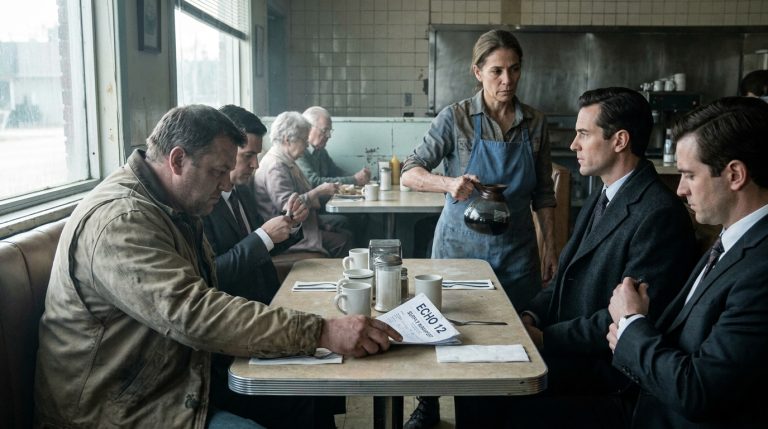
Wayne’s chest rose and fell beneath his stained white polo shirt. A bead of sweat hung from his jawline, trembling with the vibration of his breathing. He looked down at the food, then up at Clara, his lower lip twitching with the quiet fury of a man who felt his thin authority slipping away over a four-dollar blue-plate special. The remaining three customers in the front booths didn’t move. Mr. Henderson kept his fork hovered three inches above his hash browns, his eyes glued to the front page of the county ledger, though his ears were visibly red.
“Take it out of my tips,” Clara said. Her voice didn’t carry the heat of an argument; it was flat, level, the tone she used when the milk delivery was late or the grease trap needed clearing. She reached into her right pocket, her fingers brushing past her grandfather’s smooth, tarnished dog tags until they found two crumpled dollar bills and a handful of slick quarters.
“You don’t have enough tips to buy compliance, Clara,” Wayne whispered, his voice dropping below the roar of the rain but carrying twice the weight. He stepped closer, his heavy work boots crunching slightly on a piece of carrots on the tile. “This ain’t a mission. If the county sees us handing out free grease to every ghost that crawls out of the woods, the paying folks stop coming. We’re already drowning. Look around you.”
Clara didn’t look. She knew every crack in the vinyl booths, every peeling strip of laminate on the counter. She kept her eyes on the patchy gray beard of the man behind her. Eli Turner hadn’t moved an inch since the plate broke. His hands were locked around a wet knit cap, his knuckles so swollen and calloused they looked like river stones wrapped in old leather. But inside the lining of that cap, a tiny corner of yellowed paper stuck out—a frayed, unreadable receipt bearing an official military seal from three decades ago, completely out of place for a man with nothing.
“You’re fired,” Wayne said, the words cutting through the kitchen’s low hum. He pointed a thick, grease-stained index finger toward the door. “Right now. Untie the apron and get out of my sight before I call the county sheriff to clear the porch.”
Clara’s fingers stayed steady as she reached behind her back, untying the knot that held her daily armor together. She didn’t look for sympathy from the booths. She knew the silence of Ridgefield; it was the same silence that followed the factory closure. She laid the cloth on the counter, the fabric pooling over the cold stainless steel. As she reached for her coat, her thumb caught on the edge of the rusted dog tag in her pocket. The metal was warm, holding the heat of her own skin against the encroaching chill of the storm outside.
CHAPTER 2: THE SCREAMING FAUCET
The freezing rain hit Clara’s face like a handful of thrown gravel the exact millisecond her canvas shoes cleared the threshold of Billy’s Diner. The heavy glass door swung shut behind her with a dull, hydraulic hiss, cutting off the faint smell of fried onions and old floor wax, replacing it instantly with the raw, metallic scent of a Kentucky downpour. She didn’t let her shoulders drop. Her spine remained a rigid, vertical line against the gray dark of downtown Ridgefield, just as Henry James had taught her when the cold winds blew through the valley.
With every step down the cracked concrete awning, the water soaked deeper into her canvas shoes, turning the thin fabric into a freezing, heavy weight around her ankles. Her fingers were jammed deep into her coat pockets, her right thumb tracing the raised, blunt characters of her grandfather’s dog tags. Beside them lay Eli Turner’s rusted tag, its metal still retaining a ghostly sliver of warmth from her palm. She didn’t look back at the glowing window of the diner. She knew exactly what was behind her: Wayne Becker standing by the register, his face a tight mask of small-town desperation, and three regulars keeping their eyes firmly glued to their plates to avoid witnessing a neighbor’s ruin.
The walk to the auto garage on Elm Street was a slow, deliberate exercise in endurance. There were no shortcuts, no sudden jumps in time; every block had to be paid for with the steady slap of wet rubber against crumbling asphalt. She passed the abandoned textile mill, its chain-link fence choked with dead honeysuckle vines that rattled like dry bones in the wind. The streetlights overhead flickered with a faint, low-frequency hum, casting long, fractured shadows across the black puddles. Clara watched her feet move—one after the other—measuring the distance not in miles, but in the slow, rhythmic thump of her own heart.
When she finally reached the rusted iron staircase attached to the side of Miller’s Auto Garage, her hands were so stiff they could barely grip the freezing handrail. Each metal step groaned beneath her weight, the sound echoing sharply under the corrugated tin roof. She unlocked the heavy wooden door to her room, stepping into a space that smelled permanently of old motor oil, damp drywall, and the faint, sweet scent of the cedar shavings she used to line the litter box.
Smokey didn’t get up from his drawer. The one-eyed tabby merely lifted his scarred head, his single golden eye catching the dull yellow light from the streetlamp outside. He gave a low, raspy chirp, his throat vibrating against the folded kitchen towel that served as his mattress.
“I know,” Clara whispered, her voice sounding thin and foreign in the small room. “We’re home.”
She didn’t turn on the overhead light. The switch always gave a sharp, blue spark that made her skin crawl, so she navigated by the amber glow filtering through the cracked windowpane. She stripped off her soaked canvas shoes, leaving them by the door where a dark puddle began to form on the warped linoleum. Her socks were completely translucent with water, her toes white from the cold.
Walking over to the tiny porcelain sink in the corner, she turned the cold water tap. True to its nature, the faucet let out a high-pitched, banshee-like scream before a rusty brown stream trickled out, gradually clearing into an icy glaze. She filled a small plastic cup for Smokey, her hand trembling slightly as the cold metal of the pipe vibrated through the ceramic basin.
She sat on the edge of the mattress, the springs groaning a familiar, low complaint. Her entire life savings—exactly $64.38—lay inside the small plastic zipper of her coin purse on the nightstand. Rent for the room above the garage was due in ten days, and Wayne’s final words still hung in the damp air like smoke. She had no safety net, no phone calls to make, no distant relatives to rescue her from the quiet mouth of poverty.
Clara reached into her pocket and pulled out the two items that had cost her her livelihood: her grandfather’s dog tags and Eli Turner’s rusted metal circle. In the dim light, she noticed something she hadn’t seen in the chaotic rush of the diner. Eli’s tag wasn’t just old; the edge of the metal had been deliberately notched with a small file, three distinct grooves cut into the steel. Her thumb traced those ridges, the friction a sharp, grounding reality against her numbed skin.
It was a quiet clue, a physical discrepancy that hinted at something deeper than a simple homeless veteran passing through. Henry had always told her that a soldier’s gear told the absolute truth when their mouths couldn’t. She laid the tags side by side on her knee, watching how the amber streetlights caught the faded text. She was unemployed, sliding toward eviction, and completely isolated in a town that had turned its back on her—but as she rubbed Smokey’s soft ears in the dark, the initial panic began to harden into something else. A quiet, unyielding resolve.
CHAPTER 3: THE COLD PAVEMENT
Clara’s thumb slipped off the third notched ridge of Eli Turner’s dog tag, the raw edge of the filed metal leaving a cold, white indentation in her skin. The small room above Miller’s Auto Garage was completely silent save for the uneven, rhythmic rasp of Smokey’s breathing in his drawer. The yellow amber light from the streetlamp outside cut across the floorboards like a faded ribbon. Clara stood up from the groaning mattress, her stiff knees clicking in the dark. She couldn’t leave him out there. If the notches on that tag meant what her grandfather’s stories had always suggested—a deliberate marking of a life intentionally buried—then Eli wasn’t just hiding from the cold; he was hiding from a debt.
She pulled her stiff, damp canvas shoes back onto her swollen feet, wincing as the cold moisture re-invaded her socks. She didn’t have another pair. She took half of her remaining sandwich from the small plastic bag on the small table, wrapped it carefully in three layers of dry newspaper, and tucked it inside her coat pocket right next to the two heavy pieces of metal.
The descent down the rusted iron staircase was slower this time. The metal rungs were covered in a thin, greasy slickness from the garage’s exhaust vents below. Step by step, she forced her numb limbs forward, her shoulder brushing against the peeling wood of the exterior wall. The rain had slowed to a dense, fog-like drizzle that hung in the air like suspended dust, smelling strongly of old oil, wet asphalt, and the sharp tang of a coming freeze.
The journey to the downtown bus shelter was a three-block calculation of shadows. Ridgefield was empty, its storefronts dark and hollowed out like teeth in an old skull. Her shoes made a soft, wet squelch against the broken concrete of the sidewalk. She didn’t run; running invited attention, and an unemployed woman walking alone at midnight in a dead town was already an anomaly the local cruisers would circle.
As she rounded the corner by the defunct pharmacy, the blue plastic canopy of the bus shelter came into view. It sat under a dead streetlight, its Plexiglas walls scarred with old graffiti and spiderweb cracks that diffused the distant light into a dull gray haze. Beneath a long, tattered sheet of green plastic utility tarp, a shape lay curled on the concrete bench.
Clara approached softly, her footsteps slowing until she stood just inches from the edge of the shelter. The smell of wet wool and deep, chest-rattling exhaustion was thicker here. Eli’s head was tucked toward his chest, one scarred hand holding a water-stained paper bag like a visual anchor against the concrete.
“Mr. Turner,” she whispered, kneeling down on the damp pavement. The cold of the concrete soaked instantly through the knees of her trousers, a sharp, grounding ache.
The old man didn’t wake with a start; his eyes simply opened, flat and gray, reflecting the dull sky. He didn’t pull away when Clara extended the small package wrapped in newspaper.
“Thank you for remembering me,” she murmured, setting the sandwich down by his worn boots.
Eli’s fingers tightened on the paper bag. He shifted his weight, his bad leg dragging with a heavy, scraping sound against the concrete. As he moved, the tattered edge of his military coat brushed against a dark object tucked deep into the corner behind the bench’s steel support bracket. It wasn’t a piece of trash. It was a thick, leather-bound small ledger, its corners warped by moisture but its spine distinctly bearing the gold-stamped initials of W.B. Enterprise—Wayne Becker’s private accounting books.
Clara’s hand reached out instinctively, her fingers brushing the cold, wet leather before Eli could lean back. Wayne had been at the shelter earlier. The realization hit her not through an explanation, but through the physical texture of the object in her hand; the leather was still slick with the grease from the diner’s back kitchen line. She pulled it into her lap, the weight of it heavy and cold against her thighs.
She flipped the wet pages under the faint light of the distant streetlamp. Her eyes tracked down rows of neat, blue-ink calculations—years of numbers stretching back through the town’s collapse. But it wasn’t a record of profit. Under the name E. Turner, there were monthly deductions, small but continuous payments made to a regional veterans’ hospital in Lexington, signed in Wayne’s heavy, jagged cursive. Wayne wasn’t just throwing Eli out to keep the diner clean; he was tracking him. The ledger was a decoy secret, a physical proof that Wayne was deeply entangled in Eli’s hidden life long before she had ever poured a cup of coffee.
“He looks for me,” Eli rasped, his voice a dry whisper that barely carried over the low hum of the garage generator blocks away. “Wayne thinks he’s paying off the past. He thinks if he keeps the books clean, the boy won’t find out.”
Clara looked up from the pages, her heart hammering against her ribs. The absolute final reality of Eli’s exile was still locked away, obscured by Wayne’s secret payments, but the landscape of her home had completely shifted. Before she could ask the next question, the low, powerful rumble of a diesel engine vibrated through the pavement beneath her knees. A black military vehicle glided past the far intersection, its headlights cut to running lights, its dark windows reflecting the gray fog like a pair of sightless eyes.
CHAPTER 4: THE IRON LINEUP
The low, heavy vibration of the diesel engine traveled straight through the damp asphalt, humming against the skin of Clara’s knees as she knelt by the concrete bench. The black military vehicle didn’t speed up. It drifted through the freezing gray mist like a block of solid iron, its taillights bleeding a dull, dark red into the fog before vanishing behind the skeletal frame of the old hardware store. Clara held Wayne’s water-logged ledger tightly against her ribs, the damp leather softening under the heat of her fingers. Beside her, Eli’s breathing had grown shallow, a thin plume of vapor dissipating against his tattered collar.
“They’re circling,” she whispered, her fingers tracking the warped edge of the ledger. “They’ve been looking for you, Eli. Not just Wayne. Someone with real authority.”
Eli didn’t respond with words. He slowly turned his head away, his rough chin resting against the green utility tarp, his single visible eye staring down at the half-sandwich wrapped in newsprint. He knew what was coming. The town wasn’t just collapsing under economic rot; it was a cage where the past was caught in an invisible, tightening net.
Clara stood up, her joints protesting with a sharp, burning ache. The temperature had plummeted over the last hour, the thick drizzle hardening into microscopic needles of frost that coated the blue plastic canopy of the bus shelter. The ground beneath her shoes was changing texture, the slick water sheen morphing into dangerous patches of black ice that glinted like grease under the distant, dying streetlights. She couldn’t leave him here, but she couldn’t pull him up the Elm Street stairs alone. She needed leverage, or she needed the truth to act as a lever.
She began the long, freezing walk back toward the main street. Every step required a conscious placement of her weight to avoid the invisible patches of ice on the concrete. The silence of Ridgefield was no longer passive; it felt expectant, like a held breath. As she approached the intersection of Main and Market, the sky began to change, a sickly, pale yellow breaking through the heavy wool of the eastern clouds. It wasn’t a warm sunrise; it was just enough light to expose the peeling paint, the boarded windows, and the thin layer of frost covering Billy’s Diner.
At exactly 6:45 a.m., the silence didn’t break—it was crushed.
From the north end of Main Street, a line of dark, heavy SUVs moved in absolute, synchronized order. They didn’t use sirens. The only sound was the massive, collective roar of large-displacement engines and the steady, heavy crunch of heavy-tread tires grinding over the frosted asphalt. Clara stopped near the rusted mailbox on the corner, her fingers freezing inside her pockets as she watched the convoy pull into a clean, geometric line directly in front of the diner’s entrance.
The doors opened simultaneously. The first man to step out wore a sharply pressed US Army service uniform, his posture so perfectly vertical he seemed entirely separate from the decaying landscape around him. His chest was a multi-colored wall of ribbons and medals that caught the dull morning light. He didn’t look at the storefronts or the yellow traffic lights blinking their useless warnings. He stood by the rear door of the lead vehicle and waited.
And then, emerging from the side alleys and the trailing transport trucks, they filed out. Dozens of men and women in full service uniforms—Army, Marines, Navy—forming perfect, unmoving rows along the sidewalk. They didn’t speak. They didn’t look at the few scattered residents peering through the blinds of the apartments above the dry cleaner’s. Their presence was an absolute, physical weight that filled the empty street from curb to curb.
The bell above Billy’s Diner jingled with a thin, brittle sound as Wayne Becker stepped out onto the concrete porch, a grease-stained apron tied loosely around his thick waist. His face was entirely devoid of its usual ruddy color; his mouth hung slightly open, his lower lip trembling against the biting morning frost.
Clara moved closer, keeping her back against the brick facade of the old bank. She could see Wayne’s hands shaking as he gripped the aluminum frame of the door. The uniformed officer stepped forward, his boots making a clean, rhythmic crunch on the frosted pavement until he stood exactly three feet from the diner’s steps. He removed his cap, revealing a face lined with the same hard, unyielding geometry as Eli’s.
“My name is Colonel Matthew Turner,” the officer said. His voice wasn’t loud, but it possessed a strange, resonant velocity that traveled through the cold air without dropping a single syllable. “Son of Eli Turner.”
Wayne’s chest hitched. His eyes darted instinctively down toward the ledger Clara held concealed beneath her coat across the street, as if searching for an exit that had been closed decades ago. The line of silent soldiers stood like an iron wall behind the colonel, their eyes fixed forward, their collective stillness a physical accusation against the small-town indifference that had tried to wipe a veteran from the ledger of the living. Clara felt the heavy silver star in her pocket grow cold against her thigh, a silent weight waiting for its final placement.
CHAPTER 5: THE SHIMMERING SILL
Colonel Matthew Turner’s voice cut clean through the frozen mist, hanging in the narrow gap between the bank and the diner like a physical weight. Across the asphalt, Wayne Becker’s hands did not leave the aluminum door frame; his fingers gripped the metal until his knuckles went the color of curdled milk.
Clara stepped away from the cold brick wall, the heavy leather of Wayne’s ledger clutched firmly against her ribs. The lines of uniform-clad soldiers stayed motionless, an unyielding wall of iron and olive drab that parted with silent precision as her canvas shoes met the street. She walked directly toward the center of the line, her posture straight, her thumb resting on the notched metal of Eli’s dog tag inside her pocket.
Wayne saw the ledger first. A hollow, rattling breath escaped his lips, his shoulders sagging beneath his grease-stained shirt as the physical proof of his secret accounting came into the light. The moral justification he had carried for years—using the diner’s thin margins to quietly pay off Eli’s old institutional bills so the boy wouldn’t inherit the ruinous black-market military collections—crumbled the moment Clara laid the book onto the lead SUV’s frosted hood.
“He didn’t want you to find him, Matthew,” Wayne whispered, his defensive anger entirely spent, leaving only the raw, raspy voice of a broken shopkeeper. “He stayed out here in the dirt because those old medical collections were tied to his name. If he came back into the system, if he claimed his rank, the legal state codes would have stripped your officer’s commission to clear the grandfathered care debts. He protected you by becoming a ghost.”
Colonel Turner froze, his hand hovering inches above the laminated Silver Star citation he had pulled from his tunic. He looked from Wayne to the ledger, then down at Clara, who quietly drew the notched dog tag from her pocket. The physical evidence was complete. Eli had filed those grooves into the steel himself—a deliberate, tactical erasure of his identity to save his son’s future from the cold machinery of institutional debt.
“The debt is cleared, Mr. Becker,” the colonel said after a long, crushing silence. His voice had lost its mechanical edge, replaced by a deep, hollow resonance. “The military tribunal voided the collection contracts three days ago. He didn’t have to run.”
The cornered beast protocol had reached its quiet end. There was no violent confrontation, no dramatic shouting; Wayne simply stepped back into the shadows of his empty diner, the glass door clicking shut behind him for the last time. Within weeks, the neon sign would go dark, the suppliers would pull their trucks from the alley, and the peeling storefront would sit empty under the heavy Kentucky sky.
The transition from the ruined diner to the old vending machine warehouse on the south side of town didn’t happen in a single breath. Clara lived through every hour of the layout, sweeping the concrete floors, scraping the rusted scale from the iron girders, and watching the community kitchen take shape under her hands.
Now, the air inside the wide room smelled of simmering beef chili, fresh cornbread, and the clean, sharp scent of pine shavings. Smokey sat on the wide wooden window sill, his single golden eye blinking lazily in the soft afternoon light that drifted through the clean glass panes.
Clara sat at the pine table near the counter, a small screwdriver in her hand. Resting on the grain before her was her grandfather’s old wooden tobacco box, its brass hinge bent and pulling free from the lid. Slowly, deliberately, she worked the tiny steel screws into the fresh wood she had glued into the mortise, applying steady pressure until the metal sat flush and the lid closed with a solid, satisfying thud. It was a small repair, a quiet restoration of a broken thing.
The door to the warehouse creaked open, the bell above it jingling softly. A small boy, no more than seven, walked into the kitchen, his oversized sneakers squeaking against the clean gray concrete. In one hand, he held a cookie wrapped in wrinkled wax paper; in the other, a single dollar bill folded carefully into tight thirds.
He walked straight to the counter, his eyes wide as he looked at the boxes of fresh vegetables and the line of volunteers stirring the large aluminum pots.
“I saw you in the video,” the boy said softly, reaching up to place the dollar and the cookie onto the smooth pine surface. “My grandpa was a soldier too. He used to help people. Can I use this to help someone else?”
Clara didn’t give a speech. She didn’t offer a grand, cinematic gesture for the cameras that were no longer watching. Instead, she knelt down until she was eye-level with the boy, her hand rising to rest over her heart in a quiet, solemn nod—the exact gesture two hundred soldiers had given her on the frosted pavement of Main Street.
“We’ll use it today,” Clara whispered.
Behind them, near the warm light of the back hearth, Eli Turner sat in a clean, sturdy rocking chair, his bad leg propped on a low footstool. He was listening to a young volunteer read from the morning paper, his scarred hands resting quietly on his knees. He was no longer invisible. The country hadn’t changed its nature overnight, and the factory walls across town were still empty, but inside these four walls, the texture of the world had mended. Clara stood up, her hand slipping into her apron pocket to touch the smooth silver star and the tarnished dog tags resting safely at her side, entirely at peace with the quiet armor she wore.