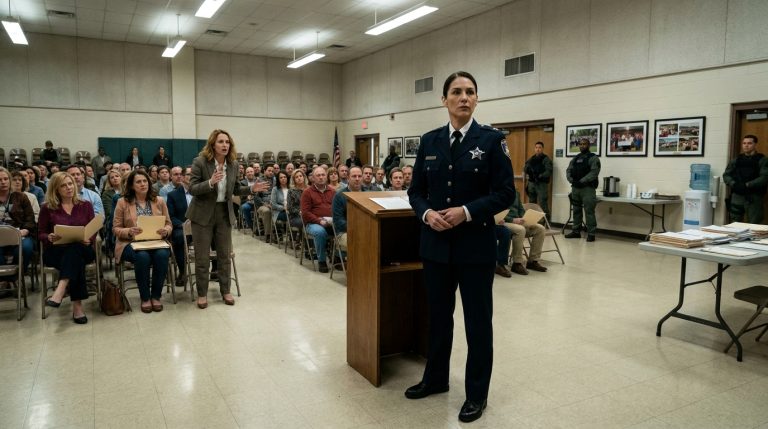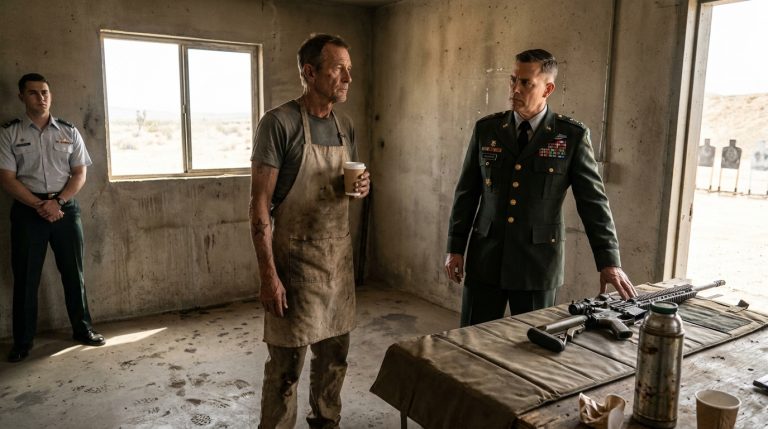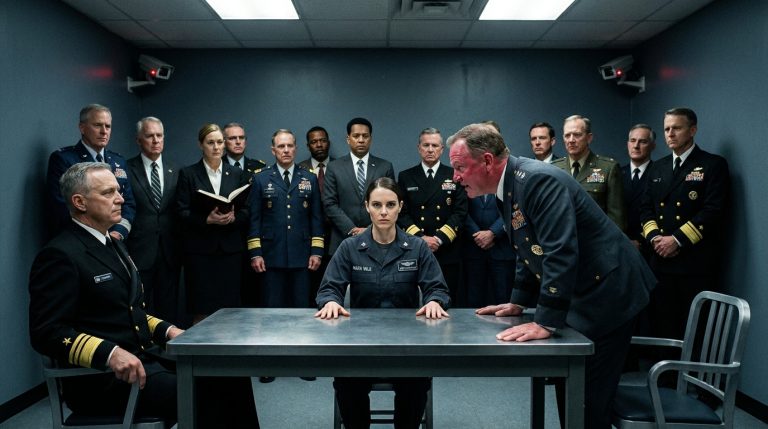
The Silent Frequency: A Master Sergeant’s Unyielding Stand Against a Crumbling Modern Digital Empire
CHAPTER 1: THE FREQUENCY OF SILENCE
The static didn’t hiss; it screamed.
Harold Meeks stood in the center of the communications tent, his boots heavy against the floor mats. Around him, the air tasted of ozone and panicked ambition. Twenty-nine-year-old Captain Derek Holland was currently shouting into a dead headset, his face flushed a violent, frantic shade of red.
“Diagnostic cycle four is failing!” Holland barked, ignoring Harold entirely. “Reroute the packet flow through the secondary uplink. Now!”
Harold didn’t look at the Captain. He looked at the main control array. It was a masterpiece of modern engineering—sleek, modular, and completely, utterly blind. Every screen displayed the same rhythmic pulse of failure. To the technicians, it was a software glitch, a localized interference, or perhaps a hardware malfunction. To Harold, it was a conversation.
He stepped closer to the primary monitor, his eyes narrowing as he watched the data stream. There was a heartbeat in the silence. A pattern. He recognized the cadence of the interference—a rhythmic, stuttering drag that echoed a specific encryption override he hadn’t seen since the winter of ’52. It wasn’t a solar event. It wasn’t a glitch.
“You’re fighting the shadow, Captain,” Harold said, his voice cutting through the tent’s chaotic noise like a whetstone on steel.
Holland spun around, his eyes locking onto Harold’s faded olive drab jacket with visceral disgust. “Who let this civilian in here? Sergeant! Get this relic out of my sight before he touches something and causes a real catastrophe!”
Harold didn’t flinch. He didn’t even blink. He reached out, his hand hovering inches from the control console, feeling the heat radiating from the overworked processors. His fingers, spotted with age but steady as stone, twitched.
“The frequency isn’t just dropping,” Harold said, his gaze fixed on the screen. “It’s being harvested. You’re looking for a repair, but you’re being bled dry.”
Holland marched toward him, his jaw muscles working. “You have no idea how these systems work. This is high-bandwidth, encrypted, real-time tactical data. It’s not some toy you can tune with a knob.”
“And yet,” Harold replied, gesturing to the wall of black screens, “it’s dead. Your silence is absolute, Captain. Why are you so afraid of an old man noticing the gaps in your logic?”
Holland grabbed Harold’s arm, his grip tight, bordering on a shove. “This is a restricted zone. You are a civilian, and you are a liability. If you aren’t off this base in two minutes, I will have you escorted out in cuffs.”
Harold looked down at the Captain’s hand on his arm, then back at the blinking, panicked face of a man who didn’t understand the ground he was standing on.
“I was leaving anyway,” Harold said, his voice dropping to a low, chilling calm. “But keep your eyes on that uplink log, Captain. The silence is getting louder.”
As the soldiers began to crowd around to usher him toward the tent flap, Harold glanced back one last time. He saw it—a flicker on the secondary terminal. A sub-directory being force-closed from an internal source. Not a hack from outside. A deletion from within.
He stepped out of the tent into the blinding Kansas sun, the weight of the secret pressing against his ribs. The static hadn’t been an accident. And now, he knew exactly who was holding the delete key.
CHAPTER 2: THE PERIMETER OF GHOSTS
The perimeter road felt longer than it had twenty years ago. The asphalt was cracked, webbed with the kind of neglect that only happens to infrastructure when the people in charge stop looking at the ground and start staring at the clouds. Harold’s knee throbbed—a rhythmic, dull pulse that timed itself to his stride. Every time his heel struck the grit, he felt the ghost of the Chosen Reservoir.
He adjusted his jacket, pulling the collar tight against the sudden, biting wind. It wasn’t just the temperature. It was the smell. Dry earth, ozone, and that unmistakable tang of overheated electronics that always seemed to precede a disaster. He kept his eyes on the fence line, his gait slightly uneven, but his mind moving with the precision of a clockwork mechanism.
He wasn’t just walking away; he was calculating.
Captain Holland’s reaction hadn’t been simple arrogance. It was panic masked as authority. When Harold had pointed out the harvest of the signal, the Captain’s face hadn’t registered confusion; it had registered exposure. That specific flicker on the terminal—the internal deletion command—was the smoking gun. Someone inside the perimeter wasn’t just losing the signal; they were actively sanitizing the logs to ensure no one could see how the uplink was actually being compromised.
Harold reached the chain-link fence and paused. He leaned against a steel post, breathing in the scent of dry, dead grass. The memory hit him then, unbidden and sharp—the biting cold of the Korean winter, the sound of a radio handset clicking in the dark, and the crushing weight of knowing the lines were cut and the company was blind. In the reservoir, he had been the only one who could hear the enemy’s frequency shift through the static.
He looked toward the storage building where the heritage exhibit was housed. The building was old, a relic of a time when the base was built for function rather than digital aesthetics. It was, in his estimation, the only place on the base that wasn’t wired into Holland’s fragile, compromised network.
“The old ways,” he whispered to the wind.
He didn’t need a satellite. He didn’t need an encrypted, modular digital backbone that relied on a handshake protocol designed by someone who had never stepped foot in a field. He needed copper, a source of power, and a clean frequency.
He pushed off the fence and began walking toward the storage building. His shadow stretched long and thin across the gravel, a dark, spindly finger pointing toward the past. He ignored the hum of a passing military truck; the soldiers inside didn’t even glance his way. They were too busy looking at their hand-held data tablets, their eyes glazed, their focus tethered to a digital reality that was currently being ripped apart from the inside.
As he reached the entrance of the storage building, he saw a young private standing guard by the door, looking bored. The kid had his phone out, tapping a screen that was likely as dead as the comm center’s main array.
“Not supposed to be here, sir,” the private muttered, not even looking up from his blank screen.
Harold didn’t stop. He slowed his pace just enough to level a look at the boy—the look of a master sergeant who had seen entire regiments vanish into the fog and had brought enough of them back to tell the story. “I’m just visiting the history, son. You might want to do the same. Everything else on this base is currently in the process of becoming history.”
The private blinked, confused, but the authority in Harold’s voice was a physical weight. He didn’t move to stop him.
Harold stepped into the shadows of the storage building. The silence inside was thick, layered with the dust of decades. It felt like walking into a tomb, but for Harold, it was a library. He moved past rows of obsolete furniture and filing cabinets, his fingers brushing against the familiar, cold surfaces of forgotten gear.
He found the BC-1000 buried under a stack of moth-eaten canvas tarps in the corner. He pulled the tarp away, and the smell of oil and dry iron rose up to greet him like an old friend. He knelt, his knee protesting, and began to unearth the radio. It was a wreck—a hollowed-out shell, missing its guts, a victim of time and indifference.
Most would have seen trash. Harold saw the architecture of survival.
He didn’t reach for a keyboard or a manual. He reached into his pockets. He pulled out a small, worn leather pouch he’d carried for years—a minimalist kit of tools he never left home without. A precision screwdriver, a spool of fine-gauge wire, and a small, multipurpose pliers.
He sat on the cold concrete floor, the radio spread out before him like a dismembered puzzle. He wasn’t just looking to fix it; he was looking to wire it into the heart of the base’s infrastructure, hidden in the blind spots of Holland’s digital empire. He had to work fast. If Holland realized the scope of the sabotage—or realized that Harold was the only one who could trace the ghost in the machine—the Captain wouldn’t just use words to keep him away.
Harold stripped a piece of wire, his fingers moving with a grace that defied the tremor in his hands. He began to bypass the broken circuit boards, mapping a new path for the electricity to flow. He worked in the quiet, the only sound the rhythmic scraping of metal against metal. He wasn’t fighting the silence anymore. He was building a bridge across it.
CHAPTER 3: THE SCAVENGER HUNT
Harold’s soldering iron hissed, a sharp, angry sound that cut through the stagnant air of the storage building. He held the tool with steady hands, the tip glowing a dull, lethal orange. He was focused on the primary circuit of the BC-1000, but his mind was already drifting back to the sensation of the solder joint he’d just finished. It felt wrong. Not structurally—the connection was solid—but there was a gap.
He squinted, bringing the radio casing closer to the flickering light of a nearby desk lamp. He had salvaged the chassis from a pile of neglected gear, but as he traced the path of the original wiring harness, he paused. A ground wire, essential for stabilizing the frequency in this specific model, was gone. Not broken. Not worn away by time. It had been cleanly snipped, the copper end flush against the terminal.
Harold sat back, the iron still in his grip. The silence of the storage building suddenly felt heavier, more deliberate. This radio hadn’t just been left to rot; it had been incapacitated.
He looked toward the doorway. The young private from before was still pacing outside, his silhouette a dark, rhythmic shadow against the bright, afternoon light of the base. Harold didn’t call out. Instead, he reached into his bag and pulled out a small, magnifying loupe. He pressed it against his eye and leaned into the chassis. There, etched into the grime on the inside of the casing, were faint, precise marks.
These weren’t the marks of an amateur scavenger. They were the signature of a technician who knew exactly how to cripple an analog signal without making the damage obvious to the casual observer.
“Someone didn’t want this equipment to ever speak again,” Harold whispered. The words were swallowed by the dust motes dancing in the light.
He stood up, his knee giving a sharp, familiar jab of pain, and walked to the wall of shelves lining the far side of the building. He began to systematically dismantle the other radio sets, his movements rapid and efficient. He was looking for components—tubes, capacitors, and, most importantly, wire. If he couldn’t find a matching gauge of copper, he would have to fabricate a bypass.
He worked with a grim, methodical focus. Every few minutes, he paused to listen to the activity outside. The base was quiet, but it was an unnatural quiet. The usual hum of tactical vehicles and the distant, rhythmic thud of generator sets were absent. The “solar event” was still in full force, and the digital systems were clearly still blind.
He found a roll of field telephone wire, high-grade copper, hidden behind a stack of old manual typewriters. He pulled it out, testing the tension. It was perfect.
As he turned back to the BC-1000, his foot caught on a heavy, metallic object near the base of the table. He looked down. It was a ruggedized external hard drive, its casing scorched as if it had been exposed to an intense, localized heat source—the kind of burn you’d see when a surge protector fails catastrophically. He picked it up. It was heavy, far too heavy to be standard-issue storage.
He flipped it over. The label was partially melted, but he could still make out the stencil: 57th Signal Battalion – Comm Operations – INTERNAL LOGS.
Harold felt a cold shiver trace the line of his spine. These were the logs from Holland’s center. They weren’t supposed to be here, buried in a storage shed among the antiques. He pulled his multitool from his belt and carefully pried at the casing. The drive groaned, the metal warping, before the back panel popped off. Inside, the internal disks were shattered, a deliberate destruction of data.
He didn’t need to read the data to know what it was. This was the trail. Holland hadn’t just ignored the backup protocols; he had destroyed the evidence of his own failure before the exercise even reached its critical phase. He had been cleaning his own tracks, perhaps preparing to blame the “solar event” for a total loss of communications, effectively covering up the fact that his digital systems were fundamentally flawed and susceptible to the very interference he claimed to be managing.
Harold set the drive aside. He didn’t have time to mourn the lost data. He had a radio to build.
He bent back to the BC-1000, his fingers working the wire into place. He bridged the gap where the ground wire should have been, soldering it with the surgical precision of a man who had survived a war by trusting his own hands above all else. He wasn’t just fixing a radio anymore; he was constructing a witness.
Outside, the base remained deathly silent. No one was coming to check on him. No one cared about the old man in the storage room. That was his greatest advantage. He was invisible, a ghost of the past moving through a present that was too obsessed with its own reflection to notice the cracks forming on the surface.
He finished the final connection, his breath steady. He tapped the handset. The radio let out a low, vibrant hum—the sound of an analog frequency waking up, searching for a signal in the dark. He wasn’t broadcasting yet, but he was listening. And as he tuned the dial, he heard it—a faint, rhythmic pulse, buried deep beneath the static.
It wasn’t solar interference. It was a data packet, encrypted and high-speed, pulsing in a pattern that was distinctly, undeniably human. Someone was transmitting from inside the base, using the cover of the “solar event” to move information.
Harold’s grip on the dial tightened. He wasn’t just competing with a flawed Captain anymore. He was listening to the enemy.
CHAPTER 4: THE FIRST SIGNAL
The hum grew into a crackle, then a rhythmic pulsing that vibrated through the wooden table and into Harold’s fingertips. It was there—the signal. It wasn’t the clean, sterile handshake of a modern digital network; it was the raw, jagged pulse of a transmission intended for someone who knew how to listen to the “noise.”
Harold adjusted the gain on the BC-1000, his breath shallow. He ignored the aching in his knee. The radio was alive, a patchwork Frankenstein of vacuum tubes and salvaged wire, singing a song that the modern world had long ago labeled as dead air. He pressed the handset to his ear, his eyes darting to the heavy wooden door of the storage building. The footsteps he’d heard earlier had stopped, but the silence that replaced them was worse. It was the silence of a predator waiting for a prey to make a move.
He needed to establish the relay, not just to talk to the command post, but to confirm the source of that pulse. If someone was broadcasting from inside the base, they were using the solar interference as a screen—a clever, cynical exploitation of nature’s own chaos.
The door handle rattled.
Harold didn’t panic. Panic was a waste of resources. Instead, he slid the BC-1000 behind a stack of rotted, canvas-covered radio crates, masking it with a few well-placed rags. He stepped back into the shadows of a filing cabinet just as the heavy iron bolt of the door slid back.
The door groaned inward. A maintenance crew—two men in dark-grey coveralls—stepped inside. They weren’t soldiers. They were contractors, the kind the military hired to maintain systems they didn’t trust their own enlisted personnel to touch. They carried diagnostic gear that looked sleek, expensive, and completely out of place in the heritage shed.
“The order was to clear the floor for the display move,” one of the men said, his voice clipped and impatient. He scanned the room, his flashlight cutting through the dust like a blade. “Said there’s a bunch of scrap in here that needs to be consolidated.”
“Everything’s scrap in here, Frank,” the second man replied, kicking a crate of old radio tubes. “The command wants the space. Apparently, they’re bringing in more of those portable servers for the comm center. The Captain’s losing his mind over the connectivity logs.”
Harold stayed perfectly still, his heart rate steady, his eyes locked on the back of the first man’s head. They were heading directly toward the crate where he’d hidden the radio.
Therefore: If they move the crate, they find the radio. But: If he moves to stop them, he reveals his presence.
He didn’t move. He waited, his hand finding a heavy, iron paperweight on the corner of the filing cabinet. It was an old military issue, solid, cold. He didn’t want a confrontation—not yet. He needed the radio, and more importantly, he needed to keep his presence hidden until he could verify the pulse he’d picked up.
The man named Frank reached for the canvas rag covering the BC-1000. He pulled. The rag came away, revealing the metal chassis. Frank paused, his brow furrowing as he looked at the radio, then at the mess of wires trailing toward the floor.
“What the hell is this?” Frank muttered, reaching down to pick it up.
“Don’t touch that,” Harold said, his voice emerging from the shadows, calm and utterly devoid of hesitation.
The two men spun around, their flashlights swinging wildly before settling on Harold. They didn’t look scared; they looked annoyed, the reaction of men who were used to being the ones in control.
“Who the hell are you?” Frank barked, stepping toward him. “This is a secured work area.”
“It’s a storage shed,” Harold corrected, stepping into the light. He stood tall, the lean in his body hidden by the way he braced his weight against the filing cabinet. “And that radio belongs to the collection. I suggest you find something else to move if you value your employment.”
“We’re on a contract, old man,” the second man said, moving to flank him. “We clear the space, we get paid. This junk is going in the incinerator.”
“Not today,” Harold said.
He moved then, not with the grace of youth, but with the efficiency of a man who knew how to use leverage. He didn’t engage the men; he engaged the environment. With a sharp kick, he sent a stack of heavy, wooden storage drawers sliding across the concrete, creating a barrier between him and the men. The sudden clatter of wood on stone echoed through the shed, a jarring, aggressive sound.
“The Colonel is expecting the heritage display to be fully intact for the final review,” Harold lied, his voice steady. “I’d hate for him to hear that you were destroying historical assets without authorization.”
The men hesitated. It was a simple, psychological play—the threat of superior authority. They exchanged a glance, their annoyance flickering into uncertainty.
“We were just doing our job,” Frank muttered, but he stepped back.
“Find another shed,” Harold said, gesturing to the door with a flick of his hand. “This one is occupied.”
They grumbled, the sound low and frustrated, but they turned and headed back toward the door. As they left, Frank cast one last suspicious look at the BC-1000. Harold waited until the heavy iron door slammed shut and the bolt slid home before he moved.
He reached the radio, his hands trembling—not from fear, but from the adrenaline of the narrow escape. He checked the wiring. Still intact. He put the handset to his ear.
The pulse was still there, stronger now, a rhythmic, repeating sequence. It wasn’t just noise. It was a code. And as Harold listened, he recognized the structure. It was an old school, long-range transmission sequence—something he’d helped design in the early days of signals intelligence.
The ghost wasn’t just in the machine. It was someone who had been trained at his own schoolhouse.
CHAPTER 5: THE RELAY NETWORK
The radio crackled, the sound thin and reedy, like a dry leaf skittering across pavement. Harold sat on the folding chair, his back against the cool, corrugated metal of the storage building wall. He had the BC-1000 tuned to the edge of the interference, his finger hovering over the transmit key. Across from him, Specialist Rivera sat on a stack of old footlockers, her eyes wide, her hands working the copper wire antenna they’d rigged through a gap in the siding.
“Sir, are you sure about this?” she whispered. Her voice was barely audible over the hum of the cooling fans from the nearby display cabinets. “If I bridge this connection, we’re bypassing the central node entirely. If the Captain’s software picks up an unauthorized shunt, it’ll flag it as an intrusion.”
Harold looked at her. He saw the flicker of hesitation in her gaze, the same look he had seen in a dozen young operators in a dozen different wars. It was the look of someone who had spent their entire career being told that the system was infallible, and who was now seeing the system rot from the inside out.
“The system is already compromised, Specialist,” Harold said, his voice a low, raspy gravel. “Every time you try to feed it data, you’re just giving the intruder more to work with. If we want to move information, we move it through the static. It’s the only place they aren’t looking.”
Rivera took a deep breath and nodded. She pulled the copper wire taut, her fingers nimble as she wound it around the terminal of the improvised relay station they’d built from the salvage pile. There was a faint spark—a tiny, bright blue arc that smelled of ozone and scorched dust.
The BC-1000 erupted in a cacophony of white noise, then settled into a rhythmic, pulsing tone. It was the same sequence Harold had heard before.
“I have the relay active,” Rivera said, her focus sharpening. “But I’m seeing strange packets. They aren’t standard military encrypted traffic. They’re… fragmented.”
Harold leaned forward, his ear pressed to the handset. “They’re using the interference as a carrier wave,” he murmured. “They’re hiding the data inside the noise of the solar event. It’s genius, and it’s dangerous.”
He gripped the handset and keyed the mic. “Any station, this is Sierra Mike 71. We are establishing an analog relay. We have a secure window on 29.7 MHz. Report status.”
He waited. For five seconds, there was nothing but the steady, hungry hiss of the ionosphere. Then, the speaker barked with a voice that sounded like it was coming from under a thousand feet of water.
Sierra Mike 71, this is Anvil Main. We are blind. Everything is dark. How are you transmitting?
Harold didn’t hesitate. He began to dictate. “Anvil Main, we are operating on a rebuilt analog transceiver. I’m bypassing the digital backbone. You need to switch your tactical data to the lower band. It’s the only way to get clear transmission until the atmospheric interference settles.”
As he spoke, he watched Rivera. She was working the dials, her face illuminated by the dim, orange light of the radio’s vacuum tubes. But then, she stopped. Her hand hovered over a secondary monitor—a ruggedized tablet she’d pulled from her own gear. She looked up at Harold, her face drained of color.
“Sir,” she said, her voice shaking. “I just ran a diagnostic on the incoming packets. The handshake protocol… it’s not just a signal. It’s an address. The system is sending our relay coordinates to an external server. We aren’t just broadcasting. We’re being traced.”
Harold felt his heart skip a beat. The sabotage he had seen in the logs, the shattered hard drive—it wasn’t just about covering up a failure. It was a beacon. Holland’s system was designed to fold, to fail, to create a vacuum that would force the units to use any available alternative. And when they did, that alternative would be intercepted.
“Close the relay,” Harold snapped.
“I can’t,” Rivera said, her voice rising in pitch. “The circuit is locked. The system is forcing the transmission out.”
Harold lunged for the terminal, his boot skidding on the concrete. He saw the screen—a wall of rapidly scrolling code, red text flashing in an aggressive, pulsating rhythm. It wasn’t just a failure. It was an active override. The Captain hadn’t just been hiding his incompetence; he had been holding the door open for someone to walk through.
The air in the storage room seemed to grow thinner. Harold reached for the main power switch on the BC-1000, his mind racing through the tactical implications. If he cut the power, he severed the lifeline for the entire battalion currently operating blind. If he kept it open, he was handing the enemy the keys to the entire exercise.
The pulse in the radio hit a high, piercing note—a screech that made Rivera cover her ears. It was a digital scream.
“Get away from the console!” Harold shouted, grabbing Rivera by the shoulder and pulling her back just as a puff of acrid, black smoke billowed from the radio’s chassis.
The BC-1000 died with a final, wet click. The silence that rushed back into the room was absolute, heavy, and filled with the metallic tang of melting insulation. They stood in the dark, breathing hard, the only light coming from the faint, dying glow of the tubes.
“They have us,” Rivera whispered, her voice barely audible. “They know exactly where we are.”
Harold stood straight, his eyes scanning the storage shed, his hand reflexively moving to his pocket where he kept his multitool. He felt the cold iron of the paperweight he’d picked up earlier. He looked at the smoking wreck of his radio, then at the dark, narrow windows of the shed.
He had won the first round, but the board had just been cleared. And he knew, with the cold, hard clarity of a man who had been here before, that the next move wouldn’t be on the radio. It would be at the door.
CHAPTER 6: THE DISCOVERY OF SABOTAGE
The smoke drifted in sluggish, oily ribbons toward the rafters, illuminated by the dying embers of the radio’s vacuum tubes. Harold stood motionless, his eyes fixed on the charred remains of the BC-1000. Beside him, Rivera was shivering, her hands clutched against her chest. The darkness in the storage shed was absolute now, broken only by the thin, silver moonlight filtering through the high, cracked windows.
“We have to get out of here,” Rivera whispered, her voice tight with a rising panic. “If they have our coordinates, they’re going to be here any second. We’re sitting ducks.”
Harold didn’t move immediately. He was listening. Beyond the walls of the storage building, the base was eerily silent. No patrol trucks, no distant chatter of soldiers—just the low, rhythmic sigh of the wind against the sheet metal roof. It was the silence of a snare being tightened.
He reached down and retrieved the ruggedized hard drive he had salvaged earlier, the one with the shattered disks. He tucked it firmly into his inner jacket pocket. If there was any hope of proving what was happening, it wasn’t in the radio anymore; it was in the fragmented data he’d pulled from the machine.
“They won’t come in with sirens,” Harold said, his voice as cold as the floor beneath his boots. “They’ll come in quietly. They’ll treat this as a technical maintenance check, and then they’ll make sure anyone who knows the truth is permanently ‘reassigned.'”
He navigated toward the rear of the building, moving with a familiarity that ignored the dark. He knew the layout of this shed better than the men who had planned to clear it. He reached a heavy, wooden service door that opened out toward the perimeter fence. He pressed his ear against the grain of the wood.
Nothing.
He opened the door just a crack. The cool night air rushed in, carrying the scent of damp earth and diesel. He looked back at Rivera. “Stay close. We’re not going back to the command center, and we aren’t going to the barracks. We need to reach the historical archives unit—the one near the old motor pool. It’s got a hard-line, analog-only terminal that isn’t connected to the primary data grid.”
“Is that even possible?” Rivera asked, stepping out into the night.
“Everything is possible if you know where the wires run,” Harold replied.
They moved along the shadows of the storage line, their feet silent against the gravel. Every shadow seemed to stretch toward them, every distant flicker of a light pole feeling like a spotlight. Harold felt the weight of the hard drive against his chest—a heavy, accusatory burden. It reminded him of a night in the Mekong Delta, decades ago, when he’d carried a satchel of intercepted intelligence through a swamp while the enemy paced only yards away. The tension was identical: the same frantic pulse in his throat, the same hyper-awareness of every snap of a twig.
They rounded the corner of the motor pool, the large, rusted hangar doors looming in the dark. Harold stopped, his hand shooting up to signal Rivera to halt.
He heard it. The soft, rhythmic crunch of tactical boots on gravel. They were coming from the direction of the command center. Two, maybe three individuals, moving in a practiced, staggered formation.
They aren’t maintenance contractors.
Harold crouched behind a stack of rusted oil drums, pulling Rivera down with him. He watched as the figures drifted past the corner of the hangar. They were wearing dark, unmarked tactical gear—the kind of equipment that didn’t exist in the 57th Signal Battalion’s inventory. They weren’t soldiers; they were shadows, and they were hunting.
“Who are they?” Rivera breathed, her eyes wide as she watched the silhouettes move with lethal precision.
“They’re the janitors,” Harold murmured. “They’re cleaning up the mess Holland made.”
As the figures paused near the entrance of the storage shed they had just vacated, one of them raised a handheld scanner. The device emitted a soft, blue glow that washed over the door. It wasn’t looking for people; it was looking for a signal. It was tracking the radio’s frequency signature.
Harold realized with a jolt that his radio—the BC-1000 he had destroyed—was still leaking a residual charge. It was acting as a beacon, a dying star calling out to its killers. He had to lead them away, or they would find the archive unit where they needed to go.
“Change of plans,” Harold said, his voice barely a breath. He pointed toward the opposite side of the motor pool, toward the main fuel depot. “I’m going to create a diversion. You take the path behind the hangar and get to that terminal. If I’m not there in ten minutes, you plug the drive into the port and upload everything. Don’t look back.”
“I’m not leaving you here alone,” Rivera said, her voice fierce.
“You aren’t leaving me,” Harold said, looking at her with a calm that defied the odds. “You’re completing the mission. The army didn’t train us to be heroes, Rivera. They trained us to hold the line. Now, go.”
He didn’t wait for her to argue. He picked up a loose piece of scrap metal and threw it with all his strength into the darkness behind the fuel depot. The metallic clang rang out through the silent night, a sharp, violent sound that cut through the air like a gunshot.
The tactical figures snapped toward the noise, their weapons moving in perfect, synchronized motion. As they sprinted toward the sound, Harold pushed off the ground, his knee screaming in protest as he forced himself into a run toward the archives, leaving the ghost of his radio to burn in the dark behind him.
CHAPTER 7: THE CONFRONTATION
Harold moved through the darkened hallway of the historical archives with the quiet precision of a man who had learned to walk on eggshells decades ago. His knee was a steady, throbbing reminder of the pace he had set, but he pushed past the pain, his focus entirely consumed by the heavy, metallic weight of the hard drive tucked against his chest. Every floorboard that groaned under his weight sounded like a gunshot in the oppressive stillness of the archive.
He reached the heavy oak door of the terminal room—a forgotten relic of a bygone era, untouched by the modern digital retrofits that had turned the rest of the base into a house of glass. He pulled a small, brass key from his pocket—a relic from his own time as a signals operator—and slid it into the lock. The tumblers clicked with a heavy, satisfying thud, and the door swung open.
Inside, the room smelled of old paper and ozone. The terminal sat in the center of the floor, a monolithic, grey box of circuitry that predated the sleek, modular glass of Captain Holland’s comm center. This was the raw reality of the base’s nervous system, a place where information still moved in binary pulses that could be touched and measured.
Harold crossed the room, his breath hitching as he approached the console. He pulled the damaged hard drive from his pocket, his fingers fumbling momentarily with the connector ports.
“Come on,” he muttered, his voice a rasp in the dark.
As he bridged the connection, a flicker of light illuminated the screen. A terminal prompt blinked—green, steady, and waiting. He began the extraction, his hands flying across the keyboard with a speed that belied his age. He wasn’t just pulling data; he was reconstructing a narrative. The logs weren’t just showing a malfunction; they were showing a series of pre-programmed commands, a digital back-door designed to pull traffic away from the satellite array and redirect it toward a non-military IP address.
The scope of it was staggering. This wasn’t incompetence. It was an occupation from within.
“I expected you’d be here, Master Sergeant.”
The voice was cold, sharp, and cut through the darkness like a razor. Harold didn’t turn around. He stayed at the terminal, his hands frozen over the keys.
Captain Holland stood in the doorway, his silhouette framed by the harsh, yellow light of the hallway. He held a sidearm, his grip firm, his face a mask of calculated indifference. He wasn’t the frantic, flushed man from the comm center anymore; he was calm, composed, and dangerous.
“The radio you destroyed was a nice touch,” Holland said, taking a measured step into the room. “But it was an analog toy. It didn’t have the capacity to store the logs you just pulled. You’re holding onto a ghost, Harold.”
Harold finally turned, his expression unreadable. He stood between Holland and the terminal, his posture relaxed, even as his mind calculated the distance between them. “The radio was a witness, Captain. And so is this drive. You didn’t just fail the exercise. You were selling the keys to the kingdom.”
“I was securing the future,” Holland replied, his voice rising, though he never took his eyes off Harold. “These digital systems are the only way to maintain superiority in a contested environment. The old ways—your ways—are obsolete. If a few bits of data had to be sacrificed to ensure the rollout of the modern standard, that is a price any commander would pay.”
“You aren’t a commander,” Harold said, his voice quiet, steady. “You’re an architect of silence. You wanted the system to fail so you could justify the cost of the rebuild. You wanted the blackout so you could point to the ‘inadequacy’ of the existing infrastructure and replace it with your own private backdoor.”
Holland smirked, the expression brittle. “You think you’re the hero of this story, don’t you? The veteran who returns to save the day. But look around you, Harold. The base is moving forward. The exercise is over. The solar event was the perfect cover, and in an hour, this terminal will be wiped clean. Who do you think they’ll believe? A decorated officer, or a bitter, retired master sergeant who broke into a secure archive to steal classified data?”
Harold looked at the terminal, then back at Holland. He saw the flicker of doubt in the Captain’s eyes—the underlying fear of a man who was fighting for his life, not his principles.
“They won’t believe me,” Harold said. “But they will believe the Colonel.”
As if on cue, the heavy door at the end of the hallway groaned open. Bright, authoritative light flooded the corridor, silhouetting a figure in a stiff, impeccably pressed uniform. Colonel James Whitfield walked into the light, his face a mask of cold fury. Behind him, two MPs moved with purposeful, disciplined strides.
Holland’s hand wavered. For a split second, the weapon in his grasp seemed to lose its weight. He turned, his gaze meeting the Colonel’s, and in that moment, the entire architecture of his lie collapsed.
“Drop the weapon, Captain,” Whitfield said, his voice a low, booming command that echoed off the metal walls. “Now.”
Holland looked back at Harold, his face a swirling vortex of denial, then at the terminal, then at the Colonel. The room grew deathly silent. The hum of the machine seemed to amplify, a digital heartbeat that now felt like a countdown. Harold didn’t look at the gun. He looked at the screen, where the final line of data finally finished its descent, locking the truth into the archive’s permanent record.
The game was over. The silence had finally been broken.
CHAPTER 8: THE FREQUENCY CLEARS
Captain Holland’s hand trembled. The sidearm, once a symbol of his desperate authority, now felt like a leaden anchor. He looked at Colonel Whitfield, then back at the blinking green prompt of the archive terminal, his face a landscape of fractured ambition. He didn’t fire; he didn’t even try to raise the weapon again. The weight of the evidence—the undeniable trail of digital breadcrumbs he had left behind—was a physical presence in the room, crushing the air out of his lungs.
The two MPs stepped forward, their movements fluid and practiced. They took the weapon from Holland’s limp fingers, their faces impassive as they pivoted him toward the door. Holland didn’t resist. He looked at Harold—not with anger, but with a hollow, distant realization. He was a man watching his entire reality, his carefully constructed career, and his fragile, ego-driven future vanish into the static.
“It wasn’t just about the money, was it, Captain?” Harold asked, his voice low, lacking the satisfaction of a victor. “It was the fear. You were terrified that if the systems weren’t perfect, you wouldn’t be either.”
Holland didn’t answer. He was led out of the room, his footsteps dragging slightly on the hardwood floor. As the door clicked shut behind him, the room felt suddenly, intensely spacious.
Colonel Whitfield walked toward the terminal. He looked at the screen, his eyes scanning the lines of data Harold had extracted. “This confirms it,” the Colonel said, his voice hard. “The state-sponsored intrusion. They didn’t just target our satellites; they leveraged the internal vulnerabilities Holland created. He didn’t just fail; he invited them inside.”
Whitfield turned to Harold, his expression softening just enough to show the respect of one soldier for another. “You knew, didn’t you? From the first moment you stepped into that comm center.”
“I knew the rhythm,” Harold said, stepping away from the console. “You can’t fake the way a signal behaves when it’s being bled. You only learn that by listening to it for a lifetime.”
The aftermath of the night was a blur of activity. MPs secured the facility, digital forensics teams arrived to mirror the archive’s data, and the quiet of the base was replaced by the low, controlled hum of a command structure restoring order. Harold stood by the archive window, watching the sunrise bleed over the horizon. The sky was turning from a bruised purple to a clean, pale gold.
The “solar event” was over. The satellite uplinks were beginning to blink back to life, their digital pulses steady and untainted.
Specialist Rivera found him an hour later, standing by the storage shed. She looked exhausted, her uniform stained with the dust of the night’s work, but her eyes were clear. She held out a small, metallic object: the challenge coin Colonel Whitfield had given Harold. It had been dropped in the scuffle.
“You saved it,” Harold said, taking the coin.
“You saved the exercise,” Rivera corrected, a small, genuine smile breaking through her exhaustion. “And you reminded us that the gear is just the medium. The message is what matters.”
Harold nodded. He looked at the coin, then toward the perimeter fence where the American flag fluttered in the morning breeze. He walked back toward his house, his knee still aching, but his gait steady. He didn’t go to the comm center. He didn’t wait for a debrief. He had nothing left to prove to the machines.
He returned to his small, modest home. The garage was exactly as he had left it—the scent of solder and old electronics hanging in the air like a comfortable shroud. He sat at his workbench, picking up the small, brass soldering iron he had used to bypass the radio’s failure. He took a scrap of copper wire and began to mend the frayed lead of a desk lamp, the simple, rhythmic motion soothing his frayed nerves.
The world outside would continue its obsession with the new, the digital, the lightning-fast. They would upgrade their satellites, their uplinks, their encrypted channels. And Harold would be here, listening to the shortwave bands, content in the knowledge that no matter how complex the machine became, the truth would always find a way to travel through the noise.
The signal was clear. The static had finally settled.