Burying the Heat: How I Declared War on an HOA, Dug Up the Common Area, and Won My Cool Air Back
CHAPTER 1: THE SWELTERING TRAP
The central air conditioner didn’t just break; it gave up the ghost with a wet, dying wheeze and a puff of gray smoke.
I sat there in my boxers, listening to the absolute silence of a home turning into a brick kiln.
My golden retriever was plastered against the kitchen tile like a discarded rug, panting in slow, rhythmic despair.
Six weeks for replacement parts on back order was a death sentence in ninety-eight-degree humidity.
I threw on a pair of shorts, climbed into my truck, and fought half the county for the last heavy-duty window unit left on the big-box store shelf.
Wrestling that twelve-thousand-BTU monster into my living room window cost me three skinless knuckles and half my patience.
When I finally plugged it in, the blast of synthetic arctic air felt like salvation descending directly from heaven.
I dragged my leather armchair straight into the draft, cracked open a cold beer, and closed my eyes against the sweet relief.
Forty-five minutes of pure, chilled bliss later, the front door rattled under a sharp, rhythmic assault.
It wasn’t a neighbor dropping off a borrowed tool or a delivery driver looking for a signature.
It was the specific, aggressive knock of someone who viewed neighborhood compliance as a personal crusade.
I didn’t even have to open the door to feel the dry, unyielding aura radiating through the wood.
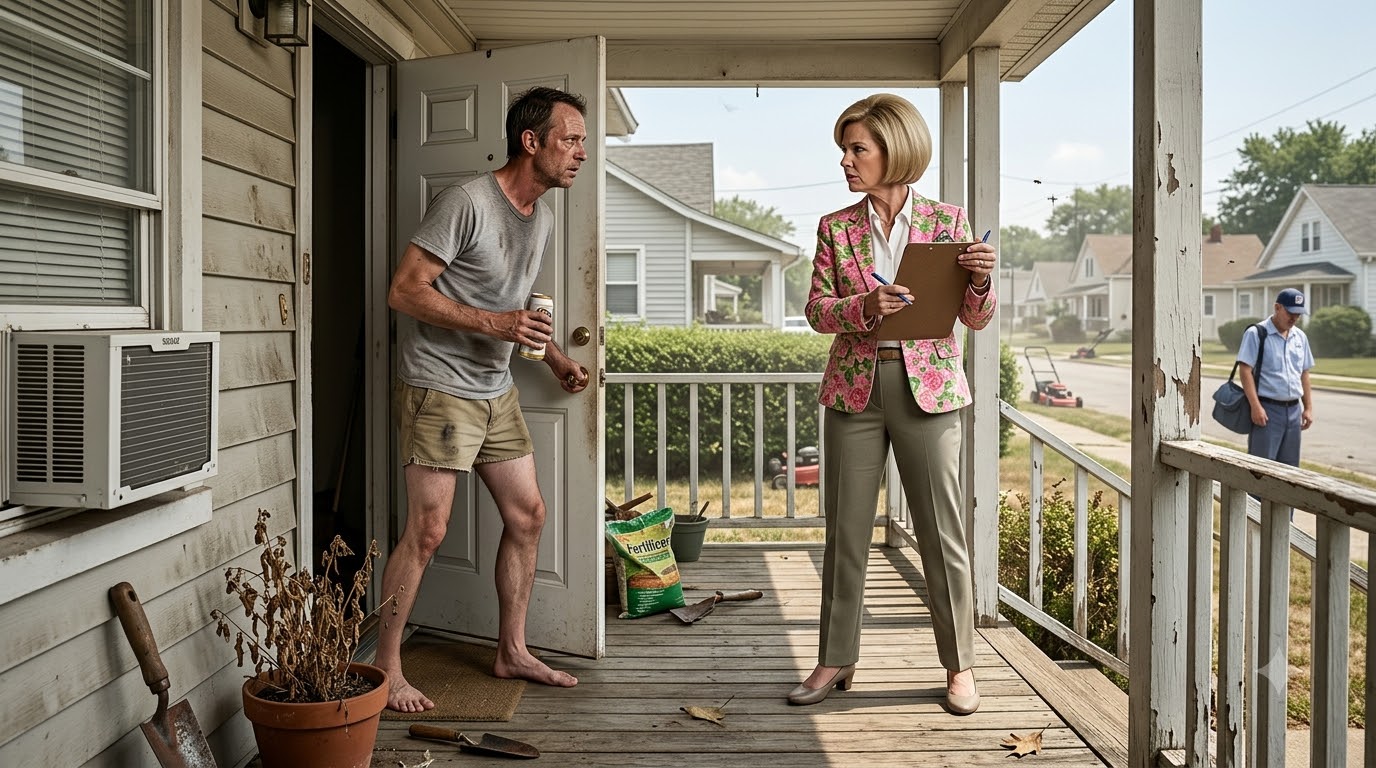
Brenda Ho stood on the porch in her floral July blazer, her blonde helmet hair defying gravity and common decency.
She held her clipboard like a magistrate’s ledger, her pen poised to strike.
“David,” she said, skipping any pretense of pleasantry as I cracked the door just wide enough to keep the cold air trapped inside.
“To what do I owe the absolute displeasure?” I asked, wiping a bead of sweat from my forehead.
She didn’t smile; she simply bared her teeth like an administrative predator sniffing blood in the water.
“We noticed an unauthorized alteration to the street-facing facade of your property,” she said, tapping her pen against the plastic trim of my window unit.
CHAPTER 2: THE PINK NOTICE
“It’s a clear violation of subsection fourteen point two,” Brenda said, her voice carrying that sterile, boardroom cadence that makes you want to chew glass.
I didn’t move the can from my neck, letting the icy water soak into my collar as I looked down at her clip-board.
“The central unit died, Brenda,” I said, keeping my tone flat to mask the slow burn rising in my chest. “Parts are on back order for six weeks. This box is the only thing keeping my dog from turning into a puddle on the kitchen floor.”
She adjusted her floral blazer with a twitchy, self-righteous snap.
“The association rules make no allowances for meteorological discomfort or canine constitution,” she retorted, flicking her pen toward the street-facing glass. “That mechanical protrusion lowers the property value of the entire block. Remove it by tomorrow noon, or the daily penalties begin.”
She tore off a pink sheet of paper with a sharp, theatrical rip and thrust it into the narrow gap of the doorway.
The paper fluttered against my knuckles before I caught it.
“Five hundred dollars a day,” she added, her smile devoid of any human warmth. “Have a blessed afternoon.”
She turned on her heel and clicked down the porch steps, leaving behind the heavy, sulfurous scent of expensive hairspray and pure administrative malice.
I pulled the window unit off, letting the synthetic chill bleed out into the humid Pennsylvania afternoon until the house felt like a convection oven.
The silence that followed was heavy, broken only by the rhythmic, distressed panting of the golden retriever on the tile floor.
I sat at the kitchen table with three hundred pages of HOA bylaws spread out like a dead language text, my thumb absently rolling a scarred brass pocket knife back and forth across the wood grain.
Page one hundred forty-two held the exact wording she had weaponized against me: No mechanical devices or auxiliary cooling units shall be visible from the street or neighboring properties.
The keyword wasn’t operable or installed.
It was visible.
If it couldn’t be seen from the street, the common area, or the sideyards, the bylaws couldn’t touch it.
My gaze drifted past the kitchen window to the fifty-foot strip of manicured emerald grass that ran along the back of my property line like a corporate lawn.
That common area belonged to the association, but the earth beneath it belonged to physics.
I tossed the brass knife onto the table, stood up, and pulled a faded plot survey from the junk drawer, squinting at a dark marker line that looked suspiciously flexible.
I picked up the landline phone and dialed a number scribbled on the back of an old receipt, a number that sounded like gravel grinding in a steel drum.
“Deepcore Solutions,” a gruff voice answered on the first ring, cutting through the static.
“I’ve got an HOA breathing down my neck and a house sitting at ninety degrees,” I said, leaning against the counter. “Can you bore fifty-foot holes without tearing up the visible skyline?”
The voice on the other end let out a dry, hacking chuckle that sounded like stones falling down a chute.
“We don’t care about their skyline,” the gravel voice replied. “We care about bedrock. You got the cash and the stomach for a mess?”
CHAPTER 3: THE DEEPCORE GAMBLE
The plot survey felt like damp tissue paper under my thumb, the old ink blurred where a long-forgotten smudge marred the scale.
I traced the thick marker line separating my patch of Pennsylvania dirt from the association’s manicured common acreage, wondering if a surveyor fifty years ago had been half-blind or just lazy.
The rumble outside turned into a steady, vibrating roar as a rust-colored flatbed semi rattled down the asphalt.
Exhaust stacks reached for the heavy gray sky, belching black diesel smoke that hung in the humid air like a bad omen.
A mountain of a man in stained overalls hopped down from the cab, a half-chewed cigar clamped firmly in his teeth.
“You the guy with the HOA problem?” he shouted over the din of the idling motor.
“David,” I yelled back, stepping off the porch and wiping my palms on my shorts. “And yeah. If we can sink enough pipe before anyone notices, my living room might actually drop below ninety degrees.”
The big man—Bedrock, as he called himself—spat a flake of tobacco onto the pristine driveway and grinned without any real humor.
“We don’t do subtle,” he muttered, jerking his thumb toward the back of the flatbed where a towering hydraulic rig rested like an iron skeleton. “You want deep? We give you deep.”
Two other figures climbed down behind him: a wiry, twitchy kid in a torn trucker hat and a broad-shouldered powerhouse shaped like a vending machine.
They didn’t waste time with pleasantries or handshakes.
Bedrock planted a heavy work boot right in the middle of the association’s prized common grass, treating the sacred turf like a staging ground.
“Sign the waiver indemnifying us from property lines and angry neighbors,” Bedrock said, thrusting a grease-smudged clipboard toward my chest. “Once that ink dries, we don’t stop for paperwork.”
I looked down at the paper, feeling the small brass pocket knife pressing heavily against my thigh in my pocket.
The legal risk was staggering, and the fines would bankrupt a small country if the association caught wind of it before the holes were punched.
I took the pen, scratched my signature across the dotted line, and handed it back without a word.
Bedrock let out a sharp bark of laughter that cut through the engine noise.
“Alright, boys,” he roared to his crew. “Unload Matilda. Let’s drill a hole in these people’s backyard.”
CHAPTER 4: THE EARTHMOVERS ARRIVE
The ground beneath my boots shuddered with a violent, rhythmic thud.
Matilda, the rust-colored drill rig, didn’t just dig; she chewed the earth, spitting out a thick, gray slurry of pulverized rock and ancient clay.
The manicured fescue grass of the common area vanished under a spreading tide of mud-geysers, transforming the neighborhood’s crown jewel into a World War I reenactment.
Skier, the twitchy kid in the trucker hat, danced around the perimeter with a flathead shovel.
He dug a hasty trench, channeling the overflow directly toward the border of Brenda Ho’s prized petunia beds.
The diesel engine roared, drowning out the ambient hum of suburban morning traffic and rattling the loose siding on my house.
I stood in the splash zone, my shirt clinging to my back in the ninety-eight-degree heat, calculating the sheer financial ruin this would cost me if the association lawyers moved faster than Bedrock’s crew.
My hand dug into my pocket, my thumb rolling over the scarred brass pocket knife, gripping it tight enough to make my knuckles ache.
I had no permits, no municipal backing, and if the cops showed up, they wouldn’t be on my side.
The sliding glass door on the adjacent property flew open with enough force to crack the track.
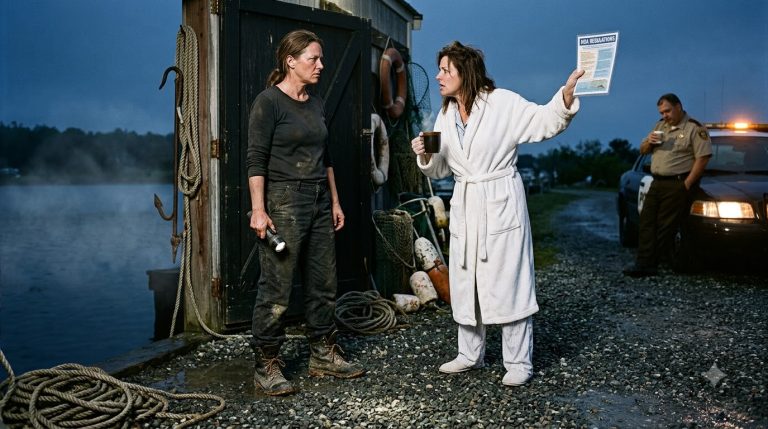
Brenda Ho stormed out in pink fuzzy slippers and a silk robe, her hair clamped in plastic curlers that shook with pure, unadulterated outrage.
“Stop this instant!” she shrieked, waving her arms, but her voice barely pierced the heavy mechanical roar.
I didn’t move.
A sudden gust of heavy, humid wind swept across the yard, catching the spray from the drill bit and blowing a thick glob of wet earth right over the property line.
It landed squarely on the shoulder of Brenda’s silk robe with a heavy, wet smack.
She froze, looking down at the gray sludge slowly sliding down her lapel, her face twisting into a mask of absolute horror.
“I’m calling the authorities!” she screamed, pointing a trembling finger at my chest. “I’m calling the police!”
“Tell them to bring a tape measure!” I yelled back over the diesel exhaust, knowing full well the badge wouldn’t save me.
She spun on her ruined slippers and fled back inside, slamming the glass door shut.
Bedrock didn’t even look up from the rig’s control panel, his thick hands pulling levers that sent the drill bit plunging another ten feet into the dark soil.
Neighbors were already gathering at the edge of the street, a growing crowd of sweaty onlookers unfolding lawn chairs and holding up cell phones to record the carnage.
We were chewing through the earth at a brutal pace, sinking pipe after pipe, but time was bleeding out.
Through the haze of exhaust and flying mud, a sleek black sedan pulled up sharply to the curb, tires screeching against the asphalt.
A man in a sharp gray suit stepped out, clutching a manila folder, his eyes locked dead on the drill rig.
CHAPTER 5: THE CEASEFIRE BLUFF
The lawyer didn’t bother trying to step around the muddy craters carved by Matilda.
He marched straight through the wet slurry, his expensive loafers absorbing gray grit with every stride, holding a temporary restraining order like an absolute decree from on high.
“Cease excavation immediately,” he demanded, his voice slicing through the heavy diesel roar. “You’re at hole one hundred eighty. Stop right now, or face immediate contempt of court and structural seizure.”
Bedrock cut the rig’s engine with a sharp yank of a lever, plunging the yard into a heavy, ringing silence that felt almost deafening after the hours of seismic pounding.
I wiped a streak of wet clay from my forehead, my hand dropping to my pocket to squeeze the cold metal of the brass pocket knife.
“We’re three-quarters done,” I said, stepping forward through the muck. “You shut us down now, and this whole common area turns into a muddy sinkhole.”
The lawyer tapped the stiff edge of the manila folder against his thigh, his smile widening with unearned corporate arrogance.
“That’s your problem, not ours,” he snapped. “Pack up the rig, clear out the pipes, or the sheriff comes back with a tow truck.”
This was the trap.
If we pulled the pipes out, the ground would collapse completely, destroying the common area for good and landing me with a six-figure cleanup bill.
If we kept drilling, the contempt charges would lock me out for good.
I didn’t yell, and I didn’t beg.
I reached into my back pocket, pulled out the damp, mustard-stained plot map, and unfolded it deliberately over the muddy hood of the rig.
“You know,” I said, my voice dropping into a flat, deliberate register, “looking at this scale again… I might have misread the property boundaries by a few dozen yards.”
The lawyer leaned in, his eyes narrowing with sudden, predatory greed as he smelled a concession.
“Are you admitting to willful encroachment on association land?” he asked, whipping out a gold-plated pen.
“I’m saying a mistake was made,” I replied, keeping my face completely blank. “And since pulling these loops out now would cause catastrophic structural damage to the common area turf, the most environmentally responsible path… is to leave them buried.”
He blinked, processing the tactical shift.
“You want to gift us a hundred and eighty underground PVC pipes?” he asked, suspicion flickering in his eyes.
“Technically, they’d become association property beneath the common ground,” I said, holding my breath. “You drop the daily fines, I fund the surface restoration, and the holes stay right where they are.”
He exchanged a sharp, triumphant glance with Brenda Ho, who had just tiptoed back to the edge of the yard, eager for any scalp.
They thought they had trapped me into surrendering control of my own yard’s infrastructure.
He snatched a pen from his breast pocket and shoved a blank addendum form against the greasy side of the drill rig.
“Sign it,” he barked, eager to claim his hollow victory.
I signed my name without another word, handing over the fines and the restoration promise, watching them march away believing they had won the day.
CHAPTER 6: THE SUBTERRANEAN VICTORY
Midnight settled over Oak Creek Estates like a wet wool blanket, devoid of the roaring diesel engines or the shouts of angry bureaucrats.
Down in the dark cellar, Bedrock’s crew worked like silent giants with hand tools and a compact electric excavator, fusing the one hundred eighty loops into a single, seamless manifold.
They hooked the buried lines straight into the heavy-duty heat pump I had ordered online, burying the final trenches and smoothing the turf above until the common area looked untouched by war.
By sunrise, the heavy machinery was gone, leaving behind nothing but the quiet promise of thermodynamic engineering.
Sunday morning broke with the familiar, oppressive weight of ninety-eight-degree July heat pressing against the windows.
Brenda Ho stood out on her manicured lawn with a green plastic rake in hand, her eyes darting suspiciously across my silent roofline.
There were no window units hanging out of the glass.
There were no smoking condensers rattling on the concrete pad beside the foundation.
I pushed the back door open, letting the wave of crisp, seventy-two-degree indoor air spill out into the morning humidity.
“Morning, Brenda,” I said, leaning against the doorframe.
She flinched, her grip tightening on the rake handle as she scanned my property for a single shred of visible evidence.
“Is it… is it actually fixed?” she asked, her voice tight with disbelief.
“All fixed,” I replied, my tone flat and even. “Just a minor internal repair.”
She sniffed the air aggressively, straining her ears for the mechanical hum of a fan or a compressor, but heard only the faint rustle of oak leaves.
“It’s quiet,” she muttered, her eyes narrowing with deep suspicion.
“Invisible,” I said.
She knew, somewhere beneath her rigid administrative pride, that the earth under her feet was acting as a massive thermal sponge, quietly radiating the heat of my living room into the soil of her precious common area.
She couldn’t point to a single violation, she couldn’t issue another fine, and she couldn’t prove a thing.
“Just—just make sure your grass is the approved fescue blend,” she snapped, turning sharply on her heel to storm back toward her patio.
I didn’t answer.
I walked back inside, letting the door click shut behind me with a solid, satisfying thud.
The house was cool, the air was clean, and the brutal Pennsylvania summer outside couldn’t touch us anymore.