The Iron and the Amber: A Veteran’s Calculated Siege Against the Architecture of Suburban Tyranny
CHAPTER 1: THE EVAPORATORS EDGE
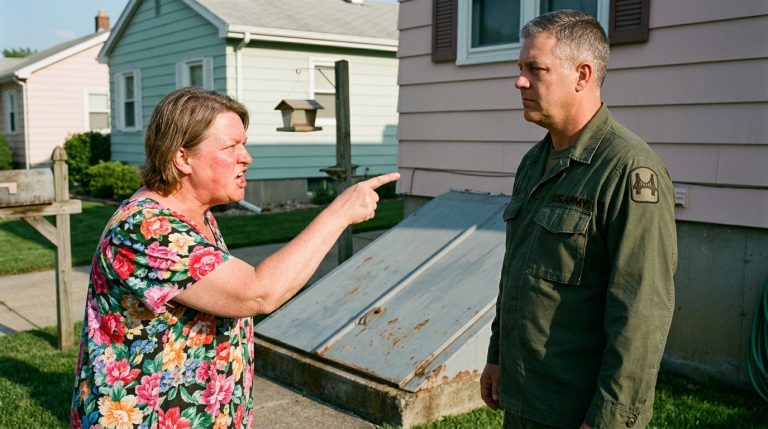
The steam tasted of wood smoke and old iron. Marcus stood motionless beside the post-and-beam sugar shack he had raised with his own calluses, timber harvested from a fallen oak on the upper ridge of land that no committee had ever touched. Across the weathered gray stones of the boundary wall stood Karen, her frame substantial and rigidly encased in pastel velour, her manicured finger extended like a bayonet.
“Seventy-two hours,” she said, her voice carrying the practiced resonance of a woman used to presiding over committee meetings where no one dared cough out of turn. “You are running an unregistered commercial enterprise in direct violation of Oak Haven Estates covenant fourteen point seven. Fine you one thousand dollars a day until that shack is dismantled.”
Marcus let the silence stretch. In the Marines, the pause between an order and a response was where tactical assessment happened. He looked past her outstretched hand toward the manicured lawns of the development rising up the hill—uniform, silent, and aggressively beige. To Karen, his sanctuary was an anomaly, a jagged tooth on an otherwise sterile horizon. To him, it was the exact square footage of stillness he had traded twenty-five years of his life to buy.
“You’re standing on private property, ma’am,” Marcus said finally, his voice level, dropped into the register he used when defusing a tense checkpoint.
“This entire perimeter falls under the architectural review board’s jurisdiction,” Karen snapped, stepping closer, her jaw tightening as if she could bully the geography itself into compliance. “We have standards. We don’t tolerate industrial eyesores bleeding into our viewlines.”
She turned on her heel with a sharp swish of fabric, leaving her threat suspended in the cold air like exhaust fumes. Marcus watched her retrace her steps up the manicured slope toward her McMansion, her posture rigid with absolute, unearned certainty. He exhaled slowly, tasting the sweet residue on his lips, and reached out to adjust the valve on the evaporator.
The immediate tactical play was obvious: do nothing, or charge into a bureaucratic skirmish unprepared. But as he wiped condensation from the steel rim of the pan, his thumb brushed against a faint, circular scratch in the metal—and beneath it, half-buried in the damp soil near the foundation of the shack, he noticed something that hadn’t been there when he drove the corner stakes three months ago: a heavy iron survey pin, freshly driven and spray-painted with a neon orange cap, sitting a full six feet inside what his deed certified as his own dirt.
CHAPTER 2: RECONNAISSANCE BY CANDLELIGHT
The evaporator hissed, a low, rhythmic sputter as the last of the sap settled into a thick, amber slumber. Marcus did not touch the valve immediately. His eyes remained locked on the survey pin protruding from the damp Vermont soil like a surveyor’s tooth, its paint gleaming with synthetic defiance under the fading gray light of dusk. Six feet. Not a rounding error. Not an oversight born of tired eyes or sloping topography. A deliberate incursion, hammered into the earth with the calculated precision of someone who expected no one to check the deed books.
He unhooked his heavy canvas jacket from the peg by the door, pulling the rough wool tight against his chest as he stepped out from the shelter of the post-and-beam frame. The wind off the ridge had teeth, carrying the sharp scent of thawing pine and wet shale.
His boots crunched over the frozen ruts of the old logging track, each step measured, habitual, the muscle memory of decades spent navigating terrain where small discrepancies often preceded worse trouble. He didn’t head back to the main house yet. Instead, he walked the perimeter fence line, flashlight cold in his palm, sweeping the beam low across the boundary stones his grandfather had laid down in the winter of fifty-four. The stones were moss-slicked, immovable, marking a clear line that had gone unquestioned for half a century until a suburban development sprouted on the neighboring ridge like a fungus on a healthy oak.
Inside the farmhouse, the dining room table looked less like a place for evening meals and more like a forward operating base. The polished oak surface was buried under an avalanche of heavy parchment—county plat maps, yellowed tax assessments, and the pristine, cream-colored extortion notice delivered by certified mail two days prior.
Marcus switched on the brass banker’s lamp, its green shade casting a tight, jaundiced circle of light over the papers. He didn’t sit right away. He poured a mug of black coffee from the pot on the counter, the liquid steaming darkly in the chill room, and stared down at the foundational deeds.
The vulnerability wasn’t in his records. His chain of title was clean, unbroken, backed by generations of tax receipts and probate filings signed in iron-gall ink. The vulnerability, if Karen’s legal scaffolding held any weight at all, rested on a fifty-year-old clerical blur—a sliver of acreage where a 1970s surveyor had smeared ink across a margin while drunk or indifferent.
“Defaulting to emotion is a wasted round,” Marcus murmured to the empty room.
His fingers tapped twice against the margin of the 1970 map. Karen wanted a war of attrition. She wanted the thousand-dollar-a-day fines to mount like a rising tide until the sheer financial pressure cracked his resolve and forced him to pack up the evaporator, dismantle the shack, and surrender the ridge to her sterile viewlines. She was counting on an old soldier being ill-equipped for the quiet, paper-shuffling violence of municipal code enforcement.
He pulled the complete covenants, conditions, and restrictions of Oak Haven Estates toward him—all two hundred and twelve pages of dense, spiral-bound legalese.
The first hundred pages were standard boilerplate: roofing material specifications, fence height limits, prohibitions on unsightly vehicles, and the rigid enforcement of pastel aesthetic uniformity. But it was in the back, buried deep within the appendices where draftsmen hid the exceptions they hoped no one would ever read, that the structure of the document shifted.
His finger traced down a paragraph marked Appendix C: Grandfathered Land Use and Historical Agricultural Exemptions.
The text was dense, wrapped in qualifying clauses, but the core mandate stood out like a tripwire: Any parcel or sub-parcel incorporated into the development footprint possessing a documented, continuous history of traditional agricultural enterprise predating the 1975 master plat filing shall remain permanently exempt from commercial and agricultural restriction bylaws, provided said enterprise generates no actionable public nuisance.
Marcus leaned back into the shadows of the wooden chair, the wood creaking softly beneath his weight. A continuous history. His grandfather had tapped these exact maples through the sixties, seventies, and eighties. The old farm ledgers—bound in black oilcloth, pages thick and yellowed with age—were sitting right now in the bottom drawer of the walnut bureau in the hallway, complete with handwritten tallies of syrup yields, gallon by gallon, stretching back to nineteen forty-six.
The legal counter-attack was there, but filing an injunction against an entrenched homeowners association required more than old notebooks. It required proof of ownership over the precise one-acre strip where the new survey pin had been driven.
A floorboard creaked in the hallway. Marcus didn’t look up from the map. He reached out, his hand resting flat against the edge of the table, fingers curving naturally toward the heavy brass stapler sitting near the edge—a reflex older than his retirement, born of rooms where unexpected visitors rarely carried good news.
The shadow fell across the threshold before a soft, hesitant knock tapped against the wooden doorframe.
CHAPTER 3: THE CLOSED DOOR AT THE CLUBHOUSE
The knock came again, lighter this time, muffled by the thick winter coat of whoever stood on the other side. Marcus did not rush. A man who moves too fast in the dark usually trips over his own boots. He slipped his hand away from the stapler, rose with deliberate slowness, and crossed the pine floorboards of the dining room into the dim, unheated corridor.
He didn’t snap the lock back immediately. Instead, he dropped his eye to the brass peephole, twisting the barrel a fraction of a millimeter to clear the condensation.
Outside stood a man whose posture screamed corporate exhaustion. A wool trench coat collar turned up against the damp Vermont wind, silver-rimmed glasses catching the harsh amber glare of the porch light, and an expression that looked like he had spent the last twenty years arguing with tax assessors. It was David Chen—the man from three houses down in Oak Haven, the one who walked a beagle past the ridge line and always tipped his chin in a silent, professional nod of mutual recognition.
Marcus turned the deadbolt. The lock clicked, heavy and dry, and the door swung inward on its iron hinges.
“You’re burning late oil, Gunnery Sergeant,” David said quietly, stepping across the threshold before Marcus could offer an invitation. He didn’t track mud; his loafers were clean, sensible, rubber-soled. He carried a leather briefcase under one arm like it was a shield.
“Better than burning the house down,” Marcus replied, his voice flat as he closed the door behind his visitor, throwing the deadbolt back into place with a solid thud. “What brings a corporate litigator off the manicured paths and down into the mud past ten o’clock?”
David unbuttoned his coat, letting it hang loosely over his shoulders, and walked unprompted into the dining room. His eyes swept over the sprawl of county plat maps, yellowed tax receipts, and the cream-colored HOA letter pinned beneath a coffee mug. A thin, humorless smile touched the corners of his mouth.
“I saw your light from the tree line,” David said, pulling out a wooden chair opposite the banker’s lamp and sitting down without waiting to be asked. He laid his briefcase flat on the oak surface and unlatched the brass clasps with a sharp, double-click. “And frankly, I couldn’t sleep. Not with Karen’s latest administrative decree sitting on my desk like a dead fish.”
Marcus leaned back against the doorframe, crossing his arms over his chest. “You got a notice too?”
“Every resident with an independent thought process got one,” David murmured, sliding a thin manila folder from his briefcase. He opened it to reveal a carbon copy of the exact same ten-page legal terror tactic Marcus had received. “Hers is a very specific kind of poison, Marcus. She doesn’t just want compliance; she wants submission. She treats the Oak Haven bylaws like a personal fiefdom, and anyone who builds a fence two inches too high—or in your case, boils sap on land she claims belongs to her imaginary skyline—gets run through the legal shredder.”
“She threatened a thousand dollars a day,” Marcus said.
“She’ll try to collect it, too, using the association’s reserve funds to pay for outside muscle,” David replied, adjusting his glasses. He tapped a finger against the corner of Marcus’s map. “Which brings me to why I’m here. You went to the community clubhouse on Wednesday. You tried reason. You let her put you in a corner in front of thirty bored homeowners.”
“Reconnaissance,” Marcus corrected softly. “You don’t engage an entrenched position until you’ve mapped their arcs of fire.”
“Well, your reconnaissance missed one crucial detail,” David said, leaning forward into the circle of green-shaded light. “Karen isn’t just fighting you over property lines. She’s hiding a massive black hole in her operating budget. For the last three years, the books for the annual Founder’s Day pancake breakfast—her crown jewel, the event she uses to validate her entire presidency—show an impossibly small line item for catering supplies. Three hundred people fed, syrup pouring by the gallon, and the expense report lists less than five hundred dollars.”
Marcus didn’t move. The silence in the room deepened, broken only by the faint, rhythmic ticking of the wall clock in the hallway. The memory of his buddy Tom at the diner—cash payments, unlabeled plastic jugs, and a client who demanded absolute discretion—surfaced in his mind with the cold clarity of a plotted coordinate.
“Five hundred dollars,” Marcus repeated, his voice dangerously low. “For three hundred people.”
“Mathematically impossible,” David said, watching Marcus’s eyes closely. “Unless she’s sourcing it locally. Off the books. Through a middleman who thinks he’s just running a standard wholesale transaction.”
Marcus unfolded his arms. He walked slowly to the table, picked up his cold coffee mug, and set it down beside the map. The sharp edges of the room—the iron nails in the timber, the heavy grain of the oak table, the precise geometry of the survey lines—seemed to snap into sudden, tactical focus.
Karen wasn’t just trying to crush an eyesore. She was protecting a secret pipeline. And she was using the very thing he made with his own hands to fund the machine trying to break him.
“She wants a war,” Marcus said, his jaw tightening as he looked down at the map. “Let’s give her a logistics problem she can’t audit.”
David closed his briefcase halfway, the latch clicking shut. “What’s your next move?”
“We don’t fight her in the dirt,” Marcus said, his eyes hard. “We wait for her next delivery.”
CHAPTER 4: THE DISCOVERY IN THE OLD COUNTY RECORDS
The county clerk’s office smelled of wet wool, floor wax, and centuries of drying ink. Outside the tall, single-pane windows, the morning mist clung to the asphalt of the municipal parking lot like a wet fleece, but inside, the heavy heat of an overworked cast-iron radiator ticked rhythmically against the wall.
Marcus adjusted the collar of his flannel shirt, leaning his weight against the polished oak counter where Esther presided over the registry books. Esther was a woman who had worked the county archives since the Carter administration, her glasses perpetually perched on the tip of her nose, secured by a beaded silver chain that hung against her floral-print blouse like a plumb line.
“Fighting with the Oak Haven crowd again, are you, Marcus?” she asked without looking up, her fingers expertly turning the heavy rag-paper leaves of a leather-bound plat ledger from nineteen seventy. “That woman, Karen, treats this office like her personal intake desk. Thinks a rubber stamp gives her divine right over the whole township.”
“I need eyes on the original seventy filing for parcel seven-bee dash one,” Marcus said, keeping his voice low, steady, measured. “The initial subdivision plat before the developers cleared the ridge.”
Esther paused, her finger tracing a column of faded blue ink. She peered over the rim of her glasses, her eyes sharp and knowing. “That parcel’s always been a ghost. The developers back then pushed their boundary stakes three rods too far east after a long lunch at the tavern, and nobody ever bothered to reconcile the mismatch because the land was just timber and stone back then. Here.”
She spun the massive ledger around, anchoring it against the wooden counter with a broad, ink-stained palm.
Marcus leaned in, the raw scent of old paper rising to meet him. Right there, scrawled in the sharp, impatient handwriting of a county surveyor long since retired or buried, was a handwritten addendum tucked into the side margin: Discrepancy noted in parcel 7B-1. Recommend formal re-survey for clarification prior to structural development.
The clarification had never been done. The developers had simply forged ahead, paving over the discrepancy and building their sterile grid of McMansions on top of a legal fault line.
“They built on quicksand,” Marcus murmured, his finger resting lightly against the margin note.
“Worse,” Esther said quietly, pulling a slim stack of certified copies from beneath the counter and sliding them across the wood toward him. “They built on land they never actually cleared through probate. If you pull the original agricultural tax exemptions filed by your grandfather back in forty-six, that one-acre strip isn’t just yours by continuous use—it was never legally detached from your deed in the first place. Karen’s lien isn’t just aggressive; it’s a slander of title.”
Marcus slipped the documents into a heavy manila folder, his thumb feeling the crisp, sharp edge of the paper. The mechanics of the defense were falling into place, cold and functional like the parts of an M240 stripped down on a field table. Every document was an asset. Every survey pin was a vector.
He thanked Esther with a brief, respectful nod, tucked the folder securely under his arm, and turned toward the glass double doors of the municipal building.
The morning air outside hit his lungs with a sharp, metallic edge. He stepped off the concrete steps and walked toward his truck, parked beside the weathered municipal sign. But before his hand could reach the door handle, the low rumble of a passing engine caught his ear. A pale sage-green luxury SUV slowed down near the curb, its tinted window sliding down with a faint mechanical hum.
Karen didn’t look like a woman managing a neighborhood. Her face was tight, pale, framed by the structured collar of her pastel tracksuit, her eyes fixed on him through the windshield with a look of undisguised, predatory malice.
“Enjoy your paperwork while you can, Sergeant,” she said, her voice dropping into a brittle, venomous register that barely carried over the idle of her engine. “Paper doesn’t protect you from a board with twenty million dollars in backing and a legal team that eats small-town veterans for breakfast. Pay the fines, or lose the land.”
She didn’t wait for an answer. The window hissed shut, the SUV’s tires spitting a fine spray of gravel against the side of his truck as she accelerated up the wet blacktop toward the pristine ridge of Oak Haven Estates.
Marcus stood motionless beside his door, his fingers tightening around the handle until the cold metal bit into his palm. He didn’t shout. He didn’t chase her down the road. He simply watched the taillights vanish around the bend, knowing precisely how much rope she had left on the spool.
CHAPTER 5: THE ARRIVAL OF THE LIEN
The truck tires crunched over the frost-heaved gravel of the driveway, the engine block ticking as Marcus cut the ignition. He climbed out, the manila folder tucked firmly under his arm, and walked toward the front porch. The morning mist had given way to a heavy, slate-gray overcast that seemed to press down on the valley, flattening the colors of the woods into shades of charcoal and ash.
Before his boots touched the wooden steps, he saw it.
Pinned beneath the heavy brass knocker of the front door was a bright, official-looking yellow envelope, sealed with a transparent packing tape that caught the pale, diffused light. Marcus slowed his pace, every muscle in his shoulders locking into a familiar, defensive readiness. He mounted the steps, peeled the tape away with two fingers, and pulled the document free.
It wasn’t a warning letter this time. It was a formal notice of lien.
He pushed the front door open, stepped into the quiet warmth of the hallway, and locked the deadbolt behind him. Walking over to the kitchen island, he laid the yellow envelope flat against the butcher block. He didn’t tear it open with frantic haste; he slit the edge cleanly with a utility knife, unfolding the heavy legal parchment with methodical precision.
The text was crisp, printed on expensive bond paper embossed with the Oak Haven Estates crest—an oak leaf strangled by a stylized script O.
Notice of Encumbrance and Claim of Lien. Filed by the law firm of Blackwood, Finch, and Associates on behalf of the Oak Haven Estates Board of Directors. The document claimed an immediate encumbrance upon the disputed one-acre parcel for the sum of sixty thousand dollars, combining the retroactive daily fines with preliminary legal retainers. Furthermore, it explicitly stated that the cloud on the title would remain in full legal force, preventing any transfer, sale, or subdivision of the property until the balance was settled in full or ordered removed by a court of competent jurisdiction.
Sixty thousand dollars. It was a paper anchor designed to sink him before he even reached the courtroom.
Marcus pulled out a kitchen chair, sat down, and placed the document beside Esther’s certified survey copies. The contrast was stark: one side represented the fabricated paper fortress of a corporate-minded homeowners association; the other represented fifty years of ink, tax stamps, and physical labor.
He reached for the telephone on the wall, lifting the receiver and punching in a familiar seven-digit local number without consulting a directory. It rang twice before a raspy, no-nonsense voice answered on the other end.
“Tom’s Diner. If you’re calling about the lunch special, we ran out of meatloaf twenty minutes ago,” Tom muttered, the background hum of a commercial dishwasher audible through the line.
“It’s Marcus.”
A brief pause, then the sound of a phone being shifted to a shoulder. “Ah, the maple baron. How’s the sugar shack holding up against the suburban invasion? I hear your favorite neighbor has been handing out notices like parking tickets.”
“She just escalated,” Marcus said, his voice steady, low. “She slapped a formal lien on the property through some high-priced state-level firm. Sixty thousand dollars in fabricated penalties.”
A sharp string of profanities hissed through the receiver—short, colorful, and entirely unfiltered. “That self-righteous piece of work,” Tom growled. “She’s going to bankrupt people just to watch them squirm. What’s your play, Marcus? You need me to lean on anyone?”
“No,” Marcus said, staring down at the yellow paper. “We keep to the timeline. How’s that ten-gallon batch looking for the end-of-month order?”
“Sitting right here in the back pantry,” Tom said, his tone shifting into something cagey and knowing. ” Sealed tight in those ten plain plastic jugs your assistant—ah, excuse me, your customer’s assistant—always insists on. She picked up the invoice schedule yesterday. Paid in crisp hundreds, just like clockwork.”
Marcus felt a cold, sharp satisfaction settle into his chest. The machinery was moving precisely as calculated. Karen was tightening the screws on her end, funneling association funds into a legal black hole while eagerly awaiting the sweet cargo that would anchor her crown jewel event.
“Keep the jugs locked in the back, Tom,” Marcus instructed softly. “Don’t let anyone touch them until I call.”
“You got it, Gunny,” Tom said, the line clicking dead with a sharp finality.
Marcus hung up the phone. He stood back up, walking over to the window that looked out toward the distant, manicured roofs of Oak Haven Estates rising above the tree line. The sky was darkening toward afternoon, the gray clouds thickening with the promise of a late-season squall. He had the deeds, he had the historical exemptions, and he had the survey notes. But the final piece of the puzzle—the one that would break her administrative stranglehold once and for all—was currently sitting quietly in a diner pantry, waiting for the trap to spring.
CHAPTER 6: THE COALITION OF THE DISCONTENTED
The knock on the farmhouse door wasn’t the corporate rap of a litigator or the heavy blow of process server. It was hesitant, rhythmic, three light taps followed by a pause—the universal signature of someone who felt awkward intruding on a perimeter they didn’t own.
Marcus lifted his gaze from the legal yellow parchment, left his coffee mug on the counter, and walked across the wide floorboards. When he pulled the heavy oak door open, the damp evening wind carried the scent of wet pine and woodsmoke. Standing on the porch steps were two figures wrapped in thick winter coats, illuminated by the cold amber glow of the outdoor sconce.
David Chen stood slightly forward, his collar turned up against the chill, holding a small paper plate covered with aluminum foil. Beside him was a woman in her late forties with sharp, intelligent eyes and an observant posture that missed nothing—Sarah Jenkins, the forensic accountant whose name had floated through David’s late-night briefings.
“We saw your kitchen light,” David said, offering a tight, apologetic half-smile. “Helen baked oatmeal cookies. Thought you might need something that didn’t taste like municipal filing fees.”
Marcus stepped back, pulling the door wide. “Come in out of the wind.”
They filed into the warmth of the hallway, shedding their coats with practiced quietness. Sarah carried a thin binder tucked under one arm, its plastic tabs sticking out like colored markers on a tactical map. As they entered the dining room, David’s eyes flicked over the spread of documents—the deeds, Esther’s certified survey copies, and Karen’s sixty-thousand-dollar lien notice lying square in the center.
“Heavy reading for a Tuesday evening,” Sarah noted, her voice crisp and dry as she took a seat opposite the banker’s lamp. She placed her binder on the table with a soft slap. “Though I see you’ve already received the preliminary love letter from Blackwood, Finch, and Associates.”
“They’re leaning hard on the paperwork,” Marcus said, pulling out a chair and sitting down. “Trying to establish a financial barrier before the court date next month.”
“It’s all smoke and mirrors,” Sarah said, flipping open her binder to a page covered in dense columns of handwritten numbers and highlighted ledger rows. “I’ve spent the last forty-eight hours cross-referencing Oak Haven’s public financial disclosures for the past three fiscal cycles. Karen runs the association like a proprietary trust, but public disclosure laws are a harsh mistress. Every penny of discretionary spending has to leave a trail.”
She tapped a column with the eraser end of a pencil. “Her legal war chest isn’t coming from an infinite reserve fund. She’s bleeding the community’s capital improvement account—money earmarked for roof repairs, drainage maintenance, and asphalt resurfacing—to pay for her private vendettas. And the residents have no idea.”
Marcus studied her face. “How long before the board members realize their own reserve funds are being drained for a boundary dispute they never voted on?”
“They’re starting to ask questions now,” David interjected, leaning forward, resting his forearms on the oak table. “George, the retired schoolteacher who lives down the lane, confronted her at the mailbox yesterday about the delayed tennis court repairs. Karen panicked, threw a minor tantrum, and threatened him with a code violation for unapproved geraniums. The cracks are forming, Marcus. People are tired of walking on eggshells in their own driveways.”
Marcus reached out, his finger tracing the edge of the survey map. “An unmanaged population eventually breaks formation. But to shatter her authority completely, we need to sever her supply lines.”
Sarah blinked, her eyes narrowing slightly with sharp comprehension. “What do you mean?”
“Karen’s entire social architecture rests on one event,” Marcus said, his voice dropping into a low, steady cadence. “The Founder’s Day pancake breakfast at the end of the month. It’s her coronation. She charges forty dollars a head, draws three hundred people, and claims it as a testament to her elite community standards.”
“And the catering budget is practically zero,” Sarah added, a slow, knowing smile spreading across her face as the pieces clicked together. “She’s been hiding the real ingredient costs under general maintenance lines. But if she’s not buying commercial syrup…”
“She’s buying mine,” Marcus said quietly. “Through an unwitting middleman at a local diner. Ten gallons of amber gold, delivered in plain plastic jugs every March, paid in cash.”
The silence in the dining room grew thick, charged with the sudden, undeniable geometry of the trap.
David leaned back, a low whistle escaping his teeth. “My God. She’s waging a five-figure legal war to shut down the exact producer who fuels her most sacred public ritual.”
“Hypocrisy is a heavy weapon once you turn it back on the shooter,” Marcus said, his eyes hard and focused. “The petition for the no-confidence vote needs to be ready by then. When she stands up in front of the entire neighborhood to take her bow, we don’t just present a legal defense. We present the ledger.”
Sarah pulled a blank sheet of paper from her binder, uncapped her pen, and pulled the edge of the map toward her. “Let’s map out the final phase. If we time the petition submission to land forty-eight hours before the breakfast…”
The drafting began in earnest, the scratching of pen against paper blending with the steady ticking of the hall clock, forging the next link in a chain that could not be broken.
CHAPTER 7: THE INTERCEPTION AT THE DINER
The predawn air bit with a sharp, iron-cold edge that coated the windshield of Marcus’s truck in a thin layer of crystalline frost. He didn’t turn on the defroster right away; he let the engine idle, listening to the deep, steady thrum of the diesel block while he scraped the glass with a brass-edged card.
The timeline was compressing. In three days, the Founder’s Day pancake breakfast would fill the Oak Haven clubhouse with three hundred unsuspecting residents, and Karen’s meticulous administrative theater would reach its climax.
He shifted into drive, his tires crunching over the frozen mud of the lane as he pointed the truck down toward the highway. His destination wasn’t the county clerk’s office or the property line. It was Tom’s Diner—a low-slung, neon-trimmed building resting on the edge of the next town over, where the coffee was always dark and the back pantry held ten gallons of amber leverage.
The highway was empty, wet asphalt reflecting the pale, bruised light of a breaking dawn. When Marcus pulled into the gravel lot of the diner, Tom’s battered pickup truck was already parked by the rear delivery door.
Marcus killed the engine and stepped out, his boots striking the frozen gravel with crisp, solid rhythm. He pulled the heavy metal service door open without knocking, stepping straight into the warmth of the commercial kitchen. The air smelled of stale grease, brewing chicory, and the rich, unmistakable sweetness of boiling maple.
Tom was standing by the stainless steel prep counter, wiping down the metal surface with a damp rag. He looked up, his brow furrowed as he saw Marcus enter.
“You’re early, Gunny,” Tom said, tossing the rag into a plastic bin. “The nervous paperwork detail isn’t scheduled to arrive until ten.”
“Good,” Marcus said, walking past the grill toward the swinging door of the walk-in pantry. “I want to inspect the inventory before the exchange happens.”
He pushed open the pantry door. The small room was cool, smelling faintly of onions and potatoes, but tucked away on the bottom wire shelf, half-hidden behind a stack of bulk flour sacks, sat ten identical one-gallon plastic jugs. Unlabeled. Sealed tight with red plastic caps. The physical incarnation of Karen’s hypocrisy, sitting quietly in the dark.
Marcus reached down, picked up the front jug, and brought it up to eye level under the harsh fluorescent bulb. The liquid inside was clear, deep amber, catching the light like liquid topaz. It was his work—boiled from the sap of trees growing on the land she claimed was outside the law.
“She doesn’t have a clue,” Tom muttered, leaning against the pantry frame with a dry chuckle. “Carol—that terrified little assistant of hers—came in yesterday to confirm the pickup time. Kept looking over her shoulder like she was running contraband across a hostile border. Paid in crisp hundreds straight out of an envelope.”
“She is running contraband,” Marcus said, setting the jug back down with a soft, metallic thud against the wire rack. “She’s funding a corporate law firm with association reserve funds while financing her marquee community event with the exact product she’s trying to outlaw.”
“So what’s the play when she collects?” Tom asked, his tone sharpening into professional curiosity.
“We let her take it,” Marcus said, turning back toward the kitchen. “We let her load those ten jugs into her sage-green SUV, drive them up the hill, and pour them into the glass pitchers for three hundred people. We let her build the stage as high as she wants.”
The kitchen door swung open with a sudden squeak, and a dishwasher poked his head in from the back hall. “Boss, a green SUV just pulled around back. Looks like the regular pickup.”
Tom glanced at Marcus. Marcus stepped back into the shadows of the prep area, his face a mask of cold, calculated stillness.
“Right on schedule,” Tom murmured, rolling his sleeves up an inch. “Let the supply chain do its work.”
CHAPTER 8: THE REJECTION OF THE OFFRAMP
The blue light of the laptop screen cast sharp, pale angles across the grain of the oak dining table. Marcus sat motionless, his finger resting lightly on the trackpad while David leaned over his shoulder, reading through the final text of the formal settlement proposal.
It was an architectural masterwork of legal de-escalation, designed to give an opponent every possible dignity while completely dismantling their leverage. The terms were comprehensive: the HOA would drop its countersuit, vacate the sixty-thousand-dollar lien, and formally recognize the agricultural exemption attached to the ridge parcel. In return, Marcus offered to waive all claims of tortious interference and pay out of pocket for a certified, undisputed survey to correct the fifty-year-old boundary blur once and for all, costing the association precisely zero dollars.
“She won’t take it,” David murmured, his breath warm against the cold air of the room. “An autocrat doesn’t want a clean border; they want an unconditional surrender. Compromise looks like weakness to someone running an empire out of a suburban clubhouse.”
“We offer it anyway,” Marcus said, his voice flat and steady. “Not for her benefit. For the record. When we stand before the judge next Tuesday, the court needs to see that we extended every reasonable off-ramp before dropping the gate.”
David tapped a knuckle against the edge of the screen. “Hit send.”
Marcus clicked the mouse. The email zipped outward through the local fiber lines, routed directly to Karen’s personal account and copied to every member of the Oak Haven board with a read-receipt request attached.
For forty-eight minutes, the house held a heavy, ticking silence. Marcus walked over to the kitchen counter, poured a fresh cup of black coffee, and stared out the window toward the dark silhouette of the sugar shack against the ridge. The wind had dropped, leaving the bare maple branches locked in rigid stillness under the slate-gray sky.
The computer chime broke the quiet—a single, sharp audio alert slicing through the room.
Marcus walked back to the table. A new message sat in the inbox, originating directly from Karen’s private address. There was no greeting, no formal closing, no consultation with corporate counsel. Just a single sentence forged in pure, unfiltered malice:
The Oak Haven Estates Homeowners Association does not negotiate with law-breaking violators, and your insolence will be met with the full force of our legal retention.
David let out a dry, humorless breath, shaking his head slowly. “She didn’t even consult the board. She bypassed every director, every fiduciary check, and every advisory voice. She just tied her own ankles to the anchor.”
Marcus highlighted the email, routed it directly to Sarah’s forensic accounting file, and saved a certified copy for the court binder. The paper trail was complete. The off-ramp had been offered, spat upon, and locked out.
“The trap is set,” Marcus said, buttoning the top collar of his shirt as he prepared for the final deployment. “Now we let her walk right into the center of it.”
CHAPTER 9: THE UNIFORM AND THE THRESHOLD
The morning air outside the Oak Haven community clubhouse had the crisp, deceptive bite of early spring, sharp enough to frost the breath but gentle enough to hint at thawing earth. Marcus stood beside his truck in the parking lot, his fingers brushing the fabric of his sleeve to ensure every button of his Marine Corps dress blue uniform was locked in pristine alignment. The deep blue jacket, the sharp red piping down the trouser seams, the rows of service ribbons pinned precisely above his pocket—they were not worn as a costume, but as a deliberate tactical instrument. When paperwork and property markers failed to pierce an autocrat’s armor, weight and discipline spoke a language that required no translation.
He wasn’t walking alone. To his left, David Chen stepped out of a sleek navy sedan, adjusting his suit jacket with the measured calm of a man entering a courtroom he knew he owned. To his right, Sarah Jenkins clutched a thick leather binder containing Esther’s certified plat maps, the seventy-five-percent no-confidence petition, and the cross-referenced financial ledgers. Behind them, a silent wedge of local residents—George the gardener, the woman with the wind chimes, and several others who had suffered under Karen’s administrative thumb—formed an unbroken escort.
The double doors of the clubhouse were propped wide open, festooned with balloons in muted shades of cream and sage green. Above the entryway hung a massive, professionally printed banner: Oak Haven Founders Day Breakfast: Supporting Our Community Standards.
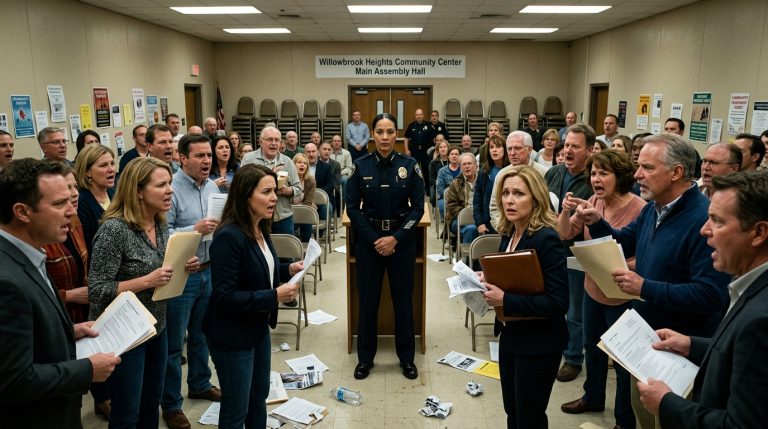
Marcus took the first step forward, his boots striking the paved walkway with a synchronized, heavy rhythm. The small procession moved past the threshold into the main hall, where three hundred residents sat clustered around round tables beneath buzzing fluorescent fixtures. At the far end of the room, a long stainless steel buffet line groaned under the weight of warming trays, scrambled eggs, and towering stacks of pancakes. At the absolute center of that display, elevated on a polished wood pedestal, sat several large, elegant glass pitchers filled with shimmering, dark amber liquid.
Conversations across the room faltered instantly. The collective gaze of three hundred people snapped toward the entrance, locked onto the deep blue wool and gleaming brass of Marcus’s uniform.
Karen was standing near the dais, holding court among her core sycophants with a clipboard tucked under her arm. When her eyes registered the silhouette moving across the floor, her pastel-suited frame stiffened. Her smile curdled into a mask of pure, unadulterated venom. She broke away from her group, her stride heavy and purposeful, marching straight down the center aisle like a bulldozer clearing brush.
“What do you think you are doing here?” she hissed, stopping three feet short of Marcus, her voice vibrating with suppressed fury and kept low for the surrounding tables. “You are not a resident. This is a private event. Security!”
Marcus did not blink. He kept his posture rigid, his eyes locked on hers with absolute, unyielding coldness. He did not raise his voice; he let the deliberate silence do the tactical work. Slowly, deliberately, he reached into his inner pocket and produced a single, valid ticket—purchased legally through a local intermediary earlier in the week—and held it between two fingers.
“I’m a guest, Karen,” Marcus said quietly, his tone flat and even. “My ticket is paid for in full.”
Her eyes bulged, her mind scrambling to calculate how he had bypassed her checkpoint. Before she could recover her footing, Marcus added the final, crushing line: “And I’m also a vendor, just here to check on the product.”
Before she could form a reply, Marcus turned past her, his boots carrying him directly toward the buffet line. The crowd parted instinctively, eyes wide, as the tall man in dress blues marched straight up to the syrup pitchers on the pedestal. He picked up one of the heavy glass vessels, swirled the dense golden liquid against the glass, brought it to his nose, and inhaled the rich, familiar scent of wood smoke and vanilla.
Karen caught up to his shoulder, her face a thundercloud of absolute panic. “I want you out of this building right now!” she snarled, her voice finally cracking as she reached out to grab his sleeve.
Marcus pulled his arm away with a microscopic shift, turning his gaze from the pitcher to look down at her with the crushing weight of a master gunnery sergeant addressing a broken line.
“Karen,” he said, his voice dropping into a register that carried effortlessly across the sudden, dead silence of the entire hall. “This entire breakfast—the centerpiece of your social calendar, the event you are charging your neighbors forty dollars a plate to attend—is built on my syrup. The very product from the land you are trying to destroy.”
The room stopped breathing. Every fork dropped against porcelain. The trap had sprung, and the walls were closing in.
CHAPTER 10: THE PUBLIC DETONATION AND THE BITTER SYRUP
The silence in the Oak Haven community clubhouse was absolute, heavy enough to feel physical against the skin. Three hundred pairs of eyes shifted from the heavy glass pitcher in Marcus’s hand back to Karen, whose face had cycled through every shade of pale panic before settling into a hard, chalky gray. Her pastel-suited frame trembled slightly, not from cold, but from the sudden, catastrophic collapse of the reality she had spent years engineering.
“He’s lying!” Karen shrieked, her voice cracking into a jagged, unnatural pitch that bounced off the acoustic ceiling tiles. “It’s a malicious conspiracy! Security! Remove this man from the premises immediately!”
The lone security guard—a burly, gray-haired man in a cheap uniform—stepped forward from the side exit, his boots dragging slowly against the linoleum. He looked at Karen, then at the rows of service ribbons gleaming on Marcus’s chest, and finally at the glass pitcher. He was a veteran himself; he understood the geometry of command, and he recognized the unmistakable look of a self-inflicted tactical disaster. He stopped two paces short, crossed his massive arms over his chest, and shook his head.
“Ma’am, he has a paid ticket, and he’s not causing a physical disturbance,” the guard said, his voice flat and deliberate. “My orders are to handle threats, not bail out your administrative blunders.”
The rejection was total. Karen’s authority—the absolute, unquestioned currency she had traded in for a decade—evaporated in real time.
Sarah Jenkins stepped out from the wedge of supportive residents, her leather binder open to the financial disclosures. With calm, unhurried precision, she and David Chen began moving down the center aisles, placing a single, devastating summary sheet onto every populated table.
“Take a look at the left column, everyone,” Sarah called out, her voice clear and carrying across the hall. “That’s sixty thousand dollars in punitive fines levied against a veteran neighbor over a sugar shack. Now look at the right column. That’s fifty thousand dollars of your HOA reserve funds—money meant for your drainage and tennis courts—funneled into a private law firm to fight him. And the syrup in those glass pitchers? Bought off the books using your own dues, supplied directly by the man she tried to ruin.”
A roar of indignation erupted from the tables. George the gardener stood up, his chair scraping loudly against the floor, pointing a trembling finger at the dais. “You told us we couldn’t afford to fix the children’s playground slide, Karen! You spent fifty thousand dollars of our money on a personal vendetta?”
Voices collided in a wave of raw fury. Neighbors who had spent years nodding politely at board meetings now glared across the room, the artificial harmony of the subdivision shattering into shards of open revolt.
David Chen stepped forward beside Marcus, holding up a single document. “Furthermore, a formal settlement offer was transmitted to Ms. Miller seventy-two hours ago—an offer that would have resolved this boundary dispute at zero cost to the association. She rejected it unilaterally without consulting the board, choosing instead to burn your capital on spite.”
Karen stood isolated in the center of the room, her supporters melting away into the crowd, her floral pantsuit seeming to droop around her shoulders like a deflated sail. She looked around the room, searching for a single sympathetic face, but found only cold, unforgiving stares. Without a word, she turned on her heel, pushed past the swinging kitchen doors, and vanished down the back hallway.
The aftermath was swift and surgical. Within forty-eight hours, an emergency petition triggered a mandatory special meeting. The vote of no confidence was unanimous. Karen was stripped of her title, her keys, and her influence, her house put on the market a month later before she quietly disappeared from the neighborhood entirely.
The civil lawsuit in county court concluded the following Tuesday as a quiet formality. The HOA’s new counsel, appointed under Sarah’s interim presidency, formally conceded the case, entering into the permanent registry that the disputed one-acre parcel was, and always had been, Marcus’s property free and clear. Esther, the county clerk, stamped the corrected plat map with a sharp, satisfying thud of her iron seal.
Back on the ridge, the spring thaw finally broke through the frozen mud, and the maples began to run heavy and clear. Marcus stood inside the post-and-beam sugar shack, watching the golden sap boil against the steel evaporator, the sweet, heavy steam rising up to warm the timber beams he had raised with his own hands.
The heavy iron survey pin—the one hammered illegally into his dirt weeks ago—lay discarded in the corner of his workbench, its neon-orange top coated in dust. Using a heavy ball-peen hammer, Marcus straightened a dented metal spile he had salvaged from the lower ridge, tapping the brass edge back into true alignment with steady, measured strokes.
The front door of the shack creaked open, and the afternoon sunlight spilled across the wide pine floorboards, carrying the faint, distant laughter of children playing on the newly repaired playground down in the valley. Marcus laid the hammer down, wiped his hands on a clean rag, and walked out onto the stone wall. The boundary stones were ancient, immovable, and entirely his own. He looked out over the quiet Vermont woods as the sun dipped low behind the ridge, casting a warm, amber glow across the stillness he had fought a lifetime to keep.