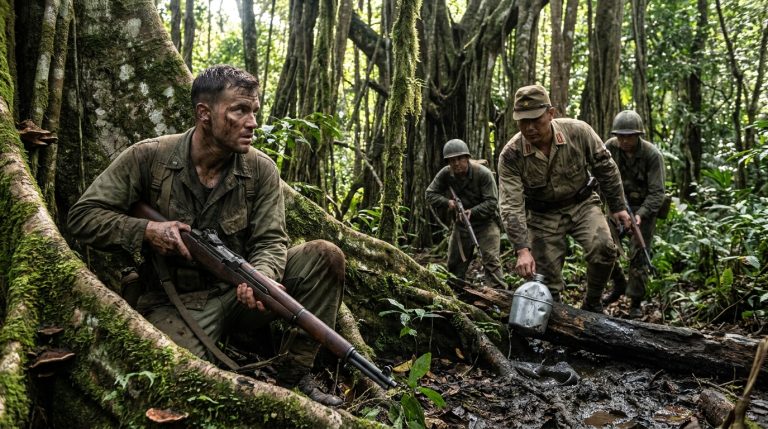
A Resonance of Iron: One Veteran’s Journey to Reclaim His Humanity Through the Echo of Steel
CHAPTER 1: The Weight of Dew
The concrete underpass was a throat that swallowed sound and exhaled the damp, suffocating smell of wet trash and long-standing neglect. Marcus pulled the frayed, olive-drab sleeping bag tighter, but the dew of the San Antonio morning had already permeated the synthetic fibers. It was a cold that didn’t just touch the skin; it reached into the marrow, a slow, insistent ache that defined his reality.
His back locked as he pushed himself upright, a familiar protest of tendons and bone. He was fifty-two, a chronological fact that felt like a cruel joke when his body insisted he was closer to eighty. He sat for a moment in the gray light, his hands resting on his knees. They were dark with a permanent, ingrained oil that no amount of public restroom soap could ever reach.
He didn’t check for an alarm. He checked for the weight of his rucksack. It was there, a heavy, familiar presence against his hip. He opened the flap, the sound of the zipper a harsh rip in the muffled silence of the underpass. Three things. The multi-tool, heavy and reassuringly sharp; the technical manual, its edges curled and soft as parchment; and the empty water bottle.
He stood, and the world tilted. He leaned against the damp concrete wall, waiting for the vertigo to pass. It was the hunger, sharp and gnawing, but it was also the static of memory. Every morning began with the same inventory, the same desperate need to ensure he was still anchored to something, anything, tangible.
A truck rumbled above on the highway, the massive, hollow boom of tires on expansion joints raining fine dust down onto his shoulders. He didn’t flinch. He walked three blocks to the gas station, his boots—held together by wire and stubbornness—making a rhythmic scuff-drag sound on the sidewalk. He washed his face in the sink, the soap burning his wind-chapped skin. He did not look in the mirror. He knew that the man who looked back was a stranger, a silhouette of a soldier that everyone in the city had learned to ignore.
By 8:00 AM, he was on the south side, seated on the curb near the Burger King. The smell of frying grease was a physical presence, a warm promise. Gloria would come out eventually. She always did. But today, the air felt charged, thin and electric.
“They’re going to cancel the whole ceremony if Brennan can’t get that Abrams running,” a voice drifted over him.
Marcus didn’t look up, but his pulse surged. A group of soldiers, their uniforms crisp enough to cut glass, passed within feet of him. They didn’t see him. He was just part of the curb, a permanent fixture of the city’s failures.
“Twelve hours and nothing,” the second soldier muttered, shaking his head. “If that tank doesn’t roll on Sunday, Brennan’s career is cooked.”
The words hit Marcus like a physical blow. Abrams. Ceremony. Dead. His heart hammered a frantic rhythm against his ribs. It wasn’t just a tank; it was a ghost he recognized. A faint, impossible shiver of belonging pulled at his chest, a sensation so sharp it was almost painful. He stood up, his joints popping, his eyes tracking the soldiers until they disappeared into the morning haze, leaving him standing in the middle of a world that didn’t know he was about to break it wide open.
CHAPTER 2: The Geometry of Memory
Marcus did not move as the soldiers rounded the corner and vanished into the morning glare. His world, which had been a quiet, manageable circle of surviving until the next meal, had just been forcibly expanded. The name Abrams acted like a tectonic shift beneath his feet. He could still smell the diesel, the cordite, and the metallic tang of fear that had accompanied every repair he’d performed in Iraq.
He looked down at his hands. They were trembling—a fine, high-frequency vibration that made his knuckles ache. He pushed himself off the curb, his joints protesting with a chorus of small, sharp snaps. The heat was already beginning to rise from the asphalt, shimmering in the distance. He needed to find Gloria. Not for the sandwich, but for the information.
He spotted her through the glass front of the Burger King, wiping down the counters with a rhythm that suggested she had been doing it for twenty years. He approached the door, his heart hammering. He caught his reflection in the tinted glass: the matted hair, the grease-stained jacket held together by layers of adhesive. He looked like a hazard. He paused, breathing deeply, trying to pull his shoulders back, trying to shed the posture of the invisible.
He pushed the door open. The bell above chimed, a bright, cheerful sound that felt horribly out of place.
Gloria looked up, her expression shifting from professional indifference to a faint, tired recognition. “You’re early, Marcus. Rush hasn’t cleared yet.”
He stepped inside, the air-conditioned relief hitting him like a physical comfort. He kept his hands visible, folded in front of him. “I’m not here for the food, Gloria.”
She stopped wiping. She frowned, her eyes scanning his face. “Everything okay? You look… different.”
“The soldiers,” Marcus said, his voice raspy, unused to forming complete, complex sentences. “The ones talking about the ceremony at the base. What ceremony?”
Gloria hesitated, glancing toward the kitchen where her assistant was busy. She leaned over the counter, lowering her voice. “It’s a big deal. Historical exhibition. They’re rolling out some of the old war machines for the Secretary of Defense on Sunday. Why? You going to crash the party?” She said it with a thin, brittle smile, trying to be kind, but Marcus saw the pity in her eyes. It was a familiar, dull weight.
“I need to know which base,” he said, ignoring the barb.
She sighed, wiping her hands on her apron. “Joint Base San Antonio. The south hangar. Honestly, Marcus, it’s not for people like us. It’s for the brass.”
“It’s eight miles,” he whispered, mostly to himself.
“Eight miles to what? It’s a heatwave out there.”
Marcus looked past her, toward the back of the store, toward the distant, shimmering heat haze that marked the direction of the base. The math was already happening in his head. If he left now, he could reach the gates by noon. His boots were held together with wire, and his water bottle was empty, but those were tactical considerations. They didn’t matter. The only thing that mattered was the relay.
He had a mental image of the tank’s hull—the way it felt, the sound it made when you tapped it with a steel rod to check for plate integrity. He knew the internal architecture of that specific machine better than he knew his own reflection. He knew the design flaw that only field mechanics from the early 2000s had ever wrestled with. It was an undocumented failure, a ghost in the machine that wouldn’t show up on any modern, computer-driven diagnostic screen.
“I have to go,” Marcus said, turning back toward the door.
“Marcus, wait,” Gloria called out, but he didn’t stop.
He stepped back into the heat. The sun hit him with the force of a hammer, but he didn’t feel it. He was already calculating the route, the shortcuts through the industrial district that would keep him off the main highways where the police were more likely to clear him out.
He began to walk. The first mile was the hardest; his muscles were stiff, and his boots felt heavy, like blocks of lead. But as he passed the final outskirts of the city, the rhythm took over. Step. Drag. Step. Drag. It was a cadence he remembered from the long, grueling patrols. He wasn’t just walking to a military base; he was returning to the only version of himself that had ever made sense.
He didn’t think about his hunger or the fact that he was homeless. He thought about the relay. He thought about the friction points in the electrical system, the way the vibration of the engine would have ground down the contact pins over two decades. He was a man walking toward a ghost, and for the first time in four years, the silence in his head was replaced by the mechanical hum of a machine that had been dead for far too long. He was coming back, and he was the only one who held the key.
CHAPTER 3: The EightMile Threshold
The city of San Antonio did not yield to Marcus Dalton; it simply stretched out, a vast, indifferent grid of shimmering heat and jagged industrial edges. The Burger King had become a receding speck in the rear-view mirror of his memory, replaced by the relentless, monotonous grind of the road. His boots, already failing, sent sharp needles of pain into his heels with every strike, but he ignored them. He had learned in the dust of Iraq that pain was merely a data point, an indicator that the system was under stress, not a reason to cease operation.
By the time he reached the industrial district, the sun was a white-hot coin hammered into the center of the sky. Sweat had long since soaked his shirt, drying into a crust of salt that chafed against his ribs. He walked with his head slightly bowed, scanning the ground not for money, but for terrain indicators—cracks in the concrete, debris that could snag his failing sole, the shifting shadows cast by warehouses that promised a few seconds of relief.
He saw the water tower first, a silver monolith rising above the haze, signaling he was on the right vector. He had not eaten since the previous morning, and the thirst was beginning to hum in his ears like a low-frequency radio signal, but he didn’t stop at the convenience stores he passed. They were places of scrutiny, of clerks who looked at him with guarded, suspicious eyes. He had a mission, and a mission had no room for the social tax of being a visible anomaly.
As he reached the outskirts where the city crumbled into dry, scrub-covered fields, he found himself falling into an old, deeply etched habit: the mental maintenance of the M1 Abrams. He wasn’t thinking about the shame of his current state or the four years he’d lost to the bottle and the bridge underpasses. Instead, he was troubleshooting.
If the relay is truly dead, he thought, visualizing the wiring diagram in the dark, crowded theatre of his mind, then the signal from the ignition switch wouldn’t even reach the starter solenoids. He traced the path with his mental hands, feeling the imaginary copper under his fingertips. It’s the corrosion. The humidity in Kuwait, the dust in Fallujah—it gets into the housing, it eats the connection. The manual diagnostics see an ‘open’ circuit, but the computer can’t tell the difference between a broken wire and a corroded contact point.
The logic was sound. It was the only thing that felt real. His own life was a series of broken circuits, but the tank—the tank was something he could fix. It was a tangible, objective truth.
He rounded a bend, and the perimeter fence of Joint Base San Antonio appeared, a long, chain-linked line that looked like a scar on the horizon. He stopped for a moment, chest heaving, his heart feeling like it was trying to punch its way out of his ribcage. He knelt, not to rest, but to check the wire holding his left boot together. It was fraying. He pulled a length of twine from his pocket—a scavenged treasure from weeks ago—and reinforced the binding.
His hands were steady. He looked toward the main gate, a mile ahead. He could see the flash of sunlight on the weapons carried by the MPs. They were young, their movements quick and unburdened by the specific, heavy exhaustion of his life.
He didn’t feel afraid. Fear was for situations where you didn’t know the parameters. He knew exactly what he was doing. He was a piece of debris moving toward a high-security installation, a man with nothing in his pockets but a multi-tool and a memory of a machine he had once resurrected from the dead.
He stood up, his knees cracking, and resumed his pace. The distance was closing. Every step was a deliberate, calculated expenditure of energy. The heat radiating off the fence line made the air ripple, distorting the world, but Marcus kept his gaze locked on the gate. He was within the threshold of the base now, the air changing, carrying the faint, sharp scent of aviation fuel and freshly mown grass—the smell of a world that operated on protocols, on hierarchies, on the kind of order he had once helped maintain.
He reached the edge of the access road. A sign marked the restricted zone, the black letters stark against the yellow paint. He didn’t hesitate. He stepped onto the pavement, his shadow lengthening as the afternoon deepened. He was no longer just a man on a road; he was a component moving into place, and he would not be turned away until the machine he remembered was breathing again. The gate loomed, the MPs watching him, their hands drifting toward their belts. Marcus kept his eyes forward, his stride steady, his hands open and empty, walking directly into the heart of the storm.
CHAPTER 4: The Hangar Perimeter
The gate was a wall of chain-link and shadow, presided over by two MPs whose youth felt like an indictment of everything Marcus had spent his life protecting. As he approached, the gravel beneath his boots crunched—a loud, abrasive sound in the quiet of the military installation. He slowed, keeping his hands away from his sides, palms open to show he carried no threat.
The taller of the two MPs, a man with a nametag that read ‘Johnson’, stepped forward, his hand dropping naturally toward his holster. “Hold it. This is a restricted zone, sir. You need to back away.”
Marcus stopped. The adrenaline of the long walk was draining out of him, replaced by a hollow, gnawing exhaustion. He looked past the MP, toward the hulking silhouette of Hangar 6 in the distance. He could almost feel the presence of the tank inside—the silent, seventy-ton monolith that he knew, in a way that was deeper than sight.
“I need to speak to someone in vehicle maintenance,” Marcus said. His voice was a rasp, unused to anything beyond the occasional grunt of survival. “There’s an M1 Abrams inside. It’s not starting. I can help.”
Johnson laughed—a sharp, dismissive sound that bounced off the perimeter fence. “Yeah, I bet you can. Look, buddy, I don’t know what kind of game you’re playing, but you’re about three steps past the ‘turn around and leave’ line. Keep walking.”
Marcus felt a flicker of the old, dormant heat in his chest, but he suppressed it. Tactical patience, he reminded himself. He reached slowly into his pocket, his movements deliberate. He didn’t pull out the multi-tool. Instead, he withdrew the fabric patch—the insignia of the First Armored Division. It was frayed, the threads unraveling, the colors bled out by years of sun and rain.
He held it out, his hand shaking just enough to make the fabric flutter in the breeze. “I served with the First Armored. I know the Abrams. I know why it’s dead.”
The MP stared at the patch, his skepticism faltering for a fraction of a second as he recognized the emblem. The second guard, an older man named Martinez, stepped closer, his expression unreadable. He looked from the patch to Marcus’s face—to the gray, matted hair and the hollows of his eyes.
“Sir,” Martinez said, his voice lowering, “you need to understand where you are. We can’t just open the gate for anyone who claims a connection. You have an ID?”
“I have a life,” Marcus said, his voice flat. He felt a phantom sensation—the smell of burning rubber and the vibration of an engine that had died in the middle of a mortar strike back in 2003. The memory hit him with a sudden, sickening clarity: the sound of a relay clicking, the smell of ozone, the absolute, crushing silence of a disabled war machine. It wasn’t a computer error then, he thought, his vision blurring. It was the housing. It was always the housing.
He blinked, pulling himself back to the present. The hangar was still there, a tomb for the machine he loved. “The relay,” he said, focusing on the word as if it were a life raft. “The tertiary relay under the Delta IV armor plate. If you tell them to check that, they won’t have to guess anymore.”
Martinez and Johnson exchanged a look. It was a moment of hesitation—the crucial gap where the rigid rules of the base met the impossible, ragged truth of the man standing before them.
“Wait here,” Martinez said, turning toward the call box.
Marcus stayed where he was, his boots sinking slightly into the sun-softened gravel. He looked at the hangar again. The acoustics of the base were starting to play tricks on him—every metallic clang in the distance sounded like the echo of a tank tread on a concrete slab. He was at the threshold now. The barrier wasn’t just the fence; it was the entire culture of the base, the polished, Ivy League efficiency that had no place for a man who smelled of failure and old grease.
But he was here. He had walked the eight miles. He had carried the knowledge of that specific, undocumented flaw across a city that wanted him gone. He closed his eyes, centering himself, waiting for the gate to move. The wait felt like a test of his own structural integrity. If he broke now, if he walked away, he would lose the only piece of himself that still functioned. He wouldn’t—he couldn’t—break. He was, as he had once been called, Ironclad.
The gate didn’t open yet, but the hum of the intercom crackled to life, the sound of static and authority. Marcus watched the movement of the guards, his heart settling into a cold, steady rhythm. He was ready for the refusal. He was ready for the ejection. But he was also ready for the slim, desperate chance that someone inside the hangar was as lost as he was.
CHAPTER 5: The Recognition of Scars
The intercom clicked off, leaving only the abrasive sound of the wind through the chain-link fence. Marcus stood in the sun-drenched silence, his pulse a steady, measured beat in his temples. He looked at the gate, then back to the distant, hulking shape of Hangar 6. In his mind, he was already inside. He was already under the chassis, the cold steel pressing against his back, his hands searching for the telltale break in the tertiary relay housing.
Seconds stretched, thickening into minutes. The silence became a physical weight, pressing against him. Johnson, the younger guard, kept his eyes fixed on the horizon, his posture stiff, while Martinez remained motionless, his hand hovering near the radio on his shoulder.
“Wait here,” Martinez repeated, but this time his voice lacked the dismissive edge of before. He stepped away from the gate and moved toward the call box again, his fingers tapping in a code.
Marcus watched him, his focus sharpening. The world around him—the shimmering asphalt, the dust-choked weeds, the distant roar of a transport plane—seemed to recede, leaving only the hangar. He felt a sudden, sharp intrusion of the past; the sound of a distant explosion, the smell of burning copper, the frantic, desperate coordination of a crew under fire. It wasn’t a memory so much as a sensory ghost. For a heartbeat, the gate didn’t exist, replaced by the chaotic, claustrophobic interior of a tank engine bay in Fallujah. The sensation was so intense that he instinctively braced himself for a jolt that didn’t come.
He blinked, pulling his breath into his lungs, and the phantom noise of battle faded back into the persistent whine of the wind.
“Step back,” Martinez commanded, his voice jarring.
The gate began to groan, the hydraulic mechanism screaming in protest as it slid open. It was a slow, agonizing process. As the gap widened, Marcus felt a rush of cold air—the refrigerated, sterile breath of the hangar complex—spilling out to meet him.
He didn’t rush. He walked with the measured, deliberate gait of a man who understood the value of every movement. As he crossed the perimeter, he passed Johnson, who didn’t look at him, though his jaw tightened. Marcus didn’t care. His eyes were locked on Hangar 6. He was nearing the center of the base, the air becoming heavy with the scent of high-grade diesel and industrial cleaner.
He reached the side entrance of the hangar and pushed. The door was heavy, solid, the kind of reinforced steel meant to withstand the elements of war. As he stepped inside, the light changed instantly. The harsh, unrelenting Texas sun was replaced by the artificial, blue-white glare of mercury-vapor lamps.
The hangar was cavernous, a cathedral of cold, gray space. In the center, dwarfing everything else, sat the M1 Abrams.
It was a beast of engineering, its turret angled, its tracks caked in the dust of a history he knew better than anyone. He stopped, his boots echoing on the concrete. He saw them then—the cluster of people huddled around the tank’s flank like a group of mourners. There was Captain Brennan, his posture rigid with a professional, brittle desperation. There was the civilian contractor, his laptop glowing with a frantic, scrolling waterfall of diagnostics. And there was the sergeant, Ortiz, her face obscured by the shadow of the tank’s heavy hull.
They didn’t see him at first. They were too absorbed in the machine’s refusal to wake. Marcus began to walk, his shadow stretching across the smooth, stained floor. Every step brought the details into focus: the specific way the hull plating caught the light, the faint, nearly invisible scratch near the turret ring.
His heart didn’t race. It settled. He was an expert returning to the scene of a crime, or perhaps, a ghost returning to a house he had built. He reached the edge of the work zone, the smell of burnt grease and unspent hope thick in the air.
“Captain,” Marcus said.
His voice, unused to the cavernous space, seemed small, yet it cut through the hum of the cooling fans. Brennan spun around, his expression shifting from frustration to sheer, visceral shock, followed immediately by a sharp, cutting contempt. The diagnostic contractor looked up, squinting, while Sergeant Ortiz took a half-step forward, her eyes narrowing as she scrutinized the man who had walked eight miles to tell them what they couldn’t see.
Marcus didn’t wait for permission. He looked at the tank—at the number 472 stenciled on the hull—and he felt the old, familiar weight settle into his joints. The ghost of the machine was in pain. He knew where the wound was. And now, he was finally in range to operate.
CHAPTER 6: The Anatomy of Failure
The air in the hangar was thin, recirculated through vents that had long since forgotten the smell of open air. Marcus didn’t wait for Captain Brennan to finish his sneer. He took three long strides toward the M1 Abrams, his presence a jarring, discordant note in the sterile, high-tech environment.
“You’re making a mistake,” Marcus said, his voice cutting through the hum of the diagnostic laptop. He stopped mere inches from the tank’s skirt.
Dr. Vickers, the MIT contractor, stepped in front of him, his face flushed. “Excuse me? This is a sensitive technical environment. You can’t just—”
“I can,” Marcus interrupted. He wasn’t looking at Vickers. He was looking at the tank. He was reading the machine’s geometry like a topographic map. He moved to the side, his hands instinctively tracing the heavy, armor-reinforced plates. He stopped near the Delta IV section. The paint here was slightly darker, the metal showing microscopic signs of stress—the subtle, structural fatigue of a machine that had been pushed to its absolute limits decades ago.
“Captain,” Sergeant Ortiz said, her voice strained. She was looking at Marcus with a mixture of confusion and a flicker of something else—recognition. “Sir, he’s not kidding. He knew the serial number. He knew where to look. We’ve spent twelve hours on the electronic systems. If the logic is elsewhere…”
“The logic is right here,” Marcus said. He gestured to the plate. “Give me the pry bar, Sergeant.”
Brennan’s face turned a dangerous shade of crimson. “Ortiz, don’t you dare. We are following proper procedure. We do not have some vagrant tearing into the armor of an eight-million-dollar asset.”
“It’s not an asset, Captain,” Marcus said, his voice dropping into that low, steady rumble that had once commanded a crew of four under a barrage of mortar fire. “It’s a machine. And it’s dying because you’re treating it like a database instead of a system under tension.”
He looked at Ortiz. She was holding a heavy-duty pry bar, her knuckles white. She looked at Brennan, then back at Marcus. She saw the grime under his nails, the sheer, unvarnished exhaustion in his posture, and the absolute, terrifying certainty in his eyes. Without a word, she stepped past the Captain and held the tool out toward Marcus.
Brennan made a sound of protest, a sharp intake of breath, but Marcus was already moving. He took the bar, feeling the cold, familiar bite of the steel against his palm. It was perfectly balanced.
He didn’t hesitate. He dropped to his knees, ignoring the pain that shot through his worn joints. He slid onto his back, dragging himself into the suffocating, dark gap between the heavy tread and the armored hull.
The transition was instant. Above him, the chassis was a ceiling of cold, unyielding iron. He felt the darkness close in, the familiar claustrophobia of the crawlspace, but it wasn’t a nightmare; it was an anchor. He found the housing. He felt the hairline crack in the metal—a fissure so small it would have been invisible to any sensor.
“It’s here,” he whispered, his voice vibrating against the steel. “The relay housing is fractured.”
He jammed the flat of the pry bar into the seam, using his shoulder as a lever. His muscles strained, the old ache in his back roaring to life, but he didn’t falter. With a sharp, metallic ping, the plate shifted. He reached in with his left hand, his fingers navigating the labyrinth of wires and connectors by touch alone. He felt the corrosion—a gritty, powdery substance that felt like death against his skin.
“The contacts are fused,” he called out, his voice muffled by the hull. “It’s not an electrical failure, it’s a physical collapse. The relay can’t ground out.”
He could hear the shouting above him, Brennan’s frantic voice commanding someone to get him out, but he was deaf to it. He was in the zone of total focus. He pulled his multi-tool from his pocket, the metal clicking as he unfolded the wire-cutter attachment. He had to bypass the relay. It was a crude, field-expedient fix—a “dirty” repair that would make an engineer like Vickers scream, but it was the only way to re-establish the current.
He stripped the wire, his movements precise and economy-driven. He twisted the leads together, the sharp copper wire biting into his scarred fingertips. He didn’t feel the sting. He only felt the connection.
“Get him out! Now!” Brennan’s voice was closer now, frantic.
Marcus braced his boots against the ground, his body an arc of tension. He twisted the final connection, his breath coming in short, rhythmic huffs. Therefore… the current flows. But the housing is shattered… therefore… bypass is the only reality.
He finished the knot, wrapped the junction with a scrap of electrical tape he’d kept in his pocket for years, and pulled his arm back. He felt the cold iron shift one last time as he realigned the assembly.
“Clear!” he shouted.
He didn’t wait to be helped. He pushed off the ground, the friction of the steel tearing at his skin, and hauled himself out from under the tank, sliding across the slick concrete floor. He stood up, panting, his hands slick with oil and fresh, red blood.
“Try it,” he gasped, his legs shaking uncontrollably. “Try the ignition now.”
The silence in the hangar was absolute. Brennan looked down at him with pure, naked hate, but the entire room—every mechanic, every engineer, every guard—was staring at the ignition switch, waiting for the dead metal to wake up. Marcus watched Ortiz, who was already climbing toward the hatch. The gamble was in the air, a physical weight that threatened to crush the breath out of him. He had stripped his life down to this one, final, desperate mechanism. If it didn’t turn over, there was nothing left.
CHAPTER 7: The Turbines Breath
The hangar was so quiet it felt as though the air had been pumped out of the room. Marcus stayed where he was, his boots planted in the layer of dust and metal shavings he’d created while underneath the chassis. Every muscle in his body felt like a frayed wire pulled to its breaking point. He watched Sergeant Ortiz’s profile as she sat in the driver’s seat, her hands poised above the controls.
“Try it,” Marcus repeated, his voice barely rising above a whisper.
Ortiz nodded. She took a breath, her fingers steady as she reached for the ignition. She didn’t hesitate. She hit the switch, and for one heartbeat—one agonizing, infinite slice of time—nothing happened.
Then, a low, guttural thrum began to vibrate through the soles of Marcus’s boots. It wasn’t the clean, humming start of a modern, well-maintained machine; it was the sound of a beast struggling to wake. The sound grew, shifting from a rhythmic sputter into a high, shrill whine that climbed the registers, piercing the thick, diesel-heavy air.
The turbine caught.
The sound became a roar—not just a noise, but a physical force that hit Marcus in the chest, shaking the concrete floor beneath him. Dust billowed out from under the tracks. The exhaust stack at the rear erupted in a blast of hot, blue-tinted air that sent papers flying from the diagnostic table. The tank, the massive, seventy-ton monolith that had been a silent tomb for twelve hours, was suddenly alive. It hummed with a deep, resonant power that felt as familiar to Marcus as his own heartbeat.
Dr. Vickers staggered back, his laptop sliding off the workbench and hitting the floor with a sickening clatter. Captain Brennan stood motionless, his mouth slightly open, the arrogance drained from his face as if he’d been struck.
Marcus let out a breath he felt he’d been holding since the day he left the service. His knees finally gave way. He didn’t collapse; he simply sank to the floor, leaning back against the cool, vibration-heavy hull of the tank. The world blurred at the edges. The smell of burning oil and ozone was a perfume he’d spent four years trying to wash off, but now, it felt like the only clean thing in the room.
Ortiz climbed out of the hatch, her face streaked with tears and grease. She didn’t look at the Captain. She didn’t look at the engineers. She climbed down the side of the tank, her movements frantic, and dropped to her knees beside Marcus.
“How?” she shouted over the deafening scream of the turbine. “How did you know?”
Marcus looked at her, his eyes unfocused. He felt the cold iron of the tank against his shoulder, a solid, immovable truth. “I didn’t guess,” he said, his voice struggling against the roar of the engine. “I lived it.”
Brennan approached them then, his footsteps heavy. He looked down at Marcus, his face a complex mask of humiliation and begrudging awe. He opened his mouth, likely to say something about the bypass he hadn’t approved, but then he looked up at the roaring turbine, at the sheer, undeniable reality of the machine rolling on its own power. He closed his mouth, turned on his heel, and walked away toward the hangar office, his shoulders slumped.
“Sergeant,” Ortiz said, her hand resting on Marcus’s shaking arm. “You’re bleeding.”
He looked at his hand. He had torn his skin on the sharp edge of the relay housing. The blood was dark, contrasting sharply with the thick, black grease covering his fingers. He didn’t pull away. He just stared at it, the physical sensation of the injury a final, grounding reminder that he was here, that he was real, and that he was no longer a shadow.
The hangar was chaos. People were yelling, cheering, and the sound of the turbine was beginning to settle into a steady, rhythmic thrum—the heartbeat of a machine that had been resurrected by a man everyone had called a bum.
Marcus watched the flickering light of the hangar lamps, his chest heaving with every ragged breath. He had done it. He had taken a piece of his past, a piece of his identity, and he had dragged it back from the dark. But as he looked at the tank, he realized the repair wasn’t just about the machine. He had finally reached into the dark, fractured housing of his own life, and he had made a connection. It was a temporary, desperate, field-expedient fix, just like the one under the armor plate—but for the first time in four years, the power was running, and the engine was turning over.
CHAPTER 8: The Weight of a Second Chance
The hangar didn’t feel like a sterile machine tomb anymore. It felt like a space that had been earned. As the turbine’s whine descended into a rhythmic, steady idle, Marcus remained on the floor, his back braced against the hull of the Abrams. The vibration was a constant, low-frequency hum that seemed to sync with the steadying of his own heart.
Sergeant Ortiz didn’t leave him. She sat on a toolbox a few feet away, her hands resting on her knees, watching the mechanics scramble toward the engine bay with an excitement she hadn’t displayed all day. “You saved them, you know,” she said, her voice soft, cutting through the residual echoes of the engine’s wake. “Not just the tank. You saved the morning. You saved the project.”
Marcus didn’t look at her. He looked at his hands, where the dark, ingrained grease was now mingled with the bright red of his own blood. It was a messy, human mark. “I didn’t do it for them,” he admitted, the words feeling heavy and true. “I did it because I couldn’t stand the thought of it being dead. I knew how to fix it. That was all.”
“That’s enough,” she replied. She reached into her pocket and pulled out the patch he’d dropped earlier. She placed it into his palm, her fingers lingering for a moment against his skin. “You should keep this, Ironclad. It belongs to you.”
The journey to the mess hall felt like walking through a dream. Marcus was unsteady, his body finally signaling the full cost of the eight-mile trek and the physical exertion of the repair. But as they entered the hall, the quiet clatter of silverware and the hum of conversation created a strange, unfamiliar sanctuary. It wasn’t the frantic, predatory hunger of his life on the streets; it was a space of shared, quiet routine.
They sat at a corner table. When the tray of food arrived—chicken, mashed potatoes, a slice of apple pie—Marcus found he couldn’t rush it. He ate with the slow, deliberate focus of a man who was learning how to be a person again. Ortiz sat across from him, her own food mostly ignored, her presence a silent, tethering anchor.
“When you go to therapy,” Marcus began, his voice barely audible over the clink of metal against ceramic, “I don’t think I can do it alone. I don’t know how to start.”
Ortiz didn’t offer empty platitudes. She didn’t tell him everything would be alright. She looked him in the eye, her gaze steady and filled with a raw, shared understanding. “You don’t have to. I’ll be there. We take it one session, one day, one step at a time. That’s how we fix the things that aren’t made of steel, Marcus.”
Later that evening, General Haywood arrived. He didn’t come with the fanfare of a ceremony; he walked into the mess hall alone, his uniform relaxed, his presence bringing a sudden, respectful quiet to the room. He pulled up a chair without asking, his eyes scanning Marcus—really seeing him, not the homeless man, not the ghost, but the man who had resurrected a machine.
“I’ve been looking at your file, Dalton,” Haywood said, his voice deep and thoughtful. “The system failed you. We lost you in the cracks. But I’m not letting you slip back into them.”
The offer followed—a position, a home, a purpose—but as the General spoke, Marcus realized the truth of his own recovery. His homelessness hadn’t been just about the loss of a job or a home; it had been a systematic dismantling of his identity, a feeling that he was a tool that had outlived its usefulness. The truth was that he had never stopped being the man he was in Fallujah; he had just stopped being seen. The fix hadn’t been the relay. It had been the connection.
As the General left and the mess hall began to empty, Marcus walked out into the cool, dark Texas night. The air was dry, and the sky was a vast, open expanse of stars. He looked back toward the hangar, where the silhouette of the tank stood in the distance. He wasn’t the man he had been four years ago, but he was no longer the man who had slept under the interstate.
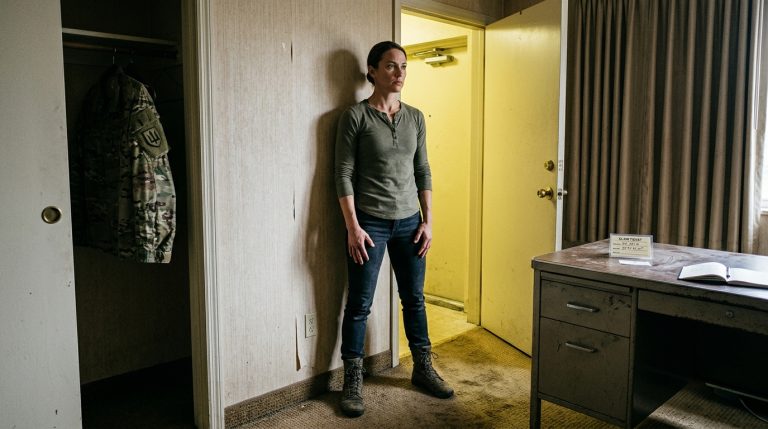
He walked to the temporary barracks, the silence of the base now feeling peaceful rather than oppressive. He unlocked the door to his room, the metal key heavy and substantial in his hand. Inside, the space was small and sparse, but it was his. He sat on the edge of the bed and looked at the rusty crowbar he had retrieved and placed on the small desk—a physical, tactile reminder of where he had started.
He wasn’t going to fix everything overnight. The nightmares might return, the ache in his back would certainly remain, and the world would continue to be a chaotic, unpredictable place. But for the first time in four years, the circuit was closed. He was grounded. He was connected. He laid back against the pillow, the sheets feeling crisp and clean against his skin, and for the first time since his wife had died, he didn’t wait for the world to kick him. He closed his eyes, his breathing slow and steady, and finally, he let himself sleep.