The Iron Boundary: How One Quiet Home Stood Firm Against the Unstoppable Tide of Entitlement
CHAPTER 1: THE FIRST FOOTPRINT
The metal click of the garden gate sounded sharper than usual against the quiet Sunday morning. I didn’t rush. I wiped the soil from my calloused palms onto the thighs of my work jeans and stood up from the flower bed, my lower back giving a dull, familiar throb.
Ten years in Maple Hollow were supposed to buy a man some quiet. Instead, a woman in a spotless pastel cardigan was currently strolling diagonally across my wife Elise’s prized peony patch, tossing a paper coffee cup directly into the mulch.
I picked up the discarded cup before she even reached the sidewalk. It was lukewarm and still half-full of cheap vanilla creamer.
“Excuse me,” I said, keeping my voice level, pitched just loud enough to carry over the distant ringing of the church bell.
The woman stopped, turning around with a look of mild, unbothered surprise, as if I had interrupted her walk through a public park. She adjusted her silk scarf and stared at me through oversized sunglasses.
“Oh, hello,” she said, her voice dripping with practiced cheer. “You must live in the old Victorian. Such a lovely lot for the neighborhood.”
“It’s private property,” I said, holding out the cup. “You dropped this in my wife’s flower bed.”
She didn’t take the cup. She just blinked, tilting her chin up with a sudden stiffening of posture that told me everything I needed to know about her tolerance for being corrected.
“Well, everyone uses the shortcut,” she said, waving a hand toward the gravel shoulder where two dozen SUVs were already spilling out onto the narrow street. “Pastor Briggs encourages a welcoming community. We are all family here.”
“Family uses the front door and the sidewalk,” I replied, dropping the cup into the trash can by the porch steps. “Not my yard.”
She scoffed, a quick, dismissive puff of air, and turned on her heel, her low heels grinding fresh tracks into the turf. I watched her cross the property line and join the stream of parishioners filing into the brick building next door.
My knuckles tightened around the cold handle of the garden trowel in my pocket. The bell stopped ringing, leaving a heavy, oppressive silence over the two acres we had spent a decade building into a sanctuary.
Elise stepped out onto the porch, wiping her hands on a dishtowel, her eyes resting on the fresh crescent-shaped scar torn into the grass.
“She leave another mess?” Elise asked quietly.
“Just a cup,” I said, walking over to the hose to wash the dirt from my hands. “For now.”
CHAPTER 2: THE WORN PATH
By the following Wednesday, the crescent-shaped scar across the grass had widened into a trampled trench of mud and dead roots.
Elise spent forty minutes kneeling by the hostas with a pair of pruning shears, snipping away bruised stems that had been crushed beneath the weight of morning strollers.
“We need a physical barrier,” I said, leaning on the rake handle. “Signs didn’t work. Talking didn’t work.”
“A barrier looks petty,” Elise said without looking up, her breath pluming slightly in the crisp morning air. “It looks like we’re declaring war on a church.”
“We aren’t declaring anything,” I replied, feeling the stiff denim of my jeans scrape against my knees as I knelt down to help her clear the debris. “We’re just keeping people off our land.”
The problem multiplied by Saturday afternoon. A group of three teenagers carrying folding tables and boxes of promotional flyers cut straight across the center of the lawn, ignoring the gravel shoulder entirely.
One of them stumbled over a low border stone, dropping a stack of glossy pamphlets into the damp dirt.
“Watch it, old man,” the taller boy muttered, not even bothering to apologize as he scooped up the papers and kept walking toward the church annex.
I didn’t yell. I walked over to the spot where they had crossed, picking up a stray plastic flyer left behind in the grass.
The headline blazoned across the glossy paper read: Expanding Our Reach – Growth Without Limits.
Beneath it was a map detailing the church’s new parking expansion proposals, which conveniently overlapped three feet of our eastern property line.
Elise wiped her forehead with the back of a mud-stained wrist, staring at the flyer in my hand.
“They aren’t just walking through here anymore,” she whispered, her voice tight. “They’re mapping us out.”
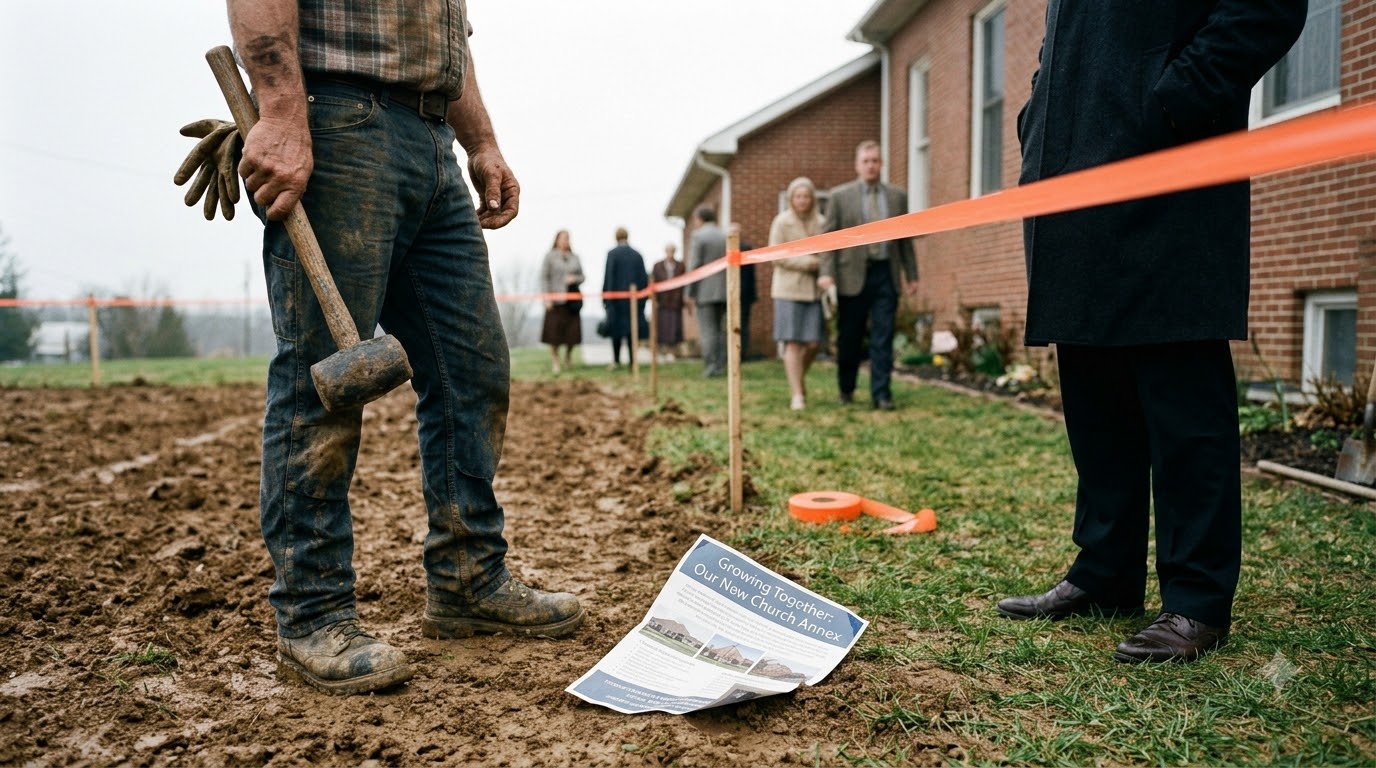
I didn’t answer. I pulled a wooden stake and a roll of orange marker tape from the shed, walking the perimeter line with deliberate, heavy steps.
Every yard of bright tape tied to a stake felt less like a boundary and more like a fuse waiting for a match.
CHAPTER 3: THE IRON SHEARS
I tightened the knot on the wooden stake and drove it another two inches into the hard Pennsylvania clay with the back of a heavy mallet.
Elise watched from the kitchen window, her shadow framed against the pale lace curtain like a quiet warning I couldn’t ignore.
The sound of gravel shifting behind me broke the rhythm of the work. I didn’t turn around right away; I just kept my grip on the wooden handle, feeling the raw friction of the grain against my skin.
“You’re making quite a spectacle of yourself, Daniel,” Pastor Briggs’s voice carried smoothly across the lawn, devoid of any genuine neighborhood warmth.
I stood up slowly, wiping my brow with the back of a work-gloved hand, and turned to face him standing right on the edge of our newly taped boundary.
He wore a tailored wool coat that looked completely out of place against the damp dirt, his hands shoved deep into his pockets with a calm, institutional arrogance.
“I’m marking my line, Nolan,” I said, my voice flat, keeping my eyes locked on his polished leather shoes standing squarely on our side of the property tape.
“A line that happens to block our parishioners from accessing the annex fellowship entrance,” Briggs replied, flashing a tight, unyielding smile that didn’t reach his eyes. “We have a church community to build, Daniel, and petty fencing won’t stop the spirit of growth.”
“That spirit is trampling my wife’s flower beds,” I said, stepping forward until the bright orange ribbon fluttered between us.
“People make mistakes when they’re looking for fellowship,” Briggs said, shrugging his shoulders as if vandalism were a minor administrative error. “Perhaps you should consider a donation of land rather than a wall of stakes. It would look much better in the parish newsletter.”
He turned on his heel before I could answer, walking back toward the brick building with the casual stride of a man who believed every door in town belonged to him.
My fingers curled around the steel handles of the garden shears tucked into my belt loop, the cold iron biting into my side.
CHAPTER 4: THE FORGED EASEMENT
I picked up the thick manila packet without opening it right away, my thumbs feeling the crisp, expensive weight of corporate stationery.
Elise stood in the doorway behind me, her eyes fixed on the bold legal letterhead stamped across the front cover.
“They didn’t stop,” she said, her voice dropping into a flat, exhausted register. “They’re escalating.”
I sliced the envelope open with the edge of the metal shears, pulling out four pages of formal text dense with legal jargon and signed affidavits.
The church’s new counsel claimed that a historic pedestrian route had crossed our western acreage for over forty years, complete with sworn witness statements from two longtime parishioners.
I laughed, a short, humorless sound that echoed off the wooden porch siding.
“Historic route,” I muttered, flipping to the back pages where municipal land plats were attached. “We checked the zoning maps when we bought this place in 2009. There was nothing here.”
“Memory is flexible when a church wants to expand its parking lot,” Elise replied, stepping down to trace a finger over the blurry photocopy of an old property survey.
Hidden beneath the second affidavit was a small, stapled addendum referencing municipal expansion permits tied directly to local right-of-way foot traffic counts.
It wasn’t just about people taking a shortcut to Sunday service; it was a paper trail proving the church needed our land to clear zoning requirements for their new mega-annex.
My jaw tightened as I set the papers down on the porch railing, the cold wind rustling the corner of the forged documents.
“They want a paper war,” I said quietly, gripping the edge of the wood until my knuckles turned white. “Fine. We’ll look at the ground ourselves.”
CHAPTER 5: THE SURVEYORS STAKE
The damp Pennsylvania soil clung to my work boots as I probed the eastern flower bed with a heavy iron trowel.
Elise stood by the kitchen window, her reflection blurred against the glass as she watched me trace the perimeter where the church’s expansion maps claimed their historic path ran.
A sharp metallic clink rang out beneath the blade, jarring my wrist.
I dropped to my knees, scraping away the wet mulch and dark dirt until a small, weathered iron stake came into view.
It wasn’t a property marker from when we bought the Victorian in 2009; it was a municipal utility pin stamped with an unlisted township code—the exact code referenced in the church’s expansion grant filings.
They hadn’t just walked across our land; they had secretly surveyed it months before Pastor Briggs ever knocked on our door, engineering a fake footprint to secure municipal funding for their mega-annex parking lot.
The weight of the iron peg felt cold and heavy in my palm, a tangible piece of evidence buried right under our hydrangeas.
Pastor Briggs stepped out from behind the church annex wall, his wool coat buttoned tight against the wind, stopping right at the property line.
“You’re disturbing the peace of the grounds, Daniel,” Briggs called out, his voice sharp and unyielding as he pointed toward the iron stake in my hand. “That pin belongs to the township easement.”
“It belongs three feet over on your side of the municipal boundary, Nolan,” I said, standing up slowly and wiping the damp earth from my jeans.
“You have no legal representation, and you’re fighting an entire community,” Briggs snapped, his polished shoes shifting aggressively in the gravel as his professional mask finally cracked under the pressure. “You’ll lose the house, the land, and every dime you have trying to stop us.”
“I don’t need a lawyer to read a township map,” I replied, holding the iron stake up between us.
CHAPTER 6: THE GREEN WALL
“You’re trespassing on municipal alignment!” Pastor Briggs shouted, his face flushing a furious, dark red as he tried to wrench the iron stake from my grasp.
I didn’t flinch, holding my ground against his weight while the cold metal bit into my palm.
“The township plat shows this boundary runs three feet outside your parking lot, Nolan,” I said, my voice completely steady against his frantic panic. “And these grant pins prove you faked the route to secure your annexation funds.”
Parishioners spilled out of the annex doors, stopping dead in their tracks as they watched their visionary leader lose his composure on our lawn.
Briggs let go of the iron stake, stumbling back a half-step into the gravel with a look of pure, unadulterated disbelief.
“You can’t do this,” he hissed, his hands trembling as he straightened his wool coat. “We are bringing growth to this town! You’re destroying the community spirit!”
“Community doesn’t mean stealing someone’s yard,” I replied, dropping the iron stake into the dirt at his feet.
Judge Whitaker’s prior ruling on property boundaries carried all the weight we needed, and without a lawyer to save him, Briggs had nowhere left to hide his fraudulent land grab.
Within two weeks, the township zoning board pulled the expansion permits, and heavy wooden privacy fencing went up along our eastern perimeter, backed by a thick row of fast-growing evergreen shrubs.
The church’s parking overflow redirected down the main commercial street where it belonged, away from our home.
Three years have passed since that Sunday morning confrontation, and the dense green wall now stands tall and thick, shutting out the noise and the entitlement.
On Sunday mornings, the church bells still ring at nine sharp, but the sidewalk outside our fence remains completely empty of shortcuts.
I set down the garden pruning shears on the wooden porch table, wiping the dust from my hands as the afternoon sun warmed the quiet acreage.
Elise stepped out onto the porch with two mugs of hot coffee, handing me one before leaning against the railing to look out over the flawless, undisturbed hydrangeas.
“Quiet out here today,” she said softly.
“Just the way we built it,” I answered, taking a slow sip of the coffee as the peace settled back into the ground where it belonged.