The Silent Keeper: A Legacy of Honor, Memory, and the Quiet Redemption of a Young Soul
CHAPTER 1: The Weight of Silence
Petty Officer Jack Reynolds liked the world in crisp, clean lines. He liked the weight of the trident on his chest, the precise cadence of a salute, and the absolute clarity of an order followed. But here, in the midday roar of the naval base mess hall, everything was blurring at the edges.
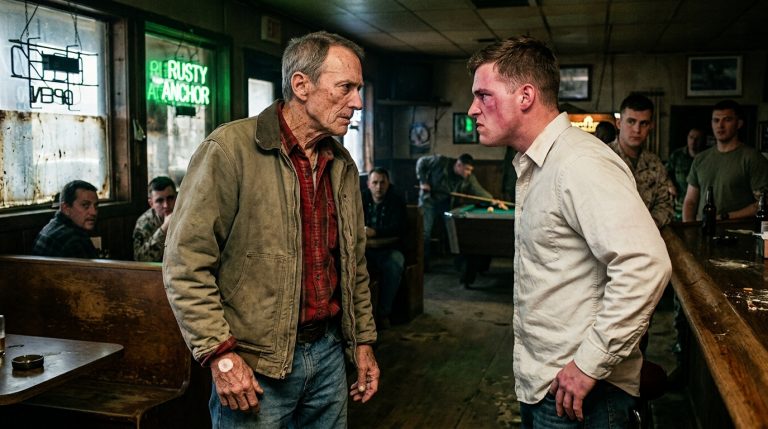
He stood over a small table, his boots planted in a solid, aggressive stance. Beneath him sat an old man, Henry Cole, whose back was as straight as a blade, despite the fraying, worn jacket he wore. Cole was busy with a bowl of soup, his movements slow, deliberate, and entirely unbothered by the presence of a man half his age who was practically vibrating with irritation.
“Hey, old man,” Reynolds said, his voice cutting through the clatter of silverware like a razor. “What rank did you hold back in the stone age?”
Cole didn’t look up. He scooped another spoonful, his hand steady.
The sound in the mess hall hit a jagged stutter. Forks froze mid-air. The steady background hum of a hundred conversations seemed to hit a wall. Reynolds felt the familiar, addictive surge of power—the way a room pivoted toward him whenever he exerted his will. It was the only rhythm that made sense to him.
“I’m talking to you,” Reynolds pressed, leaning in until he could smell the stale coffee and dust radiating from the man’s coat. “This is a military installation. Do you have any identification?”
Cole finally set the spoon down. He didn’t look up at Reynolds’s face. He just placed his hands flat on the table, the skin thin and mapped with deep, violet veins. The silence that followed wasn’t a pause; it was an expansion. It felt heavy, a physical weight that pressed against Reynolds’s chest, making his breath hitch.
The silence wasn’t fear. Reynolds knew fear; he had seen it in the eyes of trainees and targets alike. Fear was chaotic. This was something else—something carved out of cold, hard stone.
Reynolds felt his composure fraying. The snickering of his teammates behind him was starting to sound thin, desperate. He looked around, searching for the validation he usually found in his peers’ faces, but he saw only the bowed heads of sailors who had suddenly become fascinated with the contents of their trays.
He leaned in closer, his voice dropping into the dangerous, jagged tone of a man who had lost his patience. “Are you ignoring me? Or do you think staying silent gives you permission to be here?”
Cole didn’t flinch. He didn’t even blink. He reached out with a trembling, deliberate precision and adjusted the cuff of his jacket. It was a small gesture, almost invisible, but in the oppressive quiet of the room, it felt like an insult. He raised his head slightly—not to meet Reynolds’s gaze, but to stare at a point on the wall just past the Petty Officer’s shoulder.
Then, he looked back down.
Reynolds felt a sudden, sharp spike of vertigo. The silence was becoming an accusation, a mirror he didn’t want to look into. He reached out, his hand hovering over the edge of the tray, ready to reclaim the narrative, ready to force the world back into the crisp, clean lines he understood. But as his fingers twitched, he noticed a small, dull metal pin attached to the man’s lapel. It was cheap, worn to the point of unreadability. A souvenir. A lie.
“Fine,” Reynolds hissed, the heat rising into his face. “If you won’t speak, I’ll speak for you.”
He pointed a finger, steady and cold, directly at the pin. And at that exact moment, he felt a strange, cold vibration in his own fingertips, as if the metal of the pin were pulsing with a history he wasn’t yet capable of understanding.
CHAPTER 2: The Cracks in the Consensus
Petty Officer Jack Reynolds did not pull his finger back. To do so would be to admit a hesitation he didn’t feel—or, at least, one he refused to acknowledge. He kept his hand steady, pointed at the cheap, worn insignia on Henry Cole’s lapel. The silence in the room had transitioned from a mere pause into something pressurized, a vacuum that sucked the air out of the surrounding tables.
“I’m waiting, old man,” Reynolds said, his voice dropping to a low, serrated edge. “Surplus store buy? Or did you steal this from a display case?”
Henry Cole remained perfectly still. His hand, which had been resting on the edge of the metal tray, didn’t twitch. He didn’t look up. The pin itself, under the harsh, flickering fluorescent light of the mess hall, seemed to catch a strange, almost unnatural glimmer. Reynolds narrowed his eyes. He had seen thousands of these in his time—reproduction pins, cheap commemorative tokens—but there was something about the way the light caught the edge of this one. It wasn’t the uniform shine of mass-produced brass. It had the uneven, pitted texture of something that had been hand-worked, oxidized by a depth of time that made Reynolds’s own career feel like a passing afternoon.
“Are you deaf?” one of Reynolds’s teammates muttered, stepping up beside him. The laughter that had buoyed them earlier was gone, replaced by a nervous, twitchy energy. “He’s talking to you.”
The room was held in a state of suspended animation. A young sailor at a table ten feet away had stopped eating mid-chew, his fork hovering halfway to his mouth. No one moved. The air felt thick, charged with the static of unspoken judgment. Reynolds felt a bead of sweat track down his temple. He was the one in command, he told himself. He was the one with the trident, the authority, the mission. Why did the old man’s silence feel like a wall of water rising up to drown him?
Cole finally shifted. He didn’t look at Reynolds. Instead, he reached out with his free hand and adjusted the placement of his water cup. The movement was incredibly slow, agonizingly deliberate. It was the movement of a man who moved because he wanted to, not because he was being pushed.
“You’re making a mistake, son,” Cole said.
The voice was thin, reedy, like dry leaves skittering over pavement, but it possessed a strange, resonant quality that carried clearly across the room. It wasn’t a plea. It wasn’t an apology. It was a statement of fact, as calm and unarguable as a change in the weather.
Reynolds felt his jaw tighten until the muscles ached. “A mistake? You’re in a secure naval facility. You’re an unauthorized presence. That isn’t a mistake; that’s a security breach.”
“Is it?” Cole asked. He finally looked up.
His eyes were not the cloudy, unfocused orbs Reynolds had expected. They were a piercing, washed-out blue, like the sky after a long, violent storm. There was no malice in them, no anger—just a profound, weary clarity that looked right through the Petty Officer, examining the empty space behind his badge, behind his bravado, behind the trident on his chest.
Reynolds recoiled half a step, caught off-guard by the sheer weight of the gaze. He felt exposed, as if the old man could see the insecurity that drove his every action—the desperate need to be the loudest voice in the room, the constant, clawing anxiety that he wasn’t quite enough.
“Show me your ID,” Reynolds barked, his voice rising in volume, an attempt to drown out the sudden, cold realization that he was losing control of the room. “Right now. Or I’m calling the gate.”
Behind him, a few of the other SEALs shifted uncomfortably. The “decoy” narrative—that this man was just some confused veteran looking for a hit of nostalgia—was beginning to buckle under the sheer, immovable gravity of Cole’s demeanor. The atmosphere in the mess hall had shifted from one of mockery to one of uneasy dread. It was the feeling of a pre-storm, where the birds stop singing and the wind drops to nothing.
Cole didn’t move to check his pockets. He didn’t make a show of searching for a wallet. He simply leaned back, his back remaining rigid, his hands coming together in his lap, fingers interlaced. It was a posture of total, terrifying composure.
“The gate,” Cole repeated, his voice barely a whisper. “I’ve spent more time at the gate than you’ve spent in the water, boy. You wouldn’t know the first thing about what’s kept this base together.”
A heavy, ringing silence followed, shattered only by the distant, rhythmic clatter of the kitchen staff cleaning up the lunch shift. Reynolds’s hand was still hovering near the old man’s tray, his finger inches from the lapel pin. He felt a sudden, irrational urge to rip the pin off—not to confirm it was fake, but to stop the way it seemed to be staring at him.
“You’re going to walk out of here with me,” Reynolds said, his voice straining with the effort to remain authoritative. “We’re done talking.”
He reached out to grab the old man’s arm. His movement was quick, practiced, and firm—the way he had been taught to extract a non-compliant asset. But as his fingers closed around the old man’s bicep, he didn’t find the soft, yielding resistance of an elderly civilian. He felt bone and sinew, hard and unyielding as a ship’s hull.
The old man didn’t flinch. He didn’t pull away. He sat there, anchored to his chair, and for the first time, Reynolds realized that if he wanted to move this man, he would have to use force that would be seen by every single person in the room. He was trapped. He was the one holding the arm, but it was he who was being held in place by the man’s refusal to be moved.
Then, at the far end of the hall, a young seaman named Parker, who had been watching with his knuckles white-knuckled around his tray, finally stood up. The sound of his chair scraping against the floor was like a gunshot in a library.
CHAPTER 3: The Call to Witness
The scraping sound died away, but the vibration of it seemed to linger in the air, a physical itch that made the back of Jack Reynolds’s neck prickle. He didn’t turn around. He couldn’t. His hand was still locked onto the old man’s bicep, and the physical resistance—the immovable, stone-like quality of Henry Cole’s arm—was starting to make Reynolds feel like he was holding onto a live wire.
“Stay seated,” Reynolds muttered, though the command lacked its usual bite. It sounded defensive, even to his own ears.
Parker stood motionless at his own table, his tray abandoned, a half-eaten sandwich sitting like a tombstone in the center of it. He felt the phantom weight of a grocery store floor beneath his feet, the smell of dust and floor wax, and the ghost of his grandfather’s bowed head. That moment, years ago, had been a lesson in cowardice—a lesson he had promised himself he would never repeat. Now, the mess hall was replaying that scene in high definition, only this time, the victim wasn’t a frail old man in a store; it was a ghost in a jacket, and the bully was a man Parker had once looked up to.
Parker didn’t look at Reynolds. He looked at the floor, his peripheral vision catching the way the Petty Officer’s fingers were digging into the old man’s sleeve. It was brutal. It was petty. And it was exactly the kind of thing that turned a uniform into a shroud.
Parker began to move. He didn’t rush—rushing would be an admission of panic, and panic would draw eyes. He walked with the measured, disciplined gait of a seaman who had somewhere legitimate to be. His heart was hammering a frantic, uneven rhythm against his ribs, a drumbeat of terror that whispered career suicide with every step. But as he passed the edge of the mess hall, the sterile, industrial smell of the cleaning agents and the lingering scent of cooked grease sharpened his focus. He wasn’t going to the exit. He was going to the service wall.
He reached the wall-mounted phone, a relic of a time before digital encryption, its cord coiled like a black snake. He picked up the receiver. It felt cold, heavy, and impossibly significant. His hands were slick with a cold, frantic sweat that made the plastic grip slippery.
“Command Master Chief’s office,” a voice clipped through the line. It was brisk, professional, and entirely unaware that it was about to be pulled into a storm.
“I need to speak with the Master Chief. Urgently,” Parker said. His voice was a thin, reedy thing, but he willed the tremor out of it, focusing on the texture of the plastic under his thumb.
CHAPTER 3: The Call of Conscience
Seaman Parker’s legs felt uncoordinated, heavy as lead, as he pushed away from his table. He didn’t look at his teammates. He didn’t look at the Petty Officer who was currently gripping the old man’s arm. He kept his eyes locked on the floor, his vision narrowed to the scuffed, polished concrete moving beneath his boots. Every step toward the serving area felt like an admission of mutiny. He was a seaman, a junior rank, and he was about to defy the unwritten laws of the deck plate—the law that said you never interfere with a senior leader, especially not a SEAL.
His heart thudded against his ribs, a frantic, irregular rhythm. As he walked, the environment around him seemed to lose its sharp edges, fading into a dull, desaturated blur. A sudden, intrusive phantom of memory clawed at him: his grandfather, a man whose hands always smelled of grease and dry tobacco, standing in a crowded grocery store line, head bowed, while a younger, sharper-tongued man mocked his slow movements. Parker remembered that specific, hollow shame in his grandfather’s eyes—the way the old man had simply accepted the indignity because he had lived through enough violence that the petty cruelties of daily life didn’t merit a fight.
Parker’s knuckles tightened around his empty tray. The memory wasn’t just a thought; it was a physical weight in his chest, a cold pressure that made his throat raw. He wasn’t just walking toward a phone; he was walking away from the version of himself that had stood silently behind his grandfather in that grocery store aisle.
He reached the wall-mounted phone near the serving area. The handset was cool and slick against his palm, the coiled cord swaying slightly with the tremor in his grip. He didn’t hesitate. He dialed the internal line for the Command Master Chief’s office, his fingers moving with a frantic, learned muscle memory.
“Command Master Chief’s office,” a voice clipped and bored answered on the second ring.
Parker swallowed hard, his throat clicking. He glanced back over his shoulder. At the center table, Reynolds was still looming over Henry Cole. The Petty Officer’s hand hadn’t moved from the old man’s arm; it looked like a vice, an iron clamp against the thin fabric of the old man’s jacket.
“I need to speak with the Master Chief. Urgently,” Parker said, his voice coming out lower than he intended.
“He’s in a meeting. Who is this, and what is the nature of—”
“I’m reporting a situation,” Parker interrupted, his eyes darting back to the table. Reynolds had leaned in closer, his lips moving in what looked like a demand. “A SEAL is harassing an elderly man in the mess hall. He’s being threatened.”
There was a pause on the line—a flat, professional silence that felt like an eternity. “Report it to the Master-at-Arms on duty, Seaman. That’s the proper procedure.”
“No,” Parker said, his voice cracking, the weight of the moment forcing a surge of unexpected courage into his lungs. “Please. Just listen to me. The old man… his name is Henry Cole.”
The line went silent. It wasn’t the silence of someone checking a calendar or waiting for a report; it was a sudden, absolute vacuum. The ambient background noise of the CMC’s office—the murmur of typing, the distant hum of a printer—seemed to vanish.
“Say that again,” the voice on the other end was no longer bored. It was low, dangerous, and stripped of all the bureaucratic padding that had been there seconds before.
“Henry Cole,” Parker repeated, his hand trembling so violently that he had to brace his shoulder against the wall to keep the phone steady. “He’s sitting in the mess hall. A Petty Officer named Reynolds is… he’s holding his arm. He won’t let him leave.”
A faint, sharp sound came through the receiver, like a heavy wooden chair being shoved back violently against a floor. Then, the voice returned, altered—compressed, precise, the tone of a man who had suddenly stepped into a war zone. “Where are you?”
“At the base mess hall, sir.”
“Do not leave,” the voice commanded, each syllable landing with the weight of an order that brooked no interpretation. “Keep your eyes on him. Do not, under any circumstances, let him leave that area.”
“Yes, Master Chief.”
The line clicked dead. Parker stood for a moment, the receiver pressed against his ear, listening to the hollow dial tone. His hands were slick with sweat, his heart still hammering against his ribs, but the paralyzing, cold dread had been replaced by a focused, terrifying clarity. He set the receiver down with a soft clack.
He took a deep breath, the air in the room suddenly seeming to smell like ozone, like the moments before a massive thunderhead breaks. He turned back toward the center of the mess hall. Reynolds was still standing over the table, still holding the old man’s arm, unaware that the gears of the base—a structure of authority he had always believed he was a part of—were beginning to grind him into the dust. Parker moved back toward his original position, his feet feeling lighter now, as if he had just cut an anchor line he hadn’t realized he was dragging.
He didn’t know what was about to happen. He didn’t know who or what would come through those doors next. He only knew that he had made his choice. He had looked, and he had seen, and for the first time in his life, he hadn’t walked away.
CHAPTER 4: The Gears of Command
Seaman Parker remained at the service wall, his hand still lingering near the phone, his fingers tracing the coiled, plastic cord. The mess hall felt different now. The ambient clatter of cutlery and the muffled conversations of other sailors had not actually stopped, but to Parker, they had been relegated to a distant, muffled layer of sound. He was tuned entirely to the center table.
Jack Reynolds was still there. He hadn’t moved, but his posture had shifted. The Petty Officer was no longer posturing for his teammates; he was staring at the old man’s lapel pin with a look that flickered between confusion and a rising, desperate irritation. Parker watched, his throat dry, as Reynolds leaned in again, his hand twitching on the old man’s sleeve. Reynolds was looking for a reaction—a flinch, a tremor, a verbal defense—but Henry Cole remained as anchored as a sea wall against a receding tide.
Parker needed to be elsewhere, but his feet felt glued to the linoleum. He watched, helpless, as the tension at the table ratcheted up another notch. Reynolds looked around, his eyes scanning the mess hall. He seemed to sense the change in the room’s atmosphere, the subtle shift in how people were looking at him—not with the casual respect of peers, but with a growing, nervous curiosity.
While Reynolds wrestled with the old man, three rows of tables away, a different kind of movement was occurring. Command Master Chief Donovan had not sat back down. His office was a space of Spartan efficiency—gray walls, polished mahogany, and the faint, biting scent of old coffee and floor wax. When he hung up the phone, he didn’t move toward the door with the frantic energy of a man responding to a crisis. He moved with the slow, terrifying deliberation of a man preparing for a funeral.
Donovan stood behind his desk and adjusted his cover. His movements were rhythmic, precise. He caught his reflection in the glass of a framed photograph on his wall—a group of men, long dead, posing on the deck of a vessel that hadn’t seen open water in decades. His jaw tightened. The name “Henry Cole” didn’t just rattle him; it unearthed a cold, hard knot of grief he had spent a lifetime keeping buried beneath the regulations of base security.
He walked to the door, his boots clicking in a steady, metronomic beat against the hallway floor. He didn’t run. Running was for people who didn’t know the gravity of the situation. He reached the base commander’s office, a few doors down, and didn’t bother to knock with the standard, hesitant rap. He pressed his palm against the heavy oak and pushed, entering with the authority of a man whose presence was expected.
“Base Commander,” Donovan said, his voice flat, devoid of the usual bureaucratic warmth.
The commander looked up from a stack of manifest logs, his eyebrows arching in surprise. “Master Chief? I’m in the middle of—”
“There is a situation in the mess hall,” Donovan interrupted, his gaze fixed on a point just above the commander’s shoulder. “It involves Henry Cole.”
The commander froze. The pen in his hand hovered over the logbook, a small drop of ink blooming into a dark, ugly stain on the page. He looked at Donovan, his face draining of color. “Cole? Are you certain?”
“A seaman reported it. A Petty Officer named Reynolds is… detaining him.”
The commander didn’t wait. He didn’t ask for a second opinion. He stood, his movements mirroring the same cold, measured urgency Donovan possessed. They both understood that this wasn’t about base protocol; it was about the sanctity of a history that the modern military had largely forgotten how to honor.
As they stepped into the hallway, the commander reached for his radio, his thumb hovering over the push-to-talk button. “Get me the Admiral’s security detail,” he ordered, his voice echoing in the hollow, sterile hallway. “They’re ten minutes off-base. Tell them to turn around. This is a matter of honor, not procedure.”
Back in the mess hall, the atmosphere had reached a fever pitch. Reynolds was no longer just holding the old man’s arm; he was starting to shake, a fine, barely perceptible tremor that betrayed the crumbling of his own confidence. He had expected a quick, easy victory—a display of dominance that would cement his standing in front of his team. Instead, he had trapped himself in a standoff with a man who refused to acknowledge the reality Reynolds was trying to impose.
Parker, still hovering by the service wall, saw the doors at the far end of the mess hall swing inward. It wasn’t the guards. It wasn’t the Master-at-Arms. It was the command staff, moving in a tight, silent formation that cut through the room like a blade through silk.
The air in the room seemed to drop ten degrees. The conversations stopped entirely, as if the room itself had been put on hold. Reynolds didn’t notice them yet. He was too focused on Henry Cole, his voice a low, threatening hiss. “Last chance, old man. Stand up, or I’ll make you.”
Cole looked up, not at Reynolds, but toward the entrance. For the first time, a faint, ghost-like smile touched the corners of his mouth. “You’re about to have your answer, Petty Officer.”
Reynolds frowned, confused, his grip on the man’s arm finally loosening. He turned, and as he did, he saw the three stars of the Admiral’s detail behind the base commander, their faces etched with a cold, unrelenting focus that stopped the Petty Officer’s heart in his chest.
CHAPTER 5: The Shattering of the Status Quo
Petty Officer Jack Reynolds did not just stagger; he nearly lost his footing, his boots sliding against the linoleum in a frantic, graceless struggle for stability. His hand, which had been clamped onto Henry Cole’s arm like a predatory claw, sprang away as if the old man’s jacket had suddenly burst into flames. The air around the center table had evaporated, replaced by a sudden, chilling drop in temperature that seemed to originate from the three newcomers standing at the mess hall entrance.
Admiral James Harper moved with a terrifying economy of motion. He didn’t scan the room. He didn’t look for a threat. He walked straight toward the small table where the drama had been unfolding, his footsteps sounding against the floor like heavy hammer blows. Behind him, the Base Commander and Master Chief Donovan followed, their faces masks of disciplined, cold resolve.
Reynolds stood frozen, his mouth slightly agape. His mind was trying to process a sequence of events that defied his entire understanding of naval hierarchy. He was a SEAL; he was supposed to be the apex of this food chain. But as he looked at the Admiral—a man whose very shadow seemed to command the space around him—he felt the trident on his own chest lose its weight. It felt like a prop, a cheap, hollow thing that had been stripped of its meaning.
“Petty Officer,” the Admiral’s voice was not loud. It didn’t need to be. It possessed the deep, resonant quality of a bell struck in an empty canyon, cutting through the heavy air with surgical precision.
Reynolds tried to bring his hand up in a salute, but the movement was disjointed, clumsy. His muscles felt as if they were filled with wet sand. “Admiral. I… I wasn’t aware—”
“You were not aware of many things today, Petty Officer,” Harper interrupted, the tone flat, devoid of any room for defense.
The Admiral stopped three feet from the table. He ignored Reynolds entirely. He turned his eyes toward Henry Cole, who remained seated, his posture undisturbed, his hands still neatly resting on the edge of his tray. For a second, the entire mess hall seemed to lean in, everyone watching the exchange with bated breath.
Then, something happened that defied every protocol Reynolds had ever been drilled on. Admiral Harper, a man whose authority sat at the very pinnacle of the base, brought his heels together with a sharp, crisp clack and raised his right hand in a formal, rigid salute.
“Sir,” Harper said. The word hung in the air, weighted with a depth of respect that sent a physical shiver through every person in the room.
The silence that followed was absolute. No trays clattered. No one breathed. Reynolds felt his knees go weak, the blood draining from his face until he felt lightheaded. The old man—this ‘impersonator,’ this ‘civilian security risk’—was being saluted by a three-star Admiral.
Henry Cole shifted his gaze upward. He looked at Harper, not with the subservience of a subordinate, but with the quiet, weary recognition of a man looking at a brother across a long, dark divide. “Admiral,” Cole acknowledged. His voice was soft, barely audible over the hum of the ventilation system, but it carried a finality that made the Admiral’s salute seem like the only appropriate response.
“I sincerely apologize for what has just occurred,” Harper continued, his eyes flickering toward Reynolds for a heartbeat. The look was not one of anger. It was worse. It was the look of a man observing a stain that needed to be cleaned. “You should never have been disturbed.”
Reynolds felt the room tilting. He wanted to speak, to offer an excuse—to explain that he had been following procedure, that he had been securing the area, that he hadn’t known—but the words died in his throat. Any explanation would only make the situation more grotesque. He felt the weight of a hundred pairs of eyes on him, all of them judging, all of them realizing the same thing: he had not just made a mistake; he had committed a sacrilege.
The Base Commander stepped forward, his expression etched in cold, hard lines. He didn’t look at the Admiral. He looked at Donovan, then back at Reynolds. The silence that Donovan maintained was even more terrifying than the Admiral’s speech. The Master Chief’s eyes were fixed on the Petty Officer, devoid of the fury Reynolds might have expected. Instead, there was a quiet, profound disappointment that made the Petty Officer feel smaller than he had ever felt in his entire life.
“I believe,” Admiral Harper said, his voice dropping another octave, “it is time everyone here understands who they are standing before.”
The Admiral reached out, his hand hovering over the small, worn pin on Cole’s lapel. He didn’t touch it. He simply hovered his fingers there, framing the relic as if it were a sacred object.
Reynolds felt a surge of nausea. He knew what was coming. He knew that the ‘decoy’—the idea that this man was a nobody—was about to be incinerated. And he knew that he would be the one holding the match when the fire went out. The Command Master Chief stood a step behind the Admiral, his gaze locked onto Reynolds. He knew exactly what this moment would do to the Petty Officer’s life, and he wasn’t going to look away. He was going to watch it happen.
CHAPTER 6: The Weight of Memory
Admiral Harper didn’t wait for Reynolds to recover. He moved with the slow, terrifying patience of a man who knew exactly how much pressure a structure could take before it buckled. He looked past Reynolds, past the trembling Seaman Parker, and directly into the eyes of the gathered sailors, his voice low but carrying with it the force of a tectonic shift.
“The man before you is Henry Cole,” Harper said. The name seemed to vibrate in the sterile, air-conditioned space of the mess hall. It was a name that carried no titles, no rank, yet the way Harper spoke it transformed the mess hall into a cathedral.
“He was a Navy frogman during the Second World War,” Harper continued, his gaze drifting back to the small, worn pin on Cole’s lapel. “Before the Trident became a badge of status, before it was a marketing tool for the elite, there were men like him. Men who understood that the badge was not a license to rule, but a contract of absolute, self-denying service.”
Reynolds felt the floor beneath him feel unsteady. He tried to lock his knees, to stand tall, but he felt like he was shrinking. The Trident on his own chest, polished and pristine, suddenly felt like lead. He could feel it pulling at his skin, heavy and searing. He looked at his teammates, but they wouldn’t meet his eyes. They were staring at the old man with a mixture of dawning horror and reverence, their own bravado dissolving in the face of a legacy they hadn’t realized was still walking among them.
“In the final stages of the war,” Harper continued, his voice dropping to a conversational, almost gentle register that made the truth feel even more brutal, “Henry’s unit was deployed on a mission that went wrong. Intelligence failures. Communications breakdown. His team was decimated within the first hour of contact.”
The room was so quiet that the hum of the overhead lights sounded like a roar. Parker, still standing by the wall, felt a sudden, sharp ache in his chest. He looked at the old man—at the way Cole sat with both hands resting flat on the table, still as a statue—and the image of his grandfather merged with the reality in front of him. This wasn’t just a veteran; this was a man who had been carved out of the wreckage of a life he had been forced to leave behind.
“He was the only one who made it out,” Harper said, his eyes finally locking onto Reynolds again. The look was not one of hatred; it was one of utter, profound pity. “For three days, he stayed behind, deep in enemy territory. Alone. No resupply. No support. He completed the mission, not because he was told to, but because he was the only one left to keep the promise his team had made.”
Reynolds’s heart was hammering against his ribs, a frantic, desperate rhythm. He wanted the floor to open up. He wanted to be anywhere else. The ‘decoy’—the narrative he had clung to, that this was just some old, confused trespasser—wasn’t just dead; it had been a lie he had constructed to protect his own ego, and now, that lie was being systematically dismantled.
“For those actions,” Harper said, his voice ringing with a cold, clear clarity, “Henry Cole was awarded the Medal of Honor.”
A soft, collective intake of breath swept through the mess hall. A low murmur rippled through the back of the room, then died as quickly as it had arrived. Everyone knew what that meant. The Medal of Honor wasn’t just a piece of metal; it was a testament that stood above everything—above rank, above the SEALs, above the entire structure of the modern naval command.
Harper tilted his head, his eyes moving back to the small, dull pin on the jacket. “The pin you mocked, Petty Officer… it is the original insignia of his unit. It was given to him by his team leader, minutes before that man died. It is not jewelry. It is not a souvenir.”
The Admiral took a single, deliberate step toward Reynolds. The Petty Officer flinched, a small, involuntary jerk of his shoulders.
“It is a promise,” Harper said, his voice sharpening. “It is a promise made to the dead, and it is a burden that you have neither the history nor the depth to comprehend.”
Harper turned to the Base Commander. “Petty Officer Reynolds. You will report to the commander’s office immediately. Your record will be opened, and your standing will be reviewed. There will be disciplinary action.”
Reynolds nodded, his movements mechanical, his head hanging low. He didn’t offer a defense. He didn’t try to explain the pressure he felt to keep the base ‘secure.’ He simply understood, with a sudden, devastating finality, that he had failed the only test that actually mattered. He reached up, his fingers brushing the Trident on his chest, and for a moment, he looked like he might tear it off himself, just to stop the feeling of being burned by it.
“And you will learn,” Harper added, his tone softening only slightly, “what the cost of your arrogance has actually been.”
Henry Cole remained seated throughout the entire performance, his expression never shifting, his hands still resting flat on the tray. He looked tired—not the exhaustion of age, but the profound, bone-deep fatigue of someone who had carried a history for too long. He looked at Reynolds, then at the room full of sailors who were finally beginning to understand the weight of the air they were breathing.
The silence that followed wasn’t uncomfortable anymore. It was heavy, textured, and absolute. It was the sound of a foundation being re-laid, one realization at a time.