The Rusted Iron and the Dusty Gray Road That Broke a Suburb’s Tyranny
CHAPTER 1: THE CEDAR AND THE CLIPBOARD
The weight of the hammer in my palm felt entirely too light against the humid, heavy air of the afternoon. I had just finished setting the final galvanized screw into the cedar post of the front porch, the sharp, aromatic bite of fresh sawdust still clinging to the wool of my cuffs, when the grating rhythm of entitlement punctured the quiet.
Her voice cut through the pines like an ungreased axle. It was a sound designed to curdle milk from fifty paces.
“This isn’t a request, Mr. Miller.”
I didn’t turn around immediately. I let the metal hang loose against my thigh, feeling the solid, dead weight of the tool while I finished sweeping my thumb across the damp grain of the wood. When I finally shifted my weight, the floorboards of the porch gave a low, familiar groan.
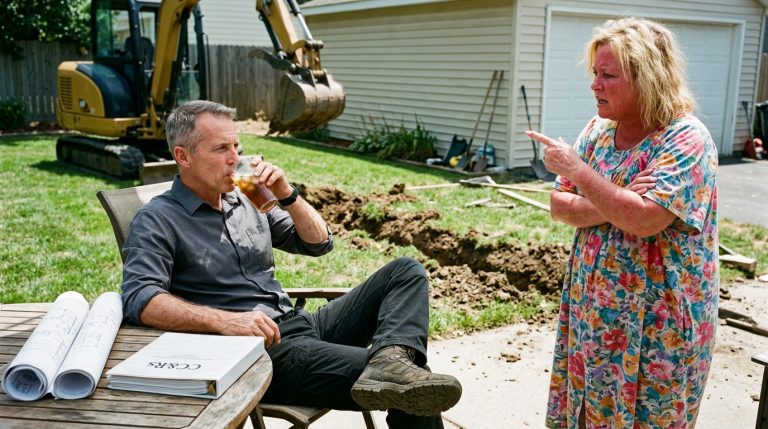
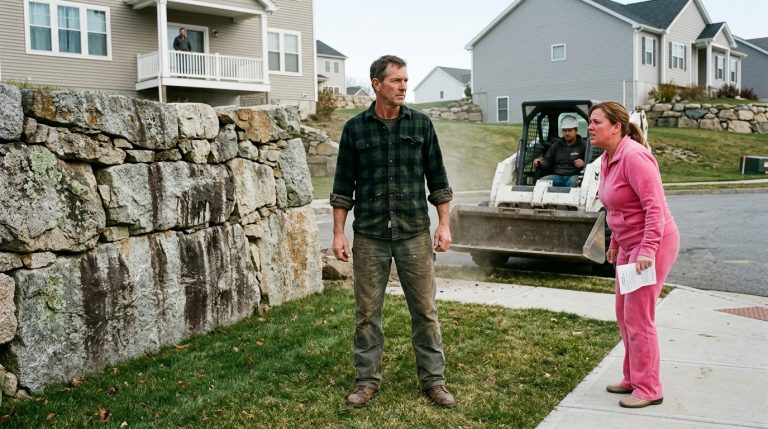
She stood at the very edge of the gravel line—my gravel line, hauled, graded, and packed by my own hands over the better part of a decade. Her floral print dress strained against a frame that suggested a lifelong, deeply personal intimacy with every industrial bakery in a thirty-mile radius. A pristine cream-colored clipboard rested against her chest like an ecclesiastical shield. This was Karen, the self-appointed sovereign of the beige grid next door, pointing a manicured, sausage-thick finger down the three-quarter-mile strip of packed earth that wound through the oaks to my house.
Behind her, anchored like a nervous afterthought to the weeds of the county road, stood a thin man in a golf shirt two sizes too broad. He was staring down at a clump of dandelions with the terrified intensity of a man trying to defuse an unexploded mortar shell in the dark.
“Your gravel path,” Karen continued, her smile stretched thin and tight across powdered skin, “is being designated as the primary access road for the Willow Creek Estates phase four expansion. You’ll be required to sign a shared maintenance agreement effective the first of next month.”
The sheer, unmitigated audacity of it hung there, dense and humid, pressing down through the canopy of the oaks. Ten acres of rolling timber, old homestead land bought to escape the crushing noise of the world, and this woman was treating my driveway like a municipal thoroughfare.
I looked from her smug, powdered face down to the dust on my boots, then back up to her eyes. “You’re telling me,” I said, letting the words drop slow and flat, “that you, president of an association I’ve never joined, are attempting to commandeer my private road?”
Her smile didn’t fracture; it just sharpened into something colder. “Language like commandeering is so unnecessarily hostile, Mr. Miller. We’re all neighbors here. The developer determined this is the most cost-effective route, and the board has approved it. You’ll be compensated, of course. We’ll waive your first year’s maintenance fee.”
A cold, familiar knot tightened in the pit of my stomach—the exact same sensation I used to get right before stepping out of a wire-mesh transport into a stretch of contested dust. It wasn’t panic. It was calculation.
I let my grip tighten around the handle of the hammer, feeling the grain of the hickory bite into my palm. Before I could answer, a sudden, sharp glint of light caught my eye from the far treeline—a reflection off the windshield of a slow-rolling sedan parked just past the county right-of-way, its engine idling with a low, rhythmic vibration that didn’t belong to any of my neighbors.
CHAPTER 2: DESCENT INTO THE COUNTY RECORDS
The sedan’s tailights dissolved into a smear of crimson through the thick stand of oak trees, leaving behind only the heavy, settling heat of the afternoon and the sharp, pine-tar scent of the newly driven cedar post. Karen’s parting words hadn’t been an empty threat; they were the opening salvo of a machine designed to grind down private ground with legal paper and institutional pressure.
I let go of the hammer, sliding it into the canvas loop of my tool belt with a dull, heavy slap of leather. The metal teeth of the zipper on my work vest caught slightly as I pulled it shut, a minor friction that mirrored the grit tightening in my chest. If they wanted to play a game of municipal attrition, they needed a framework. And a framework wasn’t built on porch railings or shouting matches across property lines; it was built on archival paper buried beneath decades of dust and municipal neglect.
The county records office sat six miles south, a square, flat-faced brick building that looked like it had been designed by an accountant with a low imagination and a deep aversion to natural light.
Inside, the air smelled of stale coffee, damp concrete, and the distinct, vinegar-sweet scent of aging wood-pulp paper that had sat undisturbed in metal filing cabinets since the Eisenhower administration. The hum of an antiquated fluorescent ballast overhead flickered with a rhythmic, dying pulse, casting long, bruised shadows across rows of heavy oak tables.
Marge sat behind the high walnut counter, her bifocals perched precariously on the bridge of a nose that had cataloged half a century of local boundary disputes. She didn’t look up as the heavy glass door clicked shut behind me, her fingers continuing a steady, mechanical clack against the keys of a terminal that predated reliable internet.
“You’re back early, soldier,” Marge said without lifting her gaze from the amber glow of the screen. Her voice was dry as autumn stubble, carrying the cadence of someone who had seen every flavor of neighborly war this side of the county line. “Word around the diner is that the queen of Willow Creek is drafting a petition to make your gravel path part of her kingdom’s royal carriage drive.”
“Let her draft,” I said, leaning my forearms against the scarred varnish of the counter. The wood was cold under my skin. “Ink is cheap until you have to back it up with a survey mark.”
Marge finally stopped typing, sliding her glasses down to look at me with eyes as sharp and gray as flint. “You want the deep boxes this time? The ones from the 1990s development filings won’t help you much. If you’re going to block a corporate entity backed by a developer’s title insurance, you have to look at what they bought, not just what they built.”
She reached beneath the counter and heaved a gray cardboard transfer case onto the surface. It hit the wood with a dull, powdery thud, kicking up a microscopic plume of gray lint that drifted lazily in the sliver of sunlight cutting through the high vertical blinds.
“Start with the original master farm division,” Marge muttered, sliding a yellowed index card across the laminate toward me. “Long before the McMansions sprouted up like concrete toadstools, that whole 200-acre tract belonged to a man named Alistair Vance. When he died off in the late seventies, the family didn’t sell it whole. They carved it like a cheap ham.”
I pulled the steel clasp of the box open. Inside lay a dense, disorganized mass of onionskin paper, carbon copies with faded purple ink, and stiff blue-backed legal instruments tied with brittle cotton string.
I didn’t rush. Speed in an archive is how details get buried. Using the Sovereign Protector lens, I treated every document not as a historical artifact, but as a logistical map of an ongoing siege. Every deed transfer, every zoning variance, every marginal note scribbled in the hurried hand of a 1950s county clerk was a coordinate in a defensive perimeter.
An hour bled away in silence, punctuated only by the intermittent hum of the fluorescent light and the dry, rasping sound of paper turning against paper. I traced the lineage of the adjacent parcel through three distinct corporate shells, watching the acreage shrink and morph as developers bought up tracts with the intention of stamping out identical colonies of beige and gray siding.
The documents began to reveal a pattern of sloppy consolidation. Developers routinely skipped tedious title verifications when the real estate market was booming, relying on standard title guarantees that assumed contiguous land parcels shared identical access rights. They had treated the local geography like a blank blueprint, ignoring the older, more stubborn contours of the land carved out decades prior.
Near the bottom of the box, trapped beneath a thick stack of 1998 annexation requests, my fingers brushed against something heavier—a stiff, folded piece of linen-weave parchment with the embossed seal of the State Land Office stamped in faded red wax.
I carefully lifted it out, holding it by the edges to avoid tearing the brittle folds. The ink on this document wasn’t typed; it was executed in a clean, sharp fountain-pen script that belonged to an era when surveys were measured in rods and chains rather than satellite coordinates.
As I unfolded the sheet, smoothing out the creases against the cold grain of the counter, a specific phrase caught my eye, underlined twice in faded violet ink. It referred to the original partition of the Vance homestead, defining the boundaries of the large parcel that would one day become Willow Creek Estates.
My breath caught in my throat, the quiet hum of the room fading into a sharp, absolute silence as the structural logic of the paper aligned with the physical reality of the gravel road outside my house.
CHAPTER 3: UNEARTHING THE 1958 DEED AND THE THIRTYFOOT EXCEPTION
Marge didn’t look up from her amber terminal, but the rhythmic clacking of her keyboard paused for a fraction of a second at the sound of the snapping string. The gray transfer box sat between us like an open trench, its contents smelling faintly of iron mold and old lime.
I kept my eyes fixed on the linen-weave parchment. The handwriting was iron-gall ink, oxidized to a deep, rusted brown that had bitten slightly into the fibers of the paper. It wasn’t just a casual marginal note; it was a formal county description drafted when bulldozers were scarce and boundary lines were carved into the landscape using iron stakes and landmark oaks.
My thumb traced the margin where the text folded over. The memory of military logistics maps flickered unbidden behind my eyes—grid lines, choke points, and perimeter defenses where an unrecognized salient could compromise an entire sector. This document wasn’t merely a piece of real estate history; it was a pre-engineered defensive barrier that had been sitting in a municipal blind spot for decades.
“Find what you were looking for, soldier?” Marge asked quietly, her fingers returning to the keys with a subdued, methodical click.
“I found the perimeter,” I said, my voice low. I carefully slid the parchment closer under the weak glow of the desk lamp, letting the details resolve out of the shadows.
The text laid out the 1958 subdivision of the original Vance farm. It tracked the metes and bounds with excruciating precision, utilizing ancient fence rows and stone cairns before hitting the crucial clause. My eyes locked onto the lines detailing the western boundary, where the farm met what would eventually become the sprawling acreage of the Willow Creek development.
There it was, embedded in the technical prose like a hidden mine: Save and excepting a strip of land thirty feet in width for the purpose of a roadway, running from the county road north along the westernmost boundary line for a distance of approximately three-quarters of a mile, as described in survey book twelve, page forty-five.
I didn’t smile. Victory in logistics wasn’t a moment for celebration; it was a cue to check the next variable. I reached into the box and pulled out survey book 12, its heavy cardboard cover warped by humidity. Flipping through the brittle, onion-skin pages with calloused fingertips, I found page forty-five.
It was an ink-drafted plat map bearing the stamp of the territorial surveyor’s office. The thirty-foot strip of land was rendered in clean, unbroken lines—my driveway. More importantly, the plat explicitly carved that exact corridor out of the main tract sold off to the developers in the late nineties. The corporation that built the initial phases of Willow Creek hadn’t just omitted a second entrance out of cost-cutting laziness; they had acquired a parcel whose legal boundaries literally wrapped around a pre-existing, independently deeded right-of-way that belonged exclusively to the original homestead.
They hadn’t just failed to secure access for phases three and four. They had built an entire suburban expansion on a foundation that depended entirely on a piece of ground they did not own, had never bought, and had legally signed away the right to cross.
The friction of the room felt different now. The smell of damp concrete and vinegar-sweet paper receded, replaced by the mental clarity of a completed puzzle. But a document in a county archive was only dead weight until it was deployed with absolute precision. Karen and her board were operating on the assumption of corporate immunity and neighborhood intimidation, confident that a single independent landowner would buckle under the cost of legal defense.
I gently folded the parchment back along its original creases, handling the fragile edges with the care of a man packing ordnance. I slipped it into my heavy canvas folder, closing the metal clasp with a sharp, definitive snap that cut cleanly through the ambient hum of the office.
Marge stopped typing entirely this time, turning her head slightly to look at me over her bifocals. The amber glow from the terminal cast long amber reflections across the lenses of her glasses.
“You look like a man who just found out the bridge he’s standing on is rigged with remote det,” Marge observed, her voice neutral, though a faint, knowing curve touched the corner of her mouth. “That paperwork make a dent in the queen’s fortress?”
“It doesn’t make a dent,” I said, lifting the folder and tucking it securely beneath my arm. “It removes the foundation.”
“Be careful, Jack,” she murmured, her tone dropping into a low, protective register as I turned toward the exit. “People backed into a corner with an HOA treasury behind them don’t fold gracefully. They start looking for any tool they can swing.”
“Let them look,” I replied, the screen door of the records office beginning its slow, pneumatic swing behind me as I stepped back out into the harsh afternoon glare. “I have the coordinates now.”
The heat hit me like a physical wall, the dusty gravel of the municipal parking lot crunching beneath my boots as I walked toward my truck. The truck’s weathered green fenders caught the glaring sunlight, silent and steady. The war for the ten acres wasn’t going to be fought with shouting matches on the porch anymore. It was time to take the intelligence back to someone who spoke the language of corporate law, and the first stop on the map was Arthur Abernathy’s front door.
CHAPTER 4: THE COFFEE TABLE COALITION
The drive from the county archives to Arthur Abernathy’s doorstep took twelve minutes, every mile of asphalt chewing under my tires like a countdown. I didn’t rush the turns, maintaining a steady, measured pace that burned fuel without attracting notice, keeping the heavy canvas folder wedged firmly between the passenger seat and the console.
Arthur’s house at 112 Willow Way sat like an island of quiet resistance in the sea of beige siding and manicured lawns. A small, elegant stone bird bath stood near the front walk, surrounded by unmanaged hostas that had clearly escaped the HOA’s uniform aesthetic guidelines.
When I cut the engine, the sudden silence of the suburban street felt artificial, heavy with the hum of central air conditioning units running behind shuttered windows. I stepped out, the dry gravel crunching under my boots, and walked straight up the flagstone path. Before my knuckles could hit the oak, the door swung inward.
Arthur stood there in a collarless tweed vest over a faded flannel shirt, his sharp, intelligent eyes taking in the canvas folder in my hand before locking onto mine.
“I heard about the town message board post ten minutes ago,” Arthur said, stepping aside to let me pass. “Karen’s drafting an emergency all-hands assembly for Thursday night. She’s calling it an existential threat to community property values.”
“She can call it whatever she wants,” I said, stepping into the cool, shadowed interior of his hallway. The air inside smelled of old paper, pipe tobacco, and floor wax—a grounded, stable contrast to the plastic sterility outside. “A title doesn’t care what a message board calls it.”
He led me back into a small, oak-paneled study lined with ceiling-height bookshelves. A heavy mahogany coffee table sat in the center, flanked by two leather armchairs that had seen decades of hard use. I dropped the canvas folder onto the polished wood, the brass zipper clicking against the grain.
Arthur didn’t reach for the papers immediately. He walked over to a sideboard, poured two fingers of amber liquid into a heavy-bottomed tumbler, and slid it toward my side of the table before sitting down opposite me.
“Talk to me, Jack. What did the boxes yield?”
I pulled the linen-weave parchment from the folder and unfolded it, anchoring the brittle corners with a brass paperweight and a pocketknife.
“They didn’t just miss an entrance,” I said, leaning forward and resting my forearms on the edge of the table. “They built phases three and four on a logistical fault line. Look at the western metes and bounds from the fifty-eight partition.”
Arthur adjusted his reading glasses, leaning over the spread of documents. The silence in the room stretched, broken only by the grandfather clock ticking a measured, unhurried rhythm in the corner. His eyes tracked across the faded fountain-pen script, following the technical demarcation lines down to the exclusion clause.
For a full minute, the retired corporate lawyer didn’t move a muscle. Then, a slow, dry breath escaped his lips, followed by a sharp, quiet chuckle that carried no humor—only absolute, professional vindication.
“Good lord,” Arthur murmured, looking up over the rim of his spectacles. “The save-and-excepting clause. They didn’t just fail to secure a right-of-way; the original developer purchased a legally severed parcel. The thirty-foot corridor has been an independent tract outside their deeded boundaries for over half a century.”
“Which means their entire claim of an easement of necessity collapses under its own weight,” I added, tapping a finger against the margin of the survey plat. “The necessity didn’t arise from external changes. It’s the direct result of their own structural negligence during the layout of phase three.”
Arthur leaned back, steepening his fingers together under his chin. His expression hardened, shifting from academic appreciation to strategic calculation. “If we hand this directly to their corporate counsel or drop it in the mail, Karen will intercept the narrative. She’ll frame it as an aggressive extortion attempt by an outsider trying to isolate the neighborhood. We can’t just fight her on paper. We have to break her hold on the residents before Thursday’s meeting.”
“I’ve already started mapping the perimeter,” I said quietly. “There are other households taking the brunt of her petty fines—the basketball hoop violations, the landscaping threats. People who are just as tired of the tyranny as I am.”
“Good,” Arthur said, his eyes glinting in the dim light of the study. “Then we don’t present this in a lawyer’s office behind closed doors. We take the intelligence directly to the assembly floor on Thursday night. We let her gather her entire constituency into one room, and then we pull the pins.”
The plan settled into place with the cold, undeniable friction of machinery locking into alignment. The war for the ten acres was shifting from a private defense into a public siege, and the walls Karen had built around her little kingdom were about to crack.
CHAPTER 5: THE SHOWDOWN AT THE WILLOW CREEK CLUBHOUSE
The air inside the Willow Creek community clubhouse was thick, recycled, and humming with a restless, collective anxiety. Every folding chair was occupied, and local residents stood packed shoulder-to-shoulder along the baseboards, their murmur rising and falling like distant surf against a bulkhead.
I walked in behind Arthur, keeping my stride measured and grounded. In the row immediately behind us, Top Rodriguez and four other veterans from my old unit moved with quiet, deliberate precision, taking their seats without a word. They didn’t wear uniforms, but their presence carried a distinct, immutable weight that subtly altered the atmospheric pressure of the entire room.
At the front, anchored behind a long, polished laminate table, sat Karen. She wore a bright red power suit that radiated an aggressive, calculated energy, clutching a black wireless microphone like a tactical baton. Beside her, her nervous associate from the roadside inspection stared intently at his notes, while the board treasurer looked down with tight-lipped apprehension.
Karen opened the floor with a performance built entirely on manufactured outrage, her voice amplified by the cheap speakers that hissed with static whenever she leaned too close.
“This man,” she declared, pointing a manicured finger directly toward my seat, her voice vibrating with a theatrical tremor, “this outsider is attempting to hold our entire community hostage. He wants to block our roads, trap us in our homes, and extort hundreds of thousands of dollars from your families.”
A low wave of hostile murmurs rippled through the rows of homeowners. Several heads turned toward me, their expressions hardening under the weight of her narrative. She was painting a picture of an aggressive, predatory outsider launching a blind assault against their neighborhood sanctuary.
She slammed her palm down on the table, the sharp thud cutting through the chatter. “The board has consulted with legal counsel. We will not bow to this extortion. We will file for the easement we are legally entitled to, and we will win. But it requires a united front, and an immediate special assessment of five hundred dollars per household to cover our defense.”
The room erupted into fragmented arguments. Voices clashed across the rows—some shouting in protest against the unexpected fee, others demanding to know why the developer’s failure had landed on their doorsteps.
Karen smiled thinly, treating the chaos as proof that her control was holding. “We must stand together, or—”
“Before we discuss any special assessment,” Arthur Abernathy’s voice cut cleanly through the din, steady and resonant, “I believe the community has a right to hear from Mr. Miller directly, and to examine the complete record, not just the board’s interpretation.”
Karen’s face tightened, her red-jacketed shoulders stiffening. “This is a private association meeting, Arthur. He is not a member.”
“He is the primary subject of your proposed action,” Arthur countered, standing up with unhurried dignity. “And under the association’s own bylaws, a person targeted by board litigation has the right to present facts. Furthermore, as a resident in good standing, I yield my remaining floor time to him.”
The room surged with immediate agreement. Voices shouted down the table, demanding transparency. Cornered by her own procedural rules, Karen gripped the edges of the laminate table until her knuckles went pale. “Fine,” she snapped into the microphone, her voice sharp with venom. “Let him speak. Let’s see what kind of fiction he’s brought to the table.”
I stood up, walking past the rows of seated neighbors until I reached the front projector screen. I didn’t reach for the microphone. I let my voice carry naturally, grounded and flat.
“My name is Jack Miller,” I said, looking out across the room. “I own the ten-acre homestead at the end of the gravel road. I’m not here to extort anyone. I’m here to show you what your board left out of the notice.”
Top Rodriguez stepped forward, clicking the remote for the portable projector we had set up near the podium. The first document flashed onto the screen—the 1998 master development plan, highlighting the grand, unbuilt entrance originally promised to the neighborhood.
“This was the designated access route,” I said, pointing to the blueprint lines. “The developer abandoned it years ago to save overhead, routing construction traffic directly across a temporary path that clips the corner of my property.”
I signaled Top to advance the slide. The next image revealed the hand-drawn, ink-lined plat map from the 1950 county records office.
“For over a decade, your association has relied on that temporary path,” I continued, the room falling completely silent as the technical lines projected a stark, undeniable reality. “Your president told you I was trying to steal your road. The truth, recorded in the county courthouse sixty years before this subdivision was ever sketched out, is that this driveway was legally excluded from your parcel before the developer ever laid a shovel of dirt.”
I let the words settle into the heavy air. The historical clause was displayed in sharp, clear contrast on the screen: Save and excepting a strip of land thirty feet in width for the purpose of a roadway.
“Your board knew this,” I said, looking straight at Karen’s rigid posture. “They received the complete title documentation over a week ago. They knew their legal argument for an easement of necessity was dead on arrival because the necessity was manufactured by their own corporate shortcuts. Yet they asked you for five hundred dollars each to fund a personal vendetta for a war they knew they had already lost.”
The silence in the room broke like thin ice under a heavy boot.
Shouts of disbelief erupted from the middle rows. Neighbors turned to glare toward the front table, demanding answers from the treasurer and the nervous board members. Karen slammed her fist against the table again, her face flushed a furious, mottled crimson.
“He’s lying! It’s an archaic error!” she shrieked into the mic, her polished veneer finally cracking under the weight of exposure.
But the mutiny was complete. Arthur stepped back to the podium, calmly organizing a recall petition as the homeowners surged forward, turning the clubhouse into a chaotic, beautiful bonfire of corporate tyranny. Karen stood frozen amidst the noise, her reign evaporating under the dry, unyielding light of the public record.
CHAPTER 6: THE FINAL DEPUTY ESCORT AND THE RESURFACED GRAVEL
The rumble of the diesel engine shook the loose windowpanes of my workshop before the truck even cleared the stand of oak trees. I was in the middle of a pass with the hand-file, smoothing the cutting edge of a chainsaw bar, the rhythmic rasp of steel against steel filling the cool morning air. When the vibration of the heavy vehicle locked into place right at the edge of the clearing, I didn’t rush. I set the file down on the workbench, the metal clinking against the wood with a dull, heavy note, and walked out into the open light.
Karen stood beside the towering winch cab of a commercial recovery rig, her face flushed with a desperate, frantic intensity that had abandoned all pretense of corporate polish. She pointed a trembling hand directly at my restored 1968 Ford F-100 parked on the grass near the edge of the trees.
“Hook it up,” she shrieked to the burly driver, who sat behind the wheel with a look of profound discomfort. “This is a municipal code violation! Unlicensed property in public view!”
The driver looked from Karen to me, his hands resting uneasily on the rubber of the steering wheel. “Ma’am, I need a signed writ or a county order to pull from private acreage—”
“I am the president of the board!” she screamed back, her voice cracking under the pressure of total administrative collapse. “Do your job!”
I didn’t raise my voice. I didn’t need to. The legal truth mapped out across the 1958 deed and the county plats was heavier than any tow cable she could string. I pulled out my phone, dialing the direct county dispatch without breaking stride.
“County dispatch, this is Jack Miller at fifteen-fifty County Road six,” I said into the receiver, keeping my eyes locked on Karen’s frantic posture. “I have an attempted illegal seizure and trespass in progress on private property. Send a unit.”
Within ten minutes, Deputy Miller’s patrol car crunched up the gravel drive, its amber lights dark but its presence absolute. The deputy stepped out, tall and unhurried, taking in the massive tow truck, my quiet posture by the workshop, and Karen vibrating with fury beside the truck fender.
“What seems to be the problem here?” the deputy asked, his voice steady.
Karen thrust a crumpled violation notice toward him. “This man is obstructing a legitimate association enforcement! That vehicle is an eyesore under our access corridor covenants!”
Deputy Miller glanced at the paper, then looked past her toward the long winding road and my house. “Ma’am, this address isn’t part of Willow Creek Estates, is it?”
“It’s adjacent, and the access road falls under our community jurisdiction—”
I reached into my pocket, pulling out the certified copy of the original deed with the highlighted save-and-excepting clause, and handed it directly to the deputy. He unfolded it, his eyes scanning the technical wording down to the thirty-foot roadway exclusion. A slow, definitive comprehension settled across his features.
He handed the parchment back to me, then turned his gaze squarely on Karen. “According to county records, deputy-verified and archived, this property is entirely outside your association’s bounds. Furthermore, the road you drove in on belongs exclusively to Mr. Miller. You are trespassing, and you have no legal standing here.”
“I am the president—!” she shrieked, her final thread of authority snapping completely.
“If you don’t clear the premises immediately, ma’am, I’ll place you under arrest for criminal trespass,” the deputy said flatly.
The tow truck driver didn’t wait for a second invitation. He threw the rig into reverse, tires crunching against the gravel as he turned tail and rolled back down the driveway. Karen let out a choked, desperate sound, spun on her heel, and marched back to her SUV, her reign dissolved into pure, unmitigated irrelevance.
In the days that followed, the fallout was absolute. The recall petition swept through Willow Creek like a dry prairie fire, and Karen along with her entire board resigned before the vote could even be tallied. Arthur Abernathy took the interim seat by a landslide and walked up my driveway alone, not as an adversary, but as a neighbor seeking a sustainable peace.
We sat at my kitchen table, drinking black coffee while the morning sun warmed the edges of the porch.
“We want to make it right, Jack,” Arthur said quietly, sliding a clean, professionally drafted agreement across the wood. “We need legal ingress, but we want it built on partnership, not extortion.”
We agreed on terms that honored the land: a modest, reasonable trust fund to maintain the road in perpetuity, jointly managed, with strict limits protecting residential access while permanently dissolving the petty architectural covenants that Karen had used to terrorize families.
A week later, my old platoon sergeant, Top Rodriguez, brought his heavy machinery up the drive. For three days, the sound of graders and gravel spreaders filled the air. They laid down deep, fresh layers of crushed stone, packing it tight until the three-quarter-mile stretch ran smooth, dark, and solid beneath the oak canopy.
The transformation settled over the ten acres like a deep, exhaled breath. Sarah didn’t look over her shoulder anymore when she walked out to check the garden. Leo’s laughter echoed from the treehouse, clear and unburdened by the shadow of the beige houses beyond the tree line. Neighbors from Willow Creek began to wave as they passed, and the couple who lived near the front even dropped off a basket of fresh bread—a simple gesture of mutual respect restored.
Sometimes, in the early morning stillness, I step out onto the front porch with a mug of coffee, feeling the cool grain of the cedar post beneath my hand. I look out at the long, winding gravel path catching the first amber rays of sunlight through the leaves. It’s more than just a way home now. It’s a testament written in stone, earth, and patience—proof that no matter how loud a tyrant’s voice may be, they can never rewrite the truth buried deep within the ground.