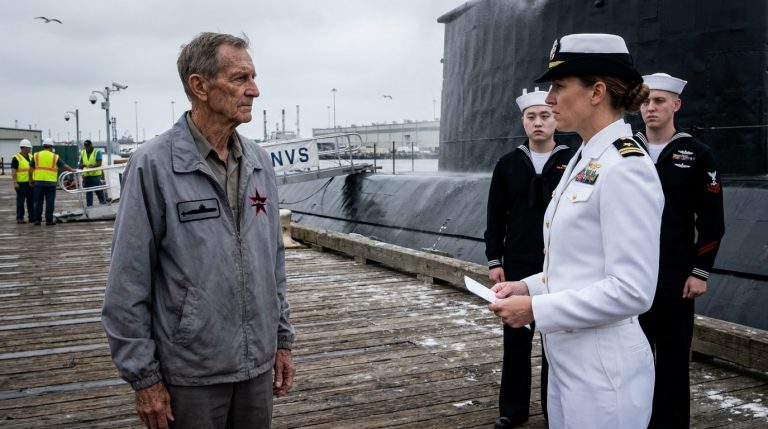
A Lesson in Stillness: How an Aging Veteran’s Single Shot Changed the Future of Precision Shooting
CHAPTER 1: The Weight of Noise
The Creekside range in rural Ohio smelled of ozone, burnt powder, and the sharp, metallic tang of too many ego-driven ambitions. To fourteen-year-old Tyler, it was a cathedral of high-end engineering. To his grandfather, Henry Mueller, it was something far more fragile.
Hank walked with a measured, rhythmic gait, his hand resting lightly on Tyler’s shoulder. He wore a work shirt that had survived more wash cycles than the average attendee had lived years, and a veteran’s cap that had lost its structural integrity long ago. The embroidery—once bold, now muted—seemed to be the only thing holding the fabric together, much like the man himself.
“Look at the glass on that one, Grandpa,” Tyler whispered, pointing toward a booth displaying a custom precision build that cost more than their family’s sedan.
Hank slowed, his eyes drifting over the optic. He didn’t see the price tag or the slick marketing materials. He saw the cold, detached way the metal was machined, the lack of soul in the assembly. “It’s a fine tool, Tyler. But it’s a tool that does half the work for you. Makes a man lazy.”
Around them, the atmosphere was chaotic. The One-Shot Challenge booth acted as a gravity well, pulling in the loud, the arrogant, and the desperate. A man in expensive tactical gear just finished his attempt, slamming his rifle into the rack with a string of colorful curses after missing the 400-yard plate by a country mile.
The booth was run by a thirty-year-old marketing rep named Derek. Derek had a smile that felt like it had been polished with sandpaper, and he leaned against the counter, surveying the crowd with the bored confidence of a man who knew he was winning. He watched the failures with a sense of grim satisfaction—every miss was a testament to the difficulty of the sport, and every failure justified the expensive equipment he was peddling.
Hank stood at the edge of the crowd, his eyes not on the rifles, but on the wind flags fluttering erratically past the berm. He felt the mirage boiling off the gravel, a shimmering heat that signaled a shifting, unpredictable current. It was a language he had spent half a century reading, a silent dance of atmosphere that the other shooters were trying to beat with sheer velocity.
“Doesn’t anyone see it?” Hank muttered, more to the wind than to his grandson.
“See what, Grandpa?”
Hank didn’t answer. He watched another competitor pay twenty dollars, take a shot, and miss by six feet. As the man turned to leave, Derek’s voice cut through the noise, loud enough to stop a conversation at the opposite end of the hall.
“Tell you what, Pops, you can use this one.”
Derek pulled a bone-stock Ruger 10/22 from beneath the counter, his laughter infectious and cruel. The crowd turned, sensing the kind of easy entertainment that only came from watching an old man fail. Hank felt Tyler tense up, his fingers digging into the fabric of his jeans.
Hank didn’t flinch. He looked at the rimfire rifle, then up at the silver plate glinting at 400 yards, and then at the shimmering haze above the gravel. He noticed something then—a faint, rhythmic clicking of a loose bolt on a nearby display table, a sound so out of place in the high-tech cacophony that it felt like a static charge building in the air.
He stepped forward, the floorboards creaking under his worn boots, and felt the weight of every eye in the room shifting toward him, waiting for the stumble.
CHAPTER 2: The Calculated Gamble
Derek’s grin didn’t falter, but it hardened, losing its earlier, effortless edge as he watched the old man’s fingers settle onto the Ruger’s action. It was a rhythmic, practiced motion—the sound of steel sliding against steel, a clean, well-oiled movement that lacked the hurried nervousness of the amateurs he had been fleecing for two days.
Hank didn’t look at the crowd. He didn’t look at the $8,000 custom rifles lining the walls or the high-definition optics that promised a digital shortcut to accuracy. He looked at the 10/22, a piece of equipment so ubiquitous it was almost invisible. He checked the magazine, the mechanical click sounding unnaturally loud in the sudden hush of the booth.
1969. The memory hit him not as a thought, but as a physical sensation—the smell of damp Georgia clay and the biting scent of CLP solvent on a hot afternoon. He felt the phantom pressure of a different rifle, a military-issue trainer, tucked into his shoulder under the watchful, unforgiving eyes of instructors who didn’t care about excuses. He remembered the specific, grinding frustration of the first few weeks, the way the wind mocked the .22 projectile, turning it into a dancing leaf in the air. He had learned then that to shoot was not to aim; it was to surrender to the environment until you became part of the math.
“You realize that’s a rimfire, Pops?” Derek asked, his voice tighter now, carrying a hint of projected superiority to reclaim the audience’s attention. “You’re looking at thirteen feet of drop at that distance. You’ll be aiming at the tree line just to hit the berm.”
Hank didn’t glance up. He was busy working the bolt, testing the tension of the spring. The feeling of the cold metal against his calloused skin was a grounding wire. He wasn’t bothered by the physics Derek was reciting; he was already calculating them.
“The rules,” Hank said, his voice quiet, barely carrying over the background hum of the expo floor. “You said they don’t specify caliber.”
“They don’t,” Derek conceded, his arms folded across his chest. He turned to the crowd, flashing a practiced, knowing look. “But they don’t change the laws of gravity, either. Be my guest.”
Tyler, standing just behind his grandfather’s shoulder, was trembling. He saw the way the crowd was closing in, a tightening circle of observers expecting a spectacle of failure. He felt the weight of the collective cynicism in the air—the assumption that this old man was a dinosaur, out of his depth, clinging to a past that had no place among the carbon-fiber, long-range masters.
“Grandpa, maybe we shouldn’t,” Tyler whispered, his voice cracking.
Hank leaned down slightly, just enough so only Tyler could hear. “Look at the wind flags, son. Not the ones on the poles. Look at the way the heat is dancing off the gravel near the 200-yard marker. The flags are lying to you. The ground tells the truth.”
Tyler looked. He saw only shimmering haze. Hank saw a map of invisible currents, a turbulence that shifted with the passage of every cooling breeze.
Hank settled onto the shooting bench. The chair was designed for a younger, more flexible frame, but he sat with a rigid, disciplined posture that hadn’t wavered in decades. He placed his left hand under the forend, his grip firm but not strangling, feeling the subtle vibrations of the floorboards as the expo crowd moved nearby. He was carving out a sanctuary of stillness in the middle of a carnival.
Derek stepped back, pulling out his phone as if to record the inevitable embarrassment for his social media feed. He was already rehearsing the quip he would use to dismiss the old man when the round inevitably kicked up dust ten feet low.
Hank closed his eyes for a heartbeat. He wasn’t praying. He was clearing the mental debris—the noise of the expo, the judgment of the onlookers, the artificial urgency of the challenge. He was sinking back into the rhythm of the schoolhouse at Benning. Breathe, wait, read, commit.
He opened his eyes and leveled the rifle. The iron sights—a simple post and aperture—snapped into focus. They were crude, unadorned, and brutally honest. He didn’t have the luxury of magnification to blur the world into submission. He had to see the target as it was: a tiny, glinting promise in a sea of heat and distance.
He didn’t fire. He didn’t even put his finger on the trigger. He simply held the rifle, letting the weight of it become an extension of his own skeletal structure. The crowd began to murmur, the sound rising like a tide. A few people checked their watches. A man in a high-end hunting jacket chuckled and started to turn away.
Derek cleared his throat, his patience fraying. “Whenever you’re ready, sir. Some of us have a booth to run.”
Hank didn’t move. He was listening to the range. He felt the lull in the breeze—a momentary stabilization of the mirage. It was the window he had been waiting for, a fleeting second of order in a world of chaos.
He didn’t snap the shot. He didn’t rush. He exerted the barest pressure on the trigger, a steady, linear pull that had been honed through thousands of hours of repetition. He wasn’t thinking about the five thousand dollars. He wasn’t thinking about the onlookers. He was thinking about the trajectory of a small, lead bullet fighting its way through a mile of atmosphere to kiss a plate of steel.
The silence on the firing line had reached a critical, suffocating density. Even Tyler stopped breathing. Hank felt the pressure reach its breaking point.
CHAPTER 3: The Eighteen Minutes
The trigger broke. It was a clean, crisp sensation, not unlike the snapping of a dry twig underfoot—a sound so small it was swallowed instantly by the ambient noise of the expo hall. But for Hank, the world had effectively ceased to exist the moment that internal sear released.
The recoil of the .22 was negligible, a gentle nudge against his shoulder, but he stayed behind the rifle, eyes locked through the simple aperture sight. He watched the target through the shimmer. At 400 yards, the flight time of a .22 subsonic round was not a blink; it was a physical journey. He tracked the mirage, his mind silently counting the variables he had processed during the long eighteen minutes of preparation. He had accounted for the wind flags, the slight shift in the light that indicated a pressure change, and the subtle, rhythmic pulse of the ground beneath the shooting bags.
He did not pull away. He held his position, the rifle held steady against his cheek, as the tiny, lead pill fought its way through the Ohio air. He was not waiting for an impact; he was witnessing the result of a decision made long before his finger moved.
Then, from the far end of the range, came the sound. It wasn’t the heavy, reverberating ‘thud’ of a centerfire bullet hitting steel. It was a thin, high-pitched ping—a metallic chime that floated back through the haze, fragile and impossible.
For a heartbeat, nothing happened. The crowd remained frozen, their mouths slightly agape, the cynical laughter of a moment ago dying in their throats. Even Derek, who had been readying a dismissive smirk, found his face frozen in a mask of confusion. The range officer, the man in his sixties with the weathered eyes, leaned forward, his hands gripping the railing until his knuckles turned white.
Hank exhaled. The sound was a long, slow release of tension that seemed to deflate his entire frame. He worked the action of the 10/22, a smooth, metallic cycle, and then finally sat back, the rifle resting across his knees like a tired companion.
“Did you hear that?” Tyler asked, his voice barely a breath. The boy’s eyes were wide, fixed on the silver speck four football fields away.
Hank didn’t answer. He turned to the range officer and nodded, a slight, respectful tilt of his head. The man nodded back, a slow, solemn motion that communicated volumes. They were two men who had spent their lives observing the world through lenses of lead and distance, and in that exchange, they acknowledged the rarity of the moment.
The crowd finally broke its paralysis. A murmur surged, growing into a low, rumbling roar of disbelief. Phones were raised, some recording, some just held in shaking hands. People began to press closer, their earlier indifference replaced by a hunger to understand what they had just seen.
Derek walked out from behind the counter. He looked down at the rifle in Hank’s lap as if it were a bomb. He looked at the 400-yard target, then back at the old man, his composure shredded. “That was… that was an eight-inch plate,” Derek stammered, his voice losing its polished, marketing edge. “With a rimfire? That’s impossible.”
“Nothing is impossible, son,” Hank said, his voice raspy and thin, the exhaustion of the eighteen-minute focus finally settling into his shoulders. “It just requires the patience to be ignored.”
Hank stood up, his joints popping with the protest of age, and began to pack his gear. He moved slowly, methodically, ignoring the growing circle of onlookers. He didn’t look for applause. He didn’t look for the payout promised by the booth’s rules. He was reaching for a sense of normalcy, a desire to get back to the quiet of the aisles, but the world wouldn’t let him.
As he turned, he felt a strange, dizzying wave of detachment. The air inside the expo hall, once filled with the smell of new synthetic stocks and cleaning solvents, suddenly felt sterile and thin. He felt a phantom weight in his hands—not the Ruger, but the memory of the heavy, cold steel he’d carried in his youth, the weight of responsibility that came with being the one who had to be certain. He leaned against the bench for support, his vision blurring slightly.
He was an old man in a room full of young, hungry people, and for a moment, he felt like a ghost, a remnant of a different era drifting through a digital, high-speed reality.
Tyler grabbed his arm, steadying him. “Grandpa? You okay?”
Hank looked at the boy, and the blur retreated. The face of his grandson was the anchor he needed. “I’m fine, Tyler. Just… the heat.”
“You want to sit down?”
“No,” Hank said, though his legs felt like lead. “We should go. We’ve seen enough.”
But the crowd had other plans. A man in the back pushed forward, clearing a path. It was the man in the faded army windbreaker, the one with the silver high-and-tight. He didn’t look at the crowd; he looked only at Hank. His eyes were wet, and he walked with the stiff, deliberate gait of a man who had served a long time ago.
“Mueller,” the man said, his voice rough.
Hank recognized him. It was a flicker in the back of his mind, a face from a briefing room, a voice from a radio, a name etched into the quiet corners of his life.
“Ritter,” Hank replied. The recognition hit him like a physical blow, a sudden, sharp reminder of the cost of the life he had lived. He didn’t want this. He didn’t want the spotlight, the acknowledgement, or the re-opening of the archives he had spent decades sealing. But as he looked at Ritter, he saw that the man wasn’t there for the spectacle. He was there for the truth.
The silence grew heavier. The onlookers stopped their whispering, sensing that the game—the marketing, the bet, the exhibition—was over. They were standing in the presence of a history they couldn’t possibly comprehend, and the weight of it forced them into an uncomfortable, reverent stillness.
CHAPTER 4: The Impossible Note
The ringing of the steel plate didn’t fade; it seemed to hang in the air, a high-frequency ghost that refused to dissipate. Around the shooting bench, the atmosphere had undergone a violent, tectonic shift. The casual, bored apathy that had characterized the expo for the last two days had been incinerated, replaced by an electric, almost suffocating tension.
Hank remained seated. His shoulders, usually stoic, betrayed a slight tremor—not from fear, but from the cumulative toll of eighteen minutes of total, unblinking focus. He watched the empty space between the bench and the target as if he could still see the path of the .22 bullet, a invisible thread connecting him to the steel.
Derek was the first to move, a frantic, uncoordinated motion. He scrambled from behind the counter, his polished shoes scuffing against the polished concrete. He didn’t look at the crowd; he looked only at the small, distant glint of the target, his face drained of all color. He moved with a clumsy, forced energy, heading toward the range boundary as if he could walk off the shock that had settled into his bones.
“Stay here,” Derek muttered to no one in particular, though his voice was little more than a jagged rasp. He started toward the target, the long walk across the gravel floor turning into a pilgrimage of apology.
Hank didn’t follow. He stayed on the bench, his hand resting on the stock of the Ruger. He felt the cold metal under his palm, a stark, grounding reality in a room that felt increasingly unreal. Tyler stood beside him, still as a statue, his eyes wide and unblinking.
“Grandpa,” the boy whispered, the word heavy with a sudden, overwhelming realization of who he was standing next to. “You just… you just hit that.”
Hank didn’t answer. He was watching the crowd. The spectators—the ones who had been filming, the ones who had been laughing, the ones who had been selling—were now gravitating toward the center of the room. They weren’t moving quickly; they moved with the slow, reverent caution of people approaching an altar. The noise of the expo, the background clatter of gear and deals, had died away to a faint, distant hum.
Then came the impact.
Derek returned from the 400-yard line, his head bowed, his hands shaking as he held a brightly colored impact marker. The crowd parted for him, a silent, fluid motion that felt more like a religious rite than a simple shift in geography. He stopped in front of the bench, his breath hitching, and he held up the marker.
“One and a half inches,” he said, his voice barely audible. “One and a half inches from the center.”
The information didn’t hit the crowd like a shout; it hit them like a falling curtain. A woman with a camera—a professional, by the look of her gear—lowered her lens, her expression caught in a permanent state of wonder. The laughter that had defined the afternoon felt like a sin committed in another lifetime.
Hank looked at the marker, then at Derek. He didn’t feel triumph. He didn’t feel the need for validation. He felt only the deep, aching fatigue of a man who had done exactly what he said he would do, and who wished, more than anything, that he could simply go home.
“The wind died for a second,” Hank said quietly, his voice neutral.
“No,” Derek replied, and for the first time, there was something like respect in his eyes. He looked down at the Ruger 10/22. “The wind didn’t die, sir. You just… you just knew how to wait for it.”
The crowd tightened. It was then that the man in the faded army windbreaker pushed through the front line. The Silver Star veteran, the man who knew the name Mueller, approached the bench. The respect in the air was so thick it was almost physical, a pressurized atmosphere that made it difficult to breathe.
“Master Sergeant Henry Mueller,” the man said, the title falling like a gavel.
He snapped to a salute, not a casual gesture of recognition, but a full, formal, sharp-angled salute that defied the age of his joints and the casual nature of the surrounding civilian crowd. He held it, his back rigid, his eyes locked on Hank’s.
Hank felt a cold shiver run down his spine. This was the moment he had avoided for twenty-one years. The archives, the classified reports, the cold, hard truths written in the blood of men he’d trained—they were all here, standing in front of him in the form of a man who remembered.
He didn’t want to stand. His legs felt like they were anchored to the concrete, the heavy, metallic smell of the range floor seeping into his clothes. But he understood the language of the salute. He understood the debt that was being acknowledged.
With a slow, deliberate motion, Hank rose. He ignored the protest of his knees, the slight wobble of his balance. He squared his shoulders, the posture of his youth returning in a sudden, intuitive rush of muscle memory. He lifted his hand—stiff, precise, and perfect—and returned the salute.
It was a quiet movement, a shadow of the man he used to be, but in that gesture, the entire expo hall seemed to bow. The civilians, sensing that they were witnessing something that didn’t belong to them, retreated, leaving a vacuum of space around the two veterans.
The silence wasn’t just quiet anymore. It was an absence of time.
Then, from the back of the room, a young man stepped forward. It was Marcus Delaney, the competitive shooter who had spent his life chasing perfection in equipment, his own high-end rifle slung over his shoulder like a leaden anchor. He moved toward the bench, not with the arrogance of the crowd, but with the desperate, hollow eyes of someone who had just discovered that everything he believed was built on a foundation of sand.
“How?” Marcus asked, his voice trembling. “I have the best glass, I have the best data, I have the best gear… how did you do that with this?” He gestured to the humble 10/22, a toy in the eyes of everyone who had seen it ten minutes ago.
Hank looked at the boy, and for the first time, he really saw him. He saw the potential, the hunger, and the dangerous, misplaced faith in things that could be bought. He didn’t want to answer, but he knew he had to. If he didn’t, the cycle would continue, and the substance would continue to be sacrificed on the altar of the gear.
“You’re asking the wrong question, son,” Hank said, his voice softer than before, yet somehow carrying further. “You’re asking how to hit the target. You should be asking how to become the person who never misses.”
The tension in the room peaked, a static charge that made the hair on the back of Tyler’s neck stand up. Hank was looking not at Marcus, but at the empty, shimmering air where the plate had been. The exhaustion was deepening, a heavy, velvet weight that pressed against his chest. He knew he couldn’t maintain the stance for much longer. He knew the world was closing in on him again, the real world of age, of memory, and of the things he had left behind in the jungles and the mountains.
The man in the windbreaker didn’t drop his salute. He held it, a bridge across time, and in that gesture, the entire, fragile architecture of the expo’s ego began to crumble.
CHAPTER 5: The Recognition
The salute held. It was a structural defiance of gravity, a testament to a code that existed outside the noisy, frantic commerce of the Creekside range. Around them, the crowd had effectively vanished; the booths, the flashing LED displays, and the chatter of commerce had receded into a blurry, irrelevant background. There were only two men, separated by decades but linked by a shared silence that spanned seven deployments and places that didn’t exist on any map.
“Sergeant Major,” Hank said, his voice dropping into a tone that was less a greeting and more an acknowledgement of the toll taken. He finally lowered his hand, his arm feeling heavy, as if he were fighting through water.
Ritter dropped his salute with the same crisp, professional economy. He took a single step forward, his eyes never leaving Hank’s face. “I didn’t think I’d see you again, Mueller. Not after the reports out of the A Shau Valley. Most of the men from that group… they stayed out there.”
“Some of us just got tired of running,” Hank replied. He glanced toward Tyler, who was watching them with wide, terrified fascination. The boy was beginning to understand that the grandfather he helped into his coat every morning was a stranger, or perhaps, a much deeper, more complex version of the man he thought he knew.
Ritter turned to address the crowd, his voice booming with the practiced, effortless authority of a career NCO. “You are looking at a man who spent his life in the shadows so that you could stand here today and argue about optics and caliber. Sergeant Mueller didn’t shoot that plate because he was lucky. He shot it because he has been training for that moment since 1967. He trained the men who built the doctrine you’re all currently using. This isn’t a show. This is a tribute.”
The crowd didn’t cheer. They couldn’t. The weight of the moment was too heavy for anything as trivial as applause. A few people began to back away, embarrassed by the thinness of their own lives compared to the depth of the history standing before them.
Derek, standing near the edge of the clearing, looked like he had been hollowed out. He was holding the custom-built, $8,200 precision rifle he had promised, but it looked different now. It didn’t look like a prize anymore; it looked like a flimsy, over-engineered distraction. He took a hesitant step toward the bench, his movements sluggish.
“I… I don’t know what to say,” Derek whispered, his bravado completely obliterated. “I thought… I thought this was just about the show.”
Hank looked at him—not with anger, not with the cold, superior gaze of a victor, but with a weary, patient pity. He reached out and took the rifle from Derek’s trembling hands. The walnut stock was cold, the glass on the scope pristine and unmarred by the grit of the real world.
“The show is a distraction, son,” Hank said, his voice raspy. “It’s a way to feel like you’ve accomplished something without having to endure the discipline required to actually achieve it. But you’re not a bad man. You’re just looking in the wrong place.”
Hank turned the rifle over in his hands, feeling the balance. It was a masterpiece of modern manufacturing, but it lacked the singular, brutal purpose of the old 10/22. It was designed to make shooting easy. And that, he realized, was the fundamental error.
He walked over to where Marcus Delaney was still standing, his eyes fixed on the Ruger on the bench. Marcus looked as though he had been hit by a physical force, his world of competitive, data-driven shooting suddenly rendered obsolete.
“Take it,” Hank said, pressing the $8,000 rifle into Marcus’s hands.
Marcus blinked, his hands closing around the walnut stock. “I can’t… sir, I can’t accept this. This is the showcase piece. This is—”
“It’s a tool,” Hank interrupted, his gaze intense. “And you’ve been looking for an answer. You have the tool now. But it won’t make you a marksman. Only the practice will. Only the hours in the dirt, the days of reading the wind until you stop trying to control it and start listening to it—that’s what makes the marksman. Don’t look at the optics. Look at the horizon. Learn how to be still when everything else is moving.”
Marcus gripped the rifle, his knuckles white. The weight of the gift was tangible, a physical connection between the aging master and the young, hungry student.
Ritter stood back, a faint, proud smile touching his lips. He watched the transfer with the satisfaction of a man who had seen the line of duty extended just a little further, a little longer.
Hank felt the fatigue hitting him now, a deep, bone-weary exhaustion that made the floor feel like it was shifting. The adrenaline had burned off, leaving behind the reality of his seventy-three years. He felt the cold sweat on his neck, the harsh, unforgiving light of the expo overhead, and the absolute, crushing desire to be somewhere—anywhere—quiet.
“We’re done here, Tyler,” Hank said, his voice barely a whisper.
Tyler moved quickly, sliding an arm under Hank’s back, guiding him away from the bench. As they walked, the crowd parted for them, a slow, respectful parting of the waves. No one spoke. No one reached out to congratulate him. They just watched, their gazes heavy with the realization that they had been in the presence of something they were not yet ready to name.
Ritter fell into step beside them, his gait mirroring Hank’s. “I’ll see you at the truck, Sergeant,” he said, his voice low.
Hank didn’t answer. He kept his eyes fixed on the exit, the patch of daylight visible at the end of the aisle. The world was noisy, crowded, and loud, but he wasn’t looking at the crowd anymore. He was looking at the end of a long, long day, and the quiet, empty miles that lay between him and home.
CHAPTER 6: The Passing of the Torch
The transition from the expo hall to the parking lot was not merely a change in location; it was a shift in gravity. The heavy, pressurized air of the range, thick with the weight of unsaid history and the sharp, sudden light of recognition, vanished the moment the heavy fire doors swung shut behind them. Outside, the evening air was cool, smelling of drying pavement and the faint, sweet scent of distant clover.
Hank took a deep, jagged breath. His lungs felt as though they had been filled with the stale air of the hall for a lifetime. He adjusted his cap, the fabric so soft now it felt like a second skin, and walked toward his truck. His movements were slow, burdened by the physical fatigue of the day, but there was a lightness in his stride that hadn’t been there when he arrived.
Tyler walked beside him, his hands shoved deep into his pockets. The boy was uncharacteristically quiet, his eyes scanning the horizon. He wasn’t looking at the cars or the activity of the departing expo attendees; he was looking at the way his grandfather moved, observing the man with a new, sober understanding.
“Grandpa?” Tyler said, his voice hesitant.
Hank stopped at the driver’s side door. He looked at his grandson, the fading light catching the boy’s face, highlighting the innocence that Hank had spent years trying to protect. “Yes, son?”
“You didn’t have to give him that rifle. The $8,200 one.”
Hank leaned against the side of the truck, the cold metal a relief against his shoulder. He looked out toward the tree line where the sunset was bruising the sky in shades of deep violet and burnt orange. “Marcus Delaney is a man who was looking for a shortcut. If I had kept that rifle, it would have been just another toy in his collection. By giving it to him, I gave him a burden. He has to prove he’s worthy of the tool. And if he fails, he’ll know exactly why.”
“But you don’t even have it anymore,” Tyler said, his voice tinged with a lingering, childish concern for material loss.
Hank smiled—a gentle, tired expression that reached his eyes. He reached out and tapped the brim of his cap. “The rifle doesn’t make the shooter, Tyler. I told him that. It’s what you carry inside that matters. The discipline, the patience… the ability to wait for the world to be still. Those aren’t things you buy at an expo.”
The silence between them was comfortable, a stark contrast to the performative silence of the range. As they climbed into the truck, the engine turned over with a familiar, rhythmic growl. It wasn’t the high-tuned sound of a precision machine, but it was reliable.
They drove out of the Creekside range in silence. As they hit the open road, the landscape of rural Ohio shifted into a blur of familiar shadows and rolling fields. Hank watched the world pass by, his mind unspooling the memories of the day. He thought of Ritter—the formal, sharp salute, the acknowledgment of a ghost. He thought of Derek, whose arrogance had been peeled away like a cheap veneer. But mostly, he thought of the stillness.
He had gone there to show Tyler a world of gear and noise, but he had ended up teaching him something far more essential: that in a world obsessed with speed, there is a profound, almost revolutionary power in the ability to simply hold your ground.
When they arrived home, the house was dark, a welcoming, quiet harbor. Hank stepped out of the truck, his legs feeling the strain of the long day. He walked to the back of the property, to the small, improvised range he’d kept for twenty years. He picked up his old 10/22 from the workbench—the rifle he had used at the expo, the simple, honest tool that had done more in eighteen minutes than all the high-end equipment in the state.
He didn’t clean it. He didn’t put it in a case. He sat on the stool, feeling the night air settle around him. He felt the cold iron of the sights, the familiar grain of the wood, and the weight of the moment. He realized then that his work wasn’t finished, but it was changing. He had passed the torch, not through the rifle he gave to Marcus, but through the example he had set for the boy sitting on the edge of the workbench.
Tyler watched him, not with the awe of the crowd, but with a quiet, steady understanding.
“Tomorrow,” Hank said, his voice low and firm. “We’ll go to the bench early. Before the wind picks up.”
“I’m ready, Grandpa,” Tyler replied.
Hank nodded, leaning back and watching the stars begin to poke through the dusk. The layer of his life that he had kept hidden—the silencers, the missions, the stars on collars—felt like a long-forgotten dream. The truth, he realized, was much simpler: he was just a man who had learned to read the world, and now, he had the rest of his life to teach someone else how to listen.
The struggle to keep his past private had ended, but it didn’t matter. The respect he had earned wasn’t about the medals or the records; it was about the quiet, uninterrupted life he had lived in the years since. He closed his eyes, listening to the wind rustling through the leaves, realizing that the only target that had ever really mattered was the one he had aimed for all along: the ability to leave behind a legacy that was, in the end, as steady and quiet as a single, well-placed shot.