The Shadow Over Interstate 40: A Small Town Waitress and Her Unlikely Protectors
CHAPTER 1: CORNERED IN THE NEON GLOW
Rain hammered the tin roof of the Starlight Diner with the force of a falling river. It was 2:10 a.m., and the Interstate 40 corridor outside was dead, swallowed whole by the high desert storm. I stood behind the counter, my fingers white-knuckled as I wringed a damp cleaning rag over and over, trying to squeeze out a terror that wouldn’t leave my veins.
In booth four, Andrew sat. He hadn’t touched his black coffee in over an hour. His beige windbreaker was dry now, but the agitated rhythm of his fingers tapping against the Formica table sounded like a clock ticking down to zero. He wasn’t watching the room anymore. He was watching my hands, my waist, my neck.
“Restroom check is late, Charlotte,” Andrew said, his thin lips barely moving as he stood up from the vinyl seat. He didn’t walk to the register. Instead, he angled his body toward the dark hallway that led back to the restrooms and the blind spot of the wall cameras. “I’ll be waiting back there until you clean it.”
I took a sharp breath, backing away until my spine hit the hard glass of the pie display case. My heart slammed against my ribs like a trapped bird. There was no desk sergeant to call—the precinct had made it clear that sitting in a booth wasn’t a crime, and nobody was coming down Interstate 40 to check on a night-shift waitress. I was entirely on my own.
Andrew stepped closer, stepping right up to the edge of the Formica counter until I could smell the stale peppermint on his breath. He reached across the divider, his cold, clammy fingers clamping down on my left wrist like a iron vise. His thumb dug viciously into my pulse point.
“Your shift ends in forty-five minutes,” he hissed, his eyes wide and unblinking behind wire-rimmed glasses. “You’re going to walk out to that rusted Honda, and I’m going to be parked right beside your door. Don’t make a scene, Charlotte. Nobody is coming to help you.”
Before I could yank against his grip, the floorboards beneath my feet began to vibrate.
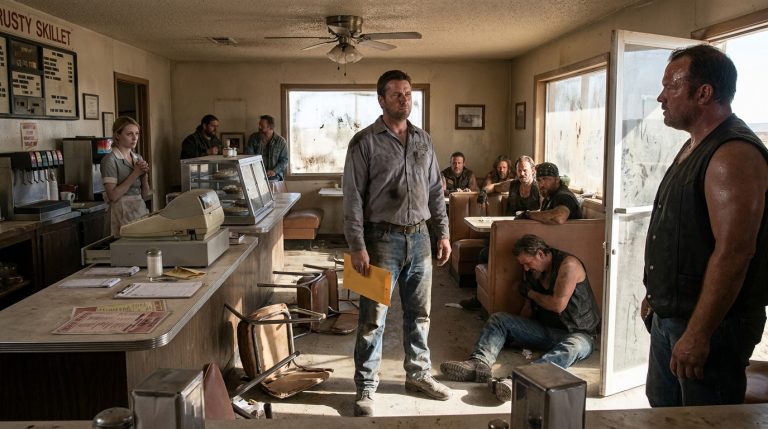
It started as a low, guttural vibration that rattled the silver napkin dispensers on the tables. Through the torrential sheets of water hammering the front windows, six blinding high beams cut through the blackness of the lot. The thunderous roar of six custom V-twin engines drowned out the storm, vibrating deep inside my chest as the bikes pulled up directly beneath the flickering neon sign.
Andrew’s grip loosened just enough for me to pull my wrist free. His face twisted into a scowl of pure, unadulterated rage as the diner’s bell wildy chimed, throwing the door open to a gust of freezing wind, exhaust, and wet leather.
Six massive men stepped into the light, their heavy boots thudding against the linoleum in a deliberate, unhurried rhythm. The lead rider had to duck slightly to clear the doorframe—a towering figure carved out of granite, a thick salt-and-pepper beard framing a face marked by a long, jagged scar running down his neck. The patch on his leather vest caught the overhead light: a winged skull above the words Hells Angels California.
Rick Collins swept his dark, piercing eyes across the empty diner, skipping over Andrew’s rigid frame and locking directly onto my shaking hands.
“Evening, darlin’,” the giant rumbled, his voice a heavy, resonant bass that instantly shattered the suffocating air in the room. “Hope you don’t mind us dragging a little water inside. We need six black coffees and whatever meat you’ve got left on the grill.”
CHAPTER 2: FIVE WORDS ACROSS THE FORMICA
Andrew didn’t back down immediately. The audacious, entitlement-driven heat in his eyes flared brighter as he stared at the six leather-clad figures filling the center booth. He threw a crumpled ten-dollar bill onto the Formica counter, his fingers twitching toward his windbreaker pocket before he turned his scowl back to me.
“You didn’t check the restrooms, Charlotte,” Andrew whispered, his voice dropping into a harsh, wheezing rasp meant only for my ears. “You think these degenerates are going to sit here until dawn? They’ll leave. And I’ll be right outside.”
He turned on his heel and marched toward the glass doors, the storm swallowing his silhouette the second he pushed into the deluge.
The heavy scrape of a vinyl booth seat cut through the sudden silence. Rick Collins stood up. At six-foot-five, his massive frame seemed to swallow the dim overhead neon, the long scar along his jawline pulling taut as his dark eyes tracked Andrew’s path through the window.
He walked over to the counter with slow, deliberate strides. He didn’t look like a hero out of a movie; he looked like a weary, dangerous man who had seen every rotten trick the world had to offer. He rested one calloused, ringed hand on the Formica, leaning his bulk down toward my level.
“Miss,” Rick rumbled, his voice low enough that it barely carried over the drumming rain on the roof. “Do you know that man?”
My breath hitched in my throat. I looked at the winged skull patch on his vest, then down at my left wrist where the red, angry outline of Andrew’s grip was already beginning to swell. I thought about the desk sergeant who had shrugged off the folded napkin. I thought about the gray sedan idling outside my apartment night after night.
I leaned across the counter, the smell of damp leather and motor oil rising off Rick’s jacket, and whispered five words:
“He won’t stop following me.”
Rick didn’t blink. He didn’t ask for proof, nor did he lecture me about calling the authorities. The muscle in his jaw flexed once, hard enough to turn the scar on his neck pale.
He turned his head slightly toward the center booth. Smitty, the bald sergeant-at-arms, was already watching him, his hands resting flat on the table. Rick gave a single, almost imperceptible nod.
“Pour me a warm-up, darlin’,” Rick said quietly, pushing his ceramic mug an inch forward. “Then I want you to go into the back office, lock the door, and stay put until the clock hits three. We’ll handle the tab.”
I filled his cup with a trembling hand, set the pot down, and retreated through the swinging kitchen doors without looking back.
Through the small square window of the kitchen door, I watched the six men move. There was no shouting, no dramatic draw of weapons. They simply zipped up their leather cuts, pulled on thick riding gloves, and walked out into the downpour in a tight, disciplined file.
Outside, the gray sedan’s headlights flickered on, sitting right beside my blue Honda. Andrew was idling his engine, waiting for the lot to clear. But the bikers didn’t head for the highway on-ramp.
Smitty swung his leg over his Road Glide, fired the engine with a guttural roar, and rolled the heavy front wheel forward until his chrome bumper was resting less than two inches from Andrew’s front grille.
CHAPTER 3: THE CAGE OF AMERICAN STEEL
Blinding high beams sliced through the dark downpour, turning the interior of Andrew’s car into an interrogation room. Inside, Andrew frantically hit his door-lock toggle, his hands shaking so violently he nearly dropped his keys onto the floorboards.
“Roll it down,” Rick commanded. He didn’t yell. His gravelly rumble carried straight through the glass, heavy and absolute.
“I’ll sue you!” Andrew screamed from inside, his voice thin and muffled behind the glass. “You can’t touch me! I know my rights!”
Smitty didn’t waste breath arguing. He reached into his leather saddlebag, pulled out a small steel spring punch, and pressed the tip against the rear driver’s side window.
Click.
The tempered glass exploded inward with a sharp crack, spraying thousands of tiny, sparkling cubes across the back seat. Freezing air and rain rushed into the sedan. Andrew shrieked, throwing his arms over his head as Rick reached a massive, tattooed arm through the shattered frame, flipped the mechanical lock, and yanked the driver’s door wide open.
“Get out,” Rick said.
“I didn’t do anything!” Andrew sputtered, scrambling over the center console toward the passenger side, his wire-rimmed glasses crooked on his sweat-slicked nose. “She wants me here! We have a connection!”
“Smitty,” Rick said calmly, ignoring the tantrum entirely. “Check the floorboards.”
Smitty leaned through the ruined window and dragged a heavy black duffel bag out onto the rain-slicked asphalt. With a slick tug of the zipper, he inverted the bag.
Heavy silver duct tape, a box of thick industrial zip ties, a bottle of chloroform, and a coiled hunting knife tumbled into the puddle at Rick’s boots. Along with them fell a thick stack of glossy photographs—close-up shots of my apartment door, my car’s license plate, and pictures of me walking alone to the diner at midnight.
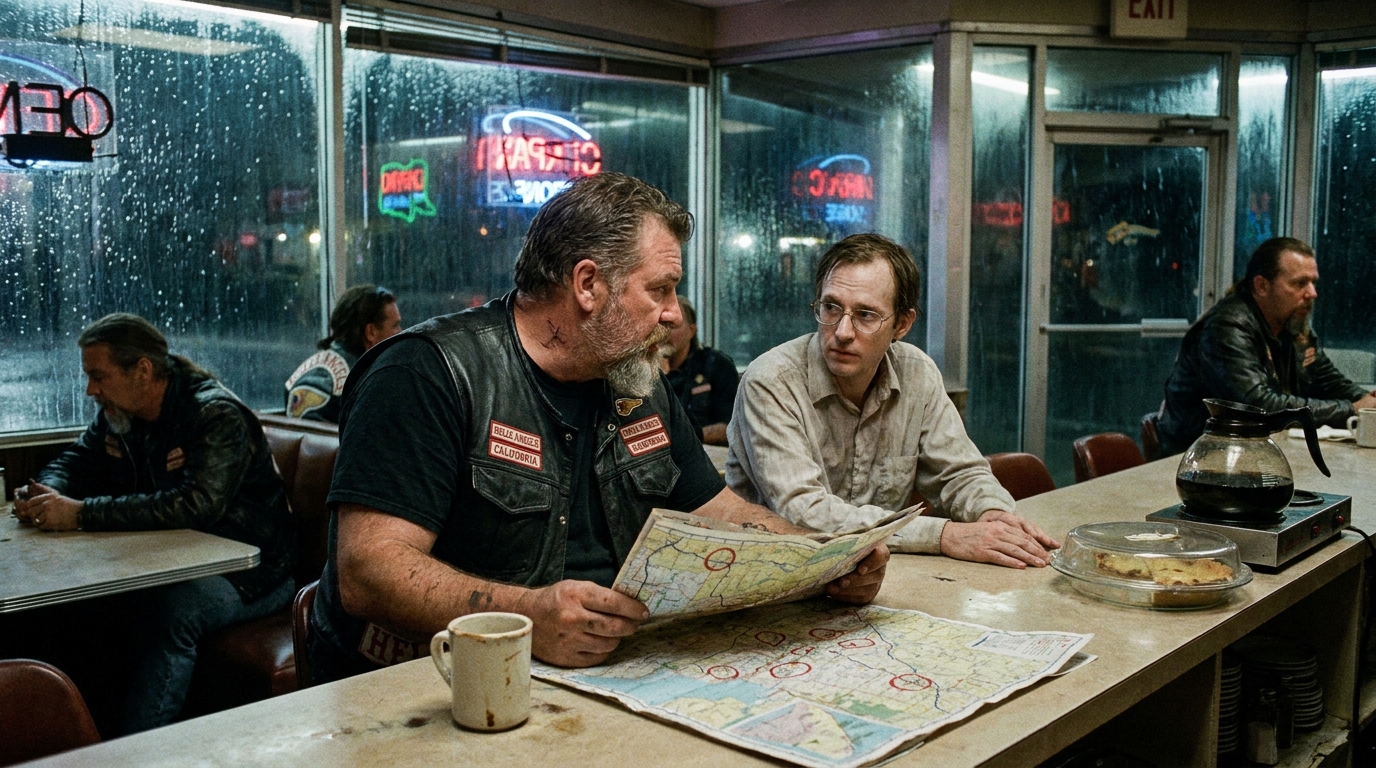
And resting right beside the knife was a worn, water-stained highway map of Interstate 40. Three isolated pull-outs were marked in heavy red ink.
Andrew went dead silent. The arrogant, entitled flush drained completely from his face, leaving behind a pale, trembling wreck backed against his own passenger door.
Rick picked up the map, his thumb brushing over the red circles before he tucked Andrew’s driver’s license into his own vest pocket.
“Andrew Pendleton,” Rick read aloud, his voice dropping into a register that made the hair on my arms stand up. “San Bernardino. You’re going to start walking back there right now. If I see your car, your face, or hear your name anywhere along this highway again, my chapter comes to your front door.”
Rick snapped the electronic key fob in half with one quick twist of his thumb and tossed the metal ignition key down the roaring storm drain at the edge of the lot.
CHAPTER 4: THE SENTINELS SHADOW
Andrew was gone, his silhouette vanishing on foot into the vast desert darkness along Interstate 40, leaving his disabled sedan rusting in the downpour.
“Get your coat, darlin’,” Rick rumbled, his voice cutting cleanly through the persistent hum of the neon sign above us. “We’re escorting you back to your door. You won’t have to look over your shoulder again.”
The drive back to my apartment complex was a thunderous parade. Six custom V-twins flanked my battered blue Honda Civic in a tight diamond formation, their blinding high beams slicing through the sheets of rain. For the first time in three weeks, the knot of cold terror between my shoulder blades began to unwind.
When I pulled into my parking spot, Rick didn’t make a big speech. He simply gave a single, firm nod from his bike, idling at the curb until my apartment lock clicked into place and the living room light flicked on.
Ten days passed without a single whisper of Andrew or his gray sedan. Booth four stayed empty during the graveyard shifts, save for the occasional night when Smitty would sit quietly at the counter, eating cherry pie and flipping through a magazine until dawn.
Then came Tuesday morning.
I sat at my kitchen counter, pouring hot water over a tea bag, while the small television set flickered in the corner. The local morning anchor’s voice dropped into a grave, urgent tone.
“Authorities in San Bernardino have taken forty-six-year-old Andrew Hughes into custody late last night,” the reporter announced as a mug shot filled the screen. “An anonymous tip hand-delivered to the sheriff’s department contained Hughes’s real driver’s license, surveillance photos, and a hand-marked map connecting him to three cold-case disappearances along the I-40 corridor over the past five years.”
My mug froze halfway to my lips. Staring out from the screen were the same pale, forgettable face and cold gray eyes from booth four.
Layer 1 had been the duffel bag in his car—the immediate threat of an abduction kit. But Layer 2 was the absolute, horrific truth: Andrew wasn’t just a local creep with an obsession. He was a seasoned highway predator who had been hunting isolated women working late-night shifts for years.
He hadn’t left on his own. Rick had taken his license, his map, and his photos, handing them straight to the authorities in a package that left the predator zero room to squirm or deny what he was. Andrew was picked up hitchhiking near the Nevada border, completely broken and rambling to deputies about giant wolves in the rain.
I set my tea cup down on the counter, the warm ceramic solid and grounding against my palm. The house was quiet. The rain outside had finally cleared, leaving behind crisp desert sunlight streaming through the clean glass.
Later that night, the bell above the Starlight Diner’s door chimed softly at 2:00 a.m.
Rick Collins stepped inside alone, shaking a few rogue water drops from his leather vest. He didn’t say a word about the news broadcast or the missing women. He just walked up to the counter and took his seat.
“Coffee, darlin’?” he asked softly.
I reached across the Formica divider, picked up the hot glass pot, and poured the dark, rich brew straight to the brim. No shaking. No white knuckles. Just a quiet, steady hand in a diner that finally felt safe again.