The Weight of Quiet Marks: A Chronicle of the Ghost Walkers and the Sanctuary of the Scarred
CHAPTER 1: THE HUM OF THE SERVERS
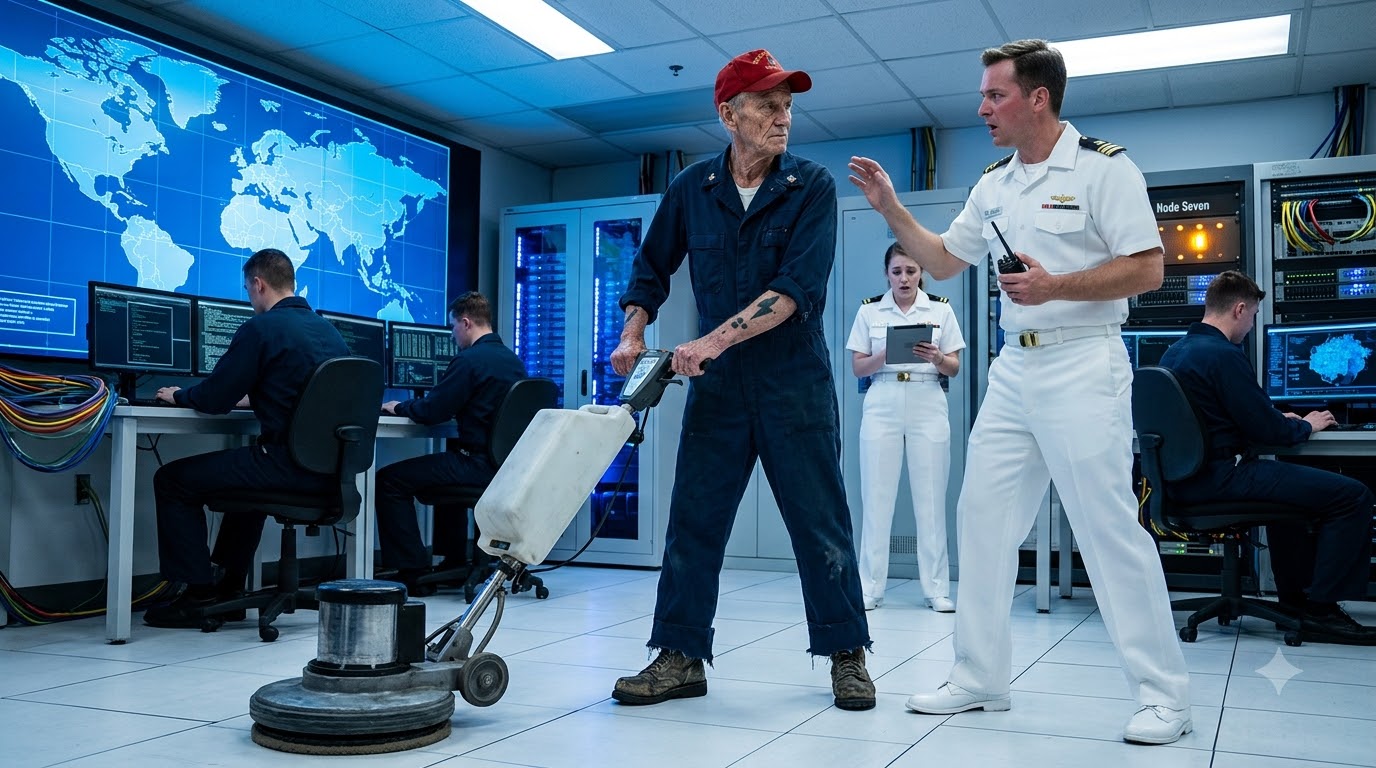
The air inside the naval command and control center carried the scent of frozen ozone and expensive, corporate floor wax. It was a sterile, blue-lit cave, sixty-five degrees precisely, designed to keep millions of dollars of solid-state electronics from sweating while the men in pristine whites simulated wars on high-resolution glass.
Harold Beck didn’t look up. His eighty-two-year-old hands stayed loose but anchored on the vibrating T-bar of the industrial floor buffer. The machine was heavy, a cast-iron beast that wanted to pull to the right, but Harold guided it in a slow, rhythmic arc over the white linoleum, the steady wuff-wuff-wuff of the pad serving as his clock. At his age, he had learned that silence wasn’t just a lack of noise; it was an armor.
“Hey, I’m talking to you, Pops. I asked about that ink.”
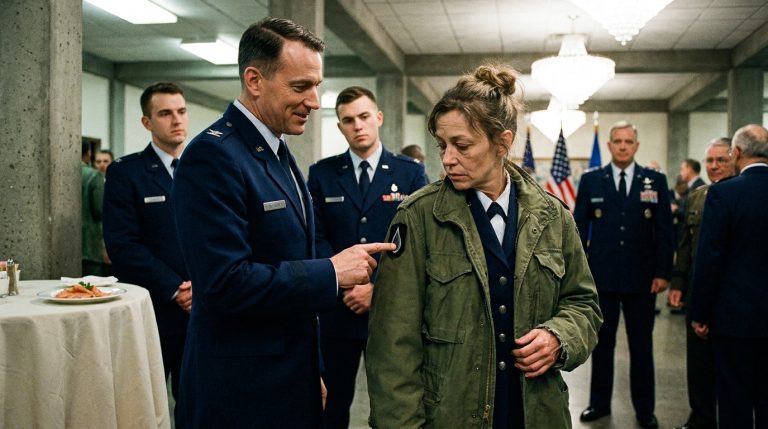
Lieutenant Commander Vance stepped directly into Harold’s peripheral vision. Vance was smooth-skinned, his uniform holding the sharp, razor-creased discipline of a man who fought his battles inside air-conditioned sanctuaries. In his right hand, he cradled a styrofoam cup of coffee; with his left, a manicured index finger pointed down at Harold’s exposed forearm.
Harold squeezed the trigger, letting the buffer’s motor whine down into absolute stillness. The sudden absence of the machine’s pulse made the room feel tight, almost cavernous. Slowly, with the deliberate care of a man whose vertebrae had spent forty years settling into concrete, Harold straightened his spine. He looked at his arm.
The ink was old. It didn’t look like the bright, precise work the young sailors got down on the boardwalk. It had bled into the crepe-paper texture of his skin over fifty winters, graying at the margins until the lines looked fuzzy, like charcoal dust. It was a crude black diamond, intersected by a jagged, uneven lightning bolt, with three distinct, misshapen dots sitting just beneath the apex. It looked like ancient, desperate work.
“It’s just a mark, sir,” Harold said. His voice was a low, gravelly rasp, the product of old dust and too many cold mornings. He shifted his grip back to the buffer handle, wanting nothing more than to lose himself back in the machine’s vibration. “Just a reminder.”
“A reminder of what? Bad choices?” Vance laughed, a quick, sharp bark that signaled the two junior ensigns flanking him to chuckle on cue. Only one of them, a girl named Miller, didn’t join in. Her eyes drifted instead to the massive digital array on the main wall, where blue icons hovered over an empty sea.
Vance took a step closer, his polished leather shoe touching the edge of the wet wax border Harold had just laid down. “We have regulations about professional appearance on the command deck, Harold. Even for contract maintenance. That thing looks like gang tagging. You got a history you aren’t telling admin about? Some time in the state pen?”
The old man looked up, meeting the officer’s eyes. Vance’s face was unblemished by wind or time; it was the face of a clean desk. Harold’s face was a topography of deep ridges and dried skin.
“No prison, sir,” Harold murmured, his thumb rubbing the worn brass button of his red utility coveralls. “Just work.”
Vance took a slow, deliberate sip of his coffee, his eyes narrowing as he caught the subtle deflection. “Right. Work. Well, cover it up. Roll down your sleeves, Harold. I don’t need to see that scratch-pad garbage while I’m coordinating fleet movements. It’s distracting.”
Harold didn’t move his arms. The room was freezing, but the weight of the industrial buffer kept his core hot. If he rolled the heavy canvas sleeves down to his wrists, the fabric would catch the damp friction of the machinery within twenty minutes, turning the rest of his shift into an agonizing drag.
“With all due respect, sir,” Harold said, his voice dropping into a steady, unhurried cadence that felt older than the room itself, “the contract maintenance regulation allows for rolled sleeves above the forearm when operating heavy rotary equipment. It’s safety protocol. To prevent snagging.”
The silence that followed was different. The electronic hum of the servers seemed to sharpen. Vance’s face lost its playful smirk, replaced by a dark, bureaucratic frost. He lowered the coffee cup. “Are you quoting safety regulations to the watch officer of this deck, janitor?”
CHAPTER 2: THE CAUSALITY MATRIX
The question hung in the frigid sixty-five-degree air, stiff and heavy as a formal reprimand. Vance lowered the styrofoam cup a fraction of an inch, his fingers tightening against the thin white foam until it gave a soft, microscopic crinkle. To his left, the massive digital map wall pulsed with a rhythmic, cool blue light, casting long, geometric shadows across the pristine white tiles Harold had spent the last forty minutes refining.
Harold did not flinch. He didn’t drop his chin, nor did he shift his weight away from the heavy cast-iron spine of the floor buffer. He simply watched the small, dark ring of black coffee sway inside Vance’s cup. In the silence, the local server display rack behind the officer gave an anomalous, rhythmic click—a tiny hiccup in the climate-control manifest that only someone who spent hours listening to the room’s baseline respiration would notice. A single green indicator light flickered into a dull, amber hue before steadying itself.
“I am quoting the standard operating parameters for civil contracted labor on high-clearance military installations, sir,” Harold said. His voice didn’t rise; it remained a flat, low-frequency rumble that seemed to come from the deep foundations of the concrete building rather than his throat. “Section four, paragraph nine. It exists to protect the gear as much as the man. A torn sleeve jams a drive spindle. A jammed spindle costs the department three thousand dollars before the technician even opens their kit.”
Vance’s chest swelled beneath his immaculate white shirt, the fabric stretching tight over his shoulders. “You’ve got a lot of mouth for a man holding a stick with a rag on the end of it, Beck. You think because you’ve been drifting around these corridors since the old admiral was in diapers that you’re part of the architecture?” He stepped forward, his polished leather shoe firmly crossing the damp line of fresh wax. The sharp scent of synthetic polymers and industrial solvents rose between them, biting and raw. “Miller. Take his card.”
Ensign Miller shifted her weight from one foot to the other. Her fingers hovered over the edge of her issued digital tablet, her face caught in the pale glow of the screen. For a second, her gaze darted from Vance’s rigid profile back to Harold’s faded coveralls. “Sir,” she murmured, her voice losing its military crispness, filtering down into something smaller, more defensive. “Mr. Beck’s schedule has been cleared through the terminal log every Tuesday morning. It’s a standard maintenance loop.”
“I didn’t ask for a logistical summary, Ensign. I gave an order,” Vance snapped, his eyes never leaving Harold’s face. “The C&C deck is currently running live tactical tracking for the third fleet’s transit corridor. We don’t leave variable factors wandering around the server blocks with heavy iron tools and unvetted backgrounds. Pull the credential history. Now.”
Miller stepped forward, her soft-soled boots making no sound against the dry portion of the floor. Her hands were slightly unsteady as she reached toward the laminated security badge clipped to Harold’s left breast pocket. Harold remained perfectly stationary, his breath coming in slow, shallow increments that barely registered against the heavy fabric of his uniform. As Miller’s fingers brushed the plastic casing of the badge, Harold’s focus drifted past her shoulder, fixing entirely on the secondary server terminal—Node Seven—where the cooling manifest had just altered its rhythm.
In that quiet space between breaths, the sterile blue light of the command deck seemed to thin out, losing its sharpness. The low, expensive whine of the cooling fans didn’t stop, but it changed density, softening into the heavy, sodden drone of monsoon rain hitting a canopy of broad-leaf teak. The smell of corporate wax gave way to something older, darker—the greasy, metallic tang of hot rifle oil and the thick, suffocating stench of rotting vegetation turning to black muck under the weight of three dozen boots. He could feel the coarse weave of a wet canvas strap digging into his collarbone, the coarse texture of a field dressing slick with brackish water.
“Hold the line, Harry,” a voice muttered in the dark of his memory, cracked and dry from lack of salt. “Don’t let the radio touch the grease.”
“Commander,” Miller’s voice broke through the fog, clean and sharp as an ice pick. The digital tablet in her hands emitted a low, three-tone chime that signaled a cleared diagnostic query. She was staring at the display screen, her eyebrows knitting together as her thumb scrolled rapidly through a dense wall of text that shouldn’t have existed for a standard custodial file. “The system… it isn’t rejecting the credential. It’s pulling an elevated protocol.”
Vance didn’t look at her. “Then override the flag and log the temporary suspension. He can wait in the corridor until the master-at-arms sets up the interview.”
“No, sir, you don’t understand,” Miller said, her voice dropping into a tight, cautious register. She held the tablet closer to her chest, her eyes fixed on a specific line of cryptographic code pulsing at the top of the terminal screen. “The clearance level isn’t a baseline contractor pass. It’s an active, unrevoked command proxy. It’s tied directly to the legacy architecture of the lower deck network node. It says here it can only be modified by a direct flag-officer authorization code.”
A small, hard knot of tension tightened in Harold’s stomach. The secret was still there, buried deep within the copper wiring of a station that had built its new digital walls over the bones of an older world. He looked down at the floor, his fingers adjusting their position on the cold brass safety switch of the buffer, his thumb tracing the worn edge of the metal casing.
Vance slowly turned his head toward the ensign, his expression stiffening as the tone of the room altered. “What do you mean, legacy proxy? He’s contract maintenance. Read the employer field.”
“The employer field is blank, sir,” Miller whispered, her fingers frozen on the edge of the glass panel. “It just says… Section Three. Retained.”
CHAPTER 3: SHIFTING THE CENTER
The word hung in the cold air like frozen oil. “Retained.”
Vance’s jaw set, a small, rhythmic knot of muscle twitching right below his cheekbone. He didn’t snatch the tablet from Miller’s hand—not yet—but his weight shifted backward, away from the damp line of floor wax, his boots making a dry, sharp squeak against the scrubbed tile. The pristine white of his uniform seemed to catch the pale, amber flicker from the server rack behind him, casting an unyielding glare across his forehead.
“Read the protocol number again, Ensign,” Vance said, his voice dropping below the steady, dull roar of the room’s cooling manifolds. It was the tone he used when a simulation dataset began to warp at the parameters. “The system doesn’t leave unassigned proxies active on a flagship tactical deck. Check the network route.”
Miller’s thumb was already moving, the glass of the screen clicking beneath her fingernail with a tiny, dry rhythm. “I’m tracing it now, sir. The routing path isn’t jumping out to the main base server pool. It’s hardwired. It’s pulling directly from the legacy sub-floor terminal under the server core—Node Seven. The validation logic was signed off by the base commander’s terminal three years ago, but the underlying root certificate… it dates back to 1972.”
Harold stayed perfectly still. His hands remained loose, almost soft, wrapped around the cold iron T-bar of the buffer. He didn’t look at the tablet, nor did he look at the changing lights on the server face. Instead, his eyes remained fixed on the small, dark puddle of spilled coffee near Vance’s heel. A tiny hair from the buffer pad had floated into the liquid, breaking the surface tension, drawing a thin line of brown fluid across the clean white porcelain tile.
The weight in his chest wasn’t a secret anymore; it was just old iron. He could feel the cold draft from the floor vents hitting his ankles, rising up through the thick, coarse denim of his utility coveralls. The fabric was frayed at the cuffs, the threads pulling apart into a soft, gray fuzz that caught the dust from the floor. It was real. It was right now.
“It’s a dead entry, Commander,” Vance muttered, his eyes narrowing as he finally looked down at Harold’s forearm, tracing the faded edges of the black diamond and the jagged lightning bolt. “A legacy artifact from when this station was a signal hub during the line deployment. Admin probably missed the termination notice when the department migrated the secure keys to the solid-state racks.” He took a sharp step forward, his hand rising to tap his radio. “It changes nothing about the current deck security. Miller, clear the terminal screen. Mr. Beck, step away from the machinery.”
The officer’s hand didn’t hit the radio casing. It went straight for Harold’s shoulder, a fast, transactional movement intended to break the old man’s stance and force him toward the secure exit door.
Harold didn’t swing. He didn’t raise his arms to block the contact.
Instead, as the heavy, manicured fingers touched the coarse blue canvas of his shoulder, Harold simply lowered his hips by half an inch. He dropped his center of gravity into the heels of his heavy, thick-soled work boots, turning his right collarbone backward by a single fraction of a degree. It was a movement of pure weight and friction, a technique learned in the thick, unyielding mud of the valley when a man had to slide past a low-hanging vine without shifting the thirty-pound radio pack on his spine.
Vance’s fingers found no purchase on the stiff, coarse denim. His hand slipped off the curved bone of Harold’s shoulder as if it had struck an unyielding piece of ironwood, the momentum carrying the officer forward until his shoe skidded into the fresh, slick film of industrial wax. His elbow caught the edge of the server desk with a sharp, hollow thud, the styrofoam cup in his grip tilting until a long, dark stream of lukewarm coffee ran down the side of the brushed aluminum terminal casing.
The room went completely silent. The three technicians at the secondary tracking monitors didn’t turn their heads, but their shoulders went rigid, their fingers hovering half an inch above their keyboards.
“Don’t touch me, son,” Harold said.
The ‘sir’ was gone, buried under fifty years of quiet dust. The voice wasn’t a rasp anymore; it was the heavy, flat strike of a stone hitting the bottom of an empty well. He didn’t raise his chin, but his eyes moved up, locking onto Vance’s pale face with the unblinking, steady weight of a man who had watched the horizon change through three days of mortar fire without moving his head.
Vance straightened his posture, his face flushing a dark, blotchy red where his cheek had nearly clipped the server frame. He looked down at his damp fingers, then back at Harold, his breathing coming in short, ragged bursts that rattled against the starch of his uniform collar. “You just… you just physically resisted a watch officer on a live command deck,” he sputtered, his hand finally reaching his belt, ripping the small black radio from its plastic clip. “Master-at-arms, this is Watch Officer Vance. C&C deck. I have an unvetted civilian contractor refusing removal. Deploy security elements to the inner sanctum immediately.”
The radio gave a short, metallic squelch in response, the voice on the other end small and garbled through the heavy shielding of the room.
Harold didn’t move. He stood his ground in the center of the wet tile, his feet planted shoulder-width apart, his long, thin fingers resting on the black plastic handle of the buffer. The faded ink on his arm was fully visible now beneath the blue fluorescent lights—the ugly black diamond, the crooked lightning bolt, and the three uneven dots that sat beneath the scar tissue. He looked at the server rack behind Vance, where the single amber light was still pulsing, a small, steady heartbeat in the silence of the room. He knew exactly what was on that lower node. He knew why the certificate had never been revoked, and why his name was still written in the copper lines of the base protocol. It was the only thing left of the five men who had gone into the valley with nothing but a radio and a box of salt.
“The buffer is too heavy to carry down the stairs, Commander,” Harold said softly, his voice dropping back into its slow, rhythmic cadence. “And the service elevator has been down since Thursday. I’m going to finish the northeast quadrant. Then I’m going to put the gear away.”
Vance didn’t answer. He stood by the desk, his knuckles turning white around the radio casing, his eyes fixed on the double doors at the back of the deck, waiting for the first sound of heavy boots coming down the hall.
CHAPTER 4: THE SHADOW OF THE MOUNTAIN
The metallic click of the radio receiver hung in the quiet between the server racks, a tiny, thin scratch of sound that did nothing to break the heavy density of the air. Vance remained motionless beside the desk, his knuckles still pressed white against the hard plastic casing of his communicator, his boots tracking a dull, dark smear through the fresh film of wax he had violated. He didn’t look at Miller. He didn’t look at Harold. His eyes were pinned entirely to the glass-paneled double doors at the far end of the platform, tracking the sudden, sharp distortion of light as a shadow broke the clean reflection of the hallway.
The doors didn’t swing; they cracked open with a clean, explosive weight that rattled the brass alignment pins in the frame.
“Attention on deck,” a voice boomed from the threshold. It wasn’t a standard command; it was a physical percussion that flattened the low-frequency drone of Node Seven’s cooling fans within a microsecond.
The technicians at the perimeter consoles didn’t slide their chairs; their spines snapped rigid in a single, synchronized motion, their heels hitting the linoleum with a heavy, hollow click. Vance’s hand dropped from the desk, his posture jerking upright so quickly the starched cotton of his shirt gave a dry, papery rip along the back seam.
Through the opening strode Captain Julian Iron Sterling. He was an immense presence, his green utility coveralls unmarred by the damp cold of the deck, his chest bearing rows of ribbons that looked like faded bars of lead under the blue fluorescent light. Behind him, two gunnery sergeants took up flanking positions by the glass partition, their faces carved out of grey stone, their eyes sweeping the room with the transactional indifference of men who measured terrain by its casualty potential. A senior Navy captain followed a half-step behind, his brow furrowed as his eyes locked onto the dark stream of coffee still dripping off the side of the aluminum terminal.
Vance recovered his stance instantly, his fingers snapping to the brim of his cover in a rigid salute that vibrated with small, defensive energy. “Captain Sterling. Sir. Apologies for the operational disruption. We are currently managing a non-compliant civilian asset who has violated deck protocol and physically actively resisted a security detail.”
Sterling didn’t pause. His heavy, steel-toed combat boots beat out a slow, mechanical rhythm against the dry white tile—tock, tock, tock—completely ignoring the hand Vance held extended toward his temple. He walked past the main tracking monitors, past the screen where Miller’s tablet was still displaying the pulsing amber text of Section Three, and stopped exactly three feet from the front of Harold’s floor buffer.
The silence returned, larger this time, smelling of the damp wool of Sterling’s winter coat and the raw, synthetic bite of the floor wax.
Harold didn’t drop his hands from the T-bar. He didn’t offer a salute. He simply stood with his shoulders slightly rounded beneath the faded red canvas of his coveralls, his old skin grey and translucent under the stark lighting. For a brief microsecond, as the marine captain’s radio gave a low, high-frequency hiss, a phantom signal cut through Harold’s mind—the dry, rhythmic tick-tick-click of an AN/PRC-25 radio set sputtering through a waterlogged handset in the dark of Hill 881. The sensory phantom faded as quickly as it had arrived, leaving only the smell of frozen ozone.
Sterling’s eyes didn’t fix on Harold’s face. They went straight to the old man’s left forearm. He traced the fuzzy, bleeding margins of the ink—the black diamond, the uneven lightning bolt, and the three misshapen dots that sat right above the pale white tracking scar of an old shrapnel exit wound. The marine’s chest rose in a slow, deep inhalation that expanded the fabric of his uniform until the brass pins of his insignia creaked.
“Lieutenant,” Sterling said. His voice was low, almost quiet, but it had the gravelly, unyielding weight of an iron chain being dragged over a bulkhead. “Do you know what this terminal route is?”
Vance blinked, his hand slowly lowering from his brow as the lack of a returned salute began to register against his ego. “Sir? It’s a legacy custodial entry. A clerical error in the automated administration pool. I’ve already contacted the master-at-arms to have the individual removed pending a formal security pass revision.”
“The master-at-arms isn’t coming down those stairs, Lieutenant,” the Navy captain behind Sterling interjected, his voice sharp with a cold, institutional disgust that made Vance’s jaw go slack. “I canceled the detail from the corridor.”
Sterling took another step forward, his shadow completely swallowing the small, dark puddle of spilled coffee on the floor. He looked at Harold, his face softening by a single fraction of an inch, his mouth tightening into a thin line that looked exactly like the old photographs Harold had carried in his wallet until the paper turned to mush in ninety-two.
“The three dots, Lieutenant,” Sterling murmured, his eyes still fixed on the faded ink of Harold’s arm. “They don’t mark a prison sentence. They represent Corporal Miller, Private First Class Gentry, and Sergeant Tolliver. They were left on the ridge because the line company couldn’t clear the LZ under the heavy mortar box. My father was the operator who stayed on the key until the battery went black.”
Harold’s fingers tightened on the plastic handle of the buffer, the skin across his knuckles turning yellow. He looked at the giant marine’s chin, recognizing the slight, off-center break in the bone where an old fracture had healed rough. “Jimmy,” the old man whispered, his rasp returning, thin and dry. “You’ve got Jimmy’s chin.”
“Yes, sir,” Sterling said, his voice thickening as he stood in the freezing center of the command deck. “He told me about the ridge, Mr. Beck. He told me about the five miles through the teak.”
Slowly, with a deliberate, geometric precision that looked like a ceremony performed in an empty church, Captain Sterling raised his right hand. His fingers aligned perfectly with the edge of his cover, his elbow locking into a sharp, unyielding angle that held the salute for one second, then two, then three. The two gunnery sergeants at the door followed him instantly, their boots striking the floor with a synchronized boom that seemed to rattle the glass partitions of Node Seven.
Vance stood completely frozen, his radio still clutched in his hand, his mouth open slightly as the absolute collapse of the deck’s hierarchy settled into his chest like a block of ice.
CHAPTER 5: THE REMNANT SHORE
The salute held. For three unbroken seconds, the only movement on the command deck was the tiny, frantic oscillation of a digital gauge on the perimeter wall. Vance stood paralyzed, his fingers still hooked around the dead weight of his hand-held radio, his eyes wide as they darted from the pristine fabric of Captain Sterling’s sleeve to the frayed canvas cuff of Harold’s coveralls. The space between them seemed to expand, absorbing the mechanical hum of Node Seven until the room felt less like a high-clearance command deck and more like a concrete vault designed to bury things that refused to rot.
Slowly, the Navy captain stepped forward, his eyes cutting through the remaining distance between himself and Vance. “Lieutenant Commander, you will surrender your watch badge to Ensign Miller. You are relieved of your duties as watch officer of this deck, effective immediately.”
Vance’s hand shook slightly as his fingers found the pin of his security badge. He didn’t speak. The arrogant clarity that had defined his posture for the last two hours collapsed inward, leaving his shoulders narrow and hollow beneath his starched linen. He unclipped the metal disk and laid it flat on the aluminum console, right beside the dark, sticky pool of lukewarm coffee that was still dripping onto the frame.
“Ensign Miller,” the captain turned his head.
“Sir.” Miller stepped up to the terminal, her movements fast and exact.
“Take the handle of that machine. Ensure the northwest quadrant is brought to full inspection standard before the afternoon briefing.”
“Understood, sir.” Miller didn’t look at Vance as he walked past her toward the secure egress corridor, his boots making a faint, damp click on the ruined floor wax. She stepped onto the wet linoleum, her fingers gripping the black iron T-bar of the buffer with a quiet, careful reverence. She compressed the trigger, and the motor whined back to life, its low, rhythmic drone filling the empty space left by the confrontation.
Sterling turned back to Harold, his arm dropping to his side with a crisp, fluid snap. “Mr. Beck, the briefing down the hall is scheduled for fourteen hundred. It’s a review of non-standard coordination protocols in dense riverine sectors. The Admiral is present, but… I believe your presence at the table would carry more weight than the satellite telemetry we’ve been tracking.”
Harold looked down at his own hand. His knuckles were loose now, the skin across them soft and grey. He reached into his pocket and pulled out a small, lint-covered roll of black electrical tape—the tool he had used for fifteen years to secure the vibrating cord of the industrial machine whenever the rubber housing began to split from the heat. With slow, trembling fingers, he began to peel back the silver thread of a loose wire near the safety switch, pressing the dark adhesive band down until the frayed edge was bound flat against the metal casing. It was a tiny repair, a small act of maintenance for a piece of iron that would outlive them both.
“The floor needs forty minutes to cure, Captain,” Harold said softly, his voice dropping back into its familiar, gravelly baseline. “If the wax sets uneven, it leaves a cloud in the grain. The Admiral doesn’t like a cloud.”
“Miller has the handle, sir,” Sterling replied, a faint, genuine warmth softening the hard edge of his jaw. “She knows how to hold the center.”
Harold nodded once, a slow, heavy inclination of his head that seemed to acknowledge more than the floor. He stepped away from the machine, his old work boots leaving two dry, clean ovals on the polished tile where he had stood his ground. He walked toward the double glass doors, Sterling shifting his weight seamlessly to remain exactly one pace behind his right shoulder—the traditional position of deference assigned to a commanding element.
They entered the carpeted corridor, the sterile blue light of the C&C deck fading into the warm, low-intensity gold of the administration wing. The noise of the servers died behind them, replaced by the quiet, insulated silence of a building that had forgotten how to sweat.
At the end of the hallway, inside a small, recessed alcove near the secure briefing room, a heavy silver urn of coffee sat on a wood-grained table. Sterling reached for a thick, white ceramic mug—not the thin styrofoam Vance had carried—and filled it to the brim with the dark, bitter liquid. He handed it to Harold, then filled a second one for himself.
Harold took a slow sip, the heat of the ceramic soaking into the stiff, dry joints of his palms. The fluid was bitter, tasting faintly of over-boiled grounds and iron pipe.
“Tastes like old battery water,” Harold murmured, a tiny, creased line appearing at the corner of his eye.
Sterling laughed, a short, quiet sound that died quickly against the heavy carpet. “My father said the same thing. He told me that every time the command group sent down a fresh crate of rations to the base at Dong Ha, the first thing he did was trade the sugar caps for a tin of chicory mud from the local drivers.”
Harold looked into the black surface of his cup, watching his own weathered reflection sway against the white porcelain rim. “Jimmy was a good operator. He kept the wire clear when the tree-line was burning. He didn’t look at the sky; he just listened to the click.”
“He kept the ink dry, too,” Sterling said softly, his eyes moving down to Harold’s exposed forearm where the black diamond sat in the quiet light of the alcove. “He told me that when you carried him across the creek, he could hear the mortar fins whistling through the bamboo, but every time he tried to slide off your pack to clear the line, you just dug your fingers into his trousers and told him to keep his mouth shut until the birds arrived.”
“The birds came,” Harold whispered. His voice was very thin now, the weight of the years settling back into his shoulders as the heat of the coffee reached his chest. “But three of them didn’t see the landing.”
He looked back toward the glass doors of the command center, where the faint, rhythmic wuff-wuff-wuff of Ensign Miller’s buffer could still be heard through the insulation. The floor was dry now. The marks left by the boots, the spilled coffee, and the long, bitter history of the Section Three protocol had been smoothed out, absorbed into the clean, unblinking surface of the flagship deck. The world was moving forward, clean and fast, but beneath the new linoleum, the old wire was still running, holding the frame together for the men who had left their names in the mud.
“Come on, Jimmy’s boy,” Harold said, setting the mug down on the wood table with a small, solid click. He straightened the front of his red utility coveralls, his shoulders rising until his posture looked exactly like the faded photograph on the wall of the base headquarters. “Let’s go see what your Admiral thinks he knows about the river.”
Sterling stepped out of the alcove, his heavy boot tracking perfectly with the old man’s stride as they turned the final corner toward the light.