When a Forgotten Girl Saved a Life on Frozen Concrete, She Uncovered a Cold Truth Worth Killing For
CHAPTER 1: COLD SIDEWALK REVIVAL
The icy concrete bit straight through the thin denim of my jeans.
My wrists throbbed with a dull, sickening ache—especially the left one, where the old bone had knit together crooked inside my flesh eleven months ago.
“One, two, three, four, five,” I counted under my breath, my voice rasping like dry leaves against the twenty-degree air.
Beneath my trembling hands, the teenage girl in the heavy oversized leather jacket remained completely motionless.
Her dark ponytail lay flattened against the frozen pavement, and her lips had already taken on a faint, terrifying shade of blue.
“Please don’t die,” I whispered, pressing down again with every ounce of my ninety-eight pounds. “Come on. Stay with me.”
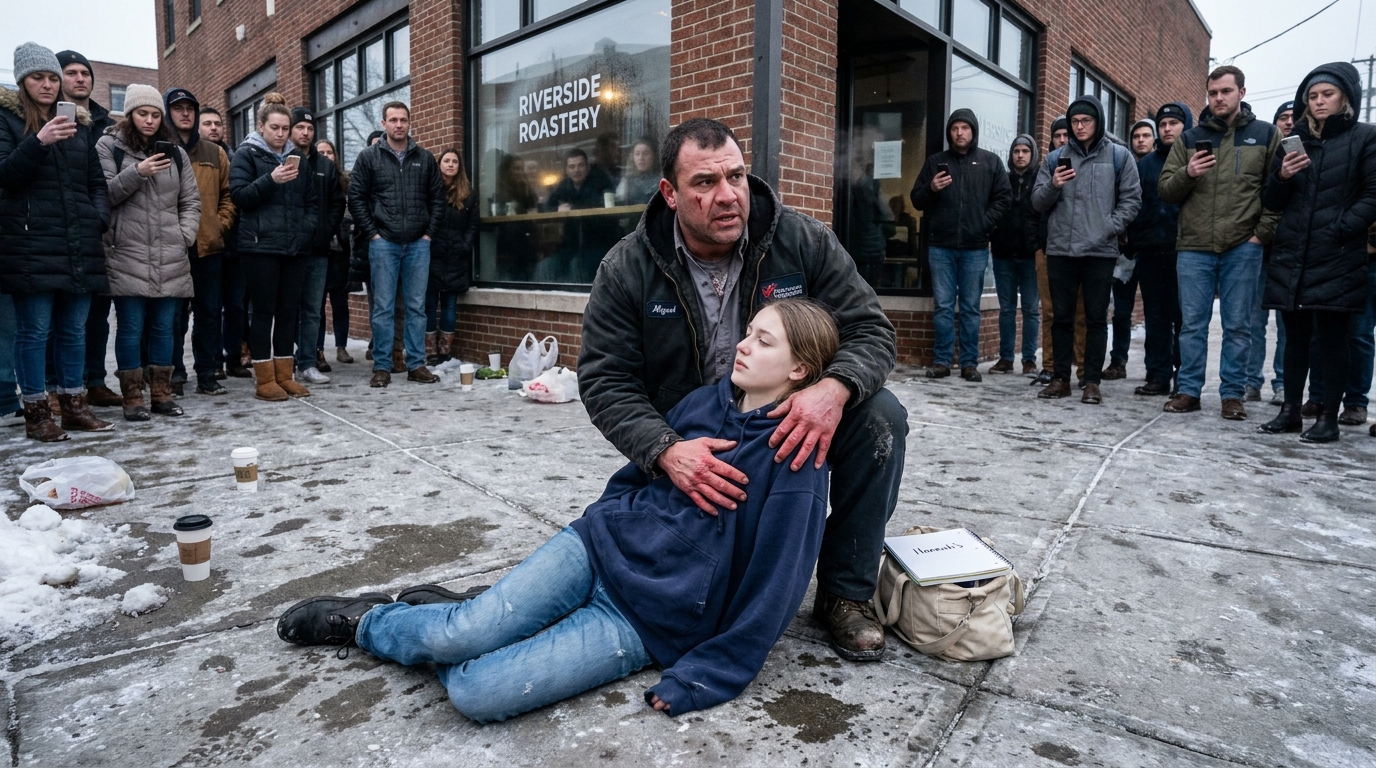
Around us, a wall of thirty strangers stood glued to the sidewalk outside Riverside Roastery.
None of them moved forward. None of them offered a coat.
Instead, a dozens of smartphone lenses stared back at me, glowing quietly in the gray Saturday morning light.
They weren’t helping; they were recording a tragedy for their feeds.
I reached up with one cold-numbed thumb and squeezed the heavy brass nurse’s penlight tucked inside my frayed navy hoodie.
It was my mother’s light—worn smooth along the barrel from fifteen years in the Cincinnati ER—and pressing its rigid brass casing into my palm was the only thing keeping my head from spinning into blackness.
My lungs burned with the first sharp clawing of pneumonia, but I couldn’t stop compressions.
My mother had drilled the rhythm into my brain when I was twelve years old: thirty compressions, two breaths, don’t stop until someone else takes over.
On compressions twenty-four and twenty-five, a heavy boot crunched hard onto the ice beside my knee.
“Step back, kid. Let me look at her.”
The voice was low, clipped, and echoed with absolute command.
I looked up through blurred vision into the face of a broad-shouldered man wearing a dark work jacket over a scarred gray shirt.
His knuckles were calloused, his eyes sharp and analytical as he immediately dropped to one knee beside the girl.
“Is she breathing?” he asked, his fingers already sliding against her neck to find a carotid pulse.
“No,” I choked out, my teeth chattering uncontrollably. “No pulse. I’ve been… eight minutes.”
He didn’t waste a second. “I’m Miguel. Former Marine medic. Take a breath, kid. I’ve got the chest now.”
He shifted his weight seamlessly into position, taking over the compressions with smooth, powerful drives.
As he worked, his sharp eyes swept over me—taking in my pinned-together sneakers, my skeletal frame, and the raw, purple rope burns circling both of my exposed wrists.
A sharp gasp suddenly tore from the girl’s throat, her chest heaving as air rushed back into her lungs.
Miguel let out a heavy breath, immediately rolling his daughter onto her side into the recovery position as distant sirens finally began to wail down Elm Street.
“She’s breathing,” Miguel said, turning his head toward me.
He didn’t look at the crowd or their glowing phones; he looked directly at the deep bruises on my arm and the way I instinctively flinched when he reached toward his back pocket.
Instead of a threat, he pulled off his thick flannel-lined canvas coat and draped it across my shivering shoulders.
“You saved my daughter’s life,” he said quietly, his voice carrying a cold, steady weight. “What’s your name, kid?”
“Hannah,” I managed to whisper, pulling his warm coat tight around my chest. “Hannah Cole.”
“Well, Hannah,” Miguel said, watching the ambulance pull up to the curb. “You’re shivering, your wrist is broken, and somebody did a number on you. You’re coming to the clinic with us.”
“I can’t go to a public hospital,” I blurted out, terror instantly cutting through the exhaustion. “If they run my name, they’ll call Marcus. He’ll take me back to the basement.”
Miguel stopped in his tracks, his dark eyes narrowing into slits. “Who is Marcus?”
I reached into my canvas bag, my fingers locking around the battering edges of my mother’s old spiral notebook.
“My guardian,” I said, my voice cracking against the wind. “He’s waiting for me to freeze so he can take the rest of my mother’s money.”
CHAPTER 2: THE PAPER TRAIL
The sterile smell of rubbing alcohol and industrial bleach hit my throat, forcing a harsh, shallow cough that rattled deep in my lungs.
“Take it easy,” Miguel said, his heavy hand resting on the small of my back just enough to keep me upright as he guided me down the tiled hallway.
A woman in scrubs stepped out of an examination room, her sharp eyes sweeping from Miguel’s daughter on the gurney to the way I favored my left side.
“Room three,” Dr. Elena Morales said, her tone leaving no room for argument as she gestured toward the open door. “Get her on the table, Miguel. She’s breathing too shallow.”
I sat on the edge of the examination table, the thin paper crinkling under my jeans as I pulled my mother’s battered spiral notebook out of my canvas bag and set it flat on my lap.
Dr. Morales gently eased the sleeve of my oversized navy hoodie back, her fingers pausing the moment the frayed cuff cleared my left wrist.
The skin was a mottled patchwork of jagged, purple-and-white rope burns, crisscrossed over a swollen, misaligned bone that stuck out at an unnatural angle.
“This fracture was never set,” Dr. Morales said quietly, her thumb pressing lightly against the surrounding tissue. “Eleven months old. And these marks are from prolonged restraint.”
“He used nylon paracord,” I said, looking straight at the small brass penlight resting against my thigh. “When I tried to use the landline in the kitchen last summer, he locked the basement door and tied my hands to the water pipe for three days.”
Miguel stood by the door, his large frame blocking the hallway light, his jaw working silently as he listened.
“I kept dates,” I added, flipping the crinkled pages of the notebook with my good hand to show the tight, meticulous handwriting. “Every withdrawal from my mother’s trust account. Every time Marcus spoke to his lawyer on the speakerphone upstairs while I was under the floorboards.”
Dr. Morales pulled a digital camera from a drawer and began taking precise, high-resolution photographs of the crooked wrist, the scars, and the sharp outline of my collarbones sticking out beneath my skin.
“Her BMI is under fifteen,” Dr. Morales told Miguel without looking up. “Advanced malnutrition and early-stage lobar pneumonia. If she’d stayed on the streets another week, her organs would have started shutting down.”
“He didn’t want me to stay in the basement forever,” I said, my voice dropping to a flat whisper as I tapped a specific entry in the ledger. “He stopped bringing down food in January because it was easier to let the winter do it. Once I escaped, he didn’t even file a missing person report until twenty days later—and he logged me as a habitual runaway with psychological delusions.”
A soft click echoed in the small room as Dr. Morales set the camera down.
She reached into her coat pocket and pulled out a clean manila folder, sliding a copy of an old document across the paper-covered table toward me.
“When you mentioned your mother’s name outside, I had our record clerk pull the archive from the county system,” Dr. Morales said, her voice uncharacteristically grim. “Your mother was Evelyn Cole, correct?”
I nodded once, my chest tightening. “She was an ER nurse at St. Jude’s.”
“This is the police intake summary from the night of her car crash fourteen months ago,” she said, tapping the corner of the top page. “The initial responding officer logged it as black ice, but tucked into the sub-file is a single-page addendum from the municipal garage mechanic.”
I reached out with my right hand, pulling the page into the light.
Under the section marked Mechanical Inspection, a single sentence stood out in bold type: Vehicle brake lines show severe localized shear wear inconsistent with vehicle age; recommend immediate forensic laboratory review.
“That review was never ordered,” Dr. Morales added, looking over at Miguel. “Marcus Web signed the vehicle release forty-eight hours later and had the car crushed for scrap.”
I stared at the black ink on the page, my pulse hammering in my ears like a distant drum.
Marcus hadn’t just waited for me to freeze on the sidewalk to collect the remaining fifty-three thousand dollars of the trust.
He had cut my mother’s brakes to get the first hundred and eighty thousand.
“He took everything she left me,” I whispered, my fingers clenching around the brass penlight until my knuckles turned stark white. “And he’s going to use her money to buy his way out if he knows I’m here.”
Miguel took one step forward, the floorboards groaning under his weight as he looked down at the police report on the table.
“He’s not buying anything,” Miguel said, his voice flat and iron-hard. “He thinks you’re just a ghost on the street with no family left to speak up. He doesn’t know you left a trail.”
CHAPTER 3: FRAGMENTED WHISPERS
A man in a navy blue suit stepped past Miguel, setting a heavy leather briefcase onto the small wooden desk.
“I’m Frank Dalton,” he said, pulling out a yellow notepad without sitting down. “I ran homicide in the first district for twenty years before I retired. Miguel called me twenty minutes ago.”
Dr. Morales tapped the digital printouts resting on her tray. “Her wrist has a malunion fracture, Frank. Deep ligature scars on both forearms, severe malnutrition, and a lung infection. She’s seventeen.”
Frank clicked an old ballpoint pen, his eyes scanning the worn pages of my mother’s spiral notebook spread across the desk.
“The physical evidence is clear,” Frank said, his voice clipped and dry. “But if we walk into a prosecutor’s office today with just an ER report, Marcus Webb’s defense attorney will call it a runaway’s fabrication within five minutes.”
“He filed a fake CPS clearance,” I said, leaning forward as a sharp stitch burned in my side. “Eight months ago. A caseworker named Thomas Reed came to the house.”
Frank paused, his pen hovering over the paper. “Did he speak to you alone?”
“No,” I said, pressing the brass penlight against the desk surface to stop my thumb from shaking. “Marcus stood right behind the couch the whole time. He told the man I had behavioral issues and that I made up stories about my mother. The caseworker didn’t even walk down the hallway to check the basement.”
Frank made a quick mark on his pad. “And the police?”
“Six months ago I ran to the District One precinct,” I said. “The desk officer didn’t write anything down. He called Marcus directly. When Marcus arrived with guardianship papers, the officer told me to stop wasting city resources and handed me right back to him.”
Miguel leaned his back against the closed door, his arms crossed tight across his chest. “So the system handed her back to her mother’s killer.”
“The system runs on paperwork and path-of-least-resistance,” Frank said quietly, turning to a fresh page. “Which means we don’t rely on the system to do the digging. We do it ourselves.”
He picked up the copy of the mechanic’s report, thumbing the edge where the signature line remained blank.
“Mrs. Wells lives right next door to Marcus on Thornhill Drive,” Frank said, looking directly at me. “She’s lived there thirty years. Did she ever see you?”
“She saw me getting the mail last June,” I said. “I had bruises on my shoulders. She looked right at me, but Marcus came out on the porch and smiled at her, and she just went back inside.”
“Then she’s going on record,” Frank said, pulling a pocket voice recorder from his coat and setting it on the desk. “People stay quiet because it’s comfortable. They stop staying quiet when an investigator sits on their living room sofa with a recorded statement.”
“And the high school?” Miguel asked.
“Daniel Chen,” I said, the name coming out before I could think. “My tenth-grade teacher. He logged a abuse report with the principal two weeks before Marcus pulled me out for ‘homeschooling.'”
Frank snapped his notepad shut with a sharp, echoing slap against the wood.
“That’s three independent points of failure,” Frank said, his eyes hard as flint. “A caseworker who skipped inspection protocol, a desk officer who failed to log a minor’s report, and a teacher whose warning was buried by an administrator.”
He reached out and picked up the voice recorder, slipping it back into his pocket alongside his pen.
“We gather those three statements before the sun sets,” Frank said. “When Marcus Webb realizes the paper wall he built is falling down, he’s going to panic.”
“Let him panic,” Miguel said, his voice dropping into a low, icy quiet. “An arrogant man only makes mistakes when he thinks he’s running out of room.”
CHAPTER 4: THE SEALED BASEMENT
“We don’t wait for him to scrub the bank servers,” Frank said, resting his hand flat on the doorframe. “If he thinks he’s only facing an inquiry about a missing teenager, he’ll move the remaining balance before nightfall.”
“He already paid off his mortgage,” I said, thumbing the edge of my mother’s brass penlight where it sat against my leg. “Last September. A hundred and twenty-seven thousand dollars left the trust account in three separate lump wire transfers.”
Dr. Morales pulled a second printout from the manila folder on her desk and slid it across to Frank.
“That matches the county recorder’s filing,” she said, her finger tracing a highlighted line near the bottom. “The lien on the Thornhill Drive property was satisfied thirty days after Evelyn Cole’s funeral. He didn’t even wait for the probate judge to sign off on the full estate executor status.”
Frank took the paper, his eyes narrowing as he read the transaction dates against the handwritten ledger in my mother’s spiral notebook.
“A hundred and twenty-seven thousand out of one hundred and eighty thousand,” Frank said softly, his voice dropping an octave into cold calculation. “And the rest sits in a high-yield holding account that rolls over directly to the designated trustee the moment the minor turns eighteen—or passes away.”
“He told someone on the phone in January that nature would take its course,” I said, my teeth catching my lower lip as the memory surfaced sharp and clear. “I heard him through the floor vent in the kitchen. He said the remaining fifty-three thousand would cover his business debts once the winter was over.”
Miguel stepped out from the doorway, his boots making a dull, heavy thud against the tile as he pulled his heavy work jacket back over his broad shoulders.
“That’s not just embezzlement,” Miguel said, turning to Frank. “That’s a calculated timeline. He engineered the entire environment to make sure she didn’t see November.”
“And he used her mother’s life insurance to fund the whole setup,” Frank said, snapping his notepad back open to write down two specific account numbers. “The initial payout went straight into a single-signatory account under his name as trustee. He didn’t set up a dual-authorization minor’s trust like the probate court mandated.”
He looked over at me, his gaze holding steady.
“Hannah, when you escaped nine months ago, did you lock the basement door behind you?”
“No,” I whispered. “The latch was rusted. I used a bent screwdriver to pop the striker plate out of the frame while he was outside working on his truck.”
“So the padlock is still hanging on the pantry door,” Frank said. “And the eyehooks he set into the exposed ceiling joists above the hot water heater are still there.”
“They’re still there,” I confirmed, my fingers tightening around the brass penlight until my palm throbbed. “He never took them down because he didn’t think anyone would ever walk down those steps with a search warrant.”
Frank carefully packed the mechanic’s report, the forensic financial summary, and my mother’s notebook into his briefcase, pulling the leather straps tight.
“He built a cage and thought the town’s indifference would keep the door locked,” Frank said, stepping into the hallway. “Now we take this paper trail directly to Hamilton County Prosecutor Rachel Monroe before he realizes the lock is broken.”
CHAPTER 5: THE TRAP AT THORNHILL DRIVE
The gravel driveway at 2847 Thornhill Drive crunched under the tires of Detective Rachel Monroe’s unmarked sedan.
Marcus Webb stood beside his brand-new Ford F-150 in a pressed polo shirt, holding a socket wrench over the open engine bay.
He didn’t drop the wrench when Detective Monroe stepped out of the cruiser with Frank Dalton right behind her.
Instead, he wiped his hands on a grease rag, a slow, practiced smile spreading across his face.
“Frank,” Marcus said, his voice dripping with neighborly condescension. “If this is about my stepdaughter again, I already told the patrol officers. She ran away last June. She has severe psychological issues, and I’ve been cooperating fully with CPS.”
Frank didn’t return the smile. He reached into his coat pocket and pulled out a fresh stack of court-certified affidavits.
“Thomas Reed filed his amended statement two hours ago, Marcus,” Frank said, his voice flat and steady. “He admitted under oath that he never inspected the basement, and that you personally barred him from speaking to Hannah alone.”
Marcus’s jaw twitched, the rag pausing mid-wipe against his knuckles. “Thomas Reed is covering his own neck for a sloppy case file. That doesn’t prove a thing.”
Detective Monroe stepped forward, unclipping a thick manila folder from her belt clip.
“We pulled the bank records from First National,” Monroe said. “One hundred and twenty-seven thousand dollars withdrawn from Hannah Cole’s minor trust account. Three wire transfers straight to your personal mortgage lender and a local casino marker.”
“I am the legal trustee,” Marcus snapped, his tone instantly sharpening as he stepped away from the truck. “I spent that money maintaining the household for an ungrateful delinquent! Every cent was authorized under the guardianship provisions!”
“Not when the probate court mandated dual-signature authorization,” Frank countered, pulling out a copy of the mechanical forensic report. “And certainly not when you bought this truck six weeks after Evelyn Cole’s brake line suffered internal shear wear.”
Marcus’s face went pale, then flushed a dark, mottled red.
He thrust his finger directly into Frank’s chest, his voice echoing down the quiet suburban street. “You think you can come onto my property with expired police credentials and intimidate me? She’s a street kid! She’s malnourished, she’s lying, and no judge in Hamilton County is going to take the word of a runaway over a deacon of the church!”
“She’s not alone anymore, Marcus,” Detective Monroe said, pulling her cuffs from her utility belt with a sharp, metallic click. “And Mrs. Wells next door just finished signing her statement regarding the cries coming from your basement floor vents.”
Marcus took a fast step backward toward the open garage door, his knuckles white around the heavy steel socket wrench.
“This is a witch hunt!” Marcus shouted, his eyes darting frantically toward his house keys resting on the workbench. “She ran away! I didn’t touch her! You can’t prove a single word of this!”
“Turn around and put your hands behind your back, Marcus,” Detective Monroe commanded, her voice dropping into an absolute, unyielding line. “You’re under arrest for grand theft, felony child endangerment, and premeditated fraud.”
He didn’t turn around. He held the wrench tight at his hip, his chest heaving as he glared at the paper trail spread across the hood of his truck.
CHAPTER 6: THE UNBROKEN LEDGER
“Drop the tool, Marcus,” Detective Monroe said, her voice cutting through the garage chill without a trace of hesitation.
A sharp gasp hitched in Marcus’s throat as he looked past her, realizing Frank Dalton was recording every second on a small hand-held camera.
The heavy steel wrench clattered against the oil-stained concrete floor.
Marcus swung his arms behind his back, his face contorted in a dark, bitter sneer as the steel cuffs snapped shut over his wrists.
“You think this holds up?” Marcus spat, staring directly at Frank as he was guided toward the back seat of the cruiser. “It’s my word against a homeless runaway! My lawyer will tear your little notebook to shreds before the preliminary hearing!”
“The grand jury already reviewed the forensic bank audits this morning,” Detective Monroe said, pushing his head down gently as he slid onto the vinyl seat. “And the prosecutor added two counts of grand larceny before we drove out here.”
The cruiser door slammed shut with a heavy, final thud.
Sitting inside the warmth of Miguel’s truck three blocks away, I watched the red taillights disappear down Thornhill Drive.
My right hand rested in my lap, my thumb slowly tracing the cool, raised lettering along the barrel of my mother’s brass penlight.
The malunion in my left wrist still throbbed with the changing weather, but the sharp, suffocating weight that had rested on my chest for nine months was gone.
Dr. Morales slid a fresh intake clipboard onto the console between us, pointing to the line marked Patient Representative Signature.
“The court assigned temporary medical guardianship to the clinic until your eighteenth birthday,” Dr. Morales said gently. “Your physical therapy starts Monday, Hannah. We’re setting that wrist right.”
“And the remaining balance in the holding account?” I asked, looking up at Miguel.
“Restraining order executed,” Miguel said, turning the key in the ignition. “The probate judge frozen every account under his name. The rest of your mother’s insurance stays right where she wanted it—for your education.”
I pulled the cap off a clean black pen and signed my full name across the bottom of the intake form—Hannah Cole.
The ink dried dark and permanent against the white paper.
I clicked the brass penlight once, watching its bright, focused beam illuminate the dashboard in front of me, steady and unbroken in the quiet afternoon air.