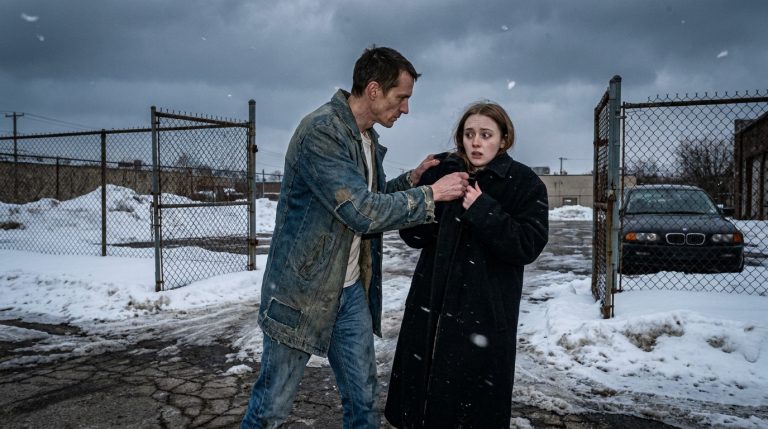
The cost of maintaining a crumbling foundation is paid in the sweat of those the system forgot.
CHAPTER 1: THE WEIGHT OF DUST
The heat of the low Georgia sun didn’t strike; it pressed, heavy and thick as wet wool, settling into the frayed cotton of Ben Carter’s shirt. The grease on his knuckles was cool against the hot iron of the truck’s engine block, a familiar, grounding bite. Beneath his boots, the gravel of the shoulder gave way to dry, orange clay that puffed into small clouds whenever his weight shifted. Through the cracked passenger window of his own Ford forty feet away, he could hear the faint, repetitive hum of Logan’s plastic juice bottle ticking against his small teeth. The boy was watching. He was always watching, measuring the world by the steadiness of his father’s shoulders.
“Your own roof is weeping every time the clouds bruise, Carter, but sure—go ahead and sweat for a ghost who won’t pay you a dime.”
Mr. Dobs didn’t stop walking. He just slowed his pace along the edge of the asphalt, his shadow stretching long and distorted across the weeds. His old work boots were clean—polished with the defensive vanity of a man who spent his retirement monitoring his neighbors’ lawns from behind sun-bleached curtains.
Ben didn’t lift his chin. He let the words slide into the dust with the scrapings of rust he was digging from the stranger’s battery terminal. He used the flat edge of a worn 1/2-inch socket wrench, its steel silvered down to the base alloy by years of his own palms. He didn’t have the breath to waste on Dobs. Every movement had to be rationed now; the grocery bags in his own truck bed were sweating through their brown paper, the cheap margarine turning soft.
Beside him, the old man in the mud-stained jacket stood entirely still. He hadn’t reached for a cigarette, hadn’t looked at his watch, and hadn’t muttered a single curse since Ben had pulled over. Most drivers on Route 9 had an manic edge when their engines died—a desperate need to blame the sky or the oil company. This one simply watched Ben’s fingers with a cold, geometric focus.
“The terminal’s starved,” Ben said, his voice low, matching the rhythm of the wrench. “The copper’s gone green inside the lead casing. It’s drawing juice, but it can’t bridge the gap to the starter.”
The stranger nodded once. The movement was small, precise, and lacked the casual slouch of the local farmers. The fabric of his jacket was stained, yes, but the collar was stiff, unfrayed, and tucked perfectly against his throat despite the stifling heat.
Ben leaned deeper into the engine bay, his forearm brushing against the radiator hose. It was hot, but the pressure was wrong. His eyes narrowed. Tucked deep beneath the frame rail, right where the primary wiring harness met the fire wall, was a small, black plastic module. It didn’t belong to a twenty-year-old farm truck. The plastic was fresh, matte, and bore a serial number stamped in military-grade silver ink. A high-frequency signal transponder, wired directly into the ignition bypass.
Ben’s thumb caught the edge of the module. It shouldn’t be here. The truck hadn’t stalled because of age; the circuit had been cut from the inside out.
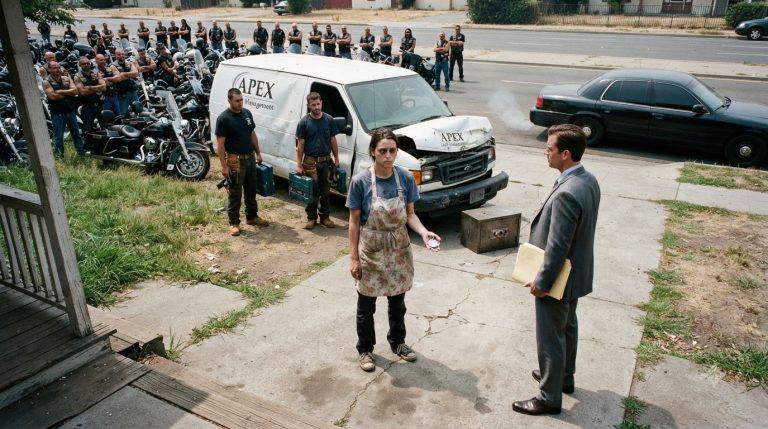
He didn’t speak. He tightened the battery clamp until the lead groaned, then reached down to pull his rag from his back pocket. As he wiped the black grease from his palm, the sound of three synchronized engines cutting through the valley’s silence made the metal under his hand vibrate. Three black SUVs, windows blacked out to the trim, rounded the bend, slowing to a precise, calculated halt right behind his rusted Ford.
CHAPTER 2: THE HORIZON SHIFTS
The vibration didn’t stop in the frame rail of the old farm truck. It traveled up through the handle of Ben’s wrench, settling into the marrow of his collarbone with a low, hydraulic hum that he hadn’t felt since the motor pools of Fort Stewart. The air between the vehicles grew thick, smelling suddenly of premium diesel exhaust and sun-baked asphalt. Behind the tinted glass of the lead SUV, the glare of the Georgia afternoon turned the windshield into a sheet of silver foil, completely masking the faces within.
Ben kept his hand on the radiator wall. His boots didn’t shift in the orange dirt, but his fingers slipped down an inch, masking the small, non-standard transponder module beneath the cuff of his grease-streaked sleeve. The sudden, rhythmic clicking of three heavy passenger doors opening in unison cut through the idling rumble of the truck engine.
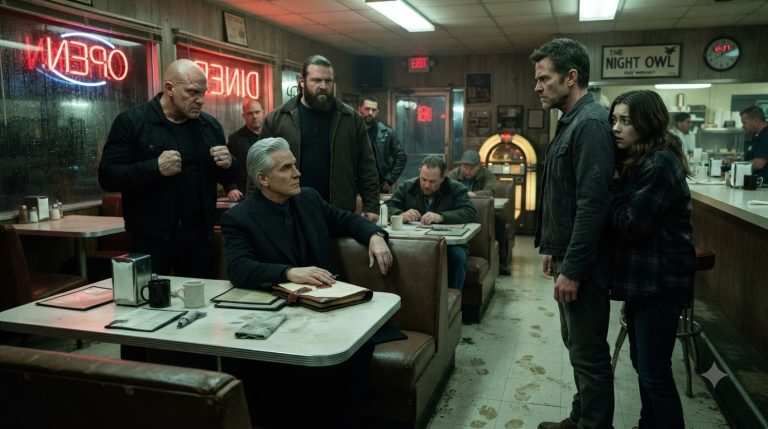
From the center vehicle, a man stepped out into the dust. His movements were fluid, devoid of the stiff-backed hesitation common among town bureaucrats, yet marked by a precision that Ben recognized instantly. He was tall, his hair a clean, clipped shelf of silver that caught the sharp light. His plain-clothes attire—a charcoal polo shirt and dark trousers—carried no explicit markings, but the lack of a crease in his collar and the calculated way his eyes swept the tree line spoke of a uniform recently laid aside. Two other men emerged from the flanking vehicles, their postures identical, hands resting lightly near their waistlines, their gazes parsing the roadside with professional indifference.
A sudden, sharp memory flared behind Ben’s eyes—the quiet, clinical row of white medical transport vans parked outside the oncology ward three years ago, their engines idling with that same indifferent, rhythmic hum while the nurses prepared Melissa’s final release forms. The weight of that faded, sterile memory pressed against his chest, dry and heavy as paper. He forced it down, his grip tightening on the iron wrench until the knurling bit into his palm.
The silver-haired man approached the shoulder of the road, his boots crunching deliberately through the gravel. He stopped exactly four feet away, a distance that allowed him to overlook the old truck’s engine bay without crowding Ben’s reach. He pulled a small leather folder from his pocket, unfolding it with a single, practiced snap of his thumb to reveal the laminated credentials within.
“Mr. Carter,” the man said. His voice was flat, tempered by years of shouting over turbines but delivered now in a low, controlled register that didn’t carry toward the road where Dobs stood watching. “My name is Lieutenant Colonel Samuel Whitaker, formerly with Joint Special Operations Command. We’re here on behalf of the Veteran Personnel Outreach Division. Someone you met yesterday would like to speak with you.”
Ben’s jaw remained set. He looked past Whitaker’s shoulder toward his own Ford, where Logan’s small face was still pressed against the glass, the juice bottle held slack in his hands. The boy’s eyes were wide, reflecting the long, black flanks of the government convoy. The economic precarity of the last three months—the red notices on the kitchen counter, the peeling weatherstripping on the porch, the calculation of pennies at the Henderson’s grocery counter—crystallized into a cold, protective instinct.
“I don’t have any outstanding business with the division, Colonel,” Ben said, his tone dry and thin as pine shavings. “My discharge was finalized three years ago. The paperwork is clear.”
“The paperwork isn’t why we’re here, Sergeant,” Whitaker replied. He didn’t offer a hand. Instead, his gaze dropped to the wrench in Ben’s hand, then to the green-crusted battery terminal that was now humming with clean, restored voltage. “The man you assisted yesterday doesn’t like to leave his machinery unfinished.”
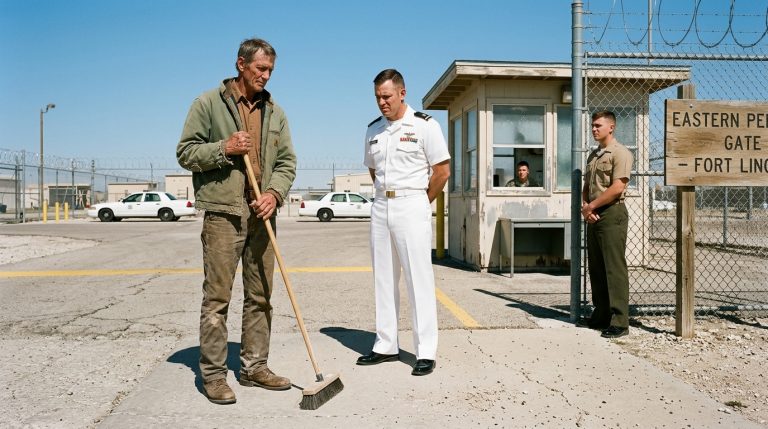
From the rear door of the second SUV, a figures emerged. The mud-stained jacket from the previous evening was gone, replaced by a gray blazer that fit the broad, slightly slouched line of the man’s shoulders with military tailoring. His gray hair was parted cleanly, and his boots, though plain, carried the high, mirror-like gloss of old leather that had seen decades of grease and floor polish.
General Nathaniel Caldwell walked with a slight, favored limp on his left side—the subtle structural legacy of an old mortar fragment—but his eyes remained fixed on Ben with the same detached, evaluating intensity that had broken the silence on the highway twenty-four hours prior.
Ben stood up fully, his spine straightening by reflex before his mind could check the habit. The silver wrench hung at his side, its cold iron a dead weight against his thigh.
“Ben Carter,” Caldwell said, his voice carrying the deep, gravelly resonance of a man accustomed to briefing congressional committees in rooms three times this size. “I’m General Nathaniel Caldwell, retired. I served as commander of operations in Afghanistan, and currently advise the Department of Defense on infrastructure resilience. Yesterday, you spent forty minutes in the dirt fixing an alternator without asking for a registration or a name.”
“You needed a bridge to the starter, sir,” Ben said, the ‘sir’ slipping out before he could catch it, smooth and worn from a decade of service. “That’s all.”
“Exactly,” Caldwell said, his face softening into a brief, geometric smile that didn’t reach the tight lines around his eyes. He glanced past Ben toward the peeling green paint of the Ford, then toward the small house visible through the low gap in the pine trees down the road. “And that’s precisely why the Colonel and I took the long route through Thomas this morning. May we come inside? We have an operational blueprint that requires a specific kind of hand.”
Ben looked down at his fingers, where the black grease had settled into the cracks of his skin like ink. He could smell the ozone from the truck’s cooling system and the faint, sweet scent of the pine needles cooking in the ditch. The horizon felt smaller now, bounded by the long, dark shapes of the vehicles that had rewritten the texture of his quiet street in a matter of minutes.
“The kitchen’s small, General,” Ben said quietly, turning toward his truck to unbuckle Logan. “And the roof leaks if the wind comes from the east. But the door’s unlocked.”
CHAPTER 3: THE BROKEN KITCHEN
The latch on the Ford’s rear door gave way with a dry, mechanical click that felt loud against the low idling thrum of the three black SUVs. Ben reached into the cab, his large, grease-darkened hands contrasting sharply with the faded blue fabric of Logan’s car seat harness. The boy didn’t move initially; his small fingers remained wrapped around the plastic juice bottle, his wide eyes scanning the tall silhouettes of Lieutenant Colonel Whitaker and General Caldwell over his father’s shoulder. Ben offered a slow, deliberate nod—the silent reassurance he had practiced on every difficult morning since Melissa’s passing. Logan let go of the bottle, allowing himself to be hoisted into the crook of Ben’s arm, his small chin nesting naturally into the worn seam of Ben’s denim shirt.
The walk down the short gravel driveway was measured. Ben carried the boy’s weight evenly, his work boots kicking up tiny plumes of orange dust that quickly dissolved in the heavy Georgia air. Behind him, the synchronized sound of Caldwell’s slightly limping stride and Whitaker’s crisp, unhurried footsteps followed in near-perfect cadence. Nobody spoke. The neighborhood seemed to have drawn a collective breath; even the harsh, rhythmic rattle of a cicada in the high pines felt distant, muffled by the presence of the idling convoy at the curb.
When Ben stepped onto the porch, the lowest wooden step groaned under the combined weight, its old pine fibers yielding with a soft, splitting friction that reminded him of the unpatched roof directly overhead. He pushed the screen door open with his elbow, letting the spring snap it shut behind the two officers.
The interior of the house smelled of old linoleum, cold instant coffee, and the faint, sweet trace of the apple slices he had prepped for breakfast. Sunlight slanted sharply through the yellowing lace curtains Melissa had chosen years ago, throwing a crosshatch pattern across the stack of past-due utility notices resting on the corner of the small laminate table. Ben didn’t try to hide them. He carried Logan straight to the narrow hallway, setting him down gently by the threshold of his small bedroom.
“Go find the blue tractor, buddy,” Ben murmured, his voice softening into that low, gravelly register reserved only for the house. “I need to talk shop with these gentlemen for a minute.”
Logan blinked, looked past Ben’s hip at the silver-haired men standing in his kitchen, and then slid silently into his room, the door clicking shut with a soft click of the latch.
Ben turned back to face the room. General Caldwell had already removed his gray blazer, draping it neatly over the back of one of the chipped ceramic-and-chrome kitchen chairs. He sat down without invitation, his broad shoulders settling into the frame with the practiced ease of an officer who had occupied drafty field tents from Bagram to Fort Bragg. Whitaker remained standing by the narrow screen door, his back to the mesh, his hands clasped loosely at his front—not blocking the exit, but monitoring it with an unblinking, geometric vigilance.
“Your boy has his mother’s eyes, Ben,” Caldwell said. He didn’t look up immediately; his fingers were tracing a faint, circular water stain on the table’s edge where an old mug had rested for months. “Melissa was a meticulous planner. She understood structural integrity, whether it was in a calculus proof or an engineering battalion.”
The mention of her name in this room, by a man who had never crossed their threshold while she was breathing, made the skin across Ben’s knuckles tighten. He walked over to the old porcelain sink, turning the cold tap to rinse the residual black grease from his palms. The pipes rattled within the wall, a deep, hollow shudder that took ten seconds to pass before a thin stream of clear water broke through.
“You didn’t track me down to talk about school boards, General,” Ben said, keeping his back turned as he scrubbed his hands with a block of coarse pumice soap. “And you didn’t rig a high-frequency transponder to cut your own fuel injector just to see if a broke mechanic would pull over on Route 9.”
A short, dry silence followed, broken only by the rhythmic scraping of the soap against Ben’s calloused palms.
Behind him, Caldwell let out a slow, approving breath that was closer to a sigh than a chuckle. “Whitaker told me you’d spot the module within thirty seconds. I told him twenty. It seems we both underestimated the First Armored’s maintenance standards.”
Ben shut off the tap, the brass valve grinding tightly under his thumb. He took down a frayed linen towel from the wooden peg, drying his fingers with deliberate precision before turning around to face the table. He stood by the counter, his frame casting a long shadow across the linoleum toward Caldwell’s chair.
“Why the theater, sir?” Ben asked, his tone transactional, stripped of any defensive anger. “If the Department of Defense needs an infrastructure assessment or a logistics foreman, you send a letter or an agent from the VA. You don’t bring three armored vehicles to a dirt road in Thomas unless you’re trying to bypass a system that’s already watching.”
Caldwell looked up then, his grey eyes perfectly clear beneath his heavy brows. He slid his hand into the interior pocket of his discarded blazer and withdrew a thick, white bond envelope. It didn’t carry the standard Department of Defense seal or a government routing barcode; the exterior was entirely blank, its edges crisp and heavy enough to resist the damp heat of the room. He placed it precisely on top of the stacked utility notices.
“The system isn’t watching, Ben—the system is what’s failing,” Caldwell said, his voice dropping into a low, resonant register that seemed to absorb the small kitchen’s ambient hum. “The Veteran Technical Corps isn’t a standard civil service program. It’s an insulated pilot initiative funded through a selective infrastructure defense allocation. We aren’t recruiting from universities or corporate consulting firms. We’re looking for men who can look at a failing municipal grid or a compromised water line and see a tactical repair, not a budget line item.”
Ben’s gaze dropped to the envelope. The paper seemed to hold a specific, silent weight between them, a bridge over the economic quicksand that had been pulling at his boots for thirty-six months.
“The salary inside that envelope is eighty-five thousand a year to start,” Caldwell continued, his eyes remaining fixed on Ben’s face, charting every micro-movement of his jaw. “Full medical coverage for you and Logan. A housing stipend that clears you out of this county within forty-eight hours, and an educational trust that guarantees the boy’s tuition anywhere in the state. No traditional credentials required. Just your toolbox, your discharge code, and your signature.”
Ben didn’t reach for the paper. He could hear Logan in the next room, the faint, wooden clack of a toy wheel striking the baseboard. The warmth of the kitchen seemed to rise from the floorboards, carrying the dry smell of old pine and the memory of Melissa sitting in that exact same chair, recalculating their meager savings on a yellow legal pad while her hair began to thin from the first round of treatments. She had always told him that true leverage never came from an easy loan; it came from knowing exactly who held the other end of the iron bar.
“Who’s funding the allocation, General?” Ben asked softly. He leaned his hips back against the porcelain edge of the sink, crossing his forearms over his chest. “The government doesn’t pay triple the market rate for a mechanic out of charity. Not even for a veteran.”
Whitaker shifted his weight by the door, his eyes darting toward Caldwell for a fraction of a second before returning to the screen mesh.
“The funding is private-public partnership, authorized under Section 4 of the Emergency Infrastructure Act,” Caldwell said, his expression completely flat, his voice steady as a dial tone. “Large-scale domestic utilities are moving toward autonomous security frameworks, Ben. They need operational field directors who don’t rattle when the grid goes dark. You’ve got forty-eight hours to look over the logistical schedule. The first assessment team assembles in Atlanta on the first of the month.”
Caldwell stood up, retrieving his blazer from the chair and slinging it over his arm with a single, smooth motion. He looked toward the hallway door once, then back at Ben. “Bring your tools, Sergeant. The country’s rotting from the foundation up, and I don’t intend to let the rust take everything before we start turning the bolts.”
Ben didn’t move as the two men walked out onto the porch, the screen door clicking shut with its usual loose rattle. He stood in the quiet kitchen, watching the long shadows of the black SUVs slowly pull away from the curb through the yellowed lace of the window, his hand slowly reaching out to touch the heavy, blank envelope on the table.
CHAPTER 4: THE CORE REVEALED
The text on the heavy white paper didn’t shift, but the light hit it differently under the unblinking flicker of the institutional fluorescent bulbs. Ben’s thumb rested against the crisp edge of the document folder, his calloused skin catching on the fibrous grain of the high-grade stock. The quiet kitchen in Thomas, Georgia, with its peeling green trim and groaning floorboards, had been left behind through a series of early-morning bus rides and gray interstate miles that he had forced his body to endure step-by-step, refusing to let his mind skip the physical reality of the distance. Now, the smell of burnt instant coffee was replaced by the sharp, sterile bite of industrial degreaser and wet concrete rising from the floor of the Atlanta logistics terminal.
Across the wide steel desk, the orientation materials were stacked in precise, uniform columns, their layout mimicking the exact block-paragraph architecture of an Army field manual. Yet, as Ben slowly turned the third leaf of the operational handbook, his eyes stopped on a small, pale indentation near the binding margin. It wasn’t a standard Department of Defense indexing stamp. It was a faint, circular watermark—a geometric emblem of a local North Georgia teachers’ collective that Melissa had belonged to during her final two years at the academy.
Ben leaned forward, his forearms flattening against the cool metal desk. The texture of the paper under his fingers felt suddenly fragile, its edges slightly frayed where the heavy binding machine had crimped the margins. He traced the curvature of a logistics diagram detailing the regional water-line redundancies for the Piedmont sector. The calculus used to balance the flow equations didn’t look like the standard, bloated templates used by federal contractors. It was structured with a specific, elegant minimalism—curriculums broken down into modular units, each lesson plan mapped with small, hand-drawn annotations that had been scanned and digitized into the official technical manual. In the lower-right corner of the index leaf, hidden beneath a grey institutional bar code, were three tiny, initials printed in a light gray drafting font: M.E.C. Melissa Elena Carter.
The breath caught in his throat, dry and tasting of the chalky dust that drifted through the high vents of the terminal. The room seemed to expand, the distant clatter of iron wrenches and the low hum of defensive transport vehicles out in the staging yard fading into an absolute, localized silence.
“Sergeant Carter.”
Lieutenant Colonel Whitaker’s voice broke the stillness from the doorway, the sound hard and lacking the conversational warmth of the previous meeting in the kitchen. He didn’t enter the room fully; his shoulder remained anchored against the metal frame, his dark eyes tracking the exact position of Ben’s hands on the documentation folder.
“The instructional staff is waiting down in Bay 4,” Whitaker said, his hand resting casually on the seam of his trousers, right above his belt line. “The General wants the first diagnostics on the heavy generator sets finalized before the shift change. He said your resume was in your fingers, not the paperwork.”
Ben didn’t close the folder immediately. He let his palm rest against the initials, the heat of his skin dampening the paper until the gray ink seemed to deepen slightly against the white bond. The realization that this entire structure—the very vocabulary Caldwell had used on his porch—was built upon a blueprint Melissa had drafted while her body was failing her felt like a heavy lever shifting behind his ribs. She hadn’t just planned their savings; she had engineered an entire regional recovery matrix, using his old maintenance logs as the primary physical proof to ensure the state would have to call him back into the light if the world ever fractured.
“I’m familiar with the layout, Colonel,” Ben said, his voice flat, matching the gray iron of the walls. He slowly turned the leaf over, masking the initials as the heavy cover fell back into place with a dry, hollow thud. “The curriculum is… unusually thorough for a new pilot program.”
Whitaker’s eyes narrowed slightly, his gaze dropping to the edge of the desk where the utility notices had been replaced by the official corporate credentials of the infrastructure consortium. “The private partners don’t like gaps in the line, Carter. They pay for precision. If there’s an issue with the training metrics, we adjust them in real-time.”
“There’s no issue,” Ben said, his grip tightening on the heavy leather handle of his old toolbox as he lifted it from the concrete floor. The weight of the iron implements inside clattered with a familiar, solid friction that settled his pulse. “Let’s go down to the bay. I want to see what kind of system we’re actually putting together here.”
He walked past Whitaker without waiting for an invitation, his boots striking the industrial concrete with a measured, unhurried rhythm, his eyes already looking for the subtle discrepancies that would tell him exactly who had stolen his wife’s work to build a wall around the state’s most critical assets.
CHAPTER 5: THE FRICTION OF CHANGE
The heavy leather handle of Ben’s toolbox didn’t stop vibrating against his palm as he stepped through the low entryway of the Oconee District pumping station three weeks later. Every step across the cracked concrete floor had been earned through miles of real-time transit, moving from the Atlanta hub through the humid, grey dawn of the Georgia backroads until the physical weight of the infrastructure crisis stood directly before him. The air inside the subterranean vault was cold, smelling of ancient river mud, wet limestone, and the sharp, burning tang of a overworked electrical stator.
Beneath his boots, a thin sheet of water was already pooling, rippling in sync with the rhythmic, bone-deep shudder of the primary intake valve. Two younger recruits—former line mechanics from the Third Infantry Division—were huddled over the high-pressure casing, their fingers slipping against the wet brass bolts. Their faces were gray under their plastic helmets, their breath coming in short, panicked plumes as the pressure gauge on the wall crept steadily into the crimson zone.
“The hydraulic seal is splitting from the bottom up, Carter,” the taller recruit shouted over the roar of the rushing water. He was jamming a heavy steel pry bar into the valve collar, his muscles straining until his knuckles turned the color of lard. “We tried to torque the retaining ring down like the corporate field manual said, but the threads are stripped. If this main line goes, the pressure will wash the foundation out from under the whole southern sector.”
Ben didn’t answer with words. He dropped his toolbox onto a dry ledge of the concrete footer, the latches popping open with a sharp clatter that cut through the low-frequency drone of the pumps. He knelt into the cold water, his knees sinking into the grit-laden slickness of the floor. Through the faded denim of his jeans, the freezing moisture bit into his skin, a sharp reminder of the mechanical reality that no corporate office handbook could calculate.
He didn’t reach for the pry bar. Instead, his hand slid beneath the valve casing, his bare fingertips tracing the jagged, weeping fracture where the cast iron met the high-pressure lead line. The metal was vibrating like a trapped pulse, a deep, uneven shudder that matched the irregular rhythm of the river intake outside. It was exactly the kind of structural flaw Melissa had noted in her regional appendix—a systemic failure caused by using cheap, rigid composite couplings on old, shifting clay foundations. The private consortium had ignored her warning, replacing the flexible copper sleeves with cheaper synthetic rings to clear their quarterly profit margins.
Suddenly, a loud crack echoed through the vault. The synthetic ring split wide, and a high-velocity spray of mineral-heavy water erupted from the base of the valve, striking Ben full in the chest. The force of the jet was freezing, blinding him instantly and knocking him back against the concrete wall. The water level around his shins rose an inch in seconds, swirling with grey silt and loose flakes of rust.
“Get out of the pit!” the younger mechanic yelled, his boots slipping as he scrambled up the steel ladder toward the safety of the upper gantry. “The main bypass is locked from the remote terminal in Atlanta! We don’t have the security codes to override the automated shutoff!”
“Stay on the deck!” Ben commanded, his voice slicing through the roar of the water with a low, authoritative rasp that anchored the second recruit to the floor. He wiped the freezing spray from his eyes with his forearm, his gaze fixing on the ruptured coupling. “The remote terminal won’t save this vault. We fix it here, with what’s in our hands.”
He reached into his open toolbox, his fingers passing over the shiny, new adjustments provided by the consortium and closing instead around the old, silvered 1/2-inch socket wrench he had carried from his garage in Thomas. He needed leverage, not automation.
“Grab the manual lever on the intake sleeve,” Ben ordered the remaining recruit, pointing toward a rusted iron wheel tucked deep behind the secondary pump housing. “It’s not connected to the digital bypass. It’s a mechanical gate. You have to turn it against the flow until the valve seats, or the pressure will split the entire casing.”
The boy hesitated, his eyes wide as the water sprayed across his face. “The manual says that valve is decommissioned, Sarge! It’s not in the operational checklist!”
“The checklist was written by men who don’t live in the mud,” Ben said, his voice dropping into a flat, unyielding register. “Turn the wheel.”
Ben threw his shoulder against the cold iron of the valve collar, using his own weight to counter the high-pressure spray while his right hand fought to thread a heavy brass plug into the weeping fracture. The metal cut into his palm, the raw friction of the iron thread tearing his skin until his blood mixed with the grey rust water swirling around his wrists. He didn’t let go. He could feel the fine, structural logic of the system beneath his fingers—the hidden balance points Melissa had calculated on their kitchen table. She had known that when the automated networks failed, only the raw, physical resistance of a human hand could hold the line together.
With a final, agonizing wrench of his shoulder, Ben drove the plug home. Across the vault, the young recruit threw his entire body against the rusted manual wheel, his boots finding purchase in the mud as the iron gate slowly ground down into its seat.
The roaring spray died down to a rhythmic, heavy dripping. The water in the pit stopped rising, settling into a dark, stagnant pool that reflected the cold glare of the emergency lights overhead. Ben remained on his knees in the silt, his chest heaving, his hand still clamped around the handle of the old wrench. His palm was bleeding, the red stain spreading slowly through the grease on the iron tool, but the pump station was silent. The foundation had held.
He looked up at the two recruits, who were staring down at him from the ladder, their faces pale but their shoulders finally dropping from their ears. They hadn’t been saved by an automated directive or a corporate field officer from Atlanta. They had earned their survival with the weight of their own bones, paid for in the cold, wet dark of a system that didn’t know their names.
“Clean the debris out of the suction lines,” Ben said quietly, his voice shaking slightly from the cold as he stood up, his wet boots heavy with silt. “The pressure’s down, but the rust is still in the pipes. We have three more stations to check before the sun sets, and I don’t intend to leave the line bleeding.”
CHAPTER 6: THE PAPER TRAIL
The mud didn’t dry as Ben pulled his heavy, water-logged boots up the final rung of the steel gantry ladder. Every step carried the physical friction of the silt scraping between the rubber sole and the iron grating. Below him, the two recruits were still clearing the suction lines by hand, their rhythmic, wet scoops echoing off the subterranean concrete walls. Ben didn’t look back at them. He kept his grip firm on the railing, his bloody palm leaving a faint, dark smear on the galvanized iron pipe as he guided his frame through the narrow, unlit corridor toward the facility’s administrative annex.
The air in the upper office track was different from the pit—hotter, stagnant, smelling of baked circuit boards and the old binder glue of historical ledger files. A single field terminal hummed on a folding desk in the corner, its amber screen casting long, sharp shadows across a row of olive-drab storage crates that bore the stenciled logo of the private infrastructure consortium.
Ben stopped before the desk. His wet shirt clung to his ribs, cold and stiffening from the mineral-heavy river water. He placed his old socket wrench down on the laminate surface, the metal clattering softly against a stack of unencrypted shipping manifests. He wasn’t supposed to be in this sector; the operational checklist assigned his team strictly to the physical manifolds downstairs. But the split synthetic coupling in the pit had proven that the system’s failures weren’t accidental. They were a matter of record.
His fingers, still dark with grease and dried blood, reached for the edge of the top manifest folder. The paper was cheap, thin, and lacked the watermarked density of the curriculum manuals he had analyzed in Atlanta. As he flipped the cover back, a series of proprietary data sheets revealed themselves under the amber glare of the terminal.
It wasn’t a public-works project. Layered beneath the infrastructure allocation codes were private corporate insurance bonds—high-risk domestic indemnity contracts tied directly to the Veteran Technical Corps. The document detailed a specific, calculated metric: by utilizing uncompensated veteran labor under the legal umbrella of an emergency defense initiative, the consortium was systematically bypassing federal labor audits to repair crumbling, private utility grids at a fraction of commercial cost. The high salary promised in his kitchen wasn’t a recognition of character; it was a pre-calculated premium designed to keep operational specialists quiet while the private equity group capitalized on the systemic decay of the state.
Ben’s eye traced the routing column down to the final signature block. There was no Department of Defense stamp at the base. Instead, a corporate seal stood pressed into the fiber, validated by an executive oversight board that listed Lieutenant Colonel Samuel Whitaker as a chief operational security director.
A shadow crossed the frosted glass pane of the office door.
Ben didn’t slam the folder. He held his palm flat against the document, letting the coarse grain of the paper press into his open cut, absorbing the sting as a tactical anchor. Through the glass, the distinct, uneven silhouette of General Caldwell’s limping stride paused, then stopped completely. The door didn’t rattle on its hinges; it swung open with a slow, heavy friction that suggested the hinges had been freshly oiled to prevent a sudden warning sound.
Caldwell stood in the threshold, his blazer unbuttoned, his gray hair slightly disheveled from the humid valley wind outside. He didn’t look at Ben’s face; his eyes went straight to the open ledger folder under Ben’s hand, then to the bloody wrench resting on the manifests.
“You should be down in the bay ensuring the secondary intake is sealed, Sergeant,” Caldwell said. His voice was lower than usual, stripped of its command-level resonance, carrying instead the dry, flat rasp of an old soldier who knew exactly what lay on the table.
“The intake is sealed, General,” Ben said, his voice matching the unyielding weight of the iron pumps humming below the floorboards. “We used the manual bypass. The one your corporate handlers took off the digital grid so they could claim the sector was completely unserviceable.”
Caldwell took a single step into the room, his boots making a dry, scraping sound against the linoleum. He didn’t reach for his pockets. He simply leaned his weight onto his good right leg, his gaze remaining fixed on the ledger sheets.
“The private sector holds the keys to the steel, Ben,” Caldwell said softly, the words coming slow, as if he were counting the cost of each sentence. “The Department of Defense can’t pass a budget through a split Congress to rebuild three thousand miles of clay pipe and copper wire. If the consortium doesn’t monetize the labor pool, the grid stays dark. Your town stays broke. Your roof stays open to the weather.”
“And Whitaker?” Ben asked, his thumb sliding over the corporate seal, leaving a faint, red crescent moon against the ink. “Is he fixing the system, or is he just managing the risk for the board?”
The General didn’t answer immediately. He looked toward the small window that faced the dark pine woods outside, his face catching the dim amber glow of the terminal. The lines around his mouth looked deeper now, weathered not by the sands of a foreign theater, but by the quiet, administrative corruption of a peace he didn’t know how to maintain.
“Whitaker does what the contract requires, Sergeant,” Caldwell said, his voice dropping into a flat, defensive register that sounded dangerously fragile. “And you have an obligation to the unit you’re building down there. Don’t look too hard at the foundation while you’re trying to keep the walls from dropping on your boy’s head.”
Ben slowly pulled his hand away from the paper, leaving the folder open under the light. He picked up his old silvered wrench, the weight of the iron familiar and uncompromised in his palm. He could feel the small initials M.E.C. printed in his memory from the Atlanta documents, a legacy that had nothing to do with corporate insurance bonds or private equity margins. Melissa hadn’t designed this program to line Whitaker’s pockets; she had designed it to give men like him a real, uncompromised purpose.
“The foundation is all we have, sir,” Ben said quietly, walking past the old man toward the exit without checking his stride. “And I don’t intend to let Whitaker turn my toolbox into a corporate asset.”
CHAPTER 7: THE TRUE LEGACY
The dry fabric of the gray suit didn’t sit right against the old, deep-set calluses on Ben’s shoulders. The transition from the muddy banks of the Oconee facility to the limestone corridors of the Rayburn House Office Building had required hours of real-time movement—cleaning the grease from beneath his split fingernails in a Greyhound station basin, packing his old wrench into a canvas satchel, and tracing the grey ribbons of the interstate north while the weight of the corporate ledgers burned a quiet hole in his pocket. Now, as his boots pressed into the dense, high-pile carpet of the congressional committee chamber, the smell of river silt was entirely gone, replaced by the clean, synthetic scent of dry-cleaned wool and floor wax.
The room was shaped like an amphitheater, a steep curve of polished mahogany desks rising toward a central dais where three separate television lenses glinted like dark, mechanical eyes under the high studio lights. Behind him, the door didn’t rattle; it clicked closed with a heavy, vacuum-sealed finality that signaled the official start of the briefing.
Lieutenant Colonel Whitaker sat two chairs down along the witness row, his posture perfectly geometric, his tailored uniform jacket carrying four rows of campaign ribbons that caught the sharp white glare of the overhead beams. He didn’t turn his chin toward Ben, but his hand remained flat on a leather presentation binder—the glossy, corporate-approved summary that rebranded the Veteran Technical Corps as a seamless, high-yield private partnership.
“The committee will come to order,” the chairwoman announced, her voice echoing through the chamber’s high sound system with a thin, metallic resonance. She glanced down at her briefing sheets, her glasses reflecting the blue light of a tablet screen. “We will now hear from our primary regional supervisor, Mr. Benjamin Carter, regarding the operational integration of the Corps within the southern infrastructure network.”
Whitaker reached out, his fingers sliding a single, typed sheet of paper across the mahogany wood toward Ben’s microphone. The document was filled with pre-approved corporate summaries—vague phrases about public efficiency and structural safety margins that completely scrubbed the reality of the split synthetic couplings and the exploited veteran mechanics sweating in the dark vaults.
Ben didn’t pick up the paper.
He leaned forward, his forearms flattening against the dark wood of the desk. His right hand dipped into the satchel resting between his knees, his fingers closing around the cold, pitted handle of his old 1/2-inch socket wrench. The steel was scarred, its surface showing the raw friction of the work he had finished at the Oconee intake valve, still bearing a dark, oxidised trace of his own dried blood beneath the selector switch. He set the wrench directly on top of Whitaker’s corporate script, the heavy iron tool letting out a sharp, solid thud that vibrated through the witness microphone.
“The script in front of you says the system is stable because of automated oversight,” Ben said, his voice low and gravelly, cutting through the ambient hum of the cameras with the same flat authority he had used to anchor the recruits in the flooding pit. “But that’s a lie designed to protect an insurance dividend.”
A sharp, collective rustle passed through the staff rows behind the dais. Whitaker didn’t flinch, but his jaw line tightened by a single millimeter, his dark eyes shifting toward Ben with a cold, calculating intensity that felt like a sniper’s mark.
“Three weeks ago, the Oconee intake vault nearly washed its foundation into the river because the private contractors replaced standard copper sleeves with cheap synthetic rings to clear their quarterly targets,” Ben continued, his gaze rising to meet the chairwoman’s eyes directly. He didn’t look at the television lenses; he looked at the human faces sitting beneath the high gallery. “The automated bypass failed because it was programmed from a remote office in Atlanta by people who don’t know the weight of the water. The line held because two twenty-year-old veterans used their own muscles to turn a decommissioned manual wheel in the mud.”
“Mr. Carter,” Whitaker murmured, his voice a low, warning hiss that didn’t reach the microphone but carried the clear weight of a command. “Stick to the logistical schedule provided by the directorate.”
“The directory wasn’t written by the directorate, Colonel,” Ben said, his voice remaining level, steady as an idling diesel engine. He reached into his coat pocket and pulled out the pale leaf of the instruction index he had carried from the Atlanta hub—the page showing the faint, digitized watermark of the North Georgia teachers’ collective and the tiny gray initials M.E.C. in the margin. He placed it beside the bloody wrench. “This entire regional recovery plan was designed by my wife, Melissa Carter, before the cancer took her. She built this framework to protect the towns we lived in, using real operational logs from men who served in the dirt. She didn’t design it to be a private asset for a defense consortium.”
The chairwoman leaned forward, her glasses slipping down her nose as she stared at the watermarked sheet resting on the mahogany. The silence in the chamber grew heavy, a suffocating, atmospheric pressure that the studio lights couldn’t dispel.
“General Caldwell knew this blueprint existed because she submitted it to his division three years ago,” Ben said, his words falling like iron pins into the carpet. “He used her work to pull me out of my garage because he knew I’d hold the line. But he let your consortium monetize the blood of the people executing it. The country isn’t rotting from the foundation up, Congresswoman—it’s being sold from the top down by men who think character is something you can lease on a corporate balance sheet.”
He stood up then, his gray suit jacket hanging loose over his broad, weathered frame. He didn’t wait for a rebuttal from Whitaker, and he didn’t look back to see if the reporters were scribbling in their notebooks. He picked up his old silvered wrench, leaving Melissa’s watermarked page lying open on the desk under the high white lights, his boots striking the marble floor with a slow, unbroken rhythm as he walked out of the chamber, his hand already reaching into his pocket to check the return train schedule to Georgia.
CHAPTER 8: THE GOLDEN HOUR
The cold marble of the Capitol corridors gave way, mile by deliberate mile, to the shifting iron joints of the passenger rail cars and the low, heavy thrum of the regional bus line down Route 9. Ben didn’t let his mind bridge the distance through a summary; his body absorbed every unhurried hour of the southward journey, his thumbs tracing the worn canvas seams of his tool bag until the high, sharp limestone of Washington melted back into the heavy, familiar dampness of the Georgia pines. When his boots finally touched the packed orange clay of his own driveway, the sun was sitting low, casting long, honey-colored bars across the front yard where Logan’s plastic trucks lay scattered in the weeds.
The house was completely still. The three black SUVs were gone from the curb, leaving only deep, grooving tire impressions in the gravel that the afternoon wind was already starting to fill with loose sand. On the top step of the porch, a large cardboard package with a Department of Veterans Affairs routing stamp rested against the screen door.
Ben didn’t rush to open it. He picked up his old canvas satchel, his work boots finding the lowest step with that same deep, splitting groan of pine fibers he had left behind weeks ago. He set his old silvered 1/2-inch socket wrench down on the porch rail, the iron tool cool against the sun-baked wood.
Logan emerged through the screen door, his small bare feet padding softly across the gray floorboards. He didn’t say anything about the suit or the journey; he simply wrapped his small arms around Ben’s thigh, his face pressing into the stiff, dry wool of the trousers. Ben knelt down into the dust of the porch, letting the boy’s small weight anchor his chest.
“We have some work to do on the overhang, buddy,” Ben murmured, his voice thick with the gravel of the road, matching the slow, rhythmic hum of the evening cicadas in the high branches. “The clouds are building out near the county line.”
He reached for the cardboard package, his calloused fingers splitting the heavy packaging tape with a single, sharp pull. Inside lay the finalized, federally sealed charter for the Melissa Carter Civilian Tech Foundation—a fully restructured, public-interest framework that stripped the private consortium of its operational contracts, moving the entire regional veteran network under the direct oversight of a public trust. Beneath the charter was a formal letter of resignation from General Nathaniel Caldwell, along with a certified civil injunction that barred Samuel Whitaker from any future infrastructure allocation boards.
The corporate strategy had collapsed under its own weight, defeated not by an external force, but by the precise, documented calculations Melissa had left behind on their kitchen table. The public record had absorbed her truth, and the system had been forced to bend back into alignment because her blueprint left no room for private margins.
Ben pulled a long, straight cedar shingle from the stack he had kept beneath the crawlspace since the previous spring. He laid it flat across his knees, drawing his old iron hand plane from the bottom of his toolbox. The steel blade was nicked, but as he ran it down the length of the wood, a long, curling ribbon of cedar shaved away, spilling over his knuckles with a dry, resinous scent that instantly cleared the stale smell of the Washington briefing rooms from his nostrils.
Logan sat beside him on the deck, his small fingers catching the curling wood shavings, arranging them into small, straight lines along the grain of the floorboards.
“Is the General coming back, Dad?” the boy asked, his eyes tracking the smooth, repetitive stroke of the plane.
“No, Logan,” Ben said quietly, his forearm muscles tensing as he leveled the wood. “The General finished his shift. We’re going to handle the maintenance ourselves from here on out.”
He climbed the short stepladder at the edge of the porch, his hand holding the fresh cedar shingle against the rotted, leaking valley of the roof line. He didn’t use a specialized tool; he used his old heavy hammer, driving three galvanized nails into the wood with clean, unhurried strikes that echoed through the quiet afternoon with a solid, definitive snap. The new shingle sat tight against the old, weathered fascia, bridging the gap where the rain used to split the ceiling.
The sun dipped entirely below the pine ridge, turning the sky into a wide, faded sheet of violet and warm amber. The house didn’t creak with its usual loose strain; the new wood held the corner firm, absorbing the first cool breeze of the evening without a shudder. Ben climbed down, setting the hammer back into its leather loop, his fingers resting for a moment against the smooth iron head of the tool.
He sat back down on the top step, pulling Logan into the space between his knees. They didn’t speak about the foundation, or the schools, or the long highway that had led them back to the porch. They simply watched the shadow of the roof line stretch out across the orange dirt, the silence between them whole, resilient, and entirely earned.