The cost of forty years spent sweeping dirt is an unhealed wound in the desert sand.
CHAPTER 1: THE YELLOW LINE
The fog outside the eastern gate of Fort Lincoln didn’t rise so much as it thinned, turning from a heavy, wet wool into a pale gray film that smelled of cold diesel exhaust and damp Nevada earth. Aaron Mitchell could feel the moisture settling into the fraying cuffs of his canvas jacket—a coat that had lost its original olive hue thirty winter seasons ago, leaving behind a color like dried moss.
Left to right. Curb to gate.
He didn’t look at the two young men in the polished leather boots, though he had heard the rhythmic, synchronized click of their heels approaching across the asphalt long before they reached the perimeter. The base was changing. The air felt different this week; it had the sharp, metallic tang of new administrative directives. The old commander had looked through the chain-link fence with eyes that had seen the same dirt roads for a decade, but the new regime under Colonel Ror looked at the perimeter through the lens of grid coordinates and liability forms.
“We have our orders, sir,” the second MP said, his voice softer than his partner’s, carrying the slight hesitation of a boy who still had his mother’s cooking in his skin. “Perimeter protocol changed at midnight. No civilian loitering within fifteen feet of the primary ingress point.”
Aaron paused, the bristles of the broom whispering to a halt against a ridge of cracked asphalt. He let his gaze linger on the yellow stripe painted across the road—a mark that had faded to the color of an old tooth. For forty years, the yellow line had been an unspoken truce. He stayed on the gravel side; the uniform stayed on the concrete side.
“I’ve been clearing this ditch since before your father wore a patch,” Aaron said. His voice was low, dry as a mid-summer draw, a sound produced only when necessary. He didn’t say it to argue; he said it as a topographical fact, like pointing out a boulder that hadn’t moved since the highway was cut.
“The colonel wants the line clear, Mr. Mitchell,” the first guard replied, stepping closer. The movement was textbook—forty-five-degree angle, weight balanced on the balls of the feet. Aaron recognized the stance; it was the identical posture he had taught recruits in the high-canopy heat of Tabuaran when the world was green and loud.
Aaron nodded once, a slow, heavy inclination of his head. He didn’t want the boy to have to report a failure of compliance. He leaned the ash-wood handle against the galvanized chain-link fence, the metal links giving a small, rusty groan under the weight. He reached down for his satchel—a canvas bag with a brass zipper that had lost three of its teeth in a rainstorm five years back.
He lifted it by the webbed strap, but the fraying edge of his jacket pocket caught the metal runner. The bag twisted.
The small steel box inside didn’t slide out; it dropped like a plumb bob, hitting the concrete corner with a sharp, ringing clink that sounded far too heavy for a regular lunch tin. The latch, worn thin by decades of secret oiling, popped.
The box rolled onto its side in the gray gravel. The contents didn’t scatter far, but the morning light caught them instantly. There was no glare—only the dull, heavy reflection of silver that had lived in the dark too long. A five-pointed star, its ribbon faded to a ghostly rust, lay half-embedded in the damp sand. Beside it, the singed, blackened edge of a shoulder patch showed the faint, embroidered tracks of a stylized lightning bolt through three jagged hills.
The first guard froze, his hand dropping away from his belt as his eyes locked onto the small, creased rectangle of paper that had slid face-up against the yellow paint. It was a photograph, its borders soft as lint, showing six men whose young faces were nearly blackened out by grease and the shadow of a burning Sikorsky rotor blade in the background.
From the guard shack, Private Jason Miller dropped his clipboard against the metal counter, the sound echoing through the quiet gate like a pistol shot.
CHAPTER 2: THE ARCHIVE RECORD
The echo of the dropped clipboard did not die quickly; it seemed to bounce off the corrugated tin roof of the gatehouse, flattening out against the damp asphalt where the silver star lay in the gravel. Aaron Mitchell did not reach for the metal box. He kept his boots planted precisely three inches behind the fading yellow line, his thumb tracing the smooth, longitudinal split in the ash-wood of his broom handle. He felt the cold air pressing into his ears, bringing with it the thick scent of grease from the motor pool three hundred yards away.
The first guard had his fingers splayed, hovering just above the black polymer of his holster, his eyes tracking the frayed green threads of the Special Recon patch. He didn’t look like an authority figure anymore; he looked like a child who had pulled back a corner of the rug and found a well.
“Pick it up, son,” Aaron said softly. His voice didn’t carry the rasp of an old man’s wheeze; it had the dead, rhythmic weight of a pendulum. “The wind is coming off the ridge. It’ll take that photo into the drainage ditch.”
Private Miller was already moving before the guard could find his tongue. His boots scrambled over the concrete threshold, his knees hitting the gravel with a dry, crunching impact that tore the hem of his pristine digital-camo trousers. He didn’t look at Aaron’s face. He reached for the photograph first, his thumbs carefully avoiding the silver star as if it were unexploded ordnance. When his fingers touched the creased, soft paper, his shoulders dropped an inch. He knew the shape of that helicopter. He knew the jagged lines of the hills in the background from the classified tactical briefings they used to make the logistics clerks copy into the dead files during the night shifts.
“Get back inside the wire, Miller,” the first guard muttered, though there was no iron in the command. His eyes were still flicking toward the administrative road, watching for the white government sedan of the duty officer. “If the sergeant sees you on the deck like that—”
“Look at the tail rotor,” Miller whispered. He wasn’t talking to the guard; he was talking to the ink. His thumb was trembling slightly against the faded border where the white chemical rot of forty-year-old paper had begun to eat the image of the men. “The three-inch marking on the housing. That’s not standard-issue Seventh Cavalry. That’s the eighty-eighth logistics group out of Thailand. The ghost run.”
Aaron didn’t answer. He turned his face toward the hills, where the sun was finally cutting through the gray wool of the fog, turning the peaks the color of lard. He reached down with one long, liver-spotted hand, his knuckles prominent and scarred with white lines that didn’t follow the natural creases of his skin, and lifted the splintered broom. He didn’t look back as he began the long, rhythmic sweep toward the outer gravel shoulder, leaving the two boys with the metal box.
By mid-day, the fog had completely burned away, leaving a hard, clear sky that made the concrete of Fort Lincoln look like dry bone.
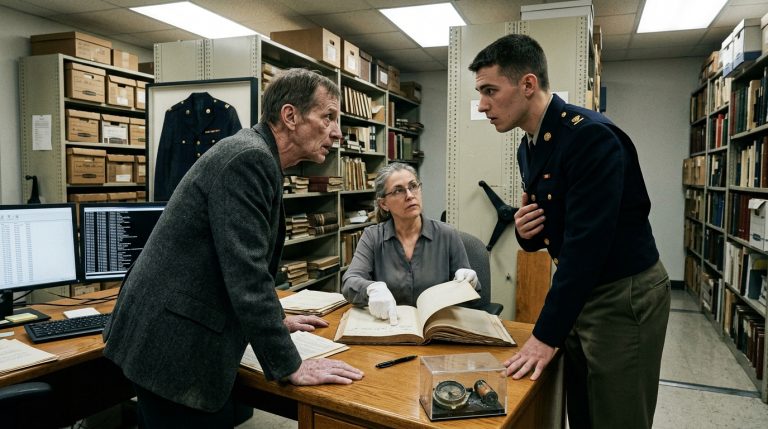
Jason Miller sat in the basement of the base library, three floors below the command deck where the air-conditioning units didn’t quite reach. The room smelled of decomposing pulp and the heavy, sweet stink of floor wax that had been layered over mold for forty seasons. A single fluorescent tube overhead flickered with a low, sixty-cycle hum that vibrated through the metal legs of his folding table.
Before him lay three binders bound in yellowing plastic—the un-indexed logs of the 1977 logistical transmittals. They weren’t classified in the red-ink sense; they were simply dead, buried under forty years of standard organizational reassignment numbers that made them invisible to the digital networks upstairs.
His fingers were gray with dust from the ledger spines. He had been tracking the name Mitchell, A. through the fuel vouchers. If a man didn’t exist on the personnel rosters, he still existed in the oil. A Special Recon unit didn’t move through the jungle on air; they used the twin-engine Sikorskys, and those turbines ate kerosene by the barrel.
He flipped a page, the old parchment tearing slightly at the brass ring binding. The log entry for April 14, 1977, was written in the hurried, violet ink of a field clerk who had been using an old ballpoint with a leaking ball.
Voucher 099-B: Fuel allocation, 400 gallons, JP-4. Destination: Sector Seven (Redacted). Carrier: Ghost Rotor 3. Authorization: The ink there had been scraped away with a razor blade, leaving only a thin, translucent patch where the paper fiber was exposed like raw wool.
But the clerk had been lazy. On the reverse side of the ledger sheet, where the heavy hand had pressed the pen down during the midnight shift, the carbon transfer had left a faint, mirror-image indentation in the fiber. Jason leaned down, his chin nearly touching the wood of the table, his breath stirring the dust on the margin. He pulled a small pocket mirror from his survival kit and laid it flat against the text.
The letters were backwards, thin, and silvered by forty years of dust, but they were clear.
Capt. A. Mitchell. Command Status: Active Field Control.
Beneath it, added in a completely different hand—a neat, architectural script that used black india ink—was a five-digit code that didn’t match any standard army serial block: TL-77-ALPHA.
Jason felt a cold drop of sweat slide down his ribcage, soaking into the stiff fabric of his undershirt. That code wasn’t an army identifier. It was a recovery routing number from the old Department of Defense missing-persons annex—the dark filing system used when a man was too hot to bring home through the front door.
A shadow crossed the narrow, high-set window that looked out onto the basement dry-well. Two pairs of polished boots passed by the frosted glass, their heels clicking with the rapid, short strides of staff officers on a deadline.
Jason didn’t close the binder. He reached into his pocket and touched the small, creased edge of the photograph he had slipped from the metal box before the guards had locked it in the perimeter cage. In the center of the group stood the man with the broom, forty years younger, his arms long and loose at his sides, his eyes looking straight through the lens with the exact same hollow, unblinking focus that watched the flag go up every morning at 0645.
He wasn’t looking at the camera then. He was looking at something behind the man holding the frame.
Jason turned the page over. On the back of the ledger, where the ink should have been dry, there was a tiny, brown smudge—a fingerprint that had been left in the corner of the paper before the ink had set. It was small, too small for a grown man. It looked like the print of a child’s thumb, or perhaps a person whose bones had been broken and mended without the aid of a surgeon.
The library door at the top of the concrete stairs gave a short, metallic click as the hydraulic arm engaged.
Miller didn’t look up, but his hand moved silently across the desk, covering the log with his forearm as the slow, heavy tread of an unhurried man began to descend the steps into the dark.
CHAPTER 3: THE THRESHOLD CHECK
The hydraulic hiss of the basement door echo coincided perfectly with a completely separate mechanical groan half a mile away. Outside the wire, the heavy galvanized gate of Fort Lincoln’s eastern perimeter vibrated against its iron locking pins as the midday heat began to warp the air over the tarmac. Aaron Mitchell did not turn to look at the approaching white government sedan, though its engine had a distinct, high-pitched valve click that he had cataloged three days into Colonel Ror’s arrival on the base.
Instead, Aaron kept his weight centered on his left heel, leaning slightly away from the chain-link structure to let a fresh gust of desert wind pass through the open weave of his canvas jacket. The fabric smelled faintly of elderberry soap and the dry, ancient iron of the push broom’s bracket.
The white sedan rolled to a stop precisely six inches from the yellow painted line. The engine didn’t die; it lingered in a quiet, low-idle rumble that caused the fine lime powder on the border markings to dance in miniature white plumes. The tinted rear window slid down with a smooth, electric whisper, revealing the sharp, unyielding profile of Colonel David Ror. His uniform shirt was pristine, the starch so stiff that the creases across his chest looked like stamped tin.
“He’s still outside the perimeter, sir,” the first guard said, his voice dropping into a dry, defensive register as he stood at a rigid attention by the car’s B-pillar. He had the metal box tucked tightly under his left forearm, his fingers gripping the underside of the steel frame to keep the loose latch from rattling against his sidearm holster.
Ror didn’t look at the guard. His eyes, the color of wet slate, fixed directly on the back of Aaron’s neck. “The directive was explicit, Corporal. Clear the perimeter. A civilian with an unverified identification profile loitering within twenty yards of an administrative ingress constitutes a failure of structural integrity.”
“He won’t move past the outer gravel, sir,” the corporal replied, a bead of sweat breaking from his temple and cutting a clean path through the fine dust on his cheek. “And… there was a physical discrepancy during the clearance check.”
Aaron stood completely still. He could feel the heat radiating from the sedan’s exhaust pipe, a dry, chemical warmth that carried the odor of unburned fuel. It was an modern smell, entirely lacking the heavy, oily sweetness of the old JP-4 that used to stain his fingers back when the sky over Thailand was full of green rotorcraft. He didn’t speak. He knew the protocol of an administrative review; the first rule was to let the senior officer exhaust his initial tactical assumptions.
Colonel Ror opened the car door with a single, deliberate pull of the interior handle. His boots hit the asphalt with a flat, lifeless sound—untreated leather on hot stone. He walked toward the yellow line, his hands clasped behind his back in a classic posture of administrative assessment. He stopped two inches from the yellow marking, his gaze tracking down to the broom bristles resting in the gravel.
“Mitchell,” Ror said. The name wasn’t delivered as a question. It was an entry on a ledger. “The base logistics office has no record of a maintenance contract under your name. The state VA office has no record of an Aaron Mitchell receiving assistance within this district. You are operating an unauthorized cleaning detail on federal property.”
“The dirt doesn’t care about the registry, Colonel,” Aaron said softly. He didn’t raise his head to look Ror in the eye; he kept his focus on a small piece of blue plastic film caught in the chain-link mesh near the ground. “If the curb fills with pine needles, the drainage basin backs up during the August flash floods. It’s been doing that since the seventy-three expansion.”
Ror’s jaw tightened, a small muscle twitching beneath the close-shorn gray hair at his temple. “The base infrastructure is the concern of the garrison command, not a civilian volunteer with a splintered handle. Your presence creates an administrative blind spot. Corporal, hand me the item.”
The young guard stepped forward, his boots crunching loudly in the dry dirt as he crossed the threshold to hand the small steel box to the colonel. Ror took it without looking down, his thumb instantly finding the worn, silvered edges of the latch. He lifted the lid with a slow, mechanical pull.
Inside the box, the silver star didn’t catch the glare of the noon sun; it seemed to absorb it, the dulled metal looking more like a piece of lead salvage than a decoration for gallantry. Ror’s fingers didn’t touch the medal. Instead, his eyes fixed on the small, frayed unit patch tucked beneath the felt lining—the lightning bolt passing through three jagged hills.
The wind shifted, carrying a low, rhythmic thrumming sound from the southern ridge. It wasn’t a car engine. It was the deep, sub-audible vibration of a twin-turbine power plant moving through the upper air corridor—the signature sound of a high-altitude transport coming in from the western command hub.
Aaron felt a slight, familiar ache in the center of his right palm where the old scar tissue lay deep beneath the surface calluses. He didn’t look up at the sky, but his fingers tightened just a fraction of an inch around the ash-wood handle, feeling the dry grain press against his skin like an old friend checking his grip before a long march.
“This identifier,” Ror muttered, his voice dropping an octave as his thumb finally touched the edge of the singed embroidery. “This belongs to a deactivated logistics pool out of Udon Thani. That sector was cleared forty-five years ago. The records were archived under a terminal file closure.”
“The files are old, Colonel,” Aaron said, his voice remaining flat, perfectly balanced against the steady whistle of the wind through the wire perimeter. “But the hills don’t move. They just get a little smaller every time it rains.”
Ror closed the box with a sharp, metallic snap that cut through the low rumble of the approaching aircraft. He turned back toward the sedan, his posture stiffening as the first long shadow of the transport plane crossed the concrete courtyard behind him. “Hold him here, Corporal. Nobody crosses the wire until I verify the routing logs with the central archive.”
Aaron watched the white car door close, the tinted glass rising back into place like a shutter sealing out the light of the desert. He adjusted his boots in the gravel, his hands resuming their position at the top of the splintered handle, waiting for the first stroke of the broom against the white dust.
CHAPTER 4: THE SHADOW ON THE CONCRETE
The white sedan’s door seal engaged with a muted, pressurized thud, but the silence that followed lasted only as long as it took for a pebble to slide down the embankment. From around the southern curve of the perimeter wall, a heavy black utility vehicle with dull government lacquer moved into the approach lane. It carried no red-and-blue strobe bars, no flags, and no auxiliary security detail, yet its sheer mechanical momentum caused the young corporal to shift his grip on the metal box, his knuckles turning the gray-white color of dry pine bark.
The vehicle came to a halt three feet behind Colonel Ror’s idling car. Its large tires ground into the white limestone dust with a slow, tearing weight, and through the dark mesh of the front grille, the radiator hissed a soft, rhythmic stream of overheated coolant.
Aaron Mitchell didn’t step back. He maintained his stance on the gravel, his palms remaining loose over the raw grain of the ash-wood handle. He watched the passenger side panel of the black vehicle expand as the heavy door swung open. A single boot came down on the tarmac—not the modern, lightweight composite style worn by the gate guards, but an old-style leather combat boot with three layers of custom welt stitching meant to balance an unyielding ankle.
General Richard Hawthorne stepped out into the dry Nevada glare. His green dress uniform looked almost gray under the direct sun, its wool weave displaying the faint, fuzzy nap of fabric that had been dry-cleaned a hundred times across forty winters. The rows of brass medals on his chest didn’t rattle; they were pinned down with small rubber backing washers to keep them silent during movement. He dragged his right leg slightly, the heel of the sole leaving a short, dark scrape on the concrete line as he straightened his spine.
Colonel Ror had already spun around, his hand rising to his brow in a stiff, by-the-numbers salute that stopped exactly two inches from his temple. “General Hawthorne. We were not notified of an inspection by the regional command. The ingress point is currently under a temporary protocol review.”
Hawthorne didn’t return the salute. He didn’t look at Ror’s face. His eyes, heavily hooded by folds of loose, sun-damaged skin, were fixed on the lone figure standing on the gravel side of the wire. A low, internal whistle left the general’s chest—a sound like air escaping an empty oil drum. He took three short, halting steps forward, his right boot trailing its dull, scraping mark through the white lime powder of the boundary line.
“Aaron,” the general whispered. The voice was brittle, cracking across the middle vowels like dry parchment under a thumb. “Aaron Mitchell. They told the committee the river took you before the second bird could drop its rope.”
The corporal at the gatehouse let his clipboard tilt forward, his fingers slipping off the aluminum edge as he watched the general’s cap come down. Hawthorne lifted his right hand—not to salute, but to remove his service cover with a slow, circular motion that seemed to require the weight of his entire shoulder. He held the gold-trimmed brim against the center of his ribcage, his eyes reflecting the pale yellow image of the old photograph still held in Private Miller’s trembling hand inside the guard shack window.
“You saved my life, Captain,” Hawthorne said, his jaw tightening until the old scar tissue along his throat turned the color of lard. “I spent forty years looking at a copper plaque in the East Wing. I gave the dedication speech for the empty frame.”
The air between the two men became very thick, charged with the smell of the SUV’s hot engine vents—a scent that brought a sudden, dark surge of memory to Aaron’s mind. For a fraction of a second, the dry desert sage vanished, replaced by the wet, rotting stench of high-canopy jungle oil and the specific, suffocating pressure of a canvas web harness soaking up three days of river mud. He could feel the phantom weight of fifteen magazines bouncing against his hip bone.
“The frame wasn’t empty, Richard,” Aaron said, his voice remaining level, completely devoid of the emotional static that was making the general’s shoulders tremble. “The names were in it. That’s what mattered. The rest of it was just logistics.”
Colonel Ror took a step backward, his boots clicking once against the white sedan’s bumper. His face had gone completely white, the administrative sharpness of his features dissolving into a blank, un-indexed confusion. “General… the civilian profile is unverified. The state files—”
“Shut your mouth, Colonel,” Hawthorne said, without turning his head. The command wasn’t shouted; it was delivered with the cold, functional finality of an iron gate swinging into its latch. “This man doesn’t have a profile in your database because your database was built by people who weren’t born when he was holding the ridge at San Dun. Get the gate open. Not the pedestrian gate. The main transport bar.”
“Sir, the safety parameters—”
“Open the bar,” Hawthorne repeated, his voice dropping into a register that made the corporal jump toward the control box before the phrase had fully cleared the general’s lips.
The iron security arm rose with a heavy, hydraulic grunt, its counterweights clanking within the steel housing. Aaron Mitchell looked at the open lane, then down at his broom. The bristles were dusty, coated in the fine white lime of the threshold he had spent ten seasons protecting from the outside. He didn’t cross immediately. He carefully lifted the bucket of cleaning supplies by its wire handle, tucked the satchel under his arm, and took his first step over the yellow line, his worn soles making no sound at all as they touched the clean, black asphalt of the base interior.
CHAPTER 5: THE BENCH TESTIMONY
The grit beneath Aaron’s left heel ground into the fresh tar of the inner security lane with a dry, permanent hiss. He did not look down to mark the transition, but his hand adjusted the balance of the weathered zinc bucket, preventing the metal utility scraper inside from rattling against the rim. General Hawthorne moved with him, the older man’s dragging right boot leaving a faint, continuous sweep through the chalky gray lime powder that had drifted across the road from the morning’s boundary checks.
They did not go toward the air-conditioned brick enclave of headquarters, nor did they look back at Colonel Ror, who remained standing by the open door of his white sedan like an abandoned marker buoy. Instead, by some unspoken alignment of old habits, their strides carried them twenty feet down the inner fence line to the weathered pine bench—a structure that had grown gray and deeply fissured under forty seasons of northern desert sun.
Aaron set the zinc bucket down first. The base of the metal pail met the cracked asphalt with a dull, wet thud, the greasy water inside sloshing once against the rim. He sat down on the far left of the timber frame, his long, thin thighs fitting into the bowed curvature of the wood with the familiarity of a stone settling into a dry creek bed. His hands remained wrapped around the ash-wood broom handle, keeping it vertical between his knees like an unread guidepost.
Hawthorne lowered himself beside him with a slow, mechanical stiffness. The salt-crusted green wool of his dress tunic pulled taut across his shoulder blades, the bronze pins of his citation ribbons catching the sharp glare of the desert noon. He did not lean back; his spine remained three inches clear of the timber support, his hands flat on his knees, palms down, revealing the pale, purple-rimmed spots where old jungle ulcers had turned into smooth tissue decades ago.
“The log in the basement is still active, Aaron,” Hawthorne said. The words came out thin, carried away almost instantly by the dry ridge wind that rattled the chain-link mesh behind them. “A young clerk named Miller found the fuel records. He has the mirrored transfer from the seventy-seven transmittal. He thinks you were left behind because the recovery line was cut by the garrison at Nakhon Phanom.”
Aaron looked at the galvanized fence post directly across from them. The zinc coating had begun to flake off in thin, gray scales, exposing the dark iron beneath to the dry mountain air. “The recovery line wasn’t cut, Richard. The third rotorcraft had an engine failure before it crossed the Mekong. The line didn’t break; it just ran out of lift.”
“Ror thinks it was a terminal failure of the command structure,” Hawthorne muttered, his fingers tightening against the green fabric of his trousers until the seams creaked. “He spent three hours yesterday cross-referencing your name with the casualty annex at the Pentagon. He’s going to file an information discrepancy report before the evening muster.”
Aaron rotated the broom handle an eighth of a turn between his palms, feeling the raw grain friction against his skin. His eyes tracked a small, out-of-place detail on the bench’s right support bracket—a brass hinge stamped with a non-standard procurement number, TL-77-BETA, the metal oxidized to the dark, grease-green color of river scum. “Let him file the paper. The paper doesn’t change the number of people who boarded the second bird.”
“You stayed on the sandbar for three days after the extraction collapsed,” Hawthorne said. His voice dropped into a lower, flatter register, the tone he used when reading the names of dead men during the regional memorials. “We looked at the thermal photographs from the high-altitude flights. There was a single return near the burning hull. The intelligence clerks said it was a water buffalo carcass that had caught fire from the magnesium drops. I knew it wasn’t a buffalo, Aaron. I knew the height of that signature.”
“The grass was high,” Aaron replied softly. He didn’t turn his head to look at the general’s face, but his gaze remained fixed on the green-gray oxidation of the brass hinge. “If you stand still in the elephant grass, the thermal scanners can’t separate the heat of a man’s blood from the stone beneath him. The sandbar was hot for a long time after the fuel tanks went.”
Inside the gatehouse, fifty yards away, the glass pane slid back with a short, metallic rattle. Private Jason Miller stood in the shadow of the eave, his digital-camo uniform looking too bright against the dark wood of the interior desk. He held the yellowing ledger binder against his chest with both arms, his eyes tracking the two old men on the bench with the intense, unblinking focus of a scout marking an ambush line. He didn’t move toward them; he stayed behind the copper screening, his posture completely rigid as he listened to the low, dry murmurs drifting across the gravel through the heat waves.
“The third platoon didn’t know you were still tracking the frequency,” Hawthorne said, his left shoulder dropping an inch as if the weight of his dress medals had suddenly doubled. “We left the radio on the command tent table for six months after the unit was deactivated. Every night at twenty-four hundred, the night clerk would hear a single carrier click on the high band. No voice. Just three short drops of the squelch circuit. The colonel told us it was atmospheric noise from the ridge line.”
Aaron lifted his left hand from the broom handle, his thumb tracing the jagged white seam where a piece of flying plexiglass had split his palm during the seventy-seven extraction run. “The battery was low, Richard. If you use the voice modulator, the voltage drops below the transmission floor within four seconds. A carrier click only takes half a watt. You can run a clicker for two winters on a single dry cell if you keep it out of the rain.”
The general’s jaw tightened, the skin over his cheekbones turning the dry, yellow color of old horn. He reached into his pocket and pulled out a small, flat object wrapped in a piece of oil-soaked lint fabric—the small metal latch mechanism from the old lockbox that Colonel Ror had confiscated at the perimeter. He laid it flat on the gray pine timber between them, the metal clicking against the wood like a spent casing hitting a concrete floor.
“The record isn’t going to stay in the basement, Captain,” Hawthorne said, his voice cracking slightly on the title. “The logistics office at the Pentagon has already flag-routed the tracking number Miller found. They think the extraction was compromised from the inside. They think someone gave the coordinates of the sandbar to the radar crews at Vinh before the rotors even turned.”
Aaron Mitchell didn’t look at the latch. He kept his eyes on the white dust rising from the administrative road where a second command car was just beginning to turn the corner by the motor pool, its radiator grille throwing a long, silver reflection across the dry asphalt.
“The coordinates didn’t matter, Richard,” Aaron said, his voice remaining as steady and unhurried as the slow drift of the desert clouds above the ridge. “The ambush didn’t happen because of the radar. It happened because the sky was too clear that night. You could see the rotor wash from five miles away if you were standing in the hills.”
CHAPTER 6: THE VERIFICATION LOOP
The final syllable of Aaron’s sentence was still hanging in the hot air when the secondary command vehicle—a tactical communications van with three thick, spring-mounted whip antennas—came to a heavy, shuddering halt twenty feet behind the bench. The air brakes released with a loud, mechanical pfffft that blew a cloud of pale limestone dust over the bottom rails of the chain-link fence. The exhaust smell was thick and bitter, masking the scent of the dry pine needles and the old elderberry soap embedded in Aaron’s moss-colored canvas sleeves.
A lieutenant with a plastic-coated administrative folder tucked under his arm scrambled out of the van’s side door, his boots slipping once on the loose gravel before he found his footing. He didn’t look at the general. He ran straight toward Colonel Ror, who had turned away from his own sedan to track the vehicle’s arrival.
“The Pentagon wire just cleared the first registry segment, Colonel,” the lieutenant said, his breathing shallow and rapid from the heat. He held out a single sheet of pale teletype paper, the green-inked edges showing the serrated tear marks of a secure encrypted terminal. “The fingerprints from the log don’t match the standard VA active files because they were locked under the seventy-eight executive exemption. But the handwriting sample from the voucher… they ran it through the digital archive at St. Louis.”
Colonel Ror took the paper with a slow, defensive extension of his forearm, his slaty eyes scanning the text while the tactical van’s cooling fans began to hum with a high, whining vibration that set the chain-link mesh behind Aaron’s head to a continuous rattle. Ror’s lips moved silently as he read the classification block at the top of the sheet: STATUS: ACTIVE RETIREMENT – COVERT HOLD.
Aaron didn’t look back at the paper. He kept his palms flat on the gray pine timber of the bench, feeling the minute, splintered ridges of the wood fiber press into his calluses. He knew exactly what that green ink looked like; it was the exact same system printout they used when a man’s pension was routed through a third-party corporate front in Delaware to keep his actual location off the state tax rolls.
“The identification is verified,” Ror muttered, his voice losing its rigid administrative precision, flattening out into a dull, un-indexed drone. He turned toward General Hawthorne, the teletype paper fluttering slightly in the rising mountain wind. “But the billing codes are thirty years out of alignment. The system shows a continuous monthly deposit to an account that was closed during the seventy-nine banking reform. If he wasn’t drawing the funds, General… who was signing the clearance logs?”
Hawthorne didn’t answer immediately. He reached down and picked up the small metal latch mechanism from the old lockbox that lay between them on the gray timber. His thumb traced the small brass hinge, his expression remaining dark and heavily hooded. “The clearance logs were signed by the director of the recovery annex, Ror. The same director who signed the death certificates for the rest of the sandbar team. It was a closed loop. It was designed so that nobody would ever look for a living body as long as the numbers balanced on the ledger.”
Inside the gatehouse window, Private Jason Miller shifted his weight, his digital-camo uniform rustling against the copper screen as he leaned further out into the glare. He had the yellowing ledger binder balanced on the narrow sill now, his thumb holding the page open at the point where the razor-cut authorization line showed through the thin paper. He had seen that five-digit code before—TL-77-ALPHA—not in an army handbook, but on the bottom of a rusty fuel container he had excavated from the old storage bunker behind the motor pool two summers ago.
The tactical van’s pneumatic compressor kicked on again with a sharp, metallic clank that caused a flock of gray desert sparrows to rise from the top of the chain-link fence, their wings whistling as they headed toward the southern ridge.
Aaron Mitchell adjusted his grip on the ash-wood broom handle. He could feel the cold iron of the bracket pressing into his knee through the thin canvas of his trousers. “The loop wasn’t about the money, Richard,” he said softly, his voice remaining level and dry as a gravel bed. “The loop was there to make sure the families got the insurance vouchers without having to answer questions about the coordinates. If the registry showed a missing body, the line wouldn’t clear the probate court for seven years. The annex just shortened the wait.”
“They didn’t shorten it for you, Aaron,” Hawthorne said, his knuckles turning the gray-white color of old limestone as he squeezed the metal latch. “You stayed in the dark for forty winters because the protocol didn’t have a check-box for a man who walked out of the jungle through the civil perimeter instead of the transport lane.”
“The transport lane was busy,” Aaron replied, his eyes tracking a small courier truck that was just beginning to enter the outer loop by the east gate, its pale rubber gaskets squeaking as it slowed down for the guard’s light. “They had six hundred men from the fourth cavalry coming through the terminal every morning. A man with an ash-wood broom doesn’t get in the way of the trucks.”
Colonel Ror took three slow steps toward the bench, the teletype paper folding between his fingers until the green ink block was hidden by his palm. He looked at Aaron’s moss-colored canvas coat, then down at the zinc bucket resting on the asphalt. The administrative certainty had left his face entirely, leaving behind a hollow, gray exhaustion that made him look like a man who had spent forty years reading the wrong map.
“The registry is being updated now, Captain,” Ror said, his voice dropping into a transactional, flat tone that was completely safe for the administrative recorder inside his car. “The garrison command is preparing a formal transition order. They’re going to move the files from the dead annex to the active personnel loop before the evening retreat.”
Aaron didn’t look up to acknowledge the title. He simply reached down with his right hand, his fingers spreading across the zinc rim of his bucket as he prepared to lift the heavy metal weight back into the operational zone outside the wire.
CHAPTER 7: THE RETURNED WEIGHT
The cold wire of the bucket handle had just begun to sink into the callused creases of Aaron’s fingers when Colonel Ror adjusted his stance, his polished leather boots clicking against the asphalt as he cleared his throat. He did not drop his arm. The teletype paper remained extended across the yellowing grain of the bench, its green-inked text trembling slightly under the continuous vibration of the nearby communications van.
“There is an auxiliary file attached to the routing, Captain,” Ror said, his voice stripped of its earlier regulatory edge, carrying only the flat, mechanical neutrality of an official presentation. “The garrison command has cleared the provisional vault. The original case folder—the one logged before the terminal archive seal was applied—contains a direct authorization for an immediate field reinstatement. It was signed by the theater commander before the extraction team even reached the coast.”
General Hawthorne reached out and took the document from Ror’s fingers. His hand was not steady; the gold insignia on his cuff made a tiny, metallic scraping sound as it brushed against the edge of the paper. He didn’t read the text. He kept his hooded eyes fixed on the silver star that lay inside the steel box on the bench timber, its five-pointed silhouette looking dark and dense against the worn velvet lining.
“The reinstatement was never processed because the logistics desk required a physical signature from the unit commander,” Hawthorne said softly. He lifted the box, the dry metal hinges giving a short, muted squeak that was instantly swallowed by the rumble of the transport plane passing over the southern motor pool. “The annex couldn’t process a signature from a man who was listed as a geographical non-entity. They just locked the medals in the grey cabinet and let the interest accrue on the back-pay ledger.”
Aaron let go of the bucket handle. His hand returned to the vertical ash-wood shaft of his broom, his thumb finding the deep, longitudinal split where the grain had opened during the heavy frost of ninety-four. “The interest doesn’t clean the ditch, Richard. A man doesn’t need an administrative voucher to tell him how many minutes he stood on the sandbar before the rotors cleared the ridge.”
“The garrison has arranged a formal assembly at the main flagpole for 0600 tomorrow,” Ror intervened, his arms returning to his sides with a stiff, habitual precision. “The regional command has sent a secure courier with the original decoration bars. The press office has already been notified of a significant profile recovery.”
Aaron looked past the colonel toward the eastern gatehouse. Private Jason Miller was still leaning against the screening, his arms wrapped tightly around the yellowing ledger binder as if he were holding a piece of live ammunition. He had heard every syllable. His young face looked tight, his mouth set in a hard, pale line that reminded Aaron of the recruits who used to wait in the rain outside the supply tents at Udon Thani, waiting for the flight manifests to clear the desk.
“Tell the press office the broom needs new bristles,” Aaron said, his voice low and dry as a mid-summer draw. “The plastic ones they use now don’t hold the lime dust. They just push it into the seams of the concrete.”
“Aaron,” Hawthorne said, his voice dropping an octave as his fingers closed around the edges of the silver star’s box. “The army is giving you back your name. They’re clearing the dead files. You don’t have to stand outside the wire with a splintered handle anymore. You’ve paid the baseline three times over.”
“The name didn’t leave the sandbar, Richard,” Aaron replied, his gaze returning to the small brass hinge stamped TL-77-BETA on the right bench support. “The name is on the copper plaque in the East Wing. It’s been there for forty seasons. It knows the way around the building. If you move it now, the night clerks won’t know which cabinet to check when the fuel logs don’t balance.”
He stood up from the timber bench with a slow, deliberate elongation of his spine. His knees didn’t pop, but his canvas jacket gave a dry, soft rustle as the fabric settled against his shoulders. He reached down, his fingers closing around the zinc rim of his bucket with a final, unhurried pressure, and lifted the heavy container back into the operational alignment. He did not look at Ror, nor did he look at the green-ink teletype paper that was already beginning to collect a layer of white limestone dust on the gray pine wood.
He took his first step back toward the pedestrian gate, the bristles of his broom dragging softly against the asphalt behind him, leaving a thin, dark line through the gray glare of the afternoon sun.
CHAPTER 8: THE FINAL FOLD
The drag of the broom bristles against the fine limestone dust outside the wire did not stop when the light changed from gold to gray. The continuous path Aaron had cleared across the inner loop remained etched into the tarmac, a soft, sweeping border that marked exactly where a forty-winter vigil had crossed from a hidden ledger into the open air. The administrative cars had long since cleared the access lane, their exhaust smell replaced entirely by the cool, thin scent of morning sage drifting down from the northern ridge line.
The transition from that long afternoon into the quiet space of late-life resolution did not require a sudden jump in coordinates. It unpooled one micro-second at a time through the steady, unhurried maintenance of his routine. Aaron sat in the small studio apartment two miles outside the gate, his fingers slowly turning a light coat of machine oil over the brass hardware of his storage case. The room was sparse, containing only the worn recliner, the narrow bookshelf, and the vertical wooden rack where the splintered ash-wood handle stood at attention against the plain plaster wall.
He could hear the distant, sub-audible hum of the base generator through the open window mesh. It was 0540. The sky over the desert was the color of a wet slate shingle, the stars fading into a pale, clean ivory along the eastern horizon.
Aaron stood up, his canvas coat settling over his shoulders with a soft, familiar weight. The fabric around the cuffs had begun to fray into a lace of thin, green threads, but the structure remained sound, its weave containing the deep, permanent memory of forty seasons of morning dew. He lifted the ash-wood handle from its cradle, his palm fitting precisely into the longitudinal split he had mended with two turns of copper wire during the heavy frost of ninety-four.
He did not rush the walk along the gravel shoulder. Every pebble under his boots was an entry he had checked a thousand times; he knew the exact spot where the drainage basin met the chain-link footer, and he knew the precise rate at which the weeds tried to reclaim the lime line.
When he reached the primary flagpole court inside the main transport loop, the honor guard was already standing in a wide semicircle three yards back from the copper base ring. They were young—none of them had their names on a voucher before the Udon Thani pool was closed—but their uniforms were silent, their hands folded over their belt buckles in the guarded, respectful posture Aaron had taught the garrison recruits back when the world was green.
Private Jason Miller stood at the center of the detail, his digital-camo tunic carrying the small, silvered insignias of a newly confirmed sergeant. He held a large, heavy presentation case under his forearm, the dark mahogany wood showing the faint, oiled gleam of hand-rubbed linseed. He didn’t offer a formal administrative salute as Aaron crossed the concrete perimeter; he simply bowed his head three inches, a quiet, generational acknowledgment between the man who had dug through the basement files and the captain who had stayed on the sandbar.
“The registry is locked, Captain,” Miller said, his voice flat and steady, entirely free of the expository jargon that had clogged the command desk during the review weeks. “The terminal file was cleared by the central office at midnight. The insurance vouchers have been reissued to the survival annex, and the names on the wall have been updated with the active service tags.”
Aaron set the base of his broom handle against the copper ring of the pole. The metal was cold, sweating a thin film of morning moisture that smelled of oxidized zinc. “The names were always active, son,” he said softly. “The paper just caught up to the height of the grass. Lift the lanyard.”
General Hawthorne stepped out from the shadow of the administrative archway, his green dress uniform looking slightly loose across his chest, the bronze citation ribbons pinned flat against his ribcage with the same soft rubber washers. He didn’t carry an administrative folder. He walked with a slow, heavy drag of his right boot, his fingers reaching out to take the loose end of the braided cotton line as it swung in the ridge breeze.
“The third bird never made it past the river because I gave the clearance code before the engine pressure had stabilized, Aaron,” Hawthorne said. The words were delivered with a gradual, unpacking clarity, a confession forty years in the making, spoken into the cool silence of the desert dawn. “I thought the secondary ambush line was moving from the north ridge. I panicked on the radio. If I had held the rotorcraft on the sandbar for sixty more seconds, you would have been in the cabin with the rest of the section.”
Aaron didn’t adjust his grip on the ash-wood. He watched a small desert beetle navigate the cracked mortar between the concrete tiles at his feet, its tiny shell leaving a microscopic track in the gray lime dust. “The sky was too clear that night, Richard. If you stay on the sandbar for sixty seconds in the open light, the mortar crews find the rotor housing before the turbines can clear the trees. You didn’t panic. You just chose the five men who were already on the floor.”
He reached out his right hand, his liver-spotted knuckles showing the pale, white scars of the old plexiglass cuts, and took the brass clip of the flag assembly from Miller’s box. The fabric was heavy—high-grade wool bunkered in the dry preservation vault since the seventy-three expansion—and as it unrolled between his palms, the red and white bars gave a soft, heavy snap against the breeze.
There was no sudden movement, no unearned administrative intervention, and no dramatic fanfare. Together, the three old men and the young sergeant hoisted the linen into the pale ivory light of the Nevada sky, the rope whispering through the top pulley with a continuous, rhythmic hiss that sounded exactly like the first stroke of a push broom across a dusty floor.
Aaron Mitchell stood at the base of the staff until the brass clips hit the upper limiter block. He did not raise his hand to salute the cloth; he simply leaned his forehead against the raw, split grain of his ash-wood handle, his eyes closing as the first ray of the sun cleared the eastern peaks, turning the faded olive of his canvas jacket into a warm, silent green that looked exactly like home.