The Iron Horizon: A Gritty Neo-Western Tale of Ancestral Land, Systemic Corruption, and Silent Reckoning
CHAPTER 1: THE IRON BREACH
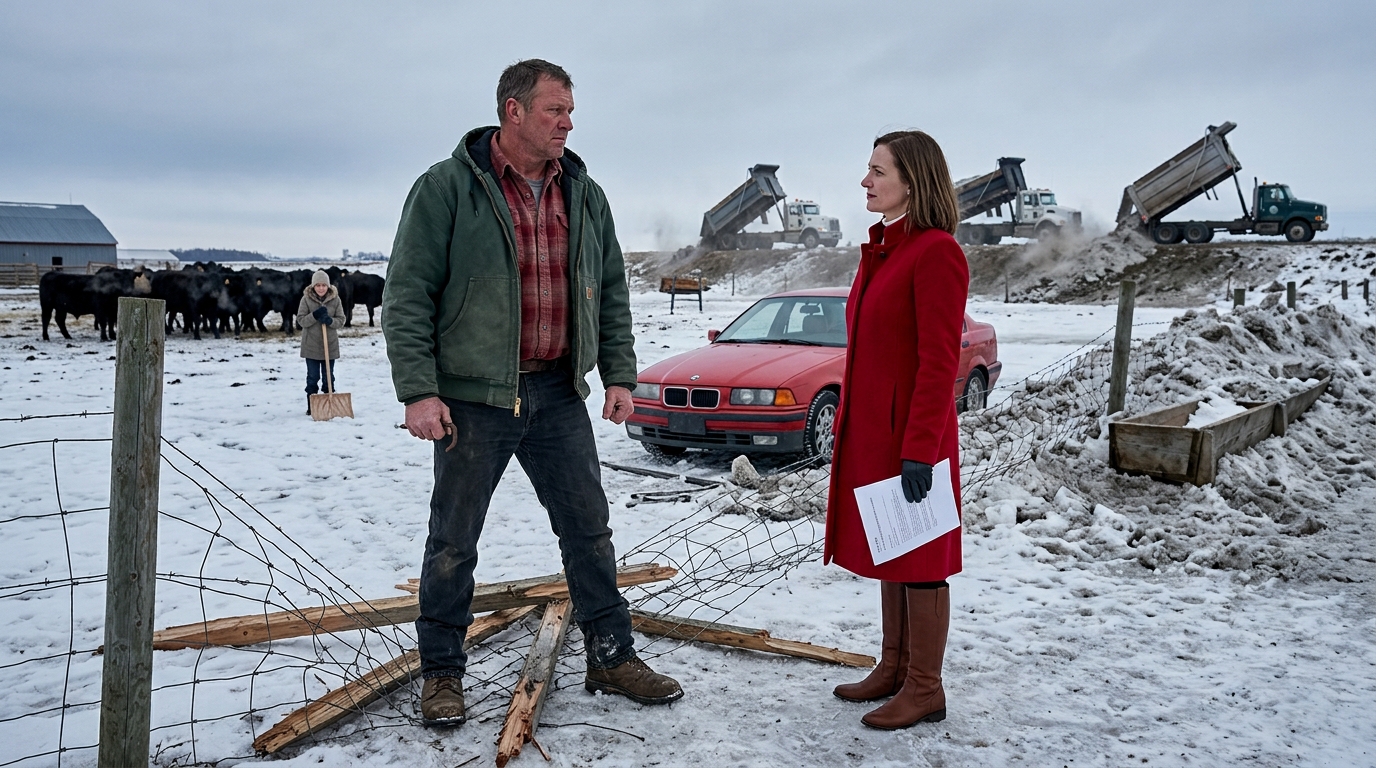
The steel high-tensile wire didn’t just snap; it sang. It whipped through the freezing air with a sharp, metallic crack that cut clean through the winter gale, followed instantly by the grinding crunch of cedar posts splintering beneath three tons of hydraulic steel.
I stopped dead in the frozen mud of the lower paddock. Between my thumb and forefinger, the rusted iron fence staple I’d been turning over felt like an ice cube, its jagged point biting hard into my palm.
Up on the ridge, a yellow municipal plow blade shoved aside three hundred feet of perimeter wire like straw. Behind it, three heavy-duty dump trucks rumbled in reverse, their exhaust plumes thick and black against the gray sky. Bed hydraulics squealed. A avalanche of filthy, salt-caked, chemical-laden slush crashed into the winter pasture, burying the feed trough beneath a six-foot mound of gray sludge.
The bulls panicked instantly. Twelve hundred pounds of black Angus muscle collided in a chaotic tangle of hooves and steaming breath. One bull slipped on the ice, his flank slamming hard against the wooden gate latch before he scrambled up, eyes white, snorting frost into the gale.
I didn’t run. Running gets you killed on ice. I rolled the iron staple across my knuckles, feeling the sharp corner press against raw skin, grounding the cold fury before it could reach my face.
Behind me, the barn door creaked open. Martha stood wrapped in three layers of wool, her hands shaking as she pulled her collar tight against the freezing wind pouring straight into the sheltered bay. Half our winter hay storage was already pinned under the gray avalanche.
A red BMW pulled up to the broken fence line, its tires crunching over the shattered cedar posts. The driver’s door swung open.
Evelyn Miller stepped out onto the crushed wire. Her leather boots were spotless. Her long wool coat showed not a single speck of windblown salt. She held a single sheet of paper in her gloved hand, unfolded it with crisp, practiced precision, and didn’t bother to raise her voice above the idling diesel engines.
“Emergency winter safety authority,” Evelyn said. Her voice was flat, smooth, and utterly devoid of hesitation. “Temporary land seizure for municipal safety. The subdivision roads require clear disposal zones.”
She didn’t look at the thrashing herd. She didn’t look at the buried trough. Her eyes drifted over my shoulder toward Martha, lingering on her shivering frame for a fraction of a second before locking back onto mine.
“You’re obstructing public clearance, John,” she added, waving a hand toward the idling dump trucks. “Tell your animals to move.”
I stepped forward, my boots cutting heavy tracks into the crust. The iron staple in my palm dug deep enough to draw blood, but my face remained as still as the frozen ground beneath us.
“This is private agricultural acreage,” I said, my voice low, gravelly, and barely louder than the wind. “That slush is loaded with magnesium chloride. It kills the grass and poisons the water.”
Evelyn smiled. It was a thin, cold twitch of her lips that never reached her pale eyes.
“Then you should have adapted sooner,” she replied softly. “Winter doesn’t wait.”
She turned back toward her car, leaving the paper pinned beneath her windshield wiper. Behind her, another truck bed tilted, and ten tons of sludge thundered down onto the frozen earth.
CHAPTER 2: THE COLD SIEGE
The red BMW didn’t drive off immediately. It idled by the orange survey flags, its dual exhaust piping thick, white plumes into the freezing air. Through the tinted glass, Evelyn Miller’s silhouette remained perfectly still—a dark, sharp outline watching the second dump truck line up its rear axle with my ruined fence.
I squeezed my right hand shut. The sharp tip of the rusted fence staple pressed deeper into the meat of my palm, the sting of torn skin sharp enough to cut through the cold air. Blood trickled down into the creases of my wrist, freezing before it could drip onto my boot. I didn’t wipe it off.
The truck driver hit his bed hydraulics. A wet, thunderous slide of road sludge crashed down, expanding the dirty gray wall by another ten feet. Salt-laden slush sloshed into the runoff ditch that fed straight into the lower creek.
Martha was already moving toward the barn, her gait stiff and uneven. She picked up a wooden snow shovel, trying to clear a pathway to the water trough before the slush hardened into solid ice. Her breath came in short, ragged puffs. Her hands, red and swollen from the bitter wind, slipped twice on the shovel handle.
I didn’t offer to take the shovel. Instead, I walked past her into the equipment shed, grabbed two fifty-pound bags of coarse feed, and carried them out to the far paddock line, well away from the dumping zone. The bulls followed the scent, hooves crunching through the crusted drift, their heavy heads low and cautious. One young yearling limped slightly—the ice near the ditch had stripped a patch of hide from his left fetlock.
“They won’t drink from the trough,” Martha said, her voice strained over the roar of a third truck pulling into the driveway. “It tastes like chemicals, John. I tried filling a bucket from the pump, but the surface in the trough is already oily.”
“They’ll drink when I haul fresh water from the house tank,” I said. My voice was flat, devoid of emotion. “Keep them away from the north ditch.”
I walked over to the windshield of the tractor where Evelyn had left her paper. I pulled it out from under the wiper blade. The ink was fresh, protected by a thin plastic sleeve.
MUNICIPAL EMERGENCY USE AUTHORIZATION — PARCEL-909
Below the bold heading, the text cited emergency winter safety codes, temporarily ceding access rights for regional snow management. At the bottom was a rubber-stamped seal from the County Clerk’s Office, dated six days ago.
I stared at that date. Six days ago, the storm hadn’t even formed off the coast. The weather service hadn’t issued a single freeze warning until seventy-two hours ago.
“Watch the herd,” I told Martha. I dropped the staple into my jacket pocket alongside the document. “I’m going to the courthouse.”
“John,” she called out, stepping into the lee of the barn door to cut the wind. She reached out, her fingers catching the rough canvas of my sleeve. Her knuckles were white. “She wants you to break something. You know how she works.”
“I’m not breaking anything,” I said softly, disengaging her grip gently. “I’m looking at stamps.”
The drive into the county seat took twenty minutes over roads turned treacherous by grey ice. My old Ford pickup rattled along the corridor, the heater blowing lukewarm air against a frosted windshield. Halfway there, a commercial transport truck passed me heading back toward the ranch. Painted on the side of the cab in clean, block lettering was the contractor name: Apex-Snow-Logistics.
I parked in the gravel lot behind the municipal building. Inside, the heating system hummed, smelling of old paper and damp wool.
The clerk behind the counter was a woman named Clara who had worked the land records desk since my father was paying property taxes on the lower forty. She looked up over her bifocals as I laid the plastic-sleeved authorization on the wooden counter.
“Need to see the original entry for this, Clara,” I said. “Parcel-909.”
She picked up the document, running a thumb over the rubber stamp. Her brow furrowed slightly. “Emergency winter authorization? These usually go through the county commissioners’ weekly session.”
“Check the log book,” I said. “The date says the fourteenth.”
Clara turned to her terminal, her fingers tapping rhythmically on the mechanical keyboard. Blue light reflected off her glasses as she scrolled through the land registry database.
“That’s strange,” she murmured, clicking her mouse twice. “The entry was created yesterday afternoon at four forty-five PM. But the timestamp on the digital file is backdated to the fourteenth.”
“Who filed it?”
“Submitted electronically under the HOA’s administrative account,” she replied, pulling up the signature page. “It’s backed by a land-use conversion waiver.”
She turned the monitor slightly so I could see. My name was listed as the granting property owner. Below it, on the dotted line reserved for agricultural exemption waivers, was a signature.
It was my name written in dark blue ink. The loops of the J were round and soft, completely unlike the jagged, angular stroke I’d used on every bank check and property deed for forty years.
“Is that your signature, John?” Clara asked softly, her tone shifting instantly from professional routine to quiet alarm.
“No,” I said.
Clara leaned back from her desk, her hands resting flat on the counter. “An emergency land conversion bypasses public notice, John. But only if the owner signs the safety waiver. Without this signature, emergency powers can’t touch agricultural deeded land.”
“Print the audit trail,” I said, my hand slipping back into my coat pocket to feel the hard, sharp edges of the iron staple. “Print every document tied to Parcel-909 filed in the last forty-eight hours.”
Clara didn’t ask further questions. She pressed print. The laser printer behind her hummed to life, spitting out six pages of dense, legalese-filled text.
As I picked up the warm pages from the tray, my eyes caught a line entry near the bottom of the financial summary attached to the filing:
DISPOSAL SITE FEE CLEARANCE: APPROVED — REF VOUCHER-77B
I folded the papers neatly, placed them inside my heavy canvas jacket, and walked out into the falling snow.
CHAPTER 3: THE GHOST IN THE DRIFT
The paper felt hot against my chest through the canvas of my coat, but the wind off the courthouse steps hit like a wet blade. I folded Clara’s printouts twice, sliding them into the inner breast pocket right next to the rusted iron staple.
The Ford’s cab smelled of burning heater dust and cold damp. Before heading back toward the ranch, I turned off the main county access road, cutting the wheels down the narrow timber lane that wound up toward Saint Jude’s cemetery. The snow here hadn’t been plowed. The tires chewed through eight inches of uncrushed drift, the truck’s rear end swaying twice before I caught the line and pulled up along the iron perimeter gate.
I walked the tree line on foot. The wind dropped to a low hum inside the pines, but the cold here felt older, heavier.
Fifty yards in, near the granite headstone marked with our family name, the snow wasn’t pristine. Heavy boot tracks had carved deep ruts through the white crust. A municipal snow marker—a six-foot lathe painted neon orange—had been driven straight into the soft earth beside my son’s footstone, pinning a laminated site-survey tag to the frozen ground.
Beside the stone, the small cedar cross I’d shaped with a drawknife six years ago lay in the drift. It hadn’t fallen. The base was cleanly snapped, the split wood raw and white against the gray slush. It had been kicked aside, shoved far enough into the snow bank that only one cross-arm poked out like a broken bone.
I knelt. The snow soaked through the knees of my denim, freezing instantly against my skin. I picked up the snapped wood. The grain was dry, smelling faint of pine resin.
My son had worn a badge for this county. He’d spent three years tracking municipal spending discrepancies before his patrol car hit a patch of black ice on the ridge road. Two weeks before the crash, he’d sat at our kitchen table with three manila folders, showing me line items from the regional road maintenance fund—disposal contracts approved without public bidding, emergency vouchers routed through shell accounts, all bearing the same signature from the HOA oversight board.
He’d filed a formal complaint. Evelyn Miller had paid a fifteen-hundred-dollar administrative fine, publicly called his report a “misunderstanding of rural infrastructure management,” and went right back to chairing the board.
I didn’t feel my hands shaking. I didn’t feel the cold. I turned the broken cedar cross over in my palms, pressing the sharp, splintered edge into my thumb until the pressure balanced the dull ache behind my ribs.
This was never about snow clearance.
The plow trucks weren’t just clearing subdivision streets. They were establishing continuous occupancy under the backdated emergency conversion clause. If Parcel-909 stayed classified as an active municipal disposal asset for fifteen consecutive days under Voucher-77B, the agricultural tax exemption was permanently revoked. The land would default to commercial zoning. The HOA’s shell partner, Apex-Snow-Logistics, held the right of first refusal for the public auction.
Evelyn wasn’t just settling a six-year-old score with a dead deputy. She was using his father’s pasture to scrub the paper trail clean.
I stood up, placing the broken cross inside my coat next to the court filings.
On the drive back, I didn’t head straight for the barn. I stopped at the end of the lower lane where Miller’s Creek ran beneath the access bridge. Three pickup trucks were parked on the shoulder with their hazard lights blinking—Miller, Miller’s neighbor Miller, and Miller’s cousin who ran the feed store down in town. Men who had paid their HOA assessments for ten years without asking where the road salt budget went.
I pulled over, rolled down the window, and held out a single sheet of paper from Clara’s printer.
“Tom,” I called out over the rattle of my idling engine.
Tom Miller stepped over the slush, his coat collar pulled high. He looked at me with the cautious, tired look of a man who didn’t want trouble on his property line. “John. Hear you’re having a rough time with the plow contractors.”
“Take a look at the signature on line three,” I said, handing the page through the window. “Then look at the date.”
Tom frowned, adjusting his reading glasses. He scanned the header, his eyes stopping on the rubber-stamped seal for Parcel-909. His thumb traced the forged loops of my name.
“That’s dated the fourteenth,” Tom said, his voice dropping. “There wasn’t a flake on the ground on the fourteenth.”
“And the waiver waives the entire watershed protection clause,” I said. “Read the vendor payout attached to Voucher-77B. It’s drawn directly from the subdivision’s reserve maintenance fund. Two hundred and ten thousand dollars for seasonal clearance. Paid upfront to Apex.”
Tom looked up from the paper, his face hardening as he looked past my truck toward the yellow plows still working the ridge. He didn’t speak for ten seconds. The only sound was the wind snapping the pine branches overhead.
“She told the board this was a county-mandated emergency,” Tom whispered. “She said if we didn’t authorize the access, the county would levy a surcharge on every homeowner in the tract.”
“She lied,” I said. “And she forged my deed waiver to pull it off.”
Tom handed the paper back, his jaw set tight. He turned back toward the other two trucks parked by the bridge, motioning them over with a curt wave of his arm.
“Drive up to the house, John,” Tom said softly. “Keep your bulls off the north fence. I’m making six phone calls.”
CHAPTER 4: THE PAPER TRAPS
The rumble of my Ford’s exhaust rattled against the underside of the wooden bridge as Tom Miller stepped toward the second truck. He didn’t look back. Through my rear-view mirror, I watched him pull a grease-penciled notebook from his flannel sleeve, tap the glass of Bob’s cab, and hold up three fingers.
I put the truck in gear and let the clutch out slow. The tires bit into the fresh slush, crawling up the steep rise toward my home gate.
By two o’clock, the wind pivoted straight out of the north. The temperature dropped eight degrees in forty minutes, turning the gray slush on the pasture into a jagged, petrified shield. Every blade of orchard grass near the fence was encased in a cloudy sheath of magnesium salt.
Near the runoff ditch, the yearling bull was down again.
He lay on his side, his breath blooming in thick, ragged bursts against the crusted ice. His flank twitched, legs stiffening as he tried to find leverage against the frozen mud. I killed the pickup engine, grabbed a ten-foot length of braided nylon rope from the bed, and walked out into the drift. The ice broke beneath my boots with sharp, glassy cracks that sounded like pistol shots.
Martha met me at the ditch, her face red from the cold, carrying a pair of heavy leather work gloves and a bucket of dry sawdust. She didn’t ask where I’d been. She knelt in the snow without a word, scattering the sawdust behind the bull’s rear hooves to give him traction.
“He won’t stand if his leg is cold-locked, John,” she said, her voice raspy from the wind. Her fingers were stiff inside the fleece lining as she helped me pass the loop under the bull’s chest.
“He’ll stand,” I said. “He has to.”
I hitched the free end of the rope to the Ford’s rear bumper, put the transfer case in four-low, and let the truck creep forward an inch at a time. The line went taut, humming like a bowstring. The bull grunted, his dark eyes rolling back as the nylon pulled his chest upward. He scrambled, hooves slipping twice on the sawdust before his back legs locked, holding his twelve-hundred-pound weight against the gale.
I stepped out of the cab, unhitched the line, and slapped his hindquarter hard enough to send him trotting toward the sheltered barn bay.
A white county sedan crested the ridge, its suspension groaning over the rutted ice. Two men in thick high-visibility parkas stepped out, clipboards tucked inside their coats to protect the paper from the blowing snow.
The first man wore a brass badge pinned to his parka—County Environmental Code Enforcement. He didn’t introduce himself. He walked straight to the high gray bank of road waste, pulled a stainless-steel core sampler from his tool belt, and drove it eight inches deep into the crust.
“This is private agricultural ground?” he asked, twisting the sampler and pulling out a gray cylinder of frozen soil and slush.
“Deeded pasture,” I said, rubbing my thumb against the stiff seam of my canvas jacket. “Parcel-909.”
He took a small digital meter from his pocket, pressed the probe into the core sample, and waited four seconds for the screen to settle. He let out a short, cold whistle.
“Salt concentration is six times the legal agricultural limit,” he said, turning to his partner. “Look at the drainage path. It’s heading straight for the creek bank.”
His partner was already taking photographs, the shutter clicking rhythmically over the howl of the wind. “Who authorized this drop zone?”
I pulled Clara’s printed audit trail from my inner pocket, the paper stiffened by the frost, and held it out. “The HOA filed a backdated emergency waiver under Voucher-77B. Supposed to be run by Apex-Snow-Logistics.”
The inspector took the sheet, his eyes narrowing as he read the vendor clearance codes. “Apex isn’t registered as a municipal contractor. They’re a private LLC registered out of a post office box in the next county over.”
“Check the primary account holder,” I said, my voice cutting clean through the storm.
He flipped to the second page, his gloved thumb tracing the line items down to the authorization stamp. His posture changed—his shoulders straightened, his head tilting as he re-read the dollar amounts.
“Two hundred and ten thousand dollars cleared in one transaction,” he muttered. “They didn’t just dump snow here. They logged this site as an active industrial waste facility to trigger the commercial conversion clause.”
Before he could write another note, a blue pickup truck pulled up behind the county sedan, followed closely by two more cars. Tom Miller got out of the first cab, holding a stack of yellow legal pads. Behind him, four other neighbors stepped into the road, their faces set like granite as they looked at the massive gray mounds buried under the snow.
“We just checked the subdivision ledger, John,” Tom called out, walking past the orange survey flags. “There’s no record of a board vote for Voucher-77B. Evelyn transferred the funds three days before the storm hit.”
The environmental inspector looked from the neighbors to the ruined fence line, then down at his clipboard. He took a red plastic tag from his kit, looped it through the chain on my gate, and pulled the zip-tie tight.
“Notice of Code Violation,” the inspector said loudly, ensuring everyone on the road heard him. “All dumping operations on Parcel-909 are suspended immediately under county health codes. Any truck crossing this line faces impoundment.”
As he spoke, a yellow plow truck appeared at the top of the ridge, its blade lifted, diesel engine roaring as it prepared to back another load toward the paddock. Tom Miller stepped straight into the middle of the lane, folded his arms across his chest, and didn’t move an inch.
The plow driver hit his brakes, the heavy tires skidding three feet on the ice before coming to a complete stop ten yards from Tom’s chest.
CHAPTER 5: THE STAMPEDE CLIMAX
The plow driver’s door slammed open with a sharp, metallic pop. He didn’t step down onto the ice; he leaned half his body out of the cab, his face flushed red under a grease-stained baseball cap.
“Out of the road, Tom!” the driver yelled, his voice carrying over the idling diesel rumble. “I’m on a timed run for Apex-Snow-Logistics. The township road manager authorized this drop.”
Tom didn’t budge. He kept his feet planted four feet apart in the rutted slush, his arms folded tight across his canvas jacket. “The county code officer just tagged the line. Read the red paper on the gate.”
Behind us, two more pickup trucks cut their engines, their headlights bathing Tom’s back in stark white light. The county code inspector stepped into the center of the lane, holding up his official badge case and pointing a finger at the plow’s front bumper.
“Engine off,” the inspector said. His voice was calm, clipped, and completely unyielding. “This site is sealed under an emergency environmental hold. Turn the vehicle around or I log the registration for immediate impoundment.”
The driver stared at the badge, then looked at the four homeowners standing shoulder-to-shoulder across the narrow lane. He swore under his breath, yanked his cab door shut, and jammed the transfer case into reverse. The heavy tires spun once, throwing a shower of gray slush against the snowbank, before the plow backed down the ridge toward the main road.
Tom turned around slowly, his eyes meeting mine. “Evelyn called an emergency HOA assembly at the community hall for six o’clock. She’s pushing a forced assessment vote to cover the municipal enforcement penalties.”
“She’s trying to lock down the board before the county prosecutor reviews the audit trail,” I said.
Martha walked up beside me, her wool scarf pulled tight around her throat. She handed me a manila folder she’d brought from the house—the original land grant deed for Parcel-909, yellowed at the edges, signed by my grandfather fifty years ago.
“Take the truck, John,” she said softly. Her breath fogged between us. “Show them what belongs to this family.”
By five forty-five, the parking lot at the community center was packed thirty cars deep. Headlights cut through the heavy whiteout as residents hurried through the double glass doors, pulling their coats tight against the sub-zero gale.
Inside, the hall smelled of wet floor mats, industrial floor wax, and stale coffee. Folding metal chairs scraped against the linoleum as sixty homeowners crammed into the rows.
Evelyn Miller stood at the wooden podium near the front stage. She had already set out her microphone and her leather-bound laptop case. Her hair was swept back, her dark grey wool suit crisp and without a wrinkle. She looked entirely composed, radiating the icy, practiced authority of someone who had run every meeting in this township for a decade.
When I stepped through the back doors with Tom Miller and the county inspector right behind me, her eyes flicked up. Her hand tightened briefly on the edge of the podium—a micro-fraction of a second where her knuckles went bone-white—before she smoothed her expression into a polite, dismissive smile.
“Please take your seats,” Evelyn said into the microphone, her voice amplified clean and clear above the hum of the room. “We are opening an extraordinary executive session to address an illegal obstruction of critical winter infrastructure on Parcel-909.”
She tapped her laptop screen, projecting a large satellite map onto the wall behind her. The boundaries of my ranch were highlighted in bright red, relabeled in bold black font: MUNICIPAL EMERGENCY SITE – APEX LOGISTICS OPERATIONAL ZONE.
“As your HOA President,” she continued, “I have exercised emergency authority under township bylaws to secure winter access. Unfortunately, a single landholder has chosen to defy emergency public safety directives, incurring potential daily municipal fines that will be distributed across all property owners unless we ratify the land conversion tonight.”
A murmur rippled through the front rows. A couple in the second row turned to look back at me, their faces strained with anxiety over potential assessments.
I didn’t take a seat. I walked down the center aisle, my heavy work boots thudding softly against the floor. The iron staple in my right coat pocket felt cold against my knuckles.
“You don’t have emergency authority, Evelyn,” I said. My voice wasn’t raised, but in the closed room, it carried like a hammer strike.
“John, you are out of order,” Evelyn cut in, her tone sharp, authoritative. “You will have two minutes during the public comment period at the conclusion of the board vote.”
I reached the front table, pulled the certified county audit sheets from my jacket, and laid them flat on the table right in front of the board secretary.
“Line item three,” I said, pointing a calloused finger at the top sheet. “Filing number for Parcel-909. The owner waiver carries my name, but the filing timestamp is backdated by five days. The county clerk verified the digital signature was forged from an administrative login.”
Evelyn didn’t look at the paper. She leaned closer to the microphone. “That is an administrative error made by the county filing portal. Our legal counsel is already rectifying the paperwork.”
“What about Voucher-77B?” Tom Miller spoke up from the middle aisle, standing tall. “Two hundred and ten thousand dollars transferred from our reserve maintenance fund directly to an unlisted entity called Apex-Snow-Logistics. An entity registered to your home address, Evelyn.”
The room went dead silent. The hum of the projector fan suddenly sounded like a jet engine.
Evelyn’s smile vanished. Her eyes narrowed into tiny slits as she looked past me toward the back doors.
“This assembly is adjourned,” she declared abruptly, reaching out to shut down the laptop. “The board will handle these baseless accusations through formal legal channels.”
Before she could pack her briefcase, the double doors at the back of the hall swung wide. Two uniformed County Sheriff deputies stepped into the warmth, accompanied by the chief investigator from the District Attorney’s office.
Evelyn froze. Her breath hitched, her fingers locked on the handle of her leather case.
“Mrs. Miller,” the investigator said, walking down the aisle with a manila arrest warrant in his hand. “We need you to step away from the podium. County prosecutors have issued a warrant regarding fraudulent land conversion filings and funds misappropriation under Voucher-77B.”
Her composure shattered in an instant. “This is an outrage! This is a private subdivision matter!” she snapped, her voice breaking into a high, shrill pitch as she grabbed her coat and tried to push past the side stage door.
The lead deputy moved with practiced speed, stepping into her path and grabbing her wrist before she could touch the crash-bar. Metal clicked—a sharp, cold snap of handcuffs echoing off the hardwood stage.
The homeowners erupted into a wall of noise, chairs scraping backward, voices shouting over one another as the deputies escorted Evelyn Miller down the center aisle. She kept her head down, her face flushed dark crimson, refusing to look at the neighbors she had ruled for ten years.
I stood by the front table as the room emptied into the cold night air. The satellite map was still projected on the wall, but the red lines around Parcel-909 no longer felt like a cage.
CHAPTER 6: THE THAW AND THE THRESHOLD
The heavy double doors of the community hall clicked shut behind the deputies, cutting off the sharp whistle of the gale outside. Inside, the quiet came on slowly, heavy and thick, like the first snowfall after a hard freeze.
I reached out and flipped the power switch on the projector. The blue light died instantly. The wall went dark, erasing the red outlines of Parcel-909 and the corporate block lettering of Apex-Snow-Logistics.
Tom Miller stepped up to the front table, his winter cap held in both hands. He didn’t speak right away. He reached into his coat, pulled out a thermostatic flask, and poured two paper cups of dark coffee, sliding one across the folding table toward me.
“The county prosecutor’s office already locked the HOA bank accounts,” Tom said, his voice quiet against the vast, empty space of the hall. “Every check issued under Voucher-77B is frozen. The district attorney said the state land board is voiding the emergency conversion order by morning.”
I took a slow sip. The coffee was hot, bitter, tasting faintly of chicory. “What about the contract with Apex?”
“It didn’t exist,” Tom replied, shaking his head. “Not as a real logistics firm. It was a shell account set up through a bank in the state capital. Evelyn was using the snow disposal fees to replace three years of embezzled reserve funds before the annual audit hit. She needed Parcel-909 classified as industrial waste so the commercial buyout would cover the missing two million dollars.”
The truth didn’t arrive with a bang; it settled into the room like heavy frost. The entire siege—the crushed high-tensile wire, the chemical slush dumped on the feeding lanes, the forged waivers—was never just a petty dispute over winter road clearance. It was a desperate, calculated cover-up designed to consume my family’s legacy to hide her own paper trail.
We walked out into the night together. The storm had broken. High above the pine ridge, the clouds were tearing open, revealing a sharp, icy ceiling of stars.
By seven o’clock the next morning, three heavy excavators owned by the county road department were idling along my north boundary line. They weren’t dumping. Their broad steel buckets worked methodically, scraping the gray, salt-caked slush off the pasture and loading it into sealed industrial hoppers to be hauled to a state-certified treatment plant.
Martha stood beside me on the porch, wrapped in her thick canvas coat, holding a mug of tea. The wind had dropped completely. For the first time in six days, the only sound across the valley was the steady, rhythmic crunch of heavy equipment cleaning the earth.
Out in the paddock, the black Angus bulls were moving again. They walked the perimeter without fear, their heavy heads down, sniffing the clean orchard grass exposed beneath the cleared drifts. The young yearling bull walked without a limp, his flank dry and scabbed over where the ice had cut him.
I walked down to the shop, pulled my fencing pliers from the leather sheath on my belt, and picked up a spool of fresh sixteen-gauge galvanized wire.
Tom Miller pulled his truck up to the gate ten minutes later, carrying a heavy post-hole digger and a box of cedar staples in the back of his bed. Behind him, two other neighbors from down the creek line stepped out with wooden mallets.
Nobody made a speech. Nobody offered an apology for the days they’d stayed quiet. We worked in a steady, unhurried rhythm—pulling the bent T-posts straight, setting three new cedar uprights deep into the freezing earth, and stringing three lines of high-tensile wire across the broken gap.
By noon, the fence stood tight and true again, straight as a rifle barrel along the northern boundary of Parcel-909.
I reached into my heavy coat pocket, feeling the cold, jagged piece of snapped cedar wood I’d brought back from the cemetery. I took my pocketknife, pared away the splintered edges where it had been kicked into the drift, and fitted a new hardwood dowel into the spine, binding the joint tight with waxed linen thread until the cross was whole again.
“Martha,” I called out softly, stepping off the porch. “Let’s drive up to the ridge.”
We drove up the timber lane in the Ford, the cab warm and quiet. The sun was bright over Saint Jude’s, turning the white drifts into a blinding sheet of light.
At the family plot, the ground was still frozen hard, but the orange municipal lathe was gone, pulled up and thrown away. I knelt in the snow, set the repaired cedar cross deep into the earth beside my son’s headstone, and packed the cold soil tight around its base until it stood firm against the winter wind.
I stood up slowly, pulling off my work glove to touch the rough grain of the wood one last time.
The pasture below was open and clear, stretching wide beneath the cold blue horizon. The land didn’t bear a single mark that couldn’t be healed by spring. I reached into my coat, pulled out the rusted iron fence staple I’d carried for seven days, and dropped it into the deep snow at the base of the stone.
Martha reached out, her gloved hand slipping into mine. We turned back toward the truck, leaving the ridge behind us, silent and at peace.