The Ghost Rider’s Final Alignment: A Study of Ego, Legacy, and the Unyielding Weight of Command
CHAPTER 1: THE TARMAC CHALLENGE
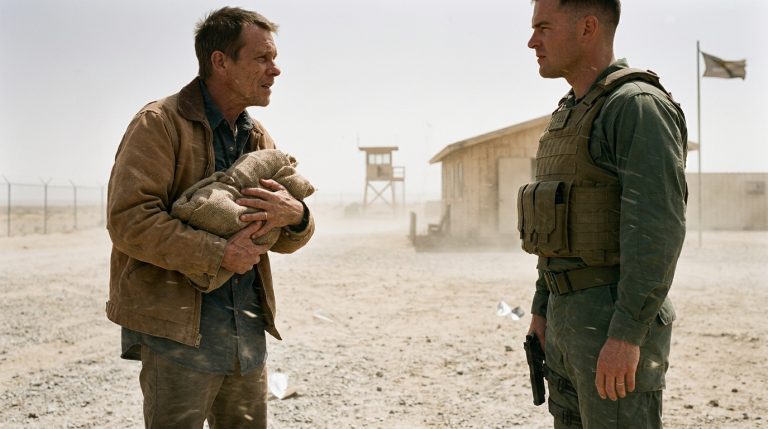
The heat radiating off the tarmac was a physical weight, thick enough to taste. It tasted of kerosene, burning rubber, and the sharp, metallic tang of the AH-64 Apache’s fuselage. Captain Ryan Miller wiped a bead of sweat from his temple, his irritation mounting. He thrived on the sterility of the flight line—everything in its place, every procedure documented in triplicate. This intruder was a discordant note in his symphony of order.
“I’m going to ask you one more time, old-timer,” Miller said, his voice clipped, designed to cut through the hum of the distant ground power units. He took another step forward, closing the distance until he was well within the man’s personal space. He expected the usual reaction: the flinch, the stuttered apology, the rapid shuffle away from military property.
Instead, the man in the red leather jacket—a garment so out of place it looked like a costume from another century—remained infuriatingly still. His eyes, deep-set and obscured by the shadow of the Apache’s massive rotor housing, were fixed on the front strut.
“The hydraulic fluid,” the man said. His voice wasn’t weak; it was like the sound of gravel shifting under the weight of a heavy truck. “You’re running too heavy on the front strut. It’s bleeding pressure. You feel that vibration in your cyclic during hover, don’t you?”
Miller felt a cold prickle of annoyance shoot down his spine. He laughed, a short, sharp sound that earned him a glance from Lieutenant Evans, who stood a few paces behind, suppressing a smirk.
“You think you’re in a hangar back in the seventies, Pops?” Miller stepped in closer, his boots crunching loudly on the loose grit. He made sure his name tag was perfectly horizontal. “This is a restricted zone. Millions of dollars of hardware, a federal facility, and you’re wandering around like you’re at a state fair. You’re trespassing. If you don’t produce a valid clearance right now, I’m going to have the MPs escort you off this base in cuffs.”
The man finally turned. His face was a map of lines and hard-won patience. He reached into his back pocket, his movements slow, calculated—the kind of efficiency that suggested he had performed this exact maneuver a thousand times in much higher-stakes environments. He pulled out a worn leather wallet and extended a visitor’s pass.
Miller snatched it, barely glancing at the laminate before flicking it toward the man’s chest. It fluttered to the ground, landing in the dirt.
“Museum pass,” Miller lied, his jaw tight. “That doesn’t get you past the fence line here. You’re done.”
The man bent down. His movement was stiff, a wince crossing his features as his knees protested, but there was a strange, silent grace in how he retrieved the card. He didn’t look at Miller. He looked back at the helicopter.
“I wasn’t touching, Captain,” he said, the silence between them widening into a void that Miller felt compelled to fill. “I was listening. The machine has a voice. You’re just too loud to hear it.”
Miller felt the blood rise to his face. The insolence was a strike against his rank, his authority, his very identity. He pointed toward the cockpit with a sharp, shaking finger.
“You want to play expert? Fine. Climb up there,” Miller challenged, his voice rising, the trap closing before he even realized he had set it for himself. “If you know so much about the pitch links and the hydraulics, start her up. Let’s see you pull those blades through a sequence.”
He expected a retreat. He prayed for it. But the man in the red jacket simply looked at the sky, then back at the Apache, and took a step toward the boarding ladder. The air around them seemed to thicken, the light bending around the sudden, lethal focus in the old man’s eyes.
CHAPTER 2: THE HARMONIC DISSONANCE
The cockpit was not a sanctuary. It was a pressure cooker of recycled air and the dry, biting scent of dust that had been baked by the desert sun into the very fabric of the seat covers. Fred felt the vibration first—a subtle, high-frequency tremor that traveled through the soles of his boots and up into his spine. It was a language he understood fluently, a dialect written in friction and steel.
He sat motionless, his hands hovering over the collective. Outside, Miller was a frantic blur of agitated motion, his silhouette pacing against the shimmering heat haze of the tarmac. Miller’s voice, muffled and distorted by the thick, hardened glass of the canopy, reached Fred as little more than an irritating buzzing, like an insect trapped against a windowpane.
Fred ignored him. His focus was entirely on the instrument panel.
The digital MFDs (Multi-Function Displays) bathed the cockpit in a cold, clinical glow, a stark contrast to the analog gauges of his prime. He leaned in, his eyes narrowing. There was a slight lag in the engine readouts, a fractional delay in the synchronization of the turbines that didn’t show up on the primary caution display. It was a ghost in the machine, a whisper of inefficiency that suggested something deeper was wrong. The vibration in the tail rotor was not just a symptom of poor maintenance; it was a rhythmic irregularity, a skip in the heart of the beast.
He reached for the auxiliary power unit switch. His finger moved with a deliberate, haunting precision. As he flipped it, the high-pitched whine that began to emanate from the engine cowling shifted. It was an aggressive, predatory sound.
He watched the gauges. They weren’t just needles and numbers to him; they were the vitals of a living creature. He felt a sudden, sharp pang of disconnect. The cockpit was too quiet, too synthetic. Where were the subtle rattles of the airframe, the smell of hot oil that used to permeate every flight? The modern Apache was a masterpiece of precision engineering, but in this moment, it felt sterilized, stripped of the soul he had helped breathe into it decades ago.
Outside, the dynamic shifted. Miller had stopped pacing. He was staring at the cockpit now, his posture frozen in a strange, sudden rigidity. Fred could see the realization dawning on the young officer—the terrifying understanding that the man in the cockpit wasn’t just turning switches at random. He was performing a symphony.
Fred felt a flash of memory: a box canyon in Iraq, the smell of cordite thick enough to choke on, and the way the cyclic stick had fought him, resisting his inputs as he forced the machine to hold a hover that defied physics. That machine had been a jagged, wounded thing, held together by duct tape and sheer willpower. This one? This one was pristine, a lethally polished predator that had never known the scars of a real fight.
He looked down at the cyclic. His hand gripped the cold metal, his knuckles white. The grip was the same, the weight familiar, but the response was alien. He felt a sudden, intrusive urge to snap the controls to the left, to feel the machine bank and bite into the air, to prove that he still belonged to the sky. He pushed the thought away, his breathing steady, rhythmic.
The discrepancy in the digital interface—the lag he had noticed earlier—nagged at him. It was a symptom of a deeper, systemic rot. Someone had been cutting corners, perhaps trying to tune the engines for performance at the cost of long-term structural health. He filed the detail away, his mind working with the cold, analytical detachment of a surgeon.
He shifted his weight. The arthritis in his knee flared, a sharp, white-hot needle of pain that served as a cruel reminder of the passage of time. He allowed himself a small, wry smile. He wasn’t the man he had been in the box canyon. The ghost in the machine was still there, but the chassis was wearing thin.
Miller was moving again, gesturing frantically to his subordinates. He looked terrified. The arrogance had evaporated, replaced by a raw, naked panic. Fred watched him through the canopy glass, his expression unreadable. He wasn’t doing this to humiliate the boy, though that was clearly the result. He was doing this to test the machine—to see if the pride of the modern fleet was as solid as the doctrine he had spent his life refining.
He reached for the ignition switches. His hands were steady, the trembling he had noticed earlier vanished, replaced by the muscle memory of a lifetime spent in the service of flight. He looked at the rotor brake, then at the sky above, where the heat distortion made the horizon appear to shimmer and dance.
The machine waited for his command. Fred closed his eyes for a split second, and for that moment, he wasn’t a retired veteran in a visitor’s chair. He was the Ghost Rider, and the sky was waiting for him to return. He flicked the switch, the mechanical click echoing with finality in the small, glass-enclosed space. The engine caught, a low, guttural roar that vibrated deep in his chest, a sound that cut through the silence of the base and demanded attention.
He felt the Apache surge, a subtle shift in the weight distribution as the turbines reached their idle rhythm. Outside, he saw Miller stumble back, his hands shielding his eyes from the sudden, powerful rush of wind. The machine was awake, and it was screaming for movement.
CHAPTER 3: THE HARMONIC DISSONANCE
The roar of the two engines was a physical weight, pressing against Fred’s chest and vibrating through the soles of his boots. He sat in the center of the hurricane, the cyclic stick held in a grip that was less about control and more about communion. He felt the machine shudder—a subtle, parasitic vibration that didn’t belong in a fresh flight-idle sequence.
Below him, the tarmac was a swirling vortex of grit and dust, whipped into a frenzy by the rotor wash. Through the canopy, he saw Miller—a shrinking figure, his uniform whipped into disarray by the downwash, his hands raised instinctively to protect his face. Miller looked small. He looked like an amateur caught in a thunderstorm he hadn’t known how to forecast.
Fred’s hands danced across the overhead panel, his fingers moving with a twitchy, frantic energy that betrayed his outward calm. He was looking for the source of the harmonic dissonance. He checked the engine oil pressures, the turbine gas temperatures, the transmission fluid levels. Everything was nominally within the green, yet the rhythm was wrong. It wasn’t the clean, humming heartbeat of a well-maintained predator. It was the strained, shallow breath of a machine being pushed too hard with insufficient care.
Thump-thump-thump.
The sound triggered something in his mind, unbidden and cold. The memory of the box canyon in Iraq surged forward with the clarity of a high-definition photograph. He saw the shimmering heat, the way the sand had choked the intake filters, the smell of cordite mixing with the sweet, sickening odor of burning hydraulic fluid. He felt the familiar pull of the cyclic to the right, a phantom movement he hadn’t made in twenty years. He was back there, holding a hover while the world burned around him, the machine groaning in protest against the strain.
He blinked, the harsh, clinical light of the modern cockpit snapping him back to the present. He was on a restricted military base in the desert, not in a war zone, and he was being watched by a young captain who was currently realizing his own career was likely evaporating in the exhaust stream.
Fred shook his head, clearing the phantom debris of the past. He didn’t have the luxury of memory. He needed to identify the failure. He pushed the collective down, just an inch, feeling the torque response of the engines. It was sluggish.
Someone hadn’t been performing the required compressor washes. The engine was choking on its own inefficiency. It was a technical sin, a lazy shortcut that would eventually lead to a catastrophic flameout during a high-stress maneuver. He felt a flash of cold, intellectual anger. This wasn’t just Miller’s failure; it was a failure of the culture that surrounded him, a culture that prioritized aesthetics and rank over the fundamental, brutal physics of flight.
He reached for the communication panel. His thumb hovered over the toggle, but he didn’t key the mic. He didn’t need to explain this to Miller. Miller wouldn’t understand the nuance of a compressor wash any more than he would understand why Fred was sitting in his seat.
He watched the gauges again. The vibration was worsening. The tail rotor assembly was working overtime to compensate for the main engine’s sluggishness. He leaned forward, his eyes scanning the array of caution lights. There—the amber light for the tail rotor transmission temperature. It was flickering. It was barely visible, a subtle pulse that would have gone unnoticed by anyone who didn’t know exactly what to look for.
A shadow fell over the canopy. Fred looked up.
A figure was sprinting toward the aircraft—a man with the purposeful, heavy stride of a career officer. It wasn’t Miller. It was someone older, someone with the weight of responsibility in their gait. Fred recognized the silhouette before he saw the rank. Colonel Vance.
Fred’s pulse didn’t quicken. Instead, he felt a strange, detached satisfaction. The sequence was unfolding exactly as it should. He didn’t pull pitch. He didn’t attempt to lift the Apache off the concrete. He held the machine in a steady, aggressive hover-idle, letting the engines roar and the blades slice the air with a rhythmic, intimidating precision.
He could see the panic in the eyes of the young lieutenant, Evans, who was now standing next to Miller, his face pale, his hands trembling. They were no longer spectators. They were the subjects of a lesson they hadn’t signed up to learn.
Fred’s hand moved back to the power lever. He eased it back, just slightly, letting the RPM of the rotors drop to a lower, more controlled frequency. He wanted to feel the machine without the violent distortion of the high-speed spin. He wanted to feel the looseness in the pitch links he had sensed from the ground.
It was there. A subtle, metallic clink that resonated through the cyclic, a physical manifestation of a neglected maintenance check. He let out a long, slow breath, the tension in his shoulders beginning to dissipate. He had the answer. He had the truth.
The machine wasn’t failing because it was old. It was failing because it was being treated as a toy rather than a weapon.
Colonel Vance reached the perimeter of the rotor arc, stopping dead as the sheer force of the downwash hit him. He didn’t retreat. He stood his ground, his face a mask of iron-willed authority, staring directly at the cockpit.
Fred met his gaze. There was no fear in the colonel’s eyes—only a profound, dawning recognition. Fred nodded once, a gesture of shared understanding between two men who had spent their lives dancing with the same lethal ghosts. He then reached for the ignition switch, his fingers lingering on the cold plastic.
The lesson had been delivered. Now, it was time for the correction.
CHAPTER 4: THE COLONELS ARRIVAL
The whine of the turbines died, replaced by the ominous, rhythmic ticking of cooling metal. Each tick sounded like a gavel strike, a finality that marked the end of Miller’s command over the moment. The air around the Apache, previously thick with the smell of JP-8 and high-stakes ego, grew thin and cold. Fred sat motionless in the rear seat, his hands resting on the cyclic, feeling the final dissipating tremors of the machine’s heartbeat.
He didn’t look at the Colonel. He didn’t have to. He could feel the weight of Vance’s gaze—a stare that was heavy, informed, and devoid of the superficial bluster that defined Miller’s behavior. The silence lasted long enough for the tension to become almost unbearable, a physical pressure that tightened in Fred’s chest.
“Miller,” the Colonel said. The voice was low, devoid of shouting, and all the more terrifying for it. “Get back here.”
Fred heard the heavy thud of Miller’s boots on the grit. The Captain’s movements were frantic, disorganized. He was trying to project an aura of authority, but the way his gear clattered and his breathing hitched betrayed him. Miller stepped into Fred’s peripheral vision. He looked smaller than he had only minutes ago, his uniform dusty, his hat slightly askew, the sharp, arrogant edges of his posture smoothed away by raw, unadulterated fear.
“Sir, I—” Miller began, his voice cracking. “I was conducting an unscheduled inspection of—”
“Quiet.” Vance didn’t even turn his head toward the Captain. His eyes remained fixed on the cockpit, on Fred. The Colonel reached up, placing a hand on the edge of the fuselage. The gesture was careful, almost reverent. “Chief. Is there a reason you’re occupying the seat of an active-duty aircraft on my flight line?”
Fred shifted, the movement bringing a dull, familiar ache to his hip. He didn’t rush his answer. He took his time, assessing the Colonel, seeing the man behind the rank. He saw the graying temples, the lines of exhaustion that no amount of professional grooming could conceal. This was a man who had weathered the same storms, someone who understood the true cost of the tactical doctrine that the military treated like gospel.
“I found a vibration in the tail rotor, Colonel,” Fred said, his voice level and devoid of apology. “And the number two engine is running twenty degrees hotter than it should be at idle. Someone hasn’t been washing the compressors, and the pitch links on the number three blade are loose. It’s an accident waiting to happen, regardless of who’s in the seat.”
Miller let out a sharp, incredulous breath, his ego twitching with a final, dying spasm. “That’s impossible, sir. The maintenance logs were signed off this morning. He’s lying.”
Vance finally turned, his head snapping toward Miller with such violent intensity that the Captain recoiled, stumbling back a half-step. The Colonel’s eyes were cold, dark pools of fury. “Do you have any idea who you’re talking to, Miller? Do you have any idea whose work you’ve been ignoring?”
“He’s a civilian, sir!” Miller pleaded, though his conviction was clearly fraying. “He’s a trespasser!”
“He’s a ghost,” Vance snapped. The word hung in the air, heavy and absolute. “He’s the reason that you’re flying an Apache today instead of walking in the infantry. He’s the reason that every protocol you memorize exists. He built the very tactical foundation you’ve been using to treat your subordinates like dirt.”
The truth landed with the weight of a physical blow. Fred watched Miller’s face as the reality of the situation finally breached his internal defenses. The arrogance didn’t just vanish; it shattered. Miller stared up at the cockpit, his eyes darting to Fred’s face, then to the Colonel, then back to the Apache. The machine that had been his plaything, his instrument of status, was suddenly a monument to his own inadequacy.
Fred saw the change in Miller’s posture—the way his shoulders slumped, the way the light left his eyes. It was a failure of the ego, a collapse of the false self-image that had driven his behavior. It was the “unreliable perception” of his own greatness finally hitting the wall of hard, immutable fact.
“Chief,” Vance said, his voice softening just a fraction, the transition from commander to peer almost imperceptible. “Climb down. We’re going to the club. And Miller… you stay right here. You’re going to wait for the maintenance crew. You’re going to hold the ladder. And you are going to watch them pull every single bolt I just heard about.”
Fred didn’t wait for Miller to respond. He unbuckled his harness, the familiar click of the release sounding like a gunshot in the stagnant air. He swung his leg over the side, his movements deliberate, his eyes never leaving the Colonel. When his boots hit the tarmac, he didn’t stumble. He stood tall, the red leather jacket—the subject of so much derision—feeling like armor once again.
As he walked past Miller, he didn’t look at him. He didn’t need to. The Captain was a statue of humiliation, frozen in place, staring at the Apache as if the machine might suddenly reach out and strike him. The silence of the base, once heavy with tension, now felt pregnant with the weight of a lesson that had finally, painfully, taken root.
“After you, Chief,” the Colonel said, gesturing toward the staff car.
Fred walked forward, his stride rhythmic, the aches of age momentarily forgotten. The path ahead was clear, but the air still held the sharp, metallic tang of the machine’s cold, cooling heart. The conflict was far from resolved, but for the first time that day, the hierarchy was properly aligned, and the ghost in the machine was no longer a secret.
CHAPTER 5: THE LESSON IN THE HANGAR
The walk to the hangar was a study in contrasts. Colonel Vance led the way with a measured, disciplined cadence, while Fred followed with the loose, slightly uneven gait of a man whose body remembered more than it could currently perform. Behind them, Miller trailed like a man walking toward a scaffold, his uniform still rumpled, his face a hollow mask of shock. The mid-afternoon sun beat down on the blacktop, turning the base into a shimmering landscape of heat and shadows.
As they reached the heavy steel doors of the hangar, a sudden, sharp gust of wind caught the corrugated metal, causing it to groan in a discordant, metallic shriek. It was the same sound Fred had heard in the tail rotor assembly—a reminder of the mechanical dissonance he had diagnosed. He paused, his hand hovering over the door’s pull-bar, listening.
“The wind’s shifting,” Fred murmured, mostly to himself. “If that assembly isn’t tensioned properly, the gusts will stress the pitch links even further. It’s not just a maintenance issue; it’s a design failure waiting to happen if you treat her with the arrogance you’ve been displaying, Captain.”
Miller didn’t answer. He couldn’t. He looked at the hangar doors as if they were the gates to a prison.
Vance pushed the doors open, and the transition was instantaneous. The blinding glare of the desert vanished, replaced by the cool, cavernous dimness of the hangar. The space was filled with the scent of degreaser, hydraulic fluid, and the lingering, sharp ozone of industrial machinery. Several maintenance crews were working on other birds, but as the small procession entered, the atmosphere shifted. Word had clearly traveled. The mechanics stopped their work, their heads turning in unison to see the legend in the red leather jacket walking through the heart of their domain.
Vance led them toward the Apache. It sat in the center of the floor, lit by the harsh, overhead halogen lamps that cast long, dramatic shadows against the concrete. The maintenance team leader, a Master Sergeant with grease-stained hands and eyes that had seen enough to know exactly who Fred was, stepped forward.
“Chief,” the sergeant said, offering a curt, genuine nod. “We’ve got the tail rotor pulled. You were right about the number three blade. Tension was off by three percent.”
Fred walked toward the aircraft. He didn’t look at the Colonel, and he didn’t look at Miller. He walked to the tail assembly, where the intricate, spider-webbing structure of the rotors was exposed. He ran a hand over the steel, feeling the micro-vibrations of the metal, the way the components fought against each other. It was an intimate, tactile language.
“Three percent is the difference between a controlled flight and a mid-air disintegration,” Fred said, his voice echoing in the vast, silent space. He turned, looking at Miller, who stood a few feet back, his arms crossed over his chest in a desperate, failed attempt to maintain some shred of composure.
“You said you knew every bolt, Miller,” Fred said, his tone devoid of malice—which made it significantly worse. “But you didn’t know the most important one. You didn’t know the bolt that holds the pilot’s responsibility to the machine. You thought it was a toy. You thought your rank made you superior to the physics of the rotor blade.”
Miller opened his mouth, then closed it. The air in the hangar felt heavy, pressurized. The mechanics were watching, their faces inscrutable, waiting to see if the Captain would finally break.
“I’m not here to humiliate you,” Fred continued, his gaze drifting back to the exposed rotor. “I’m here to ensure that when you finally do take this bird up, you don’t kill the crew that trusts you. Because the machine doesn’t care about your ego. It only cares about the maintenance of the truth. And the truth is, you’ve been reckless.”
He reached out and picked up a torque wrench from the workbench nearby. He stepped up to the tail assembly and held the tool out toward Miller. It was a simple, heavy piece of metal.
“Take it,” Fred said.
Miller hesitated, his eyes wide. He looked at the wrench, then at the Colonel, then back at Fred. He reached out and took the tool. The weight of it seemed to surprise him.
“You’re going to spend the next forty-eight hours with the crew,” Fred said. “You’re going to clean every housing. You’re going to tighten every bolt under the Master Sergeant’s supervision. And you are not going to move until the bird is airworthy by the standards of someone who actually knows how to fly.”
Vance stepped forward, his hand resting on the holster at his hip—not as a threat, but as a reminder of authority. “He’s giving you a chance to keep your wings, Miller. Take it, or leave the flight line permanently.”
Miller looked down at the wrench. For the first time, his face wasn’t arrogant. It wasn’t even shocked. It was defeated—and in that defeat, there was the flicker of something else. The start of genuine humility. He didn’t say a word. He simply walked over to the tail rotor, knelt down, and began to work.
Fred turned away, his duty in the hangar finished. He felt a sudden, profound exhaustion. The adrenaline that had sustained him for the last few hours was retreating, leaving behind the dull, persistent ache in his joints. He walked toward the hangar door, the rhythmic sound of a wrench tightening a bolt echoing behind him—the most beautiful sound he had heard all day.
CHAPTER 6: THE FINAL HORIZON
The hangar doors remained cracked open, a sliver of the late-afternoon sky bleeding through—a brilliant, bruised orange that signaled the end of the day. Fred stood near the threshold, watching the last of the light crawl across the concrete floor. The silence in the hangar had changed. It was no longer the heavy, pressurized silence of confrontation; it was the quiet, industrious hum of professionals doing their work. Miller was still there, bent over the tail rotor, his hands stained with oil, his focus absolute. The arrogance was gone, replaced by the grim, necessary labor of penance.
Colonel Vance stood a few paces away, his arms crossed, watching the maintenance crew finish their final checks. He didn’t look at Fred, yet he seemed to be tracking the older man’s presence with a quiet, respectful awareness.
“You did a good thing here today, Chief,” Vance said, his voice barely rising above the distant sound of an air compressor. “Not just for the aircraft. For the culture. It’s a hard thing to teach a young man that he doesn’t own the sky—that he only gets to borrow it, provided he respects the machine that holds him there.”
Fred nodded slowly, his gaze drifting to the Apache. It sat silent now, the massive rotor blades stilled, its predatory silhouette softened by the shifting light. “He’s a good pilot, Colonel. He just never had to learn the difference between being a master and being a caretaker. A pilot who doesn’t understand the mechanics of his own survival is just a passenger with a high-stakes hobby.”
“He’ll remember this,” Vance said. “The next time he climbs into a cockpit, he’ll think of the pitch links. And he’ll think of you.”
Fred felt a strange, lingering warmth in his chest—a sense of closure that he hadn’t realized he was seeking until the moment it arrived. He had come to the base as a man living in the past, a ghost wandering the halls of a life he thought he had outlived. He had expected nothing more than a few hours of nostalgia, a quiet moment to touch the metal and hear the hum of the turbines. Instead, he had been forced to reclaim his identity, not as a veteran, but as the architect of the very doctrine that defined this place.
He looked at his hands. They were steady now. The tremor was gone.
“I should go,” Fred said, his voice quiet. “Martha’s waiting.”
Vance turned, offering a final, sharp salute—a gesture of genuine, unvarnished respect that held more weight than any commendation. Fred returned it, his movement crisp, a mirror of the discipline he had carried for forty years. He didn’t linger. He didn’t seek further validation. His work was done.
The walk back to the parking lot felt lighter than the walk to the hangar had. The cooling desert air brushed against his face, sharp and clear. As he reached their sedan, Martha was already waiting, her eyes tracking him as he approached. She didn’t ask what had taken him so long, but as he slid into the passenger seat, she reached out and rested a hand on his forearm, a silent, knowing touch.
“You look tired, Fred,” she said softly.
“I am,” he admitted, leaning back against the seat and closing his eyes. “But it was a good day.”
As the car pulled away, driving toward the main gate, Fred caught one final glimpse of the flight line. In the distance, under the harsh glare of the floodlights, he could see the silhouette of the Apache. It was a dark, jagged shape against the encroaching night. He knew that tomorrow, the crew would run a test flight. They would check the pitch links, they would verify the engine torque, and they would take her up, and she would fly with the smooth, lethal efficiency that she was built for.
He didn’t need to be there to see it. He knew the machine. He knew the doctrine. And he knew that the lesson had held.
He rested his head against the window, watching the base lights flicker and recede. The memory of the box canyon, the roar of the rotors, the scent of cordite—it all seemed to settle into place, no longer a haunting, but a foundation. He wasn’t just a man who had retired; he was a man who had left behind a legacy that would continue to breathe, and roar, long after he was gone.
The sedan moved smoothly onto the highway, leaving the base behind. Fred watched the horizon, where the last light of the sun was being swallowed by the rising dark. For the first time in years, he felt a profound, quiet peace. The ghost had been laid to rest, not by disappearing, but by finally finding his place in the present. He breathed out, a long, steady sigh of relief, and let the hum of the tires on the asphalt carry him home.