The Iron Gradient: Blood on the Powder, Paper in the Rust
CHAPTER 1: THE COLD SLAP
The cold didn’t just bite; it sliced.
I pulled my gloves tight, knuckles popping under the worn leather, and stared at the gap where my warning stake used to be. The split-oak post was gone. In its place: a jagged hole stuffed with slush, grayed by oil and boot-grit.
Someone had dragged a heavy iron bar straight across the fall line. Deep, dirty ruts cut sideways through the groomed powder, turning the steep descent into a neck-breaking trap.
Halfway down the run, laughter echoed through the pines. Clear. Smug.
Logan Mercer stood with four others near the tree line. He held a flat-head spade, tossing loose chunks of ice against the reflective markers. His crew laughed as the orange tape snapped under the impacts, fluttering down into the brush like dead leaves.
“Careful, Caleb!” Logan shouted. His voice carried sharp in the thin air. “Trail’s a health hazard today. Might want to stay off it!”
Behind me, the hiss of metal on snow broke the silence. A skier hit the blind curve above the ruined section.
“Hold up!” I yelled, pivoting.
Too late. The lead skier—a tourist in a blue parka— hit the first rut sideways. His edges caught hard, boots popping out of the bindings with a violent crack. He tumbled thirty feet, sliding on his chest until he hit the lower bank and stayed still, groaning into his gloves.
I moved toward him, my boots sinking ankle-deep into the ruined pack. Before I reached the tree line, the diesel rumble of a heavy engine choked through the access gate.
A dark gray SUV pulled up onto the shoulder, crushing my private-property sign under its front bumper. The door creaked open.
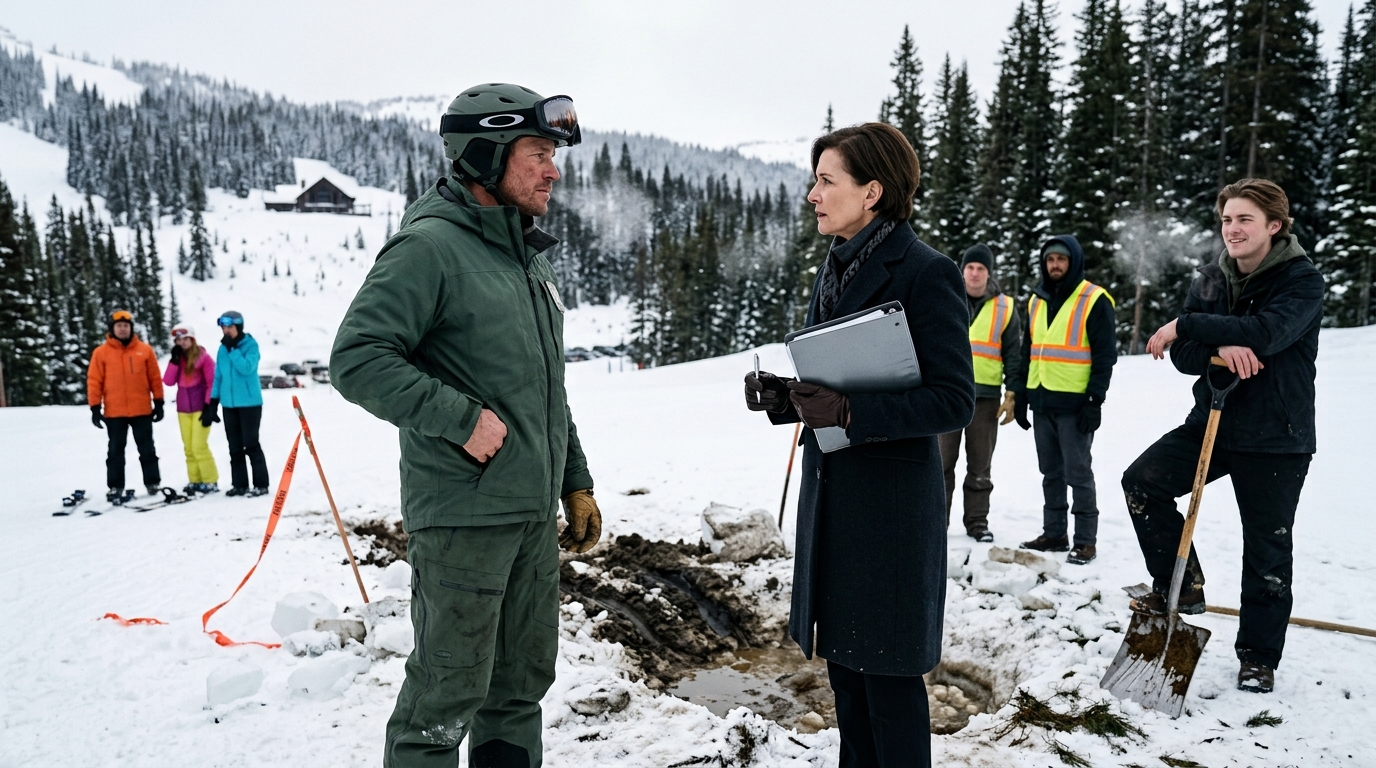
Diane Mercer stepped out. She didn’t hurry. She didn’t check on the skier struggling to sit up in the drift. She pulled a heavy steel-clipped binder from under her arm and clicked a silver pen.
“That’s enough, Caleb,” she called out, her voice flat, carrying the dry authority of someone used to signing eviction notices. “The HOA is shutting this run down. Effective immediately.”
I stopped ten feet from her. The brass trail-cam key in my pocket felt frozen against my thigh. I rolled the notched metal edges against my thumb until the sharp teeth bit into my skin.
“This slope isn’t HOA land, Diane,” I said, my voice low, raspy from the cold. “You’re standing six feet past my property marker.”
She didn’t look at the boundary pin embedded in the frozen granite. She didn’t look at her son, who was currently leaning against his shovel, grinning.
“Jurisdiction follows risk, Caleb,” she said, her pen tapping the clipboard with a rhythm like a ticking clock. “And right now, your land is an uninsurable liability.”
CHAPTER 2: SABOTAGE IN THE POWDER
The silver tip of her pen hit the stainless steel plate three times. Click. Click. Click.
“The board’s temporary injunction holds until the quarterly review,” Diane said, her jaw locked tight against the wind. “Until then, any feet on this snow face a three-hundred-dollar daily trespass assessment. Per person.”
“You don’t have a quorum for an emergency assessment,” I said. My thumb dug harder into the brass key in my coat pocket, the sharp notches of the trail-cam tool leaving a raw, dented crescent in my skin. “And your jurisdiction ends at the drainage ditch.”
“We created an emergency safety precinct,” she replied smoothly, not a single hair out of place despite the gale whipping down the slope. She gestured toward two men in high-vis vests unstepping from the back of the gray SUV. “Put the posts in, boys. Right across the neck.”
The workers didn’t look at me. They dragged heavy steel barricade frames over the ice—commercial-grade crowd control barriers, far too heavy for standard residential HOA inventory. On the lower crossbar of the lead frame, a small, stencil-painted serial code caught the weak sunlight: PRT-INV-088.
PineRidge Trust. Not Pinerest Ridge Association. A private holding company logo, slapped over fresh zinc plating.
I stepped into the path of the first barricade. “Touch my fence wire and you’re committing property destruction on a recorded boundary.”
Logan took two steps forward from the tree line, his boots crunching loud through the crust. The flat-head spade dangled from his right hand, the steel blade smeared with gray mud and crushed pine needles.
“Let it go, Rowan,” Logan sneered, his breath pluming thick and white. “You’re outnumbered, you’re out-funded, and your trail is trash anyway.”
“Logan,” Diane said without looking at him. A single word, sharp as a razor, shutting him down instantly. But the kid didn’t lose the grin. He knew what I knew: the skiers behind us were already backing away, unbuckling their bindings, whispering as they headed toward the parking lot.
The crowd was dissolving. The trail was dying right where I stood.
I didn’t throw a punch. I didn’t reach for the shovel. I took three steps backward, letting the cold air clear the iron taste from the back of my throat, and watched them chain the heavy steel frame directly to my cedar gateposts.
“We’ll serve the formal notice by certified mail,” Diane called out over the idling rumble of the SUV. “Don’t break the seal, Caleb. It makes the court filings so much messier.”
They drove off twenty minutes later, leaving the heavy steel gate blocking my access route. The mountain went dead quiet, save for the moan of the wind through the high canopy.
I waited until their tail lights vanished down the access road before I moved.
I walked the perimeter of Parcel-88, staying ten feet inside my own tree line. The snow was deep here, untouched by the groomer, pulling at my knees with every step. At the base of the old white pine overlooking the steep drop of the mid-run, I dropped to one knee.
The first camera was a weather-sealed Bushnell, strapped three feet up the trunk behind a cluster of dead branch tips. I popped the latch with the brass key.
The SD card was cold enough to stick to my skin. I slid it into the portable viewer pulled from my internal jacket pocket.
I flipped through the infrared stills from midnight.
01:14 AM. Two figures on snowshoes.
01:22 AM. A cordless drill angled straight into the base of my timber safety stanchions, weakening the structural lag bolts right at the stress points.
01:31 AM. Logan Mercer’s face, captured in full illumination under the IR flash as he leaned into the lens to kick loose the orange marker tape, his shovel blade raised high.
He hadn’t just modified the trail. He had engineered a structural failure right where the high-speed turn compressed the snowpack.
I tucked the viewer into my vest, locked the camera housing back down, and turned toward the upper cabin. The fine structure of their legal trap was clear now, but they had made one critical error in their rush to lock down the mountain.
They thought I was trying to save a business. They didn’t realize I was documenting an invasion.
CHAPTER 3: THE BROKEN GUEST
The cold viewer fit snug in my palm, its screen flickering blue against the dim gray light under the pines. I slid it deep into my internal vest pocket, zip-locking the lining over the plastic housing so the condensation wouldn’t fog the lens.
I didn’t head back toward the access road where Diane’s zinc barricades sat chained to my posts. I took the steep, unpaved spur toward the guest cabin, my boots grinding through two inches of fresh crust that had accumulated over the packed snow.
Fifty yards up, the cabin’s cedar porch hummed with the steady thrum of an oil heater.
I pushed the door open without knocking.
The air inside smelled of stale tea, rubbing alcohol, and the sharp, chemical tang of iodine. Elliot Ward sat near the cast-iron stove, his back rigid against the ladder-back chair. He wore his heavy wool coat, but the right sleeve was unbuttoned, slitting open to accommodate a stark white sling pinned tight across his shoulder.
His left hand held a small white ceramic cup. His knuckles were raw, greyed with frostbite around the nails, but his posture didn’t yield an inch to the pain.
“You’re back,” Elliot said. His voice was flat, rhythmic, carrying the dry, unhurried resonance of a courtroom bench. “Did she bring the local deputy?”
“She brought private steel,” I replied, dropping my gloves onto the rough-cut oak table. “And two men with a flatbed. They chained crowd-control gates across the gap at Parcel-88.”
Elliot’s gaze drifted to the window, watching the snow accumulate on the outer sill. He set the tea cup down with a single, controlled click. His thumb hovered over the handle, tracing the hairline crack in the glaze without pressing into it.
“The frame wasn’t stamped with municipal tags, was it?” he asked.
“PRT,” I said. “PineRidge Trust. Stenciled in black industrial paint on the lower rail.”
Elliot closed his eyes for two long seconds. His jaw didn’t clench, but his breathing slowed into a deliberate, shallow cycle—the involuntary restraint of a man holding three broken ribs together under his sternum.
“Aegis Underwriters issued a provisional notice to my office yesterday morning,” Elliot murmured, opening his eyes. They were sharp, pale grey, completely unclouded by the painkillers sitting untouched on the end table. “An inquiry regarding liability limits for private parcels backing onto the HOA corridor. They named Parcel-88 specifically.”
I leaned against the doorframe, my thumb instinctively reaching into my pocket to turn the brass trail-cam key against my palm. The sharp edges tore at the callus I’d built up over ten winters of grooming this mountain.
“They’re setting up a default,” I said. “Diane issues the fine under the HOA umbrella. If I don’t pay, the lien attaches to the county deed. If I do pay, I acknowledge their jurisdiction over my boundary.”
“Precisely,” Elliot said. He reached down with his uninjured hand, pulling a thick Manila folder out of his leather briefcase resting beside the chair. The corner of the paper was stamped with a faint blue seal: United States District Court – Chambers. “Which is why you aren’t going to fight them in the county court.”
“I’m not a lawyer, Elliot.”
“Neither was the man who tried to condemn my family’s timber lot in ninety-two,” Elliot said, his voice dropping an octave, colder than the wind outside. He slid the folder across the table with a flick of his wrist. “Read section three. The emergency assessment Diane signed this morning requires a sworn affidavit of public danger. She filed it under penalty of perjury.”
I stepped to the table, picking up the document. My fingers left faint wet prints on the crisp bond paper.
“Logan broke those stanchions at midnight,” I said, my voice tight. “I have the IR frames on an SD card in my vest. Timestamped. High resolution.”
Elliot leaned back against the ladder-frame chair, a micro-grimace pulling at the corner of his mouth as his injured shoulder shifted under the sling.
“Then you don’t show her the footage,” Elliot whispered. “Not yet. You let her swear to the affidavit at the emergency meeting tonight. Let her sign her name to the lie in front of forty witnesses.”
“And if she forces the closure before tonight?”
Elliot looked up at me, his gaze locked hard onto mine.
“She already did,” he said, tapping the white sling with his left index finger. “She closed it on a federal officer. And that turns her little land-grab into something very different.”
CHAPTER 4: THE LEVERAGE ENGINE
The blue seal on the bond paper felt cold under my thumb, the raised ink stiff against the grain. Outside, the wind rattled the single-pane glass of the guest cabin, blowing a fine draft of powdery snow under the door frame.
“A federal officer,” I said, my voice barely audible over the crackle of the oil heater. “She thinks you’re just another winter tenant staying out the season.”
“She didn’t ask,” Elliot replied. His left hand smoothed the corner of the court document against the oak table, his fingers moving with deliberate, measured precision. “Assumptions are cheap up here, Caleb. People rely on them until the bill comes due.”
I pulled the portable viewer from my internal pocket and laid it beside his file. The screen flickered awake, casting a faint blue sheen over the paper.
“This is midnight,” I said, tapping the glass. “Logan Mercer and one other. They used an eighteen-volt cordless driver to back out the three-inch lag screws holding the lower safety netting at the mid-run turn. Then they piled six inches of loose powder over the shear line.”
Elliot leaned down, his eyes narrowing as he scanned the timestamped stills. The blue light caught the sharp lines of his jaw, the gray stubble along his throat motionless.
“You have the camera’s serial log?” he asked.
“Hard-coded on the card,” I said, reaching into my pocket and pulling out the brass trail-cam key. I set it on the table between us. It clinked against the wood with a dull, heavy thud. “Internal memory registers shock sensors and temperature data. The file integrity hasn’t been broken.”
“Good,” Elliot said softly. He didn’t smile. His eyes stayed locked on the image of Logan’s face illuminated under the infrared array. “Now look at the bottom left of the frame. Behind the spruce branch.”
I leaned closer, zooming the image two steps.
Past the brush, parked on the access shoulder forty yards behind my property line, sat a white heavy-duty pickup. The side panel carried no HOA crest. Stenciled in low-contrast gray paint along the rear quarter panel were two words: Aegis Underwriters.
My pulse didn’t spike; it went dead cold.
“Aegis,” I muttered. “The insurance firm you mentioned.”
“They aren’t just evaluating risk, Caleb,” Elliot said, his left index finger tapping the edge of the screen once. “They’re conducting a pre-acquisition survey. Pinerest Ridge Association doesn’t have thirty thousand dollars to erect commercial-grade steel barriers. But PineRidge Trust does. And Aegis holds the primary lien on every asset the Trust operates.”
Layer 1 was breaking wide open. This wasn’t a petty neighborhood dispute over broken fences or snow safety. Diane hadn’t pushed her son onto my trail out of maternal negligence or local spite; she was using Logan’s sabotage to create a documented trail of negligence. A paper trail designed to trigger an emergency default on Parcel-88.
“She’s filing the sworn safety affidavit at seven tonight,” I said, piecing the mechanical timeline together. “At the community hall.”
“She has to,” Elliot said, standing up slowly from the chair. He adjusted the stiff blue linen sling supporting his right arm, a thin, controlled exhalation escaping his teeth as his shoulder took the weight. “An emergency closure without an executed affidavit forfeits the HOA’s indemnity clause. She’s trapped by her own procedural structure. She must sign it, or the board faces immediate personal liability for my injury.”
“And when she signs it, she swears under oath that the trail was inherently unsafe due to owner neglect,” I said.
“And that,” Elliot said, picking up the Manila file with his left hand and tucking it securely under his bad arm, “is where an administrative dispute becomes a felony.”
He walked toward the door, his heavy boots echoing on the pine floorboards. He didn’t look back at the warm stove or the untouched tea.
“Get your truck, Caleb,” Elliot said, his voice dropping into that terrifying, calm cadence of an absolute verdict. “We’re going to give Diane Mercer all the room she needs to sign her name.”
CHAPTER 5: THE TRAP SPRUNG
The tires of my F-250 bit into the slush outside the community hall, throwing dirty gray spray against the snowbanks. Engine heat bled off in a thin, trembling haze across the windshield as I cut the ignition.
Elliot didn’t wait for me to round the tailgate. He opened his door with his left hand, his boots hitting the packed ice with a muffled crunch. He kept his right arm pinned tight inside his wool coat, the blue sling invisible under the dark tailored wool, but his posture was as straight as a plumb line.
Inside, the hall smelled of damp carpets, cheap urn coffee, and wet pine needles.
Overhead fluorescents hummed a steady sixty-cycle drone. Sixty or seventy residents filled the folding metal chairs—skiers in Gore-Tex jackets, property owners with folded notices, and four board members seated behind a long folding table at the front.
Diane Mercer stood behind the center microphone. She wore a sharp charcoal blazer, her silver hair lacquered down against the mountain humidity. Her leather binder lay open before her, flanked by three stapled copies of the emergency assessment.
Beside her, leaning against the wood panelling of the side wall, Logan stood with his hands rammed into his hoodie pockets. He caught my eye as I stepped through the double doors and let out a single, silent puff of air through his teeth. His grin was tight, arrogant, backed by the roomful of neighbors he assumed were already in his mother’s pocket.
“We have a quorum,” Diane announced, her voice booming through the tinny PA system. A sudden backdraft in the hall’s chimney sent a bitter cloud of damp woodsmoke leaking through the overhead vents, making her pause to clear her throat. She tapped her glass with a silver pen. Click. Click. “Item one on tonight’s emergency agenda: the immediate ratification of Safety Injunction Twenty-Four-A, governing the private boundary corridor known as Parcel-88.”
She picked up a fountain pen, unscrewing the cap with slow, theatrical movements.
“Before we take the vote,” Diane continued, projecting her voice toward the back rows, “the board requires my sworn signature on the affidavit of public hazard. This document confirms that the land owner, Mr. Caleb Rowan, has repeatedly refused mandatory maintenance standards, resulting in severe physical injury to visitors on our mountain.”
She set the tip of the pen to the signature line.
“Madame President,” a voice cut through the hum of the fluorescent lights.
It wasn’t loud. It didn’t carry anger. It had the dry, weightless gravity of a steel beam sliding into a mortise.
The room went dead silent. Heads turned toward the aisle.
Elliot Ward stepped past the last row of chairs. He moved slowly, his boots unhurried on the scuffed linoleum. He reached into his coat with his left hand, pulled out a white envelope, and laid it flat on the edge of the board table.
Diane’s hand froze two millimeters above the paper. Her eyes narrowed, flicking over Elliot’s unbuttoned coat sleeve and the stiff blue edge of the sling beneath it.
“Sir, this is an executive board proceeding,” Diane said, her tone dropping into that familiar, practiced edge of administrative dismissiveness. “Floor comments are restricted to registered HOA members during the first fifteen minutes.”
“I am not seeking the floor, Mrs. Mercer,” Elliot said softly. “I am serving a preservation order.”
Logan took a half-step off the wall, his hands coming out of his pockets. “Hey, old man, you don’t—”
“Quiet, Logan,” Diane snapped, though her eyes never left Elliot’s face. A microscopic twitch caught the corner of her lower lip. “A preservation order for what?”
“For all digital logs, physical hardware, and financial communications between Pinerest Ridge Association, Aegis Underwriters, and PineRidge Trust regarding Parcel-88,” Elliot said. He reached down with his thumb and turned the portable viewer resting on the table toward the board.
The screen lit up. The infrared stills cycled in real-time.
Frame one: Logan Mercer at 01:22 AM, a cordless driver pressed against my stanchion bolts.
Frame two: The white pickup with the gray Aegis Underwriters stencil idling on the access shoulder forty yards away.
Frame three: The high-resolution zoom on the steel barricade serial code: PRT-INV-088.
Gasps rippled through the fourth and fifth rows. A retired engineer from the upper loop leaned forward, pointing at the screen. “That’s Logan. That’s the kid holding the drill.”
Diane didn’t look at the screen. She looked at the affidavit beneath her hand, her fingers tightening around the pen until her knuckles turned the color of lard.
“These images are unverified,” she said, her voice dropping an octave, fighting to keep the tremor out of her vocal cords. “They have no standing in an HOA proceeding.”
“They don’t need standing here,” Elliot said. He pulled his left hand from his pocket, displaying a gold-embossed identification card held in a black leather wallet. “They have standing in the United States District Court for the District of Colorado. Where I sit as Senior Circuit Judge.”
The room seemed to lose two pounds of air pressure in an instant.
Diane’s gavel slipped from her thumb, clattering against the metal table leg before hitting the floor with a hollow, echoing crack.
Two men in plain dark coats stepped through the side exit behind the board table—not county deputies, but uniformed state investigators who had been standing silently in the foyer.
“Mrs. Mercer,” the lead investigator said, his voice flat and professional. “Do not sign that paper. Step away from the table, please.”
Logan made a sudden, frantic move toward the rear door, but the second officer intercepted him with a single, heavy hand against his shoulder, pinning the boy’s momentum against the wall with the cold, unyielding weight of physical law.
Diane didn’t scream. She didn’t argue. She stood behind her microphone as her authority stripped away frame by frame, her eyes fixed on the blue seal of the court file resting inches from her hand.
CHAPTER 6: GROUND AND IRON
The silence in the community hall was heavier than the three feet of packed snow sitting on the roof beams.
Diane didn’t move. Her right hand stayed hovering two inches above the unsigned affidavit, her fountain pen leaking a tiny, dark blue bloom of ink into the white paper grain. The lead investigator didn’t raise his voice or draw a restraint. He simply picked up the leather binder, closed it over the wet document, and tucked it under his arm.
“Mrs. Mercer,” he said, his tone dry as kiln-dried oak. “We have a search warrant for the association’s administrative server and all physical ledgers logged under PineRidge Trust.”
Diane looked past him, her eyes searching the fifth row for an ally, a board member, or a neighbor to speak up. No one stood. The room stayed motionless, sixty residents watching in absolute silence as the state officers escorted her and Logan through the double exit doors. The heavy brass latch clicked shut behind them with a flat, final thud.
The corporate land-grab didn’t collapse in a single dramatic explosion; it unravelled layer by layer through six weeks of forensic accounting.
Elliot Ward stayed three more days in the upper guest cabin before his court-appointed transport arrived. On the morning he left, he stood on the porch with his arm still immobilized in the blue wool sling, watching me haul the heavy zinc-plated barricades off Parcel-88 with my tractor chain.
“The state attorney general filed the injunction an hour ago,” Elliot said, his voice quiet against the cold mountain draft. “PineRidge Trust’s charter is frozen. The holding company was a shell entity funded directly through Aegis Underwriters to manufacture solvency defaults across private mountain parcels.”
I backed the F-250 up to the property line, the iron tow chain clinking loud against the steel frame of the lead gate. “What happens to the association?”
“Dissolved,” Elliot replied flatly. “A court-appointed receiver takes over municipal maintenance until a legal board can be elected. Your deed on Parcel-88 is clean. Unencumbered. Permanent.”
He held out his left hand. I shook it, my calloused palm rough against his.
“Keep the camera running at the mid-run turn,” Elliot added, a faint, razor-thin smile touching his lips. “I intend to ski that slope again next December.”
“The trail will be groomed,” I said.
The time-lapse of late winter settled across the ridge. By mid-April, the snowpack receded up the north face, exposing the damp granite ledges and the crushed pine needles below the timberline. The barricades were gone—stacked behind the county road supervisor’s barn as civil evidence.
I walked the perimeter of Parcel-88 alone under a clear, cold spring sky. The air smelled of wet earth, melting runoff, and fresh resin bleeding from the pine bark.
At the mid-run turn where Logan had backed out the lag bolts, I dropped to my knees with a heavy socket wrench and a bucket of galvanized three-inch fasteners. I lined up the oak stanchions, seated the steel washers, and turned the iron ratchet until the threads bit deep into the heartwood, locking the safety net frame tight against the mountain.
When the last bolt was seated flush, I reached into my coat pocket and pulled out the brass trail-cam key.
The notched teeth were smooth now, rounded off by months of nervous friction against my palm. I slid it into the housing of the trunk camera, turned the lock until it clicked, and snapped the weather seal shut.
The mountain was quiet. No engines. No bullhorns. No threat of legal liens or corporate seizures. Just thirty acres of timber and snow-bed, anchored deep in the granite where no paper title could cut it loose.