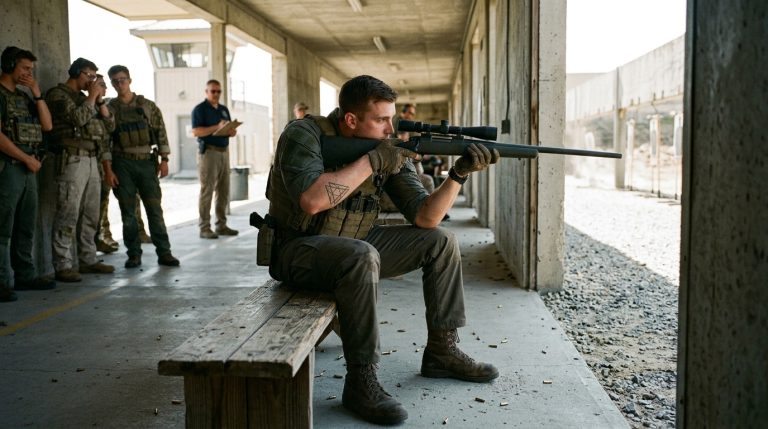
A Decorated Veteran Dismantles Suburban Tyranny Through Cold Calculation, Precise Evidence, and Inescapable Legal Warfare
CHAPTER 1: THE WRECKAGE AND THE COLD ASSESSMENT
The boots sank half an inch into the damp Virginia loam, right at the edge of the hundred-year-old barn’s eastern foundation. Jack didn’t look down. His gaze remained locked upward, tracing the jagged silhouette where thirty kilowatts of state-of-the-art silicon had rested less than twenty-four hours ago. Now, the roof looked like an open fracture—ribs of bent aluminum racking, severed copper leads dangling like exposed nerves, and the deep, deliberate gouges of a pry bar slicing through the standing-seam galvaloom.
A hundred thousand dollars of retirement savings, engineered specifically to keep Sarah’s oxygen concentrator humming through local grid failures, was currently reduced to scrap metal.
“That’ll teach you to ignore a stop-work order, Mr. Garrison.”
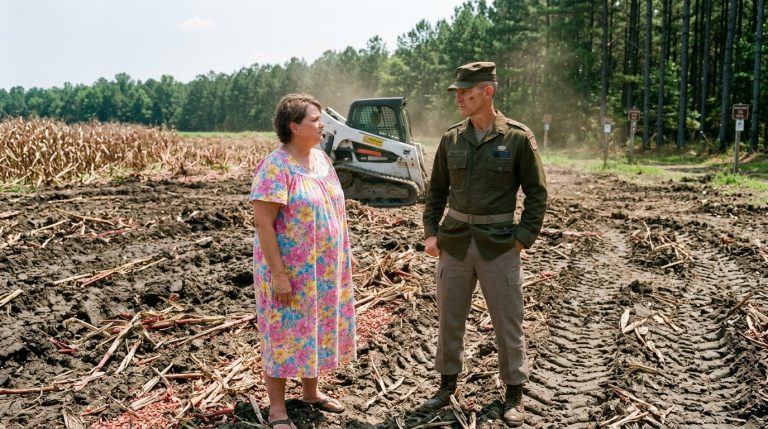
The voice carried the smooth, oily satisfaction of someone who practiced tyranny in front of a mirror. Karen stood near the property line, her floral-print blouse stretched tight across her midsection, a laminated clipboard tucked under her arm like a scepter. Behind her, a white commercial van was kicking up muddy spray as it pulled away down the subdivision’s manicured asphalt.
Jack’s heart rate stayed locked at sixty beats per minute. Two decades of combat engineering in the Marine Corps taught one fundamental truth: panic is a liability, and emotion is a wasted calorie. You do not react; you assess. You catalog variables.
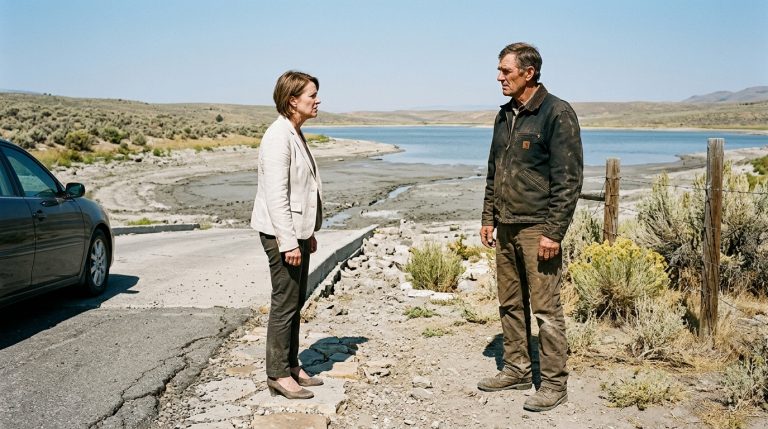
“There was no stop-work order, Karen,” Jack said. His voice was flat, devoid of the tremor she was clearly fishing for. He kept his eyes fixed on the twisted aluminum, burning every detail into his memory. “I received no notice. No certified letter. No email. Nothing.”
Karen scoffed, a sharp puff of air that rustled her carefully styled hair. “It was posted on the community bulletin board. Section fourteen, subsection C. All homeowners are responsible for checking the board for official notices. Your unapproved aesthetic modification was a direct violation of community standards.”
The community bulletin board was a corkboard locked behind a smudged sheet of plexiglass next to an empty community pool a full mile away. Jack lived on a ten-acre agricultural grandfathered plot at the literal edge of the development.
“It’s a functioning piece of agricultural equipment,” Jack said, finally turning his head. His eyes were cold, flat stones. “Exempt under state law. And you know it. We discussed this when I submitted the architectural plans two months ago.”
“The committee disagreed,” she snapped, stepping half an inch closer, her smile widening into something predatory. “And as president, I have the authority to enforce compliance and remedy violations at the homeowner’s expense. You’ll be receiving the removal bill by the end of the week, plus a two-thousand-dollar fine.”
She turned on her orthopedic sandals, the rubber squelching softly in the mud as she began her triumphant retreat back toward the paved world. She thought she had won. She thought she had disciplined an outsider who didn’t know his place.
Jack reached into his pocket, pulled out his phone, and tapped the camera icon. He framed the shot of the ruined roof, then slowly panned down to capture the retreating figure of the HOA president, pausing just long enough to record the license plate of the white van turning onto the main road.
The ice in his chest began to shift, generating a heat so absolute it felt like freezing. She had crossed the line from petty nuisance into criminal trespass and felony-level property destruction. She wanted a war against a man who wanted peace.
He tapped the screen to stop recording, locked the device, and turned back toward the dark, quiet doorway of the farmhouse, where a low, rhythmic mechanical hum echoed from within.
CHAPTER 2: THE BUREAUCRATIC RECONNAISSANCE
The transition from the open air of the ruined yard to the interior of the farmhouse was marked by a sudden, heavy shift in atmospheric pressure. Inside, the world compressed into the dimensions of a scrubbed pine kitchen table, illuminated by a single pendant lamp casting harsh, metallic highlights across a scattering of highlighters, sticky notes, and a three-ring binder thick enough to stop a low-caliber round.
Jack did not sit immediately. He paused by the doorway, his boots leaving dry, gray smudges of mud on the wide plank flooring, and listened to the baseline pulse of the house. From the adjoining bedroom came the steady, rhythmic wheeze of the oxygen concentrator—a mechanical respiration that sounded too much like a patient on life support, which, in truth, it was. Sarah was resting in there, her breathing shallow and controlled, insulated for the moment from the friction outside.
He pulled out the wooden chair, the legs scraping against the floor with a dry, grating sound that pulled a phantom ache through his old knee injury. It was a weather-change ache, the kind he used to feel back in the dust-choked sectors of Ramadi when the barometric pressure dropped before a sandstorm. The mind always tried to find a familiar shape for a new conflict. The military had taught him that an enemy without an intelligence dossier was just an ambush waiting to happen; the same rule applied here. Karen had moved first, relying on surprise and the inertia of institutional apathy. She had counted on him folding, paying the fine, and retreating into quiet resentment.
Instead, he opened the thick vinyl binder containing the Oak Ridge Estates Covenants, Conditions, and Restrictions.
The pages were yellowing slightly at the edges, bound by a plastic spine that smelled of stale office supply closets. Jack reached for a black gel pen, uncapped it with his teeth, and began to read. He didn’t read like a homeowner looking for a loophole; he read like a sapper mapping a minefield, looking for the pressure plates and tripwires.
The first hour yielded nothing but standard bureaucratic boilerplate—landscaping height requirements, architectural committee review windows, color palettes restricted to desert beige and muted clay. It was designed to wear down the human spirit through sheer monotony, a dense forest of legalistic hedges intended to make any deviation feel like a capital offense.
Then, halfway down page seventy-eight, his thumb stopped.
Section 19.4: Enforcement and Remedies for Non-Compliance.
Jack leaned in, the harsh overhead light catching the sharp planes of his face. He read the paragraph once, then twice, his eyes tracking the lines with absolute stillness.
The clause laid out an ironclad, multi-step protocol for any corrective action taken by the association. Step one: a certified letter of violation detailing the exact infraction. Step two: a mandatory thirty-day cure period or a request for a formal hearing before the board. Step three: a recorded vote of the directors. Step four: fourteen days’ notice prior to any physical remediation.
Karen had skipped every single one. She hadn’t sent a certified letter. She hadn’t held a hearing. There was no board vote recorded in the margins, no signature from the secretary, no paper trail whatsoever. She had operated as an absolute monarch in a subdivision of mortgage-holders, leaning entirely on the assumption that nobody would ever challenge her authority with actual paper.
Jack reached for his phone, bringing up the digital folder where he had stored the photographs of the mangled solar array, the deep gouges in the galvaloom roof, and the license plate of the white van. He lined them up side by side with the photocopied text of Section 19.4.
The air in the kitchen grew colder as the night deepened outside, the wind rattling the old double-paned glass of the windows. He didn’t turn on the television or pour a drink. He simply sat there, methodically cross-referencing every statute, every rule of procedure, every structural vulnerability in the HOA’s governing charter. By the time the digital clock on the microwave clicked past midnight, he had drafted a clean, clinical email to Marcus Thorne, the community treasurer—a man whose financial background meant he would understand the terrifying liability of an unbonded, unauthorized executive action.
Jack hit send without a second thought. The first stake was in the ground. The perimeter was marked. Now it was just a matter of waiting for the enemy to step on the wire.
CHAPTER 3: RETAINING THE APEX PREDATOR
The digital clock on the microwave still glowed a harsh green, reading 6:15 AM, when Jack closed the binder with a dull snap. He did not go to bed. Instead, he stood up, stretched his stiff shoulders, and walked down the short hallway to check the steady, rhythmic pulse of Sarah’s oxygen unit. She was still asleep, her chest rising and falling in a quiet, fragile cadence. He adjusted the blanket over her shoulder with calloused fingers, his movements economical, before heading out the back door into the biting morning air.
The gravel under his boots crunched loudly in the stillness. The ruined barn sat under the pale gray sky like a skeletal ribcage, the twisted galvaloom catching the dull, frost-tipped light. Jack walked the perimeter, taking three separate measurements of the tire tracks left by the roofing contractor’s van, noting the exact tread pattern and the heavy mud caked near the drainage ditch. Evidence required preservation; an engineer left nothing to chance.
By 9:00 AM, he was off the property, driving his pickup truck south toward the city skyline where the concrete monoliths pierced the overcast clouds.
He didn’t choose a local county attorney or some small-town general practice lawyer who played golf with the local magistrates. He wanted someone whose reputation was built on tearing down corporate veils and dismantling institutional overreach. Eleanor Albright’s office occupied the twentieth floor of a glass-and-steel tower overlooking the river.
The elevator ride was a silent, vertical ascent past layers of polished brass and tinted glass. When the doors slid open, Jack walked straight into a reception area designed to intimidate. There was no art on the walls—only dark wood paneling and a sharp, austere marble desk behind which a receptionist sat like a sentinel.
“Mr. Garrison,” a crisp voice cut across the room before he could state his name.
Eleanor Albright stood in the doorway of her corner office. She was in her late forties, wearing a tailored charcoal suit with sharp lapels. Her eyes were piercing, entirely devoid of polite corporate warmth. “You have thirty minutes. Impress me.”
Jack didn’t blink. He walked past her into the office, his stride measured and steady, carrying the heavy black leather portfolio containing the printouts, photographs, and photocopied bylaws. He dropped the portfolio onto the center of her large mahogany desk with a dull, satisfying thud.
“Five days ago, the president of my homeowners association, acting entirely outside her statutory authority and bypassing every procedural safeguard in our covenants, hired a private crew to trespass on my property and destroy a one-hundred-thousand-dollar solar installation,” Jack said, his voice flat, even, and relentlessly controlled.
Eleanor crossed her arms, her gaze dropping to the portfolio. She didn’t touch it yet. “HOA disputes are a dime a dozen, Mr. Garrison. People squabble over fence heights and trash cans. If you’re here because someone towed your car, waste someone else’s time.”
“This isn’t a dispute over trash cans,” Jack replied, unzipping the case. He pulled out the itemized contractor’s estimate and laid it across the mahogany wood. “This is $340,000 in total replacement costs and documented damages. Here is the engineering assessment. Here is the video proof of the president admitting to the act on camera without a shred of legal remorse. And here,” he slid the highlighted pages of Section 19.4 across the desk, “is the proof that she violated every single mandatory notice and voting requirement in the association’s own charter.”
Eleanor’s eyes flicked down to the paper. She adjusted a pair of thin-rimmed reading glasses, leaning forward. The sharp skepticism in her posture began to evaporate, replaced by an intense, analytical focus. Her fingers turned the pages of the bylaws one by one, tracing the yellow marker over the mandatory thirty-day cure period and the explicit requirement for a formal board vote.
“She didn’t file a certified notice,” Eleanor murmured, half to herself.
“She skipped every gate,” Jack said. “She went straight to a commercial crew with pry bars because she wanted to make an example of an outsider.”
Eleanor reached for the tablet Jack had set beside the papers, tapping the screen to play the short, high-definition clip of Karen standing in the dirt, smiling with smug, unearned authority as she confessed to the demolition. The attorney watched it once, expressionless. Then she watched it a second time.
When the video looped back to the beginning, she set the tablet down, leaned back in her high-backed leather chair, and let out a slow, sharp breath. A thin, predatory smile touched the corners of her mouth.
“Mr. Garrison,” she said softly, the crispness in her voice sharpening into something lethal. “She didn’t just pierce the corporate veil. She took a sledgehammer to it. By acting completely unilaterally, she stripped herself of the business judgment rule. She exposed every single director on that board to personal liability.”
“That’s why I’m here,” Jack said. “I don’t just want a settlement. I want a complete dismantling of the administrative structure that gave her the weapon in the first place.”
Eleanor stood up, walking slowly toward the floor-to-ceiling window that looked out over the sprawling gray expanse of the city below. She stared out at the traffic moving like ants far beneath them before turning back to face him.
“A retainer of ten thousand dollars is required to file the injunctions and serve the demand packages,” she said, her eyes gleaming with cold professional satisfaction. “When can we start?”
Jack reached into his breast pocket, pulled out his checkbook, and placed it on the desk alongside a pen. The war had moved from the dirt of the farm into the machinery of the law, and the gears were finally starting to turn.
CHAPTER 4: THE SHOCKANDAWE MAILBOX OFFENSIVE
The ink on the check was barely dry before Eleanor Albright set her pen down with a crisp, decisive click. She slid the document across the mahogany wood, her dark eyes locking onto Jack with the hard focus of a commander reviewing field coordinates.
“The retainer is processed, Mr. Garrison,” Eleanor said, her voice cutting through the quiet hum of the high-rise HVAC system. “Now we deploy the artillery. We don’t wait for a polite back-and-forth. We hit their balance sheet and their personal mailboxes simultaneously.”
Jack didn’t smile. He took his copy of the receipt, folded it once with mechanical precision, and slipped it into his breast pocket. “What’s the payload?”
“The demand letter,” she replied, pulling a heavy cream-colored document from her desktop printer tray. “Drafted under my firm’s letterhead, copied directly to Karen Miller and every individual member of the Oak Ridge Estates board of directors at their home addresses. Certified mail with return receipt requested. It bypasses Karen’s administrative filter entirely. They will all hold the physical proof in their hands within forty-eight hours.”
The strategy was ruthless in its simplicity. By targeting the individual directors—people like Marcus Thorne, who had assumed their positions were purely honorary rubber stamps—the legal team forced a wedge straight into the heart of the association’s leadership.
The descent back to street level felt heavier than the ascent. Jack walked out of the glass tower into a sharp, slate-gray afternoon where a sudden autumn squall was brewing over the river, driving wet, biting wind down the concrete canyons. He climbed into his pickup truck, turned the ignition, and pointed the nose north toward the county line. The real work wasn’t happening in the boardroom; it was happening in the mailboxes of the subdivision.
By Wednesday morning, the first return receipts began to blink green on the tracking portals, and the psychological fallout rippled across the neighborhood like a tremor through a fault line.
Jack sat at his kitchen table, the three-ring binder open before him, when his phone buzzed against the wood. It was an email from Marcus Thorne. The subject line lacked the haughty, defensive punctuation of their previous exchange; it was a fragmented, panicked cry for dialogue. The treasurer was cracking under the weight of personal financial exposure.
Jack ignored the notification, letting the silence work its psychological leverage. Eleanor’s standing order was absolute: Defendants do not dictate terms.
Instead, he stood up and walked to the kitchen window, watching the gray clouds settle low over the ridge. A heavy gust of wind rattled the loose flashing on the edge of the ruined barn, the jagged aluminum glinting dully under the overcast sky. He knew Karen wouldn’t take this lying down. A tyrant backed into a corner doesn’t surrender; they lash out. And true to form, by Thursday evening, Dave Kowalski called with intelligence from the front lines.
“Jack, you’ve blown the lid off the anthill,” Dave said over the phone, his voice low and urgent. “Karen has panicked. She just filed an emergency community-wide notice for a special general meeting next Tuesday at the high school auditorium. She’s scrambling to spin a narrative that you’re trying to bankrupt the neighborhood with a malicious lawsuit.”
Jack stared out at the dark fields, his reflection ghosted sharply against the glass pane. “Let her book the auditorium,” Jack said quietly. “A public stage is the absolute worst place for a liar when the lighting changes.”
CHAPTER 5: THE HIGH SCHOOL AUDITORIUM EXECUTION
The double doors of the Oak Ridge High School auditorium swung open with a muffled click, admitting the smell of floor wax, old paper, and stale panic. Jack stepped inside, his boots hitting the linoleum with measured, deliberate strides. Beside him, Dave Kowalski and Tom Miller moved with the quiet discipline of an advance guard.
The room was packed. One hundred and fifty homeowners filled the tiered plastic seating, a dense cluster of anxious whispers and sideways glances that died the instant Jack entered. Down front, sitting behind a long folding table draped in green felt, Karen looked up from her notes. Her face hardened instantly, the tight smile of a cornered executive snapping into place. Beside her, Marcus Thorne stared straight ahead at his hands, his knuckles bloodless as he gripped a stack of bylaws.
Jack walked down the third-row aisle, pulled back a folding chair, and sat down. He didn’t drop his eyes. He kept his posture rigid, shoulders squared, hands resting flat on his knees.
On the stage, Karen tapped the podium microphone, sending a high-pitched squeal echoing through the rafters before she cleared her throat. “Thank you all for coming,” she began, her voice dripping with artificial composure. “I called this emergency session to address the wild rumors and malicious misrepresentations currently circulating through our community. Certain individuals are attempting to subvert our neighborhood standards and inflict financial ruin upon every resident here.”
She gestured vaguely in Jack’s direction, leaning forward into the light. “Mr. Garrison chose to ignore a formal stop-work order regarding an unauthorized industrial eyesore on his property. When the association exercised its lawful duty to remedy that violation, he responded with an extortionate, frivolous lawsuit designed to bankrupt our reserves. The rules apply to everyone. If we yield to intimidation, property values across Oak Ridge Estates will plummet into the dirt.”
A heavy murmur rippled through the seating tiers. Heads turned, eyes darting toward Jack with a mix of suspicion and defensive anxiety. Karen had played her card well; she had framed herself as a martyr protecting their mortgages.
Jack waited until the murmur peaked, then slowly stood up.
“That is a complete fabrication,” Jack said. His voice was not a shout; it was low, flat, and carried the effortless authority of a briefing room. It sliced through the acoustic tiles of the auditorium instantly.
Karen’s head snapped around, her eyes widening with sudden venom. “You are out of order, Mr. Garrison! Sit down or I will have deputies remove you from this facility!”
“You’ll do nothing of the sort,” Dave Kowalski boomed from the third row, standing to his full height. “He has the floor. He has a right to speak.”
“Let him talk,” Tom Miller added, rising beside Dave. Within seconds, half a dozen homeowners scattered through the rows were on their feet, their voices amplifying the demand.
Karen sputtered behind the table, her cheeks flushing a mottled red as she looked frantically toward Marcus Thorne for backup. The treasurer simply shrank back into his chair, refusing to meet her gaze.
Jack didn’t wait for permission. He reached into his coat pocket, pulled out a small black USB drive, and walked down the central aisle toward the base of the stage. He handed it to the student volunteer manning the audiovisual booth near the soundboard.
“Put it up,” Jack said quietly.
A second later, the massive projection screen suspended behind the stage flickered from blue to sharp, brilliant color.
Slide one flashed onto the wall: the high-resolution aerial photograph of the pristine, fully functional solar array against the clean lines of the old barn roof, stamped with the date and time. A collective intake of breath swept through the rows. It didn’t look like an industrial hazard; it looked clean, modern, and expertly engineered.
“This is my property on the morning of October fifth,” Jack said into the aisle microphone.
He clicked the remote. Slide two appeared: the brutal, jagged wreckage of bent aluminum and severed wires.
“And this is what it looked like a few hours later, after our president acted without a single vote, without a single certified notice, and in direct violation of the association’s own governing charter.”
Jack turned his gaze from the screen back to the stage, locking eyes with Marcus Thorne. “Mr. Thorne. You’re the association treasurer. I put a formal request to your office for the meeting minutes authorizing this destruction. Tell this community: was there ever a formal board vote?”
Marcus Thorne swallowed hard. His mouth opened twice before a dry, fractured whisper escaped the microphone before him. “No… there was no vote. The board never authorized it.”
The silence that followed was absolute. It was the heavy, suffocating silence of an illusion shattering in real time.
Jack raised his hand and hit the final button on the remote. The screen shifted to video, and Karen’s amplified voice poured from the ceiling speakers across the entire auditorium.
That’ll teach you to ignore a stop-work order, Mr. Garrison. Some of us actually care about property values.
The video looped, showing her standing in the mud, smiling with supreme, self-righteous arrogance. When it cut to black, the room stayed dead quiet for five full seconds. Then, an older voice from the back row broke the spell.
“Resign,” the man shouted.
Within seconds, the entire auditorium erupted into a deafening wall of sound. One hundred and fifty people stood as one, the chant rolling forward in waves. “Resign! Resign! Resign!”
Karen stood frozen behind the folding table, her mouth slightly open, staring out at a sea of furious faces. The crown had slipped, and underneath, there was nothing left but empty air.
CHAPTER 6: THE QUIET HUM OF THE LAST ACRE
The transition from the roar of the high school gymnasium back to the gravel drive of the farm was marked by a sudden, absolute drop in atmospheric pressure. The shouting, the glaring lights, and the frantic whispers of the board members evaporated, replaced by the steady, unhurried whistle of a cold autumn wind moving across the open fields.
Jack shut the truck door with a solid, heavy thud. He stood by the driver’s side for a long moment, his hands resting on the cool metal of the door frame, watching the faint, rhythmic glow coming from the farmhouse window. Inside, Sarah’s oxygen concentrator maintained its silent, life-sustaining pulse—a quiet anchor that had remained true while the entire legal and administrative scaffolding of the neighborhood collapsed in on itself.
The final resolution did not arrive with sirens or dramatic confrontations. It arrived in the mail six weeks later in the form of a certified bank check, coupled with a signed legal settlement that dismantled the architectural review committee permanently and transferred full restitution funds directly into his account. Marcus Thorne and the remaining directors had voted unanimously to strip Karen of her title, cut her loose from the corporate liability shield, and initiate direct legal proceedings against her personal assets to recover the debt.
The corporate veil had not merely been pierced; it had been atomized by the weight of its own bad faith. The ultimate reality—that a petty tyranny built on intimidation and silent complicity could only be broken by striking its financial foundation—stood fully exposed and legally codified.
Jack walked slowly toward the barn. The contractor’s crew had finished the restoration three days prior, replacing every twisted sheet of galvaloom with heavy-gauge, hurricane-rated metal panels and mounting a sleek, black-on-black solar array that sat flush against the timber framing like an integrated armor plate.
He climbed the steel ladder to check the inverter housing. His fingers brushed the cold, unyielding surface of the aluminum conduits. Every bolt was torqued to specification; every connection was sealed against moisture and friction. The system was already drawing power from the pale afternoon sun, feeding clean energy silently back into the grid while a steady surplus flowed directly into the backup battery banks inside. The noisy, fume-belching diesel generator that had served as their temporary lifeline was gone, sold for scrap metal weeks ago.
When he stepped back down onto the packed earth, he saw Sarah standing by the back porch steps. She was wrapped in a heavy wool cardigan, her breath pluming faintly in the chill air as she watched him with a quiet, steady gaze.
Jack walked over to her, his boots crunching rhythmically on the gravel. He reached out, taking her hand within his own, feeling the familiar warmth despite the evening drop in temperature.
“The monitoring system is green,” Jack said softly, his voice losing the hard, metallic edge it had carried through months of strategic deployment. “Everything is running above capacity.”
Sarah smiled, a subtle, profound expression that smoothed the lines of stress carved around her eyes during the height of the conflict. “I know. The house hasn’t hummed this quietly since we moved here.”
She turned and looked past the barn toward the eastern boundary line. A few hundred yards away, across the open acreage, a familiar silhouette caught the fading light of the sunset. A Moving van sat idling in front of Karen’s meticulously manicured driveway. Figures in gray jackets were carrying cardboard boxes out through the front door, loading them into the back of a rental truck with hurried, awkward movements. The floral blouses, the laminated clipboards, and the self-righteous certainty were gone, replaced by the hollow, defeated posture of someone packing up the remnants of an empire built on sand.
Neither of them spoke as they watched the truck’s tailights blink red against the dusk before turning down the asphalt and disappearing toward the highway. There was no triumph in the sight, no bitter gloating—only the heavy, resonant satisfaction of equilibrium restored.
Jack knelt by the base of the porch steps where a small, forgotten patch of dry earth met the foundation. He picked up a stray wooden peg left behind by the builders, turned it over in his calloused palm, and tossed it into the scrap bin. The tool had served its purpose. The perimeter was secure.
He stood up, looped his arm gently around Sarah’s waist, and guided her toward the warm light spilling from the kitchen door. Behind them, across the ten acres of open land, the solar panels caught the last glint of twilight, absorbing the dying light and storing it safely away for the long, quiet night ahead. The war for the last acre was over. The ground was held.