The Quiet Hand that Guides the Needle: A Symphony of Faded Scars and Shattered Legacy
CHAPTER 1: THE GATE AND THE SCAR
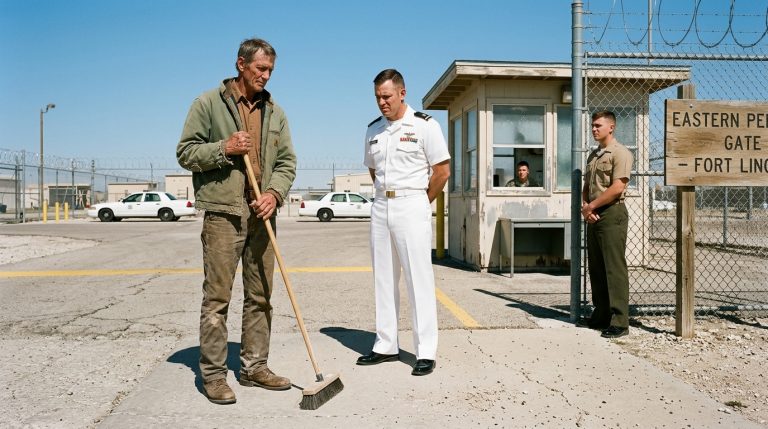
The chain-link fence at the perimeter of Fort Benning didn’t rattle; it vibrated with the rhythm of distant diesels. Elena Crawford adjusted the strap of her canvas rucksack, feeling the rough weave of her sand-colored Henley grind against the salt-dried skin of her shoulder blade. The fabric was heavy, damp with the pre-dawn humidity that rose from the red clay like steam from a fresh wound. She kept the cuffs buttoned tight at the wrist, despite the thick, stagnant heat of the Georgia morning.
Ahead, the guard-shack light was a jaundiced yellow box in the grey fog. The young specialist inside looked like he’d been stamped from the same sheet metal as the gate posts—sharp creases in his fatigues, eyes bright with the unblemished certainty of an enlistment contract signed in a clean room. He held her laminated contractor credentials between two fingers, his thumb brushing the edge where the civilian agency seal met the crisp black type: Advanced Combat Instruction – Curriculum Development.
“The command building is straight through the courtyard, ma’am,” he said, his tongue catching slightly on the title, his gaze dropping to her boots. They were old, the leather scarred across the toe box by gravel from fields he hadn’t yet heard of. “Master Sergeant Brennan’s office is on the first floor. Corner.”
“Thank you, Specialist,” Elena said. Her voice lacked the clipped resonance of the active-duty personnel; it was low, dry, shaped by decades of quiet rooms.
She stepped through the turnstile. The air inside the base tasted different—sharper, laced with the sulfurous drift of the morning fire-pits and the stale, industrial tang of floor wax. A squad of recruits moved past her in the half-light, their boots hitting the gravel road in a ragged, four-count cadence. They were young enough that their skin still held the softness of air-conditioned high school gyms, their shoulders hunched under the unseasoned weight of their web gear. Elena stopped by the edge of the asphalt, her boots sinking half an inch into the soft loam beside the ditch.
She reached beneath her collar, her fingers tracing the cold, dented rim of the brass compass hanging from the cord around her neck. The casing was scratched down to the bare zinc, the glass crystal cloudy from ancient condensation. When she tilted it, the needle didn’t snap north; it floated with a sluggish, heavy friction, hunting for its orientation like an old animal in thick brush.
The Training Command building was a low-slung concrete block, its facade stained gray by decades of pine smoke and torrential rain. Elena pulled the heavy glass door open, entering a corridor where the air conditioning hit her chest like a flat palm.
Master Sergeant Marcus Brennan sat behind a steel desk that had been scrubbed until the green enamel was translucent. His frame was a solid block of Georgia clay—wide, blunt-featured, with a pale line of scar tissue running from his left temple down into the collar of his utility shirt. He didn’t look up when her boots clicked on the linoleum. He was signing a stack of requisitions, the black ink scratching against the cheap paper with a sound like a small animal digging through dry leaves.
“Briefing was scheduled for 0600,” Brennan said, his voice level, flat, testing the silence between them. He capped the pen with a distinct, metallic click.
“The gate guard had a discrepancy in the registry,” Elena replied. She didn’t offer her hand. She stood in the center of the room, her rucksack hanging loose from her right fingers, her weight perfectly distributed across the arches of her feet. “It’s 0558.”
Brennan rose then. He was an inch shorter than her, but he carried his bulk with the heavy, forward-leaning posture of a man who spent his life expecting the ground to rise up and hit him. His eyes were small, the color of pond ice, cataloging her—the frayed hem of her sleeve, the tight grain of her hair, the absolute stillness of her hands.
“They told me they were sending a consultant from the technical cell,” Brennan said, stepping around the desk. His boots were polished to a mirror sheen, but the leather around the ankles was split from sweat. “I expected someone with a briefcase and a fresh set of slides. Not someone who looks like they drove here in a truck with a bad alternator.”
“The truck runs fine,” Elena said softly. “And the slides don’t teach a kid how to drop his center of gravity when his left knee gives out on a wet slope.”
A muscle twitched once near the point of Brennan’s jaw, right where the old scar tissue puckered into a small knot. He reached for his patrol cap, adjusting the bill with both hands until it sat exactly two fingers above his bridge. “Alpha Company’s on the mats. They’ve been there since 0500. They think they’re made of glass because the recruitment posters told them they were special. Don’t get behind them when the whistles blow.”
He blew past her, his shoulder brushing the sleeve of her Henley. The fabric pulled back an eighth of an inch, just enough for the dark, ancient ink of a coiled tail to show against the pale skin above her wrist before she tucked her hand into her pocket.
CHAPTER 2: THE GEOMETRY OF THE FLESH
The door to the office didn’t click behind Master Sergeant Brennan; the latch caught with a soft, heavy thud that rattled the loose glass panes in the window. Elena didn’t move. She stood in the dead air left by his departure, her thumb still tucked into the pocket of her tactical pants, her skin recording the exact fraction of an inch where her sleeve had slid upward. The ink was cold against her skin. It always felt colder when the air conditioning ran this high, like the pigment itself was made of old ice that refused to melt under the fluorescent tubes.
She turned her head toward the steel desk. On its gray enamel surface, a leather-bound logbook lay open, its edges frayed down to the yellow backing board. It wasn’t the digital manifest the current active-duty clerks used; it was a legacy piece, an item issued under the old Department of the Army supply lines before the warehouses were automated in the late nineties. Elena stepped closer, her leather heels making no sound on the green linoleum. Her fingers brushed the top page. The entries were written in a thick, uniform hand—purple ink from a fountain pen, the kind of script used by administrators who had learned their trade under the old manual typewriters.
Her eyes settled on the margin of the current training week’s roster. There was a faint pencil notation near the bottom, three letters followed by a five-digit routing code: G.B. – 87042.
The paper felt thin, dry enough to crack if her nail caught the edge. Elena closed the logbook with the flat of her palm, the small cloud of dust that rose from the binding smelling of old glue and cellar damp. She knew that code. She had seen it on the corner of a requisition form in a transit tent near Safwan thirty-five years ago, stamped over a shipment of unlisted field rations that had never crossed the manifest of the 24th Infantry Division. She filed the five digits into the dark behind her eyes, right next to the memory of the water-buffaloes at the Kuwait border.
“Ms. Crawford.”
The voice came from the doorway, thin and slightly breathless, lacking the gravel of the NCOs. Private First Class Travis Bennett stood there, his cover held between both hands, his fingers twitching against the stiff cotton brim. He hadn’t changed into his utility uniform yet; his shirt was still marked by the salt-trails of the morning run, the fabric sticking to his shoulder blades in wide, dark triangles.
“The Master Sergeant said you’d be tracking the sand pit drills from the western platform,” Bennett said. He didn’t look at her eyes; his gaze was fixed on her collarbone, on the small indentation where the cord of the brass compass disappeared beneath her sand-colored shirt. “Alpha Company’s already formed up. They’re running the hip-throws.”
“I’m aware,” Elena said. She picked up her canvas rucksack by the single strap, letting the weight settle against her hip. “Your grandfather was administrative branch, wasn’t he, Private?”
Bennett’s fingers stopped twitching. The boy’s face didn’t hold the suspicion of a seasoned soldier; it simply widened, the skin around his temples tightening until the small blue veins became visible against his sunburn. “Yes, ma’am. Logistics. General Staff. He retired out of Savannah in ninety-four.”
“He kept a clean ledger,” Elena said, passing him without slowing down. Her shoulder didn’t touch his, but she felt the small prickle of his body heat—the sharp, sour smell of a young man who hadn’t learned how to regulate his output during a twelve-minute mile. “Let’s go see if you can throw a man twice your weight without tearing your own groin.”
The hallway led out into the blinding white light of the training yard. The red Georgia clay had been ground into a fine, flour-like powder by thirty squads of combat boots, and as Elena stepped out, the wind caught it, coating the lower six inches of her pants in a dull, brick-colored rust. Alpha Company was arranged in a loose double circle around the sand pit, twenty-four men standing with their arms crossed, their breath coming in short, uniform puffs that vanished into the humid air.
In the center of the pit, Brennan stood with his boots buried three inches deep in the grey river sand. His shirt was off, his chest a grey-furred wall of muscle marked by the square indentation of an old flak-jacket burn.
“Crawford,” Brennan barked, not looking up from the recruit he was currently holding by the webbing of his trousers. “We’re running the redirection matrix. These kids think if they hit a wall hard enough, the wall moves. Show them the angle.”
Elena didn’t drop her rucksack. She set it at the edge of the timber frame, her boots stepping onto the logs with a small click. She didn’t take off her Henley; she merely unbuttoned the top two buttons at the throat, letting the cloudy glass of the compass dangle free into the grey dust.
“Private Bennett,” Elena said, her eyes scanning the double circle until they found the farm-boy shoulders of the kid from the doorway. “Get in the pit.”
The recruits snickered—a low, rhythmic rumble that died out the moment Brennan turned his cold, winter-pond eyes toward the eastern line. Bennett stepped over the timbers, his boots sinking into the loose sand. He tried to set his feet wide, his knees locked in the standard instructional manual stance.
“Don’t lean,” Elena said. She walked toward him, her movements smooth, her center of gravity staying perfectly level as she navigated the uneven ground. “If you lock your pelvis, you’re giving me the lever. A lever is just a bone someone doesn’t know how to hide.”
She reached out, her fingers touching the grey cotton of his undershirt at the shoulder blade. Her touch wasn’t heavy; it felt like the weight of a dry leaf, but Bennett’s whole frame tilted forward an inch, his heels lifting from the sand as if he’d been pulled by an invisible wire.
“You’re tracking my hand,” Elena murmured, her voice staying below the rhythm of the wind in the pines. “That’s your first mistake. You’re looking for the impact. There isn’t going to be an impact.”
She shifted her hip three inches to the left. It was a minor adjustment, the kind of movement a tailor makes when measuring a seam, but as Bennett lunged forward to regain his balance, his weight met nothing but the empty space she had just vacated. His momentum carried him over her thigh, his own arm pulling his chest down into the grey river sand with a dull, hollow thud that left him gasping for the humid air.
Elena didn’t look down at him. She looked across the pit at Brennan, who was watching her hands with his jaws clamped so tight the white scar on his temple had turned the color of lard.
“He’s looking at the ink, Master Sergeant,” Elena said softly, her hand sliding back into her pocket, the canvas fabric concealing the serpent before the boy could clear the sand from his eyes. “He thinks the history is what throws him. It’s just the geometry.”
CHAPTER 3: THE SERPENT DISCLOSED
Master Sergeant Brennan did not answer right away. His boots remained buried in the grey river sand, his toes gripping the shifting earth through his leather soles like the roots of a mountain pine. A heavy, collective hold of breath seemed to freeze the perimeter of recruits, the twenty-four pairs of eyes oscillating between the fallen form of Private Bennett and the dry, unblinking composure of Elena’s profile. The wind down from the ridge line carried a sharp scent of split pine and hot engine oil, the humidity gathering into thick, grey pillows along the southern horizon.
“Get up, Private,” Brennan said finally. His voice was lower now, lacking its initial command rasp—it carried the distinct, quiet precision of a man who had recognized an unmapped obstacle in the dark.
Travis Bennett shifted, his knuckles digging into the loose limestone gravel beneath the sand layer as he pushed his bulk upright. His utility shirt was ruined, coated from the pocket flaps to the collar in a thick, wet mask of brick-colored loam. He didn’t look at his peers; his eyes remained locked onto the small line of grey cord dangling from Elena’s throat, his chest lifting in heavy, programmatic hitches as his lungs cleared the dust.
“Form up,” Brennan ordered the ring of recruits, his hand swinging toward the western fire-breaks without momentum. “Run the three-mile interval down to the wash-racks. Move.”
The squad scrambled. The sound of their retreat was a disorganized rattle of loose canteens and shifting webbing against canvas, their boots chewing into the hardened perimeter clay until the dust rose high enough to obscure the base of the watchtowers. Within ninety seconds, the yard was clear, leaving only the three of them standing under the long shadow of the concrete command block.
A second set of boots struck the limestone path behind the platform. They weren’t utility issue; the heels were dense, vulcanized rubber, hitting the stone with a rhythmic, measured authority that made the Master Sergeant snap his spine into a clean vertical before the figure had even crossed the threshold of the shadow.
Colonel Harrison Vaughn didn’t carry a clipboard. He came across the training grounds with his hands tucked behind the small of his back, his fingers woven together over the brass buckle of his duty belt. Sixty-eight years of Georgia sun had baked his neck into a cross-hatched landscape of pale creases, his silver hair cropped so close to the scalp that the blue veins of his skull traced the architecture of his thoughts. His uniform was the old poplin weave—faded to the color of wet sage, the seams pressed into lines that looked sharp enough to split wood.
He stopped three feet from Elena. The silence between them wasn’t the silence of strangers; it had the specific, dense weight of an old iron door that hadn’t been unbolted since the rains of ninety-one.
“The registry in Savannah lists your vehicle as an eighty-eight long-bed, Crawford,” Vaughn said, his voice carrying the dry, whistled resonance of a man who had lost half his lung capacity to the smoke of the oil fields. He didn’t look at Brennan. “The block numbers on the engine frame don’t match the title. They belong to a logistics pool that was liquidated out of Fort Meade during the transition.”
“The parts were surplus, Colonel,” Elena said. She didn’t drop her head. Her fingers remained steady within her pockets, her weight staying anchored on her left heel. “The ledger was signed off by an office that didn’t keep duplicates.”
Vaughn turned his pale, clear eyes toward Private Bennett, who was still standing by the edge of the timber frame, his chin dropped toward his collarbone as he wiped a streak of grey river sand from his teeth.
“Your grandfather was General Staff, Bennett,” Vaughn noted, his words falling like small stones into the dry clay. “He spent five years in the sub-basement of the Pentagon writing the redistribution codes for the procurement units in the Gulf. He knew exactly how many tons of material could disappear between the port of Shuaiba and the border without triggering an audit.”
Bennett cleared his throat, his posture stiffening into an awkward, half-formed attention. “He didn’t talk about the procurement schedules, sir. He only kept the logs for the personnel movements.”
“He kept the receipts,” Vaughn corrected him softly. He turned back to Elena, his shoulders shifting an inch to the north, cutting off the light that filtered through the breezeway. “Roll up your left sleeve, Crawford.”
The command was flat, devoid of anger or institutional theater. It carried the simple, heavy gravity of a legal filing. Elena didn’t look at Brennan, though she could hear the Master Sergeant’s teeth grinding against his tobacco blade three feet to her right.
She reached down with her right hand. Her fingers were calloused at the tips, the skin yellowed from years of handling tool-steel and zinc wash. She unbuttoned the cuff of her sand-colored Henley, the small horn button catching once on a loose thread before it slipped free. She rolled the fabric back once. Then twice. The motion was deliberate, measured by the internal cadence she used when clearing a jam in the dark.
The ink emerged like an old timber line uncovered by a low tide.
The serpent was dense, the black pigment faded by thirty years of sweat and Georgia rain into a dull, slate-grey outline, but the execution remained unblemished. It coiled around the hilt of a thick fighting knife, the scales etched with microscopic precision where the tail met the guard. The head of the snake was positioned exactly two inches below the crook of her elbow, its fangs bared toward her inner wrist in a permanent, structural strike.
Brennan let out a short, wet breath through his nose. His hand moved toward his utility belt, then dropped back to his thigh, his fingers curled into a hard white knot against the green poplin of his trousers.
“The Black Viper mark,” Vaughn said, his voice dropping below the register of the wind. He stepped closer, his thumb rising to hover a fraction of an inch above the ink without making contact with her flesh. “There were ninety-seven who took that iron between eighty-seven and the collapse. The administration branch under Bennett’s grandfather spent six months trying to burn the files after the Safwan withdrawal. They thought they’d left the names in the sand.”
“Major Summers kept the original duplicates in her locker at Safwan,” Elena said, her arm remaining perfectly horizontal, the muscle beneath the ink steady. “She didn’t trust the logistics pool to clear the trail.”
“Summers is dead, Crawford,” Vaughn said.
“I’m aware,” Elena murmured. “But the geometry stays the same.”
Vaughn looked at Private Bennett, whose eyes were wide now, his gaze tracking the exact lines of the snake’s belly where it wrapped the steel hilt. “Look at it, Private. That isn’t decoration. That’s an administrative record paid for before your father had his commission. If your grandfather had been three minutes quicker with his pen in ninety-one, this woman would be a serial number in a trench near the pipeline.”
He turned back toward the command block, his boots hitting the gravel with that same vulcanized thump. “Brennan, get the company into the MOUT facility by thirteen hundred. We’re running the live marking rounds. Let’s see if they can find their way through a door when the shadows don’t stay where they’re told.”
CHAPTER 4: THE FATAL FUNNEL
The shadow of the concrete command block did not recede; it lengthened across the yard, casting a cold violet shroud over the timber edge where Elena stood. She slowly rolled her sleeve back down, her fingers smoothing the heavy, faded weave of the sand-colored Henley over the slate-grey ink until the serpent was once again buried in the dark. Beside her, Master Sergeant Brennan remained perfectly vertical, his gaze trailing the space where Colonel Vaughn had just been, his knuckles white against his utility trousers.
“Get your gear, Private,” Brennan said, his teeth clicking together as he broke his stare. He didn’t look at Elena. “The transport line leaves from the fuel point in ten minutes. If you’re not on the tail-gate, you’re a scratch on my roster.”
Private Bennett didn’t answer with words. He gave a single, rigid nod, his sand-crusted boots clearing the timber frame with a heavy, uncoordinated scramble as he broke into a jog toward the barracks. The dust from his retreat hung in the heavy air, tasting of old lime and parched weeds.
Elena picked up her rucksack. Her thumb traced the zinc rim of Major Summers’ compass beneath her collar, feeling the slow, heavy vibration of the needle inside the housing as she turned toward the western road. She didn’t wait for Brennan’s permission to move; she walked with a long, level stride, her heels grinding into the red clay with a dry, rhythmic hiss. The journey from the training command yard to the MOUT facility was exactly nine hundred meters of unshaded gravel, bordered on both sides by old loblolly pines whose needles lay in thick, rotting carpets over the drainage ditches. The heat was shifting now, the stagnant humidity thickening into a damp weight that smelled of ozone and scorched grease.
The facility appeared through the trees like a concrete boneyard. It was a cluster of windowless, three-story blocks designed to mimic the dense, anonymous architecture of a foreign grid. The walls were scarred by thousands of old impact marks—blue, red, and yellow wax splatters that had dried under the Georgia sun until they looked like layers of ancient, peeling oil paint.
Alpha Company was already stacked along the northern wall of Block Charlie when Elena arrived. The recruits had changed into their full combat loads—thirty-five pounds of canvas webbing, ceramic plates, and nylon pouches that rattled with every nervous shift of their weight. Their weapons were M4 carbines fitted with blue simunition bolts, the translucent magazines showing the small, plastic-tipped marking rounds.
Brennan was standing at the threshold of the main entry point—a jagged breach in the concrete block that led into a sixty-foot corridor. He held a blue marking cartridge between his index finger and thumb, his scar white against his sweat-slick forehead.
“The scenario is a simple linear breach,” Brennan announced to the stack, his voice echoing off the flat concrete facade with a dull, institutional ring. “One room at a time. Call your corners. If you don’t clear the angle, the angle clears you. Crawford is inside. She’s your single hostile profile. She’s carrying an identical load. Torso and head hits only. Everything else is a wound.”
He turned his pond-ice eyes to Elena, his hand rising to indicate the dark interior of the corridor. “Go take your box, Crawford. Let’s see if the manual still works when the bullets have teeth.”
Elena didn’t look at the stack of recruits. She stepped through the breach into the cool, limestone-scented dark of the structure. The air inside smelled of dust and damp wool, the light filtering through the high, square ventilation cutouts in narrow, yellow shafts. She moved forty meters down the hallway, her boots finding the dry spots where the old puddles had evaporated into chalky rings.
She entered the second room on the left—a twelve-by-twelve space with an exposed stud wall in the center. She didn’t set an elegant trap; she simply pulled her carbine into the pocket of her shoulder, her cheek resting against the cold polymer stock, her weight distributed across her heels so her silhouette stayed narrow behind the concrete pillar.
As she waited, her eyes drifted to the doorframe. There was a faded stencil on the concrete wall near the floorboards, three letters and a series of numbers that had been painted over with gray primer but still caught the light through the dust: G.B. – 87.
The exact same mark from the ledger. Elena’s breathing didn’t change its pace, but her thumb tightened against the safety selector of her carbine. The facility hadn’t been built by the training command; it had been funded under a special infrastructure allotment during the same year her cell was initialized at Meade. The grandfather hadn’t just kept the receipts for the bodies; he had laid the very stone she was currently standing in.
A leather sole clicked against the gravel at the entrance of the corridor.
“Stack left,” a voice whispered from the breach. It was Bennett. His tone was tight, the vowels clipped by the pressure of his throat. “Smoke first. Then the hook. Don’t linger in the throat.”
A cylindrical tin rolled through the doorway, its metal rim striking the concrete with a sharp, hollow ring before it began to hiss, a thick cloud of white chemical smoke boiling out over the floorboards. Elena didn’t react to the smoke; she kept her sights aligned on the exact point where a shoulder would emerge from the fog.
The first recruit came through the fatal funnel with his weapon high, his chest wide, his body leaning into the corner exactly as the manual had prescribed. He was looking for a target at eye level.
Elena didn’t fire at his chest. She dropped her weight three inches, her first round breaking from the muzzle with a sharp, pneumatic snap that echoed like a whip inside the narrow room. The blue wax tip struck the recruit’s thigh, right over the femoral strap of his holster.
“Hit,” the kid gasped, his knee buckling into the plaster dust as his momentum failed.
“Keep moving,” Bennett’s voice barked from the fog behind him. “Don’t bunch. Push the wall.”
Bennett didn’t follow the manual’s path. Instead of coming through the center of the breach, he executed a dynamic button-hook, his left shoulder scraping the raw edge of the concrete doorframe as he entered the room at a low, forty-five-degree crouch. He didn’t look for Elena where she had been; his muzzle was already sweeping the blind spot behind the stud wall before his heels had even settled into the sand layer on the floor.
Elena pivoted on her heel, her carbine swinging in an arc that should have caught his collarbone, but Bennett had already dropped his center of gravity into the river-sand technique she had demonstrated two hours before. He didn’t fight her movement; he used his own momentum to slide his ribs under her guard, his muzzle rising until the blue plastic tip of his barrel was less than two inches from the sand-colored canvas of her Henley pocket.
He didn’t fire. He held the weapon steady, his breath coming in hot, sulfurous gasps against her throat, his eyes bright with the sudden, terrifying realization of what he had just executed.
Elena stood perfectly still in his circle of security. The white smoke from the canister was settling around their shins now, smelling of old salt and scorched paper, the quiet between them so dense she could hear the sluggish floating of the needle inside her brass compass.
“You changed the angle,” Elena said softly, her safety selector remaining under her thumb, her face showing nothing but the grey reflection of the concrete.
“The manual was getting us killed,” Bennett whispered, his hands trembling against the polymer handguard of his M4. “Therefore, I took the floor.”
CHAPTER 5: THE VERIFICATION OF GHOSTS
“The manual was getting us killed,” Bennett repeated, his voice dropping into a ragged whisper that barely cleared the muzzle of his carbine. “Therefore, I took the floor.”
Elena looked down at the plastic barrel-tip pressed against her sand-colored shirt. Her breathing remained rhythmic, a low, systematic rise and fall that didn’t stagger under the proximity of his grip. She didn’t push the weapon away; she simply reached down with her left hand, her thumb and forefinger catching the cold steel ridge of the receiver ring, her touch lighter than the settling plaster dust.
“You took the floor,” Elena murmured, her eyes assessing the damp, trembling grain of his skin under the fluorescent glare. “But you didn’t check the perimeter behind your shoulder. A room is never empty just because the primary target is covered.”
From the shadows behind the stud wall, Master Sergeant Brennan stepped into the yellow shaft of light. He hadn’t fired his weapon; his blue-bolted M4 was slung low across his chest, his thick fingers tracing the webbing of his sling with a slow, abrasive scratch. He looked at Bennett’s mud-caked boots, then at the single blue wax circle dried against the first recruit’s thigh near the doorway.
“Clear the facility,” Brennan ordered flatly. His winter-pond eyes didn’t hold the heat of an instructor’s wrath; they carried the dense, grey stillness of a man who had seen too many drafts written in purple ink. “The trucks are waiting at the secondary tree line. The daylight’s gone.”
The transition from the concrete skeleton of Block Charlie to the open-bay barracks was an unbroken crawl through the cooling Georgia dark. Elena didn’t take the seat in the front of the command truck; she stood on the tail-gate step, her fingers hooked into the rusted chain of the latches, her boots gathering the loose limestone dust as the vehicle navigated the unpaved logging paths. The sky above the pine ridge had deepened into a bruised, sulfurous iron, the heavy smell of swamp-water and scorched fuel rising from the ditches like steam.
By midnight, the barracks was a long room of uniform shadows. The twenty-four steel cots were arranged in two parallel rows, their grey wool blankets pulled tight across the frames with an institutional stiffness that looked like sheet metal in the half-light. The recruits didn’t speak; they moved through the narrow spaces between the lockers with the slow, heavy gestures of men whose muscles had been hollowed out by thirty-five miles of combat weight.
Elena sat on a wooden bench near the orderly room door. Her rucksack was between her boots, the canvas stained dark by the grease of the M4 she had cleaned three hours before. She pulled her phone from her pocket—the screen a small, sharp rectangle of grey light that cast long, geometric shadows against the raw pine rafters above her head.
The photograph on the digital display wasn’t a modern file; it was a scanned copy of an old five-by-seven silver-halide print, its borders yellowed to the color of lard by decades of storage in an attic locker near Savannah.
Six people stood in front of a sand-bagged revetment. The desert camouflage they wore was the old six-color “chocolat-chip” pattern, the fabric stiff with the salt of a dry sea. On the far left, a seventeen-year-old version of Elena looked toward the lens, her eyes wide, hollowed out by three weeks of listening to the artillery exchanges along the pipeline. Next to her stood Major Rebecca Summers, her captain’s bars pinned crookedly to her collar webbing, her right hand resting on the shoulder of a small, thin corporal whose name had been lined through with black marker.
Elena’s thumb hovered over the upper right corner of the scanned frame. There was an administrative stamp visible through the grain—a five-digit routing code that matched the ink in Brennan’s ledger line: 87042.
The smell of old oil and damp wool inside the barracks faded, replaced for an single, terrifying second by the memory of burning sulfur—the dry, chemical prickle of the smoke that had come out of the bunker breach near Safwan when the extraction team’s radio went dead. The compass against her throat felt heavy, like a lead sinker pulling her chin down toward the dark.
A shadow crossed the yellow light of the orderly room threshold.
Private Bennett stood there, his utility trousers unbuttoned at the waist, his white undershirt marked by a long, grey smear where the simunition bolt had cleared his shoulder. He carried a small, leather-bound notebook in his right hand, his fingers tracing the frayed grain of the spine as if he were trying to find a balance point.
“My grandfather didn’t sign the operational orders,” Bennett said. His voice was low, staying below the level of the rhythmic breathing that rose from the cots. He didn’t look at the screen of her phone. “I looked through his boxes when he died in Savannah. There was a ledger with that exact routing block. It was marked as an infrastructure project for the division pool.”
“It was a liquidation schedule, Private,” Elena said, her voice dry as the limestone dust on her cuffs. She turned the phone slightly, letting the grey light catch his chin. “Your grandfather didn’t write the names because he was paid to make sure the names didn’t have an allotment line. Major Summers knew that. She knew it before we crossed the wire at the border.”
Bennett stepped into the narrow space between the bench and the first cot, his knees nearly touching her rucksack. “If she knew the line was unlisted, why did she lead the cell through the funnel?”
Elena didn’t answer with the manual. She reached up and pulled the brass compass from beneath her collar, letting the cloudy glass crystal catch the fluorescent hum from the hallway.
“Look at the needle, Bennett,” she murmured, her thumb clicking the latch open until the bare zinc ring was exposed. “It tracks three degrees off-true because the casing was twisted by a fragment from a seventy-three grenade. It doesn’t find north; it finds the iron inside the box. Your grandfather didn’t leave us in the sand by mistake. He left us there because the duplicate files were already signed by the director’s office before the first tank left the port.”
She swiped the screen once more, opening the second document—a presidential citation with the name Summers, R. visible beneath three thick bars of institutional black ink.
“The ultimate reality isn’t in the training manual, Private,” Elena whispered, her face settling into the faded texture of the dark. “The manual is what they give you so you die with your boots polished. Tomorrow morning, we run the ridge-line. Let’s see if you can see the hunter before he takes the lever.”
CHAPTER 6: THE HORIZON OF BORROWED TIME
“Tomorrow morning, we run the ridge-line,” Elena whispered into the long shadow of the barracks bay, her thumb locking the zinc casing of Major Summers’ compass back down with a clean, muted snap. “Let’s see if you can see the hunter before he takes the lever.”
Private Bennett did not move from the narrow gap between the wood bench and the first cot. He stood under the low-wattage hum of the corridor light, his fingers staying perfectly frozen across the frayed spine of his leather-bound notebook, his chest rising and falling in one final, silent hitch before he gave a rigid, single-inch nod and slid back into the parallel rows of steel frames.
The dark did not dissolve cleanly; it bled away into a thick, silver fog that rose from the drainage ditches by 0430. Elena did not sleep. She spent the remaining ninety minutes sitting on the untreated cedar bench, her palms resting flat against the knees of her civilian tactical pants, her ears recording the precise micro-steps of the morning routine as Alpha Company adjusted their canvas web gear for the final six-hour field progression.
The journey to the extraction clearing was an unbroken three-kilometer march up the eastern spine of the ridge-line. Elena walked ten meters to the flank of the main column, her boots cutting through the wet pine needles with a soft, uniform crunk that was answered only by the rhythmic rattle of thirty-two unslung canteens behind her. The mist was heavy enough to taste—flat, metallic, holding the sharp tang of low-lying swamp water and the sulfurous scent of the base generators below.
By 0900, the ridge broke into a wide, limestone shelf that overlooked the northern perimeter fence. Colonel Vaughn was already there, his sage-green poplin shirt completely dry despite the dampness of the trees, his hands woven behind his back as he watched Master Sergeant Brennan tally the final arrivals against a small, plastic-sheathed roster.
“Thirteen through the throat, Colonel,” Brennan reported, his voice low, his pond-ice eyes settling on Private Bennett, whose utility shirt was still marked by the faded purple smudge of the simunition grease from Block Charlie. “Eleven scratched at the valley line. The geometry held.”
Vaughn didn’t check the roster. He walked toward the edge of the limestone ledge, stopping exactly two feet from where Elena had set her canvas rucksack. The silver hair along his temples was beaded with moisture from the fog, but his posture remained an unyielding vertical—the ramrod grace of a man who had spent forty years surviving the ink his peers had tried to burn.
“The transport’s scheduled for the secondary airfield at eleven hundred, Crawford,” Vaughn said, his voice carrying that dry, whistled rattle through his chest. He reached down, his thumb and forefinger sliding a heavy manila envelope from the map pocket of his utility shirt. The paper was stiff, the corners bound with old linen tape that had turned the color of parched bark. “The Savannah pool cleared the registration on your truck. The title’s locked. But the sub-basement duplicates from the eighty-seven authorization are still in the container at Meade.”
Elena accepted the envelope by the corner, her fingers registering the distinct, dense weight of administrative records—the thick, fibrous texture of documents that didn’t have a digital twin. She didn’t open the flap; she slid it into the main pocket of her rucksack, her movements smooth, devoid of curiosity or haste.
“Major Summers didn’t lose the cell because the radio went dead, Colonel,” Elena said, her voice remaining level against the whistle of the ridge wind. She looked at the pale cross-hatched creases on Vaughn’s neck. “She turned the frequency dial to the dummy channel before the first grenade hit the trench. She knew the distribution codes were unlisted. She broke the cell herself so the rest of the ninety-seven wouldn’t be routed into the pipeline.”
The silence that followed was different from the silence of the training yard; it was the heavy, absolute clarity of an account that had finally reached its balance point.
Vaughn’s jaw didn’t twitch. He merely shifted his gaze toward the far horizon, where the Georgia pines met the slate-grey floor of the low country. “She was Viper One, Crawford. She knew how many rounds were left in the box before the requisition order was even typed. If she’d brought you back across the border in ninety-one, the branch under Bennett’s grandfather would have had to account for the surplus.”
He turned back toward the transport vehicle, his vulcanized heels striking the stone with that uniform, institutional thump. “The boys are yours for the final brief, Brennan. Clear the line.”
Elena didn’t look back at the formation as she picked up her rucksack and moved toward the white civilian truck parked near the gravel turn-around. The journey down from Fort Benning to the perimeter gate was fifteen minutes of real-time deceleration, the tires throwing small showers of red clay against the wheel wells until she crossed the turnstile into the state highway.
Three months later, the air in the small shop classroom in western Montana tasted of cedar shavings and linseed oil.
Elena sat at a long workbench made of raw, five-inch pine blocks, a vintage brass cabinet hinge clamped into the iron jaws of her vise. The metal was old, its screw-holes clogged with three decades of hardened lacquer and green oxidation. She held a small piece of fine-grain steel wool between her thumb and forefinger, moving it in slow, uniform circles across the leaf until the raw yellow grain of the brass began to show through the corrosion.
The door to the alley didn’t rattle; it clicked open with the quiet, balanced friction of a latch that had been oiled before the first snow.
Private Travis Bennett stood in the threshold, his green active-duty dress shirt unbuttoned at the throat, his canvas duffel bag resting against his leather heel. He wasn’t wearing his utility load; his shoulders were broad, his sunburn faded into a clean, uniform tan that reached the edge of his ears. He looked at the row of hand-planes on the rack, then at the small line of grey cord dangling from her collar.
“The platoon ran a linear breach in the suburbs outside Damascus three weeks ago, ma’am,” Bennett said, his voice holding the steady, transactional weight of an NCO who had learned how to breathe through the smoke. He didn’t step into the room; he stayed by the cedar frame. “The company commander wanted to push the throat through the main courtyard. Therefore, I took the western flank. I used the sand-pit pivot on the doorframe.”
Elena didn’t lift her hand from the vise. She gave the steel wool one final, circular pass, the fine metal shavings falling onto the cedar dust below like silver salt.
“Did you check the rear angle?” she asked softly.
“The angle was clear,” Bennett replied. He reached into his cargo pocket, pulling out a small, old brass compass with a cloudy glass crystal and a zinc rim that had been polished down to the bare metal. He set it on the edge of her workbench, his fingers sliding away without leaving a print. “Colonel Vaughn said you’d need the needle calibrated before the winter rains hit the ridge. It’s tracking three degrees off-true, but it finds the box.”
Elena reached out, her fingers catching the cool, familiar circle of the zinc casing. She didn’t tilt it; she simply let her palm cover the glass, feeling the slow, sluggish floating of the needle inside the housing as the silence of the shop settled around them like old dust.
“The geometry stays the same, Private,” she murmured, her face turning toward the window where the first mountain mist was beginning to blur the pines. “Keep your heels low.”