When a Homeless Mother Walks Into a Biker Bar, She Finds Her Fallen Son’s Hidden Legacy
CHAPTER 1: THE FACE ON THE WALL
The wind off the river carried the kind of damp cold that settles deep into swollen joints. My right knee throbbed with every step, a dull rhythm that had kept time for my last three miles.
I pulled my thin wool coat tighter across my chest and held tight to the yellow plastic bag carrying everything I owned.
Ten minutes ago, the girl behind the shelter desk hadn’t even lifted her eyes from her phone screen. “Full for the night,” she had said, her voice flat as a wooden board. “Try the north annex tomorrow.”
There was no north annex, not one that takes a seventy-one-year-old woman with empty pockets. So I kept walking until my boots gave out against the brick wall of a dive bar on 4th Street.
I just needed thirty seconds to stop the shaking in my hands. I leaned back against the red brick, closed my eyes, and listened to the low rumble of a jukebox playing through the glass.
When I opened my eyes, I looked through the fogged tavern window.
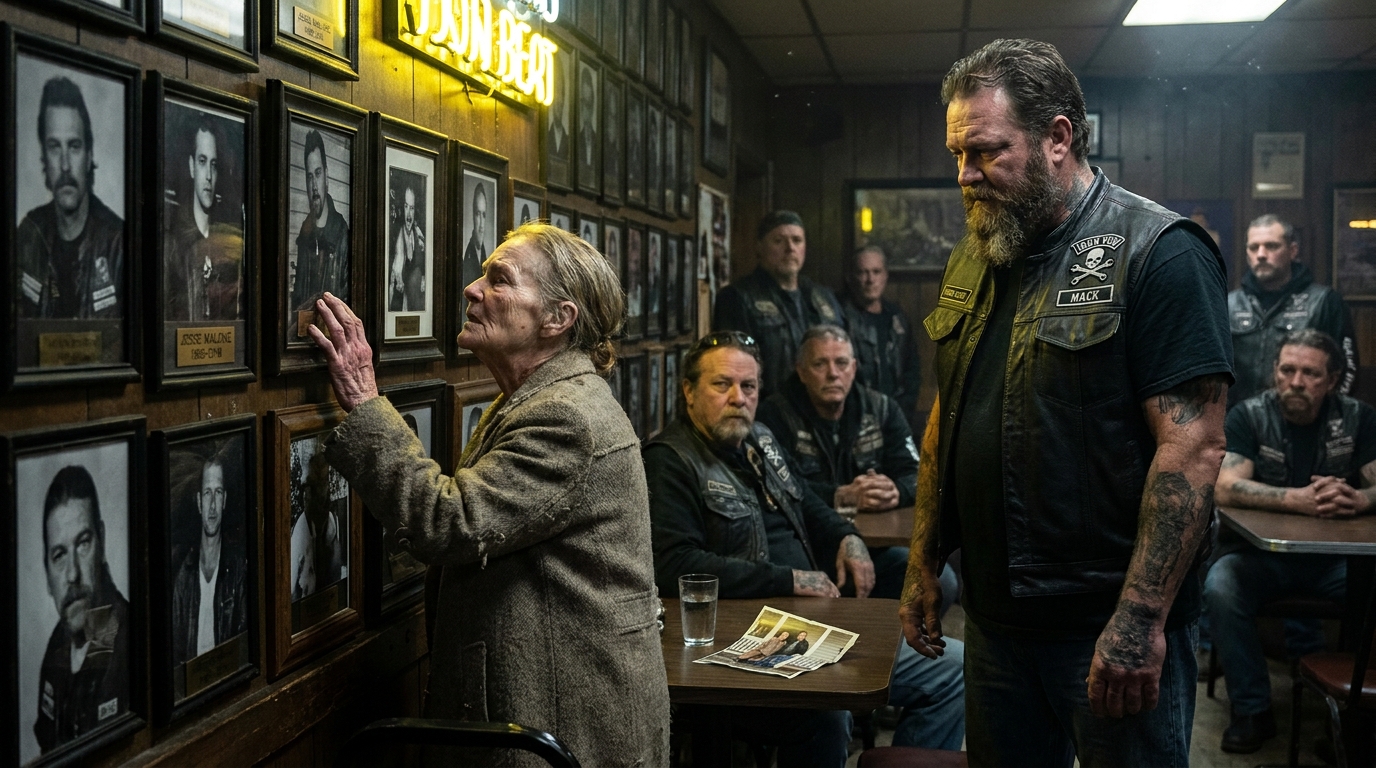
Dozens of framed photographs lined the back wall under a soft yellow neon sign. Black-and-white portraits, Polaroid shots with faded corners, and small brass nameplates fixed to dark mahogany paneling.
My gaze drifted over the rows without thinking, just letting the light warm my eyes. Then my heart slammed against my ribs so hard my breath caught in my throat.
Third row from the top. Second frame from the left.
The jawline was unmistakable. The slight curve in the left eyebrow where he had caught a stray baseball in the sixth grade.
Jesse.
Underneath the glass, a line of thick black marker spelled out Jesse Malone, followed by a date I had carved into my soul two long years ago.
My fingers pressed flat against the cold exterior glass before my brain even gave the order.
He was gone. I had stood in the pouring rain at Oakridge Cemetery and watched six strangers lower his plain grey pine box into the mud.
I knew he was dead, but I didn’t know this place. He had never mentioned a bar on 4th Street. He had never mentioned the black leather patches framed beside his picture.
I turned the brass knob and pushed the heavy wooden door inward.
The bell above the frame gave a dry chime, and the low hum of conversation died instantly.
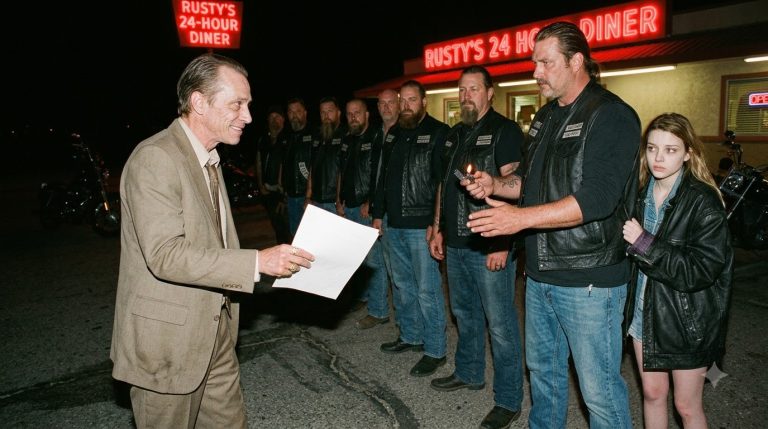
A dozen men sat across the dim room. Heavy boots, thick forearms mapped in dark ink, and leather cuts carrying a silver skull over crossed wrenches—Iron Vow MC.
Nobody reached for a glass. Nobody spoke.
I didn’t look at their faces, and I didn’t care about the leather or the tattoos. My eyes stayed locked on that wall as I walked past the first row of laminate tables.
My wet boots squeaked against the floorboards, the only sound left beside the quiet rasp of my own breathing.
I stopped three inches from the wood paneling, lifted two trembling fingers, and touched the bottom corner of his frame.
“Why is my son’s photo on that wall?”
The whisper barely left my lips, but in that silent room, it sounded like a crack of thunder.
A heavy wooden chair scraped against the floor in the far corner.
A man stood up slowly. He was built like a brick retaining wall—six-foot-three, graying beard trimmed tight, and eyes that had clearly buried more than one secret.
He didn’t rush. He walked across the open floor with a slow, deliberate stride until he stopped two feet to my right.
He looked at the picture on the wall. Then he looked down at my worn face, taking in the frayed cuffs of my coat and the plastic bag resting against my ankle.
His rough face softened, just enough for his jaw to unlock.
“Are you Jesse’s mom?”
I looked him square in the eye, keeping my chin up the way I always taught my boy. “I am.”
CHAPTER 2: THE UNSPOKEN DEBT
“Jesse’s mom,” Mack repeated, his voice low, dropping like a heavy stone into a deep well.
He didn’t pull back. He just stood there, taking up half the air in the room, his eyes scanning my face with a slow, deliberate intensity that made my chest tighten.
“Come sit down,” he said softly. “Please.”
He reached out and pulled back a heavy oak chair from the nearest table. The wood scraped loudly against the floorboards, cutting through the silence.
I didn’t answer right away. I held my plastic bag against my leg, feeling the sharp corner of a spare bar of soap pressing through the thin yellow film.
“I don’t need a seat,” I said, my voice steady despite the cold stiffness in my jaw. “I just need to know why his face is on your wall.”
“Because he earned it,” a voice called out from a booth near the jukebox.
I looked over. A younger man with tattooed knuckles and a crooked nose was leaning forward, his hands resting flat on the dark laminate top. He wasn’t sneering. He wasn’t looking at my old coat like the shelter worker had. He was looking at me like I was someone he already knew.
“Sit down, Dot,” Mack said again, softer this time. He used my name like he had spoken it a hundred times before. “You’ve walked enough today. Just give us five minutes.”
My knees decided for me. The joint in my right leg gave a sharp, grinding bite, and I sat down heavily into the wooden chair.
I set the plastic bag carefully on the floor right between my boots, folding my hands in my lap so no one could see them shaking.
Without a word being spoken, a man behind the bar stepped around the counter. He was bald, built like a barrel, with a long white beard tucked under his collar.
He set a heavy glass of tap water down right in front of me. No ice, just plain, clean water.
“Thank you,” I murmured.
He gave a single, tight nod and walked back behind the wooden counter without saying a word, picking up a rag to wipe down an already clean brass fixture.
Mack sat down across from me, resting his thick forearms on the table. The leather of his cut creaked under the weight of his shoulders.
“Jesse came through that door seven years ago,” Mack said, his eyes locking directly onto mine. “He was twenty-six. Quiet. The kind of guy who didn’t say three words when two would do.”
“He was always quiet,” I said, the words slipping out before I could stop them. “Even as a boy. He’d sit on the back porch for an hour just watching the birds in the tomato patch.”
A faint, sad smile touched the corner of Mack’s mouth, tucked beneath his graying mustache.
“He didn’t change much,” Mack said. “He showed up on a broken-down Honda with a flat rear tire and twenty dollars in his pocket. Helped us haul three crates of engine parts out of the rain before he even introduced himself.”
Mack paused, his large hands flat against the table.
“A lot of men come through here looking for something to hide behind,” Mack continued, his tone dropping an octave. “They want the patches, they want the noise, they want people to be afraid of them. Jesse wasn’t looking for a shield. He was looking for a family he could build with his own two hands.”
I tightened my fingers in my lap. “He had a mother.”
“He talked about you every single week, Dot,” Mack said smoothly, not dodging the blade in my voice. “He didn’t join us to run away from you. He joined us because he knew the world was hard, and he wanted to make sure he had twelve men at his back if things ever went sideways.”
Mack reached down to the lapel of his leather cut. His thick fingers worked carefully at a concealed inner pocket lined with dark canvas.
“He kept something on him,” Mack whispered. “Every ride. Every shift at the shop. It never left his vest.”
CHAPTER 3: THE CREASED MEMORY
He laid it down on the dark laminate surface between us, placing it right next to my glass of water.
The paper was creased deep down the middle, white lines scarring the glossy finish where it had been folded and unfolded a thousand times.
I didn’t reach for it right away. My hand stayed rested on my knee, my fingers twitching against the coarse fabric of my trousers.
“Take a look, Dot,” Mack said quietly.
I leaned forward, the wooden chair creaking beneath my weight. The dim light from the beer sign overhead reflected off the surface of the print.
It was a photograph. A sunny porch, red brick steps, and a wooden planter box spilling over with bright green vine leaves.
Jesse was sitting on the top step, wearing a dark blue t-shirt with grease stains across the chest. His arm was thrown loosely over my shoulders, his head tilted back in a full, unscripted laugh.
Beside him sat a younger version of me, holding a mason jar full of iced tea, laughing so hard my eyes were squeezed shut.
Twenty years ago. The house on Elm Street, before the mortgage fell through, before my joints turned to iron, before the world started stripping away pieces of my life one room at a time.
My breath hitched in my chest. A cold, prickling heat spread behind my eyes, but I kept my shoulders straight. I wouldn’t cry in front of these men.
“He carried that every single day,” Mack said, his voice grating like dry gravel. “In his pocket on every long haul. He told me if he ever took a hard spill on the highway, that was the only thing he wanted us to make sure stayed dry.”
I picked up the photo with both hands, using my thumb and forefinger to hold the very edges so the oils on my skin wouldn’t smudge the glass finish.
“He never brought it up,” I whispered. “When he called on Sundays… he just asked about my garden. He asked if the hot water heater was still making that clanking noise.”
“Because he didn’t want you worrying about him being out on the road with us,” Mack said. He smoothed his graying mustache with a thick thumb. “He was planning to bring you down here, you know. Before… before the truck crossed the center line.”
A second chair scraped against the floorboards. The younger man with the crooked nose walked over, holding a small copper key tag stamped with a four-digit number. He set it down gently on the edge of the table, far enough from the photo not to touch it.
“He kept your old Sunday dinner recipes in his locker out back, ma’am,” the younger man said, his eyes fixed on the floorboards between his boots. “The pot roast one. He made us buy fresh rosemary instead of the dried stuff from the jar. Said his mom would throw a wooden spoon at his head if he used dried herbs.”
A dry, quiet chuckle escaped my throat before I could catch it.
“He was right,” I said, my voice thick. “I would have.”
The air in the room shifted. It wasn’t the heavy, watchful quiet of when I first walked in. It felt like the kitchen on Elm Street after a long rain, when the windows were still fogged but the air inside was warm and smelled of boiled coffee.
Mack leaned forward, resting his elbows on his knees, bringing his face down to my level.
“Jesse didn’t leave you with nothing, Dot,” Mack said, his eyes locking onto mine with a sharp, immovable focus. “He left you with us. And around here, we don’t let family sleep in the rain.”
CHAPTER 4: THE SHARED TABLE
Mack didn’t pull the photo back. He left it sitting right on the wood between my glass of water and the brass key tag.
“We don’t hand out charity, Dot,” Mack said, his forearms shifting against the table as he leaned in closer. “Jesse would have thrown a wrench at my head if I treated his mother like a sob story. But we take care of our own.”
The barrel-chested bartender walked back over, holding a heavy porcelain bowl steaming with dark beef broth, potatoes, and thick cut carrots.
He set it down next to my water without a word, the wooden table thumping under the weight of the dish.
“Eat,” Mack said softly. “You’ve been running on cold air and water for three miles.”
I looked at the bowl, then up at the bartender’s graying beard. My stomach gave an embarrassing, hollow rumble that carried across the nearest three tables.
I picked up the heavy metal spoon. The first bite hit my tongue like fire and salt, warming the back of my throat where the river cold had been sitting all afternoon.
As I ate, two more men stepped away from the bar and pulled up wooden chairs. Nobody asked permission. They just sat, keeping their hands in sight, their leather cuts creaking with every movement.
“He fixed my oil pump in the middle of a November rainstorm,” the bald bartender said, pointing a thick finger toward the photo on the wall. “Didn’t take a dime. Just said I owed him a loaf of his mom’s zucchini bread whenever she mailed a box.”
“He backed me up when three guys tried to jump my shop on 8th Street,” the younger man with the crooked nose chimed in. “Didn’t ask who was right or wrong first. Just stood in the doorway with a tire iron until they walked off.”
Story after story came across that table, unspooling in plain, blunt words that smelled of grease, rain, and tobacco.
They weren’t making him out to be a saint. They talked about the time he stripped a bolt on a custom engine, cursing for twenty minutes straight before starting over from scratch.
They talked about how bad he was at poker, folding every time he held a pair of jacks because his chin gave a little twitch on the left side.
I knew that twitch. He’d done that since he was seven years old, whenever he tried to hide a second cookie in his jacket pocket.
With every word, the heavy, hollow ache in my ribs began to shift. The son I had buried two years ago wasn’t just a memory rotting under a wet patch of grass.
He was here. He was built into the very frame of this room, carried in the minds of twelve men who didn’t give a damn about my old coat or my frayed boots.
“He wanted to bring you here,” Mack repeated, his voice dropping into that low, gravelly register. “He was working on something for you. A place off the street where nobody could ever hand you an eviction notice.”
I set my spoon down against the rim of the bowl, wiping my mouth with a brown paper napkin.
“I don’t have money for rent, Mack,” I said, looking him dead in the eye. “And I won’t take handouts. I worked thirty-two years at the laundry. I pay my way.”
Mack didn’t flinch. A slow, knowing grin spread across his weathered face.
“Good,” Mack said, his knuckles knocking once against the table. “Because we’ve got a back room that needs three coats of paint, a new subfloor, and someone who knows how to keep an inventory list without losing the pencils. You’re going to work for every square foot.”
CHAPTER 5: HANDS AND TIMBER
“I don’t need charity,” I said again, my voice cutting clean through the low hum of the jukebox. “And I don’t take gifts from strangers.”
“We ain’t strangers, Dot,” Mack said, his voice flat as a iron skillet. “And it ain’t a gift. It’s an investment in someone who knows how to hold a tape measure.”
He stood up, his heavy boots thudding against the floorboards as he gestured toward the narrow hallway beside the bar.
I picked up my plastic bag, my knuckles white around the handles, and followed him past the restrooms to a heavy oak door marked Private.
Mack threw the latch. The door swung open into a long, rectangular storage bay smelling of cedar chips, old oil, and sawdust.
Stack of pine tongue-and-groove boards lined the far wall. A brand-new cast-iron stove sat in the corner, its black pipe already routed through the chimney collar.
“Jesse bought those boards three weeks before his accident,” Mack said, pointing a thick forearm at the lumber. “Paid for them out of his own pocket from his overtime shifts at the freight yard.”
I stepped across the threshold, my wet boots leaving dark ovals on the concrete subfloor.
“He was building this?” I asked, my voice barely above a whisper.
“He was building it for you,” the younger man with the crooked nose said, stepping up behind us carrying a heavy toolbox. “He said your apartment landlord was raising the rent again. Said he was gonna surprise you before Christmas.”
My fingers tightened around the handles of my plastic bag until my knuckles throbbed.
I set the bag down on a wooden workbench in the corner, right beside a pair of safety glasses and an aluminum square.
“Give me a pair of work gloves,” I said, turning around to face Mack. “And tell me which wall needs the insulation first.”
Mack didn’t smile, but his eyes softened around the edges. He reached into his back pocket and tossed a pair of yellow leather work gloves onto the bench.
For four hours, we worked in tight, quiet rhythm.
No one made speeches. No one brought up the shelter or the cold rain outside.
The younger guy measured the studs while Mack drove 16-penny nails into the floor plates with three sharp, rhythmic strikes of his hammer.
I hauled the cut insulation batts, tucking them firmly between the pine studs, smoothing the paper backing flat with my gloved palms until the draft off the river was choked off entirely.
My knees burned. My lower back locked up every time I stood up from a crouch, but every nail driven into that frame felt like a deadbolt sliding into place against the cold.
By the time the streetlights flickered on outside the high frosted window, the bare studs were wrapped in tight, fresh sheetrock.
Mack set his hammer down on a sawhorse, wiping a bead of sweat off his brow with his sleeve.
“We finish the mud and tape tomorrow,” Mack said, looking over the straight lines of the new partition wall. “The stove is already hooked up. Key’s in the lock.”
I walked over to the cast-iron stove, reaching out to touch the flat black top. It was already radiating a deep, steady heat that reached all the way to my bones.
“I’ll be here at seven sharp,” I said, looking Mack straight in the eyes. “To mix the joint compound.”
CHAPTER 6: ROOTED AGAIN
I lifted my hand from the iron top and turned toward the window.
The pane was clean, framed in fresh pine trim that smelled of sap and sandpaper. Outside, the early morning light hit the wet asphalt of 4th Street, turning the puddles into silver ribbons under the overcast gray sky.
On the wooden sill sat three clay pots. The soil inside was dark, rich, and damp, packed firmly around three small tomato saplings I had brought in from the alley garden box behind the kitchen.
My fingers brushed against the fuzzy green stalk of the center plant. It held fast against the light draft leaking through the glass.
Behind me, the brass latch clicked as the door swung inward.
Mack walked in carrying a mug of black coffee in one hand and a small, plain wooden frame in the other. He set the mug on the sill next to the clay pots without saying a word.
“Walls are dry,” Mack said, his voice as steady as the concrete under my boots. “Bar’s open.”
He handed me the wooden frame. Inside, behind clean glass, sat the creased photograph—Jesse and me laughing on the red brick steps of Elm Street, twenty years younger, completely untroubled by the years ahead.
I took it with both hands, setting it firmly right between the two largest tomato pots.
“I brought my ledger down from the workbench,” I said, looking up at him. “The kitchen order for flour and coffee is ready. You’re paying three cents too much per pound on the dry beans.”
A dry, quiet noise came out of Mack’s chest—a laugh he didn’t bother hiding.
“I told the boys you’d find a way to audit us before noon,” he said, taking a slow sip from his own mug. “Keys stay on the hook by the stove. Nobody locks this door while you’re inside.”
He turned and walked back toward the main barroom, leaving the heavy oak door resting a few inches open.
Through the gap, I could hear the familiar sounds of the morning taking shape—the scrape of wooden chairs, the low hum of the jukebox playing an old country track, and the clatter of heavy mugs hitting the laminate counter.
I picked up my coffee mug, feeling the warmth spread through my palms.
I looked at the photograph sitting between the green leaves on the sill, then out at the street waking up in the pale morning light.
My son wasn’t gone. He was in the floorboards under my boots, the oak frame in my hands, and the twelve men sitting outside that door who answered every knock without asking for a single thing in return.
I took a slow sip of the coffee, leaned my hip against the warm wooden trim, and watched the first tomato leaf turn toward the sun.