The Rusted Line: How a Quiet Neighborhood Reclaimed Its Soul From the Iron Fist of Bureaucracy
CHAPTER 1: THE WEIGHT OF IRON
The aerosol can had left a fine, toxic mist hanging in the humid morning air, a cheap floral scent masking the bitter tang of industrial propellant. John McTavish did not blink. His hand, resting flat against the top of the open door of his custom-lifted F-250, remained entirely steady. Thirty years in the Army Corps of Engineers had taught him that the most dangerous enemy was never the one shouting across a barricade; it was the one who arrived with a clipboard, measuring tape, and a terrifying certainty of their own righteousness.
Behind him, the house sat low and wide, a single-story ranch designed with precise, deliberate geometry to accommodate Sarah’s knees without a single step of compromise. Every line of the property had been calculated for function and peace. Now, a jagged streak of fluorescent orange cut straight from the municipal sidewalk to the threshold of his garage,bisecting the smooth blacktop like a brand on livestock.
“That’s a five-hundred-dollar fine, Major,” Karen’s voice had carried that cloying, heavy weight, sticky as spilled syrup on a linoleum floor. She was standing on his property line, her floral muumuu stretched tight across a frame built entirely on petty tyranny. “And another five hundred for every day it remains non-compliant.”
John slowly curled his fingers inward, feeling the calloused leather of his grip tighten. He did not look at her face. Instead, he mapped the geometry of the intrusion. The spray had been applied at a downward angle, the pooling at the start indicating a hurried, nervous pressure. She thought she had him cornered. She thought this subdivision was a pocket-sized forward operating base where she held the sole authority to grant or deny existence.
He breathed in, tasting the dry grit of the suburban morning. In the quiet hum of the cul-de-sac, a distant lawnmower buzzed like a trapped wasp, but here, the space was dead silent, charged with an invisible friction. Karen expected an explosion. She expected the red-faced sputtering of a civilian unaccustomed to bureaucratic friction, someone who would throw their hands up or reach for a shovel.
Instead, John turned his head just enough to catch the reflection of the security dome tucked neatly beneath the aluminum soffit of the garage eve. The wide-angle lens was tracking every micro-movement, recording the precise trajectory of the can, the exact decibel of her administrative decree, and the ugly slash of synthetic color on his driveway.
“Karen,” John said, his voice dropping an octave, flattening into the neutral, unyielding register he had used when briefing brigade commanders on structural integrity under fire. “You are standing on private property. You have committed an unprovoked act of criminal mischief. I am giving you thirty seconds to step back onto the public right-of-way.”
Her smug, self-satisfied smirk flickered, the edges pulling tight as her internal script failed to account for a target that refused to flinch. Her hand twitched around the empty paint can.
“This is official Willow Creek Estates governance,” she blustered, her chest puffing up as she fought to reclaim the narrative. “You cannot simply ignore—”
“Twenty seconds,” John interrupted, his gaze locking onto hers with a cold, absolute clarity that left no room for negotiation.
She blinked then, a sudden, sharp intake of breath revealing the cowardice crouching beneath the laminated bylaws. She didn’t wait out the count. With a furious swish of fabric, she pivoted on her orthopedic sandals, huffing back toward her flashing-yellow golf cart like an oversized beetle retreating under a lifted stone.
John stood completely still as the electric motor whined into a high-pitched whine, watching her speed away toward the clubhouse. He reached into his pocket, pulled out his phone, and tapped the screen to check the live recording feed. The footage was crisp, high-definition, and completely damning.
He walked slowly down the length of the driveway, his boots crunching lightly against the dry grit. He knelt beside the orange line, pressing the pad of his thumb against the tacky, drying pigment. It smeared slightly, leaving a bright streak of artificial fire across his skin.
He wiped his thumb clean on a rag from his back pocket, stood up, and looked toward Arthur’s house down the block, where a gray head was already visible behind the tinted panes of a front porch screen. The lines were drawn. The terrain was mapped. And the first brick of her fragile empire had just begun to crack.
CHAPTER 2: RECONNAISSANCE AT THE CULDESAC
The amber light of the computer monitor cut sharp angles across the dining room table, illuminating the dust motes suspended in the quiet air of the house. Outside, the morning sun was burning off the last remnants of dew, but inside, the temperature felt regulated, cool, and flat. John did not look up when Sarah walked through the doorway, her footsteps soft and measured against the hardwood, mindful of the joint pain that she carried like an invisible shadow. She placed a mug of black coffee beside his keyboard without a word. The ceramic cup settled with a faint, grounding clink.
“You’ve been staring at those property logs for two hours, John,” she said, her voice low, carrying that familiar cadence of quiet concern. She didn’t press or hover; she knew the posture of a man mapping a grid.
“Data doesn’t lie, Sarah,” John replied, his eyes tracking a line of digital text across the screen. “People panic, people posture, but a balance sheet always tells you where the weight is resting. Karen didn’t invent this machinery. She just inherited the keys and started locking doors.”
He took a slow sip of the coffee, letting the bitterness settle on his tongue. The local public records portal was a sluggish, archaic beast, but with a trained engineering eye, it wasn’t hard to spot the structural anomalies. Before Karen took the presidency ten years ago, Willow Creek Estates distributed its maintenance contracts across four distinct local vendors, cycling bids every fiscal year to maintain competitive pricing. The asphalt sealing, the lawn maintenance, the drainage clearing—all of it accounted for down to the last decimal point.
Then came the transition year. A sudden amendment to internal governance, a rushed vote during a low-attendance autumn session, and the introduction of a sole-source vendor clause. Prestige Property Management.
John scrolled down, opening a separate window containing the state business filings he had pulled an hour prior. The corporate address was a registered post office box in a neighboring county, but the principal owner listed on the registry was a Daniel Petrov. Petrov. The name didn’t ring a bell in the subdivision directories, but cross-referencing property tax data revealed a residential purchase made six years ago—a modest split-level house three towns over, bought with a down payment wired from an account bearing Karen’s maiden name signature line.
It was a closed loop. A self-licking ice cream cone, as they used to say in logistics. She wrote the rules, approved the inflated invoices, and funneled community funds into a shell conduit managed by her own blood.
Yet, as John studied the digital archive, a minor discrepancy caught his attention—a small, jarring friction point in the data matrix. [V-1] Buried deep within the historical utility easements of the 1990 subdivision charter, long before Karen ever drafted a single bylaw, was an uncatalogued rider regarding the original property lines of the cul-de-sac. The municipal right-of-way didn’t quite match the modern plat maps currently enforced by the HOA. The asphalt edge of his own driveway rested four inches deeper into public territory than what the current board records claimed. Karen hadn’t just targeted his driveway at random because it looked “glossy”; she had weaponized a tiny physical discrepancy that she had likely discovered while reviewing the old blueprints—a technicality meant to trap anyone who altered the surface without her direct, hand-signed stamp of compliance.
She wasn’t just a petty tyrant; she was an architect of small traps, designed to trip up anyone who didn’t bow before her clipboard.
John closed the browser tabs, stood up from the chair, and reached for his leather jacket draped over the back. “I’m going to see Arthur,” he said, adjusting his collar. “The digital paper trail is solid, but numbers don’t carry the weight of memory. I need to know how deep the foundations of her little kingdom really go.”
“Be careful, John,” Sarah said quietly, her hand brushing lightly against his sleeve as he reached the front door. “People who build walls out of rules usually panic when someone starts looking for the gate.”
“Let them panic,” John said, opening the door to the bright glare of the morning. “I spent thirty years tearing down concrete bunkers under worse conditions than this.”
The walk down the cul-de-sac was short, rhythmic, and deliberate. The air smelled of dry dust and sun-baked grass. Two doors down, Arthur Pendleton’s front porch was a quiet sanctuary of stacked books, empty iced tea glasses, and peeling white paint that spoke of thirty years of unhurried weathering. The retired history professor was sitting in his usual wicker rocking chair, a heavy volume resting open across his knees, his eyes fixed on the neat rows of mailboxes lining the street.
As John’s boots crunched on the gravel path, Arthur didn’t look up immediately. He slowly slid a thin wooden bookmark between the pages, closed the cover with a dull thud, and peered over the top of his half-moon reading glasses.
“Major,” Arthur greeted, a faint, dry smile touching the corners of his mouth. “I see the orange line is still holding down your asphalt. Are you charging admission to view the modern art yet?”
John took the empty folding chair across from him, settling into the worn seat with a quiet creak of metal. “Not yet, Arthur. But I’ve been looking at the blueprints. Not just the modern ones—the old ones from when this tract was first zoned thirty years ago.”
Arthur’s eyebrows rose slightly, the lines on his forehead deepening into folds of ancient amusement. “Ah. You’ve found the skeletons in the basement, have you?”
“I found a discrepancy,” John said, leaning forward, resting his forearms on his knees. “The original easement on the cul-de-sac doesn’t match the modern boundary definitions Karen enforces in her binder. She didn’t just pick my driveway out of a hat because she was having a bad Tuesday. She knew about that four-inch overlap. She engineered the rule to fit the weapon.”
Arthur let out a low, gravelly chuckle, shaking his head slowly as he picked up his glass of tea, watching the ice cubes shift against the sides. “You give her too much credit, John, and not enough. Karen didn’t engineer the trap—she inherited it from the developer who cut corners back in ninety-four. But she’s brilliant at one thing: finding every rotting board in the floorboards and making sure everyone else has to tiptoe across them while she stands safely on the beams.”
“She’s running a kickback scheme through Prestige Property Management,” John stated flatly, his voice dropping into a register that brooked no argument. “Daniel Petrov. Her brother-in-law. The numbers in the public registry match the budget inflations over the last five fiscal years.”
Arthur stopped rocking. The humor vanished from his eyes, replaced by a cold, hardened realization. He set his glass down on the side table with deliberate care.
“Prestige,” Arthur murmured, the word tasting like ash. “We wondered why the landscaping bills doubled overnight when the local crews were let go. We thought it was just ordinary inflation. Bureaucratic bloat.”
“It’s not bloat,” John said, his gaze locking onto the old professor’s eyes. “It’s an extraction pump. And she’s been running it dry for a decade because nobody ever stood still long enough to audit the math.”
“Well,” Arthur said, leaning back into his chair, a quiet, dangerous resolve settling over his features like iron cooling in the air. “An audit is a very dangerous thing for a queen who built her castle out of paper. What’s our next vector, Major?”
John didn’t answer immediately. He looked past Arthur’s porch, down the long, orderly stretch of Willow Creek Estates, where identical mailboxes stood like silent sentinels under the relentless midday sun. Somewhere down that road, behind beige walls and locked doors, a printing press was likely already churning out the next wave of intimidation notices. Let them print. The terrain was mapped, the logistics were locked, and the first true line of defense had just been drawn.
CHAPTER 3: THE COMMAND CENTER
The door of the subdivision clubhouse’s rear utility room swung open with a dry, metallic squeak, releasing a stale wave of air that smelled of ozone, cheap toner, and damp cardboard. John stepped across the threshold without breaking his stride, his eyes sweeping the compact, windowless perimeter. It was a space designed for compliance, not conversation. A single commercial laminator sat dormant on a folding plastic table, surrounded by stacks of heavy cardstock and three-ring binders labeled with color-coded spine inserts.
At the far end of the room, behind a desk that looked like it had been salvaged from a municipal surplus yard ten years prior, Karen did not look up immediately. She was feeding a stack of violation notices into an automated folding machine, the rhythmic, mechanical thud-thud-thud echoing off the beige cinderblock walls.
John did not announce his presence. He let his boots grind audibly against the commercial-grade linoleum, stopping six feet short of the desk.
Karen’s hands paused on the paper tray. She slowly raised her head, her thin lips tightening into a hard, defensive line as she recognized the silhouette standing in her fluorescent-lit domain. The smug superiority of the morning had frayed slightly at the edges, replaced by the brittle posture of a minor official unaccustomed to uninvited guests inside her operational perimeter.
“This is a restricted administrative workspace, Major,” Karen said, her voice carrying that cloying, artificial sweetness like a spoiled peach. “Residents are required to schedule appointments through the portal. You know the bylaws.”
“Bylaws require transparency, Karen,” John replied, his voice level and entirely devoid of heat. He reached into his jacket pocket and placed a crisp manila folder flat on the center of her desk, right beside the stack of unmailed notices. The folder made a sharp, authoritative slap against the laminate. “Article eight, section four. Homeowners have a statutory right to inspect active municipal service contracts and vendor licensing disclosures during standard operating hours.”
Karen didn’t touch the folder. She leaned back in her metal-framed rolling chair, her muumuu rustling against the fabric. Her eyes flicked down to the tab of the manila file before snapping back to his face. “We don’t keep those records here. They are handled by our regional management partners. You’ll have to submit a formal request in writing and wait the standard thirty-day review window.”
“Prestige Property Management,” John said quietly, watching her pupils contract by a fraction of a millimeter. [V-2] The sharp, acrid scent of the hot laminating machine suddenly triggered a brief, sharp memory behind his eyes—the smell of diesel and scorched circuit boards inside a command trailer in Ramadi, where local contractors used dummy shell companies to skim reconstruction steel. The mechanics of corruption were always identical, regardless of whether the landscape was a war-torn river crossing or a manicured suburban cul-de-sac. The scale changed; the human greed did not.
Karen’s jaw tightened. “Prestige operates under a binding exclusivity contract approved by the full board. Their credentials are a matter of private corporate record.”
“They are a matter of public state registry,” John corrected, leaning forward slightly, placing his knuckles on the edge of her desk. The physical weight of his posture forced her chair to shift backward an inch. “Daniel Petrov. Registered agent. A residential property three towns over purchased six years ago with funds wired from an account matching your maiden name endorsement. That’s not a corporate partnership, Karen. That’s a siphon.”
The color drained instantly from her cheeks, leaving her skin a sallow, mottled gray under the harsh overhead tubes. The mechanical thud of the folding machine had stopped, leaving the room wrapped in an oppressive, ringing silence. For three seconds, she didn’t speak. She just stared at him with a look of pure, unadulterated venom, the mask of civic duty completely slipping away to reveal the trapped operator underneath.
“You’re playing a very dangerous game, Major,” she whispered, her voice dropping into a harsh, trembling rasp. “You think you can come into a peaceful community, stir up trouble, and walk away clean? I made this neighborhood. Every rule, every lawn, every property value in Willow Creek exists because I enforced the standard that kept the riffraff out. You’re nothing. A retired engineer with too much time on his hands.”
“Peaceful?” John repeated, his tone cold enough to frost glass. “You brought a can of spray paint onto private property and vandalized an asphalt driveway to enforce a fake compliance fee. That’s not governance, Karen. That’s extortion.”
Before she could form a retort, John straightened up, picked up his folder, and tucked it securely under his arm.
“The thirty-day review window expired the moment you stepped onto my land with that aerosol can,” John said, turning toward the door. “My lawyer is already compiling the asset freeze documentation for the state real estate commission. Enjoy your paperwork while you still have a desk to stack it on.”
He didn’t wait for her answer. He pushed through the door, letting it swing shut behind him with a solid, definitive click. The stale air of the clubhouse faded as he stepped out into the bright, unyielding afternoon sunlight, his mind already calculating the next coordinate on the grid.
CHAPTER 4: THE SECOND PINCER
The sun dipped low behind the rows of identical rooflines, casting long, geometric shadows across the cul-de-sac. John walked the remaining thirty yards from the clubhouse back to his property, his boots striking the pavement with steady, calculated momentum. The orange line on the asphalt seemed to hum under the fading light, a neon scar that had already begun to lose its chemical brilliance in the cooling air.
When he unlocked the front door and stepped inside, the familiar scent of brewed coffee and old paper greeted him. Sarah was sitting at the kitchen island, her hands wrapped around a warm mug, her eyes fixed on the heavy envelope resting on the granite countertop. It was a certified delivery, its green return receipt slip staring up with an unmistakable administrative authority.
“It arrived ten minutes after you left,” Sarah said softly, her voice carrying a quiet weight. She didn’t touch it; she simply nodded toward the seal.
John stepped forward, dropping his keys and the manila folder onto the table with a dull thud. He pulled out a kitchen chair, sat down, and reached for the envelope. The paper stock was thick, heavy-weight cardstock embossed with the deep blue seal of Willow Creek Estates. He didn’t tear it open wildly; he used a small utility pocket knife to slice the upper seam with clean, clinical precision, sliding out the formal notice inside.
The figures had doubled.
The initial five-hundred-dollar fine for the unapproved surface alteration had now ballooned, compounded by daily penalties and legal administrative processing fees, bringing the total ledger demand to an aggressive four thousand dollars. Below the figures sat the explicit, chilling legal threat: failure to cure the violation within seventy-two hours would result in an immediate encumbrance filing—a formal property lien registered directly against the deed of the house.
[V-3] Just as John flattened the paper against the wood, a sudden, sharp gust of autumn wind whipped around the corner of the ranch house, rattling the aluminum siding and blowing a flurry of dry, brittle leaves skittering across the driveway outside. The noise was brief, a sharp scratch against the windowpane, but it forced a momentary pause in his breathing—a reminder of the external elements closing in, demanding that the defense be mobilized before the storm hit.
“Four thousand,” Sarah whispered, reading the line over his shoulder. Her fingers tightened around her mug. “John, they’re moving faster than we calculated. If they place a lien on the deed—”
“They won’t,” John interrupted, his voice steady, anchoring her anxiety with absolute calm. He pulled a yellow legal pad and a Pilot G2 pen toward him. “A lien requires a valid, uncontested underlying infraction. By escalating the penalties before the thirty-year covenant review window closes, Karen just overplayed her hand. She’s panicking because she knows the digital records from the clubhouse are vulnerable.”
He didn’t waste time arguing or pacing. He began to draft the response—not an emotional plea, but a counter-notice. Every sentence was built on the framework David Chen had outlined during their years together in the JAG corps: procedural precision, strict statutory citation, and an unyielding paper trail. He cited State Statute 720.305, demanding an immediate stay of penalties pending formal arbitration, and cross-referenced the exact subsection protecting homeowners from arbitrary, retaliatory enforcement.
When the draft was complete, he slid it across the island toward Sarah, letting her review the wording. Her eyes scanned the lines, the tension in her shoulders slowly easing as she recognized the airtight logic woven into every paragraph.
“We aren’t just defending ourselves against this single letter,” John said, standing up and walking toward the window to look out at the darkening street. “We’re going to use this exact notice as the anchor for every other resident she’s squeezed over the last three years. If she wants a paper war, we’re going to bury her in a landslide.”
He reached into his pocket and pulled out a stack of blank, neutral-colored index cards. “While I draft the formal dispute notices for the printer, I need you to help me sort the addresses of the six families Arthur identified. We aren’t cold-calling. We’re delivering a blueprint.”
Sarah set her mug down, the ceramic meeting the counter with a crisp, decisive click. The hesitation in her eyes was gone, replaced by the quiet, steel resolve of a partner who understood that survival in this terrain required absolute synchronization. She pulled the stack of residential blueprints toward her, and the operation began to take shape, brick by painstaking brick, in the fading light of the kitchen.
CHAPTER 5: THE WAR COUNCIL
The digital clock on the microwave blinked 6:58 PM. In two minutes, the front doorbell would ring. John stood by the front window, parting the vertical blinds by an inch to inspect the quiet, darkening cul-de-sac. The air outside was heavy, smelling faintly of dry earth and automobile exhaust as the evening commute settled down. On the dining room table behind him, Sarah had laid out a ceramic coffee urn, a stack of paper cups, and two plates of plain sugar cookies—simple provisions for an extraordinary gathering.
They hadn’t sent mass emails or posted flyers on public boards. Every invitation had been delivered by hand under the cover of dusk, slipped quietly into the hands of residents who had spent months operating under the quiet terror of Karen’s laminated citation notices.
At precisely 7:00 PM, a sharp, double rap sounded against the front door.
John didn’t wait; he stepped across the entryway and pulled the door open. Arthur Pendleton stood on the porch, leaning slightly on a carved wooden walking stick, his face framed by the porch light in sharp, tired lines. Behind him stood Mr. Garcia, his shoulders tense, holding a folder tightly against his chest, and Lisa, the single mother from three doors down, whose eyes carried the exhausted hollows of someone working sixty hours a week just to keep pace with arbitrary penalties.
“Major,” Arthur nodded, stepping over the threshold into the cool interior of the house. “I see you kept the perimeter secure.”
“Come in,” John said, closing the door firmly behind them as the rest of the group—two other families who had suffered under the board’s arbitrary fines—filed into the hallway in hushed, reverent silence. There was no casual banter. People didn’t chat about the weather when they were gathering to form a resistance. They moved with the cautious, defensive posture of soldiers stepping into a briefing room before a contested crossing.
They gathered in the living room, settling into chairs or standing near the edges of the room. The atmosphere was thick with a shared, suppressed anxiety. For years, each of these families had fought Karen in isolation, believing their individual fines were unique failures of compliance.
John stood by the head of the dining room table, resting his hands flat on the polished wood surface. He didn’t waste time with introductory pleasantries.
“Thank you for coming,” John began, his voice cutting cleanly through the ambient hum of the refrigerator. “I know taking this step carries a risk. Karen has spent ten years convincing this neighborhood that her word is absolute law, and that any deviation results in financial bleeding.”
He reached down and slid a printed copy of the corporate registry across the table toward Mr. Garcia. [V-4] For a fleeting, surreal second, as the fluorescent light overhead caught the white paper, John felt a strange sense of unreality—as if the neat rows of ink and corporate filing numbers were part of a complex simulation rather than a real battle over a suburban street. The familiar, orderly living room suddenly felt less like a sanctuary and more like a tactical operations center monitoring a hostile grid.
“This is the structural flaw in her empire,” John continued, steadying his focus. “Prestige Property Management isn’t an independent third-party vendor. It’s a shell conduit registered to her brother-in-law, Daniel Petrov. Over the last five fiscal years, the board has funneled over one hundred thousand dollars in inflated maintenance contracts through this entity without a single competitive public bid.”
Mr. Garcia caught the paper, his eyes scanning the corporate registry numbers, his breath catching in his throat. “A shell company? She fined me three hundred dollars because my son’s basketball net was the wrong shade of blue, while she was bleeding the HOA dry?”
“Exactly,” John said, his tone flat and unyielding. “She didn’t build a community standard. She built an extraction pump. And every notice, every fine, every threat of a property lien was just a tool to keep everyone too intimidated to look at the balance sheet.”
Lisa stepped forward, her hands trembling slightly as she clutched her own manila folder containing three months of violation notices for weeds in her flower beds. “What can we do, Mac? She controls the board, the committees, the voting proxies. Every time we try to appeal, she just moves the goalposts.”
“We don’t appeal,” John replied, meeting her gaze directly. “We issue a coordinated counter-offensive. Tomorrow morning, each of you will file a formal dispute notice using identical statutory language citing State Statute 720.305. You will pay any levied fines strictly under protest, with those exact words written across the memo line of your checks. And you will demand, pursuant to Bylaw 11.3, an immediate public hearing before the full board within fourteen days.”
Arthur leaned on his walking stick, a thin, knowing smile breaking across his weathered face. “A public tribunal. She won’t be able to hide behind her closed-door office. If she refuses the hearing, she violates state law and opens herself up to immediate personal liability. If she grants it, she has to face an audited room full of the people she’s robbed.”
“And if she tries to issue liens before the fourteen days expire,” John added, picking up his Pilot pen, “my contact in the city’s legal sector—a former JAG colleague who specializes in real estate fraud—will file an immediate asset freeze on the HOA accounts.”
The tension in the room didn’t vanish, but it shifted. The heavy, suffocating weight of isolation cracked, replaced by the sharp, electric clarity of a plan. Mr. Garcia let out a long, slow breath, nodding as he set the corporate documents down. Lisa wiped a stray tear from her cheek, her posture straightening as the exhaustion gave way to cold determination.
They spent the next hour synchronizing dates, reviewing document indices, and pooling their records into a single, unified digital repository. By the time the meeting broke up and the neighbors stepped back out into the cool night air, the foundation of Karen’s kingdom had begun to fracture. John stood in the doorway, watching them walk down the driveway under the dim amber glow of the streetlights. The terrain was mapped, the alliance was forged, and the countdown to the public reckoning had officially begun.
CHAPTER 6: THE CALL TO THE JAG
The analog clock on the office wall ticked with a steady, heavy pulse as John dialed a sequence of digits committed to memory long before he ever set foot in Willow Creek Estates. The phone rang twice before a sharp, no-nonsense voice cut through the static on the other end.
“Chen,” the voice answered, brisk and entirely unburdened by pleasantries.
“David,” John said, leaning his hip against the edge of the dining room table. “It’s Mac.”
A low, gravelly chuckle rumbled across the line. “Mac. The last time you called me from a civilian sector, you were complaining about the zoning board’s refusal to approve a fishing pier. Don’t tell me you’ve managed to start a trench war with a garden gnome.”
“Worse,” John replied evenly, watching the amber light of his computer monitor flicker across the glass of the window. “A neighborhood association president with a laminator and an unauthorized can of fluorescent orange spray paint. She trespassed on private property, defaced a newly sealed asphalt drive, and then issued a four-thousand-dollar compliance fine complete with threats of an immediate property lien.”
On the other end of the line, the rustle of papers stopped instantly. The silence that followed was dense, sharp with the focused attention of a man who spent his career dissecting military contracts and institutional corruption.
“Let me make sure I heard you correctly,” David said, his tone dropping into a cool, forensic register. “An elected civilian official crossed your property line, committed physical mischief on camera, and then attempted to monetize her own vandalism through administrative penalty fees?”
“That’s the exact vector,” John confirmed. “And it goes deeper than a single driveway. I pulled the corporate registry for Prestige Property Management—the sole-source contractor handling the neighborhood maintenance budgets for the last five years. The principal owner listed on the state filings is a Daniel Petrov. Six years ago, he purchased a home three towns over using funds wired from an account bearing maiden name signatures that match our dear president, Karen Petrov.”
Another brief pause, followed by the sound of a pen tapping against a hard desktop surface. “A closed-loop kickback scheme operating under the cover of municipal HOA bylaws. It’s textbook municipal embezzlement on a micro-scale. People think homeowners associations are harmless little social clubs, but when they’re structured with sole-source vendor exemptions, they function exactly like unregulated fiefdoms.”
“We have six families ready to file formal dispute notices tomorrow morning,” John said, mapping out the tactical layout step-by-step. “Each notice will cite State Statute 720.305, pay the levied fines under strict written protest, and demand a mandatory public hearing before the full board within fourteen days pursuant to Bylaw 11.3.”
“Splendid,” David murmured, a note of sharp professional satisfaction entering his voice. “You’re trapping her in her own procedural machinery. If she denies the hearing, she violates her own charter and opens herself up to personal civil liability. If she grants it, she has to defend her balance sheets in front of an audited room of taxpayers. Send me the corporate filings, the high-resolution security stills of the spray-painting incident, and copies of all certified correspondence. I’ll draft the asset freeze injunction and tee it up for the state real estate commission.”
“It’s already in the Dropbox,” John said. “You’ll have the complete dossier within five minutes.”
“Understood,” David said. “Hold your ground, Major. Let her exhaust herself spinning the wheel. When she realizes the brakes are gone, she’ll do the rest of the work for us.”
The line clicked dead with a sharp, clean tone. John lowered the handset back onto the cradle, the mechanical action solid and reassuring. He looked over at Sarah, who was standing quietly in the kitchen doorway, watching him with an expression of quiet steadiness.
“He’s in,” John said simply.
“Then the trap is set,” Sarah replied, walking over to place a hand on his shoulder.
The perimeter was secured, the legal artillery was positioned, and the final countdown to the public reckoning had begun.
CHAPTER 7: THE PAPER TRAP
The morning sun cast long, clean lines across the kitchen table where the six packets of formal correspondence lay arranged in precise, military rows. Each envelope contained an identical core: a check covering the levied fines written with strict, immutable instructions across the memo line, accompanied by a legally binding dispute notice citing State Statute 720.305 and demanding a formal public hearing pursuant to Bylaw 11.3.
John checked his watch. 8:15 AM. The subdivision management office in the back of the clubhouse opened its doors at eight sharp.
He didn’t delegate the delivery. In operations of this scale, logistics required direct oversight. He slid the packets into a secure leather briefcase, zipped the brass latches with a crisp snap, and walked out the front door, stepping past the faded orange line on his asphalt driveway without a second glance. The asphalt was just a placeholder now; the real engagement was shifting to the administrative paper trail.
The walk down the paved sidewalk of Willow Creek Estates was quiet, save for the distant hum of a lawnmower three blocks over. When John reached the community clubhouse, the parking lot was nearly empty, save for Karen’s modified electric golf cart parked haphazardly in the designated visitor space, its yellow strobe light dark and dormant.
He pushed open the heavy glass door of the clubhouse lobby. The interior smelled of commercial floor wax and stale air conditioning. Moving past the empty reception desk, he walked down the short, beige-carpeted hallway toward the back utility office where Karen ruled her domain.
[V-1] As he neared the open doorway of the administrative room, a stray detail caught his peripheral vision on the community bulletin board mounted in the hallway. Tucked behind a thick, modern layer of laminated pool schedules and restriction notices was an older, water-stained parcel map from the original 1994 zoning commission. A handwritten note in the margin—faded by years of ultraviolet light—noted an old drainage easement discrepancy right along the edge of the cul-de-sac. It was a fleeting, silent clue, hinting that Karen’s rigid enforcement of modern property lines might be built over an old municipal oversight she had quietly weaponized for years.
John didn’t pause at the bulletin board. He maintained his forward momentum, stepping directly across the threshold of the utility office.
Karen was seated behind her metal desk, a cup of lukewarm coffee in hand, her eyes scanning a fresh stack of violation printouts. When she looked up and saw John standing in the doorway carrying a leather briefcase, her expression tightened instantly, the color draining slightly from her cheeks.
“This is a restricted operational space, Major,” Karen said, her voice dropping into that familiar, cloying register of defensive authority. “I told you yesterday, appointments must be scheduled through the portal.”
“This isn’t a social call, Karen,” John said smoothly. He stepped forward and placed the heavy stack of six envelopes squarely in the center of her desk, right over her morning printouts. The paper met the laminate with a solid, undeniable weight.
She stared down at the stack, her eyes tracking the certified return addresses and the formal legal headings. Her fingers twitched around her coffee mug. “What is this?”
“Six formal disputes,” John replied, his voice calm, flat, and absolute. “Filed by six property owners in this subdivision. Each notice disputes the validity of your recent fines under State Statute 720.305. Each check has been paid under strict written protest. And pursuant to Bylaw eleven point three, every single one of these notices demands a mandatory, formal public hearing before the full Board of Directors within fourteen days.”
Karen’s jaw dropped open slightly, the artificial sweetness evaporating entirely to reveal pure, unadulterated panic. “You can’t… the board doesn’t hold open public forums for routine infractions. That’s not how the process works. I handle the reviews in my office.”
“You used to handle them in your office,” John corrected, leaning forward with his hands resting lightly on the edge of her desk. “Bylaw eleven point three doesn’t give you discretionary veto power over due process. If you refuse to schedule this public hearing within the statutory window, my legal counsel will file an immediate motion for personal civil liability against you and freeze the HOA operational accounts by noon tomorrow.”
She looked up at him, her eyes wide with a sudden, dawning realization that the trap had snapped shut. The binder of bylaws she had used as a weapon for a decade had just been turned against her. She opened her mouth to speak, but no words came out—only a choked, shallow breath as she realized she had nowhere left to maneuver.
John didn’t offer any parting advice. He turned on his heel, his boots clicking rhythmically against the linoleum as he walked out of the office, leaving her alone with her stack of protest letters. The paper trap was set, and the clock was ticking down to zero.
CHAPTER 8: THE MEDIA INSERTION
The midday sun beat down hard on the asphalt of the clubhouse parking lot, radiating a dry, heavy heat that shimmered against the hoods of parked sedans. John stepped out through the glass doors, his briefcase gripped firmly in his right hand. Waiting beside a neutral-colored van parked near the perimeter fence was a woman in a sharp blazer holding a professional digital camera rig, accompanied by a sound technician adjusting a shotgun mic.
Jessica Riley, lead consumer advocate and investigative reporter for the regional news network, didn’t waste time with formalities. She stepped forward as John approached, her eyes sharp and assessing.
“Major McTavish,” Jessica greeted, her voice crisp and measured. “You said you had more than just a driveway dispute.”
“I have a complete operational log,” John replied, stopping beside the van. He unzipped his leather briefcase and pulled out a clean, neatly labeled manila folder containing copies of the state business filings, the inflated vendor invoices, and the signed dispute notices he had just dropped on Karen’s desk. “Prestige Property Management isn’t an independent contractor. It’s a sole-source shell entity registered to Daniel Petrov—Karen Petrov’s brother-in-law. Over the last three years, the association has funneled over one hundred thousand dollars of homeowner fees into that account without a single competitive public bid.”
Jessica took the folder, her gloved fingers flipping quickly through the corporate documents, her gaze scanning the line items with practiced intensity. [V-2] The sudden glare of sunlight reflecting off the van’s side mirror triggered a sharp, unbidden memory in John’s mind—the blinding, torrential downpour during a bridge-building deployment in Southeast Asia where a swollen river threatened to wash away the primary supply span before the anchors could be locked. The pressure of rising water and failing foundations felt identical to the administrative storm about to break over Willow Creek Estates. The mechanics of collapse were always the same: neglect the underlying stress points until the whole structure gave way at once.
“One hundred thousand,” Jessica murmured, more to herself than to him. She lifted her head, a slow, determined smile cutting across her features. “And she’s been using HOA penalty fines to silence anyone who questions the budget.”
“Six families filed formal dispute notices and demand notices for a public hearing this morning,” John said. “Karen has fourteen days under state statute to schedule an open forum, or her operational accounts get frozen by an asset injunction.”
Jessica looked back toward the clubhouse entrance, her production instincts instantly locking onto the tactical advantage. “Four days from now, our evening segment goes live. But a public hearing inside that clubhouse? That’s not just a meeting. That’s a tribunal. My crew will be parked right at the front doors with full live-broadcast equipment. Let’s see how well her laminated bylaws hold up under studio lights.”
John nodded once, a silent acknowledgment of the strike package falling into place. The media insertion was locked. The narrative was no longer a private dispute hidden behind beige walls; it was an open-air investigation that would dismantle the last remaining barricades of Karen’s authority.
CHAPTER 9: THE BROADCAST FALLOUT
The television screen cast a harsh, electric blue glow across the living room furniture, throwing long, distorted shadows against the walls. John stood near the edge of the kitchen counter, his arms crossed over his chest, watching the local evening news broadcast with absolute, unblinking focus. Beside him, Sarah sat quietly on the sofa, her hands resting tightly in her lap.
The anchor’s grave voice filled the room, introducing the lead segment with a stark graphic of the Willow Creek Estates entrance sign. Then, the screen cut to Jessica Riley standing live outside the subdivision clubhouse, her microphone catching the muffled whine of passing traffic.
“Tonight, a community in crisis,” Jessica’s voice rang out clearly through the speakers. “Homeowners in Willow Creek Estates are speaking out against a decade of alleged administrative intimidation and financial misconduct overseen by association president Karen Petrov.”
The package rolled seamlessly into the high-definition footage John had provided—starting with the crystal-clear security still of Karen standing over his driveway with a can of fluorescent orange spray paint, then transitioning smoothly to the corporate state filings exposing the sole-source shell entity, Prestige Property Management, registered to her brother-in-law. The screen displayed side-by-side comparisons of inflated maintenance invoices against competing local contractor bids, laying out the financial discrepancy with surgical precision.
Then came the ambush footage. The camera crew had tracked Karen to the local grocery store parking lot two days prior. The screen showed Karen swatting impatiently at the reporter’s lens, her face twisted in a mask of fury, shrieking, “No comment! This is a private matter! You’re harassing me!” before scurrying away between rows of parked cars.
The broadcast then flashed brief, uncomfortable clips of the other board members—Carol stammering defensively before fleeing to her sedan, and Bob closing his front door in absolute, guilty silence. Their evasiveness spoke louder than any formal confession.
The segment concluded with Jessica looking directly into the camera lens. “Tomorrow night, it all comes to a head at a public hearing where President Karen will have to answer to the very people she has sworn to serve. We’ll be there.”
The screen flickered back to the studio anchor, but John had already reached out and clicked the remote, plunging the room into a deep, heavy silence.
[V-3] The abrupt cutoff of audio left an echoing vacuum in the room. Outside, a sudden drop in evening temperature had caused the front windows to fog over slightly, warping the amber glow of the neighborhood streetlights into smeared, distorted halos against the glass. It was a subtle, quiet reminder of the shifting climate outside—the invisible boundary walls of the subdivision were finally cooling down under the harsh light of public scrutiny.
Within seconds of the broadcast concluding, John’s cell phone buzzed violently against the wooden tabletop. The screen flashed an unknown, local residential caller ID.
He picked it up on the second ring, keeping his voice entirely flat and neutral. “McTavish.”
“Mr. McTavish?” A woman’s voice trembled through the speaker, high-pitched and frantic. It was Carol, the bird-like board member whose face had just been broadcast nationwide running to her car. “I saw the news. I—I had no idea about the shell company, the contracts, the brother-in-law! I swear to you, I just rubber-stamped what Karen put in front of me!”
“You signed off on one hundred thousand dollars in unbid municipal contracts, Carol,” John said, his tone like cold iron. “Ignorance isn’t an exemption from fiduciary liability.”
“I’m resigning,” Carol blurted out, her voice breaking into a sob of pure panic. “Effective immediately. I’m stepping down from the board. Bob is resigning too—he’s packing his files right now. We’re terrified of being dragged into the civil asset freeze.”
The line clicked dead with a sharp, electronic tone.
John lowered the phone slowly, looking across the room at Sarah. “The enablers are fleeing the bunker,” he said quietly. “Carol and Bob just resigned.”
Karen was completely isolated now. The wall of board members who had once acted as her royal court had dissolved the moment the spotlight hit them. She had no proxies left, no administrative shields, and nowhere to hide. All that remained was the final confrontation inside the clubhouse—the public tribunal where the remaining architecture of her reign would finally be dismantled, brick by painstaking brick.
CHAPTER 10: THE CLUBHOUSE TRIBUNAL
The parking lot of the Willow Creek Estates community clubhouse was jammed solid an hour before the scheduled start of the public hearing. Sedans and pickups choked the overflow spaces, their tires biting into the gravel verges. Near the main entrance, Jessica Riley’s broadcast van sat with its high-gain antenna mast extended into the darkening evening sky, a stark beacon of accountability visible from every corner of the cul-de-sac.
John walked through the sea of parked vehicles, his boots striking the pavement with measured, heavy rhythm. Beside him walked Mr. Garcia and Arthur, their expressions carved from stone. When John pushed open the heavy glass double doors of the clubhouse, the wave of sound inside hit like a physical wall.
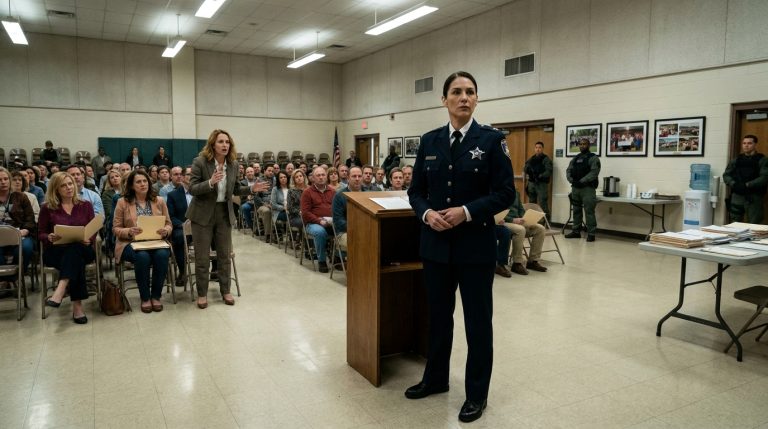
The main hall was packed to absolute capacity. Every folding chair was taken, and residents lined the perimeter walls three deep, their faces illuminated by the harsh overhead glare of fluorescent tubes. At the front of the room, a long, linoleum-topped table served as the board’s dais. Two of the five chairs sat conspicuously empty—the physical proof of Carol and Bob’s hasty resignations. In the center sat Karen.
Her hair was rigidly styled, but her face was pale, tight around the eyes, and locked in a brittle, defensive glare. Flanking her was Henderson, the sole remaining board member, who looked as though he wanted nothing more than to dissolve into the cinderblock wall behind him.
As John and his group walked down the center aisle, the collective murmur of the crowd began to subside, replaced by a tense, electric silence. David Chen, the JAG lawyer, walked step-for-step beside John, carrying a single, thick black binder tabbed with white index labels.
Karen raised her gavel, her hand trembling slightly as she struck the wood once. “This… this meeting of the Willow Creek Estates Board of Directors is called to order,” she announced, her voice lacking its usual administrative snap. “We are here to address… specific operational grievances.”
Before she could finish her script, David Chen stepped forward, placing his hands on the front row’s folding table.
“Madam President,” David’s voice filled the cavernous room with calm, unyielding authority. “Before the board proceeds to individual grievances, we move that these proceedings be officially recorded by all present media to ensure an accurate public ledger.”
Karen’s jaw clenched. She looked toward the back of the room where Jessica Riley’s camera crew stood with their red tally lights glowing bright in the dark. “This is a private association matter,” Karen retorted, her voice rising in a defensive squeak. “We don’t need a media circus—”
“These are public proceedings mandated under your own bylaws and state statute,” David interrupted smoothly, letting the heavy implication settle over the room. “Unless you have something to hide, a transparent board would welcome the record.”
The crowd murmured in sharp, hostile agreement. Trapped under the weight of hundreds of staring eyes and the looming threat of the camera lens, Karen swallowed hard and gave a stiff, jerky nod. “Fine. Proceed.”
John took the floor. He didn’t raise his voice; he didn’t need to. The acoustic gravity of the room carried every syllable. He opened his binder and placed the primary evidence before the board.
“Exhibit A,” John said, pointing directly to the high-resolution still from his security camera showing Karen standing over his asphalt with a can of fluorescent orange spray paint. “An unauthorized act of property damage committed on private land by the president of this association.”
A collective gasp rippled through the rows of homeowners. Karen’s face flushed a deep, mottled crimson.
“That was an enforcement action!” she shrieked, half-rising from her chair.
“That was criminal mischief,” David corrected coldly, stepping in to block her defense. “And now, let’s examine Exhibit B.”
He projected the corporate filings of Prestige Property Management onto the pull-down screen behind the dais. The clean, unyielding digital text displayed Daniel Petrov’s name, the residential address matching Karen’s maiden name records, and the three years of inflated maintenance contracts totaling over one hundred thousand dollars without a single competitive bid.
[V-4] As the financial tables illuminated the screen, a sudden, claustrophobic press of bodies shifted in the doorway behind John. The sheer mass of homeowners crowding the entrance pushed forward, the dry smell of stale indoor air and nervous sweat tightening the atmosphere. The room felt less like a neighborhood meeting and more like a courtroom awaiting a final verdict.
“Madam President,” John asked, his voice dropping into a razor-sharp register. “Can you explain to the residents of this community why their monthly association dues have been systematically funneled into your brother-in-law’s shell company at grossly inflated rates?”
The room erupted into a deafening roar of outrage. People stood up from their chairs, shouting questions, demanding answers, pointing fingers at the dais. Karen slammed her gavel down repeatedly, the wooden cracking sound completely lost beneath the tidal wave of community anger. She opened her mouth to scream back at the crowd, but the words caught in her throat as she looked out across the sea of faces—faces she had bullied, fined, and intimidated for a decade, now united in unbreakable resolve. Her empire of paper and petty rules was burning down to the studs, and she had nowhere left to run.
CHAPTER 11: THE RECALL VOTE
The acoustic pressure inside the community clubhouse hall was dense, a thick wall of sound composed of murmurs, heavy breathing, and the low, steady hum of television broadcast equipment stationed near the double doors. Henderson gripped the edge of the linoleum-topped dais with both hands, his knuckles whitening as he looked out across the sea of residents who had broken through the administrative fortress.
Karen remained seated in the center chair, her posture rigid, her fingers clenched so tightly around her binder that her skin was bloodless. She looked smaller under the studio lights, stripped of the distant authority she had wielded for a decade. Her reign had not collapsed because of an external invasion, but because the foundation of her rules had always been hollow at the core.
David Chen stepped back, allowing the procedural machinery of the association bylaws to finish its work. Arthur Pendleton rose from his seat in the front row, his frame steady, leaning slightly on his wooden walking stick.
“Mr. Henderson,” Arthur’s voice carried clearly across the silent hall, cutting through the heavy air with unhurried dignity. “The board is in receipt of over two hundred verified homeowner signatures demanding an immediate recall election pursuant to Article Three, Section Four of our governing covenants. A quorum is present. The floor is open.”
Henderson swallowed hard, his throat dry as sandpaper. He glanced down at Karen, who shot him a venomous, frantic look, her lips moving in a silent, desperate warning. But Henderson did not look back. He had watched the news broadcast; he had seen the forensic audit trail. He was a survivor, not a martyr.
“Is… is there a formal motion from the floor?” Henderson asked, his voice shaking slightly.
“I so move,” Arthur said, his tone absolute.
“Seconded,” Mr. Garcia called out immediately from the second row.
Henderson nodded once, a quick, jerky motion of surrender. “All in favor of holding an immediate recall vote and issuing a vote of no confidence against the association president, signify by raising your hand.”
A forest of hands shot up across the room instantly. Every homeowner in the aisles, every resident lining the back cinderblock walls, every family member holding a protest letter raised a hand. The vote was a wall of solidarity, stretching from the front rows to the exit doors.
“All opposed?” Henderson whispered.
Karen slowly raised her right hand. A single, trembling arm lifted in defiance against a room of two hundred people. It was a pathetic, lonely gesture, the final stubborn spasm of an autocrat refusing to acknowledge gravity.
“The motion passes,” Henderson said, dropping his gaze. “The president is recalled, effective immediately.”
The room did not erupt into chaotic cheering; instead, a collective, heavy exhalation swept through the hall—the sound of an entire neighborhood letting go of a decade-long breath. Karen sat frozen for three seconds, staring at her single raised hand as if it belonged to someone else. Then, with a harsh, sharp intake of breath, she shoved her chair back, gathered her binders with shaking fingers, and forced her way down the center aisle, pushing past the media cameras and the silent wall of neighbors who parted just enough to let her pass into the night.
The door swung shut behind her with a dull, final thud.
David Chen turned to John, adjusting his jacket cuffs with a quiet, satisfied smile. “Well, Major. Looks like the perimeter is secure.”
CHAPTER 12: THE RENTED PAVEMENT
The evening air was cool and crisp, carrying the faint, clean scent of approaching autumn as John walked up the paved incline of his driveway. Behind him, the distant murmur of the clubhouse parking lot faded into the quiet hum of crickets settling into the manicured lawns. The orange line was gone, ground away by the professional milling crew earlier that afternoon, leaving in its place a smooth, jet-black expanse of pristine asphalt that absorbed the amber glow of the porch light without a single blemish.
Sarah was already sitting on the front porch in one of the wooden rocking chairs, a ceramic mug of tea held between her hands. As John reached the bottom of the steps, she looked down, her face softening into a quiet, profound expression of relief that had been missing for months.
“Arthur called a moment ago,” Sarah said softly, her voice carrying across the porch boards. “The state investigators have already seized the financial records from Prestige Property Management. The forensic audit confirmed over two hundred thousand dollars in unauthorized funnels over the last five years. Karen’s house is facing immediate foreclosure liens from the civil asset freeze.”
John stepped up onto the porch, pulling out the adjacent chair and settling into the familiar, weathered wood. He didn’t feel a surge of triumphant vindication or angry adrenaline; he felt only the steady, grounded weight of completion. The mechanics of corruption were predictable, and once exposed to sunlight, they dissolved exactly as engineered.
“She spent ten years building a fortress out of rules,” John said quietly, resting his forearms on his knees. “She truly believed that if she controlled every blade of grass and every shade of paint on the street, she could control the world around her. She couldn’t accept that a community isn’t a military barracks to be managed by fear. It’s a structure built on mutual trust, and the moment she tried to monetize that trust, the foundation cracked.”
Before Sarah could reply, the crunch of gravel signaled movement down the path. Arthur Pendleton walked up the wooden steps, carrying three chilled glasses of iced tea in a wire caddy. He handed one to Sarah, one to John, and lowered himself carefully into the final rocking chair with a contented sigh.
“Well, Major,” Arthur said, taking a slow sip and looking out over the flawless blacktop of the driveway. “It appears your property is finally in full compliance with community standards.”
John raised his glass slightly toward the old professor, a faint, dry smile touching his lips. “Standard achieved, Arthur.”
They sat in silence for a long moment, letting the quiet rhythm of the evening settle over the cul-de-sac. Down the street, the cheerful sound of a young boy’s laughter echoed from the Garcias’ driveway as a basketball bounced rhythmically against the backboard—a simple, unscripted noise of life returning to its natural cadence. A few doors down, Lisa’s front garden was dark, but the soil was rich and undisturbed, tended by neighbors who now stopped by simply to talk rather than inspect.
The physical scar on the asphalt had been repaired by the collective will of the people who lived beside it. The machinery of petty tyranny had been dismantled not with shouting or violence, but with the cold, unyielding weight of facts, procedure, and an unbroken chain of shared integrity.
John took a deep breath of the cool night air, feeling the tension finally drain from his shoulders. Justice wasn’t always a dramatic courtroom verdict or an iron cell door sliding shut; sometimes it was much quieter. It was the sound of a neighborhood breathing freely again. It was the sight of children playing without fear of a laminated citation. It was the profound, enduring satisfaction of drawing a line in the dust—not to keep people out, but to protect the space where everyone could finally live.