The Rusted Ridge: A Tale of Silent Iron, Broken Vows, and the Friction of Duty
CHAPTER 1: THE TASTE OF OXIDE
The air inside the cramped intel shack tasted of fried copper and the fine, alkaline silt that drifted through the door-seals every time a heavy transport ground its way toward the perimeter wall. Riley Monroe kept her fingers flat against the edge of her metal desk, feeling the faint, rhythmic shudder of the air-conditioning unit struggling against ninety percent humidity. Two inches to the right of her thumb, the small nylon strap of her field notebook lay slightly twisted. She didn’t look at it, but her index finger and thumb moved automatically, catching the coarse material, drawing it flush, and flattening it against the scarred wood until the line was perfectly parallel with her keyboard.
Behind her, the voices from the motorpool side-door were loud, dry, and thick with the carelessness of men who still believed their armor made them heavy.
“Desk-trained,” one of the rangers muttered, his shadow blocking the low amber light filtering through the entry screen. He was leaning against the fender of a disassembled utility vehicle, scraping a grease-plug with a buck-knife. “Give her a standard-issue frame and she’d drop the muzzle before she cleared the staging lane. They shouldn’t mix data-handlers with the rifle companies.”
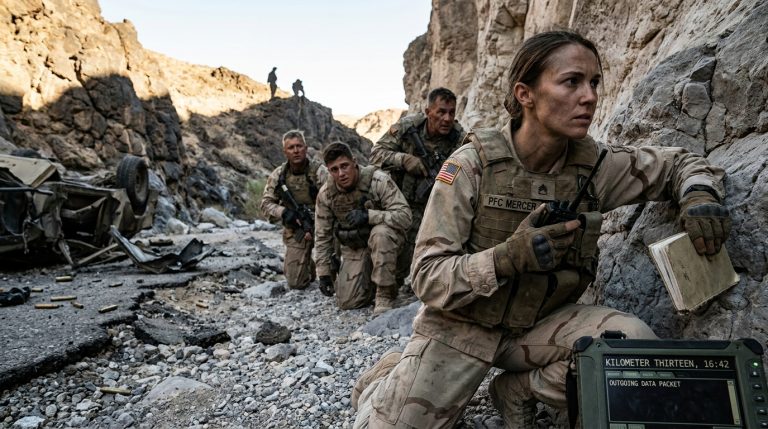
Riley didn’t turn. She focused on the flickering map overlay on her central monitor, where a single red line marked the dry riverbed winding through the base of the eastern ridge-line—the valley floor she had spent forty-eight hours charting. The data was clear in its topography: high walls of crumbling shale, three distinct blind corners, and a thermal draft that pulled downward from the cliffs every afternoon at sixteen-hundred hours. It was a natural funnel for a crossfire. She had marked it with a yellow cautionary hash-mark before shifting the file to Curtis Hail’s desk.
Curtis hadn’t even opened the secondary tabs. He was currently leaning back in his swivel chair four feet away, his boots propped on a stack of unread logistics binders, his eyes fixed on a lukewarm cup of instant coffee. Opposite him, Veronica Shaw was sighing rhythmically, her long fingers clicking through a backlog of supply requisitions with the flat, metronomic cadence of someone counting down the minutes to an early rotation.
“They’re young, Monroe,” Curtis said without dropping his boots from the binders. He hadn’t looked at her chart since Tuesday. “They think if a hill isn’t on the satellite grid as an active mortar pit, it doesn’t exist. Let them clear the route. It keeps the colonel off my back about the patrol quotas.”
Riley’s throat was dry. She swallowed the taste of the red dust that constantly hung in the room’s corners. “The grade is too steep for the standard tracks,” she said, her voice dropping into the low, unaccented register she used to minimize her presence in the room. “If they take fire from the north bench, they won’t have the torque to back out before the dust-wall hits.”
Brad Nolan, the youngest data-clerk in the section, let out a short, nasal snort from behind his dual-screen setup. “Sure thing, Sergeant Major. We’ll tell the Captain to check his mirrors for ghosts.”
Then the primary speaker on the tactical console went dead.
It wasn’t a standard transmission break. The digital green light on the transceiver stayed solid, but the background hum of the field radios vanished, replaced by a wet, heavy thud that sounded like a canvas sack hitting a steel floor. A second later, the frequency tore open.
“Overlord, this is Rogue-Six,” Captain Ridge’s voice came through, but the calm authority that usually defined his briefings had been replaced by a tight, clipped wheeze. “We have multiple contacts… high ground, north and west. Front vehicle is immobilized. We are pinned in the draw. Repeat, we are pinned—”
A sharp, metallic crack cut him off—the distinctive, hollow thump of an old-pattern mortar hitting the loose rock forty yards from the receiver. The static that followed tasted like ozone.
Inside the shack, the laughter near the Humvee evaporated. The ranger with the buck-knife stood up so fast his shoulder caught the door-frame, the blade digging a ragged splinter into the wood. Curtis’s boots hit the floor with a dull, heavy thud that sent a puff of grey silt out from beneath the baseboards. On her monitor, Riley watched the small green icon representing Third Platoon freeze at the absolute bottom of the yellow-hashed funnel.
Behind her, the operational clock on the wall clicked over to sixteen-hundred. The afternoon wind was starting to rise, and with it, the first low groan of the storm-wall scraping against the southern perimeter.
CHAPTER 2: THE ANATOMY OF STATIC
The green transceiver light on the tactical console didn’t just flicker; it buzzed with a low, electrical heat that smelled faintly of scorched insulation. The operational clock on the wall dropped its second hand into the next slot with a sharp, dry click. Nobody breathed. The silence inside the intel shack became a heavy, solid thing, thick with the smell of the incoming storm and the sudden realization that Third Platoon was dying in real-time, exactly where the data said they would.
Riley Monroe didn’t shift her weight. Her feet remained planted four inches apart, her center of gravity low and balanced against the slight vibration of the floorboards. Her hand was still resting on the scarred wood of her desk, her thumb and forefinger holding the small nylon notebook strap completely flat. She could feel the pulse in her finger against the coarse weave of the fabric. It was slow. Uniform.
“Rogue-Six, this is Overlord,” Curtis Hail said, his voice dropping its lazy captain’s drawl and tightening into something thin and ragged. He jammed his thumb down on the desktop transmitter toggle, his boots grinding a circle into the grey silt beneath his chair. “Signal is broken. Say again your last. We have you at Grid Lima-Four-Two, over.”
Nothing came back but the iron rattle of the wind against the exterior tin siding.
Riley’s eyes drifted from the frozen green icon on her monitor down to the primary logging ledger at the edge of Curtis’s desk. It was an old three-ring binder, its metal corners rusted down to a dark, pitted orange from the salt-air. The page was open to the afternoon launch log. Her gaze caught a single line written in dark blue ink—the registered frequency for Third Platoon’s patrol.
It was wrong.
The digit in the third column was an eight instead of a three. It wasn’t an accident of handwriting; it was a deliberate, heavy stroke, the ink thick where the pen had been pressed hard into the paper to cover a previous entry. A five-digit tactical frequency didn’t change itself mid-rotation unless the command net wanted the traffic isolated from the main base relays. Riley’s finger tightened against the notebook strap. The decoy was already functioning. The rangers hadn’t wandered into the valley by mistake; they had been routed there on an alternate net that shouldn’t have been active during a standard reconnaissance sweep.
“The secondary repeater is down,” Veronica Shaw said, her voice cutting through the hum as she slammed her fingers against her keyboard. The impatience was gone, replaced by the flat, transactional panic of someone realizing their administrative shield had just dissolved. “I’m trying to pull the satellite telemetry, but the dust-wall is masking the basin. We’re losing the overheads.”
“Get the colonel,” Curtis barked, his face graying under the fluorescent tubes. He didn’t look at Riley. He didn’t look at her map, which was still glowing with the yellow cautionary hash-marks she had drawn by hand. “Nolan, get on the landline to the motorpool. Tell Turner to spin up the QRF tracks. Now.”
Brad Nolan didn’t make a sarcastic comment. His fingers shook as he reached for the old black field phone, his elbow knocking an unsharpened pencil off his desk. The yellow wood rolled across the floor, its flat sides making a small, rhythmic drumming sound until it stopped against the toe of Riley’s boot.
Riley looked down at the pencil, then slowly stood up. The movement was entirely vertical, her shoulders rising without the typical backward lean that most people used to push off from a chair. Her joints didn’t pop. The old, worn canvas of her tactical trousers scraped against the edge of the desk with a dry, soft hiss.
“The tracks won’t make the ridge-line,” Riley said. Her voice wasn’t loud, but it carried through the room because it lacked the high pitch of the panic around her. It was the same flat tone she had used six years ago in the Helmand mud when the calculations had already gone red. “The wind is already north-northwest at twenty-two knots. If Turner takes the heavy iron into the draw, the sand will choke the intakes before he hits the three-kilometer marker. They’ll be blind and stationary within ten minutes.”
The ranger with the buck-knife turned from the door-frame. His face was flushed, his knuckles white where he held the handle of the blade. “Then what the hell do you want us to do, contractor? Sit here and watch the screens go black? Those are my boys out there.”
“They aren’t your boys right now,” Riley said, her eyes meeting his without a single blink. “They’re targets. And if you go out there with a standard carbine and three magazines, you’re just adding to the body count.”
The door behind them burst open with a violent crack that sent a sheet of red dust cascading across the entry mat. Colonel Avery Dalton stepped into the room, his flight jacket dark with sweat at the armpits, his face lined with the deep, gray exhaustion of a man who hadn’t slept since the eastern checkpoint had been threatened three days ago. His eyes didn’t waste time on Curtis or Veronica; they swept the room like a thermal scanner until they stopped dead on Riley.
He didn’t know her name—not under the civilian alias her contracting firm had filed in the base registry—but his jaw tightened in a slow, physical reaction that Riley recognized immediately. It was the look of a senior officer seeing an old debt walk back into his operational sector. He saw the way she stood—perfectly centered, her weight distributed across the iron plates of her boots, her hands hung loose but steady at her sides.
“Report,” Dalton said, his voice a low gravel rasp that cut through the sound of Nolan’s frantic whispering into the field phone.
“Third Platoon is split in the lower draw, sir,” Curtis said, scrambling to his feet so fast he knocked his cold coffee into the trash bin. “Rogue-Six reported heavy mortar and small-arms fire from the bench-lands. We’ve lost visual. The dust-wall is grounding the Apaches.”
Dalton walked to the central console, his heavy leather boots leaving deep, ribbed impressions in the silt on the floor. He didn’t look at the log binder. He kept his shoulder slightly turned away from Riley, his eyes fixed on the green icon that was now pulsing with a yellow distress strobe.
“Turner’s QRF is ready to roll,” Dalton said, his hand coming down onto the console frame with a dull thunk. “We push through the main gate with four tracks and clear the south approach.”
“The south approach is blocked by shale-slides from last winter’s runoff, Colonel,” Riley said from her corner. She hadn’t moved an inch. “The data was in the Monday summary. The only viable angle that sees into that bowl is the north overwatch ridge. But you need to be above the dust-line to clear the thermal glare.”
Dalton slowly turned his head. His eyes narrowed, tracking the thin, faint scar along her jawline where the dry skin had split and healed over years of mountain wind. He looked at her hands—specifically the way her right index finger was perfectly straight, resting against the seam of her trousers as if it were aligned with a trigger guard.
“The north ridge is eight hundred meters of vertical loose stone,” Dalton said, his voice dropping an octave, becoming dangerous. “No one carries a heavy system up that bench in a sand-drift. Not unless they want to die on the reverse slope.”
“I can do it,” Riley said.
The room went completely silent again, save for the rhythmic thump-thump-thump of the wind-driven sand hitting the tin roof outside.
CHAPTER 3: THE COLD IRON CAGE
Colonel Dalton did not break eye contact. The rhythmic thump-thump-thump of the sand-drift against the tin roof seemed to sharpen, matching the hard, erratic pulse of the operational console behind him. For three seconds, his jaw remained locked—a rigid line of graying stubble that didn’t yield to the rising panic in the room. His fingers lingered on the console frame, tapping once against the cold steel casing before he finally spoke.
“You’re a data contractor, Monroe,” Dalton said, his voice dropping into a flat, level rasp that was intentionally devoid of recognition. “Contractors don’t draw specialized systems. They don’t cross the perimeter fence without a military escort, and they certainly don’t clear ridges alone during an active weather event.”
“The escort will slow me down, Colonel,” Riley replied. Her voice remained entirely unhurried, a stark contrast to the high-pitched static leaking from the broken radio link. “And the ridge isn’t going to wait for the paperwork. Third Platoon has about twelve minutes before the high ground is completely cut off from your standard recovery assets. You can check my corporate file, or you can let me walk out that door.”
Dalton’s eyes dropped slightly, his gaze tracking the precise, parallel alignment of her notebook against her keyboard. He knew that mechanical order. He had seen it on field desks in three different provinces over a decade ago. Slowly, he reached into his flight jacket, his knuckles scraping against the stiff leather as he pulled out a small, notched brass key. He didn’t hand it to her. He dropped it onto the glass overlay of the tactical table, where it slid two inches before stopping right on the yellow hash-marks she had drawn across the valley map.
“The armory cage is locked on my authority,” Dalton said, his voice dropping so low that Curtis Hail had to lean forward to catch the words. “Master Sergeant Holt doesn’t open the long-range racks without an officer’s signature. If you aren’t back inside the wire before the secondary storm-wall drops at seventeen-hundred, I’m logging your contract as abandoned. Do you understand me?”
“Perfectly,” Riley said.
She picked up the brass key. The metal was cold, smelling faintly of sulfur and the heavy oil used to preserve command locks. She didn’t look back at Curtis, whose face had gone from gray to an ashen, sweating white, nor did she acknowledge Brad Nolan, who was still holding the dead field phone like a piece of useless plastic. She turned toward the narrow exit door, her boots tracking two clean ovals through the red silt on the floorboards as she moved out into the blinding glare of the corridor.
The transition from the air-conditioned intel room to the armory breezeway was a physical blow. The wind didn’t just blow; it carried the dry, granular weight of the desert floor, scraping against her exposed skin like coarse wool. Riley pulled her collar up around her throat, her index finger instinctively checking the button-seam to ensure the fabric was flush against her neck. She walked with a short, efficient stride, keeping her hips perfectly level to prevent her boots from slipping on the loose shale that had drifted into the covered walkway.
The armory door was a massive slab of solid sheet iron, pitted with rust along the lower hinges where the condensation from the cooling vents ran down every night. She didn’t knock. She inserted the brass key into the old tumbler lock, twisting it until the internal pins dropped with a heavy, ungreased clack.
Inside, the light was yellow and flickering, dominated by two long fluorescent tubes that hummed with a high-pitched, irritating frequency. The air here was thicker than in the TOC—saturated with the smell of solvent, packing grease, and the dull, metallic tang of cold barrels.
Master Sergeant Raymond Holt stood behind the heavy steel-mesh counter, his arms crossed over a grease-stained canvas apron. He was sixty, his knuckles swollen from decades of stripping receivers, his skin the color of old boot leather. He didn’t move when the door swung shut. He didn’t look at the clipboard beside his hand. His eyes fixed directly on the thin scar running along Riley’s jawline, his expression completely blank, yet his fingers slowly uncurled from his apron.
“You’re in the wrong bay, contractor,” Holt said, his voice like rocks tumbling down a dry pipe. “The office supply lockers are over in Sector Two. I don’t issue field kits to data-handlers.”
Riley stepped up to the counter, her movements fluid and centered. She didn’t drop the key. She placed it precisely on the black rubber mat separating them, aligning the brass notches with the stamped serial number on the counter’s edge.
“Dalton sent me,” Riley said softly. “Open the reverse-slope cabinet. The long-range rack.”
Holt froze. The movement was small—just a brief check in his breathing—but his chest remained unexpanded for a full two seconds. He looked down at the brass key, then up at her hands. Riley’s right hand was resting flat on the counter, her index finger perfectly straight, aligned with the seam of the rubber matting.
“That rack hasn’t been opened in six years,” Holt said, his voice losing its rough edge, dropping into something quiet and dangerous. “The system inside doesn’t belong to the current battalion inventory. It’s a legacy asset. It doesn’t have a corporate log.”
“It doesn’t need one,” Riley said. “The wind on the north ridge is hitting twenty-two knots. The standard-issue carbines will drift three meters off-target before the round crosses the draw. You know what’s in that cage, Raymond. Open it.”
Holt stared at her for another beat, then let out a slow, heavy breath that smelled of tobacco and stale coffee. He didn’t take the key from the counter. He reached under his apron, pulled out a heavy steel ring loaded with black oxide keys, and turned toward the dark, reinforced partition at the back of the room.
Riley watched his shadow stretch across the metal gun racks as he walked into the darkness of the rear cage. The fluorescent tubes above her head flickered once, buzzing loudly, then settled back into their dull, continuous whine.
CHAPTER 4: THE GRINDING AXLE
The back of the locked cage didn’t yield to the light. Master Sergeant Raymond Holt’s heavy shadow split across the vertical steel slots as his keys rattled against a dark, industrial lock mechanism. A low, dry clunk vibrated through the wire mesh floor. When he stepped back into the yellow circle of the fluorescent tubes, he wasn’t holding a standard rifle case. He carried a long, form-fitted canvas drag-bag, its green dye faded to a pale, chalky olive from years of storage, the edges stiff with dried preservation grease.
He laid it on the rubber matting with a dull, heavy thud that didn’t bounce.
“The inventory tags were pulled in fourteen,” Holt said, his voice dropping into the flat, rhythmless drone of an old-school keeper who knew exactly which rules were meant to be broken in silence. “But I kept the bore greased. Every Sunday. The seal on the optic is still solid.”
Riley Monroe didn’t pull the heavy brass zipper immediately. She reached out, her index finger and thumb catching the edge of the canvas tab, drawing it straight and parallel with the counter’s steel edge. Her two-finger tic left a clear smudge in the fine silt coating the fabric. When she slid the slide back, the scent that emerged was thick, concentrated, and old—the sharp, bitter tang of molybdenum disulfide grease and linseed oil.
Inside lay the long-range system. Its custom-tapered barrel was blackened with a matte, non-reflective oxide finish that showed slight, silver wear-marks around the muzzle brake. The stock was constructed of dense, desaturated polymer, scarred with fine parallel scratches near the cheek-piece from the gravel of old hides. It looked less like a weapon and more like a heavy, precision-machined tool meant for a job that had no room for margin.
“Six boxes of match-grade,” Holt muttered, sliding a small, green-painted ammunition tin across the rubber. The latches were rusted down to a dull brown flake that left a powdery residue on his calloused skin. “The lots are consistent. I calibrated the grains myself before the depot closed the ledger. You’re going to have to hold high if the wind clips the twenty-five-knot mark.”
“I know the drift,” Riley said.
She lifted the rifle by its center balance point. Her wrists didn’t shake under the eleven-pound weight. The physical mass settled into her skeletal frame naturally, her shoulders dropping half an inch into a locked, efficient carriage that removed any need for muscular strain. She zipped the canvas bag closed with a single, continuous pull, swung the coarse nylon sling over her left shoulder, and gripped the ammunition tin by its rusted folding handle.
She didn’t thank him. Holt didn’t offer a nod. He simply picked up his clipboard and began scraping a grease-mark off a line item with the edge of his thumb as Riley turned and pushed through the heavy iron outer door back into the rising dust-glare.
The staging lane behind the main motorpool shed was an engine-driven inferno. Four heavy QRF transport trucks were already idling in a tight echelon formation, their ten-ton diesel blocks throwing off waves of greasy, shimmering heat that turned the red silt into a swirling, baking vortex. The exhaust pipes rattled against the armored chassis panels with a continuous, metallic clank-clank-clank.
Sergeant Cole Turner stood by the rear loading ramp of the last vehicle, his face half-obscured by a dust-goggle band, his fingers ripping a fresh strip of green tape across his vest harness. His jaw was moving rhythmically, chewing a dry piece of throat-lozenge as his eyes tracked Riley’s approach.
“What is this?” Turner barked, his voice straining to clear the roar of the turbochargers. He stepped directly into her path, his heavy body blocking the metal footstep of the ramp. “Dalton said I was carrying a data asset for terrain verification. He didn’t say anything about a long-range bag. We don’t have space for extra kit, contractor. Put it in the equipment locker or stay off my track.”
Riley stopped one pace from the steel ramp edge. She didn’t drop the ammunition tin. Her left hand adjusted the canvas strap on her shoulder, sliding it exactly two inches down her arm until the weight was perfectly balanced across her collarbone.
“The locker will throw off the optic’s alignment if the track hits a shelf-slide,” Riley said, her voice remaining level and transactional. “The bag stays with me. If you don’t like the weight distribution, you can call the TOC. Dalton has the frequency.”
Turner stared down at her, his lips thinning into a hard, white line. He looked at the long canvas case, then at her boots, which were coated in the identical gray silt as his own. He let out a sharp, dismissive grunt, turned on his heel, and hauled himself up into the dark interior of the vehicle using the iron grab-handle.
“Get in,” he snapped without looking back. “And keep your hands off the internal comms. We roll in thirty seconds.”
Riley stepped onto the steel cleat, her boots making a sharp, metallic ring against the non-slip tread. The interior of the transport was a cramped, desaturated cavern of welded steel plates and green canvas bench-seats. The air was suffocating—heated to over a hundred degrees by the transmission lines running beneath the center aisle and saturated with the smell of hydraulic fluid and unwashed gear.
She took the furthest seat near the rear escape hatch, placing the canvas drag-bag vertically between her knees. Her hands folded across the thick zipper tab, her thumb resting against the cold iron of the ammunition tin at her feet. Opposite her, three young rangers from the reserve section sat in silence, their eyes wide, their fingers nervously checking the latch pins on their standard-issue carbines.
At the front of the cabin, pinned behind a hydraulic fluid reservoir, an old maintenance log binder lay open on a storage box. Riley’s eyes tracked the vehicle number on the spine. It matched the log she had seen on Curtis’s desk, but the engine hours recorded on the internal sticker were short by over four hundred miles. The discrepancy was right there, written in the grease-smudged print of a mechanic who had signed off on a machine that shouldn’t have been operational.
The vehicle lurched forward with a violent, spine-jarring shudder as the transmission engaged. The heavy tires caught the jagged stone of the perimeter trail, and the shack vanished behind a wall of cascading red sand.
CHAPTER 5: THE VERTICAL SCALE
The heavy steel bulkheads of the transport didn’t just rattle; they slammed sideways as the left-side tracks cleared the concrete apron of the outer gate and bitten down into the fractured limestone of the approach trail. Inside the dark hull, the green canvas bench seats pulled taut, the webbing groaning under the sudden, forty-degree tilt of the chassis. Riley Monroe wedged her boots into the iron floor cleats, her knees bracing the vertical mass of the canvas drag-bag until the pale olive fabric was locked flush between her shins.
Directly across from her, a young rifleman with a fresh smudge of charcoal grease on his collar slid six inches down the aluminum rail before his shoulder caught the structural rib of the frame. He didn’t swear. He simply gripped his carbine’s carrying handle with both hands, his knuckles turning a dry, pale ivory beneath the dust-coating.
“We’re losing speed,” Turner growled from the forward commander’s hatch. His upper torso was obscured by the steel blast-shield, but his heavy leather mitts were hammering against the driver’s partition bulkhead with three rhythmic, hollow thuds. “Keep the revs up! If the torque drops below twelve hundred, the dust is going to stall out the main compression line!”
The engine responded with a high-pitched, metallic whine—the sound of an over-taxed turbine digesting sand. Through the thick, yellowed plexiglass of the rear escape port, the base perimeter was already gone, dissolved into a uniform, spinning wall of red oxide that scraped against the exterior paint with the dry, continuous hiss of thousands of small needles.
Then the vehicle dropped.
It wasn’t a standard bump in the wash. The entire rear axle assembly rose six inches before slamming down onto a shelf of solid, exposed bedrock with a violent, spine-jarring bang that sent a shower of orange sparks through the floor-drain seams. The engine didn’t stall, but the mechanical rhythm changed from a synchronized roar to an erratic, heavy clatter. A sharp, bitter odor of scorched transmission oil instantly filled the small cabin, venting directly from the floor plates into Riley’s throat.
“Track slide!” the driver shouted through the internal net, his voice thin and distorted by the mechanical feedback. “The lower bench broke away! We have three feet of clear shelf on the left, but the right-side link is riding the lip of the wash!”
Turner dropped down into the cabin, his boots hitting the center deck plate with a dull, iron ring. His goggles were caked in red silt, leaving two clean, white circles around his narrowed eyes. He didn’t look at the riflemen. He reached past Riley’s shoulder, his fingers clawing at the manual release lever of the rear escape hatch until the heavy iron dogs disengaged with a cold, ungreased clack.
“Out!” Turner barked, his voice flat and transactional. “The weight balance is wrong. We move the final two hundred meters on foot up the cut. If the track drops into the gulley, the whole echelon is pinned.”
Riley didn’t wait for the riflemen to scramble. She caught the rusted folding handle of her ammunition tin with her right hand and slung the canvas drag-bag over her left shoulder in a single, vertical lift that kept her spine aligned with the vertical frame of the hatch. She was through the opening before the dust-cloud from the idling tracks could billow into the compartment.
The world outside was a vertical slate furnace. The wind was hitting thirty knots now, screaming down from the northern peak with a low, bass roar that vibrated through the iron plates of her boots. The ground beneath her feet wasn’t soil; it was a crumbling staircase of dark, rusted shale that shifted two inches down the slope every time she pressed her weight into a heel.
Ten yards ahead, the lead transport track was wedged at a violent angle against a massive, dark block of limestone—a recent rockslide that had sheared off the upper shelf and blocked the only vehicle-grade path into the basin. The gray exhaust smoke from its pipes was being torn away by the wind before it could rise three inches from the metal stack.
“Monroe!” Turner shouted, his heavy hand catching her elbow as he cleared the hatch behind her. His grip was tight, his fingers pressing into the fabric of her sleeve until the canvas was flush against her skin. “The main QRF lane is dead. We have to clear that block by hand or we go down into the draw blind. Where’s that overwatch pocket you logged?”
Riley turned her head three inches to the left, her eyes narrowing against the stinging grit that was already collecting in the fine lines around her temples. She didn’t use her hand to point. She tilted her chin toward a narrow, jagged fissure that split the limestone wall forty yards above the blocked trail—a dark, vertical scar where the water-runoff had carved a path through the iron-veined stone.
“The slot leads to the upper bench,” Riley said, her voice remaining low and even despite the roar of the sand-wall. “The slope is forty-five degrees of loose stone, but the wind is breaking against the western face. It’s the only line that keeps the optic clear of the thermal glare from the lower valley.”
Turner looked up at the black fissure, his jaw moving as he swallowed the last of his throat lozenge. He looked back at her long canvas bag, his expression a mixture of pragmatic calculation and cold, tactical irritation.
“Go,” he snapped, releasing his grip on her arm with a short, downward jerk of his hand. “Take the high shelf. But if you don’t have eyes on Brooks’s sector by the time we hit the bottom of that draw, I’m clearing the western ridge with standard mortar fire, regardless of who’s on the reverse slope.”
Riley didn’t respond with a nod. She turned toward the base of the fissure, her boots crunching into the loose shale with a slow, deliberate cadence that didn’t waste an ounce of oxygen. Every step was a calculated equation of friction and weight distribution: heel down, toe dug into the fracture line, weight centered over the pelvis until the loose stone settled into a temporary equilibrium beneath her soles.
The canvas bag clicked rhythmically against the iron lid of the ammunition tin in her right hand—a cold, continuous reminder of the six-year silence she was about to break.
CHAPTER 6: THE ANCHOR IN THE SHALE
The mouth of the rock fissure didn’t offer a reprieve from the mountain wind; it condensed it. As Riley Monroe dug the thick rubber lug of her left boot into the first fractured limestone step, the air howling through the narrow gap hit her chest like an iron plate. She didn’t pause to adjust her breathing. Her right fingers remained locked around the rusted folding handle of the ammunition tin, while her left elbow pressed the long, canvas bulk of the drag-bag flat against her rib cage to keep it from rattling against the vertical stone walls.
Behind her and forty yards down, the low, mechanical rattle of the stuck QRF transport tracks began to recede, swallowed by the roar of the sand-wall scraping across the basin floor. Every movement up the cut was an exercise in pure structural physics. The rock walls were close enough that her shoulders brushed the pitted, gray stone on every alternate step, leaving pale, powdery lines of pulverized lime across her dark sleeves.
She climbed with her weight dropped low, her center aligned strictly over the shifting shale of the path. A single skip in her footing would drop her backward into the path of Turner’s advancing rifle section, but her feet found the natural stone anchors with the flat, unthinking precision of an instrument calibrated over thousands of miles of high-altitude patrol. Her body remembered the work, even if the six-year silence had tried to dull the muscle.
Seven minutes of continuous, vertical ascent brought her to the lip of the north overwatch pocket. The shelf was small—less than four paces wide—carved into the reverse slope of the cliff face where the limestone met a dense vein of iron-rich sandstone. The wind here didn’t hit from the front; it whirled upward from the valley basin, carrying a thick, red veil of silt that coated everything in a uniform, gritty film within seconds.
Riley dropped to her knees. The impact against the sharp stone was a dull, localized pressure that she ignored as she laid the green canvas bag flat before her. Her thumb caught the metal latch of the ammunition tin first, throwing it open with a cold, dry clack. Inside, the twenty-round boxes of match-grade ammunition sat in a perfect row, their brass casings dulled by years of dry storage but free of oxide green.
She pulled the heavy brass zipper of the drag-bag, the sound a sharp, continuous hiss that cut through the bass rumble of the storm. The long-range rifle came out smoothly. Her fingers found the polymer fore-end, lifting the eleven-pound assembly until the flat bottom of the receiver settled against her thigh.
She didn’t rush the deployment. She unfolded the steel bipod legs one by one, ensuring the internal pins snapped home into their locked positions with two identical, metallic clicks. When she pressed the feet of the bipod into the loose surface shale, she leaned her entire body weight forward, driving the small, jagged metal spikes deep into the bedrock until the system was anchored against the thirty-knot crosswind.
“Overlord, this is Overwatch Pocket North,” Riley said, her voice dropping into the low, level cadence that left no echo against the surrounding stone. She had pulled the thin wire headset from her pocket, wrapping the frayed elastic band around her left ear with a single, two-finger tug. “Bipod is set on the upper bench. The thermal glare is breaking at sixty percent density. I’m preparing to acquire the center draw.”
Static surged through the earpiece—a wet, frying crackle that tasted of the red silt outside the shack.
“Overwatch, this is Hail,” the voice came back, thin and fractured by the distance. “The colonel is tracking your position on the map grid. Turn—static—Turner is three hundred meters out from the blockage. He says he hears small-arms fire from the target cluster. Do you have eyes on the medic’s vehicle? Over.”
Riley didn’t respond immediately. She slid her right cheek down against the cold, desaturated polymer of the stock, her eye finding the rear lens of the long-range optic. The glass was dark at first, coated in a fine layer of blown sand, but she used the edge of her thumb to wipe the outer protective cap clean, her finger moving with the same parallel order she kept at her desk.
The world inside the glass was a swirling, amber circle of distortion. The dust-wall was moving through the lower valley at twenty-two knots, creating long, dancing heat-waves where the dry air met the cooling shadows of the western ridge. She adjusted the side-parallax dial three clicks to the left, the internal brass gears clicking with a dry, precise friction that she felt through her jawbone.
The image settled.
Eight hundred meters down, at the absolute bottom of the yellow-hashed funnel, the white roof of Third Platoon’s lead transport vehicle was visible through a temporary break in the sand-drift. It was tilted thirty degrees to the right, its front axle shattered against a limestone shelf. Pinned against the rear loading ramp was Specialist Dana Brooks, her small helmeted head tucked low between her shoulders as she held a grey field dressing against a casualty’s chest.
Three yards from her position, a rusted iron storage wall provided the only cover from the high ground to the west, but the gap was narrowing. A dark shadow was moving along the lip of the reverse slope, its shape obscured by the red silt, but its direction was absolute—closing on the exposed flank of the medic’s cluster with a raised, dark profile.
Riley’s index finger slowly left the side of the trigger guard, her pad settling against the cold, unyielding curve of the steel blade.
CHAPTER 7: THE BREACH OF SILENCE
The steel blade of the trigger didn’t yield to a casual pull; it required a deliberate, straight compression that Riley Monroe managed by expanding the pad of her index finger until the metal was flush against her bone. Her left hand remained wrapped over the polymer stock, anchoring the rear spade hook into the pocket of her collarbone, while the iron-veined sandstone beneath her elbows ground a fine, grey powder into her skin.
Inside the glass circle of the scope, the dark profile on the western ridge-line grew distinct. The hostile fighter wasn’t improvising his advance. He moved with a measured, rhythmic gait, tracking from one limestone shelf to the next along a path that had been cleared of loose stone beforehand. It was a pre-arranged lane.
Riley’s eye widened slightly behind the lens. The discrepancy in the target’s movement pattern was absolute—he was traversing a specific, cleared contour line that didn’t appear on the standard maps but aligned perfectly with the alternate tactical frequency she had seen noted in Curtis Hail’s ledger. The ambush wasn’t a sudden, chaotic encounter; it was a structured checkpoint line, and the rangers of Third Platoon had been driven into it with precision engineering.
She didn’t track the target with her muzzle. She set her horizontal crosshair three inches ahead of his lead shoulder, allowing the twenty-two-knot crosswind to serve as the mechanical bridge between her position and his path. Her breathing fell into a flat, level cycle—inhale through the nose, exhale until the lungs were seventy percent empty, then hold the chest wall rigid against the rhythmic pulse of her carotid artery.
The world narrowed to the thickness of a steel reticle line.
Specialist Dana Brooks was still down there, her left arm bracing the collar of the wounded casualty, her right hand reaching blindly into a green canvas pack for a secondary air-needle. The hostile fighter on the ridge raised his carbine, his body dropping into a low, braced kneeling position to clear the dust-drift.
Riley squeezed.
The rifle didn’t jump; it hammered backward into her skeletal frame with a short, heavy thud that forced her heels an inch deeper into the loose shale behind her. The muzzle brake threw out a flat, parallel sheet of fire that cut through the immediate red silt before the wind could dissolve the sulfur smoke. Through the glass, the impact was instantaneous and unpolished. The target didn’t spin or shout; the round tore through his center mass before the sound of the crack could bounce off the limestone behind him, causing his torso to fold forward like a wet piece of canvas dropping into the dirt.
The empty casing rolled out of the ejection port as Riley cycled the cold iron bolt handle up and back. The spent brass hit the sandstone floor with a sharp, hollow clink, its hot primer leaving a tiny, blackened circle on the grey dust between her elbows.
“Overwatch North, hit,” Riley said into the wire headset. Her voice hadn’t shifted its pitch by a single hertz. It remained the same dry, flat instrument she used to read the weather Summaries. “Target on the western contour is neutralized. Shift your main relay focus to the lower draw, Hail. There are two secondary shooters setting up an alternate mortar base four hundred meters north of the vehicle chassis.”
The feedback in her ear was deafening. It wasn’t Curtis Hail’s voice; it was a high-frequency, electronic scream that indicated the command net was attempting to override her manual transmitter from the base terminal.
“Overwatch, stay off the net!” a voice barked through the static—clear, sharp, and carrying the distinctive, unhurried cadence of Colonel Avery Dalton. “All units on this frequency, freeze your positions. Turner, hold your section at the blockage. I have an alternate asset-recovery team entering the grid from the eastern valley wall. Do not interfere with the ridge sectors.”
Riley didn’t pull her cheek away from the polymer stock. She slid her right hand down to the rifle’s safety switch, her thumb resting on the metal ridge without throwing the latch. Through the eight-hundred-meter glass, she watched the eastern valley wall—the sector Dalton had just claimed was open.
There were no tracks moving there. There were no recovery teams. There was only the continuous, rhythmic pulsing of the dust-wall chewing through the dry brush, and the small, green icon of Third Platoon pulsing its yellow distress signal from the bottom of the iron trap.
The decoy was failing, but the structure behind it was still locking down the grid.
CHAPTER 8: THE GHOST IN THE CIRCUIT
The electronic screech inside Riley Monroe’s thin earpiece didn’t dissolve; it hardened into a steady, localized hum that tasted faintly of salt-air and ozone. Her left cheek remained pressed flush against the weathered polymer of the stock, her eye motionless behind the rear optic lens. She didn’t drop her right hand from the receiver. Her fingers stayed exactly where they were, wrapped around the cold, checkered steel of the grip, feeling the vibration of the command terminal’s digital signal as it attempted to step down her manual transmission.
The voice coming through the static wasn’t just a set of coordinates. The low, unhurried cadence of Colonel Avery Dalton carried the precise weight of an old ledger. Six years ago, that exact frequency-shift had hit her headset in a muddy hide outside of Sangin—the same flat override, the same administrative command to freeze her traverse while a non-existent asset-recovery team was logged into the sector. Her lungs empty, she held her frame entirely rigid against the rock shelf, her mind calculating the trajectory of that past failure against the immediate, rusted reality of the basin below.
“Overwatch North, confirm your hold,” Dalton’s voice repeated, the signal breaking through a fresh cascade of sand-grit that rattled against the exterior mesh of her transmitter. “Turner is adjusting his echelon. Pull your sights off the western contour line. That sector is restricted by tactical decree.”
Riley didn’t press the talk switch. Her index finger remained extended along the side of the receiver, her pad tracing a fine line of rust that had collected along the seam of the bolt carrier. She didn’t look back at the trail behind her. Through the eight-hundred-meter glass, she focused entirely on the small, amber-tinted circle where Third Platoon’s green distress strobe was fading against the rising wall of the storm.
Dana Brooks was still visible through a gap in the limestone slabs. The young medic had her weight thrown forward, her knees pinned beneath the rear bumper of the shattered transport track as she used both hands to force a steel clamp onto a ruptured arterial line. Her shirt was dark with oxide fluid, her hair encrusted with the red dust that whirled out from the engine compartment. She wasn’t monitoring the radio net; she was counting the seconds between chest expansions.
Twenty yards higher up the western ridge, a second shadow emerged from a narrow ravine—a vertical cut in the stone that hadn’t been listed on the command overlay but appeared clearly in Riley’s personal notes. The figure carried a heavy, long-barreled system with an unpitted black oxide finish, its bi-pod feet scraping against a limestone ledge as it settled into a pre-cleared firing slot.
The asset wasn’t there to recover anything. The muzzle was angling directly down toward the roof of Brooks’s vehicle, its alignment clean, surgical, and absolute.
“Rogue-Six, this is Overwatch,” Riley said. She bypassed the base terminal entirely, slamming her thumb into the manual override toggle on the side of her personal battery pack until the green light died, shifting her output to a direct line-of-sight signal that wouldn’t clear the wire at Raven Rock. “You have a heavy shooter settling on the western bench, forty meters above your current primary cover. He has an angle on the casualty cluster. Move your team inside the wheel-well. Now.”
The response from Captain Ridge was a clipped, wet cough that bled through the receiver. “Overwatch… we have three casualties on the platform… we can’t shift the backboards without clearing the open lane… Turner is supposed to have the ridge—”
“Turner is pinned at the rockslide,” Riley cut him off, her voice dropping into the flat, unaccented register that removed any trace of corporate identity. “And the eastern lane is empty. Look at the glass, Captain. No one is coming down that hill but the sand.”
Through the scope, she watched Ridge’s head turn toward the eastern ridge-line—the long, empty expanse of gray shale that Dalton had claimed was filled with recovery assets. There was nothing there but the low, uniform roar of the wind-wall chewing through the dry gravel. His shoulders dropped two inches, a physical reaction that Riley recognized as the exact moment a soldier realizes the command architecture above them has turned into a hollow cage.
Riley didn’t shift her frame. She reached down to the ammunition tin with her right hand, her fingers catching the rim of a fresh box of match-grade rounds. Her two-finger tic was automatic—drawing the cardboard edge straight, pulling the internal plastic divider clean until the long, copper-jacketed projectiles lay parallel with her loading tray. She slid the first round into the breech by hand, the cold brass casing clicking against the iron feed ramp with a sharp, dry thump that echoed inside the stone pocket.
She slammed the bolt forward, the handle locking down into the receiver groove with the unyielding weight of an absolute choice.
CHAPTER 9: THE DENSITY OF THE DRIFT
The heavy iron bolt handle didn’t just slide into the lower groove; it bit into the receiver wall with a flat, dry thud that sent a cold shudder through the length of the barrel. Riley Monroe kept her cheek anchored exactly where it was—pressed hard against the desaturated polymer comb of the stock, her eye tracking the crosshair’s position within the amber-tinted circle of the scope. The sulfur smoke from the previous round hadn’t cleared the rock pocket; it hung in a tight, gray ribbon before her face, torn away only when the next forty-knot gust whipped through the limestone fissure.
Outside the glass, the environment changed from a structured canyon to an unmapped, churning mass of crimson silt. The storm-wall wasn’t passing over the ridge; it was stacking against it, increasing the air density by twelve percent within the span of six breathing cycles.
Riley’s fingers didn’t move from the receiver. She felt the dynamic shift in her boots—the fine sand accumulating around her laces like dry lead shot, adding weight to her stance while her elbows ground down into the pulverized sandstone floor. The wind deflection calculation she had used for the first shot was already dead data. The cascading grit was creating a physical drag on the barrel’s muzzle brake, a lateral friction that would pull her next projectile six inches low and left if she didn’t compensate by eye.
She didn’t touch the windage turret. She adjusted her hold purely through the reticle, shifting the main intersection line two mils high and a full mil-and-a-half into the teeth of the red wall.
“Overwatch North, your transmission is unverified,” Curtis Hail’s voice broke through her direct loop, the signal thin, cracked, and heavily distorted by the iron-rich dust. “The command terminal at Raven Rock is showing—static—showing an empty grid on the western sector. Turner is reporting heavy obscuration from the rockslide base. He cannot confirm your target visual. Over.”
“Turner is looking through standard-issue glass at ground level,” Riley said into the wire mic, her tone keeping its rhythmic, unhurried cadence. “The drift is pooling in the wash. Tell him to look up twenty degrees. The muzzle flashes from the mortar base are clearing the haze every fourteen seconds.”
Through the eight-hundred-meter glass, she didn’t watch Turner’s tracks. She locked onto the second hostile team setting up the short-tube mortar on the northern bench. They were working behind a low wall of stacked basalt slabs—a defensive position that had been reinforced with old oil drums filled with gravel. It was an institutional structure, the kind of hardened checkpoint that took weeks to build, hidden completely from the base satellite loops by the natural shadow of the overhang.
The decoy was no longer just a frequency shift in a log binder. The physical terrain itself had been modified, and the rangers of Third Platoon had been steered into the absolute center of the kill-zone while the command terminal at Raven Rock logged the entire basin as an unpopulated transit route.
Riley expanded her chest wall, her ribs pressing against the cold gravel of the shelf. Inside the lens, the hostile loader was lifting a secondary sixty-millimeter shell from an ammunition crate, his body half-bent as he aligned the nose-fuse with the tube’s iron rim. He was completely obscured from the valley floor by the swirling wall of red dust, but the thermal signature of his exhaust line cut through the haze as a pale, flickering violet blur.
She didn’t wait for the net to clear. She took a half-breath, held the air low in her diaphragm until her pulse settled into a slow, three-beat vibration against the rifle’s stock, and began the straight rearward compression of the steel trigger blade.
The rifle boomed a second time, the heavy mechanical recoil driving the bi-pod feet three inches through the loose surface shale until the jagged metal spikes struck the solid iron-veined bedrock below.
CHAPTER 10: THE THERMAL GLIPH
The sharp, heavy recoil of the precision round left a localized ringing in Riley Monroe’s left ear that didn’t dissolve into the wind. Her fingers moved with old, ungreased automaticity, unlocking the bolt handle and drawing it back two inches until the second hot copper shell casing popped loose, bouncing twice against her forearm before settling into the fine silt near the ammunition tin. The heat from the metal left a small, red mark against her skin that she ignored as she slammed the next round forward, her eyes still trapped behind the glass of the optical system.
Through the eight-hundred-meter lens, the northern mortar pocket was no longer a structured platform. The second projectile had struck the exact rim of the gravel-filled drum, turning the sheet iron into a fan of jagged, dark shards that had collapsed the tube’s primary bipod assembly into the dirt. The loader she had seen through the violet haze was down, his silhouette blending with the gray rock slabs.
But as the dust-cloud from the impact momentarily pulled apart under a forty-knot gust, a tiny, high-frequency distortion caught the edge of her crosshair.
It wasn’t a standard muzzle flash. Pinned beneath the edge of the collapsed mortar pit was an old, olive-drab electronics casing, its status panel cracked open by the stone fragmentation. Through the thermal overlay, a small, glowing green stamp was visible on the component’s internal housing—a military tracking glyph that had been factory-etched into the metal. Even through the red sand distortion, the signature lines were clean, matching the precise, proprietary marking system used only by the heavy logistics depot at FOB Raven Rock.
Riley’s breathing froze in her throat. The equipment down there wasn’t salvaged or civilian-grade; it was active battalion stock, logged out of the base registry under the same alternate channel that had rerouted Third Platoon’s main net frequency. The puzzle pieces didn’t drop into place softly; they slammed together with the cold weight of an industrial press. The mortar position hadn’t been built by an unmapped insurgent cell; it had been supplied from the very wire she had walked out of an hour ago, organized by the command architecture to create a controlled crisis in the draw.
“Overwatch North, status report,” the headset buzzed, the voice coming through now thick with a secondary overlay of digital masking—Colonel Dalton’s terminal completely overriding the direct line she had forced through her battery pack. “The eastern team has entered the basin line. Break your hold immediately and report to Turner’s track for extraction. That is an absolute order, Monroe.”
Riley didn’t slide her finger back to the talk switch. She looked down through the glass, tracking the movement near Captain Ridge’s immobilized transport track.
Specialist Dana Brooks had cleared her casualty’s airway, her small hands now pinning a plastic valve-mask over his mouth while she used her hip to shield his shoulder from the loose gravel sliding down from the northern slope. She was entirely exposed to a narrow, vertical cut seventy yards to her left—a blind spot in the valley wall where a third shadow was currently emerging from the sand-drift, a long iron rod held low against its thigh.
“Turner,” Riley said, her voice dropping into a flat, raspy whistle that cleared the mic screen through sheer velocity. “The cut at your nine o’clock is active. There is an iron-tube weapon moving toward the medic’s blind side. If you don’t drop your ramp and clear that lane with your coaxial block, Brooks is gone in five seconds.”
The response through the net was a violent surge of engine static, followed by the dry, metallic crunch of Turner’s track trying to force its way over the limestone blockage.
“The transmission line is jammed, Overwatch!” Turner’s voice came back, thin and raw with the fury of a man trapped behind four tons of useless steel armor. “The secondary pump is choking on the silt! We can’t clear the shelf without manual levers! You have the only clean angle on that gap—take the shot!”
“She has an explicit hold order from my desk, Sergeant,” Dalton’s voice cut in from the base console, the audio perfectly clean, devoid of the wind-friction that was chewing through the field lines. “Monroe, pull your hands off the receiver. The alternate team is handling the perimeter.”
Riley didn’t look at the wire connector. She reached out with her right index finger, catching the fine wire where it entered her ear-piece, and pulled. The elastic band snapped with a small, dry pop against her earlobe, and the electronic voices vanished, replaced instantly by the uniform, bass roar of the mountain storm hammering against the iron-veined sandstone behind her head.
The silence that followed was absolute. She was alone on the shelf, her world reduced to an eleven-pound polymer tool, six inches of cold brass, and the physical weight of a choice that would leave her name logged as an active hostile in the base files before sunset.
She shifted her horizontal line two mils left, her thumb throwing the safety switch into the red zone with a hard, ungreased click.
CHAPTER 11: THE GATHERING OF THE REMNANTS
The red line of the safety selector didn’t click loudly over the wind, but the physical vibration of the spring-loaded detent passed directly through Riley Monroe’s right thumb. Her eye stayed centered behind the optical tube. The third hostile asset—the one moving through the blind cut at nine o’clock from Captain Ridge’s position—had raised the dark cylinder of an old-pattern shoulder launcher. The tube’s rusted blast-shield was aligned straight with the rear differential of the immobilized transport where Specialist Dana Brooks was adjusting her casualty’s oxygen harness.
Riley squeezed the trigger before the target could lock his support elbow.
The eleven-pound rifle didn’t jump; it drove its polymer butt-pad back into her collarbone with a single, blunt thud that sent a cascade of gray sandstone powder loose from the ledge between her arms. Through the eight-hundred-meter glass, the effect was immediate. The precision projectile struck the forward seam of the launcher’s exhaust tube just as the firing circuit engaged. A flat, localized eruption of dirty white back-blast blew sideways out of the cut, throwing the shadow backward into the loose shale before the projectile could leave the cylinder.
The empty casing spun through the ejection path, hitting the lip of her ammunition tin with a light, musical ping before dropping into the red grit.
Riley didn’t load a fifth round. She stayed behind the scope for forty seconds, her index finger resting straight along the flat steel line of the receiver, her eyes tracking the entire width of the basin funnel. The wind was starting to lose its lateral velocity, dropping from thirty knots down to a steady, heavy moan that allowed the red silt to settle into thick, ribbed waves across the limestone floors.
The northern mortar base was silent. The western bench was clear.
Down in the draw, the heavy rear ramp of Sergeant Turner’s transport finally dropped with a massive, iron clang that echoed off the opposite cliff face. Three riflemen scrambled out into the grey light, their boots crunching into the loose shale as they formed a security semi-circle around the vehicle chassis. Turner himself didn’t move toward the high ground; he sprinted straight toward the wheel-well where Dana Brooks was lifting the rear handles of the primary casualty’s backboard.
“Overwatch Pocket North,” Riley said, her voice dropping into the flat, unaccented register that carried no corporate tag. She spoke to an empty circuit, the headset wire dangling loose against her collar button where she had snapped it. She reached down, picked up the hot brass casings from the sandstone ledge, and dropped them one by one into the rusted interior of the ammunition tin.
She unhitched the steel bi-pod feet from the stone. Her movements were slow, measured, and devoid of the cinematic flair that defined the young operators down in the motorpool. The long-range tool went back into the olive canvas drag-bag, the heavy brass zipper sliding through the grease-stained teeth with a continuous, low hiss. She tucked the rusted ammunition box under her right arm, swung the coarse nylon strap over her left shoulder, and turned toward the narrow vertical fissure that led back down the reverse slope.
The walk down the mountain wasn’t summarized. Every step was an exercise in skeletal resistance—the loose limestone slabs shifting an inch under her heels, her knees absorbing the vertical mass of the kit as she navigated the forty-five-degree cut. The air was thick with the scent of fried diesel oil and burnt sulfur that had drifted up from the lower basin.
By the time her boots hit the flat bedrock of the staging lane, the wind had dropped significantly, leaving the valley painted in a dull, desaturated gray. The three transport tracks were lined up in a tight, protective column, their engines idling with a low, wet rumble that indicated the air filters were choked with alkaline dust.
Captain Mason Ridge stood by the open rear hatch of the second vehicle, his flight harness unbuckled and covered in red grit. He didn’t have his headset on. As Riley approached, his eyes fixed on the long olive canvas case on her shoulder, his jaw tightening in a slow, physical calculation. He stepped forward, his leather-gloved hand half-raised as if to catch her strap.
“Monroe,” Ridge said, his voice rough from the silt. “The base net came back up five minutes ago. Dalton is logging the sector as a closed operational loop. He’s already calling for the data summaries from the shack.”
Riley stopped two paces from him, her weight balanced across her iron soles. She didn’t drop the ammunition tin.
“The data is on the monitor, Captain,” Riley said, her voice remaining level. “It’s been there since Tuesday. You tell the colonel that the inventory tags on the northern ridge mortar matched the stock numbers from Sector Two. He’ll know which ledger to close.”
Ridge stared at her, his lips thinning until they were completely white against the dust on his face. He didn’t ask for clarification. He looked down at her right hand, where her index finger was perfectly straight against the iron handle of the ammunition box, then nodded once—a short, silent acknowledgment of an operational debt that wouldn’t be written into the formal after-action report.
“Get in the rear track,” Ridge said softly, turning back toward the medical litter where Dana Brooks was securing the final nylon strap over the casualty’s knees. “We cross the wire in twelve minutes.”
Riley stepped up onto the metal tread of the hatch, her boots leaving two grey ovals on the iron plate as she moved back into the dark, suffocating heat of the transport interior.
CHAPTER 12: THE WEIGHT OF THE LABOR
The heavy iron door of the transport track didn’t open softly; it dropped its primary steel ramp onto the grease-stained gravel of FOB Raven Rock’s maintenance bay with a blunt, industrial clang that vibrated straight through Riley Monroe’s boots. Inside the dark hull, the engine’s turbocharger wound down into a wet, whistling hiss before dying entirely, leaving only the uniform sound of the base generators humming against the twilight.
Riley stood up from the green canvas bench seat, her spine maintaining its level, vertical alignment. She didn’t drop her hands. Her left hand held the worn nylon sling of the drag-bag flat against her rib cage, while her right index finger rested parallel to the cold iron handle of the ammunition tin. As she stepped out into the grey light of the bay, the red sand-drift was gone, replaced by a low-slung, desaturated mist that smelled of unwashed canvas and hot asphalt.
The bay wasn’t empty. Master Sergeant Raymond Holt stood three paces from the ramp, his arms crossed over his grease-stained apron, his eyes tracking the silver wear-marks on her olive canvas case. He didn’t ask for a checklist. He tilted his chin toward the rear counter of his shop, where a small tub of cleaning solvent was already emitting its sharp, chemical odor into the breezeway.
Riley walked past him without a word, her boots leaving thin, parallel tracks of dark valley silt across his concrete floor. She placed the ammunition box precisely on the edge of the rubber mat, aligning its rusted hinges with the stamped inventory numbers on the counter. She pulled the heavy brass zipper of the drag-bag open, lifted the eleven-pound rifle by its center balance point, and laid it down across the wooden cleaning blocks. The barrel was grey with powder fouling, the muzzle brake caked in a fine crust of burnt sulfur.
“The head-space held,” Riley said, her voice dropping into the flat, unaccented register of an asset returning a tool to the rack. “The parallax needs two clicks of adjustment on the windage spline. The sand-drift was pulling the leaf low.”
Holt reached out, his thick, calloused thumb catching the side of the bolt carrier. He drew the action back with a single, practiced stroke, checking the empty chamber before sliding it forward into the locking recess with a clean, metallic click.
“The ledger is already logged, Monroe,” Holt said softly, his voice dropping into the low drone he used when the wire taps were active. “Dalton’s office pulled the tracking numbers for the northern mortar base three minutes after your transmission cut. They’re running a scrub routine on the Sector Two supply files right now. By midnight, those stock numbers won’t exist in the active catalog.”
“They exist in the steel, Raymond,” Riley said.
She didn’t wait for him to hand her a rag. She reached into her pocket, pulled out the small brass key Dalton had given her, and laid it exactly in the center of the rubber matting, parallel with the rifle’s receiver block. She turned on her heel and walked out through the sheet-iron door, the fluorescent tubes humming their continuous, high-pitched frequency above her head as she cleared the threshold.
The path toward the outer sandbag wall was a desaturated stretch of gravel and loose wire lines. The base was settling into its evening configuration—the perimeter floodlights kicking on with a synchronized, dull buzz that painted the grey mist in long, pale yellow bars.
Near the southern corner of the wall, sitting flat against a stack of coarse, grit-laden canvas sandbags, was Specialist Dana Brooks. Her helmet was resting between her boots, her small hands trembling slightly as she wrapped a piece of green electrical tape around a torn seam on her medical kit. Her uniform was still dark with the oxide fluid from the lower basin, her face lined with the deep, gray exhaustion of a survivor who hadn’t yet found the room to breathe.
Riley didn’t stand over her. She dropped her weight into a low, braced kneeling position, her shoulder settling against the sandbags next to the young medic’s frame. She reached down, her thumb and index finger catching the loose tail of the green electrical tape, drawing it straight and flattening it flush against the kit’s canvas lid until the line was perfectly parallel with the webbing seam.
“The valve held,” Riley said softly, her eyes fixed on the distant ridge-line where the dark silhouette of the mountain was dissolving into the night sky. “The captain said the transport line cleared the wire because the lower lane was open. You kept his chest wall stable during the drift.”
Dana didn’t look up immediately. She kept her fingers flat on the tape, her breathing ragged, catching in her throat before she could release the air. “It was too narrow,” she whispered, her voice cracking against the dry silt. “If that third shooter had cleared the ledge… I didn’t even see the alignment. I was looking at the air-needle.”
“Nobody sees the whole grid, Dana,” Riley said, her voice remaining level, steady, and entirely devoid of institutional comfort. “You see the asset that’s breathing right in front of your hands. You fix the tear in the fabric you can reach, and you let the rest of the slope settle into the stone. That’s the only way the weight stays manageable.”
Dana slowly turned her head, her eyes tracking the thin, faint scar along Riley’s jawline where the pale light of the floodlights caught the skin. She looked at Riley’s right hand—the straight, motionless index finger resting against the seam of her trousers like a physical plumb-line.
“Ridge told me what they called you,” Dana said, her voice dropping so low it was nearly swallowed by the low rumble of the base generators. “The name on the old provincial file. The one from the Helmand bench.”
Riley didn’t blink. She reached out, her fingers catching the leather strap of her own field notebook, tightening the buckle until the material was flush against the cover.
“The names don’t carry any torque out here,” Riley said, standing up with a single, vertical movement that didn’t use the sandbags for leverage. “The only thing that carries weight is the choice you make when the net goes silent, and the humility you use to carry the remnants back inside the wire. Keep your kit greased, Specialist. The dust is always moving.”
She turned away from the sandbag wall, her boots tracking two final, unhurried ovals through the grey gravel as she walked back toward the dark entrance of the intel shack. The stars above FOB Raven Rock were dim, obscured by the fine, alkaline silt that still floated in the upper air, but her posture remained straight, centered, and balanced against the long, uncelebrated silence of the valley floor.