The Iron Wolf Protocol: A Cold Calculation of Survival and Shadows Along the Canyon Floor
CHAPTER 1: THE DENSITY OF GREASE AND DUST
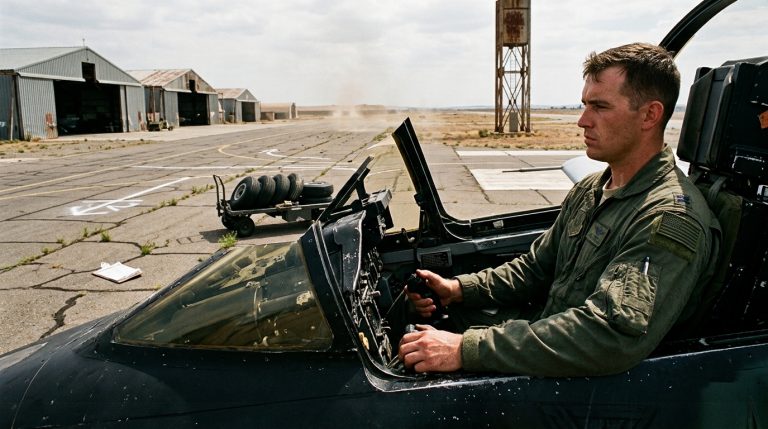
The heat did not arrive with the sun; it sat in the belly of the staging vehicle overnight, thick and tasting of burnt copper. At 0600, the shadow of the canyon lip stretched across the dry earth like an iron wedge, cutting the motor pool into clean halves of blue grit and blinding glare.
Private First Class Sloan Mercer kept her thumb pressed against the clip of the metal clipboard. The aluminum was cold enough to stick to the skin of her palm, a sharp reminder of the desert’s residual chill before the sky turned white. She counted the fuel couplings on the rear distribution line, her touch deliberate, testing the seal of each brass valve for the microscopic play that signaled a failing gasket.
Across the steel bed, Sergeant First Class Dana Whitfield watched. Whitfield’s gaze had the heavy, unblinking weight of a pendulum—slow, regular, and entirely unburdened by curiosity. To Whitfield, a new transfer was simply an unmapped asset, a duffel bag with a temporary designation attached to the manifest.
“The delivery log says forty-two hundred gallons,” Whitfield said, her voice dry as the limestone dust coating her boots. “The gauge says forty-one hundred. Either the pump at the depot is shorting us, or someone’s got a leak they aren’t reporting.”
“The lines are dry, Sergeant,” Mercer replied. Her tone lacked the defensive clip of a junior soldier caught in an error; it was flat, a statement of verified physics. “The expansion coefficient changes two percent every ten degrees after dawn. The volume is there. It’s just dense.”
Whitfield’s eyes narrowed slightly, tracing the silhouette of Mercer’s posture. Sloan didn’t shift her weight. She stood with her heels locked into the steel tread, her hands holding the clipboard exactly six inches from her chest—the standard rest position of an individual who spent years training the nervous twitching out of her musculature.
A shadow broke the light between the transport trucks. Major Patricia Forsythe arrived without the standard clatter of trailing staff. Her combat shirt was crisp, the four deployments marked by the fading green thread of her shoulder tabs, her eyes fixed on the digital overlay of Route Seven before she even reached the perimeter of the table. She didn’t look at Mercer. In the military hierarchy of the motor pool, a private handling fuel inventory was part of the landscape, no more significant than a replacement tire or a crate of dry rations.
“We move at zero-eight-forty-five,” Forsythe said, her finger tapping the canyon bottleneck marked on the display. “Intel says the high ground is clear, but the floor is narrow. I want the heavy trucks buffered. Whitfield, put the transfer in the second support vehicle. If she can handle a grease gun, she can watch the rear quarter.”
“Understood, Major,” Whitfield said.
Mercer didn’t look up from the clipboard. Her pencil made a small, precise checkmark next to the serial number of the primary manifold. Beneath her fingers, inside the pocket of her cargo trousers, the small canvas notebook pressed against her thigh—a reminder of four specific ledge coordinates she had memorized from historical satellite passes two nights prior.
She reached up to clear the primary filter screen on the delivery line, her hand disappearing into the dark recess behind the storage tank. Her fingers brushed against the drainage petcock. It was locked, but something sat inside the narrow throat of the discharge pipe—something small, heavy, and completely disconnected from the standard debris of a field depot.
She pulled it free. It was a single, unspent cartridge casing, pristine and lacking the carbon scoring of a weapon fired in training. Stamped into the base of the brass, visible only under the sharp edge of the morning light, was a five-digit logistics code that belonged exclusively to the Tier 1 distribution network at Command. The fuel lines hadn’t been filled at the regional depot. They had been sealed at the center.
CHAPTER 2: THE RECKONING OF THE BLUEPRINT
The weight of the unspent cartridge casing remained pinned against the skin of Sloan’s fingers, a cold, hard cylinder tucked deep within the fold of her glove. She didn’t slip it into her cargo pocket immediately. Instead, she let her hand drop naturally to her side, her index finger tracing the sharp, geometric border of the five-digit stamp. It wasn’t standard issue for a line unit on the perimeter of sector green. The precise, industrial indentation was too deep, the alloy too pure. It was a signature from the third floor of the logistical hub at Command—the kind of brass that only moved when operations required a completely untraceable trail.
Two meters away, Major Patricia Forsythe turned her back to the map table, her boots clicking against the gravel with a dry, rhythmic crunch that sounded like breaking bone. Her focus was entirely consumed by the digital display, her thumb resting on the housing of her radio as she waited for the final readiness reports from the forward scout teams.
“Whitfield,” Forsythe said, her voice dropping into the lower register reserved for immediate operational execution. “The satellite pass from zero-five-thirty is still showing clear along the lower shelf of kilometer fourteen. But the thermal signatures are sluggish. The limestone isn’t cooling down the way the meteorology report predicted. I want the auxiliary scanners checked before we clear the perimeter.”
Sergeant First Class Dana Whitfield adjusted her stance, her spine straightening with the practiced indifference of a veteran who had parsed commanders’ anxieties across three different continents. “The sensors on the lead vehicle were calibrated at midnight, Major. If there’s heat in the rock, it’s residual. The sun hits that eastern face earlier than the ledger indicates.”
“I don’t like discrepancies, Sergeant,” Forsythe replied, her eyes narrowing as she studied the screen. “Discrepancies are usually just administrative cover for someone else’s malice. Mercer, get the secondary diagnostics box from the storage bay. We aren’t moving an inch until I see the diagnostic line on the transceiver run green.”
Sloan moved before the command had fully settled in the air, her boots clearing the sharp edge of the staging vehicle’s steel bumper without a sound. Her internal focus remained entirely distinct from the physical task. As her hand slid into her pocket to deposit the brass casing, her thumb caught the edge of her small canvas notebook. The rough texture of the frayed binding triggered an immediate, involuntary sequence of visual data behind her eyes: the layout of the tactical operations room in Kabul eleven months ago, the high-back chairs, and the specific, left-leaning slant of the ink signature on the Black Frost contingency protocol. The logistics code on the bottom of the casing didn’t just align with Command; it matched the specific supply line allocated to the extraction team she had ordered into the hills without authorization.
The storage bay of the second transport truck was darker than the open motor pool, smelling of old canvas and hydraulic fluid that had begun to separate in the heat. Sloan reached into the steel crate beneath the bench, her fingers wrapping around the coarse handle of the diagnostics box. As she hauled the weight of the metal casing upward, she noticed a faint, regular scraping sound from the driver’s side wheel well—a rhythmic friction that didn’t belong to the vehicle’s standard suspension layout.
She lowered the box to the floorboards and knelt, her shoulder pressing against the cold iron of the frame. Through the narrow gap between the fuel tank and the inner body panel, she watched Specialist Brett Okafor. He was leaning against the front fender, his hands busy with a cleaning rag, but his eyes were fixed entirely on Major Forsythe’s map table. He wasn’t watching the commander out of respect; he was timing the intervals between her radio checks, his fingers tapping a small, distinct cadence against the side of his thigh every time the transceiver crackled.
Sloan remained motionless in the shadow of the storage bay, her breathing shallow, letting her senses register the tiny discrepancies in the motor pool’s environment. The layout was too perfect. The alignment of the six vehicles wasn’t designed for a rapid deployment through an open plain; they were stacked in a defensive wedge that anticipated a frontal constraint. Major Forsythe was preparing for a routine logistics run along Route Seven, but the physical configuration of the gear she had ordered onto the support trucks was tailored for an extended, isolated siege.
“Mercer,” Cutter’s voice cut through the dark of the bay, loud and devoid of rhythm, like a hammer hitting a dry plank. He stood at the edge of the tailgate, his blonde hair dusted with light grease, his frame blocking the glare of the morning sun. “The Major doesn’t pay by the hour for diagnostic checks. Bring the box out.”
“It’s here, Staff Sergeant,” Sloan said, lifting the heavy metal container and stepping into the light. She didn’t blink as the white heat hit her face. She passed the box to Cutter, ensuring her fingers didn’t brush against his glove.
Cutter hoisted the weight with a grunt, his eyes lingering on her face for a fraction of a second before he turned toward the front of the convoy. “You’re quiet today, Private. More than usual. Whitfield says you’ve got an eye for logistics, but I think you’re just looking for a spot where the sun doesn’t hit.”
“The sun hits everything eventually, Staff Sergeant,” Sloan said, her voice smooth, neutral, and empty of inflection.
She followed him back to the map table, her gaze tracking the physical distance between the vehicles. Every soldier was in position, their weapons held across their chests in the standard low-ready carry, but there was an underlying tension in the way their fingers rested near the safety selectors. They weren’t relaxed. They were waiting for a specific signal that hadn’t been written into the morning brief.
Major Forsythe looked up as the diagnostics box was placed on the table’s corner. Her expression remained fixed, a mask of rigid command authority that had spent years ignoring the personal histories of the people under her charge. She tapped the screen one final time, clearing the satellite overlay and replacing it with the stark, black lines of the canyon approach.
“The time is zero-eight-thirty,” Forsythe announced, her gaze sweeping across the small assembly of senior non-commissioned officers. “The diagnostics are green. We run standard combat intervals until we hit the mouth of the gap. If the radio stays clear, we keep our heads down and push through before the mid-day heat locks the valley floor. Move out.”
Sloan stepped back into the line, her hand returning to her cargo pocket, her fingers resting against the canvas notebook. The blueprint for Route Seven was locked, but the first inkling of an unmapped vector had already taken root in the dust.
CHAPTER 3: THE APPROACH TO KILOMETER ELEVEN
The vibration of the two-and-a-half-ton truck traveled straight up through the heels of Sloan’s combat boots, a relentless, mechanical chatter that rattled the heavy brass fittings inside the storage lockers behind her seat. The time was 0845. The motor pool had dissolved into a plume of fine alkali dust that hung in the stagnant air like a grey shroud, obscuring the jagged boundary walls of the staging depot as the trailing vehicle cleared the final checkpoint wire.
Sloan kept her body aligned with the hard angle of the passenger frame, her fingers lightly gripping the cold edge of the door panel. To her left, Specialist Brett Okafor held the wheel with a tight, unyielding grip, his knuckles a series of bloodless white knobs against the black rubber. His breathing was shallow, rhythmic, and perfectly synchronized with the digital hum of the primary tactical console between them.
“Route Seven is clear on the primary frequency,” Okafor said, his eyes tracing the gray strip of asphalt ahead without drifting toward the side mirrors. “The Major just logged our departure with the gateway team. Standard speed is forty miles per hour until we reach the lower shelf.”
“Keep the gap at fifteen percent, Brett,” Sloan said, her voice dropping beneath the roar of the diesel engine. “The rear axle on the lead truck is riding low. If she hits the grade at forty, the interval will compress before we clear the wide flats.”
Okafor’s eyes flickered toward the console, his thumb twitching against the steering wheel rim. He didn’t ask how she had calculated the weight shift of the command vehicle from thirty yards back; he simply let his foot lift slightly from the accelerator, allowing the distance between their bumper and Staff Sergeant Cutter’s support truck to expand by a measured five meters.
Outside the armored glass, the landscape began to lose its horizontal expanse. The flat, sun-bleached hardpan of the sector green perimeter was narrowing, pinched on either side by the gradual ascent of fractured dark volcanic rock. The shadows cast by the rising terrain were sharp, long, and perfectly blue against the red iron glare of the dirt.
Sloan reached down, her gloved fingers sliding into her cargo pocket to touch the corner of her notebook. She didn’t open it. The data didn’t require visualization; it was already engraved in the space behind her eyes. At kilometer eleven, the canyon approach changed its geometry, shifting from a thirty-degree slope into a sheer, vertical limestone face that eliminated all lateral visibility for twelve hundred meters. It was the first structural anomaly she had noted in the Command logistics manifest—a specific sector designated as an “open corridor” on Major Forsythe’s map, but marked as a high-density blind spot on the restricted satellite passes from eleven months ago.
The tactical net crackled with standard comms updates, the sound sharp and metallic inside the enclosed cabin. “Lead to all units, we are passing marker nine. Speeds are stable. Keep the column locked.”
Major Forsythe’s voice carried the precise, clipped cadence of someone who expected the universe to conform to her operational blueprint through sheer administrative discipline. Sloan watched the command vehicle’s shadow sweep across the low boulders on the right flank. The shadow was clean, but the dust kicked up by the tires was behaving strangely. Instead of settling behind the chassis, the white powder was drifting forward, caught in a subtle, thermal updraft that crawled along the face of the western wall.
The wind had shifted. It wasn’t the regional, high-altitude front predicted by the 0600 briefing; it was a low-level, topographical draft running south-southeast through the gut of the canyon approach. It was a detail most drivers would ignore, a minor variance in the cooling system’s efficiency, but to Sloan, it was a physical parameter that changed the acoustics of the entire route. Any sound generated along the upper ledges would be carried down the western stream bed, bypassing the standard line-of-sight sensors mounted on the lead vehicle’s roof.
She reached out, her index finger resting against the glass of the side mirror, adjusting the angle by two millimeters until the rear horizon came into sharp focus. The dust cloud from their own tires was a dense wall, but through the gaps in the gray haze, she tracked the distant, pale column of the Quick Reaction Force. They were thirty minutes out, exactly as planned, but their trajectory was too wide. They were tracking a path that assumed the main body would maintain continuous satellite link-up—an assumption that would disintegrate the moment the convoy crossed into the signal shadow of kilometer twelve.
“The radio has an underlying hum,” Okafor muttered, his hand lifting to adjust the squelch filter on the primary console. “It’s a ground loop. Probably a loose shield on the distribution line we checked this morning.”
“Leave it,” Sloan said. Her eyes remained fixed on the ridge line above them, where the dark stone began to curve inward like the ribs of an ancient hull. “The hum isn’t in the hardware, Brett. It’s the ambient signature of the repeater on the ridge. Someone’s adjusted the gain from the top down.”
Okafor didn’t answer. He turned the vehicle into the first true bend of the approach, the tires squealing against the hot asphalt as the canyon walls rose to fifteen meters on both sides, cutting off the last true glare of the eastern horizon and plunging the support truck into the cold, gray symmetry of the stone corridor.
CHAPTER 4: THE MIDPOINT SHIFT AT KILOMETER THIRTEEN
The transition was instantaneous. The moment the front bumper of the support truck crossed the invisible threshold into the vertical shadow of the upper rim, the ambient hum on the secondary console died. The background noise vanished, replaced by a flat, hiss-free vacuum that signaled the absolute boundaries of the canyon’s signal shadow.
Sloan didn’t alter her posture. Her eyes remained locked on the ridge line fifteen meters above, her gloved fingers resting against the door panel to absorb the subtle variations in the chassis’s pitch. Beside her, Specialist Brett Okafor’s left shoulder dropped, his weight leaning into the steering wheel as the truck rounded a sharp, narrow outcrop where the canyon floor compressed into two lanes of fractured rock.
“Comms are dead,” Okafor said, his finger striking the master reset switch on the tactical net twice. The screen cycled through its initialization loop, returning nothing but a flashing amber error code. “The repeater on the ridge isn’t responding. We’ve lost the trailing element’s beacon.”
“Keep the speed at twenty-eight,” Sloan said. Her voice was thin, sharp, and stripped of resonance. “Don’t touch the squelch. The Major is going to try a directional pulse on the tertiary line in exactly six seconds. When she does, the signal will leak from the eastern wall.”
On the console, a single green pixel flickered on the edge of the secondary tactical diagnostic array—not a voice signal, but a raw, data-heavy packet that bypassed the standardized encryption layers. It appeared for a fraction of a second, leaving behind a sharp sequence of alphanumeric strings that burned into the screen’s phosphors before fading into gray. It wasn’t an operational status report. It was an automated log file from the lead truck’s internal routing system, showing a direct, outgoing transmission timestamped precisely two hours before departure. The destination field contained the identical five-digit logistical code stamped into the brass cartridge hidden in her pocket.
The implication crystallized before Okafor could even notice the screen’s flicker. The deployment route hadn’t been cleared by routine administration; the exact coordinates of the column’s passage had been broad-casted from within Major Forsythe’s command element to a closed-loop terminal at Command.
“Mercer, look at the gauge,” Okafor muttered, his boot hovering over the brake pedal. “The fuel flow pressure is dipping on the secondary line. It’s dropping three psi every fifty meters.”
“It’s a manual override from the lead vehicle,” Sloan said, her gaze sweeping across the high ledges four hundred meters ahead. She identified the natural breaks in the limestone—four distinct, recessed shelves positioned eight meters below the lip, calculated to provide an uninterrupted crossfire angle across the narrowest stretch of the road surface. “They’re forcing a structural deceleration. They want the interval closed to ten meters before we clear the choke point.”
She reached out, her hand moving with a cold, deliberate economy as she gripped the handle of the secondary tactical transceiver. Her thumb pressed the manual override key on the tier 1 frequency, bypassing the local command block.
“Kestrel Actual, this is twenty-seven,” she said, her voice flat, matching the mechanical vibration of the dashboard. “We have an un-isolated anomaly on the primary line. The data stream has a duplicate signature.”
A sharp, distinct click echoed through the speaker—not the white noise of a failing connection, but the pressurized engagement of a high-grade military encryption system.
“Twenty-seven, this is Kestrel Actual,” the response came through, formal, measured, and stripped of the regional accents common to the field units. “We have your position verified at kilometer thirteen point four. Four hostile elements pre-placed at designated ledge positions. Confirm call sign for authorization.”
Sloan looked through the reinforced glass at the back of Major Forsythe’s command vehicle forty meters ahead. The Major’s brake lights flashed once, a sharp crimson warning that cut through the gray limestone gloom. The convoy was slowing to a crawl. The kill corridor was open.
“Iron Wolf,” Sloan said, her voice dropping into the silent space of the cabin. “Iron Wolf copies all. Activate contingency Black Frost.”
“Acknowledged, Iron Wolf,” the voice from Command returned instantly, the volume loud enough to cause Okafor’s head to snap around, his eyes widening as he caught the unfamiliar designation. “Kestrel Actual confirms command authority. Execute retrograde sequence now.”
The first shot hit four seconds later. It wasn’t a standard explosive mortar or a loud, high-caliber impact; it was a single, precise ranging round that drilled a clean, two-inch hole through the passenger-side quarter panel of the lead vehicle. The sound didn’t echo down the canyon floor; it was swallowed instantly by the wind corridor running south along the western stream bed, leaving only the sharp, metallic ring of impact to signal the beginning of the trap.
“Contact!” Okafor yelled, his arms locking as he slammed his foot against the brake. “Left wall! High ground!”
“Reverse,” Sloan commanded, her hand already moving to the door latch as she prepped her body for the kinetic transition. “Don’t look at the ridge, Brett. Put your heels into the floorboards and run the transmission back forty meters. The gap opens in seven seconds.”
CHAPTER 5: THE STREAM BED MANEUVER
The rear wheels of the support truck bit into the loose limestone gravel with a high-pitched, metallic shriek, throwing a plume of white dust against the undercarriage as Specialist Brett Okafor jammed the transmission into reverse. The forty-meter retrograde was violent, uncalculated by any manual in the convoy’s glove box, but precise down to the microsecond. Sloan kept her weight low, her left shoulder pinned against the passenger door frame until the vehicle slammed into the partial blind spot created by the western wall’s natural shelf.
The air inside the canyon floor did not settle. The rhythmic fire from the eastern ledge positions continued to skip across the empty asphalt where the support truck had sat three seconds prior, fracturing the asphalt into sharp, grey shards.
“Get your kit,” Sloan said, her hand reaching across the console to kill the auxiliary power to the secondary screen. The panel died, but the internal layout of the valley remained bright behind her eyes. “Cutter and Whitfield are already moving toward the entry point. The wind corridor is holding at nine-one-eight, but it won’t mask the resonance if you drag your heels.”
Okafor didn’t drop his hands from the wheel immediately. His chest rose and fell in short, jagged spikes, his eyes tracing the line of smoke rising from Major Forsythe’s lead vehicle forty meters ahead. “The Major hasn’t confirmed the tactical shifts on the primary net, Mercer. If we break formation on foot—”
“The formation is already gone, Brett,” Sloan interrupted, her voice entirely flat, a neutral calculation delivered through the gloom of the rock shadow. “Look at the angle of the ricochets off the lead bumper. They aren’t shooting from the rim. They’re eight meters down. If you stay in this cabin, you’re just a static silhouette waiting for the second-round grouping.”
She rolled through the passenger-side opening before his boots hit the floorboards, her knees absorbing the hard slap of the limestone dust as she dropped into the one-meter depression of the dry western stream bed. The air down here was cold, smelling of ancient mineral rot and the dry, chemical tang of unspent propellant filtering down from the upper ledges.
Staff Sergeant Raymond Cutter was already there, his bulky frame pressed flat against the crumbling gravel bank, his blonde hair plastered to his forehead by a film of gray grease. Beside him, Sergeant First Class Dana Whitfield held her rifle at a steep forty-five-degree angle, her thumb resting on the safety selector with the unblinking stillness of an automated turret.
“The wind is dragging the sound backward,” Cutter muttered, his teeth gritting as a pair of rounds cracked high above their heads, the acoustic report appearing to warp across to the eastern face of the canyon face. “It sounds like they’re firing from behind us.”
“It’s the topographical corridor,” Sloan said, sliding into the narrow gap between Cutter’s shoulder and the rock face. Her fingers reached into her cargo pocket, confirming the outline of the notebook before she pointed toward a jagged cluster of dark boulders one hundred and thirty meters north along the stream bed floor. “The thermal drift is pulling the noise along the limestone shelf. To the shooters on the eastern wall, your movement in this ditch will register as a signature twenty meters east of your actual coordinates. But you have exactly four minutes before they cycle through the primary ammunition drums.”
Whitfield turned her head slowly, her unblinking gaze fixing on the side of Sloan’s face. She didn’t ask how a private first class possessed the precise acoustic mapping of a sector that had been marked cold by Command intelligence. She simply checked the action on her weapon, her fingers feeling the clean, oily play of the bolt. “The secondary channel logged an internal data transfer before the loop dropped, Mercer. It was an outgoing routing code from the lead truck.”
“I know,” Sloan replied, her hand tightening around the strap of her tactical pack as she signaled the advance. “The coordinates were moved through a closed-loop terminal two hours before the morning brief. The ambush wasn’t a coincidence, Sergeant. It was an allocation.”
Cutter’s jaw worked, his eyes shifting from Whitfield to the boulder cluster ahead. “An allocation by who?”
“Someone who wanted the Iron Wolf designation on an open frequency,” Sloan said, her voice dropping beneath the sharp crack of a new firing sequence from the high ledge. “Move. Low crouch, single-file. If your boot strikes a loose plate, don’t halt to balance. Keep the forward momentum until you hit the cluster.”
They moved without further dialogue, their boots dragging through the dry silt with a rhythmic, scratching friction that was immediately swallowed by the low-level thermal draft. Sloan stayed in the middle of the line, her eyes scanning the upper edge of the western wall as they advanced meter by real-time meter.
As they cleared the seventy-meter mark, a sharp, localized spike on her portable receiver caught her attention—not a voice signal, but a high-frequency jamming profile that tracked the exact length of the stream bed. It was a localized block, designed to prevent any communication from escaping this specific ditch while leaving the main road nets operational. The setup was too neat. The decoy secret—the idea of a simple internal logistics leak to a local militia group—was beginning to buckle under the weight of the hardware deployed against them. The jamming layout wasn’t militia gear; it was a tactical denial network that carried the pristine signature of a Command-level black project.
Cutter reached the boulder cluster first, his shoulder hitting the limestone rock with a heavy, hollow thud. He peered through the narrow split between two vertical slabs, his rifle barrel sliding into the gap without scraping the stone.
“I’ve got the western ledge position two in sight,” Cutter whispered through his teeth, his thumb clicking the safety off. “Distance is one hundred and thirty yards. The silhouette is partial. He’s looking at the road surface, waiting for the vehicles to break cover.”
“One shot,” Sloan stated, her hand resting against the cold iron of the boulder’s base as she calculated the wind variance. “Simultaneous with Whitfield on position three. The moment those barrels drop, the eastern shooters will begin their pivot. That’s Major Forsythe’s thirty-second window to move the column.”
Whitfield brought her rifle up, her cheek locking onto the synthetic stock with absolute, frozen precision. The wind corridor howled through the rocks, a thin, whistling note that carried the scent of iron and burning rubber from the road behind them.
“On your mark, Iron Wolf,” Whitfield said quietly.
Sloan watched the dust pattern drift across the mouth of the stream bed, counting the seconds between the eastern reloads. “Three. Two. One. Mark.”
CHAPTER 6: THE MORTAR COUNTERBATTERY
The twin reports from Cutter and Whitfield’s weapons cracked through the limestone boulders like a single, fragmented piece of timber snapping under immense weight. On the high western ledge, the two silhouettes collapsed inward, their profiles dissolving into the jagged shadows of the rock face.
Sloan didn’t wait to see them settle. Her weight was already in motion, her combat boots driving back into the coarse gravel of the stream bed floor as the ambient air pressure shifted. “The thirty-second window is active,” she said, her voice sharp and cutting through the localized white noise of the jamming blanket. “Cutter, pick up the pace. The eastern team is already executing their traverse.”
Behind them on the canyon floor, Major Forsythe’s column erupted into mechanical life. The roar of accelerating diesel engines vibrated through the limestone floorboards of the ditch as the five remaining vehicles broke their stationary profiles, their tires tearing north across the asphalt at full combat speed. The eastern shooters recovered three seconds later—exactly at the midpoint of Sloan’s calculated window—their heavy suppression rounds striking the trailing truck’s tailgate as the vehicles cleared the northern bottleneck and broke into the blinding glare of the flat plain.
Sloan scrambled up the crumbling embankment of the stream bed, her hands gripping the razor-sharp edge of a protruding iron stone vein to haul her frame onto the open sand. The canyon mouth lay three hundred yards behind them, a dark, gaping wound in the earth that had temporarily stopped vomiting fire.
But the silence lasted only long enough for the dust to settle.
A high-frequency whistling tore through the upper atmosphere—not the flat, linear crack of small-arms fire, but the heavy, tumbling resonance of an incoming indirect trajectory. The impact occurred three hundred meters south of their newly formed holding position, a violent concussive shockwave that threw a tower of black dirt and white alkali powder forty feet into the air.
“Dispersal!” Major Forsythe’s voice shattered the open tactical frequency, returning with an unregulated, jagged panic that cut through the cabin speakers of the nearest support truck. “Spread north by vehicle! Do not cluster! That’s an active mortar registration!”
“The tube isn’t inside the canyon,” Sloan said, her hand dropping onto Specialist Okafor’s shoulder as he cleared the lip of the stream bed. Her eyes were fixed on the southeast horizon, where the white glare of the noon sun met the desaturated gray of the desert flats. She watched a thin, microscopic drift of dust rising six hundred meters out, moving against the natural flow of the low-level wind corridor. “It’s a secondary element trailing the convoy. They timed the canyon ambush to force the column into the consolidation zone.”
Cutter dropped to his knees beside the rear wheel well of the support truck, his face pale underneath the layer of limestone grease. “We’re completely exposed out here, Mercer. If they get the range on the trucks, they’ll turn the entire unit into scrap iron inside five minutes.”
“They won’t get the range,” Sloan stated calmly. She moved with a fast, unhurried precision toward the heavy weapons platform that had just arrived with the forward element of the Quick Reaction Force—a modified transport truck carrying a mounted Mark 19 automatic grenade launcher on its reinforced steel bed.
She reached the mounting ring in three strides, her gloved hands locking onto the cold iron handles of the receiver. She didn’t look at Captain Whitaker, the QRF commander who was shouting orders into a handheld unit ten feet away; her focus was entirely locked on the physical orientation of the weapon’s barrel.
“Sergeant Whitfield, on the mount,” Sloan ordered, her voice carrying an unyielding command authority that caused the veteran non-commissioned officer to move without questioning the rank on her collar. “The wind drift is pulling the detonation twenty meters west every four seconds. Our range calculation needs a continuous five-meter deflection to the left.”
Whitfield swung her frame into the gunner’s cradle, her boots locking into the anti-slip tread of the deck plate as her hands took the weight of the spade grips. “Give me the bearing, Iron Wolf.”
“Bearing one-four-eight,” Sloan said, her index finger pointing toward a low, jagged rock formation six hundred yards out on the edge of the desaturated flat. “Distance eight hundred meters. Suppress a fifty-meter spread. Don’t look for the tube; walk the high-explosive rounds directly across the base of that ridge line.”
A second mortar round hit sixty meters east, the concussive thump throwing a shower of sharp gravel against the side panels of the support vehicle. The shards stung Sloan’s cheek, drawing a thin line of dark crimson that she wiped away with the back of her glove without breaking her stare.
“Firing for effect,” Whitfield grunted.
The Mark 19 opened up with a heavy, rhythmic thump-thump-thump that shook the entire frame of the transport truck. The forty-millimeter grenades cut through the white glare of the desert floor, their concussive detonations walking across the southeastern ridge line with mechanical precision. Each impact threw up a uniform row of black smoke, chewing through the low brush and shattering the limestone boulders where the hidden mortar team had set their baseplate.
A third incoming round tumbled through the air, but the trajectory was wide and unstable, drifting high and to the west as the mortar crew’s aiming stakes were obliterated by the grenade spread. The fourth round never arrived. The silence that followed was heavy, total, and filled with the distinct smell of burning high explosives and pulverized iron ore.
Sloan let her hands slide off the mounting ring, her breathing remaining even as she watched the smoke column settle over the obliterated position. Across the sand, Major Forsythe stood beside her command vehicle, her radio handset still clutched in her hand, her eyes locked onto the private first class who had just rewritten her entire operational doctrine in twenty real-time minutes.
CHAPTER 7: THE ACCELERATED REVIEW
The smoke from the forty-millimeter explosions didn’t dissipate; it curdled in the freezing desert air, forming a low, grey ceiling that hung over the pulverized limestone of the southeastern ridge. Sloan let her fingers detach fully from the steel housing of the Mark 19 mount. The heat of the weapon’s barrel was already receding, radiating a faint, industrial tick as the alloy contracted in the sudden chill of the afternoon breeze.
Beside the rear tire, Staff Sergeant Cutter let out a long, ragged exhalation that left a white plume in the air. He didn’t look at the ridge line. He looked at his own hands, then up at Sloan, his eyes shifting as they re-mapped the corporate geometry of the unit. The private first class who had handled their fuel inventory was gone; in her place stood a cold, operational calculation that had executed a two-layer counter-battery under live fire without a single deviation in her pulse.
“Liaison vehicle crossing the outer perimeter marker,” Sergeant First Class Dana Whitfield reported. Her voice remained dry, but she had stepped out of the gunner’s cradle, her posture shifting into a formal, resting attention that she hadn’t given to Major Forsythe in four years.
A single, unmarked armored utility vehicle tore through the cooling sand from the north, its high-frequency antennas whipping violently against the sky before its carbon-ceramic brakes locked with a metallic hiss. The passenger door opened with a heavy, pressurized pop. A captain carrying the distinct, gold-stitched insignia of Command’s special activities branch stepped onto the gravel. His boots were immaculate, completely untouched by the gray limestone grease that coated everyone else in the sector.
Major Forsythe walked toward him, her hand still holding the radio receiver, though the screen had been permanently locked into an encrypted command protocol. She stopped three feet short of the liaison, her jaw working as she noticed the velvet-lined case tucked beneath his left arm.
“Captain Whitaker,” Forsythe said, her voice stiff, stripped of its habitual command volume. “The contact report was logged at fourteen-hundred. The secondary element has been neutralized. Casualties are limited to one non-critical through-and-through.”
Whitaker didn’t look at her manifest. He stepped past her shoulder, his eyes tracking across the spread formation of the vehicles until they locked onto Sloan. “The report was received, Major. But the parameters of the execution don’t match the authorization log of this infantry unit. The data burst that routed the retrograde sequence carried a Tier One signature.”
Sloan stepped down from the bed of the transport truck, her boots hitting the gravel with a clean, final crunch. She pulled the small canvas notebook from her cargo pocket, its frayed edges stiff with dry sweat and mineral dust. She didn’t offer an apology. She didn’t salute. She simply held the book open, exposing the final page where the internal data routing logs—the ones she had extracted from the secondary console—were laid out in precise, left-leaning pencil characters.
“The log files were leaked two hours before the morning brief, Captain,” Sloan said, her voice cutting through the silent gathering of the team. “The coordinates of Route Seven weren’t pulled by local militia scouts. They were pushed from a terminal on the third floor of the logistical hub at Command. The five-digit routing code matches the signature on my administrative reassignment paperwork from eleven months ago.”
Whitaker’s face didn’t register surprise. The corner of his mouth twitched, a tiny, professional adjustment that carried the cold intellect of the upper tiers. He opened the velvet case, revealing a pair of pristine, black-titanium major’s oak leaves.
“The system doesn’t clear people for being right, Major Mercer,” Whitaker said, using her true rank for the first time on an open frequency. His tone was direct, suspensive of all standard anti-expository protocols because the trap had already sprung. “The entire deployment through Sector Green was an engineered calculation. The third floor needed an undeniable operational baseline—a live-fire verification that your skill set hadn’t deteriorated during your administrative quarantine. They leaked the coordinates to ensure the Black Frost protocol would be activated by the only person authorized to run the board.”
Major Forsythe stood frozen, the wind pulling a strand of hair across her forehead as the structure of her battlefield collapsed into a corporate identity exercise. “You engineered an active kill corridor for an evaluation?”
“Nine lives were saved eleven months ago because Major Mercer bypassed an administrative boundary,” Whitaker replied, his voice entirely unburdened by empathy. “But those nine lives created a deficit in the operational budget of the special activities branch. Today’s data resolves that deficit. The documentation is sufficient. The review board has been accelerated, and the identity is cleared.”
Sloan looked down at the oak leaves in the case. The metal was dark, heavy, and completely devoid of light reflection. The decoy secret—the idea of an internal spy leaking data for profit—had dissolved, revealing the absolute reality of her reality: she had never been hidden; she had been preserved until the system required her specific, predatory logic to resolve a larger problem downstream.
She reached out, her fingers closing around the cold titanium of the rank insignia. She didn’t pin them to her collar. Instead, she dropped them into the main compartment of her tactical pack, right next to the pristine, unspent brass casing she had pulled from the fuel line at dawn.
“The liaison vehicle is prepped for immediate departure,” Whitaker said, stepping back toward the armored truck. “Your administrative transfer is active as of zero-six-hundred tomorrow. We’re done here.”
The denouement arrived with the speed of a desert night, the sun plunging behind the canyon wall and leaving the flats in a deep, purple frost. The kinetic energy of the morning had vanished, replaced by the slow, methodical labor of a unit prepping for a retrograde back to the main base.
Sloan sat on the bumper of the second support vehicle, a small wire brush in her hand as she worked the gray limestone grit out of the threads of a replacement fuel coupling. Her movements were slow, rhythmic, and entirely free of the tension that had governed her posture since dawn. She repaired the damaged valve with the focused patience of someone who had survived the calculation and accepted the cost of the vindication.
Whitfield appeared beside her, two metal cups of black coffee steaming in the freezing air. She didn’t say ‘sir.’ She didn’t mention the major’s leaves hidden inside the pack. She simply handed the cup over, her eyes tracing the clean line of the horizon where the smoke had finally disappeared.
“The trucks are loaded,” Whitfield said quietly, her voice matching the atmospheric peace of the cold desert floor. “Okafor’s got the transmission greased. It’s going to be a smooth run back.”
“Good,” Sloan said, taking a slow sip of the bitter liquid, feeling the warmth spread through the calloused skin of her fingers. She closed her canvas notebook, her thumb lingering on the frayed border one final time before she tucked it away. Her perimeter was her own again—intact, defined, and entirely ready for whatever room the third floor prepared for her next.