A Legacy of Silent Grace: The Unseen Marine Who Carried the Weight of Quiet Redemption
CHAPTER 1: THE VACANT SEAT
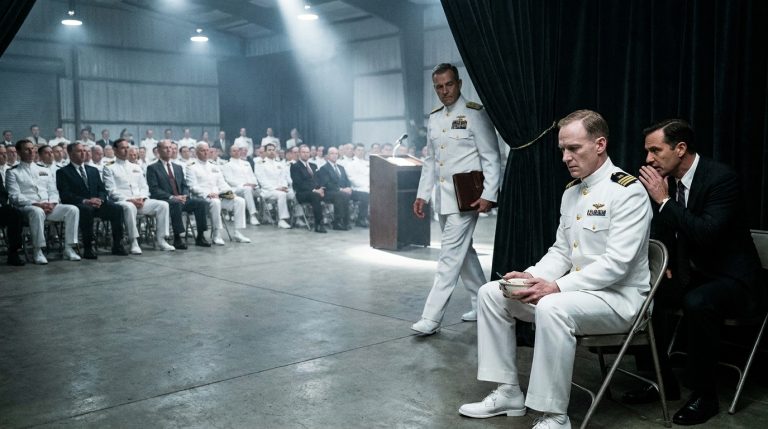
The air in the auditorium was thick with the scent of floor wax and the nervous, shifting energy of two hundred people dressed in their absolute best. It was November, but the California heat pressed against the glass, making the dress blues feel like wool blankets. At the center of it all stood Admiral Richard Bennett. He was a man composed of sharp angles and precise, controlled movements, yet he remained stubbornly anchored to the spot next to his reserved seat. He didn’t sit. He didn’t fidget. He simply stared at the double doors at the rear of the hall.
Commander Lisa Crawford, efficient and perpetually checked to her watch, hovered at his elbow. Her palms were damp. “Admiral, the schedule is firm. Captain Walsh is ready. We are ten minutes past the start time.”
Bennett didn’t turn. His eyes were fixed on the frame of the entrance, waiting for a ghost to manifest. “The room is not full, Commander.”
“Sir, every seat is occupied,” she insisted, her voice tight with the strain of holding back the whispers that were already beginning to ripple through the front rows. “We have people standing against the back wall.”
“Someone is missing,” Bennett said, the quiet authority in his voice cutting through the hum of the crowd.
On the stage, Captain Walsh leaned toward the chaplain, his expression shifting from confusion to mild panic. It was supposed to be his day. Twenty-eight years of service, the culmination of a career, and he was being upstaged by a man who refused to move.
“Who, sir?” Crawford asked, her tone edging toward desperation as the murmurs grew louder.
“Vincent Palmer,” Bennett replied.
Crawford blinked. She went through the motions of checking her tablet again, her fingers tapping rhythmically against the screen. “Sir, I’ve cross-referenced every guest, every dignitary, every family member. There is no Vincent Palmer on the registry.”
Bennett finally turned to look at her. The light from the overheads caught the silver in his hair, highlighting the deep, weary lines around his eyes. “Then the registry is wrong, Commander. Find him. He works in the cafeteria. He’s likely still there.”
A ripple of disbelief passed through the rows. An admiral, the most powerful presence in the room, was holding a retirement ceremony hostage for someone whose name tag read Vince.
Lieutenant Amy Chen was already moving toward the doors, her footsteps echoing sharply in the cavernous, unnatural silence. The Admiral ignored the mounting tension, the confused glances of the officers, and the shifting of the crowd. He wasn’t playing a game of power. He was waiting for a man who had long ago decided that being forgotten was the only way to find peace.
Near the back, a heavy steel door creaked open, admitting a slice of bright, harsh light into the dimmed auditorium. Chen slipped back in, her face flushed, and whispered to Crawford. The Commander’s face went pale. She approached Bennett, her voice barely a breath. “He’s coming, sir. But he’s… he’s still in his uniform.”
Bennett’s expression didn’t soften, but the tension in his shoulders finally eased. He stood a little taller, his hand resting almost absently on the back of the empty chair. A few moments later, the door pushed open again, and a man shuffled into the room. He was thin, weathered by decades of unforgiving sun, wearing a faded navy-blue shirt and a white apron that carried the faint, indelible stains of a thousand cafeteria meals. He stopped dead, his eyes darting toward the sea of medals and pressed fabric. His plastic name tag, crooked and scratched, caught the light: Vince. He looked like a man who had walked into the wrong room, and for the first time in his life, the Admiral stepped forward to ensure he knew exactly where he belonged.
CHAPTER 2: THE KITCHEN OF SHADOWS
The silence in the cafeteria kitchen was not the empty, peaceful quiet Vincent had curated for fifteen years. It was a pressurized, vibrating sort of stillness, the kind that preceded a storm. He stood with his back to the stainless-steel prep table, his knuckles white against the edge of the worn laminate. In his right hand, he still clutched the plastic gloves he had been peeling off when the call came.
“Gunny?”
The voice belonged to Lieutenant Amy Chen. She stood near the heavy swinging door that separated the sanctuary of the back-of-house from the chaotic glare of the dining hall. She looked less like a junior officer and more like someone who had just witnessed a ghost. She was shifting her weight from foot to foot, her eyes darting between the mop bucket in the corner and Vincent’s face.
“The Admiral is waiting, Mr. Palmer,” she said, her voice softer than it had been when she’d first barked for him to come out. She was trying to bridge the gap between the man she saw—the elderly worker in the faded apron—and the title the three-star Admiral had pinned to him.
Vincent felt the cold bite of the linoleum through his thin work shoes. He didn’t want to go back out there. Out there, the air was too thin; it was filled with the oxygen of recognition, and he wasn’t sure he could breathe it without burning up. He looked down at his apron. A smear of tomato sauce, dark and stubborn, stained the fabric near his hip. It was a badge of his current life, a mark of the mundane, and he felt a desperate, irrational urge to scrub it away before he faced the man who had once called him Gunny.
“There’s a mistake, Lieutenant,” Vincent said. His voice was a rasp, unused to projecting across a room. “I’m just here to finish the lunch rush. The trays—the lunch rush isn’t over yet.”
“Sir,” Chen said, stepping a few inches closer, though she maintained a respectful distance, as if afraid that getting too close might break the fragile reality of the moment. “The Admiral said you were the reason he’s standing there. He isn’t going to start until you’re at his side.”
The irony tasted like copper in his mouth. For years, he had operated under the radar, finding a meditative, numbing solace in the repetitive motion of wiping tables and stacking trays. He had become part of the background, a fixture as unremarkable as the salt shakers. He had built his world out of faded textures—the smooth, slightly tacky surface of a serving tray, the smell of industrial lemon cleaner, the dim, quiet corners of the storage room. Now, the past was reaching through the door, shattering the quiet.
A sudden, sharp crash echoed from the dish pit—a stack of plastic plates losing their balance and clattering onto the concrete floor. The sound was violent, an intrusion of chaos into his sanctuary. Vincent flinched, the muscle memory firing in his shoulders. He didn’t look back at the mess; he didn’t care about the plates. He only cared about the exit.
“He shouldn’t have done that,” Vincent muttered, more to himself than to the young officer. He wasn’t talking about the Admiral’s command; he was talking about the invitation back into the light. “I am not that man anymore. That man retired a long time ago.”
“The Admiral seems to think you never really left,” Chen replied gently. She didn’t press him; she just stood there, a bridge between two worlds.
Vincent took a slow, agonizing breath. He looked at the plastic gloves in his hand and dropped them into the trash bin. The motion was small, almost insignificant, but it felt like the final severing of a lifeline. He straightened his shoulders, pulling himself up from the habitual hunch of a worker who had spent years looking down at trays. The ache in his spine, a companion of his age, suddenly seemed less like a burden and more like a testament to the time he had put in.
He moved toward the door, his steps heavy and measured. He wasn’t walking like a soldier; he was walking like a man who had been found. He pushed open the swinging door. The transition was immediate and blinding. The cool, damp air of the kitchen was replaced by the stale, warm atmosphere of the auditorium. The hum of two hundred voices stopped the moment he stepped into the light.
Every eye was a weight. He felt the gaze of the young sailors he’d fed, the officers who had looked through him as if he were made of glass, and, at the front of the room, the piercing, steady gaze of Admiral Richard Bennett. Bennett was still standing at attention, his posture a mirror of the discipline Vincent had spent decades trying to forget.
Vincent froze, his heart hammering against his ribs like a trapped bird. He searched the Admiral’s face for some sign of the young lieutenant he had pulled from the mud in Da Nang, but all he saw was the heavy, polished exterior of a commander.
“Gunny,” Bennett said, the name landing in the room like a physical weight.
Vincent felt the urge to turn and walk back into the kitchen, to hide in the safety of the steam and the noise, but he knew he couldn’t. The door behind him was already closing. He stepped onto the carpeted floor, the texture beneath his feet suddenly soft, alien, and terribly exposed. He realized then that there was no going back; the invisible man had been stripped of his disguise, and the silence waiting for him was absolute.
CHAPTER 3: THE WEIGHT OF THE SALUTE
The distance between the kitchen door and the front row was only forty feet, but to Vincent, it felt like an exposed run across a fire-swept LZ. The carpet beneath his feet, thick and industrial-grade, seemed to grab at his soles, slowing him down. The auditorium air, recycled and overly chilled, clung to his clothes, smelling of high-polish brass and the stale, nervous sweat of two hundred people who didn’t know whether to stand or sit.
He walked with the hunched, careful cadence of a man who had spent fifteen years trying to minimize his own footprint, yet every movement he made felt magnified. He could hear his own heartbeat—a steady, rhythmic thrum in his ears that he hadn’t heard in years. It was a cadence he recognized: the rhythm of a man moving toward an objective he hadn’t requested.
Admiral Bennett remained a statue in the front row, his gaze tracking Vincent’s progress with the same intensity he might have applied to a tactical map. Behind him, the sea of dress uniforms rippled as attendees shifted, their faces a blurred mosaic of confusion and dawning realization. They were waiting for a resolution to the disruption, a reason for the admiral’s unprecedented behavior, but Vincent was only focused on the singular, terrifying prospect of closing the gap.
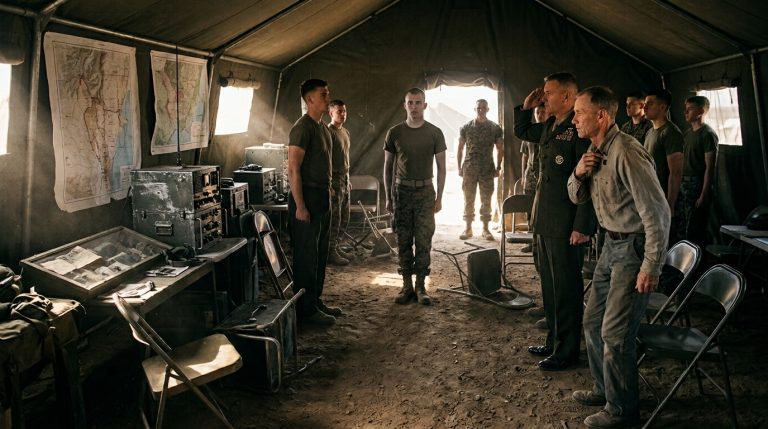
As he reached the front row, the Admiral didn’t wait. Bennett snapped into a salute, his hand moving with a crisp, fluid grace that betrayed none of the fatigue of his age. It was a perfect, regulation-tight salute, the kind that held an entire philosophy of respect within its geometry.
Vincent’s reaction was autonomic. Before his mind could filter the social awkwardness of his stained apron, his arm had already snapped up, fingers flat, elbow locked. It wasn’t the fluid, practiced movement of an active officer; it was a ghost of his former self—a bit rusty, a bit stiff, but fundamentally, unmistakably correct.
The sound of his knuckles clicking as he straightened his hand was loud in the silence.
For a heartbeat, the two men held the pose. The auditorium seemed to lean in, caught in the friction between the three-star Admiral and the man who, only minutes ago, had been pulling plastic gloves from his pockets to clean a spill.
“Master Gunnery Sergeant Vincent Palmer,” Bennett said. His voice was not loud, but it possessed a terrifying clarity, carrying to the very back of the hall. “United States Marine Corps, retired.”
The title hung in the air, transforming the room. The murmurs died instantly, replaced by a profound, suffocating quiet. Vincent felt a tremor in his hand, a vibration he couldn’t suppress, and he dropped his salute, letting his arm fall to his side as if it were suddenly made of lead.
“Sir, there’s… there’s been a mistake,” Vincent whispered. He felt exposed, the white apron a pathetic, flimsy shroud against the weight of his own history. “I’m just the cafeteria lead. I don’t—I don’t belong in this row.”
Bennett didn’t drop his stance. He reached out, his hand closing around Vincent’s forearm. The grip was firm, calloused, and undeniable. “I think you’ve spent enough time in the shadows, Gunny.”
Bennett turned, his hand still on Vincent’s arm, and addressed the room. “Most of you have walked past this man every day for fifteen years. You looked at the apron, the name tag, the service. You saw a worker. You never saw the Marine.”
Vincent looked down at his own feet, trapped in the orbit of the Admiral’s presence. He saw the polished tips of Bennett’s shoes, the immaculate crease of the trousers, and compared them to his own heavy, work-worn boots. He felt the phantom weight of a rifle, the phantom ache of a shattered collarbone, and the phantom ghost of the man he had been in 1969. The auditorium around him began to warp, the fluorescent lights losing their edge and becoming the blinding, unfiltered glare of a sun-drenched Vietnamese hillside. The smell of floor wax faded, replaced by the acrid, metallic tang of burning jungle.
He was losing his grip on the present. The cafeteria, the routine, the quiet—it was all slipping away, replaced by the relentless, crushing reality of his service. He looked up at Bennett, his jaw tight, his breath hitching. He wasn’t a cafeteria worker anymore. He was a Gunny, and he was surrounded by Marines, and he was being called to account.
“Sit, Vincent,” Bennett commanded, his voice softening just enough to imply that this wasn’t a request, but a tactical necessity.
Vincent sank into the reserved seat. The fabric of the chair was soft, an insulting luxury compared to the harsh, unforgiving surfaces he had occupied for the last decade and a half. As he sat, he felt the heavy, collective gaze of two hundred people resting on his shoulders. He didn’t look at them. He kept his eyes fixed forward, his hands clasped firmly on his knees, his spine rigid. He was in the front row now, and for the first time since the war ended, he realized that he could no longer hide. The mission had changed, and he was suddenly, violently, back on the front line.
CHAPTER 4: THE FRAGMENTS OF MEDALS
The chair felt too large, or perhaps Vincent felt too small, his posture betraying the decades of slouching over trays. He kept his spine locked in the rigid, uncompromising posture of a Marine, but his hands—gnarled, sun-spotted, and still carrying the faint, ingrained residue of kitchen work—looked out of place against the polished wooden armrests.
Admiral Bennett didn’t move. He sat with his hands folded in his lap, looking straight ahead, but Vincent could feel the man’s focus, a concentrated intensity that had followed him from the theater of 1969 to this San Diego auditorium.
Vincent’s gaze flickered to Bennett’s chest. The dress whites were immaculate, the rows of ribbons sharp and precise. His eyes landed on the third row of decorations. There was a gap where a specific silver-and-blue ribbon should have been—the one commemorating a specific joint operation they had conducted before the ambush in Da Nang. Vincent remembered that day clearly; he had been the one to pin it on a nineteen-year-old Bennett, whose hands had been shaking so violently he couldn’t hold the pin straight.
It was a physical discrepancy, a missing piece in the tapestry of the Admiral’s history. Vincent’s breath hitched. Why would he leave it off? Was it a choice to strip away the past, or had he simply forgotten the specific cost of that day? Vincent’s own fingers twitched toward his own chest, toward the invisible weight of the memories he carried, memories that had no physical manifestation in this room.
“You’re looking at the ribbons,” Bennett said, his voice barely a murmur, directed forward. He hadn’t turned his head.
“I was,” Vincent admitted, his voice rough.
“I don’t wear them all,” Bennett said. “Some of them feel too heavy, even now. Like they’re pulling the fabric down.”
Vincent didn’t respond. He focused instead on the stage, where Captain Walsh was finally clearing his throat, the sound magnified by the auditorium’s acoustics. The ceremony was resuming, but the atmosphere had been irrevocably altered. The focus of the room had shifted. The 200 attendees weren’t looking at Walsh; they were looking at the front row, at the man in the apron sitting beside the Admiral.
“This is the part that never changes, isn’t it?” Bennett whispered, barely audible. “The speeches. The formality. The pretense that we can just walk away when the work is done.”
Vincent looked at the Admiral’s profile—the silver hair, the sharp, authoritative line of his jaw. He saw not the man of power, but the scared, naive boy he had once hauled out of a trench. The irony was suffocating. He had spent fifteen years in a cafeteria, serving mashed potatoes and wiping tables, believing he was moving away from the chaos, away from the life of a leader. He had convinced himself that invisibility was his final mission. But here he was, at the very center of the hierarchy he had abandoned, realized that his invisibility had been a failure of his own perception.
He had wanted to be forgotten because he thought that was the only way to heal, but watching Bennett, he realized that he had just left a vacuum. By fading away, he hadn’t escaped the pain; he had simply left the younger men to navigate it without a compass.
“I didn’t mean to abandon you, Rick,” Vincent said, the words slipping out before he could catch them.
Bennett finally turned. His eyes were hard, but there was a flicker of something raw beneath the surface—a grief he had clearly carried for five decades. “You didn’t abandon me, Gunny. You abandoned yourself. You let the hero die in the mud so you could play at being a ghost.”
The accusation hit Vincent harder than any impact he had experienced in the field. He stared at the stage, where Captain Walsh was now speaking about the importance of family, but the words were static in Vincent’s ears. He felt the weight of the apron against his legs, the coarse fabric now feeling like a costume, a mask he had worn for too long. He had thought he was serving, feeding the troops, maintaining the routine—and he had been—but he had been doing it with a closed heart, holding himself apart, refusing to be known.
His own hands, resting on the chair, looked foreign to him. They were the hands of a man who had chosen survival, but they were also the hands of a man who had chosen to stop living.
“I needed peace,” Vincent replied, his voice barely above a whisper.
“Peace is not the absence of the past,” Bennett countered. “Peace is the ability to stand in the light of it without being consumed.”
Walsh began to conclude his speech, his voice rising in cadence as he moved toward the closing remarks. The air in the auditorium seemed to thicken, the tension rising as the inevitable moment of interaction approached. Vincent knew what was coming. He knew he would have to stand, to acknowledge the room, to step fully into the identity he had spent fifteen years burying.
He closed his eyes for a split second, trying to recapture the smell of the kitchen, the safety of the grease and the steam, but it was gone. In its place was the smell of brass, the scent of the sea, and the overwhelming, terrifying truth that he was still the man who had pulled a lieutenant out of the line of fire. The transformation was happening, a slow, painful shedding of the ghost he had become. He was not a cafeteria worker anymore; he was a Marine, and the final piece of his service was just beginning.
CHAPTER 5: THE PLATFORM OF SHADOWS
The applause for Captain Walsh’s speech hadn’t even peaked when the shift occurred. It didn’t ripple smoothly; it fractured. Vincent felt the transition in the small of his back before he mentally processed it. His knees, stiff from fifteen years of standing on unyielding kitchen tiles, gave a dull, grinding protest as he pushed himself up from the cushion. Beside him, Admiral Bennett didn’t offer a hand or a supportive nod; he simply stood up in unison, a silent flank guard ensuring that the path forward remained straight.
Vincent’s boots made a distinct, unpolished thud against the carpeted runner leading to the stage steps. Every eye in the auditorium was a physical pinprick against the white fabric of his cafeteria apron. He could see the small, individual frayed threads along the hem of his left sleeve where it had scraped against the industrial dishwasher rack earlier that morning. It was an ordinary detail, a small comfort of the mundane, but it was being systematically crushed by the overwhelming presence of the two hundred dress uniforms tracking his ascent.
He reached the first step. The wood beneath the thin carpet was old, built to handle decades of base changeovers, and it groaned slightly under his weight. With each vertical inch he gained, the glare of the overhead stage lights intensified, casting long, desaturated shadows behind him. Captain Walsh stood at the center podium, holding a brass-plated plaque that caught the light with a blinding, metallic flash. Beside him stood the base chaplain, whose expression had frozen into a mask of professional neutrality.
“Gunny,” Walsh said as Vincent stepped onto the elevated plywood platform. The Captain didn’t offer a polite handshake; he stepped back from the microphone, ceding the center of the stage with a deliberate, transactional efficiency. He was executing an order, but his eyes carried the sharp, inquisitive curiosity of a man trying to read an encrypted transmission.
Vincent stood between the two officers. The distance between them was less than three feet, yet the psychological gulf was vast. He felt the coarse texture of his work shirt rubbing against the sensitive skin of his neck, a sharp contrast to the soft, high-thread-count collars worn by the men on either side of him. The microphone at the podium hummed with a low-frequency vibration that rattled through his teeth if he leaned too close.
Bennett stepped up to the second microphone, his movements fluid and unhurried. He didn’t look at the audience; he looked directly at the script of the retirement program resting on the small wooden shelf before him, then closed it with a deliberate, soft click.
“The records from 1969 show an ambush six miles north of Da Nang,” Bennett began, his voice dropping into a register that was entirely devoid of ceremony. It was the tone of a briefing room, cold and absolute. “The platoon leader was inexperienced. He ran the unit into a pocket. The tactical evaluation at the time blamed environmental factors, but that was a lie to protect the command structure.”
Vincent felt a cold sweat break across his shoulder blades, exactly where the old scar tissue from the round he had taken knotted up against his collarbone. He looked at the edge of the podium, noticing a small scratch in the varnish where someone had carved a tiny pair of initials years ago. He focused on that scratch, using it to anchor himself as the Admiral’s words began to dismantle the carefully constructed barrier he had spent a decade and a half reinforcing.
“The platoon leader didn’t just freeze,” Bennett continued, his hand resting flat against the wood of the stage. “He abandoned his weapon. He was three feet from an NVA trench line, and he was waiting to die. The man who broke that line wasn’t an officer. It was a platoon sergeant who had already served two tours and had nothing left to prove to anyone.”
The auditorium was so still that the rhythmic click of the building’s air conditioning system sounded like a distant hammer. Vincent’s jaw tightened until his molars ached. He didn’t want this story told. He had never told his daughter; he had never told the hiring manager at the base exchange who had processed his background check. He had wanted that hill to remain buried under fifty-four years of silence.
“He took the round through the left shoulder while securing the lieutenant’s retrieval,” Bennett’s voice echoed, carrying a sharp, rhythmic cadence that matched the heavy thrumming in Vincent’s ears. “He refused the medevac because the perimeter wasn’t secure. He carried three separate men to the evacuation zone while his own collarbone was in fragments. When the report was filed, he requested his name be omitted from the primary citation to avoid a standard review of the platoon leader’s competence.”
Vincent’s gaze shifted from the scratch on the podium to Bennett’s face. The Admiral wasn’t looking at the crowd; he was looking at Vincent, his eyes reflecting the harsh glare of the stage lights. There was no triumph in his expression, only a heavy, shared burden that had finally broken through the crust of their separate lives.
“The silver star was delivered in a canvas pouch three months later at a transit hospital,” Bennett said, his voice dropping an octave. “No ceremony. No dress uniforms. Just a clerk with a clipboard. And then Master Gunnery Sergeant Palmer disappeared into the system.”
The silence that followed was heavy, almost suffocating. Vincent felt the weight of the moment pressing down on his chest, making it hard to draw a full breath. He looked down at his apron, where the silver star pinned against the stained fabric seemed to burn through the layers of cloth. He was no longer invisible. The mask had been stripped away, leaving him exposed on the platform, and as the first hands in the audience began to come together in a tentative, rising cadence of applause, Vincent realized that the true escalation of his mission had just been initiated.
CHAPTER 6: THE RESONANCE OF REMEMBRANCE
The applause was not a tribute; it was an interrogation. Each rhythmic strike of palm against palm sounded, to Vincent’s ears, like the dry, staccato pop of an NVA rifle fire from the dense brush near Da Nang. He stood rigid between the Admiral and the Captain, his hands hanging stiffly at his sides, his eyes fixed on a singular, polished floorboard knot just inches from his left boot. He didn’t know how to receive this. He had spent his life giving—handing over food, handing over training, handing over his own quiet—and the act of receiving acknowledgment felt like a structural collapse of his entire identity.
Admiral Bennett’s hand descended onto Vincent’s shoulder. The pressure was firm, almost bruising, a grounding force in the center of the sonic storm. Bennett leaned in, his voice cutting through the auditory distortion. “Stay with me, Gunny. Don’t go back there. Look at them.”
Vincent forced his gaze upward. The auditorium had transformed into a gallery of expectant, hungry faces. Young sailors, barely out of boot camp, were standing with their hands clasped behind their backs, eyes wide and shimmering. Officers who had spent their entire careers reading about the era of Vincent’s service were looking at him as if he were a living, breathing map of their own lost ideals.
“I’m not a hero,” Vincent whispered, his voice caught in the dry, heated air of the stage.
“You don’t get to decide that,” Bennett said, his own voice tightening with the strain of his four-star gravity. “They need this. They need to see that service matters, even when it’s quiet. Even when it’s invisible.”
Vincent looked at the young corporal from the cafeteria, the one who had approached him earlier to apologize for not seeing him. The young man was currently standing near the aisle, his face set in a look of profound, quiet focus. The corporal wasn’t looking for a war story; he was looking for a reason to keep showing up, a reason to endure the long, thankless stretches of a career that often felt like a series of empty movements.
The sound of the applause began to fade, replaced by a strained, expectant silence. Captain Walsh stepped back to the microphone, his face flushed with the genuine humility of a man who had realized that his retirement was merely a small piece of a much larger, more enduring mosaic.
“Master Gunnery Sergeant Palmer,” Walsh said, his voice echoing in the rafters, “on behalf of the men and women of this command, thank you. For everything.”
Vincent felt the weight of the silver star against his chest. It was a cold, hard piece of metal against the thin, synthetic fabric of his work apron, and for the first time, it didn’t feel like an intrusion. It felt like a tether. He realized that for fifteen years, he had been walking a tightrope, trying to balance the man he had been with the man he had become, but he had been doing it with a blindfold. He had thought that by refusing to be seen, he was protecting the sanctity of his service, but he had actually been denying the very people he had spent his life trying to serve.
“I served,” Vincent said, his voice stronger now, carrying across the room without the help of the microphone. He looked at the corporal in the aisle, then at the Admiral. “I served because it was my life. I didn’t need the recognition, but I see now… that maybe you needed the reminder.”
The room exhaled. The tension that had held them all captive since the moment Bennett refused to sit broke into something softer, something more sustainable. People began to sit, the sound of fabric rustling against seats creating a wave of movement that surged from the front to the back of the auditorium.
As the ceremony concluded and the crowd began to filter out, Vincent found himself trapped in a new kind of duty. The line of people waiting to shake his hand was endless. It wasn’t the boisterous, chaotic rush of a victory parade; it was a slow, deliberate procession of soldiers, sailors, and civilians coming to acknowledge the simple fact of his existence.
He didn’t want to be here. The physical exhaustion was setting in, his back throbbing in time with the rhythmic shaking of hands, but he couldn’t leave. He watched as the Admiral stood by his side, not as a superior, but as a partner in this final, unforeseen phase of their shared history.
“You’re going to have to get used to this, Gunny,” Bennett murmured, watching a young officer approach with a look of desperate sincerity.
Vincent looked at the young man, his eyes tracking the fresh, unscarred uniform, the clean lines of a career that hadn’t yet been tested by the crucible of real conflict. He didn’t see a stranger. He saw the potential for greatness, the potential for quiet, enduring service.
“I don’t need to get used to it,” Vincent replied, taking the officer’s hand in a firm, calloused grip. “I just need to make sure I’m ready to answer the next time someone needs help.”
The realization settled in his chest, steady and warm. The sanctuary of the cafeteria had been a place of healing, but the front line was a place of purpose, and he was finally ready to accept the transition. He had been looking for a way to hide, but the truth was, he had never really been hidden. He had just been waiting for the right moment to be found, and as the last of the attendees finally trickled out of the hall, leaving him alone with the Admiral in the quiet, dust-moted air, Vincent felt the ghost of the man from 1969 finally find his footing in the present. The transition was complete, and the long, silent work of the last fifteen years was just the prelude to the final, necessary chapter.
CHAPTER 7: THE HARBOR OF TRUTH
The side exit of the auditorium opened directly onto the salt-heavy air of the Naval Base San Diego docks. The change in atmosphere was visceral. Where the auditorium had been filled with the stifling, manicured quiet of protocol, the docks were a cacophony of industrial labor—the distant groan of winches, the rhythmic slapping of dark water against concrete piers, and the sharp, piercing cry of gulls circling the gray, hulking shapes of warships moored at the edge of the Pacific.
Vincent walked behind the Admiral, his feet navigating the uneven surface of the pier. The transition from the carpeted stage to the gritty concrete felt like an awakening. He pulled his shoulders back, breathing in the scent of brine and diesel. It was a clean, honest smell.
“You didn’t answer the corporal,” Bennett said, not turning back, his eyes fixed on the horizon where a destroyer was slowly cutting through the harbor channel.
“I didn’t have the right answer then,” Vincent replied, his voice barely rising above the wind. “I still don’t think I do.”
“You don’t need a speech, Gunny. You need to see what you preserved.”
Bennett stopped at the edge of the pier. He looked down at the dark, swirling water, then gestured to the ships. They were massive, iron-sided, and utilitarian—the physical manifestation of the order Vincent had spent his life defending. Vincent leaned against the rusted railing. His hands, still stained with the lingering, faint traces of his cafeteria work, gripped the cold metal. It was rough, pitted with age and oxidation—a texture that matched the long, arduous span of his own life.
“I spent fifteen years feeding kids on this base,” Vincent said, his eyes tracing the lines of a cruiser. “I thought I was just doing a job. Serving meals, cleaning trays, staying out of the way. I convinced myself that was the extent of my impact.”
“You were wrong,” Bennett said softly. “Every tray you handed over was a reminder to them that there was someone in the background, someone who had been there, someone who still cared enough to show up. You were the backbone, Vincent. You just refused to look in the mirror.”
Vincent looked down at his own reflection in the dark, oily water below. For a second, he saw the man he had been in 1969—the Gunny with the iron-will, the sharp, unflinching gaze, the man who had been the foundation of a platoon’s survival. Then, the reflection rippled, and he saw the man he was now—gray-haired, weathered, and tired, but standing tall against the wind.
He realized then that the physical secret he had been keeping—his anonymity—wasn’t a shield. It was a wall he had built to keep himself from having to confront the fact that he was still a leader, and that leadership meant accepting the pain of the memories he had tried to scrub away.
“I was afraid,” Vincent admitted. The words felt heavy, and he had to push them out through the tightening in his throat. “I was afraid that if I admitted who I was, I would have to go back into the fire. I thought I had earned the right to be cold. To be dead to it all.”
Bennett turned to look at him, the wind whipping his silver hair across his forehead. “Nobody earns the right to stop caring, Vincent. That’s what I learned the hard way. I spent forty years climbing the ladder, worried about the next promotion, the next command, the next star. It took me three months of walking past a cafeteria line to realize that the only thing that ever mattered was the person holding the tray.”
Vincent reached into his apron pocket. He pulled out the plastic, slightly cracked name tag that read Vince. It was a flimsy, meaningless piece of plastic, but it felt like a lifetime of weight. He held it up to the wind, watching it catch the gray, filtered sunlight.
“I’m done with this,” Vincent said, his voice quiet.
He didn’t make a grand gesture. He didn’t throw it into the sea. He simply opened his hand and let the wind take it. He watched it flutter, a tiny, insignificant speck, before it vanished into the dark, churning water of the harbor.
The silence that followed was not the heavy, awkward silence of the auditorium. It was the silence of a gear finally slipping into place. The final piece of his service—the transition from the man who had tried to disappear to the man who was finally, fully present—was complete. He was not a cafeteria worker, and he was not just a relic of a war that had ended fifty-four years ago. He was a Gunny, and he was home.
“Report to the counseling center on Monday,” Bennett said, the order given with a respectful, steady gravity. “They have a lot of young Marines who need to know that their service doesn’t end when they hang up the uniform. They need a Gunny.”
Vincent nodded, his gaze returning to the horizon where the ship was disappearing into the open ocean. “I’ll be there, sir.”
He didn’t salute. He didn’t have to. The bond between them had moved past the rigid requirements of the military structure. It was something more profound, something that had survived the fire and the decades of silence. He turned away from the railing and began to walk back toward the base, his steps steady, his head high, and for the first time in fifteen years, he didn’t feel the need to look over his shoulder.
CHAPTER 8: THE LEGACY OF SERVICE
The walk back to the base counseling center was long, but for the first time in fifteen years, Vincent didn’t feel the need to rush. The grit of the dockside, the smell of diesel and salt, and the cold reality of the pier were slowly replaced by the familiar, quiet geography of the base. He passed the cafeteria—the building that had been his bunker, his sanctuary, and his cage. He didn’t look back at the entrance. He didn’t think about the trays, the steam, or the anonymity of the white apron. Those things belonged to the man he had been, a man who had tried to heal by erasing himself.
He reached the counseling center, a modest, brick-faced building nestled in a quiet corner of the base, shaded by old, wind-gnarled oaks. He pushed open the door. The air inside was different—it was still, cool, and carried the faint, dry scent of paper files and floor polish. A young clerk, a Petty Officer third class with bright, observant eyes, looked up from a desk piled high with intake forms.
“Mr. Palmer?” she asked, her voice filled with a respectful, professional curiosity. “Admiral Bennett called ahead. He said you’d be stopping by to take a look at the orientation materials.”
Vincent nodded. He didn’t reach for the plastic name tag he no longer possessed; he simply walked to the desk and laid his hands on the worn surface. “That’s right. I’m here to help.”
The clerk pushed a stack of files toward him—the stories of young veterans who had returned from places Vincent had only heard of on the news. He opened the first folder. The face looking back at him was young, the eyes reflecting a mixture of confusion and guarded resentment. Vincent didn’t see a stranger. He saw the lieutenant he had been in 1969, a boy who thought the world was a series of orders to be followed and enemies to be neutralized, a boy who had no idea how much of his own humanity he was going to lose in the process.
He sat in the chair, the wood solid and grounding. He didn’t just read the files; he internalized them, feeling the weight of each story, the shared burden of service that bridged the decades.
“They’re lost, aren’t they?” the clerk asked, her voice dropping into a register of genuine concern.
“They’re not lost,” Vincent corrected gently, his voice firm and resonant in the quiet room. “They’re just looking for the next objective. They’ve spent their lives being told what to do, where to go, and who to be. Now, they’re standing on the edge of a different kind of terrain, and they don’t know the layout.”
He took a pen from the desk and pulled a blank folder toward him. He didn’t write an objective or a plan. He wrote a name. He wrote the truth of his own experience, the reality he had kept hidden for too long. He realized then that his legacy wasn’t found in the medals he had buried in a box or the silence he had cultivated in the cafeteria. It was found in the connection, in the act of standing beside someone who was just beginning to understand that their service hadn’t ended; it had simply shifted.
Hours passed. The afternoon sun drifted across the floor, painting long, golden bars of light against the walls. Vincent worked through the folders, one by one, adding notes, framing questions, and mapping out a way forward for the people who would walk through those doors tomorrow. He was building a bridge, not with steel or tactics, but with the quiet, persistent evidence of his own survival.
When the clock on the wall struck five, signaling the end of the shift, the clerk stood and began to pack her things. “Are you going to be okay, Mr. Palmer? It’s a lot to take in.”
Vincent looked at the stack of folders, the names of the young men and women now sitting on his desk. He thought of Admiral Bennett, his son, and the fifty veterans who would be waiting for him at the reunion. He thought of the cafeteria, the years of quiet, and the final, necessary choice to step out of the shadows. He didn’t feel the weight of the past pressing down on him anymore. He felt the momentum of the present.
“I’m more than okay,” Vincent said, his voice steady, his posture straight. He reached for a small, damaged photograph of his platoon—the one he had kept in his locker for fifteen years—and placed it carefully on the corner of his new desk. The edges were fraying, the image blurred with time, but the faces were clear, a permanent record of the men he had carried with him.
“I have work to do,” he added.
He stood, walked to the window, and watched the base slowly wind down for the night. The lights of the ships in the harbor began to flicker on, one by one, a constellation of artificial stars anchored in the dark water. He was no longer invisible. He was a Gunny, a teacher, and a survivor, and for the first time in his life, he was exactly where he was supposed to be. The transition was complete, the silence had been broken, and the mission—the true, quiet mission of his life—was just beginning.