The Legacy of Steel: A Story of Quiet Wisdom and the Hands That Remember
CHAPTER 1: The Weight of the Armory
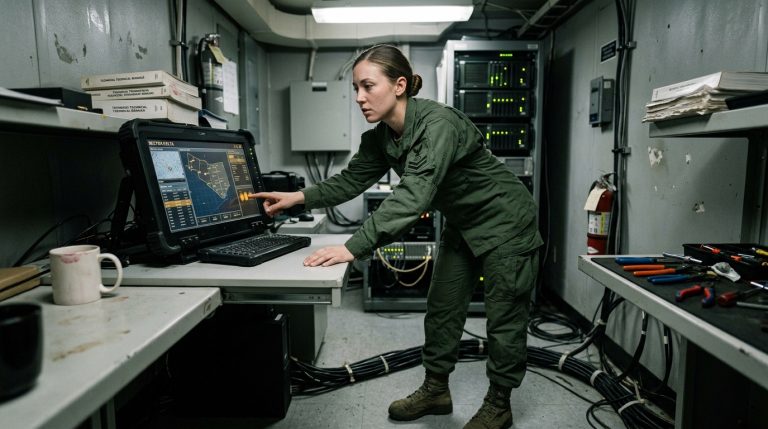
The armory smelled of CLP, that sharp, synthetic tang that usually signaled order. Today, however, it smelled like failure. Twenty-four rifles lay across the workbench, stripped and exposed like ribs in a morgue. The $47,000 diagnostic station hummed in the corner, a glowing monolith of glass and light that kept insisting, with cold, digital certainty, that there was nothing wrong.
Staff Sergeant Miller stared at the screen. The green light of the ‘PASS’ indicator was a mockery. He knew the rifles weren’t ready. The Marines would be shipping out in seventy-two hours, and their lives were pinned to these machines.
“Step aside, Sergeant.”
The voice was thin, like paper rubbing against stone. Miller didn’t have to turn around to know who it was. The cane had been tapping rhythmically against the concrete floor for the last ten minutes, an irritating cadence that cut through the low-frequency drone of the HVAC.
“Sir, I’ve got three days of diagnostic logs,” Miller started, his voice hardening as he turned. “We don’t need a walkthrough. We need a firmware update from the manufacturer.”
The old man—the visitor who had somehow cleared the security desk with nothing but a faded ID and a look that suggested he’d built the building—didn’t offer a rebuttal. He didn’t even look at the diagnostic station. He moved toward the nearest rifle, his movements slow, deliberate, and entirely devoid of the urgency Miller felt burning in his own chest.
He pulled a grease pencil from his pocket. It was a mundane object, a stub of wax and color, yet in the old man’s hand, it felt like an instrument of surgical precision. He leaned over the workbench, his shadow long and thin against the sterile light.
“The machine tells you what it sees, Sergeant,” the old man said, his eyes fixed on the metal. “But it doesn’t know how to listen to the steel.”
Miller watched, his patience fraying into something like exhaustion. The Staff Sergeant on duty was hovering in the background, looking between the veteran and the expensive, silent computer.
“Sir, that’s a legacy platform,” Miller argued, gesturing to the disassembled rifle. “It’s been fine for decades. The problem is the feed ramp integration with the new optics.”
The old man didn’t answer. He reached out, his fingers—spotted with age and mapped by a lifetime of labor—resting on the cold, blued steel. He didn’t look for a computer error code. He closed his eyes. For a moment, the bustling armory seemed to fall into an unnatural, heavy silence.
Then, the old man pressed the tip of the grease pencil into a recessed groove near the barrel lug. He circled it, his hand steady despite the tremors Miller had noticed earlier. He pulled back, leaving a smudge of vibrant, impossible red against the matte black finish.
“It’s not the optics,” the old man whispered, his eyes snapping open. “And it’s not the software. It’s the vibration, Sergeant. Every time the bolt cycles, it’s whispering a secret the computer is programmed to ignore.”
Miller moved closer, his breath catching. He looked at the red mark, then at the diagnostic screen. The machine was still green. But as he leaned in, he noticed something he had missed for three straight days: a microscopic shimmer of displaced metal right where the old man had marked the steel.
“How did you—” Miller started, but the old man was already moving to the next rifle.
“The system wasn’t designed to be perfect, Sergeant,” the old man muttered, his gaze shifting to the far wall where a faded portrait of a unit commander hung. “It was designed to be understood.”
Then, the old man turned, his expression suddenly grim. He reached into his coat and pulled out a small, bent spring that looked as if it had been salvaged from a scrap heap. He placed it on the table between them. It was the same component the diagnostic machine had marked as ‘Optimal’ less than an hour ago.
“You’re going to want to check the others,” he said, his voice dropping to a whisper. “But you’re not going to like what you find inside.”
CHAPTER 2: The Sound of the Pencil
Miller stayed frozen, his eyes tethered to the smear of red wax. In the silence of the armory, the hum of the electronic diagnostic station—previously a comforting, uniform white noise—now sounded discordant, a thin, frantic buzzing that grated against his nerves. He looked up, intending to demand an explanation, but the old man had already turned toward the second rifle, his movements a slow, rhythmic dance of arthritic precision.
“You said the system is programmed to ignore it,” Miller said, his voice sounding too loud in the confined space. He didn’t move away from the workbench. He couldn’t. The logic of his own training—the thousands of hours spent trusting green lights and binary confirmations—was curdling in his gut. “Explain that. If the diagnostic suite is integrated with the manufacturer’s schematics, how can it ignore a hardware failure?”
The old man didn’t look back. His cane clicked once against the concrete as he shifted his weight to inspect the firing pin assembly of the next rifle. “A system is only as honest as the people who feed it its definitions, Sergeant. If you define ‘optimal’ as ‘within a range that maintains contract compliance,’ then anything that doesn’t trigger a catastrophic failure becomes, by definition, ‘optimal’.”
He tapped the side of the rifle’s receiver with the tip of his cane. It was a soft sound, but in the sterile, hollow expanse of the armory, it rang out like a bell. “You’ve been trained to believe that if the screen is green, the truth is clear. But look at this spring.”
He gestured to the bent piece of metal he had placed on the table. It was pathetic, really—a small, twisted coil of steel that looked like a discard from a bin. Miller picked it up. Under the overhead fluorescent lights, the metal didn’t have the crisp, cold sheen of modern, laser-cut components. It looked seasoned. It looked tired.
“This came from the prototype series,” the old man said, his back still turned. “When we built these, we didn’t use software to tell us when a part was nearing fatigue. We used our ears. We used our hands. We felt the change in the cycle rate long before a machine could ever map it.”
Miller rolled the spring between his fingers. He felt the micro-fissures, the slight unevenness of the coil tension that the digital scanner had completely missed. A cold realization began to dawn on him: he hadn’t been an expert; he had been a clerk, recording the data the software allowed him to see. He looked at his own hands, then at the rows of rifles yet to be checked. There were twenty-three more, all of them ‘green-lit’ by a machine that was effectively lying to him.
“If the Marines take these into the field,” Miller said, his jaw tight, “and that fail-safe triggers, the cycle will jam. They won’t just have a malfunction; they’ll have a liability.”
The old man finally turned. His eyes were milky with age but startlingly sharp, catching the harsh reflection of the lights. “They won’t just have a liability, Sergeant. They’ll have a weapon that doesn’t know how to fire when it’s needed most. You wanted to know why the diagnostics fail? Because the manufacturer decided that the cost of recalling a fleet was higher than the cost of a few malfunctions in the field.”
Miller felt a surge of professional outrage, a heat that started in his chest and radiated outward. He took a step toward the old man, his grip tightening on the spring. “That’s criminal. I have the logs. I can document this. I can pull the remaining stock, run a manual override.”
“You can try,” the old man said, his voice devoid of encouragement, filled instead with a heavy, ancient pragmatism. “But be careful where you direct your anger. The system is designed to isolate the person who questions the data. It will label you ‘inefficient,’ ‘paranoid,’ or ‘unstable.’ You aren’t just fighting a machine, Sergeant. You are fighting the inertia of an entire institution that would rather be wrong with a computer than right with a man.”
Miller turned to look at the diagnostic station. The green lights were still there, blinking in a hypnotic, rhythmic pulse. He felt a sudden, sharp tremor in his own hand—not from fear, but from the sudden, terrifying instability of his own reality. If he was wrong about this, what else was he wrong about? He looked at the row of rifles, then back at the red mark on the first weapon.
“What do I do?” Miller asked, the question feeling like a surrender.
The old man stepped closer, his scent—a mix of stale tobacco, machine oil, and old paper—filling the space between them. He reached into his coat and produced another grease pencil, this one worn down to the nub. He placed it firmly into Miller’s palm.
“You stop looking at the screen,” the old man said. “And you start listening to the steel. The machine will tell you what it wants you to know. The metal will tell you the truth. But remember: once you start marking these, you’re no longer just an armorer. You’re a liability.”
Miller looked down at the pencil in his hand. It felt heavy, a solid, tangible weight in a world that had suddenly become far too ephemeral. He walked toward the next rifle, his footsteps sounding uneven on the concrete. He reached out, his hand hovering over the cold, matte-black receiver. He felt the weight of the moment, the knowledge that by touching it, he was walking away from the safety of the green lights and into a gray area he wasn’t sure he could survive.
He closed his eyes, just as the old man had, and placed his palm against the steel. He didn’t look at the screen. He waited, his senses straining, listening for the faint, impossible whisper of the metal beneath his skin.
CHAPTER 3: The Ghost in the Machine
The armory felt different under the weight of the old man’s words. It was no longer a place of predictable metrics and calibrated success, but a graveyard of forgotten intentions. Miller kept his hand pressed against the receiver of the second rifle. He didn’t look at the screen. He forced himself to be still, to ignore the instinctual pull toward the digital readout. Beneath his skin, the steel felt—at first—perfectly smooth. But as the seconds stretched into a minute, and the ambient hum of the armory faded into the background, he felt it: a minute, rhythmic vibration, a ghost of movement that shouldn’t have been there. It was a friction, a subtle stutter in the metal’s grain.
“You feel that, don’t you?” The old man’s voice was softer now, devoid of the earlier edge. He had moved to the workbench behind Miller, his cane resting against a stack of crates.
Miller didn’t answer. He couldn’t. He was too busy recalibrating every nerve ending in his hand. He pulled his palm away, feeling the cold air hit the spot where his skin had touched the metal. He grabbed a cleaning cloth and wiped the surface clean, watching the dull, matte finish reflect the sterile light.
“It’s a resonance,” Miller finally said, his voice husky. “It’s not a break, not yet. It’s a… a wear pattern.”
“A signature,” the old man corrected. He walked over to the workbench, his gait slow and deliberate. He picked up the spring from the first rifle—the one he had called the ‘optimal’ component—and held it up to the light. “The manufacturer will tell you that the material composition is consistent. They’ll show you the stress tests. But they won’t show you the heat cycles. They won’t tell you how these parts behave after six months of constant, high-frequency operation.”
Miller took the spring, feeling the weight of it. It was lighter than it should have been. Not by much, perhaps a fraction of a gram, but enough. Enough to suggest that the metal had been thinned, or perhaps it was a different alloy entirely. He looked at the diagnostic suite. The machine continued to hum, its green light blinking with a steady, indifferent pulse.
“If I report this,” Miller said, his eyes scanning the row of remaining rifles, “it’s a career-ender. Not just for me. For the whole department. We’ve certified these for deployment.”
“And if you don’t?” the old man asked. He was standing close enough that Miller could smell the faint scent of copper and old dust clinging to his coat. “What happens to the Marine who pulls that trigger in the dark? What happens when the silence isn’t an armory, but a battlefield?”
Miller didn’t have an answer. He walked to the storage locker where the remaining stock was kept. He needed to verify the pattern. He pulled out a third rifle, then a fourth. He didn’t bother with the diagnostic scan. He went straight to the receiver, placing his hand where the old man had marked the first one.
He found it again. A phantom vibration, a resonance that the digital sensors were calibrated to ignore. It was systematic. It wasn’t a defect; it was a baseline condition.
“It’s intentional,” Miller whispered, the realization hitting him like a physical blow. “They didn’t just miss this. They engineered it.”
The old man went still. He didn’t look surprised. He looked weary, a profound, soul-deep exhaustion that seemed to anchor him to the spot. “They built a system that relies on the operator being lazy. They counted on you to trust the screen more than your own senses. And for the most part, Sergeant, they were right.”
Miller grabbed a heavy-duty flashlight and pointed it into the chamber of the fourth rifle. He traced the lug, the bolt, the feed ramp. He looked for the tiny, microscopic markings that would indicate a manufacturer’s stamp or a serial batch. He found nothing. But then, as he tilted the light, he saw it: a tiny, almost invisible scratch, etched into the interior of the receiver. It wasn’t a flaw. It was a guide. A mark to ensure the spring was seated with a specific, unnatural tension.
He looked at the old man, his breath hitching. “You worked on this. You helped design the prototype.”
The old man stared at the rifles, his expression unreadable. “I helped build a tool, Sergeant. I never intended for them to turn it into a trap.”
Miller leaned against the workbench, his legs suddenly feeling weak. He looked at the row of rifles, then at the grease pencil lying on the table. The silence of the armory was no longer oppressive; it was instructive. Every click of the HVAC, every hum of the lights, felt like it was hiding the same, agonizing truth. He wasn’t just an armorer. He was the only person left who knew the machine was broken, and he had seventy-two hours to figure out how to stop it from failing without destroying his own life in the process.
He reached for the grease pencil, his hand steadying. The weight of the decision felt like iron, cold and unyielding. He looked at the old man. “How many more are there?”
The old man gestured to the remaining rows of equipment, the vast, silent collection of machinery that was supposed to keep people safe. “Enough to change the outcome of a war, Sergeant. Or to ensure a failure that no one will ever be able to account for.”
Miller looked down at the rifle in his hands. He felt the cold texture of the iron, the familiar weight, and for the first time, he didn’t see a tool of his trade. He saw a mirror. And he was terrified of what he was starting to see inside.
CHAPTER 4: A Lesson in Rust and Patience
The rhythmic strike of boot heels against concrete was the only sound that mattered now. Miller stood perfectly still in the dim, cramped confines of the secondary storage locker, his back pressed against the cold steel of a weapons rack. Beside him, the old man remained motionless, his breath shallow, a ghost in the machinery he had helped birth decades ago. Miller squeezed the grease pencil, the wax digging into his palm, a sharp, physical reminder of the truth he had uncovered—and the danger that now wrapped around him like a shroud.
The patrol was approaching the central armory door. Miller didn’t look at the entrance; he watched the old man. The veteran’s face was a map of faded textures, illuminated only by the faint, blueish glow of the security monitor that cast long, distorted shadows across his features. There was no fear in his eyes, only a weary resignation that Miller found far more unsettling than panic.
“They’re early,” the old man whispered, the words barely a vibration in the stagnant air. “The automated sweeps shouldn’t hit this sector for another ten minutes.”
Miller didn’t waste time questioning the change in schedule. His mind, sharpened by the urgency of the moment, shifted into a gear he hadn’t known he possessed. He looked at the four rifles he had already marked. If the patrol entered and saw the red grease-pencil smudges, he wouldn’t be able to explain them away. He would be flagged as a vandal, a saboteur, or worse—a man who had lost his grip on the professional standards he was tasked to uphold.
He reached out, his movements fluid and efficient, and dragged a heavy, dust-covered canvas tarp over the rifles, obscuring the evidence. The fabric felt rough, abrasive against his skin, smelling of old, trapped moisture and neglect. He retreated further into the shadows, pulling the old man with him behind a stack of shipping crates marked with the same manufacturer’s seal that now tasted like ash in Miller’s mouth.
The armory door hissed open, a sharp, pneumatic sound that cut through the silence. A shaft of harsh, white light sliced across the floor, illuminating the dust motes dancing in the air. Miller held his breath, his heart thudding against his ribs like a trapped bird. He watched the heavy boots of the patrol walk past the crates, the rhythm steady and, for now, uncaring.
“Check the diagnostic logs,” a voice echoed—the Staff Sergeant from earlier, his tone clipped, professional, and entirely unaware of the fracture in the world he was guarding.
“Logs are clean,” a second voice replied, followed by the rapid, familiar tap-tap-tap of keys on a terminal. “System shows all status indicators as optimal. Power consumption is within tolerance.”
Miller felt the old man shift beside him. The veteran’s fingers brushed against Miller’s arm, a fleeting, almost imperceptible contact. It wasn’t a gesture of comfort; it was a silent instruction to wait, to endure, to let the absurdity of the situation play out.
The wait was an eternity of micro-second decisions. Every muscle in Miller’s body coiled, ready to spring, to defend, to hide. He thought of the Marine who would eventually take one of these rifles into the field. He thought of the tiny, engineered imperfection that would turn a sophisticated piece of equipment into a liability. The cognitive dissonance was agonizing—a pull between his duty to the protocols he had sworn to uphold and the emerging, visceral duty to the men who would rely on these weapons.
“Wait,” the second voice said. The tapping stopped.
Miller’s grip on the grease pencil tightened. His eyes darted to the old man, but the veteran was staring at the floor, his face an impenetrable mask of weathered skin and shadow.
“System just logged a slight variance in the pressure regulation for rack four,” the voice continued. “Probably just a sensor ghost. I’m going to reset the cycle.”
“Do it,” the first voice replied. “We don’t want any discrepancies popping up before the final inspection tomorrow. The manufacturer is breathing down our necks about the warranty clauses.”
Miller felt the cold, creeping dread that came with the confirmation of his worst fears. They weren’t just ignoring the flaws; they were actively sanitizing the digital data to ensure the ‘optimal’ narrative remained intact. It was a closed loop, a self-correcting cycle of denial that rendered any standard diagnostic procedure useless.
The sound of the terminal being logged off followed, then the heavy tread of boots retreating toward the door. The pneumatic hiss signaled their departure, and the room plunged back into its oppressive, dimly lit silence. Miller didn’t move for a long minute, letting his heart rate descend from the threshold of panic back to a functional, cold determination.
He pushed the canvas tarp aside, the fabric sliding across the cold steel with a sound like a whisper. The red marks were still there, vibrant and accusing in the gloom. He looked at the old man, who was now leaning heavily on his cane, his eyes reflecting the dim emergency lights.
“They’re scrubbing the data,” Miller said, his voice a low, steady rumble. “Every time a discrepancy appears, they force a system reset. They’re literally training the software to lie to us.”
The old man nodded, a slow, deliberate movement. “And now you know, Sergeant. You aren’t just an observer anymore. You’re the one who has to break the cycle.”
Miller looked at the rifles, the weight of their purpose settling into his bones. He wasn’t going to look at the diagnostic screen ever again. He took the grease pencil, its surface slick with his own sweat, and moved to the next rack. He had to be faster, more precise, and far more invisible than he had ever been in his life. He began to work, his movements silent, calculated, and driven by a necessity that transcended any manual of arms he had ever memorized. He was the ghost now, moving through the machinery, etching the truth in red wax before the system could reset his efforts again.
CHAPTER 5: The Diagnostic Threshold
Miller stepped away from the final rifle, his hands coated in the thin, oily residue of the work. The armory was unnaturally still, the only sound the persistent, rhythmic hum of the diagnostic station that stood like a silent sentinel in the corner. He glanced at the old man, who was leaning heavily against the workbench, his breath hitching in his chest—a sound that echoed the strain Miller felt in his own lungs. The old man looked smaller, more fragile now, as if the act of guiding Miller through this mechanical autopsy had drained the last of his reserves.
“They’re coming back,” Miller whispered, his voice thin. He could hear it now, faint but unmistakable—the cadence of the security team returning. They were faster this time, their steps synchronized with an efficiency that felt predatory.
Miller turned his attention to the diagnostic station. He needed to lock the system, to force an error state that would override their automated cleanup protocols, but the interface was designed for users who trusted, not for those who interrogated. He pulled the cable from the terminal, the snap of the connection sounding like a gunshot in the confined space. The screen flickered, a transient, ghostly image of green lines dancing across the monitor before fading into a deep, static-filled black.
He felt a sudden, sharp intrusive memory: his own certification test, the pride he’d felt when he first successfully ran the diagnostic suite, the way the green light had seemed like a seal of professional competence. It felt like a lifetime ago. That pride was gone, replaced by a cold, hollow cynicism. He realized that the machine hadn’t just been checking the rifles; it had been certifying his own compliance.
“They’ll be here in seconds,” the old man said, his voice surprisingly firm. He reached out and tapped the terminal with his cane. “You don’t need to break the machine, Sergeant. You need to feed it the truth it isn’t prepared to handle.”
Miller frowned, his eyes scanning the interface. “What do you mean?”
“The protocol expects a ‘pass’ or a ‘fail’ based on the telemetry it’s looking for,” the old man explained, pointing to a small, hidden maintenance port beneath the console—a relic from the design stage that most modern technicians would never even think to check. “If you force it to read the resonance, the physical vibration of the steel, it won’t know how to categorize the data. It will force a hard diagnostic dump. A full stop.”
Miller understood. The machine was programmed for a digital reality, but if it were forced to process a physical anomaly, it would break under the weight of its own logic. He grabbed a data cable, stripping the end with his pocket knife, his fingers moving with a speed that surprised him. The metallic tang of ozone filled the air as he prepared to bridge the connection.
The door began to cycle, the pneumatic hiss signaling the end of his window. Miller worked with a frantic, focused precision, his heart thudding in his ears. He wasn’t just fixing a machine; he was dismantling a lie. He pushed the wires into the maintenance port, his hands steady despite the adrenaline surging through his veins.
The terminal screen shuddered. A line of text appeared, scrolling too fast to read, followed by a series of cascading alerts that turned the monitor from a soothing, stagnant green into a pulsating, urgent amber. The machine was struggling, the internal processors whining as they attempted to reconcile the physical data with the programmed constraints.
“They’re here,” the old man warned, his eyes fixed on the door as the tumblers began to turn.
Miller didn’t look up. He watched the screen. The amber pulses increased in frequency, a rapid, frantic heartbeat of error codes. He had done it. He had forced the machine to register the truth of the metal.
The door swung open, and the patrol burst in, their weapons raised, their movements sharp and instinctive. But they stopped short, caught by the sight of the diagnostic station, which was now emitting a high-pitched, piercing whine as the system began a full, forced diagnostic reset—a process that would lock the armory for hours and force a total audit of every single system protocol.
Miller stood amidst the chaos, his hands stained red and oily, his pulse slowing as he realized the weight of what he had done. He hadn’t just stopped the deployment; he had shattered the narrative. He looked at the patrol, then at the old man, who was watching the scene with a faint, almost imperceptible smile.
“I think,” Miller said, his voice surprisingly calm amidst the screech of the machine, “we’ve just run out of time.”
The patrol leader stepped forward, his eyes darting from the terminal to the rifles, his face a mask of confusion and growing alarm. Miller didn’t shrink away. He met the man’s gaze, the grease pencil still clutched in his hand like a weapon of clarity. He knew what would happen next—the questions, the investigations, the scrutiny—but for the first time, he felt the heavy, quiet satisfaction of a debt settled, not to the system, but to the steel.
CHAPTER 6: The Unfinished Map
The silence following the system’s collapse was heavy, absolute, and unforgiving. Miller stood amidst the frozen armory, the diagnostic station now nothing more than a dark, lifeless monolith. The security team had retreated to the periphery, their confusion evident as they stared at the blank screens, the sudden loss of their digital god leaving them adrift. The old man, meanwhile, remained standing by the workbench, his cane resting firmly against the concrete, his posture one of quiet, terminal completion.
“It’s done,” the old man said, his voice a gravelly rasp that seemed to carry the weight of decades.
Miller stepped away from the terminal, his hands still trembling slightly. He looked at the patrol leader, a young man who looked as though he had never faced a problem that couldn’t be solved by a software patch. The officer was tapping his comms-link, his face flushing with the irritation of someone whose tidy world had been inconveniently disrupted.
“Staff Sergeant, explain this,” the officer demanded, pointing at the dead terminal. “We have a shipment departing in hours. You’ve just locked down the entire inventory.”
Miller didn’t blink. He reached into his pocket and pulled out the grease pencil, holding it up like a piece of evidence. “The diagnostic suite was reporting ‘optimal’ conditions while the hardware was structurally compromised. I didn’t lock down the inventory. I prevented a catastrophe.”
The officer’s eyes widened, the realization beginning to sink in. He looked at the rack of rifles, then at the red markings that Miller had carefully placed. “You tampered with these.”
“I marked them,” Miller corrected, his voice steady. “I identified the fatigue patterns that your ‘optimal’ system was programmed to ignore. If you want to see the proof, don’t look at the screen. Look at the barrel lug of the first rifle in rack four. Use a magnifying glass, not a sensor.”
The tension in the room was palpable, a tight, vibrating string that threatened to snap. The officer hesitated, then gestured for one of his subordinates to check. The silence that followed was agonized, filled only by the distant, muffled sounds of the base. When the subordinate finally looked up, his expression was pale. “He’s right, sir. There’s a stress fracture. It’s… it’s microscopic, but it’s there.”
Miller watched as the reality of the situation took hold. The officer turned back to him, the initial anger replaced by a dawning, frantic concern for his own liability. He was starting to realize that the ‘optimal’ status he had been relying on was the very thing that would have dismantled his career.
Miller didn’t wait for the fallout. He turned to the old man, who was now carefully folding a thin, worn map of the armory’s original schematics—the true, physical blueprint he had carried in his pocket all these years. He handed the map to Miller. It was a relic, paper-thin and fragile, detailing the mechanical heart of the system that the digital age had forgotten.
“Why?” Miller asked, though he already knew.
The old man placed a steady hand on Miller’s shoulder. “Because someone has to remember how to listen to the steel, Sergeant. The world is getting very good at ignoring the things it can’t measure. When you lose the ability to feel the flaw, you lose the ability to protect the truth.”
The old man turned and walked toward the exit, his cane clicking against the floor in that same, irritatingly rhythmic cadence Miller had once despised. This time, however, the sound was a comfort, a reminder that some things were built to endure.
As the armory doors slid open, admitting the harsh, bright light of the corridor, the old man paused and looked back. “The map is yours now, Miller. Use it well.”
He was gone before Miller could respond. The officer was still staring at the rifles, already realizing he would have to report this, that the shipment would be delayed, that the contractors would have to be brought in and forced to answer for the design. Miller felt a strange, profound sense of peace. He walked over to the workbench, picked up his own cleaning kit, and began the work of properly maintaining the rifles, one by one.
He picked up a cloth, the texture familiar and grounding. He began to rub away the red grease-pencil marks, not because they were wrong, but because they were no longer needed. The work remained—tedious, physical, and essential. He felt the cold iron against his fingers, the weight of the rifle, and for the first time in his career, he felt the true gravity of his duty. The machine was silent, the screens were dark, but the steel—the steel remained. And he finally knew exactly how to care for it. He worked on, the quiet rhythm of his labor settling the room into a deep, atmospheric peace, the echoes of the past fading away to make room for the honest, tactile work of the present.