The Weight of the Iron Gavel: How a Retired Master Sergeant Dismantled a Suburban Tyrant Through Cold Precision
CHAPTER 1: THE SCARS ON THE LAWN
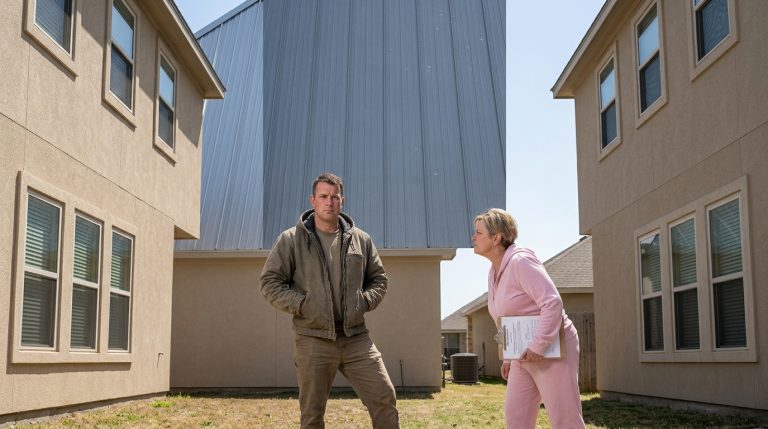
The phone was an extension of his hand, cool and dead against his ear, but the silence on the other end was heavy with a sour, petty triumph. Jack stood on the top step of his porch, his gaze locked on the empty, crushed patch of earth where the trailer had sat three hours ago. The tire tracks cut deep through the manicured blades, a messy, deliberate signature carved into the turf he spent every Saturday morning nurturing.
He didn’t shout. Shouting was a waste of breath, an expenditure of energy better spent on muscle contraction and calculation. In Kandahar, when the supply lines were ambushed or the trucks bogged down in the mud, panic was a luxury reserved for the untrained. Jack inhaled through his nose, slow and rhythmic, feeling the cold air hit the back of his throat.
“Karen,” he said, his voice dropping an octave into a low, level gravel that had once made rookie lieutenants check their gear twice. “You didn’t give me a warning. You executed a lift without jurisdiction. And now my property is missing.”
A sharp, synthetic huff blew across the speaker, the sound of a woman accustomed to compliance. “The bylaws are explicit, Mr. Davies. Commercial and recreational vehicles are prohibited from open-air storage on residential lots. I am preserving the property values of Oakridge Estates. You can settle your bill with A-1 Affordable Towing on the industrial loop. I suggest you hurry; their daily storage fees accumulate rapidly.”
Jack didn’t look at the road. He looked at the crushed blades of grass, noticing the tiny, dark droplets of hydraulic fluid staining the dirt near the edge of the driveway—a physical discrepancy, a greasy smudge that didn’t belong in a pristine suburban ecosystem. A subtle detail left behind by an amateur operation.
“Karen,” he murmured, leaning his weight slightly onto his right foot, his eyes tracking the grease trail to the asphalt curb. “When your contractor hooked up to that chassis, did he bother to check the secondary locks?”
A pause flickered through the line, brief and irritated. “We are not required to inventory private storage. That is your negligence. Honestly, the clutter people leave—”
“It wasn’t clutter,” Jack cut across her, his tone turning to flat, polished steel. “There was a living animal locked inside that box. A sixteen-hand Andalusian stallion. Worth more than everything currently bolted to your foundation.”
The line didn’t just go quiet; it seemed to hollow out entirely. The ambient hum of her beige-on-beige living room vanished, replaced by the hard, dense vacuum of absolute shock.
Jack lowered the phone slowly, his thumb brushing the dark screen as the call disconnected itself. He didn’t need to hear her stuttering recovery. He walked down the steps, knelt by the edge of the torn turf, and pressed two fingers into the fresh, wet mud of the tire track, feeling the sharp grit of crushed limestone beneath the soil. It was the exact grade of gravel used exclusively on the industrial loop.
He rose, wiping his thumb against his thigh, and his eyes drifted up toward the tree line bordering the county land. The trap had been sprung, but she had no idea whose weight was about to drop on the trigger.
CHAPTER 2: THE INDUSTRIAL LOOP
The mud on Jack’s thumb dried quickly in the thin evening wind, tightening into a pale crust of clay and pulverized limestone. He did not go inside. He walked past the front porch pillar, past the dark, silent windows of his own home, and pulled open the heavy driver-side door of his F-250. The latch clicked shut with a dense, mechanical thud that echoed off the aluminum siding of the garage.
The cab smelled faintly of gun oil, dry leather, and the lingering residue of cold black coffee from the morning commute. Jack dropped his weight onto the split-bench seat, slid the key into the ignition, and twisted. The diesel engine didn’t roar; it caught with a low, deep-throated shudder that vibrated through the floorboards and rattled the empty coffee tumbler in the console.
His phone buzzed on the passenger seat, the screen flashing a text header with a local prefix. It wasn’t Karen. It was a single line of text from an unmarked county cell.
Gate 4. Industrial loop. I’m already parked across the asphalt.
Jack slipped the transmission into reverse. The heavy truck rolled backward down the crushed-shell driveway, its high-riding tires crushing the remaining stray twigs with dry, cracking snaps. He didn’t turn on the radio. When you are moving into hostile territory—even territory as mundane as a zoned light-industrial park tucked behind a municipal water treatment plant—you do not cloud your auditory bandwidth with noise. You listen to the hum of the alternator, the shift of the differential, and the steady, metronomic rhythm of your own breathing.
The drive took twelve minutes. Twelve minutes of empty asphalt cutting through the gray perimeter of Oakridge Estates, past identical rows of brick-faced colonial facades and manicured quarter-acre lawns where automated sprinklers hissed in the gathering dusk, spitting arcs of water against pristine siding. It was a world built entirely on manufactured peace, a fragile illusion maintained by passive-aggressive notes taped to trash bins and eighty-page booklets of covenants designed to choke out individual will.
Jack kept his speed precisely five miles under the posted limit. Every stop sign was a complete, legal pause; every turn signal clicked with mechanical precision. If Karen’s network of neighborhood lookouts were watching—and experience told him that people who have nothing better to do than measure grass height also possess binoculars—they would see nothing to flag. They would see only a retired Master Sergeant driving a dusty truck with steady, unhurried hands.
The industrial loop was a different ecosystem. Here, the manicured lawns gave way to rusted chain-link fences, towering piles of corrugated scrap metal, and rows of impounded sedans sitting on bare rims like gutted carcasses. The sun dropped below the jagged roofline of a concrete block warehouse, casting long, bruised shadows across the cracked tarmac of A-1 Affordable Towing.
Parked across the street in the deep gloom of an overgrown elm tree sat a nondescript, dark gray Ford Explorer. The headlights were off, but a faint amber glow from the dashboard illuminated the unmistakable silhouette of a broad-shouldered man leaning back against the headrest. Sheriff David Miller.
Jack pulled his truck up alongside the Explorer, leaving three feet of clearance, and cut the engine. The silence that rushed back into the cab was absolute, broken only by the soft tick-tick-tick of the cooling exhaust manifold beneath the chassis.
He didn’t wait for Dave to step out. Jack pushed his door open, stepped down onto the grit of the shoulder, and walked around the nose of his truck. Dave was already out, his large frame swallowed by the shadows, his hands shoved deep into the pockets of a worn canvas jacket. There was no uniform tonight, no brass buttons or polished leather holster dangling from a tactical belt, but the way Dave held his shoulders—the rigid, slightly canted posture of a man who had spent a decade evaluating cover and concealment—spoke louder than any badge.
“You see it?” Dave asked, his voice low, gravelly, and stripped of all official pleasantry. He didn’t point; he just jerked his chin toward the rusted double gates of the compound thirty yards away.
Jack followed the motion. Through the diamond mesh of the chain-link fence, beneath a single, buzzing amber yard light that flickered like a dying ember, sat his sixteen-foot aluminum horse trailer. The side panel was smudged with black grease from the tow truck’s hydraulic winch, and the rear ramp was locked tight.
“I see it,” Jack said softly, his eyes scanning the perimeter. No motion detectors on the fence line. No guard dogs pacing the yard. Just a single, grease-stained prefabricated office trailer with a warped plywood door and a plastic slider window glowing from a dim bulb within. “They didn’t even put it under cover. They treat a living-space chassis like a repoed hatchback.”
“My horse was in that box for four hours, Jack,” Dave said, his teeth clamped so tight the words barely escaped his jaw. The restraint in his tone was terrifying—the suppressed hydraulic pressure of a man holding back an avalanche. “Four hours in forty-room humidity with no ventilation beyond what the factory vents allow. If Justice has colic, if he threw a shoe and tore a tendon kicking against those steel ribs—”
“He’s not broken, Dave,” Jack interrupted, his voice dropping into the steady, unyielding register he used to anchor panicked squads under mortar fire. “Adrenaline keeps them on their feet, but the damage isn’t physical. Not yet. The damage is what she thinks she can get away with. If you go in there swinging your shield right now, she wins. She gets to play the victim of an overreaching lawman using his office to settle a neighborhood dispute.”
Dave turned his head slowly, his eyes catching the amber reflection of the yard light. “You want to play it by the book? The book didn’t put my horse in a damn impound lot.”
“The book is the only weapon that leaves a permanent scar,” Jack said, his gaze fixed on the glowing window of the office trailer. “A badge makes arrests. Logistics dismantle empires. Let’s go see what kind of ransom her brother-in-law’s little kingdom charges for cash-only retrieval.”
They walked across the asphalt together, two sets of boots crunching in unison against the scattered gravel, stepping out of the shadows and moving directly into the light of the gate.
CHAPTER 3: THE PAPER BATTLEFIELD
The door of the prefabricated office hung slightly crooked on its bottom hinge, scraping a dull, whining arc across the pitted linoleum floor as Dave pushed it open. The room smelled of stale cigarette smoke, burnt transformer oil, and the sharp, chemical reek of cheap laminate cleaner. Behind a high, reinforced plexiglass barrier sat a man whose stained gray T-shirt stretched tight over a protruding gut, his eyes glued to the glossy pages of a comic book spread flat across a cluttered desk.
He didn’t look up immediately. “Yard’s closed for intake,” he grunted, his thumb flicking a page. “You want a vehicle out, come back tomorrow morning when the clerk’s on shift. Cash only.”
Jack did not step forward; he stayed planted just inside the threshold, letting his massive frame block the meager escape vector of the narrow doorway. His eyes cataloged the space with the cold detachment of a supply officer auditing a forward operating base. A plastic clipboard with a yellowed carbon-copy receipt pad rested beside a stack of municipal violation forms. A cheap calendar from an auto parts supplier hung crookedly on the wood-paneled wall, its date stuck on a Tuesday three weeks past.
Dave didn’t speak. He simply stepped up to the plexiglass barrier, reached inside his jacket with a slow, deliberate movement, and flipped open a black leather case. A gold star badge caught the dim, sickly yellow glow of the overhead fluorescent tube, casting a sharp reflection against the scarred plastic shield.
The man in the T-shirt froze. The comic book page slipped from his thumb, falling flat against the desk with a dry snap. His jaw slackened, revealing a row of crooked teeth, and his skin lost whatever ruddy color it had possessed, turning the pasty gray of wet sheetrock.
“Sheriff,” the man whispered, his Adam’s apple bobbing violently as he swallowed dry air. “I—look, man, I just tow what I’m dispatched to tow. I don’t write the tags.”
“You hauled a sixteen-foot aluminum chassis off private residential land without a county transport permit or an executed state lien,” Dave said, his voice dropping into a low, terrifyingly calm register that vibrated through the glass. “You locked a high-value livestock animal inside an unventilated steel box for four hours. Under state statute, that crosses the line from a civil code infraction straight into felony grand larceny and animal cruelty.”
The man scrambled backward, his swivel chair groaning in protest as he bumped against a filing cabinet. “I got a work order! It’s right here! Signed proper!” He jerked a thick, hairy arm toward the plastic clipboard, his fingers trembling as he flipped the top sheet over. “Look! Authorized by the Oakridge Estates board. Signed by the president herself.”
Jack leaned closer to the plexiglass, his eyes locking onto the signature scrawled at the bottom of the carbon copy in sharp, aggressive blue ink: Karen Miller.
The name wasn’t just a signature; it was a structural flaw in her own armor. In her haste to assert dominance, she had bypassed the county clerk entirely, using a private towing contractor owned by a family affiliate to execute an off-the-books asset seizure. It was a neat, tidy loop of nepotism—and the exact thread that would unravel her entire administrative empire.
“We’ll take the work order,” Jack said, his voice cutting across the man’s stuttering excuses. “And we’ll take the carbon copy of the tow fee receipt. Every single dollar you forced me to pay under protest.”
“Hey, now, wait a minute—”
Dave’s hand rested flat against the top of the plexiglass barrier. The silence that followed was heavy, dense, and suffocating. “You can hand it over now as a cooperative witness,” Dave said softly, “or I can impound this entire compound under a federal warrant, seize your ledgers, and let the state tax board audit every cash transaction you’ve run out of this swamp for the last five years.”
The man stared at Dave’s eyes for three long seconds, measured the absolute lack of bluff, and then slowly reached out, his fingers peeling the pink carbon copy off the clipboard and sliding it under the metal slot in the barrier.
Jack picked it up, folded it precisely twice along its natural crease, and slid it into his breast pocket. Without another word, they turned their backs on the office, walked back out into the cool evening air, and headed toward the rear of the yard where Justice waited in the dark.
CHAPTER 4: THE RECONNAISSANCE WALK
The cab of the F-250 cooled quickly as the heater fan hummed to life, blowing a dry, artificial warmth against Jack’s shins. He didn’t drop the folded pink carbon copy into the glove box. Instead, he laid it flat against the center console, smoothing out the crease with his thumb under the amber glow of the dashboard radio display.
Across the dark cab, Sheriff David Miller sat with his hands resting lightly on the steering wheel of his unmarked Explorer, his gaze fixed on the flickering amber yard light of A-1 Affordable Towing. The Andalusian stallion behind them in the trailer shifted its weight, a heavy, muffled thump-thump of hooves against the thick rubber matting, settling into the rhythmic motion of the road ahead.
“She thinks she’s insulated,” Dave murmured, his voice flat, broken only by the low rumble of his truck’s idling engine. “A signature on a yellow slip, a local contractor, a corporate shell entity. In her mind, she’s just executing policy.”
“Policy is a framework,” Jack said, his eyes scanning the pink slip’s corporate header. A-1 Affordable Towing LLC. Registered Agent: Frank Gable. “When a framework is built entirely out of exceptions for family members, it stops being policy. It becomes a closed loop. And closed loops break under sustained perimeter pressure.”
Jack shifted the gear selector into drive, the heavy transmission engaging with a mechanical clunk that signaled the end of the impound lot phase. “We don’t hit her with the badge tonight, Dave. We map the terrain first. She’s been running this sector for years unchallenged. That means there’s collateral damage scattered all across Oakridge Estates—people who took the fines because they thought they were fighting the weather instead of an individual.”
They moved out of the industrial loop in tandem, the truck and the dark Explorer cutting through the perimeter of the county line and rolling back into the hushed, manicured grid of the subdivision. The streetlights here hummed with a sterile white glow, casting long, geometric shadows across identical rows of driveways where sprinkler systems had already finished their midnight cycles, leaving the air smelling of wet asphalt and clipped St. Augustine grass.
Jack parked the F-250 not in his own driveway, but three streets over, tucked beneath the low-hanging canopy of an aging live oak that dropped dry acorns against the truck’s steel roof with sharp, hollow taps.
“Where are we?” Dave asked, cutting his engine as he pulled up alongside.
“Mrs. Gable,” Jack said, pushing his door open and stepping out into the crisp night air. “Eighty-two years old. Widowed two years ago. Her late husband gave her a set of concrete garden gnomes for their golden anniversary. Karen fined her two hundred dollars for unapproved lawn decor until she dug them up and hid them in her shed.”
They walked in silence down the winding concrete sidewalk, their footsteps muffled by the thick layer of decaying oak leaves. The Gable house was dark except for a faint blue flicker of a television screen behind lace curtains in the front parlor. Jack didn’t knock on the front door; he walked quietly along the side yard path, his eyes scanning the dark mulch beneath the front window.
There, half-buried under a scatter of pine needles, lay a small, rectangular plastic stake—the remnants of a removed notice.
Jack knelt, his fingers brushing aside the damp dirt. He pulled out a crumpled yellow paper fragment, damp around the edges. It was an older violation notice, dated six months prior. He held it up to the ambient amber light spilling from a neighbor’s porch lamp. At the bottom, stamped with a mechanical date marker, was the signature: Karen Miller.
And right beside it, smudged into the margin, was a faint, greasy thumbprint—the exact same chemical residue of synthetic bearing grease Jack had found on his own property line and on the counter of A-1 Towing.
It wasn’t just a paper trail of administrative fines. It was a physical footprint of the exact same contractor moving from house to house, enforcing compliance not through the board, but through coordinated intimidation.
Jack slipped the fragment into his pocket, his jaw tightening into a hard, linear line. The perimeter was mapped. The first layer of the decoy architecture—the petty, surface-level tyranny of neighborhood aesthetics—was beginning to peel back, exposing the dense, rotten timber underneath.
CHAPTER 5: THE LIVING ROOM WAR ROOM
The front door of the ranch-style house clicked shut with a heavy, double-sealed thud, cutting off the distant night hum of the suburban cul-de-sac. Jack did not turn on the overhead lights. He walked straight through the dark living room into his home office, his hand sliding across the cool grain of the oak desk until his fingers found the switch of the brass gooseneck lamp.
The light pooled in a tight, amber circle over a heavy three-ring binder with a blank spine.
He didn’t sit down immediately. He reached into his jacket pocket, withdrew the damp, crumpled fragment of Mrs. Gable’s violation notice, and laid it flat beside the pink carbon copy from A-1 Affordable Towing. Under the sharp beam of the desk lamp, the visual evidence lined up with clinical precision. The mechanical date stamp, the aggressive blue ink of Karen Miller’s authorization signature, and the faint, greasy smudge of synthetic bearing grease along the margin were identical.
The front window behind him rattled softly as a sudden gust of wind swept across the five-acre buffer zone, shaking the loose branches of the old oak tree against the siding.
The landline phone on the corner of the desk let out a single, shrill, electronic chirp before the answering machine picked up. Jack didn’t flinch. In his previous life, unannounced calls at zero-hundred hours rarely brought good news, and civilian life had done little to alter that statistical reality. He let the machine spin through its silent greeting tape until a breathless, reedy voice cut through the speaker box.
“Jack? Jack Davies, are you there?”
Jack stepped across the room, his boots clicking sharply on the hardwood floor, and pressed the speaker button. “I’m here, Bob.”
The retired CPA’s voice sounded thin, tight with an anxious edge that contrasted sharply with his usual analytical calm. “You need to pull the county plat records for phase three of the subdivision development. Right now. I just managed to cross-reference the annual maintenance expenditure filings from five years ago with the public tax assessments down at the municipal annex.”
Jack leaned his palms flat against the edge of the desk, his weight settling over his boots. “Give me the vector.”
“It’s not just the towing company,” Bob whispered through the speaker, his breathing shallow. “The towing fees, the landscaping retainers, the administrative cost overruns—they aren’t just inflated. They’re looping back into a private commercial ledger registered under a different LLC entirely. A shell corporation tied directly to a dummy address downtown. If we only look at the HOA bylaws, we’re chasing ghosts. She built a financial siphon that bypasses the board’s voting threshold entirely.”
Jack’s eyes narrowed, tracking the sharp edges of the documents under the lamp. The decoy secret—the nepotistic towing kickback scheme—was wide open now, a functional weapon to strip her of her seat. But Bob’s discovery pointed to a much deeper, structural vault underneath. A vault that hadn’t been cracked yet.
“Hold your position, Bob,” Jack said, his voice dropping into a steady, low rumble. “Don’t call anyone else. Don’t log into the municipal portal again tonight. If her automated tracking scripts are monitoring public record queries, we don’t want to trip the wire before the trap is fully baited.”
“Understood,” Bob said, and the line clicked dead.
Jack stood alone in the amber pool of the desk lamp, his reflection staring back at him from the dark glass of the window. The perimeter was tightening. Karen wasn’t just a petty tyrant defending grass heights; she was an entrenched administrator protecting a multi-year financial extraction machine. And tomorrow, the paperwork would have to start talking back.
CHAPTER 6: THE PAPER TRAIL OF BLOOD
The dial tone hummed a flat, monotonous note against the speaker box until Jack reached out and depressed the button with a firm, decisive click. The silence that rushed back into the home office was heavier than before, laden with the weight of Bob’s late-night discovery. A shell corporation. A private ledger bypassing the board’s voting threshold entirely.
Jack did not sit back down immediately. He walked to the side window, parting the vertical blind just enough to peer out into the dark perimeter of the front yard. The live oak branches scraped against the aluminum gutter with a dry, rhythmic hiss, casting jagged, shifting shadows across the crushed grass where the horse trailer had once rested. For a split second, a dark silhouette seemed to detach itself from the edge of the property line near the mailbox—a fleeting anomaly against the pale glow of the distant streetlamp. Jack’s eyes locked onto the spot, his muscles tightening into a defensive crouch, but the shadow dissolved back into the swaying limbs of the shrubbery. A trick of the wind and exhaustion, or a scout testing the perimeter.
Either way, the window for quiet reconnaissance was closing.
He turned back to the desk, pulled open the bottom drawer, and retrieved a heavy plastic storage sleeve containing the copies of the county plat records he had pulled three days prior. He spread them out across the oak surface, overlapping them with Bob’s annual maintenance expenditure filings and the pink carbon copy from A-1 Affordable Towing.
The pattern wasn’t just messy; it was architectural. For ten years, every single amendment filed with the municipal clerk regarding enforcement powers, subjective landscaping definitions, and board voting thresholds had been approved under the signature of Karen Miller. But when Jack cross-referenced the filing dates with the official meeting minutes archived by former residents, a glaring discrepancy stared back at him.
The bylaws required a two-thirds majority homeowner vote for any major covenant alteration. Yet on the county clerk’s timestamped documents, the vote tallies were listed as unanimous block approvals—submitted not by a quorum of residents, but via a notarized addendum signed solely by the association president.
She hadn’t just misinterpreted the rules. She had rewritten the legal foundation of the entire subdivision behind closed doors, manufacturing a pseudo-legislative authority that allowed her to levy arbitrary fines, seize private property, and channel community dues into an unmonitored financial siphon. It was a masterclass in bureaucratic usurpation, executed with the cold confidence of someone who assumed no one would ever care enough to dig beneath the surface text.
Jack picked up a yellow highlighter, uncapped it with his teeth, and drew a thick, bright line connecting the shell corporation’s registration address downtown to the physical street address of A-1 Affordable Towing. The ink bled slightly into the cheap paper grain.
The decoy secret—the nepotistic towing kickback scheme—was no longer just a useful tool; it was the wedge. But cracking the core reality—the decade-long falsification of public records—required an institutional force that could legally compel the county clerk to freeze the corporate ledgers. And for that, the tactical plan had to transition from defense to direct assault.
He reached for his cell phone lying beside the binder, punched in a familiar ten-digit sequence, and pressed it to his ear. It rang twice before a sharp, no-nonsense voice answered on the other end.
“Davies,” Sarah Jenkins said, her tone crisp and awake despite the late hour. “If you’re calling to tell me you found another parking ticket, keep it until morning. My docket is full.”
“Sarah,” Jack said, his voice dropping into a steady, gravelly register. “Pack your briefcase. We’re moving up Operation Gavel Drop. I have the county filing fraud and the shell company routing slips right here on my desk. We don’t wait for the annual meeting. We serve the injunction tomorrow morning.”
A brief pause crackled across the line, followed by the faint rustle of bedsheets as the lawyer shifted position. When Sarah spoke again, all traces of sleepiness had vanished from her voice, replaced by a sharp, lethal edge of professional satisfaction.
“Send me the scans by encrypted link in five minutes,” she said. “I’ll have the emergency civil injunction drawn up before dawn. Let’s see how fast her paper empire holds up when a federal magistrate starts asking for the unredacted ledgers.”
The line clicked dead. Jack laid the phone face down on the desk, his eyes fixed on the highlighted documents. The trap was set. Tomorrow, the gavel was coming down.
CHAPTER 7: OPERATION GAVEL DROP
The morning sun cleared the rooftops of Oakridge Estates with a cold, brittle glare, striking the manicured lawns and casting long, sharp shadows across the asphalt of the community clubhouse parking lot. Jack did not park in the visitor stalls near the front entrance. He nosed the F-250 into the rear maintenance bay, cutting the diesel engine with a soft shudder that matched the quiet, disciplined cadence of his breathing.
Beside him on the passenger seat rested the heavy, three-ring binder, its spine bulging with county plat records, former resident witness statements, and the emergency civil injunction Sarah Jenkins had compiled before dawn.
The double glass doors of the clubhouse were already propped open, letting in the cool morning draft. Inside, the annual homeowners meeting was scheduled to begin in precisely ten minutes. Unlike the monthly board sessions with their sparse, intimidated attendance, the annual gathering was mandated by covenant law, drawing a packed house of residents carrying grievances they had nursed for years under Karen Miller’s administration.
Jack pushed open the driver-side door, stepped down onto the asphalt, and adjusted the collar of his jacket. Across the lot, a dark sedan pulled in—Sarah Jenkins stepping out from the passenger side, her briefcase clutched in one hand, her expression as sharp and unyielding as a drawn blade. She didn’t wave. She gave a single, imperceptible nod, acknowledging the deployment.
They walked up the concrete ramp together, their boots clicking in steady synchronization against the aggregate stone. As they entered the main hall, the low murmur of conversation among the seated residents instantly dropped to a tense, expectant hush.
Karen Miller sat at the head of the long oak table on the raised dais, flanked by two passive board members whose eyes darted nervously across the room. Before them on the folding tables, stacked neat and uniform, lay copies of the annual agenda and sanitized financial summaries. Karen looked up, her expression tightening into a familiar, defensive mask of authority as she recognized Jack walking down the center aisle.
“Mr. Davies,” Karen announced, her voice carrying a brittle, high-pitched edge across the microphone. “According to the agenda, public comments are restricted to the final twenty minutes, and you have not filed a pre-approved motion with the secretary. Take your seat or you will be asked to leave.”
Jack did not stop walking. He didn’t head for the rows of folding chairs where Bob the accountant and Mrs. Gable sat watching with quiet intensity. He walked straight up to the base of the raised dais, placing the thick, three-ring binder flat upon the wooden edge of the board table with a heavy, deliberate thump that rattled the microphones.
“This isn’t a public comment period, Karen,” Jack said, his voice dropping into that low, level gravel that commanded the room without raising a decibel. “This is a structural audit.”
Karen’s face flushed a deep, mottled crimson. She gripped the edges of her binder, her knuckles turning bone-white. “You are out of order! Frank, call security—”
“There is no security coming,” Sarah Jenkins said, stepping forward out of the shadows of the aisle and placing a formal legal packet directly over Karen’s sanitized financial summaries. “Sarah Jenkins, counsel for the property owners of Oakridge Estates. You are formally served with a temporary restraining order freezing all HOA accounts, alongside a civil injunction for breach of fiduciary duty, fraudulent public record alteration, and corporate embezzlement tied to unverified vendor kickbacks.”
The silence in the hall became absolute. The papers sat beneath Karen’s trembling fingers—a white wall of legal text topped by the seal of the county magistrate.
Karen stared down at the documents, her lips parting as if to speak, but no sound emerged. The absolute control she had wielded for a decade had dissolved in a single, cold second, stripped away not by emotion, but by the relentless, unyielding weight of the truth.
CHAPTER 8: THE DENOUEMENT OF THE SANCTUARY
The silence in the community clubhouse lasted for three sustained heartbeats—long enough for the weight of the county magistrate’s seal to settle into the grain of the oak table. Karen Miller did not scream. She did not slam her gavel. Her fingers simply unclasped from the edges of the paperwork, sliding down into her lap as the pale, waxy color of her skin drained into absolute gray.
Sarah Jenkins stood over the dais, her posture unyielding, her briefcase resting against her knee like a deployed anchor. Around the hall, the rustle of paper stopped. One by one, the residents who had lived under the shadow of arbitrary fines and manufactured code violations stood up from their folding chairs. There were no cheers, no triumphant shouting; there was only the cold, rhythmic sound of dozens of people reclaiming their footing in a room that had belonged to a bully for a decade.
Jack didn’t step closer to the dais. He turned his back on the disgraced president, walked down the center aisle, and pushed open the heavy double glass doors, stepping out into the clean, unfiltered sunlight of late morning.
The transformation of Oakridge Estates didn’t happen overnight, but the machinery of tyranny, once deprived of its false legal foundation, collapsed with clean, structural inevitability. Within forty-eight hours, the two remaining compliant board members tendered their resignations, recognizing the exposed architecture of the corporate shell accounts and the falsified county filings. A grand jury was convened before the month was out, wrapping Karen, her husband, and her brother-in-law’s towing operation in a federal indictment for wire fraud, public record forgery, and embezzlement. The house on Wilderness Drive went on the market under a court-ordered receivership, its manicured lawn becoming a quiet monument to overreach checked by discipline.
On a warm Saturday afternoon three months later, the air across Jack’s five-acre property smelled of dry oak leaves, cut cedar, and the rich, familiar aroma of charcoal smoke rising from a low steel pit.
The temporary paddock on the side lawn was gone. In its place, the St. Augustine grass had grown back thick and green, the ugly, scarred tracks of the tow truck’s dual wheels finally softened and erased by weeks of rain, sun, and patient care.
Jack stood beside the back fence, holding a heavy-duty sanding block in his bare hand. The wooden rail of his back deck—grazed and splintered months ago when the initial chaos of the neighborhood war had first erupted—needed a final pass of fine-grit paper before the clear sealant could go down. He moved his arm in steady, metronomic strokes, feeling the friction of the wood smooth out under his palm.
Footsteps crunched across the crushed shells of the path behind him. Jack didn’t look up immediately; he finished his stroke, wiped the sawdust from his fingers with a shop rag, and turned.
Sheriff David Miller walked up, wearing a faded flannel shirt and a relaxed grin, carrying two cold bottles of water. He held one out, and Jack took it, the condensation slick against his skin.
“Inspectors wrapped up the final county audit report this morning,” Dave said, leaning his hip against the freshly sanded railing and looking out over the property line toward the open green buffer of the county land. “The new board voted unanimously to wipe every historical fine from the community ledgers. Mrs. Gable got her full reimbursement check plus interest, and her concrete gnomes are back by her steps permanently.”
“It’s about time the perimeter was cleared,” Jack said, twisting the cap off his bottle and taking a long, cool swallow.
“And Justice?” Dave asked, nodding toward the southern pasture where the Andalusian stallion was grazing peacefully beneath the shade of a sprawling oak, his coat catching the warm amber light of the afternoon sun.
“He’s balanced,” Jack replied. “Eats well, moves clean. No phantom flinches from that four-hour box.”
Dave chuckled quietly, tapping his bottle against Jack’s in a silent, unspoken toast. Down the fence line, the sound of children laughing echoed from a neighboring yard where a newly repaired swing set creaked in the breeze. Further down, Mrs. Gable could be seen through the trees, kneeling beside her flower bed with a pair of pruning shears, entirely undisturbed by the world around her.
Jack looked back down at the piece of raw timber beneath his hand. The grain was smooth now, the splintered edges worn away by labor and time. His sanctuary was intact. The lines were drawn, the ground was quiet, and the heavy iron gavel had finally been laid to rest.