The Weight of the Creed: A Journey from Borrowed Lies to the Hard-Earned Truth of Redemption
CHAPTER 1: THE WEIGHT OF THE CREED
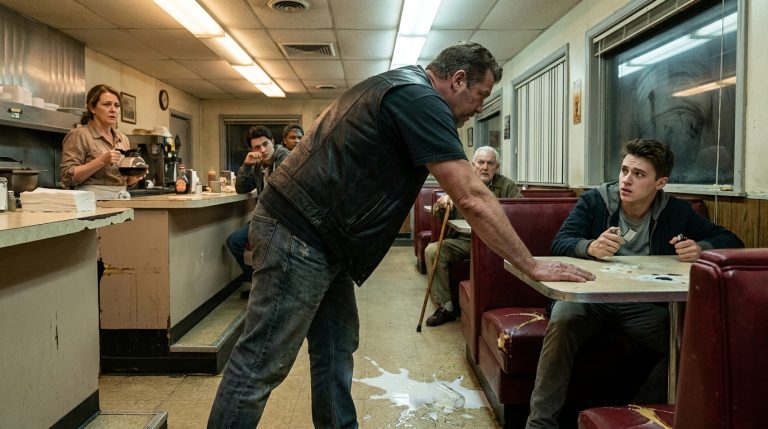
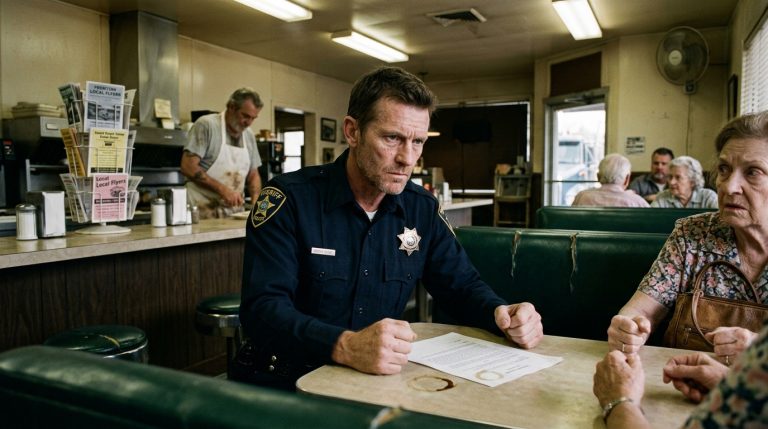
The Pinewood Diner smelled of burnt coffee and the faint, sweet grease of bacon, a scent that usually promised nothing more than a quiet hour of reprieve. For Brent Holloway, it was the stage for his favorite play. He sat at the counter, the fabric of his black T-shirt pulling tight across his shoulders, the gold-thread Ranger tab catching the overhead fluorescent flicker. He was mid-sentence, weaving a tapestry of 12-mile rucks and cold, hard nights in Mogadishu, his voice projected just enough to capture the ears of the trucker in the corner and Denise, the waitress, who wore that familiar, polished mask of polite exhaustion.
Brent reached for the sugar, his movements deliberate. He lived for the way strangers would occasionally glance his way, a flicker of respect—or perhaps just curiosity—in their eyes. It was a phantom warmth, but it kept the chill of his own life at bay.
Then, the air changed.
From the back booth, a sound emerged that stopped the room’s rhythm: the deliberate, heavy clink of a coffee cup against a saucer. It wasn’t the clumsy rattle of a tired man; it was the precise, weighted landing of someone who had just finished a long, internal deliberation.
Brent paused, the sugar spoon suspended over his mug. He felt a sudden, inexplicable prickle along the back of his neck, a sensation of being observed by something old and unyielding.
“Excuse me, son.”
The voice was soft, barely rising above the low-frequency hum of the refrigerator, yet it traveled through the diner as if it had been carved out of the very silence between the tables. Brent turned on his stool.
In the back booth sat an old man, his hair the color of brushed steel, his face etched with the kind of deep, dignified creases that only time and heavy choices could carve. A wooden cane with a small brass tip rested against the vinyl. The man’s eyes were a pale, clear gray—steady, unhurried, and unnervingly direct.
“I do not mean to interrupt,” the old man continued, his gaze pinning Brent in place. “But I wonder if you would do an old man a favor and recite the third stanza of the Ranger Creed for me. Just the third stanza. I have not heard it spoken in a long time, and I would consider it a kindness.”
The diner seemed to exhale all at once. The trucker went still, his fork hovering halfway to his mouth. Denise froze, the damp rag in her hand motionless against the Formica.
Brent felt his throat constrict. He looked at the man—really looked at him—and saw not a confused patron, but a mirror. For the first time in fifteen years, the floor beneath his stool felt dangerously thin. He tried to smile, the practiced, friendly mask sliding back into place, but it felt brittle, like dried clay.
“The third stanza?” Brent laughed, the sound hollow and small in the sudden, expansive quiet. “Sir, you’re catching me off guard. It’s been a few years since I’ve had to recite that. My memory—well, it isn’t what it used to be.”
The old man didn’t blink. He simply tilted his head, a ghost of a patient smile touching his lips. “Take your time, son. I am not in a hurry.”
Brent’s pulse hammered a frantic rhythm against his collar. He looked for an exit, but the old man’s eyes seemed to trace the geometry of the room, cutting off every path of retreat. He looked at the sugar dispenser in his hand, then back at the booth. He realized, with a rising sense of nausea, that he had spent his entire life building a wall of stories, and the man in the back booth had just picked up a hammer.
“The first word,” the old man prompted, his voice gentle, almost melodic. “Just give me the first word, and I will help you with the rest.”
Brent’s mouth opened, but no sound came out. The air in the room felt suddenly, suffocatingly heavy. He stared into those pale, gray eyes, and for the first time, he realized the man wasn’t asking a question; he was offering a choice that would rewrite everything.
And then, just behind the old man’s head, Brent noticed something—a small, faded photograph on the wall, a group of young men in uniform, their eyes vibrant and wide. They seemed to be watching him, waiting to see what he would do now that the lie had finally run out of road.
CHAPTER 2: THE ARCHITECTURE OF A CONFESSION
Brent stood at the edge of the back booth, his knees locked, his heart hammering against his ribs like a trapped bird. The silence in the Pinewood Diner had ceased to be empty; it was thick, textured, and demanding. He looked down at the old man—Henry—who sat with his hands folded around his coffee, his pale gray eyes steady, unblinking.
It wasn’t the look of a predator waiting to strike, but of a man who had already seen the end of this particular fight and was simply waiting for Brent to catch up.
Brent’s hand, still clutching the empty sugar dispenser, trembled. The gold-thread Ranger tab on his chest, which moments ago felt like armor, now felt like a lead weight pulling him toward the floor. He heard the distant, rhythmic clink of a spoon against a ceramic mug from the counter, a sound that underscored the isolation of his position.
He didn’t wait for an invitation. He moved, his legs feeling unmoored, and slid into the vinyl seat across from the old man. The upholstery hissed as he settled, the sound magnified in the quiet room.
Henry didn’t speak. He didn’t gloat. He simply gestured with a slight nod toward the space on the table. Brent set the sugar dispenser down. It rattled against the Formica.
“I didn’t mean any harm,” Brent started, his voice cracking. He tried to reclaim the swagger, the cadence of the stories he had rehearsed a hundred times in motel mirrors, but the words felt like ash in his mouth. “I just—I thought—”
“I am not asking for your justification, Brent,” Henry interrupted, his tone devoid of heat, yet possessing the gravity of a command. “And I am not asking for the stories you tell in bars. I am asking for the truth. One truth. We can build the rest of this conversation on top of that, or we can watch you bury yourself here in front of these people. Which is it going to be?”
Brent looked around. Denise was standing by the register, her expression caught between fear and a strange, hovering empathy. Pearl was watching from the kitchen threshold. He felt the phantom pressure of a mahogany stick in his own palm—a memory of a struggle he had never fought, a burden he had stolen from men like this. The weight of that theft made his chest ache.
“I never served,” Brent whispered. The words were a physical shedding of a skin he had worn for fifteen years. He felt the cold air of the diner touch his exposed skin, a vulnerability so sharp it was almost painful. “I tried to enlist in 2003. My knee… it was a tendon issue. I walked out, and I felt so small, so damn small, that I started filling the space with whatever I could find.”
Henry’s expression remained unchanged, but the intensity of his gaze softened. He pushed his own coffee cup across the table, a slow, sliding movement that signaled a truce. “Drink. You’re shaking.”
Brent reached out, his hands trembling so violently he nearly knocked the cup over. He took a sip, the bitter heat grounding him in the present. As the liquid warmed him, a sudden, intrusive memory surfaced—not his own, but a phantom of a foxhole, of mud, and the crushing weight of a friend who had died to keep him hidden. It was a mental phantom, a distortion of the lies he had fed himself for years, and it suddenly felt grotesque. He had been playing with the ghosts of men who had actually paid the price.
“I’m not a Ranger,” Brent continued, his voice steadying, stripped of the bravado that had fueled his existence. “I’m just a guy who sold warranties and lied because he was terrified of being nobody. I don’t know why you’re doing this. You should be throwing me out of here. You should be calling the police.”
Henry leaned forward, the wooden cane propped against the booth, its brass tip catching the morning light. “I’m not doing this for the Regiment, son. I’m doing this for a debt I’ve carried since 1962. A Sergeant Brennan once sat me down in an office much like this—well, not like this—and he gave me the same chance you’re currently ignoring.”
“Why?” Brent asked, looking for the catch. He expected a demand for money, for confession on camera, for some form of public degradation. But Henry only looked at him with an infinite, weary patience.
“Because the cost of becoming a man is higher than the cost of the lie,” Henry said, his voice dropping to a whisper that reached only Brent’s ears. “And the price I paid for my own mistake was to never, ever let another man drown if I could reach out and pull him to the shore.”
Brent felt the tears, unbidden and hot, track through the stubble on his cheeks. He wasn’t crying for the stolen valor or the fake badges anymore. He was crying because, for the first time in his adult life, he wasn’t playing a part. He was simply a scared, broken man, and someone he had tried to emulate was looking at him with the terrifying clarity of true recognition.
The atmosphere in the booth felt like a transition—not a resolution, but the opening of a wound that needed to be cleaned. Brent looked at the napkin, at his own hands, and then back at the man who held the power to destroy his life and was, instead, dismantling his pride.
“What do I do?” Brent asked, the question itself a surrender.
“You start by throwing the costume away,” Henry said, gesturing toward the embroidered tab on Brent’s chest. “And then, you learn how to live a life that doesn’t need a witness to be valid.”
CHAPTER 3: THE DISPOSAL OF THE MASK
The drive home had been a blurred corridor of gray asphalt and muted radio static. Brent hadn’t turned the music on. He hadn’t stopped for anything other than a quick refueling, his hands gripping the wheel with such intensity that his knuckles ached. Every time he glanced at the passenger seat, he saw the empty space where his confidence used to reside, replaced now by the hollow, echoing ache of a long-overdue accounting.
He walked into his apartment at 11:30 p.m. The space was tidy—too tidy. It was the home of a man who carefully curated his own myth. He stood in the entryway, the air smelling of stale cedar and the lingering scent of his own cologne. It felt foreign, as if he were a ghost haunting his own life.
He didn’t turn on the main lights. He walked into the bedroom, moving with the heavy, unhurried gait Henry had described as a mark of the veteran—a man who walked on the balls of his feet. He forced himself to walk flat-footed, to acknowledge the weight of his own body. He opened the closet.
There, in the back, behind a row of neatly pressed shirts, was the physical architecture of his deceit. A plastic crate containing the Ranger tab T-shirt, a set of patches he’d bought from a surplus site in Oregon, a challenge coin with a fake unit crest, and a printed, laminated copy of a commendation letter he had drafted himself on a borrowed computer three years ago.
He pulled the crate out. It slid across the closet floor with a harsh, scraping sound that seemed to scream through the apartment.
He didn’t fold anything. He grabbed the T-shirt, the fabric rough against his skin, and threw it into the heavy-duty black trash bag he’d brought in from the trunk. He grabbed the patches, the plastic coin, and the laminated lie. Each item was a brick in a fortress that had taken fifteen years to build, and now, it was taking less than sixty seconds to demolish.
As he packed the final piece—a worn cap he’d purchased at a flea market—he paused. He looked at the cap. He remembered the first time he had worn it to a dive bar in Raleigh. He remembered the way a woman had looked at him, her eyes softening with a misplaced respect that had intoxicated him more than any alcohol. He remembered the feeling of being enough.
He squeezed his eyes shut. The shame wasn’t a sudden, acute pain anymore; it was a dull, constant thrumming in his bones. I am a liar, he thought, the words simple and cold. And a liar is not a man.
He dragged the trash bag to the door. It was heavy, weighted down by the collective mass of fifteen years of small, quiet thefts. He didn’t take it to the dumpster in his apartment complex. He couldn’t. If he put it there, in the quiet of the night, he knew with agonizing certainty that he would crawl out in the early hours to retrieve it.
He loaded the bag into the trunk. He drove eleven miles to a 24-hour gas station on the outskirts of the county. The parking lot was desolate, the fluorescent lights humming with a lonely, insect-like buzz. He hauled the bag to the back of the building, toward the communal dumpsters.
His hands gripped the edge of the bag. The plastic groaned. He heaved it upward, and for a moment, he thought he might lose his footing. The bag landed with a dull, sickening thud inside the steel bin.
He stood there for a long time, the cold wind biting into his undershirt. He looked at his empty hands. He felt light—not the lightness of liberation, but the disorienting, vertigo-inducing lightness of a man who had lost his center of gravity.
He turned and walked back to the car. He didn’t look back at the dumpster. He didn’t look at his reflection in the gas station window. He just got in, started the engine, and listened. The silence of the car was different now. It wasn’t the silence of a secret-keeper; it was the silence of a void, waiting for him to decide what to fill it with.
When he finally crawled into bed, he expected to lie awake, haunted by the ghosts of the life he’d shed. Instead, the exhaustion—the deep, marrow-aching weariness of finally stopping the performance—pulled him under. For the first time in fifteen years, he didn’t dream of the war he had never seen. He didn’t dream of the medals he hadn’t earned. He dreamed of nothing at all. And when he woke, hours later, the morning light hit his floorboards with a new, uncompromising clarity.
He sat up. His gaze drifted to his nightstand, where he had placed the napkin Henry had given him. The blocky, careful handwriting was still there, a simple promise written in blue ink. Seven o’clock. Sunday.
He had forty-eight hours until the first call. He felt the cold iron of the commitment in his stomach. He wasn’t a Ranger. He wasn’t a hero. He was Brent Holloway, and for the first time in his life, he didn’t know who that was. He stood up, walked to the kitchen, and started a pot of coffee. It was a small, practical motion, the first step on a path that had no shortcut.
CHAPTER 4: THE FIRST CALL
The kitchen was a landscape of harsh, functional surfaces: chrome, white laminate, and the stark, unforgiving light of the overhead fluorescent. Brent had spent the afternoon pacing. He had cleaned the counters until they gleamed, reorganized his spice rack, and checked the clock no less than forty times.
It was 6:58 p.m.
He sat at the small, wobbly table he had bought at a thrift store, his phone—a landline he’d had installed as a matter of pure, stubborn necessity—sitting before him like a loaded weapon. The cord coiled across the table, a plastic serpent that connected him to the only man who knew the depth of his failures.
He didn’t have his notes. He didn’t have the script he’d spent fifteen years honing. He had only the truth, raw and unadorned. His hands were damp, and his chest felt tight, the same sensation he’d experienced in the diner, though the context had shifted from public catastrophe to private accountability.
6:59 p.m.
He thought about the trash bag at the gas station eleven miles away. He thought about his mother’s voice on the phone—the way she had wept, not out of disappointment, but out of a relief that pierced him. He thought about his friend Mike, whose anger had been a hot, searing heat that had eventually cooled into a weary, begrudging acceptance.
I am on the path, he whispered to the empty room.
The clock struck 7:00.
The sound was a single, metallic click followed by the steady, unrelenting thrum of a second hand moving through time.
Brent’s hand hovered over the receiver. His stomach did a slow, sickening roll. What if Henry didn’t answer? What if this was all a test he was destined to fail? What if, at the end of this call, the man on the other end decided that fifteen years of lying was simply too much to forgive?
He picked up the receiver. The dial tone was a flat, sterile hum that seemed to mock the turbulence in his soul. He dialed the number—a sequence of digits he had memorized with the same intensity he’d once used to memorize the details of the fake Ranger unit.
The line rang. Once. Twice. Three times.
Each ring felt like a heavy blow to the chest. He was hyper-aware of the apartment’s stillness—the hum of the refrigerator, the distant rumble of a car passing outside, the frantic pounding of his own heart.
“Dawson residence,” a woman’s voice said. It was soft, measured, and possessed a maternal warmth that caught him completely off guard.
“Ma’am?” Brent’s voice was a croak. He cleared his throat, trying to find the man he was supposed to be. “This is Brent Holloway. Mr. Dawson… he told me to call at seven.”
There was a pause, a soft intake of breath on the other end. “Brent,” she said, and the way she used his name made him feel as if she were looking directly at him. “Henry told me about you. I’m glad you called. He’s right here. Hold on a moment.”
He heard the phone clatter slightly as it was passed. Then, there was a heavy, deliberate silence, followed by the familiar, calm cadence of the Master Sergeant.
“Brent? Are you on the path?”
The question wasn’t a challenge. It was a lifeline. Brent slumped forward, his forehead resting against the cool laminate of the table. The tears came again, not the frantic, ugly sobbing of the diner, but a slow, rhythmic weeping that felt like he was finally letting the toxins out of his system.
“Yes, sir,” Brent said, his voice straining against the constriction in his throat. “I am on the path. I threw away the T-shirt the same day. I threw away everything else by midnight. I called my mother on Friday, and I told her the truth. She… she cried, sir, but then she said she was proud of me for telling her.”
He poured it all out—the call to Mike, the humiliating reality of his own fragility, the terrifying vacuum that remained now that the lies were gone. He didn’t polish the edges. He didn’t pretend to be the Ranger he had stolen from. He confessed the weakness, the lingering doubt, the shame that still clung to him like smoke.
Henry listened with a silence that felt active, a presence that supported him through the confession. When Brent finally fell silent, he waited for the judgment, for the cold reprimand, for the dismissal.
Instead, he heard Henry’s low, steady exhale.
“I am proud of you, Brent,” Henry said. “I know that probably doesn’t mean very much coming from a stranger you met in a diner, but for what it is worth, I am proud of you. Call me next Sunday at seven.”
“Yes, sir.”
“One more thing,” Henry added, his voice lowering, taking on a tone of quiet instruction. “The reason I asked for the third stanza in the diner, and not the first or the second, is that it is the one that matters most. Memorize it tonight, Brent. Not because you’re a Ranger—you aren’t. But because those words are a backbone you have to build yourself. I’ll hear it from you next Sunday.”
Brent hung up the phone. The apartment felt different. The light wasn’t as harsh. The silence wasn’t as empty. He sat in the dark for a long time, the words of the third stanza playing through his mind, not as a script for a performance, but as a map for a life. He took a piece of paper and a pen, and he began to write the words down, one character at a time. He wasn’t a hero. He was a man, starting over, and that, he realized, was enough.
CHAPTER 5: THE THRESHOLD OF REALITY
The recruiter’s office was an exercise in sterile efficiency. Posters of high-tech gear and focused soldiers adorned the walls, their expressions resolute and sharp. Brent sat on the edge of a hard plastic chair, his knees clicking together. He was wearing a plain, collared shirt—no patches, no tabs, no symbols of a life he hadn’t lived. He felt strangely naked.
The door opened with a sudden, sharp click. The recruiter, a Sergeant First Class with a jawline like polished granite, stepped out. He carried a manila folder that looked heavy with the weight of Brent’s past.
“Mr. Holloway,” the Sergeant said. His voice was neutral, neither welcoming nor hostile. “Step into my office.”
Brent stood, his legs feeling heavy, as if he were walking through knee-deep water. He entered the small, cramped room, the air thick with the smell of floor wax and old paper. He sat down, the chair groaning under him.
“I’ve read your file,” the Sergeant said, opening the folder. He didn’t look up, his fingers tapping rhythmically against the desk. “You tried to enlist in 2003. You were denied for a medical issue that, according to your current records, was misdiagnosed. You’re thirty-eight now. You’re past the age of standard enlistment, and your physical profile… well, it’s not what we look for in a trainee.”
Brent felt his throat tighten. “I know. I didn’t come here expecting a miracle, Sergeant. I came because I need to know. I’ve spent fifteen years lying to people, telling them I was something I’m not. I want to know if there’s a place for someone like me—not as a soldier, but as a civilian. I want to earn the respect I spent years pretending to have.”
The Sergeant finally looked up. His eyes were dark, piercing, and held an intensity that made Brent want to shrink away. He studied Brent’s face for a long, agonizing minute. He wasn’t looking at the clothes or the lack of patches; he was looking for the man beneath the veneer.
“You’re right,” the Sergeant said, his voice dropping. “You won’t be a soldier. You’re too old, and your history is a liability. But you’re right about one thing: you’re here, and that’s more than the people who just talk about it.”
He tossed a pamphlet onto the desk. It wasn’t for infantry training. It was for a Department of Defense program, a logistics support initiative for military families on base.
“We need people who understand the value of a promise,” the Sergeant said. “We don’t need liars. We have enough of those. We need people who are willing to do the mundane, boring, exhausting work that supports the people who are soldiers. It’s not glorious, Holloway. There are no patches. There are no bars to talk about in diners. It’s hard work, it’s long hours, and it’s completely thankless.”
Brent looked at the pamphlet. It was dull, printed on recycled paper, but it looked more solid than anything he had ever owned. “When do I start?”
“You apply today,” the Sergeant said. “If you’re selected, you move, you train, and you stay as long as you’re useful. But let me be clear: one sign that you’re still playing ‘Ranger’—one instance of you trying to puff yourself up—and you’re gone. We don’t have patience for games.”
Brent walked out of the office a half-hour later. The sun was low in the sky, casting long, bruised-purple shadows across the parking lot. He felt a sudden, sharp clarity. He hadn’t been redeemed. He hadn’t been transformed into a hero. He was just a man with a job to apply for, a life to build, and a commitment to hold.
He drove to the VFW post on the other side of town. It was a low-slung, cinder-block building with a peeling sign. He went inside. The kitchen was already active, the smell of institutional-grade chili and burnt coffee hitting him like a physical blow. He walked up to the counter where an elderly man with a prosthetic leg was plating food for a line of men who looked as weathered as the furniture.
“I’m here to volunteer,” Brent said.
The man behind the counter looked him up and down. He wasn’t looking for a uniform; he was looking for a pair of hands. “You know how to wash a dish, son? You know how to take orders without complaining?”
“I do,” Brent said.
“Good. Grab an apron.”
Brent tied the apron around his waist. It was stained and frayed, smelling of grease and years of honest, grinding work. He picked up a scrub brush. He started to wash the dishes, the hot water scalding his skin, the rhythm of the work pulling at his muscles. He wasn’t thinking about the third stanza. He wasn’t thinking about the lie. He was thinking about the dirt on the plate, the soap in his hands, and the simple, brutal honesty of getting it clean. He had forty-four Sundays left until the year was up, and he had a lifetime of work to do to fill the space where the lies used to be.
CHAPTER 6: THE FINAL WITNESS
The church was filled with a stillness that felt like a held breath. It was a small, Methodist chapel off Route 19, its wooden pews polished to a dull sheen by decades of service. Brent stood at the lectern, his dark suit feeling stiff and formal against his frame. Before him sat the congregation: a sea of faces, veterans with medals pinned to their chests, civilians who had only known Henry as a quiet, steady neighbor, and at the very front, Eleanor Dawson, her posture dignified even in her grief.
He looked down at his notes. They were sparse—just a few bullet points he had jotted down in the quiet of his kitchen. He didn’t need a script. The truth had become the only language he spoke.
“My name is Brent Holloway,” he began, his voice carrying through the small sanctuary, steady and resonant. “I am not a Ranger. I have never served in the United States military.”
A ripple of movement stirred the congregation. He saw a few heads turn, a few brows furrow in confusion. He didn’t waver. He focused on Eleanor’s face, seeing the small, knowing smile she offered him.
“Five years ago,” Brent continued, “I walked into a diner in this town wearing a Ranger T-shirt I’d bought online. I told a waitress lies about a unit I’d never belonged to and a war I’d never fought in. I was looking for a ghost of respect to fill a hole in my own soul. And the man whose funeral we are attending today asked me, very quietly, to recite the third stanza of the Ranger Creed. I could not. I could not recite a single word.”
He paused, the silence in the room changing, deepening. It was no longer a silence of confusion; it was the heavy, respectful silence of recognition.
“In the next ninety minutes, Master Sergeant Henry Dawson did something for me that no human being had ever done. He didn’t humiliate me. He didn’t call the police. He sat me down, and he told me a story about his own failing, a debt he’d carried for decades. He told me that he had been waiting for someone like me to pay that debt forward.”
Brent gripped the edges of the lectern. He spoke of the Sunday calls, the weekly rhythm of accountability that had slowly, painstakingly, forged a new man out of the debris of the old one. He spoke of the VFW kitchen, the hard work of serving others, and the way the quiet, thankless labor had finally silenced the need for applause.
“Master Sergeant Dawson saved my life,” Brent said, his voice thickening. “I don’t mean that as a figure of speech. I mean that the man I was that morning had nothing in his life that was real. The man I am today is a man who has a wife, a daughter, and a self-respect built on the foundation of an honest confession.”
He took a long, steadying breath. “The third stanza begins with the word ‘never.’ Never shall I fail my comrades. Henry Dawson never failed his. He didn’t even fail a stranger who had insulted them. He carried the creed in his bones. And the only way I know how to honor him is to carry the lesson he taught me in mine.”
As Brent finished, he stepped back from the lectern. The applause didn’t come. Instead, there was a collective, profound exhale. He walked back to his seat, his hand brushing Eleanor’s as he passed. She gripped it firmly, her eyes brimming with a calm, grateful light.
After the service, the churchyard was a sea of gray suits and soft, somber conversation. Brent found himself standing near the back, watching the crowd. The afternoon light was golden, filtering through the trees in long, hazy shafts.
He walked to the edge of the cemetery, where the final plot had been prepared. He watched as the mourners dispersed. When the crowd had thinned, leaving only a few lingering figures, Brent knelt. He reached into his pocket and pulled out the small, brass-tipped wooden cane he had carried as a symbol of the struggle, and placed it gently on the fresh earth. It wasn’t a hero’s tribute, but a simple, tactile sign of a debt finally satisfied.
He felt a hand on his shoulder. It was Catherine, his wife, holding their daughter, Eleanor, in her arms. She didn’t say a word, just squeezed his shoulder, her presence a grounding, warm weight.
Brent stood. He looked at the grave, at the quiet, peaceful landscape of the North Carolina hills, and he knew he wouldn’t be returning to the diner as a visitor anymore. He would be returning as a man who lived his life on the path. He felt the absence of the weight—the heavy, suffocating mass of fifteen years of pretense—and in its place was a quiet, enduring strength.
“Let’s go home,” Brent said, his voice soft.
He turned his back on the graveyard, and for the first time in his life, he didn’t need to look back to see who he had been. He only needed to look forward, at the life he had built, one honest action at a time. The path stretched out before him, quiet, steady, and entirely his own.