A Broken Mechanic Rebuilds His Soul in the Shadow of a Corrupt Arizona Sheriff’s Desert Empire
CHAPTER 1: THE DUSTY CONSCIENCE
The slap had a wet, percussive sound, like a piece of raw steak hitting a butcher’s block. It left a silence in the diner that felt heavier than the Arizona heat trapped against the glass. Rosie’s head snapped with the velocity of the impact, her body sagging against the counter, and for a fraction of a second, the coffee spilled from her hand didn’t look like liquid; it looked like blood darkening the checkered vinyl.
Sheriff Wade Collins stood there, his thumb hooked into his belt, the leather of his holster creaking as he held the pose. His uniform was an affront—too clean, too stiff for the grit of a town like Dustville. He breathed through his nose, a soft, predatory sound.
“That’s discipline,” he announced, his voice booming with the hollow authority of a man who’d spent his life bullying waitresses and terrified motorists. “For a woman who doesn’t know her place.”
Steel felt the shift in his own physiology. It wasn’t rage—rage was for the young, for the bikers who wanted to impress their brothers. This was tactical, a cold, clinical surge of adrenaline that narrowed his world to the distance between his stool and the sheriff’s knees. He noticed the way Collins’s weight was distributed: too heavy on his heels, a clear sign of overconfidence. He noticed the slight bulge of a backup weapon beneath the sheriff’s left arm.
He didn’t stand up yet. He watched the forty people in the room. They were statues, their eyes glued to the plates of half-eaten eggs and cold toast. They were afraid, but more than that, they were complicit.
Steel gripped the edge of the counter, his fingers tracing the deep, serrated gouges in the metal. The texture was familiar—industrial, hard, unforgiving. It felt like the frame of a bike that had seen too many miles. He stood up then, the movement slow, deliberate, the way a tank tread catches the ground. He was sixty-eight, but his bones possessed the density of rebar.
He stepped between Collins and the counter, cutting the line of sight. The air here was different—smelling of old oil, stale coffee, and the metallic tang of the impending collision.
“The lady asked you to leave,” Steel said. His voice wasn’t loud, but it possessed a sub-bass frequency that cut through the silence. It was a calm that invited no debate.
Collins squinted, his eyes tracking the Hells Angels ink fading on Steel’s forearm like a blue-inked warning label. “You don’t know who you’re dealing with, old man,” the sheriff spat, the mask of the friendly protector sliding off to reveal the jagged, fearful glass of a man who was used to things breaking when he hit them.
“And you,” Steel replied, his blue eyes locking onto the sheriff’s, flat and devoid of warmth, “don’t have the slightest idea who you’re threatening.”
A tremor went through the room—a shift in the atmospheric pressure. But then, in the reflection of the back-wall mirror, Steel caught the movement of the sheriff’s deputy, Bulldog Pierce, shifting his hand toward his holster. Steel didn’t flinch, but he reached into his own mind, checking the room’s geometry. Two exits, forty witnesses, and one sheriff whose pupils were dilated in a way that suggested the drink or the corruption had finally reached his brain stem. He realized, with a chilling clarity, that this wasn’t just a harassment case; he had just stumbled into a mechanism that, if triggered, would grind the entire town into dust. And he was the only one in the room who had the right tools to jam the gears.
CHAPTER 2: THE TACTICAL RADIUS
The silence in the diner was no longer empty; it was pressurized. Steel could feel it against his skin, a fine, invisible tension that made the hair on his arms stand up. He kept his stance centered, heels grounded, avoiding the trap of tension that would make his movements jerky or telegraphic. He watched the sheriff, Wade Collins, who was still vibrating with that specific, ugly frequency of a man who realized, for the first time in his tenure, that he had miscalculated his audience.
“You’re a long way from home, Donovan,” Collins whispered. The threat wasn’t in the volume; it was in the way his eyes darted to the side, checking the positions of his deputies.
“I’m exactly where I need to be,” Steel said, keeping his voice a low, steady rumble. He didn’t look at the other deputies. He didn’t have to. He could feel the shift in their posture, the way the younger one, the one with the nervous twitch in his jaw, had tightened his grip on his belt. They were predator-prey, and Steel was currently the anomaly in their calculation.
Collins finally broke the stare, his face flushed a mottled, unhealthy red. He made a sharp, dismissive gesture—a flick of the wrist that signaled to his men that this wasn’t the place for a brawl. Not yet. He turned back toward the counter, his boot heels clicking aggressively against the checkered floor, and leaned into Rosie’s space.
“I’ll have my coffee black,” Collins said, his voice regaining its practiced, booming arrogance. “And Rosie, honey, don’t worry about the bill. Put it on the town’s tab. It’s what we’re here for, right? Keeping things running smooth.”
Rosie didn’t move for a heartbeat. Her hand was pressed against the counter, right where she’d caught herself during the slap. Her fingers were white-knuckled. Then, with a practiced, liquid motion, she grabbed the pot. She didn’t look at Steel, and she didn’t look at the sheriff. She just poured, the dark liquid swirling into the mug with a hiss of steam.
Steel didn’t take his eyes off the sheriff’s back until Collins had retreated to the corner booth. Even then, his mind remained in a state of high-alert, cataloging every variable. He needed to know the exit radius. He needed to know the proximity of the cruiser outside.
He didn’t walk out the door. That would be an admission of retreat. Instead, he pulled out his wallet, laid a twenty-dollar bill on the counter, and walked—not toward the exit, but toward the jukebox. He kept his back to the wall, his peripheral vision scanning the room. He passed the booth where the deputies sat. He could hear them now, their voices lowered to a conspiratorial rasp.
“Old man’s a lunatic,” the younger deputy muttered.
“Don’t worry about him,” Collins’s voice drifted over the top of the booth, sharp and jagged. “He’s just passing through. Dustville has a way of digesting things like that.”
Steel stopped at the jukebox. He didn’t put a coin in. He just stood there, pretending to read the labels, while he watched the sheriff reach for his radio. Collins held it to his lips, his thumb hovering over the transmit button. He wasn’t calling for backup; he was logging Steel’s license plate number. It was the move of a man who was afraid of physical confrontation but had total mastery over the bureaucracy of destruction.
Steel left the diner. The moment the glass door swung shut behind him, the heat of the Arizona morning hit him like a physical blow, heavy and dry. It was 110 degrees, the kind of heat that made the asphalt shimmer and softened the tar between the cracks in the road.
He walked to his truck. He didn’t rush. He moved with the measured gait of a man who had done this before, in different deserts, under different flags. He climbed into the cab and started the engine. He didn’t pull away immediately. He sat, letting the air conditioning cycle, watching the front entrance of the diner in his rearview mirror.
Three minutes later, the sheriff’s cruiser pulled out. It didn’t drive toward the station. It made a slow, deliberate pass by Steel’s truck, the cruiser slowing down until it was nearly at a crawl. The tinted glass of the driver’s side window rolled down, revealing Collins’s face. He wasn’t smiling anymore. He looked at Steel with a profound, calculating exhaustion.
“Route 47 is a long, lonely stretch, Donovan,” Collins said through the window, his voice barely audible over the hum of the idling engines. “Be a shame if a man like you had a mechanical failure out there.”
“I know engines better than you know your badge,” Steel replied, his voice devoid of emotion.
Collins didn’t respond. He simply rolled the window back up, gave the cruiser a sharp jolt of acceleration, and vanished down the main street in a cloud of dust.
Steel gripped the steering wheel, his knuckles turning white. He didn’t drive home. He drove to the local library—a small, sun-bleached building on the edge of the civic center. He needed to see the town records. He needed to know exactly how deep the sheriff’s roots went into the municipal ledger. If Collins wanted to play a game of administrative attrition, Steel was going to start by pulling up the floorboards.
He parked the truck in the shade of a skeletal-looking cottonwood tree. As he stepped out, he looked back at the diner one last time. He saw Rosie standing in the doorway, watching him. She was holding a towel in her hand, her posture rigid. She wasn’t just watching; she was waiting for a signal.
Steel touched the brim of his cap, a brief, silent acknowledgement, and headed inside. The library was quiet, smelling of dust and decaying paper. It was the perfect place to bury the truth, and precisely where he intended to find it.
CHAPTER 3: THE ARCHIVE OF DUST
The library smelled of vanilla and slow decay, a sensory contrast so jarring to the oil-scented reality of Steel’s garage that it felt like stepping into a tomb. The librarian, a woman whose skin looked like parchment paper stretched over a frame of wire, barely looked up from her computer screen. She didn’t ask what he wanted; she just pointed a bony finger toward the microfiche machines in the back.
Steel walked past the shelves, his boots making no sound on the threadbare carpet. He kept his eyes moving, checking the blind spots. The sheriff’s cruiser had vanished from sight, but that didn’t mean he was unobserved. In a town like Dustville, the architecture itself was a surveillance network—every window, every porch, every rust-colored sedan was a node in a web that Collins controlled.
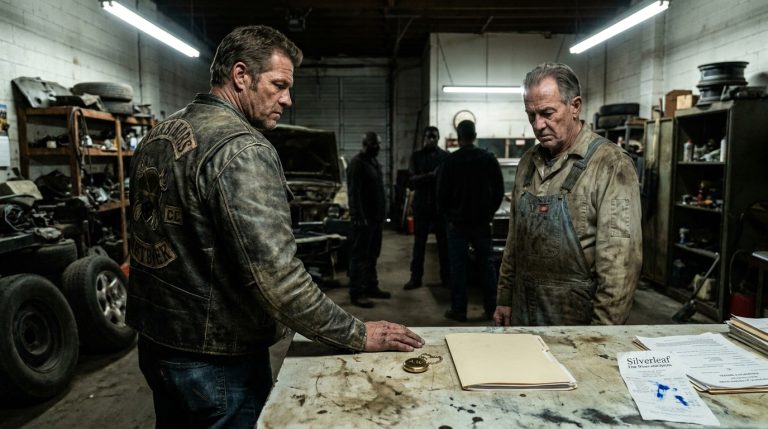
He reached the microfiche cabinets. His hands, calloused and mapped with grease-stains that no soap could reach, moved with an efficiency that felt alien in this room of quiet scholarly pursuit. He pulled out the drawer labeled Municipal Property Records: 1990-2000.
He didn’t need the whole history. He needed the pivot point. He found the file for the sheriff’s station renovation, the project Clayton had worked on six years ago. He loaded the film, the machine whirring to life with a mechanical groan that sounded like a dying beast.
As the images flickered onto the screen—black and white scans of blueprints, permits, and financial invoices—Steel leaned in. The resolution was grainy, but the numbers were stark. The renovation project had been funded by a private trust, something titled “The Mesa Stabilization Fund.” It was a generic name, designed to sound bureaucratic and boring, the kind of name that stopped people from asking questions.
Steel shifted the reel, jumping forward to the property tax assessments for the station. That was where he found the discrepancy. The station was listed as “state-owned property,” yet the utility taxes were paid by a private holding company out of Phoenix. It didn’t make sense. If the state owned it, why was a private entity paying the light bill?
He grabbed a notepad from his pocket, scribbling down the holding company’s registration number. He could feel the familiar, cold precision of the hunt setting in. This wasn’t just about a corrupt sheriff taking payoffs from a local drug crew. This was infrastructure. Collins wasn’t a boss; he was a landlord managing a facility for a tenant who didn’t want their name on the lease.
He heard the library door chime.
Steel didn’t jump. He simply dropped his hand to his waist, ensuring his coat hung loose and accessible, and shifted his posture to ensure he could see the reflection in the machine’s dark screen.
A figure entered the library. It wasn’t the sheriff. It was a man in a tan utility vest, carrying a clipboard. He looked like a surveyor or a utility worker, but the way he walked—with a heavy, balanced step that favored his right side—told a different story. He walked straight to the librarian and began a conversation, his head tilted in a way that allowed his eyes to rake over the back of the library.
Steel turned his head slightly, his gaze fixed on the microfiche screen, but his focus was entirely on the man. The intruder didn’t look at the books. He looked at the shadows. He was searching.
Steel realized then that he had underestimated the sheriff’s reach. Collins hadn’t just logged his license plate; he had trackers on the move. He had assets in the field.
Steel didn’t try to hide. If he disappeared now, he would look guilty. Instead, he pulled out his phone and made a show of checking his watch, then stood up, leaving the microfilm loaded in the machine. He walked toward the front of the library, passing the man in the utility vest with a nod that was neither friendly nor aggressive. It was the nod of a man who belonged in his own skin, regardless of who was watching.
The man in the vest stiffened as Steel passed, his eyes flickering toward Steel’s midsection. Steel didn’t break stride. He reached the library door, opened it, and stepped back out into the furnace of the Arizona afternoon.
The heat hit him instantly, smelling of baked asphalt and dry, desperate earth. He didn’t head for his truck. He turned down a narrow alleyway between the library and a shuttered hardware store. If they were tracking him, he needed to make the next move unpredictable.
He moved quickly, his shadow stretching long and distorted against the cracked brick wall. He knew this town’s geography now. Every dead end, every shortcut, every place where a man could disappear. He reached the back entrance of a building that had once been a bank, now just a storage unit for local mining equipment.
He slipped inside the shadows of the loading dock, listening. He could hear the engine of a truck idling on the main street. Not his truck. Something heavier. Something with the low, authoritative growl of a law enforcement vehicle.
He sat in the dark, the scent of rusted iron and dry silt filling his lungs. He had the registration number of the holding company. He had the name of the stabilization fund. He had enough to know that Clayton Hartwell hadn’t just died for seeing a drug deal; he’d died for seeing the ledger of a ghost.
Steel felt the weight of his promise to Jake Mitchell settle over him, not as a burden, but as a calibration. The scale was out of balance, and for the first time in fifteen years, he had the leverage to fix it. He reached into his pocket, took out the scrap of paper with the registration number, and felt the sharp edges of the paper against his skin. This was the first bolt of the engine he was going to strip down until there was nothing left but the truth.
He stayed in the dark until the sound of the truck engine faded into the distance. Only then did he move. He had to get to Rosie’s diner. If Collins was using utility workers to hunt him, Rosie was the next logical target. She was the witness they couldn’t allow to remain at the table.
He moved through the alleyways, silent and purposeful, a ghost of a man who had finally found his reason to haunt the world again.
CHAPTER 4: THE VIPERS NEST
The distance between the alley and the diner was two hundred yards of open, blistering pavement. Steel didn’t run; running invited observation. He moved with a heavy, predatory fluidity, hugging the side of the hardware store where the shadows stretched long and thin, like fingers grasping at the heat. Every step was a calculation of weight—heel to toe, minimizing the vibration he sent through the ground.
As he closed the gap, he saw them. Two men—not deputies in uniform, but civilians in tactical vests, moving with the practiced, jerky synchronization of men who worked for a paycheck and a bullet. They were parked in a nondescript SUV near the rear delivery entrance of Rosie’s diner. The windows were down, and the smell of cheap tobacco drifted on the stagnant air.
Steel ducked behind a stack of rusted mining gears. He checked his reflection in the oily puddle beneath the iron, his face a mask of iron-grey focus. He needed to know what they were looking for, or more importantly, what they had been told to find.
He moved closer, his breath hitched in a rhythm that mirrored the men’s own breathing. It was a trick from the desert, thirty years ago: synchronization. If you breathed with your target, you became a part of the background noise.
“The old man’s not at the garage,” one of the men said. His voice was gravelly, the sound of a throat burned by too much grit. “He’s gone off the grid.”
“He’s not gone,” the other replied. “He’s a creature of habit. He’ll come back to the source. He’s got some kind of debt to the dame.”
Steel felt a flare of something—not anger, but a cold, crystalline clarity. They knew about Rosie. They knew about the diner. The layer of local corruption was thinner than he had anticipated; the Vipers were already tightening the knot around the only piece of humanity he had left to protect.
He reached into his pocket and fingered the registration number he had swiped from the library. The realization hit him like a physical blow: the Mesa Stabilization Fund wasn’t just a front. It was a clearinghouse for state-level assets. The Vipers weren’t just running drugs; they were the enforcement arm of a state-sanctioned containment strategy. They weren’t cleaning up a town; they were maintaining a graveyard.
A memory flickered—sharp, unwanted, and violent—of a sandstorm in Kuwait, the way the grit felt against his teeth, the way he had lost Jake in the white-out. He forced the ghost of the memory down. He wasn’t in the desert anymore. He was in the middle of a different kind of war, and this time, he wouldn’t let the white-out claim the people who mattered.
He saw the first man step out of the SUV, a hand resting on a holstered weapon. The man walked toward the diner’s back door, his gait heavy. He was the point man. The second man remained in the vehicle, likely on a short-wave radio, providing the link to whoever was pulling the strings in Phoenix.
Steel shifted his weight. He had no weapon, only his hands, his environment, and a lifetime of muscle memory that had been honed by decades of violence. He needed to incapacitate the point man without triggering the second man, without alerting the diner, and without leaving a trail that led back to his identity.
He waited until the man was five feet from the delivery door. The heat was oppressive, shimmering in waves that blurred the man’s silhouette. Steel stepped out from the shadows, moving not with a roar, but with a silent, lethal acceleration.
He closed the distance in three strides. The man started to turn, his hand beginning to twitch toward his side, but Steel was already there. He didn’t strike for the jaw—too loud, too much room for recovery. He struck for the nerve cluster at the base of the neck, a sharp, precise hit that sent a jolt of localized paralysis through the man’s shoulders.
The man crumbled. It was a silent, graceful collapse into the dirt.
Steel didn’t stop. He caught the man by the vest, eased him down into the shadow of the dumpster, and stripped him of his comms unit and a heavy, weighted flashlight.
“I’m at the rear access,” the man in the car said over the radio, his voice crackling with static. “No sign of the old man. I’m going to do a perimeter sweep.”
Steel pressed the comms unit to his lips, his voice pitched to a gravelly, near-perfect mimicry of the man he’d just dropped. “I’m already in. Moving toward the main corridor. The perimeter is clear.”
“Copy that. Keep it tight. We don’t want a scene.”
Steel clicked the comms unit off. The second man had just given him the opening he needed. He moved to the diner’s back entrance, pushed the door—which Rosie had left unlocked per his instruction—and stepped into the kitchen.
The air was different here: thick with the smell of coffee, grease, and the faint, sweet scent of cinnamon. It was a sanctuary, and it felt like a violation to be here with the smell of the alley on his boots.
Rosie was by the stove, her back to him. She was humming something low, a melody that was as soft as the desert night. When she heard the door creak, she turned, a heavy kitchen knife in her hand, the blade glinting under the harsh fluorescent tubes.
When she saw it was him, her hand dropped. The tension in her shoulders drained away, leaving her looking small and incredibly tired.
“They’re outside,” Steel whispered, his eyes fixed on the door. “Two of them. One is down in the back. The other is in the SUV. Stay here. Do not make a sound.”
“What are you going to do?” she asked, her voice trembling but held tight by a core of steel.
“I’m going to finish the sweep,” he said. He looked at the knife in her hand, then at her eyes—green, clear, and currently reflecting the fear he had hoped to spare her. “Rosie, lock this door. If I don’t come back through it in five minutes, you get out the front, go to the truck, and you don’t stop driving until you hit the state line. You have the number.”
“I’m not leaving you,” she said, her voice rising in a sharp, fragile pitch.
“You have to,” he said, turning toward the back entrance again. “Because if you stay, they’ve already won. I need you to be the witness, not the casualty.”
He slipped back out into the heat, the comms unit in his hand feeling like a cold, heavy stone. He had four minutes and counting, and the second man was already beginning to show signs of impatience.
CHAPTER 5: THE COLLAPSING PERIMETER
Steel didn’t wait for the realization to dawn on the man in the SUV. He moved with a brutal, kinetic efficiency, tucking himself into the narrow space between the diner’s grease trap and the brick wall. His boots found purchase on a discarded milk crate, and he hauled himself up to the height of the kitchen’s rear-facing transom window.
The air was thickening. A wall of brown, pulverized earth was rolling in from the west—the precursor to a desert storm that would scour the skin off a man if he was caught in the open. The sky above was rapidly bruising into a deep, sickly plum, the light failing just enough to turn the world into a series of silhouettes.
Below him, the SUV’s doors opened. The man inside—a heavy-set individual with the frantic energy of a low-level cleaner—stepped out, his hand now gripping a suppressed pistol. He wasn’t playing around anymore. He scanned the alley, his head snapping toward the spot where his partner had been neutralized.
“Marco?” he called out, his voice thin against the rising howl of the wind.
Steel didn’t answer. He watched from his vantage point as the man paced toward the dumpster, his weapon raised in a professional, two-handed grip. He was competent, which made him dangerous. Steel shifted his weight, testing the stability of the window frame. It was rotted wood, soft and yielding. If he tried to force it, the sound would be a beacon.
He didn’t force it. He waited.
The storm hit with a violent, instantaneous surge. The temperature plummeted twenty degrees in a heartbeat, and the wind began to scream, throwing grit and debris against the side of the building with the force of birdshot. The visibility in the alley dropped to less than ten feet.
The cleaner stumbled, raising a hand to his face as the dust blinded him. This was the opening. Steel dropped from the transom, landing in a crouch behind the man. He felt the impact in his shins, the familiar jar of a tactical drop, but he didn’t pause. He spun outward, catching the man in a lateral sweep that sent him sprawling into the grit.
The man’s pistol skittered away, lost immediately in the swirl of the storm. He tried to scramble up, but Steel pinned him with a knee between the shoulder blades, his hand locking onto the man’s throat—not to crush, but to immobilize.
“The radio,” Steel barked over the roaring wind. “Who are you talking to? Give me the frequency.”
The man choked, clawing at Steel’s arm, his face turning a dark, congested purple. “Go… to… hell,” he managed to wheeze.
Steel increased the pressure, just enough to bring the man to the edge of consciousness. He could feel the panic radiating from the man’s frame—a frantic, desperate heat. “This town is a graveyard for people who think they’re important,” Steel said, his voice cold, steady, and entirely devoid of mercy. “You’re a line item on a ledger in Phoenix. They don’t know your name, and they won’t remember your death. Give me the channel, or you become part of the dust.”
The man’s eyes bulged, his resolve snapping under the weight of the old man’s iron-fisted detachment. He pointed toward the SUV’s dashboard. “…Channel four,” he gasped.
Steel didn’t let him up. He applied the joint lock, rendering the man unconscious, then dragged him into the darkness of the storage unit where he’d hidden his own gear.
The wind was reaching a crescendo, the storm turning the world into a chaotic, suffocating swirl of brown. Steel scrambled back toward the diner’s kitchen door, his lungs burning from the dust. He slammed into the door, and Rosie yanked it open, her face pale, her hands shaking as she pulled him inside.
The kitchen felt like a pressurized cabin, the howling wind muffled by the thick, insulated walls. Rosie slammed the lock shut, then leaned back against the door, her chest heaving. “They’re here,” she said, her voice small. “I saw a cruiser roll into the front lot. Collins is here.”
Steel didn’t hesitate. He stripped off his dust-caked jacket, revealing the dark, utilitarian base layer he’d worn for the move. He checked the comms unit he’d swiped from the first man. It was chirping—a low, rhythmic pulse indicating a incoming transmission on channel four.
He keyed the mic. “Status?”
The voice on the other end was clipped, efficient, and unmistakably Sheriff Collins. “The perimeter is compromised. I want the diner searched from the floorboards to the roof. Don’t worry about the woman; prioritize the recovery of the drive. The old man is a target of opportunity. If he interferes, authorize lethal measures.”
Steel felt a grim, dark satisfaction. He was the one pulling the strings now.
“Understood,” Steel replied, his voice a gravelly, perfect mirror of the cleaner’s. “Moving to the front lobby.”
He looked at Rosie. She was staring at him, her eyes wide with the realization of what he was doing. She wasn’t just a bystander anymore; she was the axis around which the entire, violent machinery of Dustville was about to spin.
“They’re coming through the front,” Steel said, his tone shifting into the flat, instructional cadence of a commander. “They’re going to expect you to be hiding in the back. I want you to go to the basement. You know the layout better than I do. Take the knife, take the flashlight, and stay in the shadows near the storage access. If I’m not back in ten minutes, you use that access point and you run for the truck.”
“And you?” she asked, her voice steadying.
“I’m going to make sure that when they search this place, they find exactly what they deserve.”
He walked to the pass-through window of the kitchen and peered into the dining area. Through the haze of the dust storm outside, he could see the silhouette of Collins standing by his cruiser, gun drawn, his deputies fanning out toward the glass. The perimeter was collapsing, but Steel had already moved the pieces. He was no longer the prey; he was the trap.
He didn’t wait for them to breach. He stepped out of the kitchen, his boots quiet on the checkered vinyl, and moved toward the center of the diner, ready to welcome the sheriff into the silence.
CHAPTER 6: THE ARCHITECTURE OF SURRENDER
Steel didn’t move toward the door. He moved toward the circuit breaker.
He knew this diner’s skeleton better than the people who worked here. Six years ago, Clayton Hartwell hadn’t just rewired the station; he had performed a total overhaul on every property he touched in Dustville. He was a man who believed in redundant systems and failsafes. Steel remembered Clayton telling him once over a beer—his voice hushed, eyes darting to the windows—that every building in this town was wired to be a fortress if it ever came down to it.
Steel reached the panel behind the counter, his fingers finding the hidden toggle that wasn’t on the public map. With a quick, sharp twist, he plunged the diner into total darkness.
The silence that followed was absolute, broken only by the frantic whistling of the wind outside. In the pitch black, the environment shifted from a liability into a tactical advantage. Steel was no longer fighting in a room; he was fighting in a void, and he had spent more years of his life navigating voids than Wade Collins had spent patrolling the paved streets of Dustville.
The front door groaned as the lock was kicked. It didn’t shatter; the heavy, reinforced wood held, but the frame groaned under the pressure. Collins was impatient. He was a man who expected the world to yield to the weight of his badge, and he didn’t appreciate resistance.
“Donovan!” Collins’s voice boomed from the doorway, distorted by the swirling dust. “I know you’re in here! You’ve got five seconds before we light this place up with enough lead to fill a graveyard.”
Steel didn’t breathe. He moved with a soundless, predatory grace, his boots navigating the familiar topography of the floor. He could smell the sheriff—the scent of cheap, cologne-masked sweat and the metallic tang of gun oil.
He reached the booth where Collins stood. He didn’t strike; he waited. He was a ghost in the machine that Clayton had built, a silent observer in the trap that was about to spring.
The beam of a tactical flashlight cut through the dark, slashing back and forth across the checkered floor. It caught the edge of a table, the chrome of a napkin dispenser, the reflection of Rosie’s abandoned coffee mug. Steel held his position, his back flat against the wall, his heart rate steadying into the rhythmic, slow pulse of a marksman.
“Search the back!” Collins barked at his deputies. “If the woman’s there, bring her out. If the old man is there, put him down.”
Steel heard the shift in weight as the deputies split up. They were moving confidently, their flashlight beams dancing across the room. He let them pass, waiting for the split-second of separation that would turn their numbers against them.
He moved behind the first deputy, a man whose breathing was too shallow, too fast. Steel tapped him on the shoulder—a soft, mocking touch—and as the man turned, Steel’s palm struck the base of his chin, snapping his head back with enough force to drop him like a sack of grain. The flashlight hit the floor, its beam spinning wildly before rolling under a booth, casting long, frantic shadows against the ceiling.
“What was that?” Collins shouted, his voice pitching higher.
“Check the floor!” the other deputy cried, his light swinging toward the fallen man.
Steel was already gone. He was a shift in the air, a whisper of motion in the dark. He caught the second deputy by the tactical vest, spinning him into the path of his own flashlight beam, forcing the glare into the man’s eyes to blind him. He didn’t need to do more. The man panicked, firing a shot blindly into the ceiling, the muzzle flash illuminating the room in a strobe of blinding white light.
The gunsmoke tasted like charcoal.
“Don’t shoot!” Collins screamed, the panic now fully unmasked. “It’s a clear shot! Target the movement!”
Steel dropped to the floor, feeling the sudden, violent rush of heat as a bullet hissed through the space where his chest had been a second before. He crawled, his hands sweeping over the floor until they found the dropped deputy’s radio. He didn’t transmit; he simply keyed the mic to ensure they couldn’t coordinate.
He reached the basement access point. He needed to be sure Rosie was secure. He whispered a name into the dark, a single, sharp syllable that cut through the sound of the storm outside.
“Rosie.”
The floorboards beside him shifted. A hand, small and calloused, brushed his shoulder. She was right there, huddled beneath the pass-through shelf. She had followed him, defying his order, and in the dark, her presence was the only thing that felt real.
“They’re everywhere,” she whispered, her voice a thread.
“I know,” Steel breathed. “Get to the access point. I’m going to draw them to the back.”
He stood up, his joints popping with the sound of a pistol shot in the heavy silence. He stomped once, hard, on the floorboards in the opposite direction, then sprinted toward the kitchen. The deputies reacted instantly, their lights converging on the sound.
Steel vaulted the counter, his movements fueled by the sudden, intense necessity of the situation. He reached the kitchen door, grabbed a heavy, iron cast-iron skillet, and threw it with everything he had against the back wall.
CLANG.
The sound echoed through the diner like a bell. The deputies turned, their flashlights flooding the kitchen in a chaotic, blinding glare.
Steel saw Collins in the doorway, his silhouette framed by the purple-grey light of the storm outside. The sheriff was aiming at the kitchen, his weapon steady, his eyes scanning for any hint of movement.
“I see you, Donovan!” Collins yelled, stepping into the diner. “Come out, and it’s over!”
“It’s over for you, Wade,” Steel said, his voice coming not from the kitchen, but from the darkness of the dining area right behind the sheriff.
Collins whirled, his gun turning, but Steel was already moving. He crashed into the sheriff, the weight of their bodies colliding with the force of two tectonic plates. They hit the ground hard, the sheriff’s gun sliding out of reach. Steel didn’t go for the gun. He went for the badge—the symbol, the lie, the artifact of the town’s decay.
He drove his fist into the sheriff’s gut, knocking the breath out of him, then pinned his arm. In the dim light of the storm, he saw Collins’s face—not the face of a lawman, but the face of a man who had spent his life waiting for this exact, inevitable moment.
“You’re nothing,” Steel hissed. “You’re just a ghost in a suit that doesn’t fit.”
He grabbed Collins by the collar and dragged him toward the center of the diner, the place where the light was dying and the truth was starting to burn.
CHAPTER 7: THE COLLINS ESTATE
Steel didn’t drag him out the front. He moved Collins toward the back, the sheriff’s boots scraping against the checkered vinyl with the rhythmic, uneven sound of a dead weight. The storm outside had intensified, a wall of howling grit that scoured the diner’s exterior, but inside, the air was still, pregnant with the metallic scent of impending collapse.
“You’re not taking me anywhere,” Collins wheezed, his fingers digging into Steel’s wrist. “You step out that door, and the Vipers don’t care about your evidence. They don’t care about your files. They’ll just turn this block into a crater.”
Steel stopped, his grip tightening until he could feel the sheriff’s pulse drumming against his palm—fast, irregular, the beat of a man who realized his insurance policy had just expired. Steel turned him, slamming him hard against the stainless-steel prep table. The impact rattled the silverware, a dissonant, ringing chime that felt like the tolling of a bell.
“You keep talking about the Vipers like they’re the gods of this desert,” Steel said, his voice a low, dangerous vibration. “But they’re just the cleaning crew, Wade. And you? You’re just the guy who makes sure the mess stays in the dark.”
He reached into Collins’s shirt pocket, his fingers finding the heavy, plasticized weight of a keycard. It wasn’t the standard sheriff’s issue. It was embossed with a subtle, stylized crest—the same crest he had seen on the Mesa Stabilization Fund invoices in the library. This wasn’t a county card; it was an access token to a facility that didn’t exist on any map he had searched.
“This,” Steel said, holding the card up. “This is the ghost in your machine.”
Collins’s eyes widened, a flicker of genuine, unadulterated fear breaking through his exhaustion. “You don’t know what you’re holding. You walk into that place with that, and you aren’t just breaking the law. You’re violating a sovereign boundary. You don’t come back from that.”
“I never planned on coming back the same way I arrived,” Steel said.
He shoved Collins toward the rear delivery door, but before they could exit, the diner’s front windows shattered. It wasn’t gunfire; it was the pressure, the sheer, violent force of the storm outside finally breaching the diner’s fragile envelope. A vortex of dust and debris flooded the room, turning the air into a brown, blinding fog.
Steel hauled Collins into the kitchen, the space now a chaotic swirl of grit and flying light fixtures. He could hear the Vipers outside, their voices muffled by the storm, moving toward the diner’s perimeter. They were coming to bury the evidence—and the sheriff was the first piece of debris they needed to clear.
“They’re not here to save you, Wade,” Steel shouted over the roar of the wind. “They’re here to sanitize the site.”
He threw the kitchen door open, dragging Collins into the maelstrom of the alley. The wind hit them like a physical wall, throwing stinging sand against their skin. The SUV was idling nearby, the headlights cutting weak, yellow paths through the brown haze.
Steel moved with a reckless, kinetic momentum. He threw Collins into the backseat of the sheriff’s parked cruiser, then hopped into the driver’s seat. The engine growled to life, the V8 roaring against the wind. He didn’t head for the station; he didn’t head for the town limits. He headed straight for the old storage facility where he’d left the equipment—the only place in this town that wasn’t wired into the sheriff’s surveillance.
As the cruiser tore down the main street, the headlights illuminated the ghost-town reality of Dustville. Every house dark, every porch light off, every citizen shuttered behind locked doors, praying the storm would pass over their roofs without leaving a mark.
Collins was shivering in the backseat, his voice barely a whisper against the wind. “They’ll hunt you. Even if you get to the truth, even if you leak it, the system has a way of correcting for anomalies. You’re an anomaly, Donovan.”
“I’ve been an anomaly my whole life,” Steel said, his knuckles white against the steering wheel. “I’m just finally starting to like the role.”
He slammed on the brakes as they reached the storage facility, the cruiser sliding sideways in the loose, wind-whipped silt. He hauled Collins out and into the dark, rusted bowels of the building. He had the drive, he had the keycard, and he had the sheriff.
But as he looked around the storage bay, he saw the telltale flicker of a red light in the corner. Not a camera—something else. A seismic sensor.
The ground beneath them groaned, a deep, tectonic rumble that had nothing to do with the storm. The realization hit him like a physical blow: Dustville wasn’t just a buffer zone. It was a structural load. The entire town was built on top of something that required constant, heavy-duty stabilization.
“You weren’t keeping the drugs in,” Steel whispered, looking at the vibrating concrete. “You were keeping the mountain from falling in.”
Collins slumped against a crate, a strange, broken smile spreading across his face. “Finally, the old man sees. You wanted the truth? There it is. The Vipers don’t run the town. The town is the site, and the site is the asset. Everything else is just dust.”
Steel felt the cold, hard weight of the keycard in his pocket. It wasn’t just about justice for Clayton or redemption for Jake. It was about whether this town, and the people in it, were allowed to exist at all. He turned to face the storm outside, his jaw set in a line of granite. He had one chapter left to rewrite, and he was done with the rough drafts.
CHAPTER 8: THE WEIGHT OF THE SETTLEMENT
Steel didn’t move toward the surface. He moved toward the wall, peeling back the rusted, corrugated metal sheets to expose the guts of the storage unit. Behind the facade, he found it—not a drug stockpile, not a cache of weapons, but a massive, hydraulic stabilization array. The entire facility was built to counteract the shifting of the cavernous, hollowed-out salt mines beneath Dustville.
The red light on the seismic sensor pulsed like a warning heart. The facility wasn’t just stabilizing the ground; it was actively monitoring the structural integrity of the entire state-sponsored project. Dustville was a lid on a pressure cooker. Collins had been the night watchman, paid to ensure the lid never blew off.
Steel stepped back, the keycard still heavy in his palm. He looked at Collins, who had gone quiet, his eyes fixed on the vibrating floor. The sheriff wasn’t a villain anymore; he was a relic, a man who had sold his soul to keep the ground from opening up.
“It’s not about the drugs,” Steel said, his voice echoing in the cavernous space. “It’s about the silence. You weren’t protecting the state’s profits. You were protecting their liability.”
Collins leaned his head back, his voice cracked. “They’ll come for you, Steel. When that sensor trips, they know. They don’t need a sheriff to maintain the lid anymore. They have automated systems. They have contingencies. You think you’re the hero, but you’re just a glitch in their simulation.”
“Then I’ll be a glitch that breaks the system,” Steel replied.
He didn’t kill Collins. He didn’t need to. He stood up, walked to the main breaker for the stabilization array, and—with a single, clean motion—pushed the lever into the ‘OFF’ position.
The rumble stopped. The silence that followed was absolute. For a long moment, nothing happened. Then, the sound of tearing metal and shifting earth began, a low, ominous groan that promised to reshape the geography of the valley.
Steel grabbed Collins by the vest, hauling him toward the exit. “Run,” he said.
They scrambled into the night, the dust storm having finally dissipated, leaving the sky an impossible, clear black studded with cold, uncaring stars. Steel didn’t head for the cruiser. He headed for the desert floor, away from the facility, away from the town. He grabbed Rosie, who had been waiting in the shadows of the bank, and ushered her toward the truck parked a quarter-mile out.
They drove until the first light of dawn touched the horizon. They didn’t talk. They watched the rearview mirror. Dustville remained a dark smudge on the desert floor until the horizon erupted—a localized, controlled collapse that swallowed the sheriff’s station, the storage facility, and the truth of the Mesa Stabilization Fund in a single, dusty, final act of erasure.
When they stopped, the air was clean. It tasted like nothing—just cold air and dry sand.
Steel got out of the truck, his joints aching from the adrenaline crash. He walked to the edge of the ridge, looking back at the valley. It was a scar now, a literal depression in the earth where the town had been.
Rosie stood beside him. She reached out, her hand finding his. It was a gesture of solidarity, not romance—the touch of two people who had survived a shipwreck.
“Is it done?” she asked.
“It’s finished,” Steel said.
He reached into his pocket and pulled out the drive, the files, the digital fingerprints of a state-level conspiracy that had built its wealth on the backs of ghost towns and silent men. He tossed it into the deep, rocky crevasse below, watching it vanish into the darkness. There was no need for the law; the evidence had been buried by the earth itself.
He walked back to the truck. He looked at his hands, no longer trembling. The repair was complete. The promise to Jake was fulfilled, the ghost of Clayton Hartwell finally laid to rest.
He didn’t look back as they drove toward the highway. He didn’t think about the state agencies that would come to clean up the crater, or the men in dark suits who would wonder how the system had failed so completely. He thought about his garage in a different town, a different life. He thought about his daughter, and the way her voice had sounded on the phone, tentative and hopeful.
He reached into his wallet and pulled out the old photo of Jake, Clayton, and himself. He looked at it for a long, final moment, then set it on the dashboard. He had been a Marine, a Hells Angel, a failed husband, a missing father. But as the sun crested the mountains, bathing the desert in a warm, forgiving gold, he realized that he was none of those things anymore.
He was just a man who had stopped running.
He tapped the steering wheel, the rhythm steady and true. He had his daughter waiting for a call, he had a new town to reach, and for the first time in his life, the road ahead wasn’t a path to somewhere else. It was the destination.
The engine hummed—a perfect, rhythmic purr that sounded like the pulse of a living thing. Steel put the truck in gear and left the desert behind, the weight of the settlement finally lifted, leaving him with nothing but the quiet, enduring grace of the morning.