The Weight of Silence: A Cold Reckoning Beneath the Shadow of a Forgotten Command
CHAPTER 1: The Line of Fire
The scent of cordite hung heavy, a metallic tang that stung the back of Dean Peters’s throat. It was the smell of efficiency, of order, of a machine functioning exactly as it was designed to. In front of him, the targets stood—shredded paper silhouettes dancing in the desert wind. Behind him, the men were silent. The only sound was the rhythmic ticking of a cooling rifle barrel and the low, abrasive hum of the distant perimeter fence.
Sergeant Miller was a wall of pressed olive-drab and granite-jawed discipline. He was young enough to be Dean’s grandson, yet he carried the weight of the entire base on his posture. His eyes, fixed on Dean, were hard, clear, and utterly devoid of anything resembling empathy.
“I am going to ask you one more time, old man,” Miller said, his voice a low, controlled growl. “Put the object on the ground and step back toward the perimeter wire. You are currently obstructing a live-fire exercise. That is not a request.”
Dean felt the weight of the bundle in his arms—it was heavy, dense, and unnervingly cold through the coarse burlap. He adjusted his grip, feeling the sharp, jagged corner of a metal frame pressing against his palm. He didn’t look at the rifles pointed toward the berm; he looked at the flag snapping frantically above the observation tower. The wind had shifted. It was blowing from the north, carrying the dry, hollow scent of churned earth—the same earth that had been turned over forty years ago, and then buried in silence.
“You’re missing the point, Sergeant,” Dean said, his voice raspy, like dry leaves skittering over concrete. He shifted his weight, his boots crunching into the loose, gravelly soil. He saw Miller’s hand twitch—a microscopic tightening of the fingers near his holster. A tactical move. A calculation. Miller was weighing the risk of a civilian incursion against the protocol of a standard sweep.
“The only point,” Miller retorted, taking another step forward, closing the distance until the heat radiating from his tactical vest was palpable, “is that you are a liability. And I have zero patience for liabilities.”
Dean kept his gaze locked on the Sergeant’s chin, never reaching for the eyes. Looking into the eyes was an invitation to be read, and he couldn’t afford to be read yet. Not until Miller saw the patch of disturbed, uneven ground near the base of the tower—the ground that wasn’t supposed to be there.
“I’m not a liability,” Dean whispered, his tone dropping just enough to force Miller to lean in, to break his own rigid stance. “I’m a ledger. And you’re just the man who has to sign for the debt.”
Dean took a deliberate step forward, ignoring the metallic click of a safety being disengaged behind him, and watched as Miller’s confidence faltered—not from fear, but from the sudden, jarring realization that Dean wasn’t looking at him at all. He was looking at the ground beneath Miller’s feet.
Then, from the tower behind them, a radio crackled to life, distorted and urgent, relaying a report that shouldn’t have existed. Miller stiffened, his radio hand hovering mid-air, his eyes darting to the tower. The message wasn’t clear, but the tone of the voice—panicked and raw—told Dean everything he needed to know. The secret hadn’t stayed buried as long as they thought.
CHAPTER 2: The Frequency of Fear
The radio on Miller’s shoulder spat out another burst of static, a jagged, unintelligible series of clicks and whistles that sounded less like human speech and more like tearing metal. Miller didn’t look at the tower again. He held his position, his boots planted like iron stakes in the gravel, but the shift in his posture was undeniable. The rigidity had leaked out, replaced by a twitch in his jaw—a telltale sign of a man whose operating manual had just been rendered obsolete.
Dean stood perfectly still. He let the burlap-wrapped weight in his arms pull at his shoulders, a reminder of the physical cost of his own choices. Around them, the wind surged, kicking up a fine, stinging grit that coated everything in a dull, uniform gray. It was the color of the desert, and the color of the secrets buried beneath it.
“That wasn’t a standard range report, Sergeant,” Dean said, his voice barely audible over the rising gale.
Miller’s gaze snapped back to him. The Sergeant’s eyes were no longer just hard; they were hunting. “You stay right there, old man. Do not move an inch. You have any idea what you’ve just done?”
“I’ve arrived,” Dean replied, his breathing shallow, a sharp pain blooming in his chest like an opening flower—the familiar reminder of the clock ticking inside his own lungs. He ignored it. He had spent years learning to compartmentalize agony; he had learned that pain was just another data point in a much larger, more complex equation. “I’ve come to finish the inspection.”
Miller’s hand drifted toward his holster, not to draw, but to secure. “There is no inspection. You are trespassing on active government property. You are a civilian in a restricted zone. I should have you on the ground in cuffs.”
“You could,” Dean admitted, his focus narrowing. He looked at the way the wind caught the hem of Miller’s fatigues, the way the Sergeant subconsciously shielded his left side, guarding the radio. “But then you’d have to explain to your command why the security alert triggered the exact moment I stepped onto this line. You’d have to explain why the frequency you’re using is carrying traffic from the old sub-sector maps. You might be the best in your unit, Miller, but you’re a soldier. You aren’t a bureaucrat. You don’t know how to bury what’s already screaming to be dug up.”
Miller’s composure cracked, a microscopic fissure in his professional facade. For a split second, the cold, razor-edged discipline faltered, and Dean saw the genuine confusion beneath. It was the look of a man who realized he was a pawn in a game whose rules he hadn’t even been allowed to read.
“What is in the cloth?” Miller demanded, his voice dropping into a dangerous, low-register whisper.
Dean shifted his weight, the burlap fabric scraping against his work shirt. He felt the cold, hard edges of the map casing through the weave. He didn’t answer immediately. He looked past Miller toward the low-slung, sun-bleached command shack standing like a tombstone at the edge of the firing range. He needed to get inside. The documents in his arms were the catalyst, but they needed the specific environmental context of the command office to hold any weight. Without the original ledger codes located in that shack, his evidence was just paper.
“It’s a record of what happens when you prioritize silence over stability,” Dean said. He took another step forward.
“I said stay back!” Miller’s voice rang out, sharper now, more authoritative. The Marines behind him shifted, their boots scuffing the gravel in unison. The sound was like the sliding of a bolt on a heavy door.
Dean stopped, not because of the order, but because he saw a shadow move in the window of the command shack. It was brief—a flicker of movement against the harsh, white glare of the afternoon sun. Someone was watching them.
Dean felt a sudden, disorienting lurch in his vision, as if the desert floor beneath him had tilted. For a heartbeat, the landscape seemed to double—the current, barren firing range superimposed over the bustling, chaotic construction site he remembered from forty years ago. He saw the trucks, the deep, yawning trenches, and the men in hazmat gear, their faces obscured by opaque, rubberized masks. He saw the barrels—the ones that shouldn’t have been there—being rolled into the dark, thirsty earth.
He blinked, and the vision vanished, replaced by the sterile, dusty reality of the present. He was eighty-two. He was dying. And he was standing in the middle of a trap he had helped build.
“The radio,” Dean said, his voice stronger now, cutting through the swirling dust. “It’s going to go silent in about thirty seconds. That’s the fail-safe. If you don’t walk me to that office, you’re going to be the only one holding the bag when the base commander realizes his perimeter just lost contact with the outside world.”
Miller hesitated. His eyes flickered to the shack, then back to Dean. The pressure of the moment was palpable, a physical weight hanging in the air, thick enough to choke on. The Sergeant was a man of logic and order, but he was currently witnessing the total collapse of both.
“You’re lying,” Miller said, though the conviction in his voice was fraying at the edges.
“Check the frequency,” Dean countered, pointing with his chin toward the shack. “I’m not a threat, Sergeant. I’m a correction.”
Miller took a breath, his shoulders rising and falling with a sharp, controlled rhythm. He signaled to the Marines with a curt, singular motion—a command to hold, to stay back, to wait for his lead. He then gestured toward the shack with his pistol, his intent clear.
“One wrong move,” Miller warned, his voice a low, gravelly promise. “One gesture that isn’t directed toward that door, and you won’t live to see the consequences.”
Dean nodded, his movements slow and deliberate, conserving the dwindling fire in his chest. He turned and began the long, slow walk toward the command shack. Every step felt like walking through water, each movement a calculated negotiation with his own failing physiology. The sun hammered down, bleaching the world of color, and the silence that followed them across the range was heavier than any sound.
They reached the steps of the shack. Dean could hear the faint, high-pitched whine of the electrical systems inside—a sound that, to his ears, was the hum of a ticking clock. Miller stepped past him, his hand reaching for the latch of the heavy, reinforced door, his eyes scanning the interior with the practiced caution of a predator.
As the door swung inward, releasing a blast of stale, air-conditioned air that smelled of ozone and ancient paper, Miller stopped. He didn’t step inside. He stood frozen, staring at the empty desk in the center of the room.
The chair was pulled out. A coffee mug sat on the blotter, the liquid inside still steaming. Someone had been here only seconds ago, and now, they were gone.
CHAPTER 3: The Ghost in the Office
The silence in the command shack was not empty; it was pressurized. It hummed with the high-frequency whine of outdated cooling fans and the rhythmic, hollow drip of a leaky pipe somewhere behind the wall—a steady, metronomic count that seemed to mirror the failing rhythm of Dean’s own heart.
Miller stepped into the room, his hand still anchored to the grip of his pistol, though his posture had shifted from combat-ready to guarded scrutiny. He didn’t look at Dean. He walked directly toward the desk, his boots making no sound on the thin, industrial-grade carpet. He leaned over the surface, his gaze locked on the mug. It was an ordinary, navy-blue ceramic cup, the kind found in every mess hall across the globe. But here, in a shack that was supposed to be a locked, decommissioned staging point, it was a glaring, physical impossibility.
“You said you were alone,” Miller said, his voice flat, stripped of its previous aggression. He didn’t turn around. “You said you were the only one coming out here.”
Dean stood by the door, his hand resting on the frame to steady himself. He felt the cold air from the vents brushing against his skin, carrying the faint, oily scent of old hydraulic fluid and burnt coffee. The sight of the mug triggered a sudden, vivid sensory spike—a phantom memory of a similar morning, forty years ago, at a different site, when he’d set down his coffee to watch a team of surveyors walk into the tall grass. He remembered the smell of their cigarettes, the way they’d joked about the bonus pay, and the look of cold, professional indifference on the face of the man who had ordered them into the trench.
“I am alone, Sergeant,” Dean said, his voice raspy. He forced himself to move, walking toward the desk with as much poise as his tired legs would allow. “I didn’t say there wouldn’t be ghosts.”
Miller spun around, his eyes narrow slits. “Don’t play word games. Who was here? Give me a name.”
Dean didn’t answer. He set his cloth-wrapped bundle onto the desk with a heavy, final thud. The sound echoed in the small, cramped room. He began to peel back the rough fabric, revealing not a weapon, but the corner of a thick, leather-bound document case. The material was scarred and weathered, the edges fraying where the gold leaf had long since worn away.
“This isn’t about people, Miller,” Dean said, his fingers tracing the embossed seal on the cover—a symbol that had been erased from current military records. “It’s about terrain. It’s about what we built, where we built it, and what we were paid to ignore.”
Miller ignored the document. He swept the room with a single, practiced look, checking the corners, the file cabinets, the back window. The office was small, windowless save for the one facing the range, and filled with the dust of decades. He moved to the cabinet in the corner, pulling the drawer open. It was empty, save for a few stray staples and a yellowed report on local wildlife sightings.
“The office was empty,” Miller muttered, more to himself than to Dean. He turned back, his expression darkening as he realized the tactical situation had shifted. He was no longer just guarding a base; he was now the only witness to an intrusion—or perhaps, a revelation—that compromised the entire facility. “If someone was here, they’ve already moved. And if you’re trying to lead me into some kind of trap—”
“The trap was set in 1986,” Dean interrupted. He began to unlatch the document case. The metal hinges groaned, a sound like a small, trapped animal. “You’re just walking through the tripwire.”
Miller moved closer, his natural curiosity warring with his training. He looked at the documents as they were laid out—a series of hand-drawn site maps, blueprints for the original foundation, and a stack of redacted logistics logs. To an untrained eye, it was just bureaucratic debris. To someone like Miller, who knew the current geography of the range by heart, the discrepancies were immediate and violent.
“These are wrong,” Miller said, reaching out but stopping himself before he touched the paper. His finger hovered over a cross-section of the firing range. “The drainage pipes aren’t where they’re drawn here. And this entire sector… this was supposed to be solid bedrock. It isn’t.”
“It’s not bedrock,” Dean said, his voice losing its raspy edge, becoming clinical, precise. He pointed to a specific coordinate marked in red ink. “It’s a containment vault. It was filled with material deemed too sensitive for standard disposal, and then it was leveled over with six feet of reinforced concrete and topsoil. We were told it was for base expansion. We were told it would be safe.”
Miller looked up, his face pale. The reality of what he was seeing—the proof that the ground he stood on every day, the ground where his young recruits practiced their marksmanship, was sitting atop a ticking environmental time bomb—hit him with the force of a physical blow. He leaned against the desk, his hand finally coming off his weapon.
“You’re saying this entire range is contaminated?”
“I’m saying we lied,” Dean replied. He looked Miller directly in the eyes for the first time. The Sergeant’s defiance had evaporated, replaced by a deep, hollow dread. “And now, the containment is failing. That’s why you’re seeing these weird signal fluctuations on your frequency. The electronic sensors in the ground are grounding out because the seals are dissolving.”
Miller looked at the mug again, then at the door. “If you brought this here, you didn’t just come to talk. You came to trigger an alarm.”
“I came to hand over the ledger,” Dean said, his voice dropping to a whisper. He felt the pain in his chest flare again, sharp and insistent, but he pushed it down. He had to be the one to hand this over. He had to see it in Miller’s hands before the end.
Suddenly, a heavy thud against the exterior wall of the shack made both men freeze. It was the sound of a heavy boot against siding. Then, the distinct, rhythmic click of a flashlight being switched on, followed by a voice—a voice that was cold, clipped, and unmistakably authoritative—calling out from just outside the door.
“Sergeant Miller? Report status. We have a security breach in your sector. We have reason to believe the intruder is armed. Proceed with termination of the threat.”
Miller’s head snapped toward the door. The color drained from his face entirely. He recognized that voice. It was the Command Sergeant Major, the man who had given him his first set of stripes, the man who represented everything Miller had worked his entire career to become.
Dean didn’t blink. He watched the door handle begin to turn, the metallic mechanism groaning under the pressure. The “decoy” was revealed; the truth was now a lethal weight in the room.
CHAPTER 4: The Archives of Duress
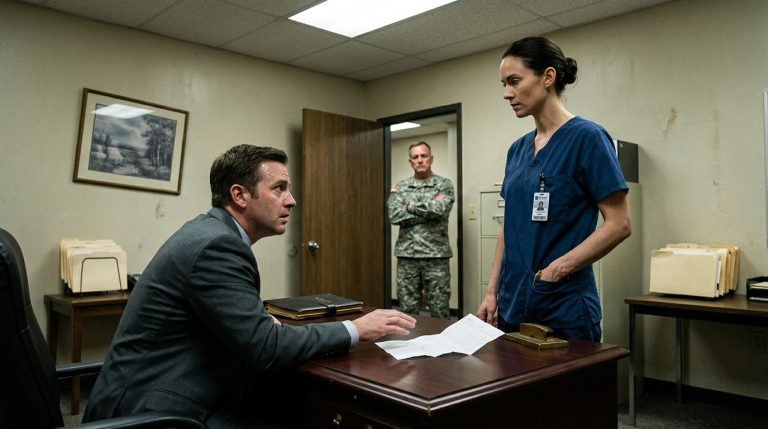
The air in the office grew impossibly thin, thick with the scent of ozone and the looming, invisible weight of impending disciplinary action. The Command Sergeant Major, a man whose face was a map of hard, unforgiving lines and whose stature seemed to occupy more space than the small room allowed, stood framed in the doorway. Behind him, the corridor lights hummed with a harsh, flickering fluorescence. He didn’t look at the files on the desk immediately. His eyes—pale, predatory, and incredibly still—locked onto Miller, then shifted slowly to Dean, assessing the threat level with the cold, mechanical precision of a ballistic computer.
“Miller,” the CSM said. His voice was not loud, but it possessed a gravity that pulled the oxygen right out of the room. “You were ordered to contain a breach. I see no containment. I see an unauthorized civilian in a restricted space, and I see classified documents laid out like a school project.”
Miller stood frozen, his hand still hovering near his holster. The internal conflict was etched into his face, a struggle between the indoctrinated loyalty to his superior and the devastating clarity of the maps on the desk. “Sir, there’s an issue with the drainage sector. The sensors—”
“The sensors are under review,” the CSM interrupted, never taking his eyes off Dean. He took a single, slow step into the room, the heel of his boot clicking against the linoleum with the sound of a closing casket lid. “And you, Mr. Peters, are a long way from the retirement home. You seem to have misplaced your clearance forty years ago, yet here you are, rifling through internal logistics.”
Dean didn’t shrink back. He knew this man—or rather, he knew the type. The men who spent their lives protecting the reputation of the machine, regardless of what the machine was crushing under its gears. Dean reached down, his fingers brushing the edge of the leather-bound document case, drawing a sense of stability from the tactile reality of the evidence.
“I didn’t come to look for a job, Major,” Dean said, his voice steady despite the familiar, crushing ache in his lungs. “I came to verify that the fault line is still where we put it.”
The CSM smiled, a thin, mirthless line that didn’t reach his eyes. “You were always a detail-oriented man, Dean. That’s why you were chosen for the project. You had a knack for burying things so deep that even the gravity didn’t notice them.”
The implication hung in the air: a confession, or something dangerously close to it. Miller’s grip on his pistol loosened, his eyes darting between them as the reality of their connection dawned on him. He hadn’t just stumbled into a civilian intrusion; he had stumbled into a history lesson that had been suppressed with extreme prejudice.
“Miller,” the CSM said, without turning his head. “Escort Mr. Peters to the holding facility. Do not let him communicate with anyone. Not the press, not the base communications hub, not the outer perimeter. He is to be processed as a trespasser, and his materials are to be confiscated for immediate shredding.”
Miller didn’t move. The order was direct, clear, and violated every instinct Miller had developed
CHAPTER 4: The Ledger of Lies
The door shuddered under the sudden, forceful pressure from the outside. Miller instinctively retreated a half-step, his hand hovering over his sidearm, his eyes locked on the latch as it began to rotate further. Dean, however, didn’t move. He stood anchored to the desk, his gaze fixed on the steaming mug. It was still radiating warmth, a tiny, defiant thermal signature in a room that felt increasingly like a tomb.
“Step away from the desk, Sergeant,” a voice commanded from the hall—cold, clipped, and terrifyingly familiar to the man in the tactical vest.
Miller looked at Dean. His face was a map of sudden, frantic calculation. He was caught between his oath to his superiors and the terrifying gravity of the document case now lying open between them. He turned his head slightly, acknowledging the threat at the door, but his body remained angled toward the desk, toward the maps that had just rewritten his reality.
“The order stands, Sergeant,” the voice outside repeated, louder now, the authority dripping with the menace of a man who dealt in certainties. “Step back. Clear the room. The target is unstable.”
Dean reached out, his hand trembling slightly, and snatched the top map—a detailed survey of the sub-surface strata—and slid it into the inner pocket of his heavy coat. He didn’t look at Miller; he looked at the coffee mug again. He noticed something he hadn’t before: a small, embossed insignia at the base of the ceramic. It was the same mark as the one on the document case.
“They’re already inside,” Dean whispered, his voice barely audible over the mechanical groaning of the door frame. “They’ve been watching since we hit the perimeter. Miller, if you open that door, you’re not serving the base. You’re clearing the scene.”
Miller’s hand tightened on his sidearm, the leather of his holster creaking. He was a creature of command, but the Command Sergeant Major on the other side of that door was the one who had facilitated the silence, the one who had maintained the lie that now threatened to poison every soldier on this range.
“Why tell me?” Miller hissed, his eyes darting to Dean. “Why drop this on me?”
“Because you have the authority to call the EPA,” Dean replied, his voice devoid of pretense now. “I’m a dying man. My testimony is worth nothing. But a line report from a senior NCO? That’s an audit.”
The door swung open with a violent, metallic crash against the interior wall.
A figure stepped into the threshold, framed by the blinding, white-hot light of the afternoon sun. Command Sergeant Major Vance was a man built of sharp angles and brutal discipline, his uniform pressed so crisply it seemed to have edges that could cut. He didn’t look at Dean at first. He looked at Miller.
“I gave you an order, Sergeant,” Vance said, his eyes scanning the desk, the open case, and the map that Dean had just secured.
“Sir,” Miller began, his voice surprisingly steady, though his grip on his weapon remained tight. “I have a civilian here making claims about sub-surface contamination. He has documentation that doesn’t match the current base records.”
Vance smiled, but it didn’t touch his eyes. It was a cold, practiced expression that signaled the end of debate. He didn’t move toward the desk. He stayed in the doorway, his silhouette blocking the path to the hallway. He was a wall of absolute, institutional finality.
“Documentation is easily forged, Sergeant. And curiosity is a contagion we cannot afford to spread on this base. Step aside.”
Dean felt the surge of adrenaline in his system—the last, frantic rush of a man who knew his time was running thin. He looked at the window, then back to the desk. His eyes landed on the ledger—a heavy, black-bound book that sat partially obscured by the map case. He reached for it, his movements deceptively slow.
“You’re not going to let him see the rest, are you, Vance?” Dean asked, his voice steadying. “You’re going to treat me just like the others. Just like the team in 1986.”
Vance’s gaze hardened. He stepped into the room, his presence filling the small space like rising water. The air felt thin, electric. Miller took a half-step forward, placing himself between Vance and the desk.
“Sir, wait,” Miller said, his voice rising, a tremor of protest in it. “If there is any question about the integrity of this sector—”
“There is no question, Sergeant,” Vance interrupted, his voice dropping into a low, terrifying register. “There is only compliance. Your career, your reputation, your future—all of it rests on your ability to distinguish between a threat and a misunderstanding. This is a misunderstanding. Leave the room.”
Dean watched the tension in Miller’s shoulders. He saw the exact moment the younger man’s loyalty fractured. It wasn’t a sudden break; it was a slow, agonizing realization. Miller looked at the desk, at the damning cross-sections of the earth, then at the man who had been his mentor.
“The mug, Sergeant,” Dean said, his voice quiet, almost conversational. “Look at the base. It’s not just a mess hall cup. It’s an asset tracker. That’s how they knew where to intercept us.”
Vance’s eyes flickered to the desk, his composure faltering for a micro-second as he realized Dean had identified the final link in the surveillance chain.
Miller’s thumb moved to the safety of his weapon.
The room went deathly still. The only sound was the distant, muffled crack of a rifle from the range, a sound that seemed to signal the start of something far more dangerous than a simple exercise.
Dean stood perfectly still, his hand resting on the black ledger, waiting for the choice that would define the rest of Miller’s life—and the final legacy of the base itself.
CHAPTER 5: The Strategic Leak
The sudden, absolute erasure of the overhead fluorescent lights was not a smooth dimming; it was a violent amputation of reality. One microsecond, the room was bathed in the harsh, sterile glow of institutional authority; the next, it was submerged in a suffocating, ink-black void. The only remaining light came from the thin, vertical sliver of the afternoon sun slicing through the slightly ajar door, casting long, distorted shadows across the linoleum.
In the darkness, the silence was heavy, broken only by the sharp, rasping intake of breath from Miller. Dean didn’t move. He kept his hand pressed firmly against the leather of the ledger, his heart hammering against his ribs like a trapped bird. He heard the faint, rhythmic scuff of a boot—someone was adjusting their stance. The air smelled of ozone, the sudden acrid bite of a blown transformer, and the metallic tang of blood—his own, from a shallow cut on his palm where he’d pressed too hard against the desk’s sharp edge.
“Miller,” Vance’s voice cut through the dark, cold and devoid of fear. “Do not let the darkness dictate your objective. Secure the perimeter of this desk. Now.”
“I can’t see a damn thing, sir,” Miller replied, his voice strained. He sounded closer now, his presence a dark, hulking shape just inches from where Dean stood.
Dean acted. He didn’t reach for a weapon; he reached for the only thing he had that could serve as a distraction. He grabbed the heavy ceramic mug—still warm—and hurled it toward the far corner of the room, near the metal filing cabinets. The sound of ceramic shattering against steel was sharp and jarring, a violent disruption in the tension.
“Contact!” Dean shouted, his voice rasping, feigning the panic of a man cornered.
The result was instantaneous. Miller pivoted, the tactical light mounted on his sidearm suddenly erupting in a blinding, strobing beam of white light. The room was washed in frantic, jerky visuals: Vance, caught in the act of drawing his own sidearm; the scattered papers on the desk; the empty doorway.
The light hit Vance’s face, illuminating the raw, predatory calculation in his eyes. He didn’t look startled; he looked annoyed. He raised his weapon, the barrel steady, aimed not at the corner where the mug had shattered, but directly at the desk—at the ledger.
“Enough of this,” Vance growled.
He lunged forward, his movement terrifyingly fast for a man of his age. Miller, caught between the instinct to protect the evidence and the conditioned reflex to obey the Command Sergeant Major, hesitated. In that heartbeat of uncertainty, Dean slid the ledger across the desk, pushing it toward the shadows behind the cabinet.
Vance’s reach missed the ledger, his hand striking the hard edge of the desk instead. The impact of the blow didn’t slow him; it only seemed to sharpen his focus. He swiveled, his weapon now leveled at Dean’s chest.
“You think you’re a hero, Dean?” Vance hissed, closing the distance until the barrel of his gun was inches from Dean’s coat. “You’re a ghost. You’re a man who signed the same waivers I did. You were the one who held the shovel, remember? You were the one who told the young ones it was safe to sleep in the tents.”
Dean felt the cold press of the steel against his sternum. The words hit him harder than any physical blow. They were the truth—the jagged, ugly truth he had been trying to suppress for forty years. He wasn’t the whistleblower; he was the accomplice.
“I remember,” Dean whispered, his voice trembling. “That’s why I’m here. To make sure the ground is finally accounted for.”
Miller stepped in, his weapon now leveled directly at Vance. The sergeant’s face was pale, his eyes wide and unblinking. “Sir, put the weapon down. If there’s an audit, we handle it through the proper channels. We don’t… we don’t do this.”
“The proper channels were flooded with cement decades ago, Sergeant!” Vance shouted, his focus fracturing as he realized he had lost control of the room. He didn’t look at Miller; he looked at Dean, his gaze filled with a desperate, furious contempt. “You want the truth? The truth is that this facility is the backbone of the region’s readiness. You tear it down, you tear down the whole sector’s defense grid.”
“Then let it fall,” Miller said, his voice dropping to a low, chilling whisper.
The air in the room was electric, the tension reaching a breaking point where the slightest friction would ignite the entire scene. Dean felt the weight of the ledger in the shadows behind him. He reached back, his fingers closing around the cold, textured binding.
Vance noticed the movement. He shifted his weight, preparing to lunge, but before he could close the gap, a low, ominous rumble vibrated through the floorboards of the shack. It wasn’t the sound of a transformer blowing or a door slamming. It was the sound of the earth itself shifting, a deep, grinding groan that vibrated up through the soles of their boots.
The lights flickered back on, weak and buzzing, revealing the room in a jarring, surreal light. Everything was in disarray. But the rumble didn’t stop; it intensified.
Outside, a low, rhythmic thrumming sound—like a heavy machine struggling to stay upright—began to echo across the firing range. It wasn’t the wind. It was the sound of the ground failing, the internal structure of the containment vault finally buckling under the weight of decades of neglect.
Vance looked toward the window, his confidence shattered by the unmistakable sound of a structural collapse. He stumbled back, his weapon wavering.
Dean stood tall, the ledger held firmly in his hand. He hadn’t just brought paper; he had brought the realization that the cover-up was no longer a secret—it was a catastrophe.
“The ground is talking, Major,” Dean said, his voice quiet, almost mournful. “You think you can silence the land? You think you can arrest a sinkhole?”
Vance stared at the window, the color drained from his face. The reality of the situation had finally overtaken the illusion of his control. Miller moved to the window, his eyes scanning the range.
“Sir,” Miller said, his voice hoarse. “The observation tower. It’s… it’s leaning.”
The tower, a steel sentinel that had stood for half a century, was slowly, agonizingly tilting to the side as the very earth it was anchored to gave way to the void beneath. The game had changed. The standoff was over. The physical truth had begun to manifest, and there was no longer a file folder or a silencing order in the world that could contain it.
CHAPTER 6: The Erosion of Authority
The sound was not merely a noise; it was an impact—a deep, tectonic shudder that traveled up through the floorboards and settled in the marrow of Dean’s bones. The command shack groaned in sympathy, the metal frame twisting as the ground beneath it surged. Command Sergeant Major Vance was thrown off balance, his boot skidding on the loose floor tiles. For a fleeting second, the iron-clad exterior of his discipline flickered, replaced by the raw, wide-eyed alarm of a man who had suddenly realized the ground he stood upon was no longer solid.
Dean didn’t retreat. He stood rooted, his hand still clamped to the black-bound ledger, watching the dust billow in the doorway like a gray shroud. The light from the hallway was now fractured, obscured by the shifting silhouette of the collapsing tower outside. The sky, once a brilliant, unblemished blue, was now choked with a rising plume of ochre grit.
“Get out!” Vance roared, his voice thick with a mixture of rage and terror. He wasn’t talking to Dean anymore; he was yelling at the base, at the world, at the failure he had spent four decades trying to ignore. He lunged toward Miller, grabbing the younger man by the shoulder, but Miller swatted his hand away with a ferocity that surprised them both.
Miller was staring at the window, his weapon lowered. He looked at the mangled heap of steel that had been the observation tower—now a shattered ribcage of iron—and then at Vance. “You knew,” Miller said, the words barely audible over the ongoing grinding of the earth. “You didn’t just maintain this place. You were the one who signed the supplemental reports for the foundation. I found them, sir. In the sub-level archives. They weren’t lost. They were archived.”
Vance stopped. The frantic energy left his body in a sudden, chilling deflation. He looked at Miller, his face suddenly appearing years older, the skin sagging around his eyes. “You have no idea what you’re looking at, Sergeant. You see a lie. I see a fortification. We gave this unit a mission, and a home. Do you have any idea what happens to the perimeter if we admit this land is poison? We don’t just lose a firing range; we lose the entire logistics chain.”
“We lose our lives!” Miller countered, his voice snapping. “Look at the perimeter fence!”
Dean peered through the window. The chain-link fence, previously a taut, straight line, was now drooping, the fence posts sinking into the soft, yawning fissure that was opening along the northern boundary of the range. The earth was literally swallowing the infrastructure.
“It’s not just the tower,” Dean said, his voice quiet, carrying over the roar of the settling ground. “The containment vault is venting. The chemical breakdown has been accelerating for years, and the shifting earth is finally opening the seals.”
Vance spun toward Dean, his eyes burning with a desperate, last-ditch venom. He leveled his weapon again, the barrel trembling. “You,” he hissed. “You were the foreman. You were the one who poured that concrete. You knew the mix was wrong. You knew the waste wouldn’t hold.”
“I knew,” Dean admitted, his voice hollow, the weight of the confession finally settling onto his shoulders. He felt the cold iron of the ledger in his grip—the final, damning proof of his own silence. “I was young, and I was told it was a temporary fix. I spent forty years waiting for it to leak. And now, here we are.”
The floor beneath them gave another violent lurch, sending the desk sliding toward the wall. Vance lost his footing entirely, crashing down onto the desk, his weapon skittering across the floor. Miller didn’t hesitate; he moved to intercept, his tactical training overriding the shock of the moment. He pinned Vance against the desk, the older man’s struggle weak and frantic, the fight of a man whose world was physically disintegrating around him.
“You’re finished, Major,” Miller said, his voice cold, devoid of the respect he had carried for years. “The base command is going to be swarming this sector in minutes. We have the logs. We have the maps. And we have the witness.”
Vance let out a dry, hacking laugh, his head dropping onto the scarred surface of the desk. “You think they don’t know? You think I’m the only one who signed off on the integrity of this sector? You’re not uncovering a secret, Sergeant. You’re uncovering the entire foundation.”
Dean watched the struggle, the cold realization dawning on him that Miller’s idealism was about to be crushed by the sheer scale of the institutional rot. He reached into his coat and pulled out the pocket watch—the one with the frozen hands. He looked at the face, the rusted glass, the stillness. He had kept it for years as a reminder of the time the world stopped, and now, it seemed, the world was finally catching up.
“It’s not about what they know,” Dean said, stepping toward the desk. He looked down at Vance, his eyes weary, reflecting a lifetime of accumulated regret. “It’s about what we leave behind. I spent my life in the shadows of this lie. I’m not going to die in one.”
The shack shook again, a deeper, more profound vibration that rattled the windowpanes in their frames. The emergency sirens began to wail in the distance—a high, mournful sound that signaled the total evacuation of the base. It was the end.
Miller looked at Dean, his face set in a grim, hard line. “What happens now?”
“Now,” Dean said, looking at the ledger in his hands, “we carry this out. All the way out.”
He turned toward the door, stepping over the debris and the shattered remains of the office. The air outside was thick with dust, the sun a pale, sickly disc behind the haze. The entire range was shifting, the earth itself turning against the architecture of the base. Dean stepped out into the grit-choked air, the ledger held to his chest like a shield. He didn’t look back at the shack, or at the broken tower. He looked toward the gate, toward the world that had been shielded from this truth for too long, and began the long walk toward the perimeter.
CHAPTER 7: The Consequence of Dust
The world was not just collapsing; it was being erased. As Dean and Miller picked their way across the shattered landscape, the ground beneath their boots felt soft, spongy, and dangerously yielding. The dust, a thick, metallic-tasting silt, hung in the air like a localized fog, obscuring the horizon. Dean gripped the ledger to his chest with both arms, his breathing coming in ragged, shallow hitches. His heart was a frantic, irregular drum in his ears, a protest against the exertion of the trek.
“Keep your eyes on the solid ground,” Miller commanded, his voice tight, his hand resting instinctively on his weapon. He was walking ahead, testing the earth with the tip of his boot before committing his weight. His face was a mask of grim, professional focus, but his eyes betrayed a flicker of genuine shock every time the ground sighed and shifted under them.
Dean looked down at his own feet, at the heavy, worn leather of his boots. He remembered standing in this exact spot forty years ago, watching the concrete trucks pour the foundation for the command tower. He remembered the specific shade of gray the wet cement had been, and the way the foreman had laughed about the “bonus” they were putting into the mix to make it set faster. He remembered the smell of the chemicals—a sharp, sweet, acidic odor that stayed in the back of his throat for days.
“It’s not just the fence, Miller,” Dean rasped, his voice barely audible over the low, rhythmic groaning of the earth. “The whole sector is a honeycomb. We didn’t build a bunker; we built a tomb, and we just happened to be the ones who got the keys.”
Miller paused, looking back over his shoulder. The gray haze caught the sweat on his forehead, turning it into streaks of grime. “Why didn’t you stop it? Why wait forty years?”
Dean stumbled, the ground under his left boot dropping an inch, a sickening sensation like stepping into a shallow grave. He caught his balance, leaning heavily against a remnant of the perimeter fence that was still standing, though twisted at a sickening angle. “Because I was a coward. And because I was told that if I spoke, the site would be scrubbed, and the people who lived in this valley would be the ones to pay the price. I thought I was protecting them by keeping the secret.”
“You weren’t protecting anyone,” Miller said, his voice flat. “You were just managing the decay.”
The brutal honesty of the statement hit Dean with more force than the physical exhaustion. He looked at the ledger, the leather cover now coated in a fine layer of gray dust, and realized that Miller was right. He hadn’t been a guardian; he had been a clerk, bookkeeping for a catastrophe that he had helped organize.
They reached the crest of a small hill—a rise that had been artificial, built to provide a vantage point for the security teams. From here, they could see the gate. It was a half-mile away, but between them and the safety of the asphalt road lay a landscape of splintered earth, exposed conduit, and the skeletal remains of equipment that had been buried in the initial cleanup.
Suddenly, a blinding flash of red light erupted from the direction of the gate—the base’s emergency signal, pulsing with a rhythmic, hypnotic urgency. The sound of heavy machinery followed, a low, mechanical growl of trucks and armored personnel carriers arriving from the main entrance.
“They’re closing the perimeter,” Miller said, his voice rising. “They aren’t here to help; they’re here to quarantine. If we don’t get through that line, we’re going to be processed as part of the waste.”
Dean’s legs felt like lead, the fire in his chest reaching a point of critical, agonizing heat. He stopped, his lungs failing, his hands clutching the ledger so hard the binding groaned. He knew he couldn’t make the distance. His body was a machine that had reached the end of its cycle.
He leaned against the fence, his breathing coming in thin, wheezing gasps. “Go, Miller.”
Miller turned, his eyes narrowing as he scanned Dean’s face. “The hell I will. We’re getting that book to the gate, and we’re getting you to a medic.”
“I don’t need a medic,” Dean said, a faint, weary smile touching his lips. He held the ledger out toward the younger man. The leather was cold, the paper inside weighted with the truth of a thousand compromises. “I need you to finish the inspection. You’re the only one left who knows what the soil is supposed to taste like.”
Miller took the book, his hand steady. He didn’t look at the ledger; he looked at Dean. The transition was complete. The authority had passed, the secret had changed hands, and the weight of the past had finally been unburdened.
“They’re coming,” Miller warned, pointing toward the approaching lights.
Dean stood straight, his posture rigid, his gaze fixed on the horizon. He was tired—more tired than he had ever been in his life. The ground gave another low, resonant moan, as if acknowledging the end of its long, restless sleep.
“Let them come,” Dean said, his voice calm, the sharp edges of his resolve softening into a quiet, profound stillness. “The ground is finally telling the truth. It’s the only thing left to do.”
As Miller turned and began the steady, determined run toward the gate, Dean stayed behind, leaning against the twisted fence, watching the dust of the collapsing facility drift toward the sky, a final, gray witness to the truth that was finally being set free.
CHAPTER 8: The Weight of the Ledger
The perimeter gate was a monolith of steel and wire, bathed in the harsh, strobe-like pulsation of emergency floods. The air was a chaotic swirl of grit, the sound of the base’s internal structures groaning as the earth beneath them surrendered to gravity. Miller reached the gate with his lungs burning, his movements heavy with the accumulated exhaustion of the last few hours. Behind him, the range was effectively vanishing—the command shack, the tower, and the secrets of 1986 were being swallowed by the shifting terrain.
Two guards stood at the gate, their rifles slung but their expressions locked in a state of confused, rigid authority. They were young, their faces pale under the harsh glare of the floodlights, uncertain whether to hold the perimeter or flee the encroaching tremors. As Miller approached, he didn’t stop. He slowed only enough to hold the black-bound ledger aloft, a signal flare of undeniable evidence.
“State your business, Sergeant,” one of the guards demanded, his voice cracking. He raised his hand, gesturing for Miller to halt. “The base is under lockdown. No one enters or leaves.”
“The base is under collapse,” Miller shot back, his voice raw, ringing with the authority of a man who had seen the foundation of his career turn to liquid. He kept moving, closing the distance until he was within arm’s reach of the guard. “And I have the audit of this sector. You can either take this ledger, or you can watch the perimeter fence get pulled into the sinkhole behind us.”
The guard hesitated, his eyes flicking to the ledger, then to the chaos unfolding in the distance. The ground gave a violent, sickening lurch—the final, massive failure of the containment vault. The gate shuddered on its hinges, the ground beneath the guard’s feet cracking open in a jagged, dark vein. The guard didn’t wait for a command. He reached out, his hand trembling as he took the ledger from Miller.
“Major Vance is still back there,” the other guard whispered, his face turning ashen.
“Vance is history,” Miller said, his tone final.
He didn’t look back. He pushed past the gate, his boots finding the solid, unyielding surface of the asphalt road outside. He stopped, finally, and breathed in air that didn’t taste of ozone or industrial waste. He looked toward the distance, where the silhouette of the base was being steadily erased by the rising dust and the uneven, broken horizon.
He thought of Dean—the old man who had chosen to stay behind, to finish his watch in the dust of his own making. Dean hadn’t wanted rescue; he had wanted accountability. He had wanted the ledger to be the final word in a life defined by silence.
The Payoff arrived moments later. From the direction of the gate, the sound of official, heavy-duty engines roared into view—not the base’s internal security, but the distinct, coordinated arrival of state-level emergency vehicles. The ledger was being opened, the maps were being scrutinized, and the reality of the toxic legacy was being read aloud by officials who had no interest in protecting the reputation of a defunct military command.
Poetic Justice was a slow, grinding process, but it was absolute. As Miller watched, he saw the Command Sergeant Major’s staff vehicles stopped at the perimeter by the very agencies that had been kept in the dark for decades. Vance, standing in the glare of the lights, looked small—a man stripped of his uniform and his context, caught in the inescapable jaws of the inquiry he had worked his entire life to prevent. He stood motionless, watching as the ledger was passed from hand to hand, the weight of it finally crushing the architecture of his influence.
The Cool Down took hours. The sun dipped below the horizon, painting the sky in colors that seemed to mock the devastation below—deep, bruised purples and blood-orange streaks. Miller sat on the hood of a idling transport, the vibration of the road a comforting, steady pulse beneath him. He was tired—a deep, soul-level fatigue that he knew would take months to shed.
He reached into his pocket and pulled out the small, rusted pocket watch he had taken from Dean’s jacket—the one with the frozen hands. He traced the cracked glass with his thumb, the texture familiar and grounding. It was a relic of a failed time, a marker of a mistake that had finally been rectified. He realized then that he wasn’t carrying a burden; he was carrying a memory.
He placed the watch back into his pocket, the metal cool against his thigh. The character arc of his own life had shifted, the rigid, unquestioning soldier dying in the dust of the firing range, replaced by someone who understood that the true strength of a wall wasn’t in its height, but in the integrity of the ground beneath it.
The base was gone, a sinkhole of silence where a proud history had once stood. But the truth was out in the air, drifting over the valley, no longer buried, no longer hidden. Miller looked toward the road, toward the vast, dark expanse of the world beyond the gate, and felt the quiet, steady growth of a future that finally belonged to him.