[The Weight of Iron and Retribution: How a Quiet Suburban Driveway Became a Masterclass in Tactical Defiance]
CHAPTER 1: THE FIRST STRIKE
The engine wasn’t even cool yet when the boy blocked the path, his palm coming down hard against the hood of Lisa’s red classic with a flat, insulting slap.
“This car is mine now,” Chadwick said. His voice didn’t waver. It carried the dangerous, hollow certainty of someone who had never once heard the word no from a mouth that mattered.
Lisa didn’t blink. She sat behind the wheel, her hands resting lightly on the leather-wrapped steering wheel, fingers curved with the static tension of a predator calculating distance. Her gaze was sharp enough to cut glass.
“You ever driven anything that hits back harder than your mother’s golf cart?” she asked.
There was no heat in her tone. It was flat, measured, and absolute.
I stood a few feet away, the gravel shifting under my shoes, my muscles tightening into a hard knot. Two years in this suburban grid of trimmed hedges and matching mailboxes had taught us one immutable law: peace here wasn’t a given; it was a temporary truce maintained by people who weaponized politeness. Chadwick and his mother ran this little kingdom like petty tyrants, and today, they had decided our garage was their next acquisition.
Chadwick smirked, his phone already out, recording the angle of his profile against the fender. “Name a price. The community owes us anyway after your little stunt last month.”
Lisa cut the engine. The silence that rushed in to fill the void was heavy, thick with the scent of hot oil and impending friction. She slipped out of the driver’s side with a fluid, economical grace, sliding past him so closely her jacket brushed his shoulder.
“When your son learns what a clutch does,” she murmured, not even looking back as she walked toward the front steps, “he can practice on a simulator.”
I held my ground for a heartbeat longer, staring down the seventeen-year-old as he opened his mouth to formulate a comeback. But before a sound left his throat, my pocket vibrated against my hip. I pulled out my phone. A real-time notification from the perimeter sensor flashed across the screen: Rear driveway security zone breached.
I looked back at Chadwick. He was grinning at his phone screen, entirely unaware that the red classic sitting ten feet away was wired into an independent telemetry system he couldn’t even begin to decode.
CHAPTER 2: THE CAR MEET CONFRONTATION
The blue glow of the monitor cast long, jagged shadows across the kitchen counter. I stared at the frozen frame of Chadwick standing by our fence, his phone held like a shield, completely blind to the fact that Lisa’s network didn’t just record intrusions—it mapped them.
Beside me, the low hum of the refrigerator seemed to stretch, echoing an old memory of a blown gasket I’d dealt with years ago on a desolate stretch of interstate—a time when things were simple, when a machine broke because of heat or friction, not because some spoiled adolescent wanted to use it as a prop for his online validation.
“He’s doubling down,” I said, my voice dropping into the quiet.
Lisa didn’t look up from the tablet where she was reviewing the encrypted telemetry logs. The kitchen smelled faintly of old coffee grounds and the crisp, ozone bite of the night air drifting through the cracked window. Her fingers moved across the glass with clinical precision.
“Let him,” she murmured, her tone devoid of anger. It was something colder. Precision wrapped in patience. “People who build their lives on performance usually forget how to handle a real machine.”
The community lot two blocks over was supposed to be a neutral zone for engine enthusiasts—a place where people who actually understood torque could gather on Saturday mornings without the static of neighborhood politics. But by the time we pulled in two days later, the monthly meet felt less like a gathering and more like a staged set.
Lisa’s red classic rolled into the lot with an exhaust note that cut straight through the chatter of lawnmowers and idling sedans. It wasn’t loud to compensate for anything; it was deep, balanced, and heavy with intent. Heads turned instantly. A few of the older gearheads standing by an open hood nodded in quiet respect.
Then came the sound of expensive sneakers crunching on loose gravel.
Chadwick stepped out from behind a pristine, rental-grade sports car that looked like it had spent its entire life inside a dealership showroom. He wore a jacket that cost more than my first set of tools, the collar popped just enough to catch the midday sun. Behind him trailed his usual entourage of two younger kids holding tripods and gimbals, their lenses tracking every inch of Lisa’s classic.
“Nice paint,” Chad said, stepping directly into our path before Lisa could even kill the ignition. His voice had that practiced, performative cadence of someone speaking to an imaginary audience. “Too bad it’s parked in the wrong driveway.”
Lisa cut the engine. The abrupt silence of the block felt heavy. She opened her door and stepped out, her movements unhurried, her boots hitting the asphalt with a solid, unapologetic thud.
“You’re standing in the way of a machine that requires a clutch, Chadwick,” Lisa said, her voice flat. “Move your camera.”
Chadwick didn’t move an inch. Instead, he flashed a tight, rehearsed grin at his recording entourage. “Name a price. The board’s been looking into historical vehicle ordinances anyway. You don’t want a compliance violation hanging over your head, do you? Especially not with parts this rare.”
A subtle chill went down my spine. Parts this rare.
We hadn’t listed the custom specifications of the engine anywhere public. The rebuild sheet was locked in a physical safe in our office. Yet here stood a seventeen-year-old kid parroting language that belonged in a high-end salvage manifest, not a neighborhood dispute.
Lisa caught it too. I saw the microscopic shift in her posture—the tightening of her jaw, the way her eyes locked onto the specific serial plate riveted beneath the classic’s hood. Her expression didn’t flare with temper; it hardened into something tactical.
“Parts are only rare,” Lisa said smoothly, stepping past him with deliberate grace, “when you don’t know who built them.”
Chadwick spun around, his ego stinging from the casual dismissal, but Lisa was already walking toward the center of the lot, leaving him standing there in the dust of his own making, staring at a lens that was starting to capture more than he intended.
CHAPTER 3: THE MIDNIGHT INTRUSION
The sun dropped low behind the manicured roofs of the subdivision, casting long, bruised shadows across the trimmed hedges and identical mailboxes. To anyone else, it looked like the picture of suburban peace. But standing on the back porch with the cold metal of a flashlight casing gripped in my hand, the silence felt brittle. Engineered.
Lisa sat at the kitchen island, the amber glow of a single desk lamp illuminating the schematics of the red classic’s custom fuel-injection mapping. She didn’t look up as I slid the glass door shut behind me, but the tension in the set of her shoulders told me she was tracking the same silence I was.
“They’re not going to let it rest at a verbal sparring match,” I said quietly, leaning against the counter. “Chadwick didn’t just guess about those rare engine parts. Someone told him. Or someone gave him a manifest.”
Lisa’s fingers paused over the trackpad. She turned her head slightly, her gaze locking onto the live security feeds displayed on the secondary monitor. “A seventeen-year-old kid doesn’t know the difference between a forged piston and a stock block unless he’s been handed a spec sheet by someone who wants to harvest them. The HOA’s architectural committee has been auditing garage modifications under the guise of compliance. They’re cataloging assets.”
The realization settled in the room like a drop of heavy oil in water. The neighborhood association wasn’t just a group of bored busybodies enforcing lawn height; it was a front for a quiet asset acquisition ring, leveraging fake municipal code violations to pressure residents into selling high-value classic vehicles or rare components for pennies on the dollar. And Chadwick was their blunt instrument—the camera-wielding distraction pushed out front while the paperwork ground away behind the scenes.
“We need to move the classic to the off-site garage tonight,” I said, stepping toward the hall.
“No,” Lisa replied, her voice dropping an octave into that absolute, unyielding register that brooked no argument. “If we move it now, we validate their manufactured jurisdiction. We let them dictate the terms of our property rights. Let them come and try to look under the hood themselves.”
She didn’t have to wait long.
A little past midnight, the low hum of the perimeter monitor chimed—not with a sharp alarm, but with the silent, pulsing amber blip of a motion sensor triggered near the side fence. I moved to the window, my muscles locking into place.
Three figures skirted the shadow of the property line, moving with the awkward, hurried gait of amateurs who thought darkness made them invisible. In the lead was Chadwick, clutching a heavy canvas tool bag against his chest. Behind him, two younger shadows crept forward, their movements jerky, illuminated only by the faint, eerie glow of a handheld flashlight beam sweeping low across our gravel path.
I looked at Lisa. She hadn’t panicked. She hadn’t even stood up abruptly. Instead, she picked up her phone, her thumb unlocking the secondary override system with cold efficiency.
“Watch the flower bed on the left,” she whispered.
Through the double-pane glass, I watched the lead figure reach out, his gloved fingers wrapping around the chrome handle of the red classic’s driver-side door.
Lisa pressed a single command on her screen.
The response was instantaneous and brutal. It wasn’t a standard, high-pitched car alarm that chirped for attention. It was a synthesized, deafening roar—a low, concussive frequency routed directly through custom subwoofers mounted beneath the chassis that shook the windowpanes in our frames. Simultaneously, a sharp, pressurized burst from the rear exhaust ports detonated a harmless but blinding flash of heat and unburned fuel, making it look and sound as though the engine block had just breathed fire into the dark.
The effect was absolute chaos.
The three figures screamed in unison, their bodies scattering like broken glass. Chadwick dropped his tool bag with a heavy, metallic clatter, tripping backward over his own feet and plunging directly into our carefully mulched flower bed. His shadows didn’t even look back; they bolted toward the street, scrambling over the low decorative fence in a panic of flying mulch and frantic breaths.
Chadwick scrambled up, his face pale under the amber streetlights, clutching his bruised elbow as he stumbled away into the safety of the dark road, leaving his tools scattered across our driveway like discarded armor.
Lisa leaned back against the kitchen counter, sliding her phone into her pocket with a slow, deliberate motion. The silence rushed back in, heavy with the scent of scorched ozone and disturbed earth.
“They’re lucky,” Lisa said quietly, her eyes reflecting the cold blue light of the monitor. “I was feeling generous tonight.”
I stared down at the scattered tools gleaming under the security lights, knowing full well that the violation notice would arrive on our porch by sunrise.
CHAPTER 4: THE ARRIVAL OF THE TRANSPORT
I crouched beside the churned-up mulch, my fingers closing around a small, discarded piece of metal left behind in the frantic retreat. It was a titanium lug nut, custom-machined—not something you buy at a hardware store, and certainly not something a group of teenagers carries around for casual trespassing. It belonged to specialized tuning gear. The kind used by high-end transport crews.
Lisa stepped out onto the back porch, her boots crunching softly on the gravel. She didn’t look down at the part in my hand; her gaze was fixed on the far corner of the street where the amber glow of the municipal lights cut through the rising fog.
“They aren’t just trying to intimidate us anymore,” I said, standing up and wiping the dark soil from my palms. “This is escalation. The HOA isn’t writing letters tomorrow morning. They’re mobilizing.”
Lisa’s expression didn’t flicker. It tightened, sharpening into that cold, calculated focus that preceded every major move she made. “Let them bring their paperwork,” she said, her voice low and steady. “We’re done waiting for their schedule.”
Two mornings later, the quiet of the cul-de-sac was shattered by a sound that didn’t belong in a neighborhood of trimmed hedges and matching mailboxes. A heavy diesel engine roared down our street, its deep, guttural exhaust note vibrating through the glass of our front windows before a massive race transport truck rolled into view like thunder on twelve wheels.
Brakes hissed with a sharp, pneumatic gasp as the rig pulled up directly across from our driveway, blocking the narrow lane. Side panels swung open to reveal a full professional paddock setup: tool chests, diagnostic rigs, telemetry laptops, and spare slicks mounted on aluminum racks. Crew members in matching black uniforms stepped out with the disciplined, synchronized precision of a pit stop team, immediately setting up cones and unspooling heavy rubber cables.
Neighbors began to peer through parted blinds. Front doors clicked open across the street. Grown men stepped onto their manicured lawns, pretending to inspect their sprinklers while rubbernecking at the absolute spectacle unfolding before them.
Lisa stepped out of the front door. She wasn’t wearing casual weekend clothes. She wore her full-face racing suit down to the waist, the arms tied securely around her hips, revealing a dark compression shirt that mirrored the sharp, unyielding lines of her posture. Under one arm, she tucked a carbon-fiber helmet.
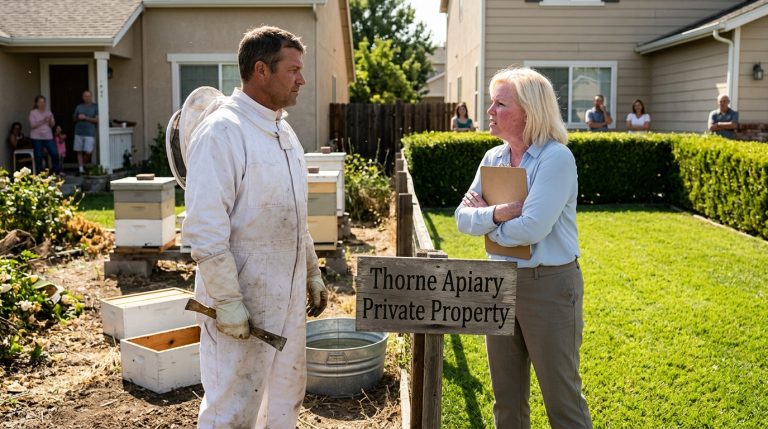
She walked past the transport rig, ignoring the staring crowd, and marched straight toward the community association office on the corner where the board president was already standing on her porch, clutching a clipboard like a shield.
I followed close behind, carrying a heavy, sealed packet of legal documents we’d compiled over the past forty-eight hours—subpoenas, property protection injunctions, and formal filings detailing systemic harassment and administrative overreach.
“Sweet as iced tea,” Lisa said, stopping at the edge of the board president’s manicured lawn. She tossed the heavy packet onto the small patio table with a sharp thud that made the ceramic coffee mug rattle. “Thought you might want to read this before your next batch of imaginative fiction goes out to the printers.”
The board president’s face flushed a deep, mottled crimson. “You can’t bring commercial vehicles into a residential zone! There are ordinances—”
“Ordinances apply to property owners who respect the boundaries of private law,” Lisa interrupted, her voice cutting through the morning air like a diamond edge. “Not to administrative committees that operate as a front for asset theft.”
A low murmur rippled through the small group of neighbors who had drifted closer. For the first time, the veneer of polite suburban tyranny began to crack under the weight of unvarnished reality. But as I watched the president’s hand tighten white-knuckled around her clipboard, I knew this wasn’t the end of the escalation. It was merely the fuse lighting the final stretch.
CHAPTER 5: THE ASPHALT SETTLEMENT
The board president did not lower her clipboard. Her fingers tightened around the edges until her knuckles turned the color of bleached bone, her eyes darting from the legal packet on the table to the towering silhouette of the transport truck idling at the edge of our cul-de-sac.
“You think a stack of paperwork changes local authority?” she snapped, her voice trembling slightly with suppressed rage. “This neighborhood operates under a strict code of mutual compliance. That vehicle is a public nuisance, and it leaves today.”
“The only thing leaving today is your illusion of jurisdiction,” Lisa replied, her tone cold, level, and entirely devoid of heat. She didn’t blink. She stepped closer, her boots grating softly on the manicured turf, closing the physical distance until the board president was forced to lean back against her own front door frame.
I stood a pace behind Lisa, my hands shoved deep into my pockets, my muscles coiled. Across the street, two other members of the HOA board had stepped out onto their lawns, watching the exchange with wide, uneasy eyes. They had spent two years hiding behind committee votes and sanitized letters, but when confronted with real accountability and a paper trail exposing their coordinated asset harvesting scheme, their collective bravado began to dissolve.
Before the president could marshal another threat, the roar of a low-slung engine cut through the heavy air.
Chadwick rounded the corner on a rented sports car, his posture rigid behind the wheel, wearing a racing suit that looked like an expensive costume tailored for a stage he had no business standing on. He pulled up hard beside the transport truck, tires spitting loose gravel across the pristine asphalt. He threw the door open and stepped out, his face flushed, a camera rig strapped tightly to his chest.
“You think a transport truck scares me?” Chadwick shouted, his voice cracking slightly on the high notes as he gestured wildly toward Lisa’s classic parked down the block. “I filed a public challenge under the regional track registry. You either race me on the tarmac by noon, or everyone in this zip code finds out you backed down like cowards.”
The crowd of neighbors—drawn out by the diesel roar and the escalating spectacle—murmured among themselves. The trap was set, crude and desperate, but public enough to force a response.
Lisa turned her head slowly, looking at the boy as if he were a minor mechanical obstruction on an otherwise clear track. There was no anger in her face, only a cold, calculated pity.
“One condition,” Lisa said, her voice carrying cleanly across the quiet street.
Chadwick sneered, puffing his chest out. “Name it. I’m taking the title anyway.”
“If you lose,” Lisa said, her eyes narrowing into sharp, unyielding points, “you spend the next month scrubbing every vehicle in this zip code from sunrise to sunset, wearing safety gear that tells everyone exactly what a amateur does when he touches a real machine. On camera. Every weekend.”
Chadwick laughed, a sharp, nervous sound. “Deal. Start your engines.”
We didn’t wait for midday. The makeshift staging area at the old county track five miles outside the subdivision was already waiting, circled by the local onlookers who had caught wind of the spectacle online. The air smelled of dry dust, scorched rubber, and the heavy, electric anticipation of an ego about to hit a concrete wall.
Lisa drove her classic to the starting grid with a slow, deliberate discipline. The engine purred low and steady—a rhythm born of thousands of hours of precision engineering, untouched by shortcuts or flash. Chadwick lined up beside her in the rental, revbing the engine until the exhaust spat unburned fuel into the dirt.
The flag dropped.
Chadwick’s car lurched forward off the line, his tires spinning wildly in a cloud of white smoke as he tried to brute-force his way into an early lead. It was all noise and momentum with no underlying physics to back it up.
Lisa didn’t rush. She let him take the straightaway by a car length, watching his line degrade as the first sharp turn approached.
When the corner came, Chadwick braked too late, his rear end sliding wide as he tried to muscle the steering wheel against the laws of momentum. Lisa took the inside line with terrifying smoothness—an unbroken arc of absolute control, her tires biting into the asphalt with mathematical precision. She slipped past him before he even realized what gear he had missed.
By the second lap, it wasn’t a race anymore. It was an exhibition of physics versus arrogance. As Lisa crossed the finish line yards ahead of a sputtering, overheated rental, the small crowd erupted into a roar that echoed off the distant treeline.
Chadwick rolled across the line seconds later, his face crimson, his hands locked in a death grip on the steering wheel as the reality of his total defeat settled heavily over him.
CHAPTER 6: THE FINAL POLISH
The final Saturday of the month arrived under a pale, washed-out sky that smelled of dry earth and impending autumn. Across the street from our driveway, Chadwick stood motionless beside a plastic bucket filled with soapy water, wearing the high-visibility safety vest stamped with the jagged, unforgiving text: Community Detail Intern.
There were no cameras today. No streaming rigs, no gimbals, no cheering crowds. Just the steady, rhythmic scrape of a sponge against metal as he worked his way through the fourth weekend of his sentence. His shoulders, once locked in an unyielding posture of engineered arrogance, now slouched under the silent weight of reality.
I stepped out onto the porch, a mug of black coffee warming my hands, and watched the street settle into a kind of quiet we hadn’t experienced since moving into the subdivision. It wasn’t the fragile, policed silence of the old HOA regime; it was a heavy, honest stillness born from exposure.
The emergency financial disclosures and bank audits we had forced through the board’s legal channels had finally laid bare the core truth behind the neighborhood tyranny. Chadwick’s mother hadn’t been enforcing compliance for the sake of property values. Their family was drowning under a mountain of undisclosed debt, facing imminent foreclosure, and their aggressive campaign to seize high-value automotive assets was a desperate, systematic liquidation scheme masked as neighborhood oversight. The board had dissolved by Tuesday night, replaced by residents who had finally seen the ledger of abuse laid out in plain black and white.
Lisa walked out of the garage, carrying a clean microfiber cloth. She stopped beside the red classic, its polished paint gleaming under the midday light like a polished weapon and a trophy rolled into one.
She walked across the asphalt, her boots crunching softly on the gravel, and stopped a few feet from Chadwick. He didn’t look up immediately. He kept his eyes fixed on the soapy surface of a sedan he was scrubbing, his jaw tight, his hands red and chapped from the cold water.
“You missed a spot on the quarter panel,” Lisa said. Her voice was steady, free of mockery. Just flat, hard truth.
Chadwick swallowed hard, his hand pausing on the sponge. He looked up, meeting her gaze for the first time without a lens between them. The bluster was entirely gone, burned away by weeks of physical labor and public humiliation.
“I thought I got it,” he muttered, his voice cracking slightly.
“Precision isn’t about what looks good from a distance,” Lisa replied, tossing a clean dry cloth onto the bucket’s edge. “It’s about knowing the weight of every action you take before you make it.”
She didn’t gloat. She didn’t offer a final insult. She simply turned back toward our driveway, leaving the sponge in his hand and the reality of his own architecture to settle into his bones.
Later that afternoon, the street was completely empty. The air had cooled, and the scent of hot engine oil and damp earth drifted from the open garage. Lisa stood beside the classic, raising a wrench to tighten a loose housing bolt on the intake manifold—the exact part that had been tampered with weeks ago. I knelt beside her, handing her the replacement gasket, my fingers brushing against the cold iron of the tool tray.
We worked in silence for a long time, the rhythmic metallic click of tools echoing off the clean concrete walls. There were no more threats lingering at the perimeter. No more fabricated notices slid into the mailbox under the cover of night. Just the quiet labor of maintaining what was ours, earned through friction and held together by absolute resolve.
Lisa wiped a smudge of grease from her cheek with the back of her wrist, looking down at the gleaming engine block as it caught the last golden rays of the fading sun. A small, satisfied smile touched the corners of her mouth—not the sharp smirk she used for battle, but something deeper, worn-in and enduring.
Across the street, Chadwick finished wiping down the final panel, dropped the bucket into the grass, and walked slowly toward his house, his head bowed against the wind. The neighborhood had gone quiet again. A real, honest quiet. And standing there in the fading light, listening to the world settle into its true weight, it felt exactly like justice.