The Weight of Earth and Retribution: How a Quiet Gardener Dismantled a Suburban Tyranny
CHAPTER 1: The Line in the Dirt
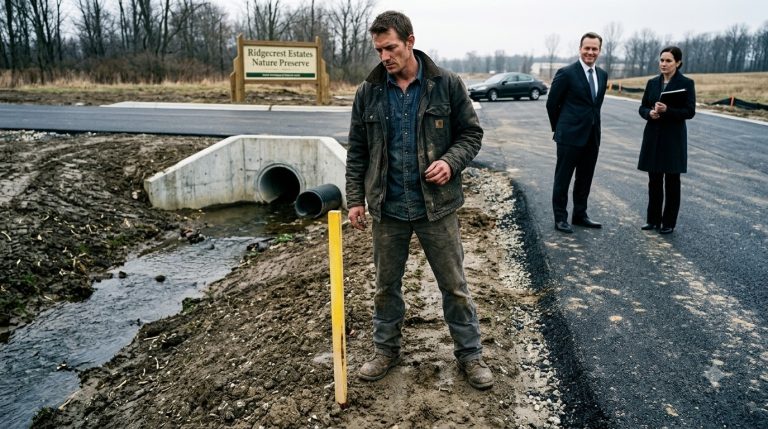
The wind did not stir the humid air; it simply sat heavy against the skin, smelling faintly of synthetic fertilizer and scorched Kentucky bluegrass. Across the low, invisible boundary that separated manicured artificial perfection from organic chaos, Karen stood with her clipboard raised like a breach shield. Her floral print muumuu could not muffle the hard, predatory angle of her jaw. Behind her, the beefy silhouette of the man in the neon green Emerald Lawns polo shifted his weight upon the asphalt, his arms crossed over his chest with the practiced indifference of a hired enforcer.
Alex did not look at the clipboard. He looked at the hinge of Karen’s right thumb, where the skin was pulled tight over the tendon—a physiological tell of suppressed frustration. He knew that micro-tension. He had seen it in forward operating bases when an insurgent realized his perimeter had been mapped before the first wire was cut.
“The EPA test will find the runoff, Mr. Miller,” Karen said, her voice dropping into that shrill, practiced cadence designed to carry across suburban lawns for maximum public humiliation. “You’ll lose this house and everything you’ve ever worked for.”
The words were meant to sting, to provoke a sudden, ragged defense that would validate every anonymous note taped to his front door over the past three months. Instead, Alex felt his pulse slow. The rush of adrenaline, sharp and cold, settled deep into his core, organizing his thoughts with the chilling clarity of a field manual. He kept his hands loose at his sides, fingers slightly curved, ready to absorb or deflect.
“Go ahead and test it, Karen,” Alex said. His voice was low, devoid of anger, scraped clean of any desire to argue or plead. “Make sure you get a deep core sample right up against your side of the property line, too. Wouldn’t want any gaps in the data.”
Her eyes narrowed, the thin line of her mouth twitching as the anticipated outburst failed to materialize. She had expected a veteran to snap, to raise his voice, to give her the ammunition she needed for the permanent injunction. She did not know that a man who spent twenty years calculating soil stability under explosive loads viewed a threat not as an insult, but as a coordinate.
Beside her, the man in the neon polo uncrossed his arms, his boots scraping against the pristine concrete of the sidewalk. A quiet, heavy warning.
“We have standards in Oak Meadow Estates,” Karen snapped, her grip tightening on the aluminum edge of her clipboard until her knuckles whitened. “We don’t tolerate unapproved hazards.”
“Standards,” Alex repeated softly. He let the silence stretch, watching the way the afternoon light caught the edge of the laminated violation notice clutched in her grip.
The paper was crisp, laser-printed, and entirely devoid of the required municipal evidentiary stamps. It was an administrative ghost, drafted in a vacuum and delivered by hand to bypass the official postal registry. A subtle discrepancy, almost invisible to anyone who did not spend their life looking for structural flaws in foundations.
He turned slowly, his boots crunching against the rich, dark mulch of his bed, leaving Karen standing alone at the boundary line with her weapon of choice already losing its edge.
CHAPTER 2: The Tactical Retreat
The front door clicked shut with a deadened, acoustic weight that muffled the faint hum of the neighborhood cicadas. Inside, the house was dim, the air conditioned down to a sharp, clean chill that contrasted with the humid afternoon clinging to the windowpanes. Sarah was still at the high school, her lesson plans stretching her past contract hours, and Lily was at an after-school art club three blocks over. Alex was alone with the silence.
He walked past the kitchen counter, where a single ceramic mug sat unwashed, and headed straight down the short hallway to his makeshift office in the back bedroom. The room smelled of dry paper, printer toner, and old oil from the cleaning kit he kept for his field tools. On the desk, illuminated by the amber glow of a single desklamp, sat the latest violation notice. It was held down by a brass paperweight shaped like an engineering plumb bob.
Alex pulled out his chair, the wooden legs protesting with a dry scrape against the hardwood floor, and sat down. He did not touch the notice yet. Instead, he reached into his top desk drawer and pulled out a fresh legal pad, its yellow paper lined with stark blue ink.
The first rule of fortification was never to react to the enemy’s opening feint in kind. Karen wanted a screaming match across the property line. She wanted a flustered homeowner waving his hands, stumbling over legal terminology, and giving her the emotional ammunition required for an immediate summary injunction. She expected a man who worked with his hands to be intellectually unequipped for a bureaucratic siege.
He uncapped a black ballpoint pen, the ink flowing smooth and heavy.
Violation 412-C, he wrote at the top of the page in neat, angular block letters. Date: Current. Fine: Fifty dollars per diem.
Beneath it, he jotted down the procedural requirements mandated by Section 12, Article 3 of the master CC&Rs—a section most residents never found because it was buried three appendices deep behind architectural guidelines for roof shingles. The bylaws explicitly stated that any notice of violation involving property aesthetics or ecological hazards must be accompanied by timestamped photographic evidence and a physical log of the infraction compiled by an objective third party, not a member of the architectural control committee.
Karen’s notice had none of those things. It had a laser-printed seal that looked official at a glance, but under close inspection, the toner was slightly smeared along the bottom edge, indicating it had been run through a cheap home printer rather than the association’s managed office machine.
A micro-discrepancy. A crack in the facade.
He reached for his phone to log into the local municipal records portal to verify when the HOA’s management company contract had last been renewed, but the screen flashed a blank error message: Service Temporarily Unavailable. He tapped the refresh icon. Another error. A localized server timeout or a sudden administrative restriction on public IP addresses querying the county clerk database from residential subnets.
Alex leaned back, the leather of his chair groaning softly under his weight. A subtle tightening of the perimeter. Someone at the municipal desk or within the HOA’s digital registry had flagged recent query spikes from his address. They were closing off the automated public loops, forcing residents to request physical paperwork in person and pay exorbitant copying fees to slow down any paper trail.
It was a petty roadblock, a digital speed bump designed to frustrate and delay. But it confirmed something crucial: they knew someone was looking. They were anticipating a legal defense, but they were thinking in terms of traditional lawyers’ letters and polite appeals to reason, not a systematic, engineering-grade audit of their operational structure.
He set the phone down on the blotter, the screen dark and silent. He did not reach for the phone again. Instead, he pulled his laptop closer, disconnected from the local Wi-Fi, and booted up an encrypted local drive containing downloaded archives of the neighborhood’s five-year building permits and environmental impact filings from when the subdivision was first cleared back in the late nineties.
The paperwork was dense, a massive archive of digital scans that most people would find unreadable. To Alex, it was just terrain. He began tracing the elevation lines of the drainage easements that ran behind the properties on Chestnut Lane, looking for the exact slope where surface water from the upper ridge pooled before hitting the storm drain at the cul-de-sac.
The room grew darker as the afternoon sun dipped behind the western tree line, casting long, sharp shadows across the desk. Outside, a neighbor’s lawnmower whined to a stop down the street, followed by the faint slam of a car door and the distant, tinny sound of children shouting. Alex did not look up. He had his coordinates. He had his map. And the ground beneath his feet was entirely under his control.
CHAPTER 3: The Soulless Room
The air inside the Oak Meadow Estates clubhouse smelled precisely of industrial-grade lemon disinfectant and decades of damp carpet fiber. It was a soulless beige room designed to look like a multi-purpose community asset, but it functioned primarily as an ideological echo chamber. Fifteen metal folding chairs were arranged in three uneven rows on the speckled linoleum floor. About half were occupied by residents who sat with their hands folded in their laps, staring fixedly at the floor tiles as if avoiding a tripwire.
At the front of the room, behind an oversized folding table draped with a dull blue plastic tablecloth, sat the architectural control committee. Karen occupied the center seat like a magistrate presiding over a drumhead court-martial. Flanking her were two women whose identical pastel sweater sets and rigid posture mirrored her own, and to the far left, Mr. Henderson sat hunched over a thick plastic binder, his thumb continuously tracing the edge of a yellow highlighter while he steadfastly refused to look up.
Alex pushed open the double doors at the back of the hall. The hinges squeaked—a dry, metallic protest that cut through the low drone of the overhead fluorescent tubes. Every head in the front row turned. Karen’s chin lifted fractionally, a thin, triumphant smile touching the corners of her mouth before she quickly smoothed her expression into bureaucratic solemnity.
“Ah, Mr. Miller,” Karen announced, her voice pitched to project off the acoustic ceiling tiles. “So glad you could tear yourself away from your… unapproved botanical project. Please, take a seat. We were just discussing association asset protection.”
Alex did not take a seat in the folding chairs. Instead, he walked down the center aisle, his boots striking the linoleum with a solid, measured cadence that commanded acoustic space. He carried a single manila folder tucked beneath his left arm. He stopped five feet short of the folding table, keeping his weight balanced evenly on both feet, his shoulders relaxed.
“You have the floor for three minutes, Mr. Miller,” Karen said, tapping a gold-plated gavel against the edge of the table. “Strictly regarding your violation notice. Keep it concise.”
The room was suffocatingly still. In the second row, Mrs. Gable clutched her purse so tightly her knuckles had gone chalk-white.
“I’m not here to discuss the compost bin, Karen,” Alex said. His voice was low, flat, and completely devoid of the defensive heat she was fishing for.
Karen’s eyebrows twitched upward, a microscopic fracture in her composure. “The agenda clearly lists Section 7, Article 4. Landscaping and aesthetic maintenance. If you refuse to address the debris pile, the board will move to enforce the daily fines retroactively starting from the initial notice date.”
“Section 7, Article 4 requires photographic proof and an onsite inspection log compiled by a certified municipal arbiter or an objective third party,” Alex replied, stepping forward half a step. He did not raise his voice; he simply let the syntax do the work. “Your notice contained neither. Furthermore, municipal code subsection twelve prohibits the levying of retroactive penalties without a formal forty-eight-hour cure window following an official hearing.”
Henderson’s thumb stopped tracing the highlighter. He looked up, blinking rapidly behind his wire-rimmed glasses, and slid his plastic binder open to a dog-eared page. He muttered something under his breath, leaning over to whisper urgently into Karen’s left shoulder.
Karen brushed Henderson’s hand away with a sharp flick of her wrist, her eyes narrowing into cold slits. “We don’t need lectures on municipal code from someone running a garbage dump in their backyard,” she snapped, losing her polished veneer under the sudden weight of public scrutiny. “This is a private association. We establish the standards. Your little science experiment is a fire hazard, a vector for vermin, and a direct threat to everyone’s property value here.”
She swept her gaze across the silent room, seeking the familiar chorus of nodding heads from her constituents. But the residents in the folding chairs did not nod. They stared at their laps, the unspoken tension thick enough to taste.
“Fire hazard,” Alex repeated, his tone dangerously level. He let the silence hang for three heavy heartbeats, forcing the room to absorb the absurdity of the claim. “The mulch is damp, composted hardwood chips kept at a controlled aerobic temperature below spontaneous combustion thresholds. Certified by the state agricultural extension office.”
He reached into the manila folder, pulled out a single sheet of paper, and laid it flat on the corner of the folding table, just out of her reach.
“If we’re going to discuss hazards, Karen, we should probably talk about the chemical runoff ratings on the southern drainage slope,” Alex added, his eyes locked onto hers. “Especially considering what the local water table is currently absorbing.”
Karen went dead still. The color drained from her cheeks, leaving her skin a pasty, mottled gray beneath the harsh overhead lights. For a fraction of a second, the predator-prey dynamic inverted; she looked not like an autocrat wielding a gavel, but like a sentry who had just realized the wire had been tripped three miles behind her lines.
She slammed the gavel down—crack—the plastic handle vibrating against her palm.
“Out of order!” she shouted, her voice cracking slightly on the upper register. “Motion to deny the appeal, enforce the retroactive fines, and issue a secondary citation for disruptive conduct during a board session. All in favor?”
The two women beside her nodded instantly in robotic unison. Henderson sat frozen, staring at the paper on the corner of the table, his hand hovering uselessly over his voting paddle. He didn’t raise it.
“Motion carries,” Karen declared, though her chest was heaving beneath her floral print muumuu. She glared at Alex, her teeth bared in a strained, venomous grimace. “You’ll be hearing from our legal counsel by Friday, Mr. Miller. Every single day of non-compliance is going to cost you.”
Alex turned on his heel, his boots pivoting sharply against the linoleum without a wasted motion. He didn’t look back as he walked up the aisle. He had planted the explosive charge right beneath the foundation of her authority, and the timer was already ticking.
CHAPTER 4: Operation Reconnaissance
The twilight air was cool, carrying the sharp, metallic tang of an approaching front from the western hills. Alex walked up the paved driveway of 412 Chestnut Lane, his boots crunching lightly against the dry gravel near the edge of the sod. He did not turn on the porch light immediately. Instead, he stood in the dense shadow cast by the eaves, his eyes sweeping the property line with the automatic calculation of a reconnaissance sweep.
From the corner of the fascia board above the garage, the first high-definition security camera stared down with a small, unblinking infrared eye.
A sudden, sharp mental flash pulled him back twelve years—a forward operating base in the Arghandab valley, checking the optic seals on perimeter motion sensors before dusk, knowing that what stayed hidden in the dark dictated who survived the morning. He pushed the memory down, neutralizing the reflex, and stepped purposefully toward the side door.
Inside, the house was dark. Sarah and Lily were upstairs, the faint, warm murmur of a bedside story filtering down through the ceiling drywall. Alex bypassed the kitchen and went straight back to his temporary command center in the rear bedroom. He didn’t turn on the overhead light; he flipped on the amber desk lamp, letting the pool of warm illumination pool across the keyboard and the thick stack of municipal building archives he had downloaded earlier.
The next phase of the operational blueprint required absolute digital security. Karen’s digital choke-hold on the municipal records portal had confirmed that administrative access was monitored, but localized property surveillance was a different terrain entirely.
He slid into his chair and plugged a high-capacity encrypted flash drive into the side port of his laptop. On the monitor, feed lines from the four newly mounted security cameras flickered into life in a quad-split grid. Camera One: the front yard approach. Camera Two: the rear patio and tool shed. Camera Three: the narrow, high-tension strip of property line abutting Karen’s chemically scorched bluegrass. Camera Four: the compost bin and drainage easements.
Every lens was clear, calibrated, and recording to an off-site encrypted cloud buffer that the HOA’s local internet service provider could neither throttle nor access.
The sound of soft footsteps in the hallway preceded a gentle tap on the wooden door frame. Sarah stood in the doorway, her arms wrapped around a ceramic mug of tea, her silhouette framed by the dim light of the corridor. Her eyes were sharp, carrying the quiet, enduring focus of a woman who spent her days managing complex systems and her nights worrying over a husband walking into a bureaucratic war zone.
“You’re still down here,” Sarah said quietly, stepping into the room and setting the mug beside the keyboard. The steam curled upward, smelling of chamomile and bergamot. “Henderson called while you were at the clubhouse. He didn’t leave a message, but his wife picked up when I called back to check the number. She said he’s been pacing his den for an hour.”
Alex picked up the ceramic mug, feeling the steady heat radiate through his palms. “Henderson is a weak link,” he said, his voice flat. “He wants to protect his property value, but he’s realizing the board’s liability shield has structural fractures.”
“Karen won’t stop at a board vote,” Sarah said, leaning against the edge of the bookshelf, her fingers brushing the spine of her old law textbook. “She’s backed into a corner. When people like that lose control of the narrative, they look for external weapons.”
“Let her look,” Alex replied, his gaze returning to the multi-split monitor grid. On Camera Three, the night wind stirred the dry stalks of the tall native grasses along the fence line, casting long, jittery shadows across the sod. “We aren’t fighting a political battle anymore. We’re building an evidentiary wall.”
He reached into his desk drawer and pulled out a leather-bound notebook—the same model he had carried through two decades of engineering deployments. He opened it to a clean page and began listing the precise sequence of data points required for the next escalation: certified copies of the past five years of HOA structural maintenance invoices, records of landscaping contracts awarded without open competitive bidding, and the specific corporate registry filings linking Emerald Lawns to Karen’s immediate family.
The pieces were aligning. Every petty violation notice, every unapproved fine, and every arbitrary threat was no longer an annoyance; they were stress fractures in an illegal monopoly. He didn’t need to shout across the property line anymore. The terrain was mapped, the fortifications were locked, and the enemy was already digging her own trench.
CHAPTER 5: The Paper Fortification
The digital clock on the edge of the desk clicked silently to 11:45 PM. Outside, the wind rattled the aluminum guttering along the roofline, a dry, sharp scraping sound that punctuated the deep stillness of the house. Alex did not blink as his eyes scanned the fifth page of the master covenants, conditions, and restrictions binder. His coffee mug sat cold beside the keyboard, untouched for over an hour.
The document in front of him was a thirty-year-old compilation of binding architectural rules, amended piecemeal by successive boards. Most homeowners treated the packet like wallpaper—ignoring it until a dispute arose, then skimming it in a panic. But Alex read it the way he used to read topographical survey maps before an engineering deployment: looking for structural tolerances, hidden utility easements, and load-bearing definitions.
His finger traced down a dense paragraph under Section 4, Article 9—a clause governing structural additions and auxiliary yard enclosures. The text had been altered. Not by official municipal amendment, but by a typed-in sub-clause inserted during a board consolidation four years prior, when Karen first took control of the presidency. The alteration redefined any organic composting structure or rain barrel system as an “unapproved industrial hazard,” effectively bypassing the standard two-thirds homeowner vote required for new bylaws.
A micro-discrepancy baked directly into the foundational ink. A forged administrative shortcut.
Alex reached for a red grease pencil—a habit left over from marking elevation adjustments on blueprints—and drew a sharp, clean rectangle around the altered paragraph. He pulled his laptop closer and opened a side-by-side comparison window against the original 1994 county-filed master deed registry. The text didn’t match. The board had expanded its own punitive powers without recording the changes with the county clerk, rendering every single fine they had levied over the past four years legally void.
The sound of soft, measured breathing came from the doorway. Sarah stood there again, wrapped in a dark fleece blanket, her bare feet silent against the hardwood. She didn’t ask if he was coming to bed. She looked at the red marks on the paper, then at his face, reading the precise, cold calculation in his eyes.
“They didn’t just bend the rules,” Sarah said softly, her voice barely carrying across the room. “They fabricated the legal framework from scratch.”
“They built a castle on a sand foundation,” Alex replied, his pen pausing against the page. “An autocrat relies on the assumption that nobody will dig beneath the topsoil. They think a few laminated warnings and a threat of daily fines are enough to deter an audit.”
“And the administrative lockout on the municipal records portal?” Sarah asked, stepping fully into the room and resting her hand on the back of the empty wooden chair opposite him. “Did you find a workaround?”
“We don’t need their portal anymore,” Alex said, tapping the edge of the red-marked page. “The moment they altered the master deed registry without county filing, they crossed from civil homeowner harassment into corporate fraud. Every penalty notice they’ve mailed out bears a fraudulent legal signature.”
He closed the CC&R binder with a solid, heavy thud that echoed off the drywall. The paper fortification was complete. He had mapped every legal vulnerability, cross-referenced every unauthorized amendment, and lined up the administrative tripwires. All that remained was waiting for the enemy to take the next predictable step—a step that would push them right into the federal jurisdiction they couldn’t control.
CHAPTER 6: The Federal Escalation
The morning air was thick with the scent of wet asphalt and damp cedar mulch. A fine, needle-like rain was driving in from the west, streaking the office windowpanes with jagged trails of water that distorted the view of the lawn outside. Alex stood by the desk, his fingers resting on the edge of the polished wood, watching the surface water pool along the perimeter line where his organic mulch met Karen’s chemically scorched bluegrass.
The front door chimed—a sharp, double-toned ring that cut through the steady hiss of the rain.
Alex did not rush. He walked out of the rear bedroom, his boots making a dry, rhythmic sound down the hallway, and pulled the front door open. Standing on the porch, sheltered beneath the narrow aluminum overhang, was a uniformed mail carrier holding a heavy, yellowing packet wrapped in weather-resistant plastic.
“Sign here, Mr. Miller,” the carrier said, holding out a digital stylus and a tethered terminal. The screen was slick with a fine mist of condensation.
Alex signed his name with a clean, sharp stroke, took the packet, and closed the door. The plastic crinkled loudly in the quiet foyer. He peeled back the seal, exposing the thick stack of government-issue bond paper inside. It wasn’t another petty fifty-dollar fine from the local architectural committee. It was a formal notification bearing the insignia of the Environmental Protection Agency—a federal response to the anonymous complaint filed earlier in the week.
The text was dense, clinical, and completely devoid of emotional padding. It stated that an official field agent had been assigned to investigate a reported chemical runoff violation originating from 412 Chestnut Lane, citing potential hazards to the local watershed and the adjacent nature preserve.
Karen had finally pulled the pin on the grenade she had threatened to throw across the property line. She had escalated a suburban dispute into a federal inquiry, assuming the weight of government bureaucracy would crush an individual homeowner who refused to submit to her authority.
Alex walked back to his desk, laid the federal packet flat beside his red grease pencil, and picked up his encrypted desk phone. He dialed an old secure line—not to a local lawyer, but to Dave, his former unit comrade who now operated an independent environmental consulting practice three counties over.
“Dave,” Alex said the moment the line clicked open.
“I heard you went quiet,” Dave’s voice came through the receiver, steady and low, carrying the familiar cadence of a field briefing. “Trouble on the perimeter?”
“Karen just called in an airstrike,” Alex said, his eyes scanning the federal notification. “The EPA formally accepted a complaint regarding chemical runoff from my property.”
A dry, humourless chuckle sounded on the other end of the line. “The EPA? She’s playing with live ordnance she doesn’t know how to disarm. Does your soil actually have anything on it?”
“Nothing except worm castings, biochar, and rainwater,” Alex replied. “The ground here is cleaner than a surgical ward. But she’s banking on the investigation forcing a panic, or at least tying us up in compliance fees until we fold.”
“Then we don’t play defense,” Dave said instantly, his tone hardening into professional strategy. “You invite them in. You make yourself the most cooperative subject they’ve ever interviewed. But you expand the survey coordinates. If the federal agency is testing your soil, make damn sure they pull core samples from the entire drainage basin—starting right on the property line and moving straight across her immaculate, chemical-soaked lawn.”
“I’m already drafting the legal addendum with Anna,” Alex said, referencing the young veteran pro bono attorney assisting their defense. “We’ll hand the agent a complete environmental log the moment he steps onto the property.”
“Good,” Dave said. “Let her think she engineered a trap. When the lab results come back, the ballistic trajectory is going to blow right back through her front window.”
The line clicked dead. Alex set the phone down on the blotter, his reflection staring back at him from the dark glass of the monitor. The battlefield had shifted. The small-town political theater was over; the machinery of federal science was now moving into position, and Karen had no idea whose fingerprints were actually on the trigger.
CHAPTER 7: The Coalition of Shadows
The gravel in the alleyway behind Chestnut Lane crunched underfoot with a dry, rhythmic friction as Alex walked the fifty yards down to Marcus’s property. The afternoon sun was hidden behind a thick ceiling of slate-gray clouds, casting long, unsparing shadows across the driveways. Inside Marcus’s open double garage, the harsh glare of a fluorescent work light hummed overhead, illuminating the skeletal frame of a vintage motorcycle chassis hoisted on steel jacks.
Marcus stood beside it, a large, thick-shouldered man with a shaved head and intricate tribal ink sleeve art winding down his forearms. He held a heavy-duty wrench in one hand, wiping a greasy rag across his knuckles as Alex stepped over the threshold.
“I saw the mail carrier drop off the federal packet this morning,” Marcus said without preamble, his voice a low, gravelly rumble that filled the concrete bay. “And I saw Karen twitching behind her front curtains like a spooked sentry.”
Alex walked further into the garage, his boots stopping beside a steel workbench cluttered with spare parts, oil cans, and a stack of neighborhood violation notices identical to his own. He caught the sharp smell of petroleum and hot metal—a sensory echo of motor pools and forward motor maintenance yards that brought an immediate, calculated calm to his thoughts.
“She triggered the federal inquiry thinking it would be a summary execution,” Alex said, leaning his weight against the edge of the workbench. “Instead, she handed us a localized survey baseline. But a paper defense isn’t enough to break an entrenched command structure. We need to consolidate the perimeter.”
Marcus set the wrench down with a heavy clank against the steel table. He reached behind a stack of tool cases and pulled out a manila folder stuffed with crisp, folded papers.
“You aren’t the only one doing reconnaissance,” Marcus said, tossing the folder onto the bench between them. “I spent the last three days talking to the people Karen spent the last four years terrorizing. The Rodriguez family—they’ve got over a thousand dollars in fines levied against them because their boy’s portable basketball hoop was visible from the cul-de-sac. And Mrs. Gable down on number four? She’s seventy-eight, lives on a fixed pension, and they threatened to seize her property lien over a cedar bird feeder.”
Alex flipped open the folder. Inside were detailed photocopies of receipts, arbitrary fine notices signed with the same smeared toner, and handwritten statements from five different families along the subdivision’s southern loop. A textbook pattern of selective enforcement designed to isolate non-compliant residents and clear the path for approved vendors.
“She’s running a closed loop,” Alex noted, his finger tracing a corporate registry stamp on a photocopied landscaping contract. “Every violation forces homeowners to drop their independent services and switch to a single approved contractor.”
“Not just any contractor,” Marcus added, his eyes narrowing as he leaned closer over the workbench. “I had an old buddy down at the county municipal clerk’s office run an audit on Emerald Lawns’ corporate filings. You want to guess who holds the majority secondary beneficiary shares on their commercial license?”
“Karen’s immediate family,” Alex said flatly, the final piece of the tactical puzzle snapping into place with absolute clarity.
“Brother-in-law,” Marcus confirmed with a grim, humorless grin. “The whole homeowners association isn’t a residential oversight committee. It’s a localized protection racket masking a kickback scheme. Every blade of chemically scorched grass in this subdivision is lining her pockets.”
Alex closed the folder, his fingers gripping the manila edge. The decoy secret—the institutional corruption of the HOA board—was fully mapped. But beneath it, the deeper reality remained shielded, waiting for the laboratory core samples to verify the chemical source of the watershed contamination.
“Keep the dossier secure,” Alex said quietly. “We let her play her hand through the end of the week. When the EPA field agent finishes processing the comprehensive basin samples, we drop the entire structure on their heads all at once.”
Marcus picked up his wrench again, his grip tightening around the steel handle with quiet, absolute resolve. “Just say the word, engineer. We’ve got the perimeter completely surrounded.”
CHAPTER 8: The Soil Sampling
The dark blue sedan with standard government plates rolled to a silent halt precisely at 9:00 AM along the asphalt of Chestnut Lane. The tires hissed slightly against the damp curb. Inside the vehicle, Agent Morales sat behind the steering wheel for a brief moment, checking a laminated clip chart before pushing the door open with a solid, mechanical click. He wore practical hiking boots, a weather-resistant field jacket, and a functional polo shirt bearing a small, understated EPA insignia.
Alex stood waiting near the sidewalk, his boots planted firmly on the edge of the manicured concrete slab. He held a thick, heavy-duty binder under his left arm—the comprehensive operational log compiled with Dave and Anna, detailing every organic seed, every drop of natural fish emulsion, and every certified soil amendment used on the property over the past three years.
From fifty feet away, a front window curtain flickered. Karen’s silhouette was razor-sharp behind the glass, her eyes locked onto the government vehicle with the predatory intensity of a sentry waiting for an artillery strike to land on target.
“Mr. Miller,” Morales said, stepping onto the pavement and offering a firm, dry handshake. His face was weathered, carrying the polite, unreadable neutrality of an investigator who had seen every variety of suburban warfare. “Agent Morales. Thanks for meeting me out here.”
“Good morning, Agent,” Alex replied, his grip solid and measured. “We’re fully prepared to assist with the audit. Everything you need is right here.”
Alex lifted the binder slightly, exposing the index tabs. Morales raised an eyebrow, a flicker of genuine professional surprise crossing his eyes as he accepted the heavy document. He flipped the cover open, scanning the precise chronological logs, receipts, and state agricultural certifications neatly filed beneath plastic sleeves.
“This is remarkably thorough,” Morales noted, his thumb tracing the edge of the spine. “Most homeowners don’t keep operational records like this for a backyard garden.”
“When you spend twenty years in the Corps of Engineers, Agent, you learn that data is the only line between a stable foundation and a collapse,” Alex said evenly, gesturing toward the side yard path. “Let’s begin the survey. I want you to pull samples not just from my beds, but from the entire drainage gradient.”
For the next two hours, the inspection moved with methodical, unyielding precision. Morales unslung his field kit, extracting a long, stainless-steel core sampler. The metal tube drove into the dark, rich earth of Alex’s vegetable beds with a dull, muffled thud, bringing up a core cylinder packed with dense, organic loam, active earthworms, and rich micro-flora. Morales dropped the sample into a sterile, pre-labeled polyethylene bag, sealing the ziplock with a sharp, airtight snap.
As they moved toward the property line, the atmospheric pressure shifted.
Morales positioned the steel core sampler exactly on the surveyed boundary separating 412 from Karen’s immaculate, chemically forced turf. As he hammered the corer into the transition line, the front door across the gravel path swung wide open.
Karen stepped out onto her porch, her floral print muumuu snapping lightly in the damp morning breeze. Her arms were crossed rigidly over her chest, her chin lifted in an expression of absolute triumph. She had orchestrated this federal intervention, and she was there to watch the final execution of her administrative sentence.
“Agent Morales,” Karen called out, her voice pitching sharp and clear across the lawn. “I trust you’re finding the contamination source exactly where the initial complaint specified. Mr. Miller’s unauthorized agricultural waste has been leaching into the municipal watershed for months.”
Morales paused, his hand resting on the handle of the soil corer. He turned his head slowly, looking past Alex toward the porch, his eyes taking in Karen’s rigid posture and the flawless, unnaturally vibrant emerald expanse of her lawn. He didn’t answer her directly. Instead, he pulled a clean, fresh specimen bag from his utility belt, stood up from the boundary line, and walked directly onto the center of Karen’s pristine turf.
Karen’s triumphant smile flickered, a micro-expression of sudden confusion breaking across her features. “What are you doing over there? The complaint was filed against his property.”
“Standard EPA protocol for watershed contamination audits, ma’am,” Morales replied calmly, his voice level and entirely devoid of deference. “To isolate an anomaly, you have to sample the entire contiguous drainage basin—upstream, downstream, and across all adjacent surface applications.”
He drove the stainless-steel corer deep into the center of her chemically treated bluegrass. The metal tube bit into the soil with a sharp, tearing crunch, extracting a core sample that looked radically different from Alex’s rich loam—pale, chemically saturated, and smelling faintly of heavy synthetic sulfur. Morales dropped it into a sterile bag and sealed it shut.
Karen took an involuntary step forward, her hands uncrossing from her chest. “That’s private property. You have no legal basis to pull samples from a compliant homeowner’s lawn.”
Morales didn’t look up as he zipped his field bag. He simply secured the samples in a padded transport case, turned his back on the porch, and walked back to his sedan with quiet, absolute authority.
“We’ll be in touch with the laboratory results in four to six weeks, Mr. Miller,” Morales said, shaking Alex’s hand one final time before opening his driver’s side door. “Keep your logs secure.”
The sedan engine purred to life, backing out of the driveway and disappearing down the cul-de-sac. Alex stood by the curb, watching it go. Across the lawn, Karen stood frozen on her porch, her fingers gripping the wooden railing so tightly her knuckles shone white. The trap was sprung, the samples were sealed, and the countdown to absolute exposure had begun.
CHAPTER 9: The Waiting Game
The weeks following Agent Morales’s departure settled into an abrasive, grinding routine of psychological friction. Every morning at precisely 7:15 AM, the plastic rustle of a fresh violation notice being slipped beneath the front door heralded the start of the day. Karen, emboldened by the silent weeks while the federal laboratory processed the core samples, doubled down on her offensive.
The citations arrived like clockwork—petty, administrative weaponization disguised as neighborhood governance. A piece of children’s chalk art on the concrete driveway was cited as an unauthorized graffiti installation. The small, weathered Corps of Engineers flag fluttering from the porch bracket was flagged as an unapproved ideological banner. Even the soft, natural chime of aluminum wind tubes near the back patio became the subject of an emergency architectural review.
Alex sat at his desk in the rear bedroom, the amber glow of the desklamp cutting through the late-afternoon gloom, logging each new piece of paper with cold, methodical precision. He did not call the board. He did not storm across the lawn. He simply scanned every notice into the secure digital folder, cross-referenced it against the fabricated CC&R amendments he had uncovered earlier, and filed it under the expanding dossier of malicious harassment.
Yet, the prolonged silence from the federal testing facility began to test the perimeter of his patience. A faint, intrusive paranoia—a shadow of old field deployments where intercepted communications meant an ambush was forming upstream—whispered that administrative delays might give the board time to maneuver.
The sound of soft, steady footsteps broke the quiet hum of the computer fan. Sarah appeared in the doorway, carrying a steaming mug of coffee. She set it beside the keyboard, her eyes resting on the tall stack of yellowing violation notices neatly organized on the blotter.
“The mailbox had three more this morning,” Sarah said quietly, her voice carrying an undercurrent of fatigue. “Mrs. Gable called a little while ago, too. She’s worried the board is going to place an official lien on her home before the EPA report ever comes back.”
Alex wrapped his hands around the warm ceramic mug, feeling the steady heat disperse the cold tension in his fingers. “Let them file the liens,” he said, his voice flat and unyielding. “The deeper they dig into their own administrative authority right now, the heavier the liability structure becomes when the laboratory data hits.”
“And if the laboratory timeline slips?” Sarah asked, leaning her shoulder against the doorframe, her gaze sharp and searching. “Karen is scheduled to hold an emergency board review this coming Tuesday to vote on retroactive fine enforcements across the entire block.”
“Let her hold it,” Alex replied, a faint, humorless edge touching his mouth. “A kangaroo court needs an audience that believes in the gavel. By Tuesday, the core sample analysis will be completed. We aren’t fighting a political debate anymore. We’re waiting for ballistic impact.”
He turned back to the monitor, his eyes fixing on the live-feed quad-split of the security cameras. On Camera Three, the tall native grasses along the property line swayed quietly in the evening wind, casting long, sharp shadows across the dirt. The perimeter was holding. The trap was fully set. All that remained was for the laboratory seals to break.
CHAPTER 10: The Nuclear Report
The front door mail slot snapped shut with a sharp, metallic echo that reverberated down the hallway. Alex stood up from his desk in the rear bedroom, his boots making a heavy, measured sound against the hardwood floor. He walked out into the corridor and looked down. Lying on the dark wood of the entryway floor was a thick, flat manila envelope bearing the official emblem of the Environmental Protection Agency.
The packaging was heavy, stiff with multiple pages of bond paper and reinforced backing. There was no polite preamble, no introductory phone call. The laboratory analysis had cleared the review queue.
Alex picked it up, feeling the substantial weight of the document before walking back into the amber pool of light cast by his desklamp. He sat down, pulled out his pocket knife, and sliced cleanly through the top seal.
The first page was the executive summary. His eyes moved rapidly across the technical terminology, bypassing the standard administrative headers until they locked onto the site address: 412 Chestnut Lane, Miller Property. The text was concise and absolute. Soil core samples taken from the vegetable beds, compost zones, and perimeter sod showed zero detectable levels of any regulated synthetic herbicide, pesticide, or chemical fertilizer. The report explicitly noted the exceptionally high concentration of organic matter and active microbial flora, classifying the land as a model of sustainable residential stewardship.
A slow, steady breath left his lungs. The tactical defense was verified. But the true weight of the report lay on the subsequent pages.
He turned the sheet over. Site Analysis: 410 Chestnut Lane, Adjacent Property.
The tone of the federal document shifted instantly from a neutral report to a technical indictment. The core samples pulled from Karen’s immaculate, chemically forced bluegrass revealed a concentrated cocktail of banned and heavily restricted compounds. Levels of 2,4-D—a potent herbicide component linked to historical defoliants—exceeded residential safety thresholds by a factor of five. Alongside it, the laboratory identified high concentrations of organophosphate insecticides like diazinon and chlorpyrifos, substances restricted years prior due to extreme neurotoxicity and environmental persistence.
The final section of the report mapped the watershed drainage gradient down to the storm drain at the end of the cul-de-sac. A chemical fingerprint analysis conclusively linked the toxins pooling in the municipal basin directly to the runoff originating from number 410 Chestnut Lane.
Karen had called in a federal airstrike to destroy an organic garden, only for the ballistic trajectory to trace straight back to her own foundation.
Alex reached for his phone, unlocked the secure interface, and opened the encrypted group chat shared with Marcus and Anna. He attached a high-resolution digital scan of the executive summary, adding a single, precise command line: The data is unsealed. Phase two is live.
Across the street, through the clear lens of Camera One, a single front porch light flickered on as Karen stepped outside to check her own evening mail, completely unaware that the ground beneath her feet had already given way.
CHAPTER 11: The Projection
The air inside the Oak Meadow Estates clubhouse was thick, stale, and charged with an unyielding static tension. The speckled linoleum floor was packed tight; folding chairs had been pushed back against the baseboards, and residents stood shoulder-to-shoulder along the walls, their faces lit by the harsh, overhead fluorescent tubes. The scent of industrial lemon disinfectant competed with the sharp, nervous sweat of a community on the brink of an institutional collapse.
At the front of the room, behind the long folding table draped in blue plastic, sat the architectural control committee. Karen occupied the center seat, her posture rigid, her chin tilted upward with an expression of defiant, unyielding authority. Flanking her, the two pastel-sweatered board members stared down at their legal binders with pale, bloodless fingers. To the far left, Mr. Henderson sat hunched over, his hands clamped tightly between his knees as if bracing for an impact.
Alex walked down the center aisle, his boots striking the linoleum with a heavy, deliberate rhythm. He carried a single, slim briefcase in his right hand. Beside him walked Anna, the pro bono veterans’ attorney, her expression calm and neutral, carrying a portable projector and a laptop bag. Marcus and the Rodriguez family flanked the rear of their row, forming an immovable human barrier that anchored the room’s collective resolve.
Karen struck the gold-plated gavel against the table—crack—the sound sharp and brittle in the heavy silence.
“This meeting is called to order,” Karen announced, her voice pitched high to mask a sudden, microscopic tremor in her throat. “Any disruptive elements or unauthorized individuals attempting to turn this forum into a public spectacle will be escorted off the premises immediately.”
Anna did not wait for an acknowledgment. She stepped smoothly to the side of the folding table, placed her laptop onto a small metal stand, and connected a high-speed data cable to the projector resting on a folding chair. With a clean keystroke, the wall behind the board lit up in a blinding, rectangular glare.
The first slide projected onto the drywall was not a set of HOA pool rules or architectural guidelines. It was the unredacted executive summary of the federal Environmental Protection Agency report, rendered in massive, stark lettering that filled the entire front of the room.
A collective murmur rolled through the packed rows like wind through dry timber.
“My name is Anna Chen,” she said, her voice clear, steady, and carrying effortlessly across the acoustic tiles. She looked directly at the members of the board. “I am legal counsel for Mr. Alex Miller and sixteen other resident families in this association. Last week, federal investigators completed a comprehensive core-sample audit of the drainage basin and watershed serving Chestnut Lane.”
Karen slammed the gavel down twice, her face flushing a deep, mottled crimson. “Out of order! This is a private association executive session! You have no legal standing to present federal documents in this forum!”
“It stopped being a private association matter the moment your architectural committee filed a fraudulent federal complaint to weaponize the EPA against a private citizen,” Anna replied coolly, clicking to the next slide.
The projector flashed a detailed chemical breakdown of the soil core samples. The screen highlighted stark, red-bordered columns listing banned organophosphates, high concentrations of diazinon, and levels of 2,4-D exceeding residential safety thresholds by five hundred percent.
“The investigation did not find agricultural contamination on Mr. Miller’s property,” Anna continued, her tone clinical and unyielding. “Instead, the laboratory fingerprint analysis conclusively traced the toxic runoff directly to a single source: number 410 Chestnut Lane.”
Karen stood up abruptly, her chair scraping backward against the linoleum with a harsh, metallic shriek. “Lies! Fabricated data! That property has been maintained by certified municipal contractors under strict association compliance!”
“Certified contractors,” Alex spoke for the first time, his voice low, steady, and cutting through the room with the weight of absolute authority. He stepped forward, placing his briefcase flat on the edge of the board’s table and unlatching the metal clasps with a sharp, synchronized click. “Like Emerald Lawns. Owned and operated by your immediate family under an undisclosed no-bid contract that funneled thousands of dollars in association fees into a private kickback scheme.”
He opened the briefcase and slid three certified corporate registry documents directly across the blue plastic tablecloth toward Henderson.
“Every fine you levied,” Alex said, his eyes locked onto Karen’s dilated pupils, “every arbitrary violation notice you manufactured for unapproved landscaping or portable hoops, was designed to eliminate independent service competition and protect a corrupt commercial monopoly.”
The room erupted. Shouts of disbelief and anger bounced off the low ceiling tiles. Residents who had sat silent for years suddenly surged forward, their collective frustration breaking through the thin veneer of administrative intimidation.
Henderson looked down at the corporate documents spread across his binder, his hands trembling violently. He raised his head, his voice cracking as he looked across the table at Karen. “You told us the organic garden was poisoning the water table. You said we were all at risk.” He swallowed hard, his skin turning pasty white. “My kids play on that grass every single afternoon.”
The other two board members shrank back in their chairs, refusing to meet Karen’s frantic, searching gaze. The unified front had shattered completely under the weight of unassailable proof.
Karen stood isolated behind the folding table, her chest heaving beneath her floral print muumuu, her mouth opening and closing as she searched for a command, a threat, a rule to invoke. But the rules were gone. The leverage was broken. The terrain had completely shifted.
Mr. Henderson reached out with a trembling hand, gripped the wooden handle of the gavel, and pulled it toward himself. He didn’t bang it. He simply set it down flat on the table, away from her reach.
“The board moves for an immediate emergency vote,” Henderson whispered, his voice shaking but audible. “To strip the presidency, revoke all executive powers, and dissolve the landscaping contract effective immediately. All in favor?”
Four hands shot into the air instantly, a unanimous, unhesitating motion.
“Motion carries,” Henderson said, his eyes fixed on the table. “Karen… you are removed from the association permanently.”
The room roared with a collective wave of absolute condemnation. Karen stood frozen for three long seconds, her eyes darting across the hostile wall of faces, realizing there was no corner left to retreat to. She grabbed her leather handbag from the folding chair, turned on her heel, and stormed up the center aisle, the ringing chants of public repudiation following her every step out the double doors and into the dark night.
CHAPTER 12: The Settled Earth
The night air was cool against the skin, carrying the crisp, earthy scent of damp mulch and autumn leaves from the adjacent nature preserve. Alex stepped out of the clubhouse doors behind Marcus and Anna, his boots crunching lightly against the asphalt of the parking lot. The storm clouds that had hung over Chestnut Lane for weeks had finally parted, revealing a vast, clear expanse of stars overhead.
Two days later, the administrative machinery of the subdivision began to correct itself with the cold, undeniable precision of a well-calibrated instrument. Under Marcus’s interim presidency, an emergency general assembly voted to permanently void every fine, citation, and warning issued during Karen’s tenure. The files were expunged, the fraudulent architectural amendments were scrubbed from the association registry, and the municipal contractor license board formally suspended Emerald Lawns pending a multi-state investigation into illegal pesticide application and commercial fraud.
Across the cul-de-sac, number 410 Chestnut Lane stood dark and still. A yellow “For Sale” sign was staked firmly into the center of the chemically scorched bluegrass lawn—a lawn that now looked brittle and exposed under the merciless glare of the streetlamps. Karen had packed her belongings into a rental truck before sunrise that morning, departing without a single farewell, leaving behind only the paper trail of her collapsed empire.
Alex walked slowly up his driveway, his hands tucked deep into the pockets of his denim jacket. The security cameras mounted under the eaves hummed silently in standby mode, their red indicator lights glowing a steady, peaceful amber. There was no perimeter to scan tonight, no hostile notices taped to the front door, no threat waiting in the shadows.
He pushed open the side gate and walked back toward the garden. The yard was quiet, bathed in the soft silver light of the half-moon. The raised beds of heirloom tomatoes—Black Krim, Green Zebra, Cherokee Purple—stood tall and thick-stemmed, their dark foliage rustling softly in the late-night breeze.
Near the corner of the cedar fence, a wooden stake supporting a heavy-fruiting vine had snapped under the weight of the recent rain, leaving the top heavy branch leaning awkwardly toward the soil.
Alex knelt down, his knees sinking into the rich, dark loam. The earth was cool, dense, and alive with the quiet hum of organic decomposition and microbial health—a foundation built on patience, resilience, and strict adherence to natural laws. He pulled a spare piece of soft twine from his pocket, his fingers working with steady, practiced precision to bind the vine back to the wooden stake, restoring its structural integrity.
The front door of the house clicked open. Soft footfalls crossed the wooden deck, followed by the light, familiar tread of bare soles on the patio stone. Sarah stepped down into the garden, carrying a single ceramic mug of tea. She stopped beside the raised bed, her eyes sweeping over the thriving, chaotic sprawl of green life before looking down at him.
“The settlement check from the directors’ insurance policy cleared the escrow account this afternoon,” Sarah said softly, the faint sound of the wind chimes tinkling gently near the back door. “Anna handled the final disbursement. Every family that paid an arbitrary fine got their ledger balanced, and the remainder is going straight to the community garden fund downtown.”
Alex finished knotting the twine, cut the excess cord with a pocketknife, and stood up, dusting the dark earth from his palms. He looked out past the fence toward the quiet street where the neighborhood had begun to reclaim its rhythm—where children’s chalk drawings remained untouched on the driveways, and Mrs. Gable’s bird feeders hung heavy with seed in the morning air.
“She tried to use the surface rules to break the foundation,” Alex said quietly, his voice blending into the night. “She never realized that you don’t fight a toxic system by shouting across a property line.”
“How do you beat it then?” Sarah asked, taking a quiet sip from her mug.
Alex looked down at his hands, stained with rich, dark soil—the living proof of a system that sustained rather than consumed.
“You tend your own soil,” he said, a faint, genuine smile touching the corners of his mouth. “You keep your records clean, you let the data speak, and you give the system enough room to bury itself.”
Sarah stepped closer, resting her shoulder against his arm as they stood together in the quiet dark, watching the earth settle into a deep, enduring peace.