The Iron Gate Holds: How One Man Fought an Entitled HOA to Take Back Generations of Family Land
CHAPTER 1: THE FRESH ASPHALT
The truck door swung open with a dry metallic creak that cut through the winter chill. I stepped down onto blacktop where wild broomsedge and ironweed used to grow.
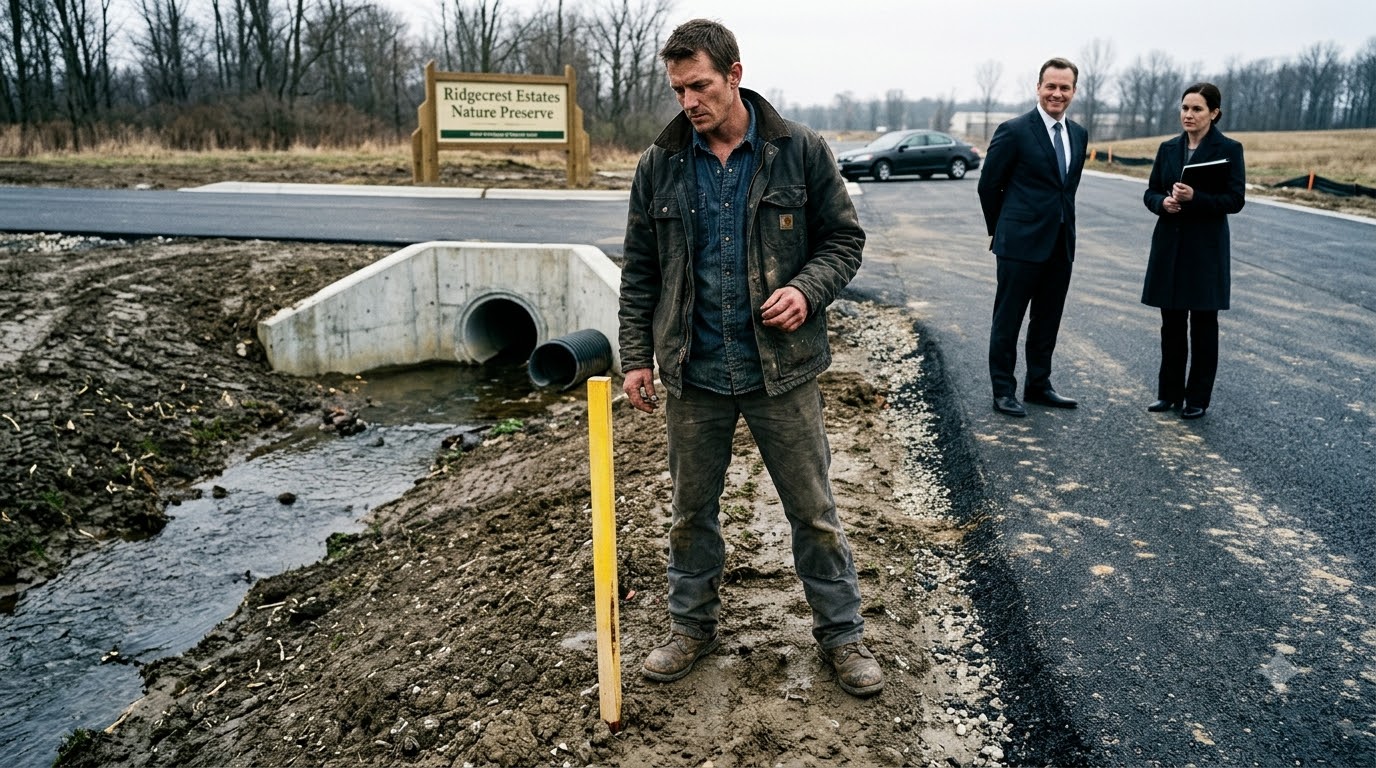
Fresh white parking lines gleamed under the gray afternoon sky, perfectly straight and entirely out of place. Two brand-new green benches sat bolted into concrete pads right over the old limestone drainage run.
A heavy pine sign at the head of the trail read Ridgecrest Estates Nature Preserve. Nobody called me. Nobody asked.
My boots scraped against the unaccustomed smoothness of the asphalt as I walked toward the creek bed. The water was forced into a narrow concrete culvert, choked off from the natural floodplain my grandfather cleared back in fifty-two.
My hand slid into my coat pocket, fingers wrapping around the cold, worn handle of my pocketknife. I didn’t pull it out; I just held the weight of it against my thigh to keep my breathing steady.
The silence of the man-made park felt heavy, wrapped in the quiet arrogance of people who thought distance meant abandonment. I pulled out my phone and dialed Sylvia Crane without taking my eyes off the asphalt.
“Caleb,” her voice came through crisp and immediate. “You back?”
“They paved the east pasture, Sylvia,” I said, my voice flat against the roar of the wind through the ridge. “I need you to draw up the papers today.”
CHAPTER 2: THE MISSING PINS
Sylvia Crane didn’t waste time with small talk when she stepped out of her sedan. Her briefcase clicked shut with a sharp metallic snap that sounded too neat for a gravel road.
She walked past the new green benches, her eyes scanning the manicured turf where the wild ferns used to grow.
“They didn’t just cross the line, Caleb,” Sylvia said, her voice tight as she pulled a rolled plat map from her leather bag. “They buried the evidence.”
I dropped to one knee beside the empty hole where my grandfather’s limestone boundary pin had stood for decades. A fresh, yellow-painted wooden surveyor stake had been hammered right through the center of where the old marker should have been.
My fingers brushed against the damp dirt, feeling for the chiseled stone beneath. It was gone, cleanly excavated and hauled away to make room for a drainage pipe.
“Warren Gil didn’t make a mistake,” I said, my hand tightening around the handle of my pocketknife in my coat pocket. “He knew exactly where the fence line was.”
Sylvia unrolled the map across the hood of her car, holding the corners down against the sharp mountain wind. Her finger traced the original deed lines recorded back in nineteen-fifty-two.
“If the physical markers are gone, the county defaults to their recent digital overlay,” she said, looking up at me with a hard, flat stare. “Unless we find something else tying the HOA to intentional removal.”
I stood up, wiping the wet clay from my knuckles onto my jeans. The wind whistled through the newly planted ornamental trees that shouldn’t have been there.
“Let’s go talk to him,” I said.
CHAPTER 3: THE BOARDROOM BLUFF
The air inside the clubhouse smelled of commercial carpet cleaner and expensive floor wax, a sterile scent that felt miles away from the damp creek bottom.
Warren Gil sat behind a heavy mahogany desk, his fingers tapping a rhythmic, impatient tattoo against a stack of community development briefs.
He didn’t look up when the door clicked shut behind us, choosing instead to let the silence stretch like a taut wire.
“Caleb,” Warren said, his voice dripping with practiced corporate condescension. “I hear you’re causing quite a stir about the drainage corridor.”
My hands stayed buried in my coat pockets, fingers locked around the cold metal of my pocketknife.
“You paved over my family’s floodplain without a word, Warren,” I said, stepping closer to the edge of his desk.
Warren leaned back, his leather executive chair groaning under his weight as he offered a tight, patronizing smile.
“The association voted on it, and we implemented a community asset to improve neighborhood property values,” he said, waving a hand dismissively. “That unused brush was an eyesore to our residents anyway.”
Sylvia stepped up beside me, her leather briefcase resting firmly against her leg like an anchor.
“An eyesore that happens to sit entirely on deeded private property, Mr. Gil,” she said, her voice sharp as glass. “Without your required permits or owner consent.”
Warren’s smile faltered for a fraction of a second, a bead of sweat catching the fluorescent glare near his temple before he forced his composure back.
“We have county map alignments that grant us full easement clearance for community public works,” Warren lied smoothly, his eyes darting back to his paperwork. “You’re fighting progress, Caleb, and the board won’t back down.”
CHAPTER 4: THE PAPER TRAIL
The leather zipper made a long, sliding hiss in the quiet room. Sylvia pulled out a thick manila folder stamped with the county clerk’s archive seal.
She didn’t hand it across the desk; she dropped it squarely on top of Warren’s community development briefs with a heavy thud.
“You might recognize this correspondence, Mr. Gil,” Sylvia said, her voice dropping into a steady, unyielding rhythm. “Sent to your private office three weeks before your contractors laid the first slab of asphalt.”
Warren’s hand twitched toward the folder, then stopped dead as his fingers hovered an inch above the cardboard.
The color drained from his face, leaving his skin the gray shade of wet concrete.
“That’s internal counsel correspondence,” Warren stammered, his polished corporate composure cracking down the middle. “It has nothing to do with the public park project.”
I leaned forward, planting my palms on the edge of his desk, bringing my face down to his level.
“It tells you in black and white that the land belongs to my family, and you went ahead and paved it anyway,” I said, my teeth clenched against the rising heat in my chest. “You knew before you touched a single foot of my soil.”
Warren swallowed hard, his throat working violently as he tried to find a lie that fit.
“The board authorized the grading based on community need,” he muttered, his voice shrinking into a defensive whisper. “We can settle this with a minor fee adjustment.”
Sylvia slid a second document out of the folder—a certified receipt bearing Warren’s own signature of delivery.
“There’s no fee adjustment coming, Warren,” Sylvia said coldly. “That’s willful destruction of private property with prior written notice.”
CHAPTER 5: THE DEMOLITION ORDER
Heavy track treads ground against the fresh asphalt, sending a sharp vibration up through the clubhouse floorboards.
Warren jerked upright in his chair, his eyes darting toward the window as a yellow excavator cleared the tree line and swung its heavy steel bucket toward the community parking lot.
“You can’t just bring equipment in here without a formal board injunction,” Warren shouted, his voice cracking as he lunged toward the glass.
Sylvia didn’t flinch, her fingers calmly sliding the manila folder back into her leather bag as the first strip of blacktop peeled away under a steel blade.
“The injunction was signed by the judge an hour ago, Warren,” she said, her tone flat and final. “The remediation order covers every foot of unauthorized pavement.”
I turned away from the desk, my boots carrying me out the heavy glass doors to watch the asphalt shatter.
The weight of the machine tore through the unearned concrete, exposing the dark, wet earth of my grandfather’s floodplain underneath.
Warren stumbled out onto the porch behind us, his face purple with furious disbelief as he tried to wave down the equipment operators.
The operators ignored him entirely, keeping their eyes locked on the grade stakes Sylvia’s team had driven into the dirt that morning.
CHAPTER 6: THE DUSTY GRAY
The last flatbed truck rolled out down the gravel road, carrying the shattered remains of the unearned parking lot away from our ridge.
The heavy diesel hum faded into the distance, leaving behind the steady, familiar rush of Drum Creek finding its old, unhindered channel through the brush.
Warren Gil was nowhere in sight, his executive office doors shut tight against the reality of the court’s remediation mandate and the bills for the teardown.
I walked down the slope toward the 1952 dam gates built by my grandfather.
The gray limestone blocks stood solid and unyielding, coated in a fine layer of dust and ancient mortar that weathered every storm without a crack.
My hand left the pocketknife and rested flat against the cool, damp stone of the gate housing.
Sylvia stood by her sedan up on the ridge, giving a single, quiet nod before closing her door and heading back down the mountain.
The land was rough, irregular, and entirely ours once again.
I reached out and turned the iron wheel of the sluice gate a half-turn, letting the water flow clean and free just as it always had.